

Mold vs Mould: What is the Difference?
Have you ever paused before writing mold or mould? The two spellings look almost the same, yet only one fits your readers. This guide on mold vs mould gives you a clear rule, simple examples, and the exceptions worth knowing. By the end, you will choose the right spelling with confidence.
Quick Answer: Mold or Mould?
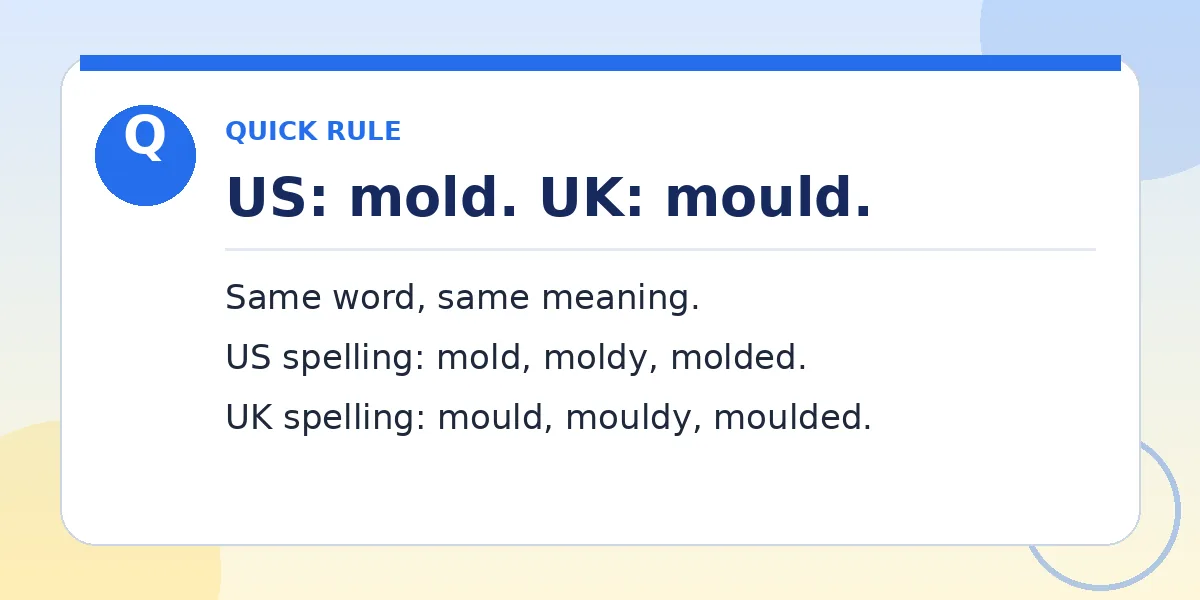
Mold is the standard American English spelling. Mould is the standard British English spelling. Both words have the same meanings, pronunciations, and grammatical uses.
In the United States, write mold when referring to fungus, a shaping tool, or a particular type or pattern. Use related forms such as moldy, molded, and molding.
In British English, the corresponding forms are mould, mouldy, moulded, and moulding.
The choice is regional, not a difference in meaning. If you are writing for American readers, choose mold and keep that spelling consistent.
Table of Contents
- Mold vs Mould: At a Glance
- What Does Mold or Mould Mean?
- American, British, Canadian, and Australian Usage
- Mold and Mould Derivatives
- Why Does American English Drop the U?
- The Consistency Rule
- Quotations, Proper Names, and Exceptions
- Mold in Technical and Manufacturing Writing
- Common Idioms With Mold
- An Easy Memory Trick
- Common Mistakes to Avoid
- Practice Questions and Answer Key
- Frequently Asked Questions
- Related Guides
- Final Takeaway
Mold vs Mould: At a Glance
The main difference is the spelling used in different varieties of English. The words have the same meanings, but American English uses mold and British English uses mould.
| Feature | Mold | Mould |
|---|---|---|
| Regional spelling | American English | British English |
| Meaning | Fungus, shaping tool, type, or soil | Same meanings |
| Pronunciation | Same word, with normal accent differences | Same word, with normal accent differences |
| Noun | Yes | Yes |
| Verb | Yes | Yes |
| Adjective | Moldy | Mouldy |
| Past tense | Molded | Moulded |
| Present participle | Molding | Moulding |
| Common example | Mold on bread | Mould on bread |
Both spellings are correct. The right choice depends on your readers and writing style.
For example:
- American English: The mold on the bathroom wall needs attention.
- British English: The mould on the bathroom wall needs attention.
The meaning stays the same in both sentences.
What Does Mold or Mould Mean?
The word has several meanings, and this mold vs mould guide covers each one. It can describe a fungus, a shaping tool, or a pattern that influences something.
It can also work as a verb. A less common meaning refers to soil or earth.
Mold as a Fungus
Mold is a type of fungus that grows on damp surfaces and decaying organic matter. It often appears as fuzzy, powdery, or discolored growth.
You may find it on bread, fruit, walls, and other materials exposed to moisture.
Examples:
- Mold appeared on the bread after several days.
- The damp bathroom wall developed dark mold.
- We threw away the fruit because it had mold on it.
In British English, people spell this word mould. The meaning remains unchanged.
Mold growth often signals excess moisture. However, its appearance alone does not identify the specific fungus.
Mold as a Shaping Tool
A mold is a hollow form or container used to give something a particular shape.
Manufacturers and craftspeople use molds with materials such as plastic, metal, wax, and chocolate. They place or pour the material into the mold until it sets.
Examples:
- The chocolatier poured the melted chocolate into a heart-shaped mold.
- The factory used a mold to shape the plastic parts.
- She made candles using a silicone mold.
British writers use mould for the same object.
Mold as a Figurative Type or Pattern
The word can also describe a pattern, model, or type that something follows.
This meaning often appears when people discuss personalities, behavior, designs, or expectations.
Examples:
- She does not fit the usual mold.
- The new design breaks the traditional mold.
- He is a leader in the mold of his predecessor.
In these examples, mold does not refer to a physical container. It describes a familiar pattern or model.
Mold as Soil or Earth
Mold also has a less common, older meaning: loose, crumbling earth or fertile soil.
This sense appears more often in historical, literary, or dictionary contexts than everyday conversation.
Example:
- The gardener planted the seeds in rich, dark mold.
This meaning is separate from the fungus. Merriam-Webster lists the soil sense separately from its entries for the shaping tool and the fungus.
American, British, Canadian, and Australian Usage
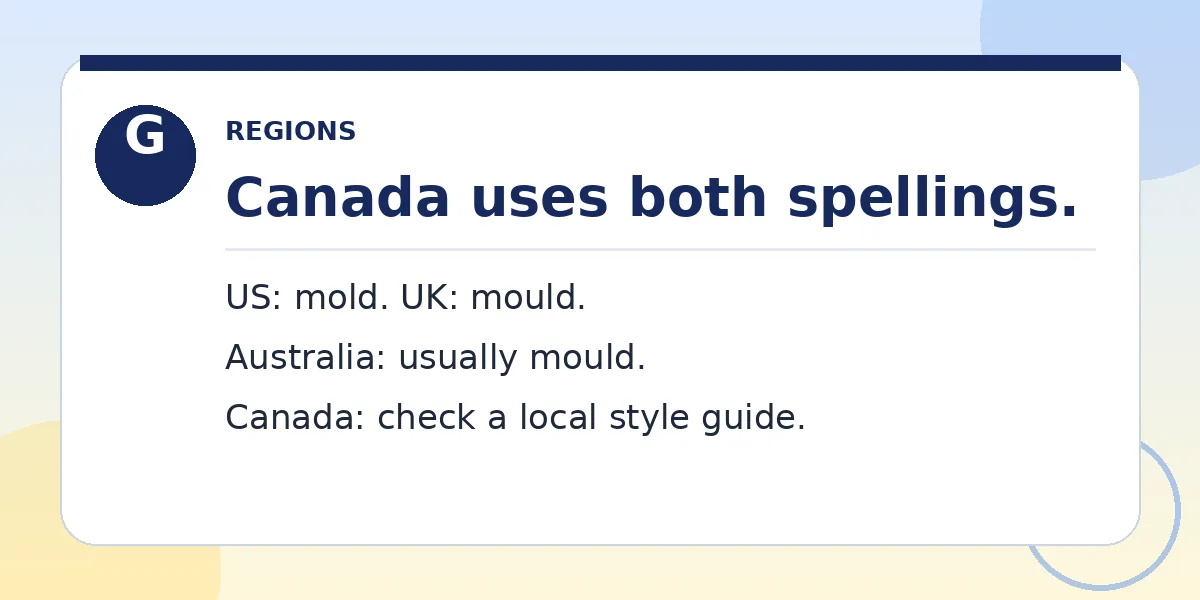
Different English-speaking countries prefer different spellings, and that is the heart of the mold vs mould question. Knowing your audience makes the choice easier.
American English: Mold
American English uses mold as the standard spelling.
Common American forms include:
- Mold
- Moldy
- Molded
- Molding
- Crown molding
Use these forms in U.S. schoolwork, business documents, websites, and everyday writing.
Cambridge identifies mold as the American spelling of mould.
British English: Mould
British English generally uses mould.
Common British forms include:
- Mould
- Mouldy
- Moulded
- Moulding
- Crown moulding
For example, a British home improvement guide would usually refer to crown moulding. An American guide would use crown molding.
Cambridge identifies mould as the British spelling of mold.
Canadian English: Both Spellings
Canadian English uses a mix of British and American spelling conventions. Both mold and mould appear in Canadian writing.
General Canadian use leans toward mould. However, mold often appears in technical and industrial contexts.
There is no single spelling rule that covers every Canadian publication or industry. Canadian writers should check a Canadian dictionary or house style.
Canada’s language guidance also recognizes spelling variation and recommends choosing a reliable reference. Consistency matters more than trying to force one spelling in every case.
Australian English: Usually Mould
Australian English generally follows British spelling patterns. Therefore, mould is the usual choice in Australian writing.
Common forms include mouldy, moulded, and moulding.
For example:
- The old fruit developed mould.
- The factory uses a mould to shape the product.
- The room has decorative ceiling moulding.
Australian writers should still follow their chosen dictionary or publication style guide. Regional spelling conventions can vary by publication.
Mold and Mould Derivatives
The spelling difference continues in related words, so a mold vs mould check should cover derivatives too. If you choose American English, use the American forms throughout your writing.
| American English | British English | Example |
|---|---|---|
| Mold | Mould | Mold on a wall |
| Moldy | Mouldy | Moldy bread |
| Molded | Moulded | Molded plastic |
| Molding | Moulding | Plastic molding |
| Crown molding | Crown moulding | Decorative ceiling trim |
Moldy vs Mouldy
Moldy is the American adjective. Mouldy is the British form.
Both describe something affected by mold or mould.
Examples:
- American: The bread became moldy.
- British: The bread became mouldy.
The meaning does not change.
Molded vs Moulded
Molded is the American past-tense and past-participle form of mold.
Moulded is the corresponding British form.
Examples:
- American: The factory molded the plastic into a new shape.
- British: The factory moulded the plastic into a new shape.
Both describe the process of giving material a particular form.
Molding vs Moulding
Molding is the American spelling. Moulding is the British spelling.
The word can describe the process of shaping material. It can also refer to a shaped decorative strip or other formed object.
Examples:
- American: The company specializes in plastic molding.
- British: The company specializes in plastic moulding.
Crown Molding vs Crown Moulding
Crown molding is decorative trim installed where a wall meets a ceiling.
The two spellings describe the same architectural feature:
- Crown molding: Standard American spelling.
- Crown moulding: Standard British spelling.
Example:
The homeowner chose white crown molding to give the living room a finished look.
Why Does American English Drop the U?
Mold and mould are part of a wider pattern of spelling differences between American and British English, which is why a mold vs mould comparison often sits beside color and colour.
American English often uses shorter spellings in certain word groups. British English often retains the letter u.
Compare these familiar examples:
| American English | British English |
|---|---|
| Color | Colour |
| Favor | Favour |
| Honor | Honour |
| Neighbor | Neighbour |
| Mold | Mould |
These examples show a common regional difference. However, they do not create a universal rule for every English word.
For example, not every British word containing ou loses its u in American English. Some spellings remain the same in both varieties.
American spelling conventions developed through several historical influences. Noah Webster’s dictionaries helped standardize many American forms.
The spelling mold became the standard American form, while British English retained mould. Avoid treating this as a change that happened on one specific date.
The Consistency Rule
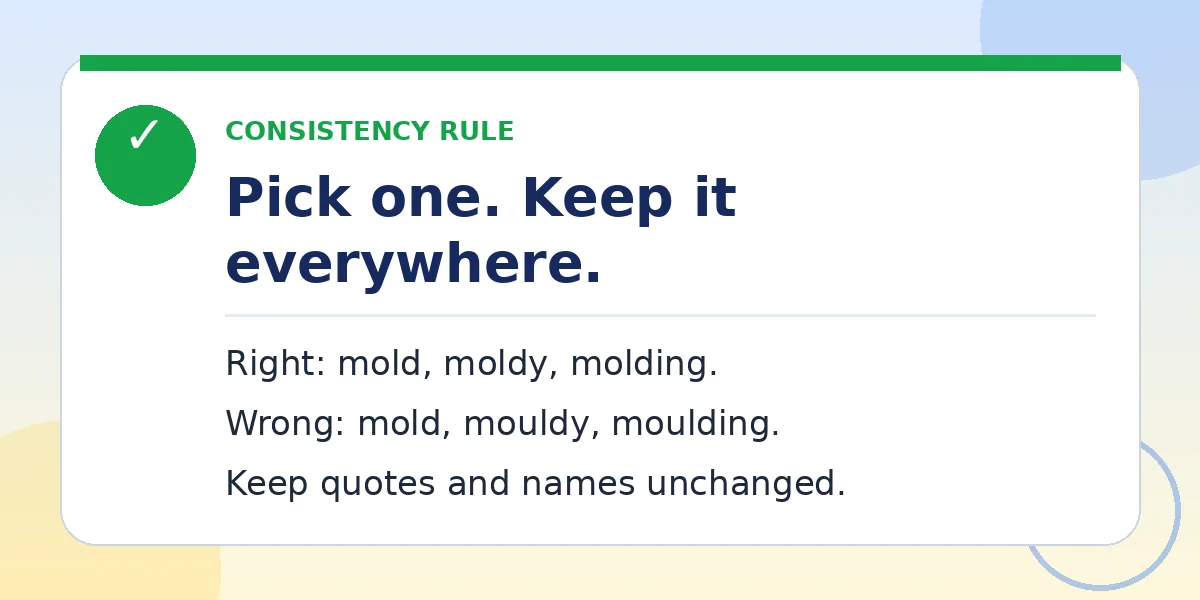
Choose the spelling that suits your audience, then use it consistently. That single rule settles most mold vs mould doubts.
This simple rule makes your writing easier to read. It also prevents unnecessary spelling changes within the same document.
Follow these guidelines:
- Writing for Americans: Use mold, moldy, molded, and molding.
- Writing for British readers: Use mould, mouldy, moulded, and moulding.
- Writing for Canadians: Follow a Canadian dictionary or your organization’s house style.
- Writing for Australians: Follow an Australian dictionary or publication style guide.
Apply the same choice to headings, captions, tables, product descriptions, and other parts of your document.
For example:
Inconsistent American English:
The mould grew beside the window, and the moldy wall needed cleaning.
Consistent American English:
The mold grew beside the window, and the moldy wall needed cleaning.
The second sentence follows one spelling convention. That is the goal, especially in professional and academic writing.
Quotations, Proper Names, and Exceptions
The consistency rule has a few important exceptions, and this mold vs mould guide flags them clearly. Sometimes, you should preserve the original spelling even when it differs from your house style.
Direct Quotations
A direct quotation should keep the source’s original spelling.
For example, an American writer may quote a British source that uses mould. The writer should not automatically change the spelling inside the quotation.
Changing the spelling inside a direct quotation can alter the original wording. Keep the source accurate when reproducing its words.
Proper Names and Brand Names
Official names should retain their established spelling.
A company, product, organization, or named collection may use Mould as part of its official name. Do not change it simply to match American spelling.
Check the organization’s official materials when you are unsure.
The same principle applies to book titles, product names, and other published titles. Preserve the spelling used by the original source.
Technical Labels and Source Material
Technical documents may use established terms from a customer, manufacturer, or industry reference.
For example, a product specification may use mould because that is the spelling in the manufacturer’s documentation.
Keep the original terminology when accuracy requires it. If necessary, explain the regional spelling to avoid confusion.
Mold in Technical and Manufacturing Writing
The spelling difference also appears in engineering and manufacturing, where a mold vs mould mix-up can look careless. It does not indicate a different tool, material, or process.
The choice usually depends on the company’s preferred English variety and target market.
Injection Molding vs Injection Moulding
Injection molding is the standard American spelling. Injection moulding is the common British spelling.
Both terms describe the same manufacturing process. A machine injects molten material into a shaped cavity. The material cools and takes the shape of the cavity.
Examples:
- American: The factory uses injection molding to produce plastic components.
- British: The factory uses injection moulding to produce plastic components.
The spelling changes, but the process does not.
Other Manufacturing Terms
The same regional pattern appears in several manufacturing terms.
| American English | British English |
|---|---|
| Compression molding | Compression moulding |
| Blow molding | Blow moulding |
| Transfer molding | Transfer moulding |
| Mold cavity | Mould cavity |
| Mold design | Mould design |
These terms describe manufacturing processes, equipment, or design features. Their spelling depends on the regional variety used in the document.
Keep Technical Documents Consistent
Manufacturing companies often use the same terminology across several documents.
These may include:
- Engineering drawings
- Product specifications
- Bills of materials
- Requests for quotations
- Manufacturing instructions
- Design and production records
Mixing regional spellings can make documentation look inconsistent. It may also create confusion when teams review several related files.
Choose the spelling that matches your company’s documentation standards or customer requirements. Then use it throughout the relevant document set.
Common Idioms With Mold
Mold and mould also appear in everyday expressions, and this mold vs mould guide explains the main ones. These phrases usually describe patterns, expectations, or similarities.
American writers generally use mold. British writers generally use mould.
Break the Mold
To break the mold means to do something differently from the usual pattern.
It often describes someone who challenges expectations or introduces a new approach.
Example:
The young designer broke the mold with her unusual furniture collection.
Fit the Mold
To fit the mold means to match an expected type, pattern, or standard.
People often use this phrase when discussing personalities, jobs, or traditional expectations.
Example:
He does not fit the traditional mold of a business leader.
Cast in the Same Mold
To be cast in the same mold means to be very similar in character, behavior, or style.
The expression compares people or things to objects made from the same shaping form.
Example:
The two sisters are cast in the same mold because they share similar interests.
In the Mold of
To be in the mold of someone means to resemble or follow that person’s style, character, or approach.
Example:
The young musician performs in the mold of an earlier jazz legend.
Use the regional spelling that matches the rest of your writing. The expressions keep the same meaning in American and British English.
An Easy Memory Trick
Here is a simple way to remember which spelling belongs to each variety of English:
Mould has a U, just like UK.
Think of the letters together:
- U.S.: Mold
- UK: Mould
The American spelling drops the extra u. The British spelling keeps it.
This trick also helps with related forms:
- American: Moldy, molded, molding
- British: Mouldy, moulded, moulding
Remember that Canada uses both spellings, while Australian English generally follows British patterns. When writing for Canada or Australia, check a local dictionary or house style.
Common Mistakes to Avoid
Even though the difference is simple, writers sometimes make avoidable mistakes, so this mold vs mould checklist is worth a quick read.
Thinking Mold and Mould Have Different Meanings
They are regional spellings of the same word. The extra u does not create a different definition.
Calling Mould Incorrect in American English
Mould is a valid British spelling. It may also appear in American writing when used in a direct quotation or official name.
Mixing American and British Derivatives
Avoid switching between mold, mouldy, and moulding without a reason.
For consistent American writing, use mold, moldy, and molding.
Assuming Canada Uses Only One Spelling
Canadian English includes both forms. General usage leans toward mould, while technical and industrial writing often uses mold.
Follow a Canadian dictionary or house style instead of assuming one spelling always applies.
Treating Australian English as Identical to American English
Australian English generally follows British spelling conventions. Therefore, mould is usually the expected form.
Confusing the Fungus With the Shaping Tool
Context helps readers understand the intended meaning.
For example:
- Fungus: Mold grew on the old bread.
- Shaping tool: She poured chocolate into a mold.
Both uses are correct. They simply refer to different things.
Changing Official Names or Direct Quotations
Do not automatically change mould to mold inside a direct quotation or official name. Preserve the original spelling when accuracy requires it.
Practice Questions and Answer Key
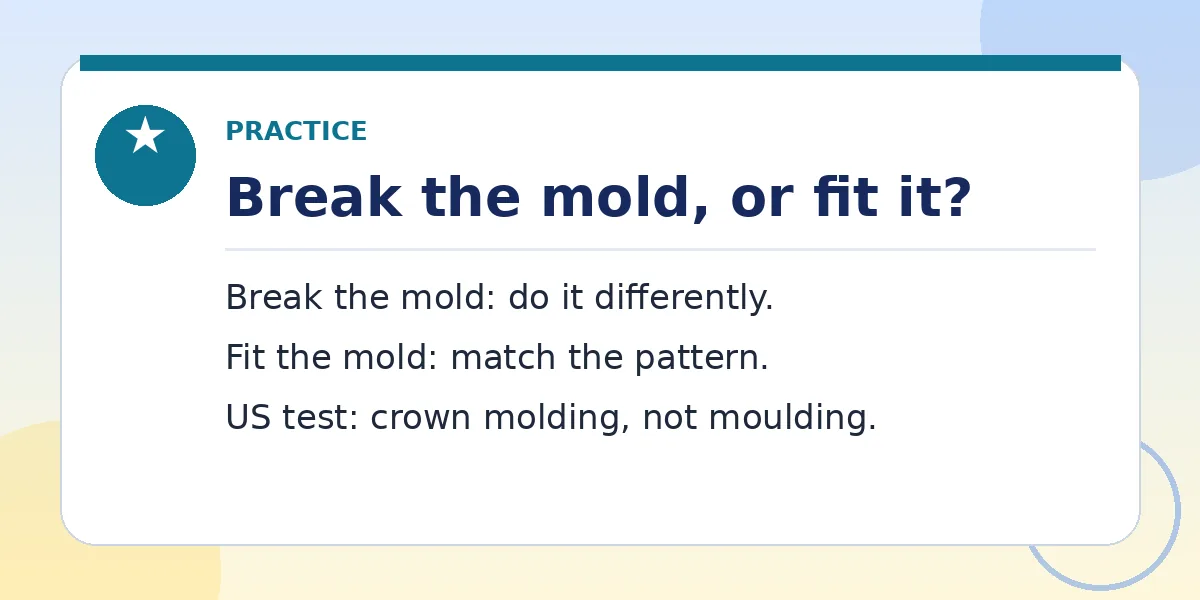
Test your understanding of mold vs mould with these ten questions. Choose the spelling that best fits each sentence or situation.
Practice Questions
- Which spelling should you use in an article written for readers in the United States: mold or mould?
- Which spelling is generally preferred in British English: moldy or mouldy?
- Complete the sentence using American English: The old bread became ______ after several days.
- Which term is standard in American home renovation writing: crown molding or crown moulding?
- True or false: Mold and mould have different meanings.
- Which spelling would you generally expect in Australian English: mold or mould?
- An American writer quotes a British source that uses mould. Should the writer automatically change the spelling inside the direct quotation?
- Complete the sentence using American English: The factory ______ the plastic into a new shape.
- Which spelling is generally preferred in Canadian writing: mold or mould? What should a writer check before choosing a spelling?
- Which expression means to challenge an established pattern: break the mold or fit the mold?
Answer Key and Explanations
- Mold. American English uses the spelling without the extra u.
- Mouldy. British English generally retains the u in this adjective.
- Moldy. This is the standard American spelling for something affected by mold.
- Crown molding. American home improvement writing generally uses this form.
- False. Both spellings have the same meanings. The difference is regional.
- Mould. Australian English generally follows British spelling patterns.
- No. A direct quotation should preserve the original source’s spelling.
- Molded. American English uses molded for the past tense.
- Both appear. General Canadian use leans toward mould, but writers should check a Canadian dictionary or house style.
- Break the mold. This expression means to challenge a familiar pattern or do something differently.
Frequently Asked Questions
1. Is Mold or Mould Correct in American English?
Mold is the standard spelling in American English. Mould is the British variant. American writers should use mold in everyday and professional writing, except when preserving official names or direct quotations.
2. Do Mold and Mould Mean the Same Thing?
Yes. Mold and mould have the same meanings and grammatical uses. Both can describe fungus, a shaping tool, or a figurative type or pattern. The soil sense is less common.
3. Is Mold or Mould Used in Canada?
Both spellings appear in Canadian English. General Canadian use leans toward mould, while technical and industrial writing often uses mold. Follow a Canadian dictionary or house style for consistent spelling.
4. Is Mold or Mould Used in Australia?
Mould is generally preferred in Australian English because Australian spelling often follows British conventions. Check an Australian dictionary or style guide when a publication has its own preference, for the preferred form.
5. Are Mold and Mould Pronounced the Same?
Yes. They represent the same word, so the spelling difference does not create a different pronunciation. However, American and British accents can sound different, just as they do with many other words.
6. Is It Moldy or Mouldy, and Molded or Moulded?
American English uses moldy and molded. British English uses mouldy and moulded. Both pairs have the same meanings. Choose one regional system and keep it consistent throughout your writing, in every document.
7. What Is the Difference Between Mold and Mildew?
Mold is a broad term for fungi that grow on surfaces and organic materials. Mildew usually describes certain types of fungal growth, often with a powdery or downy appearance. The two terms overlap, but they are not exact synonyms.
Related Guides
Explore these ClarifyWords guides to learn more about spelling differences and commonly confused words:
- Gray vs Grey: https://clarifywords.com/gray-vs-grey/
- Affect vs Effect: https://clarifywords.com/affect-vs-effect/
- Principal vs Principle: https://clarifywords.com/principal-vs-principle/
- Complement vs Compliment: https://clarifywords.com/complement-vs-compliment/
You can also visit the Spelling Differences category for more guidance on American and British English spelling: https://clarifywords.com/category/spelling-differences/
Final Takeaway
In short, mold vs mould is a regional spelling choice, not a meaning change. Mold is the American spelling and mould is the British spelling. The meanings stay the same. Match your spelling to your readers, keep it consistent, and keep original spellings in quotations and names.