Anytime vs Any Time: Simple Rules and Examples
Have you ever wondered whether to write anytime or any time? The choice can feel tricky. Both forms look almost the same. Yet they do not always mean the same thing. This guide on anytime vs any time gives you a clear rule. It also gives examples, quick tests, and practice questions. By the end, you will know which form fits your sentence.
Quick Answer
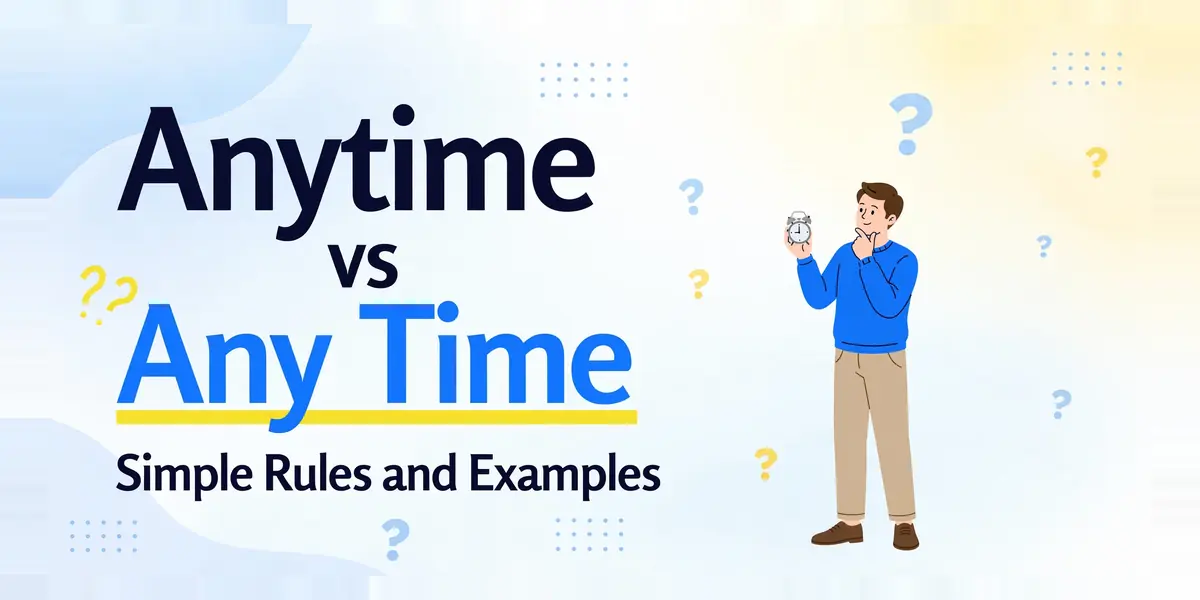
Use anytime when it means whenever. Use any time when time is a noun. The noun form refers to an amount or period of time. If you can replace the word with whenever, write anytime. If time can stand alone as a noun, write any time. After at, always write any time. That short rule answers most anytime vs any time questions.
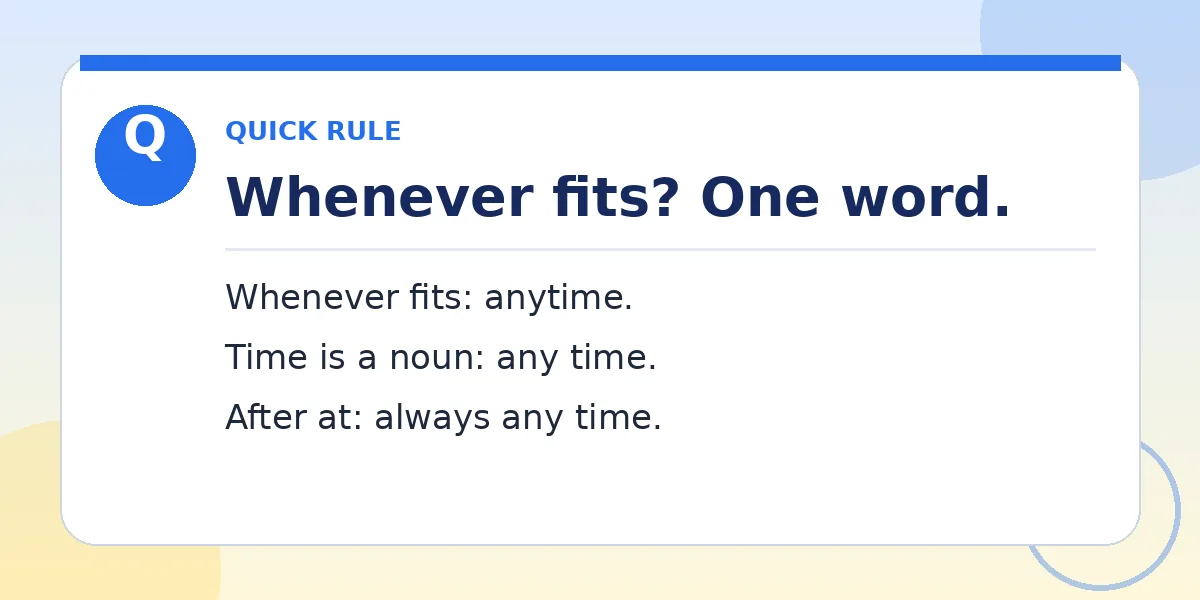
Table of Contents
- Quick Answer
- Anytime vs Any Time at a Glance
- What Does Anytime Mean?
- What Does Any Time Mean?
- Comparison Table
- Quick Checks
- Tricky Cases
- Common Mistakes
- Memory Trick
- Practice Questions
- Frequently Asked Questions
- Related Guides
- Final Takeaway
Anytime vs Any Time at a Glance
| Form | Part of Speech | Meaning | Quick Test | Example |
|---|---|---|---|---|
| Anytime | Adverb or conjunction | Whenever | Replace it with whenever | You can call me anytime. |
| Any time | Noun phrase | Any amount or period of time | Replace it with any more time | Do you have any time today? |
| At any time | Prepositional phrase | Whenever, or at an unpredictable time | Always use three words | You can arrive at any time. |
What Does Anytime Mean?
Anytime is one word. It means whenever or at any moment. It usually acts as an adverb. It can also act as a conjunction. It is common in casual American English. This part of our anytime vs any time guide covers the one-word form.
Anytime as an Adverb
Use anytime as an adverb when it answers when something can happen. It modifies a verb, an adjective, or another adverb. It can appear in different parts of a sentence.
Examples:
- You can call me anytime.
- We can meet anytime next week.
- The package could arrive anytime today.
In each case, whenever fits in place of anytime. That is a strong sign that one word is correct.
Anytime as a Conjunction
Anytime can also join two clauses. In this role, it means whenever. It introduces a dependent clause.
Examples:
- Anytime you need help, just ask.
- Anytime the rain stops, we will go outside.
- Anytime she calls, I answer right away.
In formal writing, whenever is often the safer choice. It sounds more polished. Anytime still works in casual writing.
Anytime as an Informal Adjective
Anytime can act as an adjective in informal English. It appears before a noun. It describes something that fits any moment.
Examples:
- Keep an anytime snack in your bag.
- This is a good anytime playlist for work.
- He wore an anytime outfit for the trip.
This use is casual. Avoid it in academic or professional writing. Use a clearer phrase instead, such as a snack for any occasion.
Anytime Soon and Anytime Now
Anytime soon means in the near future. Anytime now means very soon, or at any moment. Both phrases are natural in American English.
Examples:
- We should hear back anytime soon.
- The bus should arrive anytime now.
- She will finish the report anytime soon.
The negative form is also common. For example, “We will not finish anytime soon.” This means the finish is not near.
What Does Any Time Mean?
Any time is two words. It is a noun phrase. It combines the determiner any with the noun time. It refers to an amount, period, or point of time. Time can be modified or separated in this form. This part of our anytime vs any time guide covers the two-word form.
Any Time as a Noun Phrase
Use any time when time acts as a noun. You can test this by adding more. For example, any more time fits in the same slot.
Examples:
- Do you have any time this week?
- I need any time you can spare.
- Any time you offer will help.
In these sentences, time is the main idea. Anytime cannot replace it in the same way.
Any Time for an Amount or Duration
Use any time when you refer to how much time is available or needed. This is a key difference. Anytime cannot express an amount of time.
Examples:
- I do not have any time today.
- Take any time you need.
- Do we have any time left after lunch?
Each sentence asks about or refers to a quantity of time. That calls for two words.
Any Time After At
After the preposition at, always write any time. Prepositions need a noun object. Any time supplies that noun. Anytime cannot fill that role.
Examples:
- You can arrive at any time.
- Call us at any time during office hours.
- The store may close at any time today.
At anytime is incorrect. This is one of the most common errors with this pair.
Any Time in Subject Position
Any time can act as the subject of a sentence. A subject is a noun or noun phrase. Anytime cannot serve as a subject, because it is not a noun.
Examples:
- Any time is a good time for coffee.
- Any time next week works for me.
- Any time you choose is fine.
In each example, any time starts the sentence as a noun phrase. Anytime would not work there.
The Phrase At Any Time
At any time is a prepositional phrase. It means whenever, or at an unpredictable time. It is always written as three words.
Examples:
- You can visit at any time of day.
- The weather can change at any time of year.
- Help is available at any time of night.
This phrase is more formal than anytime. It works well in instructions, policies, and formal writing.
Comparison Table
| Feature | Anytime | Any Time |
|---|---|---|
| Part of speech | Adverb or conjunction | Noun phrase |
| Meaning | Whenever, or at any moment | Any amount or period of time |
| Use after at | Never correct | Always correct |
| Quantity use | No | Yes |
| Subject position | No | Yes |
| Formal register | Informal | Neutral and safe |
| Whenever test | Passes | May pass in casual use, but the noun test is better |
| Thanks reply | Common in casual use | Dictionaries favor this form |
Quick Checks
Use these tests before you choose a form. Each test takes only a few seconds. Use them for any anytime vs any time sentence.
The Whenever Test
If whenever fits, anytime is correct. Try this test first.
Example: “You can call me anytime.” Replace anytime with whenever. The sentence still works: “You can call me whenever.” Use anytime.
The Any More Time Test
If any more time fits, any time is correct. This test shows that time is a noun.
Example: “Do you have any time today?” Replace any time with any more time. The sentence still works: “Do you have any more time today?” Use any time.
The At Test
If the word follows at, use any time. This rule has no exception in standard English.
Example: “You can arrive at any time.” The word follows at. Use any time.
The Amount Test
If the sentence refers to an amount of time, use any time. Ask yourself if the sentence asks how much time is available.
Example: “I do not have any time left.” The sentence refers to an amount. Use any time.
Tricky Cases
Some cases cause extra doubt. These examples cover the most common ones.
The Thanks Reply: “Any Time”
Dictionaries favor “Any time!” as the reply to thank you. It acts as a short form of “any time is fine.” Anytime appears often in casual writing. It is less standard in this reply.
Example:
- “Thank you for your help.”
- “Any time!”
Use “Any time!” in careful, professional, or published writing. It sounds polite and correct.
Is Anytime Formal or Informal?
Anytime is informal. Some readers still see it as a casualism, similar to alright. Grammarly notes this view in its usage guidance. In formal writing, replace anytime with whenever or at any time where the meaning allows it. Any time is neutral in noun positions. It does not always replace anytime in whenever contexts, though. Choose the form that fits both grammar and tone.
US vs UK English
Anytime is more firmly established in American English. British writers often prefer two words, especially in formal writing. This does not mean anytime is wrong in British English. It means the two-word form may feel safer there. This guide focuses on American usage. In formal writing, choose the form that matches your audience and tone.
Sentence Start Capitalization
Capitalize the first word at the start of a sentence. Anytime becomes Anytime. Any time becomes Any time.
Examples:
- Anytime you are ready, we can start.
- Any time next week is fine.
The rule is simple. Keep the one-word and two-word forms distinct, even at the start.
Common Mistakes
| Mistake | Why It Is Wrong | Correct Version |
|---|---|---|
| At anytime | At needs a noun, and anytime is not a noun | At any time |
| Using anytime for an amount of time | Anytime cannot express a quantity | I do not have any time today. |
| Using anytime as a subject | Anytime is not a noun | Any time is a good time for coffee. |
| Using any time for whenever | It can work, but it may sound less natural in casual speech | You can call me anytime. |
| Overusing anytime in formal writing | Anytime sounds casual | Use whenever or at any time instead. |
Note the fourth row. “Call me any time” is acceptable. Anytime is simply more natural in casual writing. The flat errors are at anytime, anytime for an amount, anytime as a subject, and overuse in formal writing.
Memory Trick
Think of it this way. Anytime is one word for whenever. Any time keeps time separate because time is the noun. If time can stand alone, let it stand alone. This short rule covers most cases. When in doubt, try the whenever test. Use this trick for any anytime vs any time choice.
Practice Questions
Choose anytime or any time for each sentence.
- You can visit _____.
- Do you have _____ this afternoon?
- _____ you need help, just call.
- We can leave at _____ today.
- _____ is a good time for lunch.
- The train should arrive _____ now.
- I do not have _____ left.
- “Thanks for the ride!” “_____!”
- Call me _____ soon about the plan.
- We will not finish _____ soon.
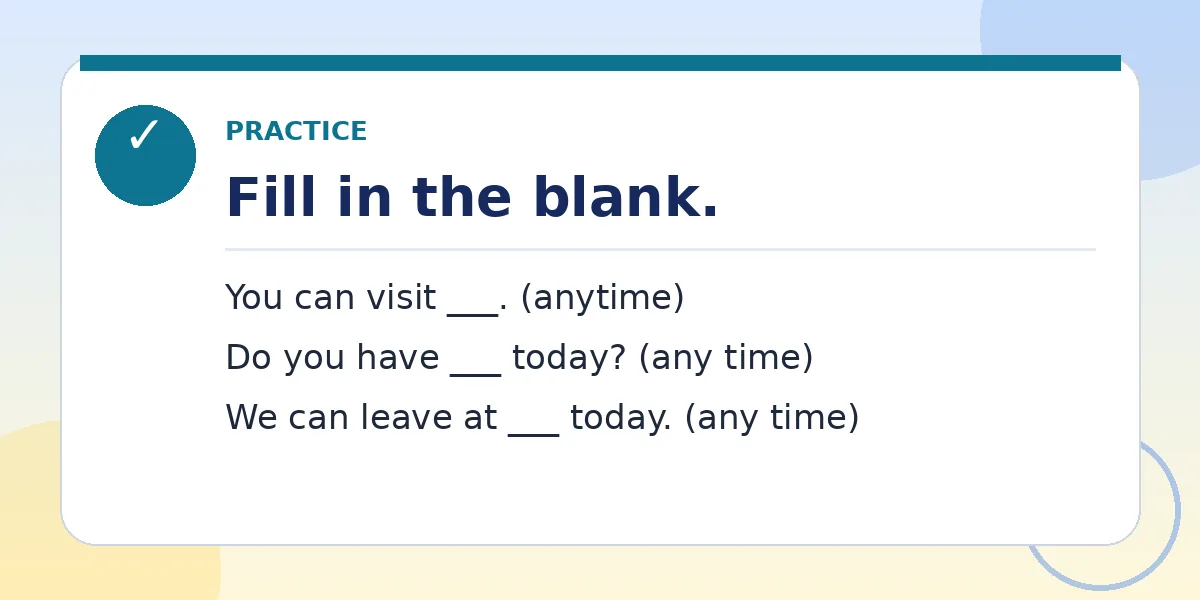
Practice Answer Key
- Anytime. Whenever fits, so one word is correct.
- Any time. The sentence asks about an amount of time.
- Anytime. It acts as a conjunction meaning whenever.
- Any time. The word follows at.
- Any time. It acts as the subject, so it must be a noun phrase.
- Anytime. Anytime now means very soon.
- Any time. The sentence refers to an amount of time.
- Any time. Dictionaries favor “Any time!” as the thanks reply.
- Anytime. Anytime soon means in the near future.
- Anytime. Not anytime soon means the finish is not near.
Frequently Asked Questions
Is It “At Anytime” or “At Any Time”?
Use “at any time” in every case. The preposition “at” needs a noun after it, and “any time” supplies that noun phrase. “At anytime” is never correct in standard English, so always keep the two words separate after “at”.
Is Anytime One Word or Two Words?
It can be either. Anytime is one word when it means whenever. Any time is two words when time acts as a noun. The meaning of the sentence decides the spelling.
Can I Use Anytime in Formal Writing?
It is best to avoid it. Anytime sounds informal, and some readers may see it as too casual. Use whenever, at any time, or a revised sentence instead. That choice keeps formal writing clear and professional.
What Is the Difference Between Anytime and Whenever?
They often overlap, but whenever is more formal and flexible. Whenever works well as an adverb and a conjunction. Anytime works best in casual speech and writing. In formal work, whenever is usually the safer choice.
Is It “Anytime Soon” or “Any Time Soon”?
Anytime soon is the standard phrase for the near future. It means something will happen before long. Any time soon works only when time refers to an amount, which is rare in this phrase. Use anytime soon for future meaning.
Do You Say “Anytime” or “Any Time” When Someone Says Thank You?
Dictionaries favor “Any time!” as the polite reply. Anytime appears often in casual writing, but it is less standard here. Use “Any time!” in careful, professional, or published writing. It sounds warm and correct.
Is Anytime Correct in British English?
Anytime appears in British English, but it is less common there. British writers often prefer two words, especially in formal writing. This guide focuses on American usage, where anytime is more firmly established in casual contexts.
Related Guides
- Affect vs Effect
- Whose vs Who’s
- Its vs It’s
- Loose vs Lose
- Principal vs Principle
- Complement vs Compliment
- Then vs Than
- Confused Words category
Final Takeaway
If you remember one rule, remember this. Anytime means whenever. Any time refers to time as a noun, or appears in phrases such as at any time. With this rule in mind, choosing the correct spelling in anytime vs any time becomes much easier.