Can vs Could: Meaning, Rules, and Examples
Choosing between can and could can be confusing because both express ability, possibility, and permission. However, they do not always mean the same thing. The main difference is that can usually describes present ability, general possibility, and permission. Could describes past general ability, polite requests, suggestions, and less certain possibilities. It also describes present and future possibilities. Understanding the difference between can vs could helps you write clearer sentences and sound more natural in English.
Quick Answer: What Is the Difference Between Can and Could?
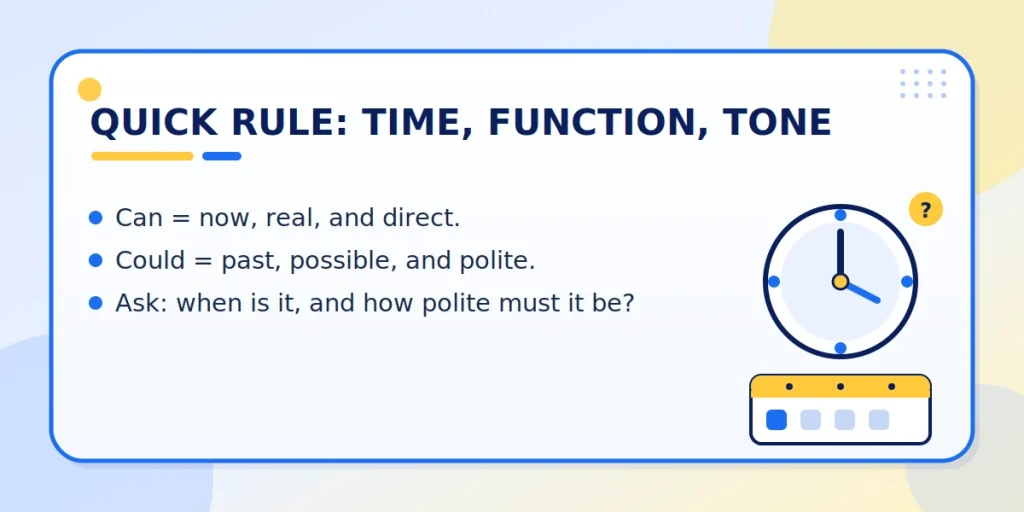
Can expresses present ability, general possibility, permission, and direct requests. Could expresses past general ability, polite requests, suggestions, hypothetical situations, and uncertain possibilities. For example:
- I can speak Spanish. (Present ability.)
- I could speak Spanish when I was younger. (Past general ability.)
- Can you help me? (Direct request.)
- Could you help me? (More polite request.)
- We can meet tomorrow. (Availability.)
- We could meet tomorrow. (A possible suggestion.)
Remember that could is not simply the past tense of can. It can also describe present and future possibilities.
Table of Contents
- Comparison Table
- Ability
- Was Able to vs Could
- Permission
- Requests
- Possibility
- Suggestions and Offers
- Hypothetical Situations and Conditionals
- Could Have: Meaning and Examples
- Can’t Have vs Couldn’t Have
- Reported Speech
- Perception Verbs and Mental Processes
- Pronunciation and Weak Forms
- Common Mistakes
- US vs UK English and Professional Emails
- Memory Trick
- Real Life Dialogues and Workplace Templates
- Practice Questions and Answer Key
- Frequently Asked Questions
1. Can vs Could: Comparison Table
Both words are modal verbs. They help express ability, possibility, permission, and other meanings. However, their functions differ depending on the situation.
| Function | Can | Could |
|---|---|---|
| Present ability | Yes | Possible in certain contexts |
| Past general ability | No | Yes |
| Specific past success | With an appropriate construction | Usually use was able to or managed to |
| Specific past failure | No | Yes, use couldn’t |
| Asking permission | Yes | Yes, more polite |
| Giving permission | Yes | Not normally |
| Everyday requests | Yes | Yes, more polite |
| General possibility | Yes | Sometimes, depending on meaning |
| Particular possibility | Possible | Common |
| Suggestions | Yes, in some contexts | Very common |
| Offers | Direct offers | More tentative offers |
| Hypothetical situations | Possible | Common |
| Conditional sentences | Yes | Yes |
| Reported speech | Original statement | Often replaces can |
| Past possibility | Not normally in affirmative statements | Could have + past participle |
The easiest distinction: Can usually sounds more direct and describes present ability or general facts. Could often adds politeness, uncertainty, or a hypothetical meaning.
2. Ability
One of the most common differences involves someone’s ability to perform an action.
Can for Present Ability
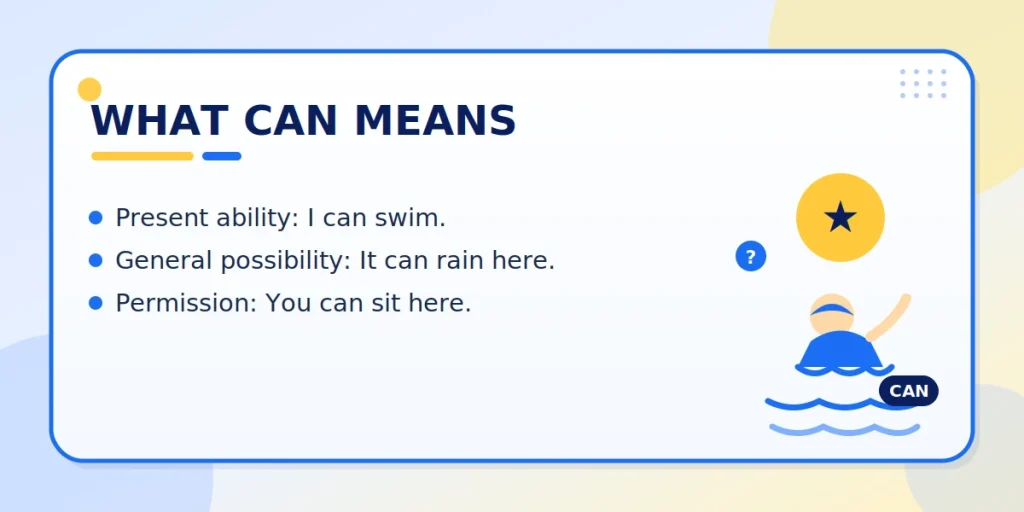
Use can when someone has the ability, skill, or knowledge to do something now. Examples: I can drive a manual car. She can speak three languages. My brother can cook Italian food. They can solve difficult problems. We can finish this assignment today. In each sentence, can describes an existing ability or capability. You can also use cannot or can’t to express an inability. Examples: I can’t swim. She cannot drive. We can’t solve this problem without more information.
Could for Past General Ability
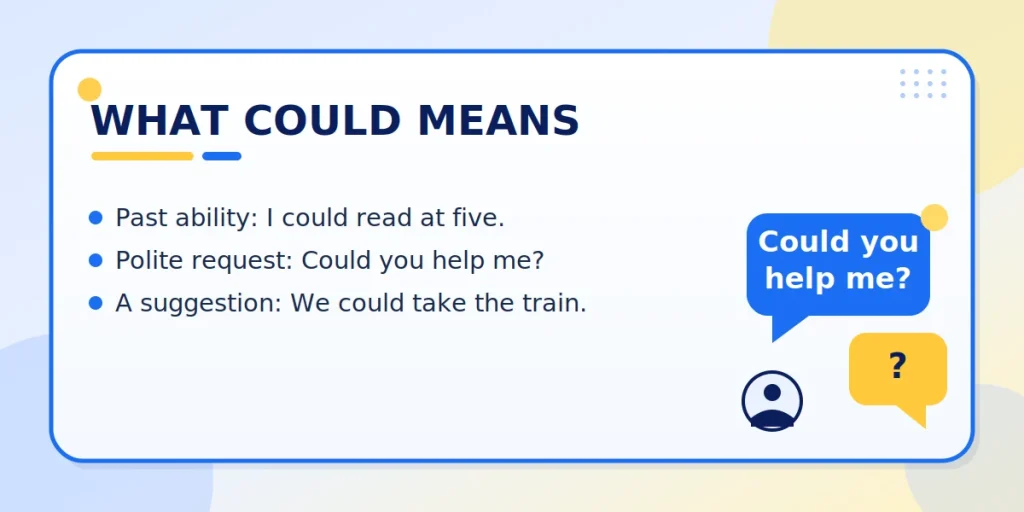
Use could when describing an ability someone had in the past. Examples: I could swim when I was six. She could read before starting school. My grandfather could play the piano. We could walk for miles when we were younger. He could speak French as a child. These sentences describe abilities that existed during an earlier period.
Could for Present Ability
Yes, but could usually adds a condition or a less direct meaning. Examples: I could help you if I had more time. I could probably finish this today. She could handle the project with additional support. For straightforward present ability, can is usually better. Compare: I can complete this task. (I have the ability.) I could complete this task if necessary. (It is a possible option.)
3. Was Able to vs Could: Which One Is Correct?
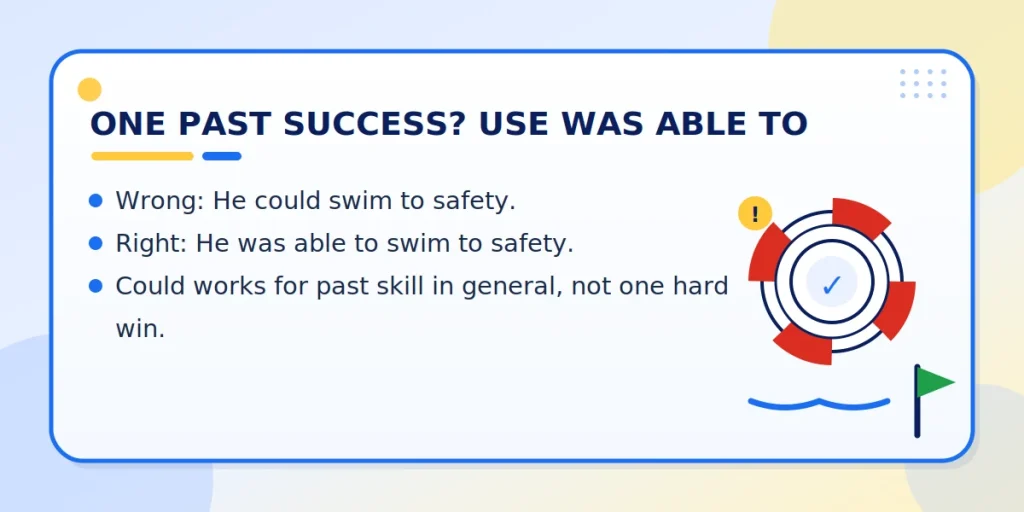
This distinction is especially important when describing successful past actions. Use could for general past ability. Use was able to, were able to, or managed to for successfully completing one specific past action.
When to Use Could
Use could for abilities that existed over a period of time. Examples: When I was young, I could run very fast. She could solve difficult puzzles. My father could repair almost anything. We could understand basic French. These examples describe general abilities rather than one successful event.
When to Use Was Able To or Managed To
Use these expressions when someone successfully completes a particular action. Examples: I was able to finish the report yesterday. She managed to find her missing keys. We were able to catch the last train. He managed to fix the computer before the meeting. These sentences describe actual achievements.
What About Couldn’t?
Couldn’t is natural when describing a specific past failure. Examples: I couldn’t open the door yesterday. She couldn’t finish the exam on time. We couldn’t find the correct address. He couldn’t answer the final question. Remember this comparison:
| Situation | Correct expression |
|---|---|
| General past ability | Could |
| One specific past success | Was able to |
| One specific past success | Managed to |
| One specific past failure | Couldn’t |
Quick rule: Could describes what someone generally had the ability to do. Was able to describes what someone successfully did on one particular occasion.
4. Permission
Both words can appear when asking someone for permission. However, they are not interchangeable when giving permission.
Can for Asking Permission
Can is common in everyday American English. Examples: Can I use your phone? Can we leave early? Can I sit here? Can I borrow your notebook? These questions sound natural in ordinary conversations.
Could for Asking Permission Politely
Could makes permission requests sound more polite or tentative. Examples: Could I borrow your pen? Could we leave a little earlier? Could I ask you something? Could I use your office for a moment? Use could when speaking with someone you do not know well or addressing someone in a professional setting.
Can vs Could for Giving Permission
Use can to grant permission. Examples: Correct: “Can I leave now?” / “Yes, you can.” Not normally correct as a permission response: “Yes, you could.” Could can ask for permission, but can normally grants it. You can also use may in more formal permission situations. For more on may, see the ClarifyWords guide to may vs might: https://clarifywords.com/may-vs-might/
General Permission vs Specific Past Permission
These sentences show three different situations: Employees can use the parking lot. (General permission.) Could I use your parking space? (Polite permission request.) My manager said I could use the parking space. (Reported permission.) Notice that the final sentence uses could because it reports what someone previously permitted.
5. Requests
Both words help you ask someone to do something. The main difference involves tone.
Can You: Direct and Friendly Requests
Use can you for ordinary requests. Examples: Can you help me? Can you open the window? Can you send me the document? Can you explain this question? These expressions are natural in everyday communication.
Could You: More Polite Requests
Use could you when you want to sound more considerate. Examples: Could you help me with this report? Could you send me the updated document? Could you please explain that again? Could you check these figures before Friday? Could makes a request less direct.
Is Can You Rude?
No. Can you is not automatically rude. Your tone, relationship, and situation influence how someone understands a request. Compare:
| Expression | Typical tone |
|---|---|
| Can you help me? | Direct and friendly |
| Could you help me? | More polite |
| Could you please help me? | Especially courteous |
Both can and could are appropriate in everyday communication. For professional situations, could often sounds more considerate.
6. Possibility
Another important distinction involves general truths and particular possibilities.
Can for General Possibility
Use can when describing something that is generally possible or happens under certain circumstances. Examples: Winter roads can be dangerous. Too much sugar can affect your health. Mistakes can happen to anyone. Exercise can improve your mood. Finding parking can be difficult downtown. These statements describe general possibilities.
Could for Particular or Uncertain Possibility
Use could when something might happen, but you are not certain. Examples: It could rain tomorrow. She could be at home. This solution could work. They could arrive earlier than expected. The meeting could take longer than planned. Could presents a possibility rather than an established general fact. There are no fixed probability percentages that separate can from could. Context determines the intended meaning.
Can vs Could for Future Possibility
Both words can describe future situations. Examples: We can meet tomorrow. We could meet tomorrow. She can finish the project next week. She could finish the project next week. The meaning depends on the context. Can often describes availability or an achievable plan. Could often presents an option or tentative possibility. For more distinctions involving uncertainty, see our guide to may vs might: https://clarifywords.com/may-vs-might/
Can vs Could for Plans and Availability
This distinction is useful when arranging meetings. “We can meet tomorrow.” This suggests that tomorrow works for you. You are available. “We could meet tomorrow.” This suggests tomorrow is one possible option. You are making a suggestion. More examples: I can attend the meeting at 10 a.m. I could attend if the meeting starts after lunch. We can finish the project today. We could finish the project today if everyone helps. Choose the expression that matches your intention.
7. Can vs Could for Suggestions and Offers
Can and could can both introduce offers. However, they often communicate different levels of directness.
Can for Direct Offers
Use can when offering assistance or services. Examples: I can help you with your homework. We can drive you home. I can explain the instructions. Can I get you something to drink? These offers sound direct and friendly.
Could for Suggestions
Could is especially common when suggesting possible actions. Examples: You could try a different approach. We could order dinner instead. You could ask your manager for help. We could schedule another meeting. These suggestions leave room for the other person to decide.
Could for Tentative Offers
Could can also make an offer sound less direct. Examples: I could help you with the presentation. We could arrange another meeting. I could pick you up after work.
Common Expressions With Can and Could
Some expressions use these modal verbs in everyday communication.
| Expression | Meaning | Example |
|---|---|---|
| Can always | An available option | You can always call me. |
| Could always | A possible alternative | We could always try again. |
| Could easily | Something that may happen without difficulty | She could easily win. |
| Could at least | A minimum possible action | We could at least ask. |
| Can hardly | Almost unable to do something | I can hardly hear you. |
| Can’t even | Emphasizes difficulty or frustration | He can’t even open the file. |
Understanding these expressions helps you use modal verbs more naturally.
8. Can vs Could in Hypothetical Situations and Conditional Sentences
Hypothetical situations describe imagined events or circumstances. Could is common when discussing possibilities that depend on certain conditions.
Could for Hypothetical Situations
Examples: I could travel more if I had extra money. She could become a doctor if she studied medicine. We could buy a bigger house if we saved more. He could get the job if he prepared well. These sentences describe imagined outcomes.
Could in Conditional Sentences
Could frequently appears in second and third conditional sentences. Second conditional: Use could to describe an imagined ability or possibility. Example: If I had more time, I could learn Spanish. The speaker does not currently have enough time. Third conditional: Use could have to describe a possible past outcome that did not happen. Example: If we had left earlier, we could have caught the train. The train was missed because the people did not leave earlier.
Can in Conditional Sentences
Can also appears in conditional sentences involving real possibilities. Examples: If you finish early, you can go home. If we work together, we can complete the project. You can improve your writing if you practice regularly.
Can vs Could in Conditionals
| Situation | Example |
|---|---|
| Real possibility | If you study, you can pass. |
| Present hypothetical | If I had time, I could help. |
| Past hypothetical | If we had left earlier, we could have arrived on time. |
The important difference is whether you describe a realistic opportunity or an imagined situation.
9. Could Have: Meaning, Rules, and Examples
The structure is: Subject + could have + past participle. Examples of past participles include finished, gone, written, seen, and completed. Could have has several important meanings.
Could Have for Past Possibility
Use could have when something was possibly true or happened in the past. Examples: She could have missed the bus. He could have forgotten the meeting. They could have taken the wrong road. The package could have arrived yesterday. The speaker does not know exactly what happened.
Could Have for Missed Opportunities
Use could have when someone had an opportunity but did not take it. Examples: I could have won the competition. We could have saved more money. She could have accepted the offer. He could have studied abroad. These sentences describe opportunities that were not realized.
Could Have for Unrealized Possibilities
Examples: You could have become a great musician. They could have bought the house. She could have chosen a different career. The situations were possible, but they did not happen.
Could Have for Regret and Criticism
Could have can express disappointment or criticism. Examples: You could have told me earlier. He could have helped us. We could have avoided that mistake. You could have called before arriving. The speaker suggests that someone should have acted differently.
Could’ve vs Could Have
Could’ve is the contraction of could have. Examples: I could’ve helped you. She could’ve finished earlier. We could’ve avoided the problem. In ordinary speech, could’ve sounds similar to could of. However, the correct written forms are could have and could’ve.
10. Can’t Have vs Couldn’t Have: What’s the Difference?
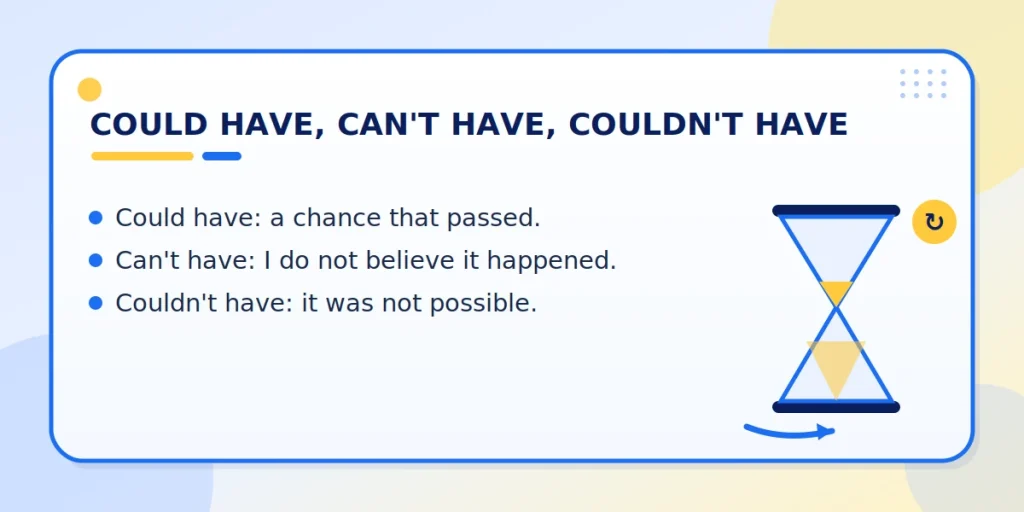
Both expressions can describe past impossibility or disbelief. Their exact meanings depend on context.
Can’t Have for Past Deduction
Use can’t have when you strongly believe something did not happen. Examples: She can’t have forgotten the appointment. He can’t have finished the entire book in one hour. They can’t have reached the airport already. These sentences express the speaker’s conclusion about the past.
Couldn’t Have for Past Impossibility
Couldn’t have can express impossibility, inability, or a situation that could not have happened. Examples: They couldn’t have known about the changes. I couldn’t have completed the project without your help. A small fire couldn’t have caused all that damage.
Can’t Have vs Couldn’t Have Comparison
| Expression | Main meaning |
|---|---|
| Can’t have | Strong negative deduction about the past |
| Couldn’t have | Past impossibility or inability |
| Could have | Past possibility or unrealized opportunity |
Can Have vs Could Have
Can have and could have do not normally serve as interchangeable affirmative forms for past possibility. Compare: I can have the report ready by Friday. I could have finished the report yesterday. The first sentence describes an ability or arrangement for the future. The second describes a past possibility or opportunity. You may also see can have in questions and negative deductions. Examples: Can she have forgotten the appointment? She can’t have forgotten the appointment. These constructions are grammatical. However, could have is the usual choice for affirmative past possibility.
11. Reported Speech
Reported speech tells someone what another person said without repeating their exact words. When reporting a statement with can in a past reporting context, can often changes to could.
Changing Can to Could
Direct speech: She said, “I can swim.” Reported speech: She said she could swim. Another example: Direct speech: He said, “I can finish the work.” Reported speech: He said he could finish the work.
Reported Questions
The same change often happens in reported questions. Direct question: He asked, “Can you help me?” Reported question: He asked if I could help him. Notice that the reported question uses statement word order.
Does Can Always Change to Could?
No. The change depends on context. If the ability or fact remains true, speakers do not always need to change can. For example: She said she can speak Spanish. This can be appropriate when she still speaks Spanish. The important point is that reported speech often changes can to could when reporting a past statement.
12. Can vs Could With Perception Verbs and Mental Processes
Could can describe individual past experiences involving perception and mental processes. This is an important exception to the usual rule about specific past achievements.
Perception Verbs
Common perception verbs include: See, Hear, Feel, Smell, Taste, Notice. Examples: I could hear music from outside. She could see the ocean from her room. We could smell fresh bread. He could feel the ground shaking. They could hear someone calling. Could works naturally here, even when describing one particular past occasion.
Mental Process Verbs
These verbs describe thinking, understanding, or remembering. Examples: I could understand what she meant. She couldn’t remember his name. We could recognize the voice. He could understand the instructions. These constructions describe individual past experiences.
Why Is Could Different Here?
The specific past achievement rule does not apply in the same way to perception and mental process verbs. For example: I could hear someone outside. (Correct.) I was able to hear someone outside. (Also possible, but less direct.) Use could naturally when describing what someone perceived or understood in the past.
13. Can vs Could: Pronunciation and Weak Forms
Both words have strong and weak pronunciations in English. The weak forms often appear in ordinary conversation when speakers do not emphasize the modal verb.
| Word | Strong pronunciation | Weak pronunciation |
|---|---|---|
| Can | /kæn/ | /kən/ |
| Could | /kʊd/ | /kəd/ |
These forms are used in both American and British English.
How to Pronounce Can
The strong form uses the vowel sound in words such as hat. The weak form has a shorter, reduced vowel. Examples: I CAN do it. (Emphasized.) I can do it. (Ordinary speech.)
How to Pronounce Could
The strong form uses the vowel sound found in good. The weak form reduces the vowel when could is unstressed. Examples: I COULD help you. (Emphasized.) I could help you. (Ordinary speech.)
Does Pronunciation Change the Meaning?
The pronunciation changes with stress and connected speech. However, the basic grammatical meaning remains the same. Use strong forms when emphasizing ability, disagreement, or contrast. Use weak forms in ordinary sentences.
14. Can vs Could: Common Mistakes to Avoid
English learners often confuse these modal verbs because their meanings overlap. Here are common mistakes and their corrections.
| Incorrect or misleading sentence | Correct sentence | Explanation |
|---|---|---|
| I can to swim. | I can swim. | Do not add to after a modal verb. |
| She cans drive. | She can drive. | Can does not take an s ending. |
| Did you could help? | Could you help? | Do not use do support with could. |
| Yes, you could. (Granting permission) | Yes, you can. | Can normally grants permission. |
| I could of helped. | I could have helped. | Could of is incorrect. |
| I could pass the test yesterday. (One specific success) | I was able to pass the test yesterday. | Use was able to for a specific past achievement. |
| It could rain yesterday. (Wrong time reference) | It could rain tomorrow. | The time reference must match the intended meaning. |
Mistake 1: Thinking Could Always Means Past
Could can describe past ability, but it also expresses present and future possibilities. Example: We could meet tomorrow. This sentence refers to a possible future arrangement.
Mistake 2: Thinking Could Always Means Less Probability
Could often expresses weaker or more uncertain possibility. However, it does not have a fixed probability value. Context determines the meaning.
Mistake 3: Using Could to Grant Permission
Remember that could can ask for permission, but can normally grants it. Correct: “Could I leave early?” / “Yes, you can.”
Mistake 4: Confusing Could Have With Can Have
Could have commonly describes past possibilities or missed opportunities. Can have appears in other constructions, including questions and negative deductions.
Mistake 5: Writing Could Of
Could of is never the correct standard spelling. Write could have or could’ve instead.
15. Can vs Could: US vs UK English, Formal vs Informal Usage
The basic grammatical rules for can vs could are shared by American and British English. There is no need to learn separate rules for the two varieties.
Is There a Difference Between American and British English?
Both varieties use: Can for present ability. Could for past general ability. Can and could for permission requests. Can for granting permission. Could for suggestions and hypothetical situations. Could have for past possibilities. The main differences in everyday use often involve personal style and context rather than separate grammatical rules.
Can vs Could in Formal and Informal English
| Context | Natural expression |
|---|---|
| Casual conversation | Can you help me? |
| Polite conversation | Could you help me? |
| Workplace request | Could you review this document? |
| Direct offer | I can help you. |
| Tentative suggestion | We could try another option. |
| Formal permission request | Could I have your approval? |
Can is perfectly acceptable in professional communication. However, could often sounds more considerate when making requests.
Can vs Could in Professional Emails
Choosing the right modal verb can make workplace messages sound clearer and more respectful. Here are useful examples.
Requesting information: Direct: Can you send me the latest report? More considerate: Could you send me the latest report when you have a chance?
Requesting approval: Could you review and approve this proposal?
Offering assistance: I can help prepare the presentation if needed.
Suggesting an alternative: We could schedule another meeting next week.
Checking availability: Can you attend the meeting on Thursday?
Making a tentative proposal: Could we move the meeting to Friday?
Use can when you want to communicate a direct ability or arrangement. Use could when you want to make a request sound more considerate.
16. Can vs Could: Memory Trick to Remember the Difference
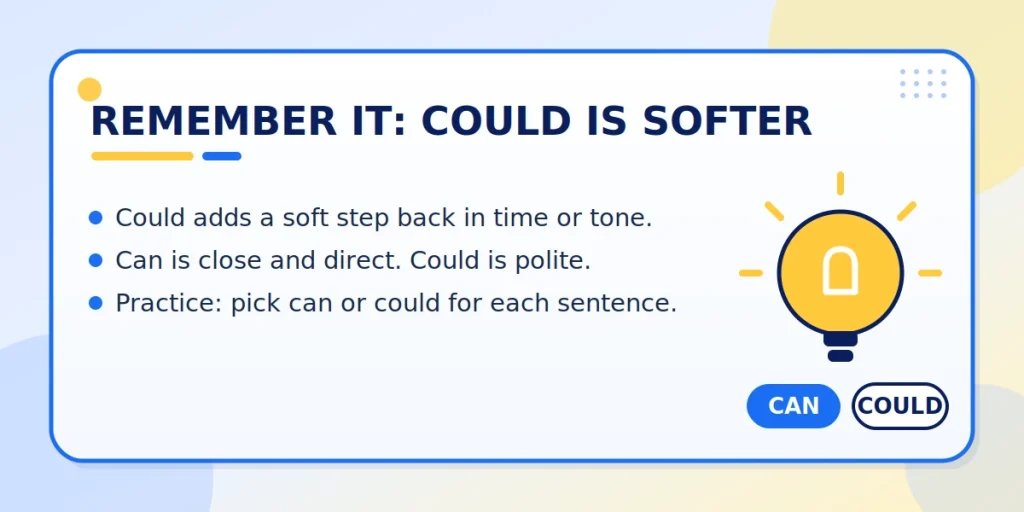
A simple memory trick can help you choose the correct modal verb. Remember: CAN = Capability, Availability, Now. Use can when discussing: What someone can do now. What is generally possible. What permission someone receives. Direct offers and everyday requests. COULD = Courtesy, Childhood, Chance, Condition. Use could when discussing: More courteous requests. Childhood or general past ability. Less certain possibilities. Suggestions and hypothetical situations.
Four Examples to Remember
- Present vs Past Ability: I can swim. I could swim when I was young.
- Direct vs Polite Request: Can you help? Could you help?
- Availability vs Suggestion: We can meet tomorrow. We could meet tomorrow.
- Giving vs Asking Permission: You can leave now. Could I leave now?
This memory trick is a learning aid, not an absolute grammar rule. Always consider the context.
17. Can vs Could: Real Life Dialogues and Workplace Templates
Short conversations help you understand how people use these words naturally.
Dialogue 1: Asking for Help
Anna: Can you help me with this assignment? Mike: Sure. What do you need? Anna: Could you explain the last question? Mike: Of course. Let’s look at it together. Here, can introduces a direct request. Could makes the second request more polite.
Dialogue 2: Workplace Communication
Manager: Could you review this report before Friday? Employee: Yes, I can finish it by Thursday. Manager: Great. Could you also check the figures? Employee: Certainly. I can handle both tasks. This conversation shows polite requests and direct statements of ability.
Dialogue 3: Making Plans
Lisa: We can meet on Saturday if you’re available. John: Saturday works. What time? Lisa: We could meet around noon. John: That sounds good. Can expresses availability. Could introduces a possible arrangement.
Dialogue 4: Asking for Permission
Employee: Could I leave early today? Supervisor: Yes, you can leave at 3 p.m. Employee: Thank you. I appreciate it. Could asks for permission. Can grants permission.
Dialogue 5: Discussing Past Ability
Tom: Could you swim when you were a child? Sarah: Yes, I could swim when I was six. Tom: Did you swim in competitions? Sarah: Yes. I was able to win my first competition at age ten. Could describes general past ability. Was able to describes one successful achievement.
Useful Workplace Email Templates
Template 1: Requesting a Document. Subject: Request for Updated Report. Could you please send me the latest version of the report? I would appreciate receiving it before Thursday. Thank you for your help.
Template 2: Offering Assistance. Subject: Support With the Project. I can help prepare the presentation if needed. Please let me know which sections require additional support.
Template 3: Suggesting a Meeting. Subject: Meeting Schedule. We could schedule a meeting next Tuesday to discuss the project updates. Please let me know if that time works for you.
18. Practice Questions: Can vs Could
Test your understanding with these ten questions. Choose the correct option in each sentence.
- When I was young, I _____ run very fast. (can/could)
- _____ you please send me the updated report? (Can/Could)
- She _____ speak three languages fluently now. (can/could)
- Winter roads _____ be dangerous. (can/could)
- He _____ have forgotten about our appointment. (can/could)
- I _____ hear someone knocking at the door last night. (can/could)
- If I had more money, I _____ buy a new car. (can/could)
- Yes, you _____ borrow my laptop. (can/could)
- She _____ finish the difficult task yesterday despite the delay. (was able to/could)
- I _____ have helped you if you had asked. (can/could)
Answer Key With Explanations
- Could – Correct sentence: When I was young, I could run very fast. Could describes general ability in the past.
- Could – Correct sentence: Could you please send me the updated report? Could makes this request more polite and considerate.
- Can – Correct sentence: She can speak three languages fluently now. Can expresses her present ability.
- Can – Correct sentence: Winter roads can be dangerous. Can expresses a general possibility.
- Could – Correct sentence: He could have forgotten about our appointment. Could have expresses a possible past event.
- Could – Correct sentence: I could hear someone knocking at the door last night. Could describes a past experience involving perception.
- Could – Correct sentence: If I had more money, I could buy a new car. Could expresses a hypothetical possibility in the second conditional.
- Can – Correct sentence: Yes, you can borrow my laptop. Can normally grants permission.
- Was able to – Correct sentence: She was able to finish the difficult task yesterday despite the delay. Was able to describes one specific past achievement.
- Could – Correct sentence: I could have helped you if you had asked. Could have describes an unrealized past opportunity.
19. Frequently Asked Questions About Can vs Could
1. What Is the Difference Between Can and Could?
Can usually expresses present ability, general possibility, and permission. Could expresses past general ability, polite requests, suggestions, and hypothetical situations. This simple distinction helps you choose the correct word in most cases.
2. Is Could the Past Tense of Can?
Yes, could is the past form of can in certain situations. However, it also expresses present possibility, polite requests, suggestions, and hypothetical situations. It is not limited to past time.
3. Is Could More Polite Than Can?
Generally, yes. Could you often sounds more polite and considerate than can you. However, can you is not rude in everyday conversation. Tone and context also affect how a request sounds.
4. Can You Use Could for Present Ability?
Yes, but usually in conditional or tentative situations. For straightforward present ability, use can. Could often adds a condition, a suggestion, or a less direct meaning. For example, “I could help if I had time” is tentative.
5. Is It Could Of or Could Have?
Could have is correct, and could’ve is its accepted contraction. Could of is incorrect. The mistake happens because could’ve sounds like could of in ordinary speech. Always write could have or could’ve, especially in schoolwork and professional writing.
6. Why Do We Say Was Able To Instead of Could for a Specific Past Success?
Was able to describes successfully completing one particular past action. Could usually describes general past ability. This distinction helps you choose the correct form for past events. For example, “I was able to pass the test” describes one success.
7. Can Could Be Used to Give Permission?
No, not normally. Could is suitable for politely asking permission, but can usually grants it. For example, answer “Could I leave early?” with “Yes, you can.” Use could to ask and can to answer, and the exchange will sound natural.
Final Takeaway: Can vs Could
The main difference between can vs could depends on ability, time, possibility, and politeness. Remember these essential rules:
- Use can for present ability and general possibility.
- Use could for general past ability.
- Use can to grant permission.
- Use could for more polite requests.
- Use could for suggestions and hypothetical situations.
- Use could have for past possibilities and missed opportunities.
- Use was able to for specific past achievements.
- Use couldn’t for specific past failures.
Can describes what is possible or available. Could adds past meaning, politeness, uncertainty, or imagination. Understanding these differences will help you choose the right word in conversations, schoolwork, and professional communication.
Related Grammar Guides
Continue improving your English with these ClarifyWords guides:
- May vs Might – https://clarifywords.com/may-vs-might/
- Which vs That – https://clarifywords.com/which-vs-that/
- Choose or Chose – https://clarifywords.com/choose-or-chose/
- Better Than or Better Then – https://clarifywords.com/better-than-or-better-then/
- Lead or Led – https://clarifywords.com/lead-or-led/
- Lay or Laid – https://clarifywords.com/lay-or-laid/
- A vs An – https://clarifywords.com/a-vs-an/
- Fewer vs Less – https://clarifywords.com/fewer-vs-less/
- Explore More Grammar Guides – https://clarifywords.com/category/grammar/