

Leafs or Leaves: What’s the Difference?

The correct plural of leaf is leaves. Use it when you mean more than one leaf on a plant, a book, or another object. Leafs has different uses. It is a verb meaning to turn pages or grow leaves. It is also part of the official name Toronto Maple Leafs.
The difference comes down to meaning and grammar. This guide answers leafs or leaves in full. It explains when to use each form, how to pronounce them, and how to avoid common mistakes.
Quick Answer: Leafs or Leaves?
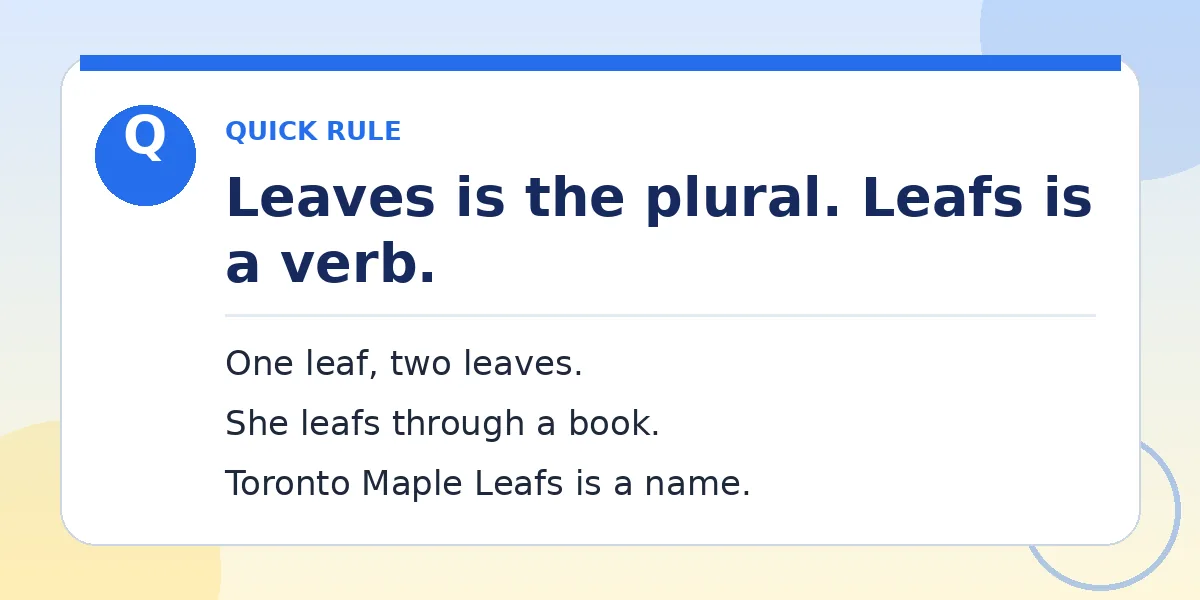
Use leaves as the standard plural noun of leaf. Use leafs as a verb or in the proper name Toronto Maple Leafs.
| Word | Correct use | Example |
|---|---|---|
| Leaves | Plural of the noun leaf | The tree has green leaves. |
| Leaves | Present tense form of leave | She leaves work at five. |
| Leafs | Present tense form of leaf | He leafs through the magazine. |
| Leafs | Part of a proper name | The Toronto Maple Leafs play hockey. |
A simple rule helps: many leaves, but someone leafs through a book. Keep that contrast in mind whenever you face leafs or leaves in a sentence.
Table of Contents
- What Does Leaves Mean?
- What Does Leafs Mean?
- Why Is the Plural of Leaf Leaves?
- Leafs vs Leaves: Key Differences
- How to Pronounce Leafs and Leaves
- Common Mistakes to Avoid
- Is It Leafs or Leaves in American and British English?
- An Easy Trick to Remember the Difference
- Practice Questions
- Frequently Asked Questions
- Related Guides
What Does Leaves Mean?
Leaves has two common grammatical uses. It can be the plural of leaf or the present tense form of leave.
Leaves as the Plural of Leaf
The noun leaves means more than one leaf. A leaf is usually the flat, green part of a plant. It helps the plant make food through photosynthesis.
For example:
- The oak tree loses its leaves in autumn.
- Wet leaves covered the sidewalk.
- The gardener collected the fallen leaves.
- A book has several printed leaves.
The word leaf can also describe a thin, flat part of something. Its plural remains leaves in ordinary usage.
Leaves as a Verb Form of Leave
Leaves is also the third person singular present tense form of the verb leave. It describes someone or something departing, going away, or allowing something to remain.
For example:
- My sister leaves for work at seven.
- The bus leaves the station soon.
- He leaves his keys on the counter.
- The dog leaves muddy footprints on the floor.
The subject determines the verb form. Use leaves with he, she, or it in the present tense.
Compare these examples:
- I leave early.
- You leave early.
- She leaves early.
This meaning has nothing to do with plant leaves. The sentence tells you which meaning applies.
What Does Leafs Mean?
Leafs is a real English word, but it is not the standard plural noun of leaf. It appears in two important situations.
Leafs as a Verb
Leafs is the third person singular present form of the verb leaf. As a verb, leaf can mean turning pages quickly or producing leaves.
For example:
- She leafs through the travel guide.
- He leafs through the old family album.
- The plant leafs out in early spring.
The verb changes according to its subject and tense:
| Verb form | Example |
|---|---|
| Leaf | I leaf through the catalog. |
| Leafs | She leafs through the catalog. |
| Leafed | He leafed through the catalog. |
| Leafing | They are leafing through the catalog. |
Notice the difference between the noun and verb.
- Correct noun: The plant has several leaves.
- Correct verb: The plant leafs out in spring.
Leafs in Toronto Maple Leafs
Toronto Maple Leafs is the official proper name of the professional hockey team. The word Leafs is part of that name.
Proper names keep their official spelling. You should therefore write Toronto Maple Leafs, not Toronto Maple Leaves.
This is a name, not an example of the usual plural rule for the noun leaf. In ordinary writing, use leaves when referring to multiple plant leaves.
Why Is the Plural of Leaf Leaves?
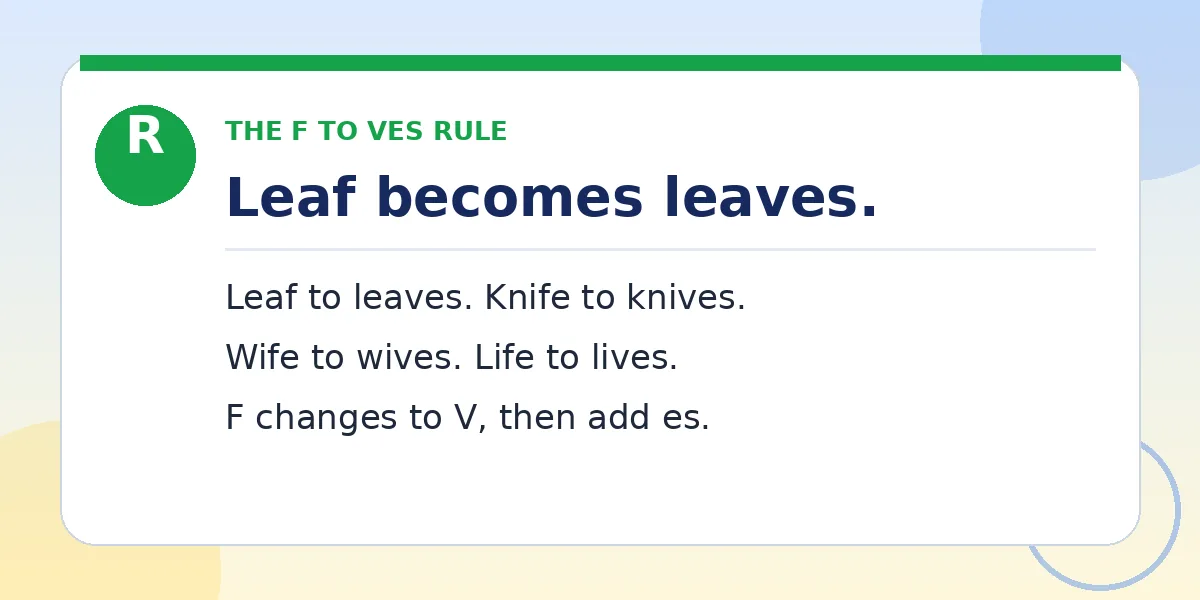
Many English nouns ending in f or fe change that ending to ves in the plural. This spelling pattern explains why the plural of leaf is leaves, and it is the key to leafs or leaves.
The change is sometimes called the f to ves plural rule. It applies to several familiar words, but not every noun ending in f follows it.
Common F to Ves Plurals
| Singular | Plural | Example |
|---|---|---|
| Leaf | Leaves | The leaves turned brown. |
| Knife | Knives | Put the knives away. |
| Wife | Wives | The story follows two wives. |
| Life | Lives | Their lives changed completely. |
| Wolf | Wolves | Wolves live in the forest. |
| Calf | Calves | The calves stayed near the barn. |
| Half | Halves | Cut the apple into halves. |
| Loaf | Loaves | The bakery sells fresh loaves. |
| Shelf | Shelves | The books fill three shelves. |
| Thief | Thieves | The police caught the thieves. |
| Elf | Elves | The story features friendly elves. |
| Self | Selves | They introduced their true selves. |
| Sheaf | Sheaves | The farmer gathered the sheaves. |
These examples can help you recognize the spelling pattern. However, English has exceptions.
F Words That Usually Add S
Some nouns ending in f form their plurals by adding s. They do not change f to ves.
| Singular | Plural | Example |
|---|---|---|
| Roof | Roofs | Several roofs need repairs. |
| Chief | Chiefs | The chiefs attended the meeting. |
| Belief | Beliefs | Their beliefs differ. |
| Cliff | Cliffs | The cliffs overlook the sea. |
| Chef | Chefs | The chefs prepared dinner. |
| Proof | Proofs | The editor checked the proofs. |
| Safe | Safes | The store has two safes. |
| Reef | Reefs | Coral reefs support marine life. |
| Gulf | Gulfs | The map shows two gulfs. |
Words That Allow Both Plural Forms
Some nouns accept both an s plural and a ves plural. The preferred form can depend on the word or context.
| Singular | Plural forms |
|---|---|
| Dwarf | Dwarfs, dwarves |
| Scarf | Scarfs, scarves |
| Hoof | Hoofs, hooves |
| Wharf | Wharfs, wharves |
These variations do not make leafs the normal plural of leaf. For standard everyday writing, choose leaves.
Leafs vs Leaves: Key Differences
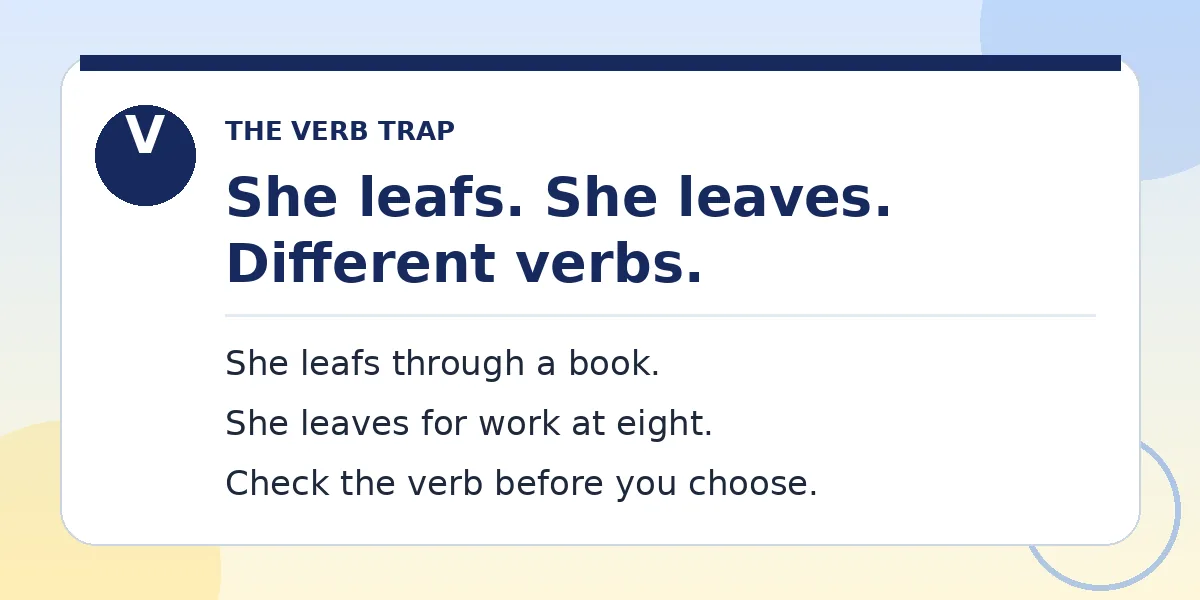
The easiest way to settle leafs or leaves is to identify the word’s grammatical role. The same spelling can serve different purposes in different sentences.
| Form | Part of speech | Meaning | Example |
|---|---|---|---|
| Leaves | Plural noun | More than one leaf | The leaves fell from the tree. |
| Leaves | Verb | Departs or goes away | My father leaves at noon. |
| Leafs | Verb | Turns pages or grows leaves | She leafs through the book. |
| Leafs | Proper noun | Part of a team’s name | The Toronto Maple Leafs won. |
Read the whole sentence before choosing a spelling. Ask whether you mean plant parts, an action, or a proper name.
For more spelling guidance, explore our Spelling Differences category.
How to Pronounce Leafs and Leaves
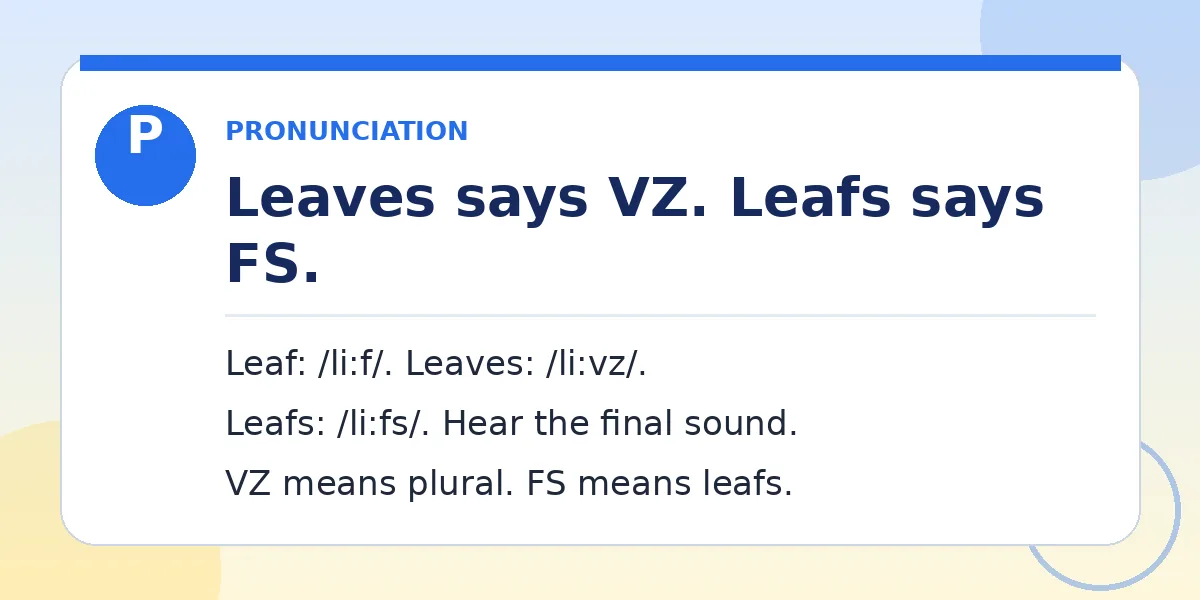
Leafs and leaves look similar, but their final sounds differ. The distinction is important when speaking and listening.
| Word | IPA pronunciation | Ending sound |
|---|---|---|
| Leaf | /liːf/ | F |
| Leafs | /liːfs/ | F plus S |
| Leaves | /liːvz/ | V plus Z |
In leaves, the final sound is voiced. Your vocal cords vibrate when you say it. In leafs, the ending uses an unvoiced F sound followed by S.
Try saying these sentences aloud:
- The leaves fell from the tree.
- She leafs through the magazine.
- The leaf is turning yellow.
Listening for the final consonants can help you distinguish the words.
Common Mistakes to Avoid
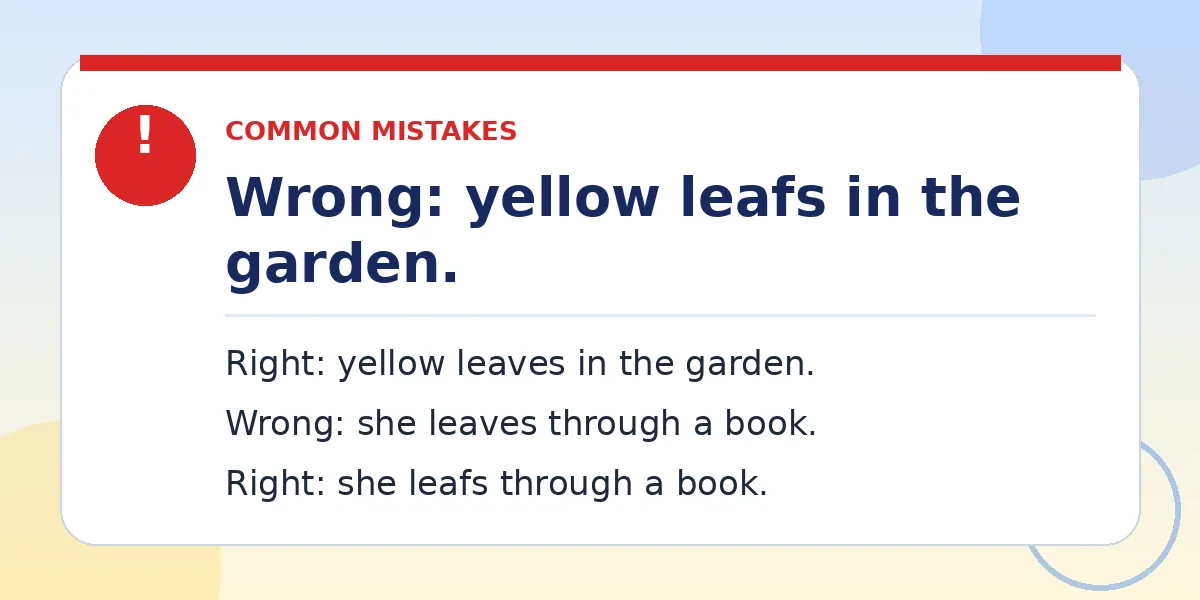
Writers sometimes confuse these forms because they share similar spelling. These examples show how to use them correctly.
1. Using Leafs as the Ordinary Plural of Leaf
Incorrect: The garden is covered with yellow leafs.
Correct: The garden is covered with yellow leaves.
Use leaves when you mean multiple plant leaves. Do not use leafs as the ordinary plural in this sentence.
2. Confusing the Noun Leaves With the Verb Leaves
These sentences use the same word in different ways:
- The leaves are wet. This is a plural noun.
- She leaves at six. This is a verb.
Check the subject and meaning to understand the grammatical role.
3. Confusing Leafs With Leaves in Verb Forms
Use leafs when the subject performs the action of turning pages.
Correct: He leafs through the newspaper.
Incorrect: He leaves through the newspaper.
Use leaves for the verb leave, as in “He leaves the room.”
4. Mixing Up Leaf’s and Leaves’
An apostrophe changes the meaning. Leaf’s is the singular possessive form. Leaves’ is the plural possessive form.
| Form | Meaning | Example |
|---|---|---|
| Leaf’s | Belonging to one leaf | The leaf’s edge is brown. |
| Leaves’ | Belonging to several leaves | The leaves’ colors are bright. |
| Leaves | Plural noun or verb | The leaves are falling. |
Do not add an apostrophe when you simply need the plural noun.
5. Changing the Spelling in Compound Words
Some expressions contain leaf as part of a compound. Their spelling depends on the expression, not the plural rule alone.
Examples include:
- Four-leaf clover
- Leaf blower
- Leaf pile
- Tea leaves
- Leaf mold
Use the established spelling of each expression. Do not automatically change every occurrence of leaf to leaves.
6. Using the Wrong Subject and Verb Agreement
A plural noun needs a plural verb. The verb leaf also changes according to its subject.
Correct: The leaves are turning yellow.
Incorrect: The leaves is turning yellow.
Correct: The tree leafs out in spring.
Correct: The trees leaf out in spring.
Check whether the subject is singular or plural before choosing the verb.
Is It Leafs or Leaves in American and British English?
American and British English both use leaves as the standard plural of leaf. There is no usual regional spelling difference for this word.
For example, an American writer and a British writer would both write:
- The leaves are falling.
- Green leaves covered the branches.
- She collected the leaves from the garden.
The verb leafs and the team name Toronto Maple Leafs keep the same spelling in both varieties.
Regional spelling differences do affect other words. For example, compare gray vs grey, judgment vs judgement, and defense vs defence.
You can also explore toward vs towards, aluminium or aluminum, and mold vs mould.
An Easy Trick to Remember the Difference
Use this simple memory trick if you keep mixing up leafs or leaves:
One leaf, many leaves.
The F in leaf changes to V in leaves. Remember the phrase “one leaf, many leaves” whenever you need the plural noun.
For the other form, connect leafs with an action:
- She leafs through a book.
- The plant leafs out in spring.
- The Toronto Maple Leafs is a team name.
Remember these three points:
- Leaves means multiple leaves.
- Leafs describes an action or appears in the team’s name.
- Leaves can also mean someone departs.
Practice Questions
Choose the correct word for each blank. Use leafs or leaves.
- The maple tree loses its ______ every autumn.
- She ______ through the magazine while waiting.
- My brother ______ for school at eight.
- The garden path was covered with dry ______.
- The Toronto Maple ______ are a hockey team.
- The plant ______ out when spring arrives.
- The green ______ look healthy after the rain.
- He ______ the office before lunchtime.
- The gardener collected the fallen ______.
- My grandfather ______ through his old photo album.
Answer Key
- Leaves. This is the plural noun of leaf.
- Leafs. This is the verb leaf, meaning to turn pages.
- Leaves. This is the present tense form of leave.
- Leaves. The sentence refers to multiple plant leaves.
- Leafs. This is part of the team’s official proper name.
- Leafs. This is the verb describing a plant producing leaves.
- Leaves. This is the plural noun of leaf.
- Leaves. This is the present tense form of leave.
- Leaves. The gardener collected more than one leaf.
- Leafs. The grandfather turns through the pages of an album.
Frequently Asked Questions
1. What Is the Plural of Leaf?
The standard plural of leaf is leaves. For example, you might say, “The tree has many green leaves.” The spelling changes from f to ves, following a common English plural pattern.
2. Is Leafs Ever Correct?
Yes. Leafs is correct as the present tense verb form of leaf, as in “She leafs through a book.” It also appears in the official name Toronto Maple Leafs. It is not the standard everyday plural noun.
3. Why Is It Toronto Maple Leafs Instead of Toronto Maple Leaves?
Toronto Maple Leafs is the hockey team’s official proper name. Proper names retain their established spelling, even when that spelling differs from ordinary grammar patterns. Therefore, write Leafs when referring to the team.
4. What Is the Difference Between Leafs and Leaves?
Leaves is the standard plural of leaf and the present tense form of leave. Leafs is the present tense form of leaf or part of the Toronto Maple Leafs name. The sentence determines its meaning.
5. Is Leaves the Plural of Leaf in British English?
Yes. British English uses leaves as the standard plural of leaf, just like American English. The spelling does not change between these varieties. You can use leaves in ordinary writing for either audience.
6. How Do You Pronounce Leafs and Leaves?
Leafs ends with an unvoiced F sound followed by S. Leaves ends with a voiced V sound followed by Z. Listen for that difference when saying each word aloud. Say them slowly.
7. Is It Leaf’s or Leaves’?
Use leaf’s to show that one leaf owns something, as in “the leaf’s shape.” Use leaves’ for something belonging to multiple leaves, as in “the leaves’ colors.” Without an apostrophe, leaves is a plural noun or verb.
Conclusion
Use leaves as the standard plural of leaf. That is the core answer to leafs or leaves. Choose leafs for the verb meaning to turn pages or grow leaves. Keep the spelling Toronto Maple Leafs when referring to the hockey team. When in doubt, check the word’s meaning and role in the sentence.