

Emigrate vs Immigrate: Meaning, Difference, and Examples
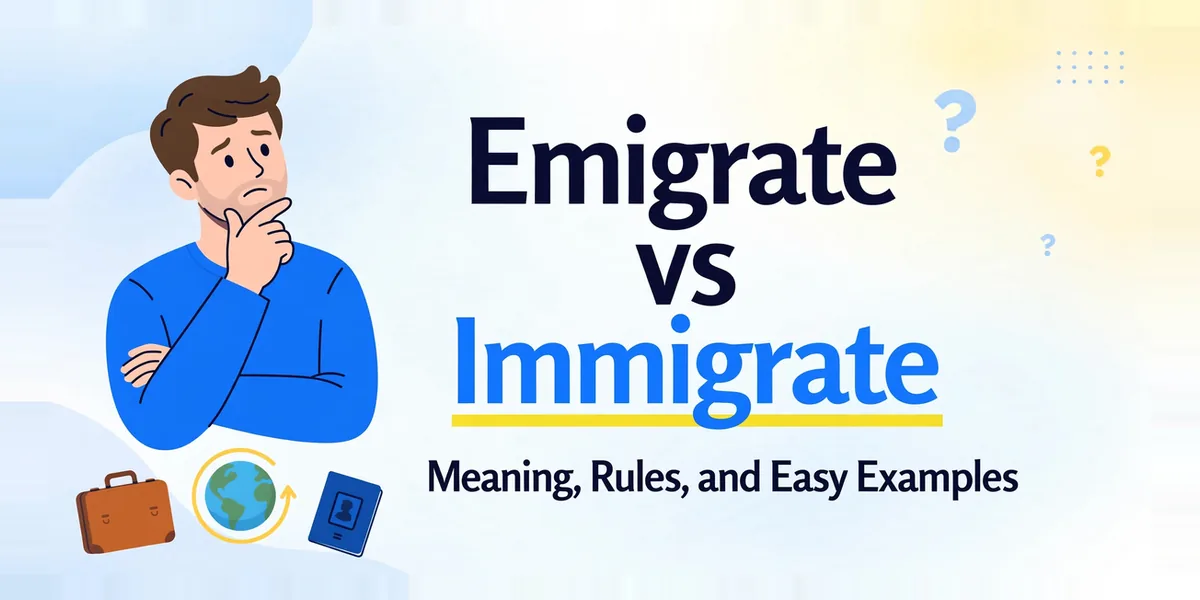
Quick answer: Emigrate means to leave one country to live in another. Immigrate means to enter another country to live there. That is the emigrate vs immigrate difference in one sentence. You emigrate from your original country and immigrate to your new country.
For example, someone moving from Germany to the United States emigrates from Germany. The same person immigrates to the United States.
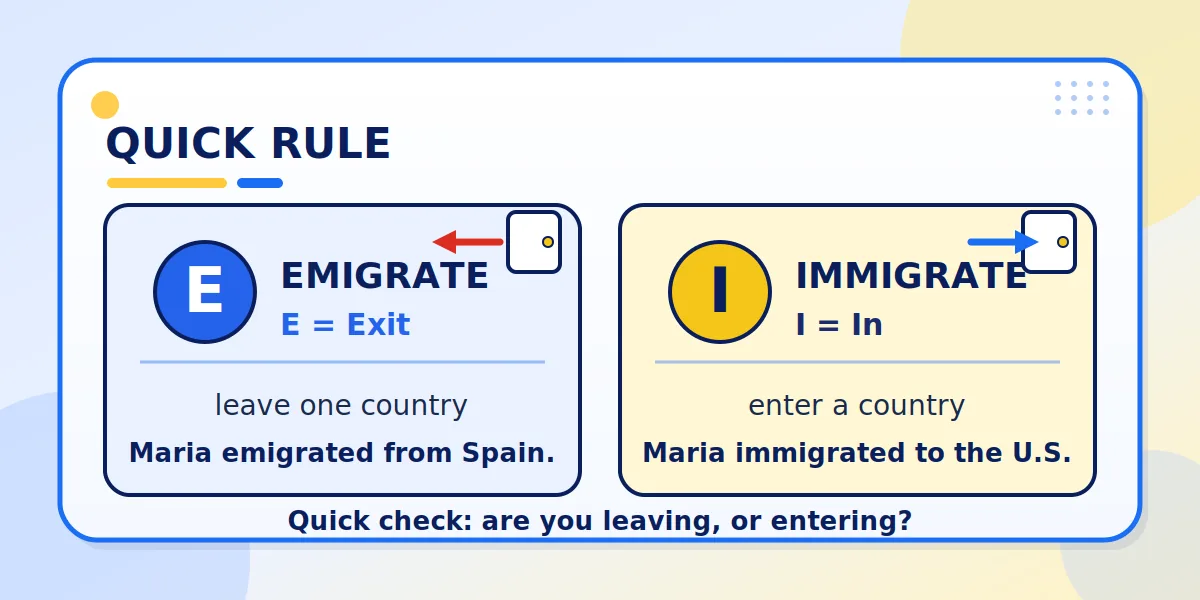
Table of Contents
- What Does Emigrate Mean?
- What Does Immigrate Mean?
- The Point-of-View Rule
- Comparison Table
- Emigrate From vs Immigrate To
- Migrate vs Emigrate vs Immigrate
- Emigrant vs Immigrant
- Emigration vs Immigration
- Pronunciation and Spelling
- Word History
- Memory Tricks
- Common Mistakes
- Related Words
- Practice Questions
- FAQs
What Does Emigrate Mean?
Emigrate means to leave one country to live in another. It focuses on the country a person leaves.
For example:
- Maria emigrated from Spain to find work in the United States.
- My grandparents emigrated from Ireland many years ago.
- Thousands of people emigrated from the region during the conflict.
- Albert Einstein emigrated from Germany to the United States in 1933.
In each sentence, the focus is on leaving the original country.
The usual pattern is emigrate from a country. You can also name the destination when it helps explain the move.
For example: He emigrated from France to Canada.
The word does not usually describe someone moving between cities in the same country. In that situation, move or relocate is clearer.
What Does Immigrate Mean?
Immigrate means to enter another country to live there. It focuses on the country a person enters.
For example:
- Maria immigrated to the United States for work.
- My grandparents immigrated to Canada in the 1970s.
- The family plans to immigrate to Australia next year.
Each sentence focuses on arriving in a new country.
The usual pattern is immigrate to a country. Some contexts also use immigrate into.
For example: They immigrated to the United States.
The word describes a move into a country for residence. It does not simply mean visiting for a holiday.
Emigrate vs Immigrate: The Point-of-View Rule
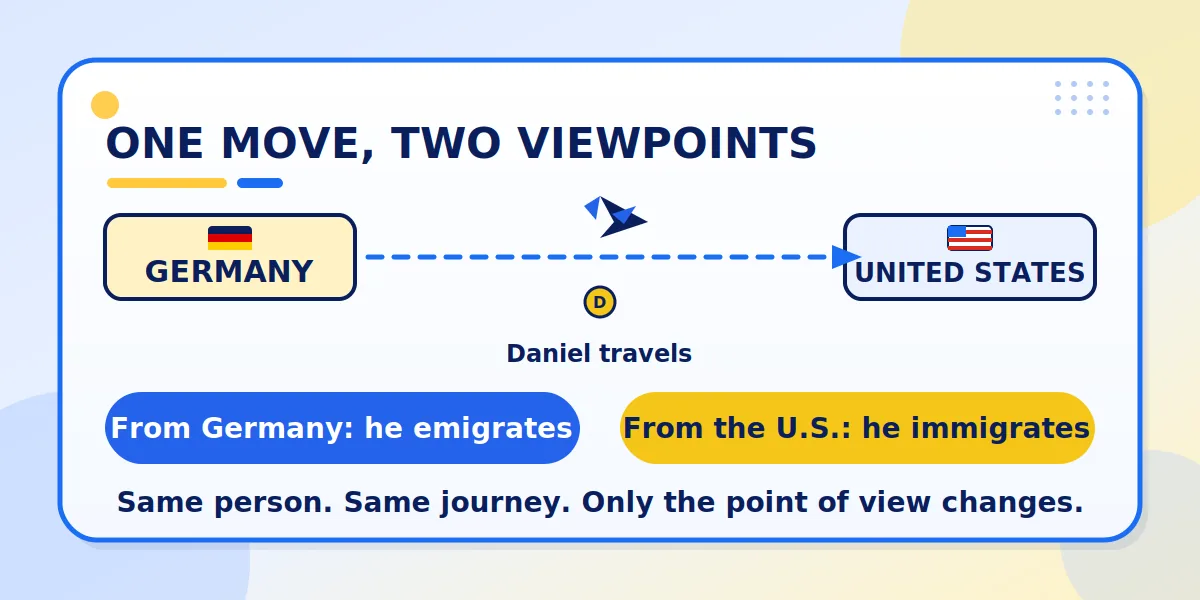
The easiest way to understand the difference is to think about the direction of the move.
One person can both emigrate and immigrate. The word changes with the point of view.
Imagine that Daniel moves from Germany to the United States.
- From Germany’s point of view, Daniel emigrates.
- From the United States’ point of view, Daniel immigrates.
Both statements describe the same move. Neither one changes what happened.
How to Choose the Right Word
Ask yourself one question: Which side of the move does my sentence emphasize?
- If you mean leaving a country, use emigrate.
- If you mean entering a country, use immigrate.
Compare these sentences:
- She emigrated from Japan in 2020. This emphasizes her departure.
- She immigrated to the United States in 2020. This emphasizes her arrival.
Both sentences can describe the same person and event.
Emigrate vs Immigrate: Comparison Table
| Feature | Emigrate | Immigrate |
|---|---|---|
| Meaning | Leave a country to live elsewhere | Enter another country to live there |
| Focus | Departure | Arrival |
| Point of view | Country being left | Country being entered |
| Common preposition | From | To |
| Person | Emigrant | Immigrant |
| Process | Emigration | Immigration |
| Memory clue | E for Exit | I for In |
The key difference is not the person or the journey. It is the perspective used to describe that journey.
Emigrate From vs Immigrate To
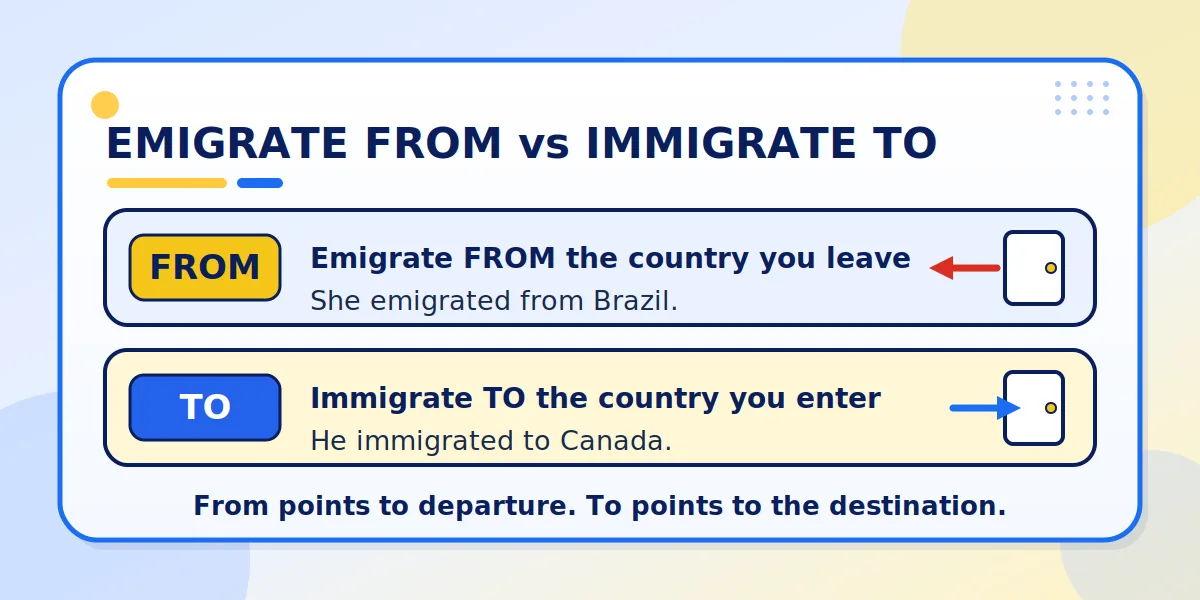
The prepositions from and to are useful clues. They often help readers identify the intended meaning.
Why We Usually Say Emigrate From
Use emigrate from when naming the country someone leaves.
Examples:
- She emigrated from Brazil.
- They emigrated from the United Kingdom.
- My family emigrated from Poland to the United States.
The word from points toward the place of departure.
Why We Usually Say Immigrate To
Use immigrate to when naming the country someone enters.
Examples:
- He immigrated to Canada.
- They immigrated to the United States.
- My neighbors immigrated to New Zealand several years ago.
The word to points toward the destination.
Are From and To Strict Rules?
No. These patterns are common, but they are not absolute grammar restrictions.
The Chicago Manual of Style explains that a sentence can use emigrated to Canada when emphasizing departure. It does not treat from as the only possible preposition.
Merriam-Webster also discusses the overlap between these words. Their meanings have porous borders in some contexts.
Remember the usual patterns, but do not treat them as unbreakable rules. Read the whole sentence and consider its focus.
Is Migrate the Same as Emigrate or Immigrate?
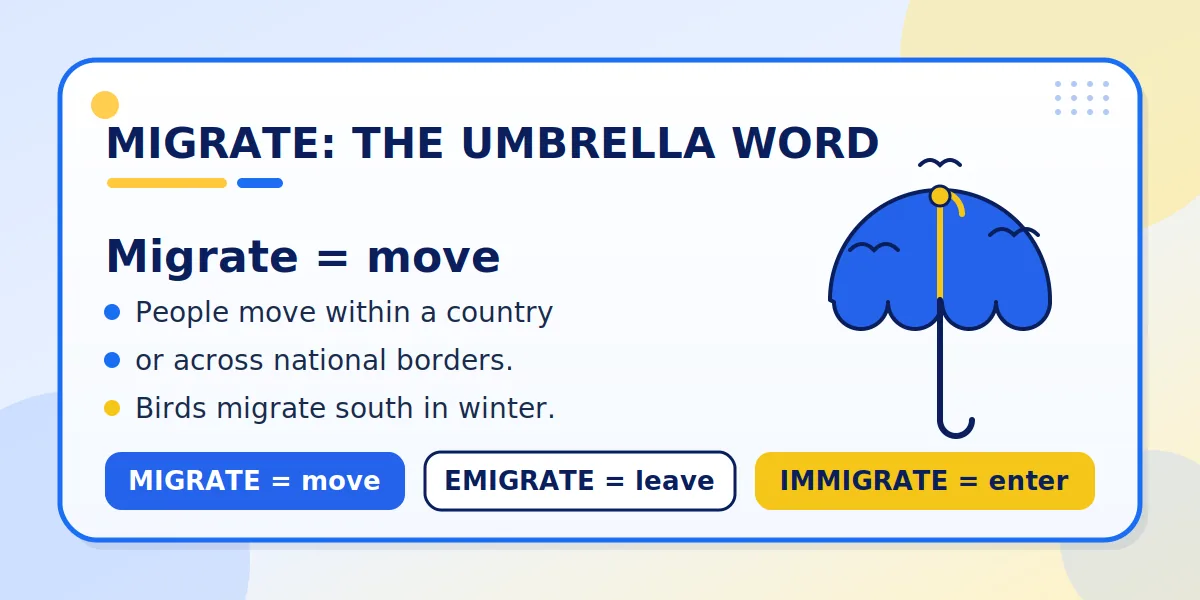
Migrate is a broader word. It means to move from one place to another.
Unlike the two more specific verbs, it does not automatically identify a country someone leaves or enters.
What Does Migrate Mean?
People can migrate within one country or across national borders. Animals also migrate between places.
Examples:
- Some families migrate from rural areas to cities.
- Birds migrate south during colder months.
- Workers migrate to another region for employment.
Migrate vs Emigrate vs Immigrate
Use migrate when the direction or national perspective does not need emphasis.
Use emigrate when focusing on leaving a country. Use immigrate when focusing on entering one.
For example, a person moving from India to the United States migrates internationally. That person also emigrates from India and immigrates to the United States.
Emigrant vs Immigrant
Emigrant and immigrant are nouns. Both describe a person who moves between countries, but they use different perspectives.
What Does Emigrant Mean?
An emigrant is someone who leaves a country to live elsewhere.
Example: The emigrants left Italy and settled in Argentina.
The word focuses on the country they left.
What Does Immigrant Mean?
An immigrant is someone who enters another country to live there.
Example: The immigrants settled in Argentina and built new homes.
The word focuses on the country they entered.
Can Someone Be Both?
Yes. A person can be an emigrant from one country and an immigrant to another.
Someone who leaves Italy for Argentina is an emigrant from Italy. The same person is an immigrant in Argentina.
Emigration vs Immigration
These nouns describe the processes connected to the two verbs.
What Does Emigration Mean?
Emigration is the act or process of leaving a country to live elsewhere.
Example: Emigration from the island increased during the economic crisis.
The sentence focuses on people leaving the island.
What Does Immigration Mean?
Immigration is the act or process of entering another country to live there.
Example: Immigration to Canada shaped the city’s growth.
The sentence focuses on people arriving in Canada.
The same movement can be described as emigration from one country and immigration to another.
Emigrate vs Immigrate: Pronunciation and Spelling
The words look similar, but their first sounds differ.
In American English, Cambridge gives these pronunciations:
- Emigrate: /ˈem.ə.ɡreɪt/
- Immigrate: /ˈɪm.ə.ɡreɪt/
British pronunciations use a different middle vowel. Both words have stress on the first syllable.
One M or Two Ms?
The spelling difference is easy to spot:
- Emigrate has one m.
- Immigrate has two ms.
Remember that immigrate begins with im. The double m belongs to its spelling.
Do not add an extra m to emigrate. Also, do not confuse the verbs with their noun forms, emigrant and immigrant.
Word History: Where Do Emigrate and Immigrate Come From?
Both words in the emigrate vs immigrate pair are connected to the Latin verb migrare, meaning to move or migrate.
Their prefixes help explain their different directions:
- The prefix in emigrate relates to going out.
- The prefix in immigrate relates to going in.
Which Word Came First?
Immigrate appeared in English earlier than emigrate.
The Oxford English Dictionary’s first citation for immigrate dates to about 1623. It appears in Henry Cockeram’s dictionary.
The recorded history of emigrate is less settled across reference sources:
- Merriam-Webster gives 1749 as its first known use.
- Dictionary.com gives a first recorded period of 1770 to 1780.
- Oxford describes it as dating from the late 18th century.
These dates reflect different dictionary evidence and editorial conventions. They should not be treated as one universally agreed year.
Emigrate vs Immigrate: Easy Memory Tricks

Two simple tricks can help you remember the distinction.
E Means Exit, I Means In
Connect the first letter of each word with its direction:
- E in emigrate means Exit. You leave a country.
- I in immigrate means In. You enter a country.
For example, you emigrate from Mexico and immigrate to the United States.
Imagine a Camera Changing Angles
Picture someone crossing a border. Now imagine a camera showing the journey from two sides.
From the country the person leaves, the camera shows emigration. From the country the person enters, it shows immigration.
The person and journey remain the same. Only the camera angle changes.
Common Mistakes With Emigrate and Immigrate
These emigrate vs immigrate errors often happen when writers focus on the destination or departure without checking the meaning.
Using Immigrate When You Mean Leave
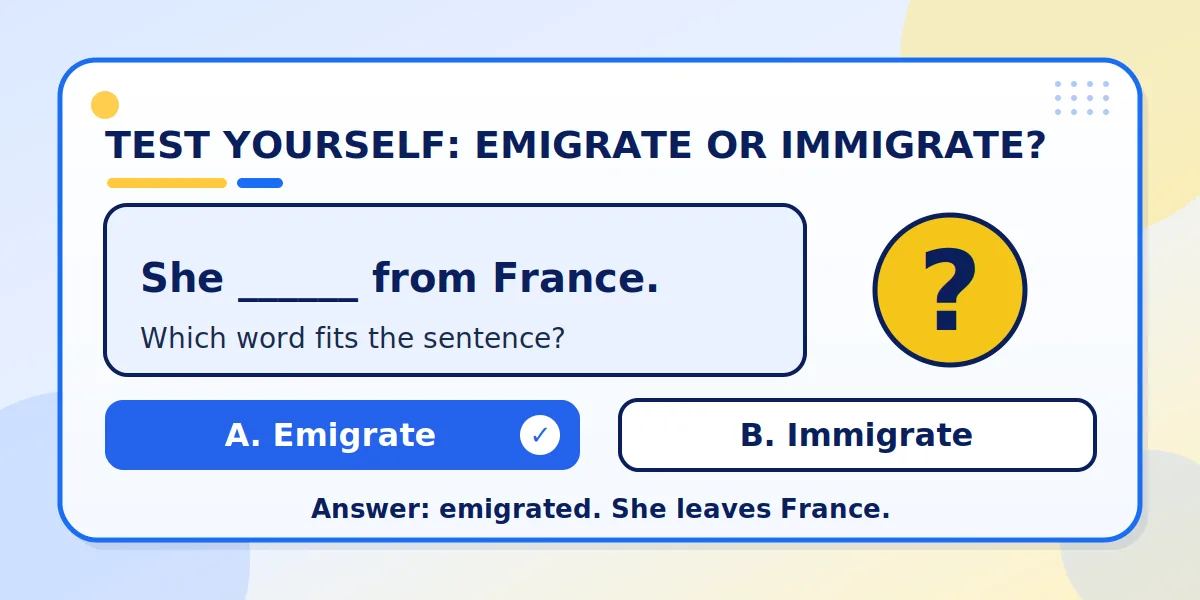
Incorrect: She immigrated from France.
Better: She emigrated from France.
Use emigrate when the sentence focuses on leaving France.
Using Emigrate When You Mean Enter
Incorrect: He emigrated to Canada as a new resident.
Better: He immigrated to Canada as a new resident.
The second sentence focuses on entering Canada.
However, remember that emigrate to can be acceptable in a sentence emphasizing departure. Context matters.
Treating From and To as Absolute Rules
Do not assume that emigrate can never appear with to. The usual preposition patterns are helpful, but sentence meaning matters more.
Confusing Migrate With the Other Verbs
Migrate is broader. It can describe movement within a country or between countries.
Do not use it when the sentence needs to make the departure or arrival perspective clear.
Mixing Up Related Word Pairs
These distinctions are similar to other commonly confused English words. ClarifyWords also explains whose vs who’s (https://clarifywords.com/whose-vs-whos/), loose vs lose (https://clarifywords.com/loose-vs-lose/), and then vs than (https://clarifywords.com/then-vs-than/).
For other common word choices, see affect vs effect (https://clarifywords.com/affect-vs-effect/). You can also explore the Confused Words category (https://clarifywords.com/category/confused-words/).
Related Words That Are Not Exact Synonyms
Words about migration often appear together. However, they do not all mean the same thing.
Migrant
A migrant is a broad term for someone who moves from one place to another.
The word does not automatically explain why the person moved. It also does not establish their legal status.
Refugee
A refugee is a person who falls within a distinct protection-related category.
The term is not simply another word for immigrant or migrant. Not everyone who crosses a border is a refugee.
Expatriate
An expatriate, often shortened to expat, is someone living outside their home country.
The word can describe someone living abroad for work or personal reasons. It does not always carry the same meaning as emigrant or immigrant.
Émigré
An émigré is someone who has left their home country. The word often appears in historical or political contexts.
It is related to emigrant, but the terms are not interchangeable in every sentence.
Legal Immigrant vs Nonimmigrant in U.S. Law
U.S. immigration law uses immigrant and nonimmigrant as legal classifications.
The Immigration and Nationality Act defines immigrant through a statutory framework. It generally excludes people covered by specified nonimmigrant categories.
This legal meaning is more technical than everyday English. Calling someone an immigrant in ordinary conversation does not, by itself, establish their legal classification.
For legal questions, consult official USCIS information or qualified immigration counsel. Do not rely on an ordinary dictionary definition to determine someone’s status.
Practice Questions: Emigrate or Immigrate?
Choose the word or form that best completes each sentence.
- My grandparents decided to ______ from Greece.
- Her family plans to ______ to the United States.
- The people who leave a country are called ______.
- The people who enter a new country to live are called ______.
- The family ______ from Peru and settled in Chile.
- Many birds ______ south during winter.
- His ______ from Italy began several years ago.
- The country’s ______ increased as more people arrived.
- She ______ from Germany and ______ to the United States.
- Which word focuses on entering a country: emigrate or immigrate?
Answer Key
- Emigrate. The sentence focuses on leaving Greece.
- Immigrate. The family is entering the United States to live there.
- Emigrants. The noun focuses on people leaving a country.
- Immigrants. The noun focuses on people entering a country.
- Emigrated. The sentence emphasizes leaving Peru.
- Migrate. This broader verb describes seasonal movement.
- Emigration. The sentence focuses on leaving Italy, the original country.
- Immigration. The sentence focuses on people arriving.
- Emigrated; immigrated. The first verb describes leaving Germany. The second describes entering the United States.
- Immigrate. It focuses on entering another country.
Frequently Asked Questions About Emigrate vs Immigrate
What Is the Main Difference Between Emigrate and Immigrate?
Emigrate means leaving one country to live elsewhere. Immigrate means entering another country to live there. The difference depends on which side of the move your sentence emphasizes most clearly.
Do You Emigrate From a Country or Immigrate To One?
The usual patterns are emigrate from and immigrate to. These prepositions help show direction. However, they are not absolute restrictions. The full sentence and intended perspective determine the best wording.
Can You Emigrate and Immigrate at the Same Time?
Yes. Someone moving from Germany to the United States emigrates from Germany and immigrates to the United States. Both verbs describe the same journey from different national perspectives, depending on the viewpoint being described.
Is It Better to Say Migrate, Emigrate, or Immigrate?
Use migrate for movement between places generally. Choose emigrate when focusing on leaving a country. Choose immigrate when focusing on entering another country to live there, rather than simply visiting it.
What Is the Difference Between an Emigrant and an Immigrant?
An emigrant is someone who leaves a country to live elsewhere. An immigrant is someone who enters another country to live there. One person can be both when viewed from the two countries involved.
Which Word Came First, Emigrate or Immigrate?
Immigrate has an earlier recorded history, with an Oxford citation dating to about 1623. Dictionaries place emigrate later, though their recorded dates differ because reference works use different historical evidence in their entries.
Is an Immigrant the Same as a Migrant or Refugee?
No. Migrant is a broad term for someone who moves. Refugee refers to a distinct protection-related category. Immigrant focuses on entering another country to live and does not describe every cross-border move.
Keep Learning: More Confused Words
- Its vs It’s (https://clarifywords.com/its-vs-its/)
- Lie vs Lay (https://clarifywords.com/lie-vs-lay/)
- Weather vs Whether (https://clarifywords.com/weather-vs-whether/)
- Advice vs Advise (https://clarifywords.com/advice-vs-advise/)
- Complement vs Compliment (https://clarifywords.com/complement-vs-compliment/)
- Principal vs Principle (https://clarifywords.com/principal-vs-principle/)
- Anytime vs Any Time (https://clarifywords.com/anytime-vs-any-time/)
- Capital vs Capitol (https://clarifywords.com/capital-vs-capitol/)
- Everyday vs Every Day (https://clarifywords.com/everyday-vs-every-day/)
- Exempt vs Non-Exempt (https://clarifywords.com/exempt-vs-non-exempt/)
Final Takeaway: Remember the Direction
The emigrate vs immigrate difference comes down to perspective.
- Emigrate means to leave a country.
- Immigrate means to enter another country.
- Emigrant describes someone who leaves.
- Immigrant describes someone who arrives.
- Migrate is the broader word for moving between places.
Remember E for Exit and I for In. Then consider which side of the journey your sentence describes.