

Discernment Meaning: Definition, Origin, Examples and How to Build It
Quick answer
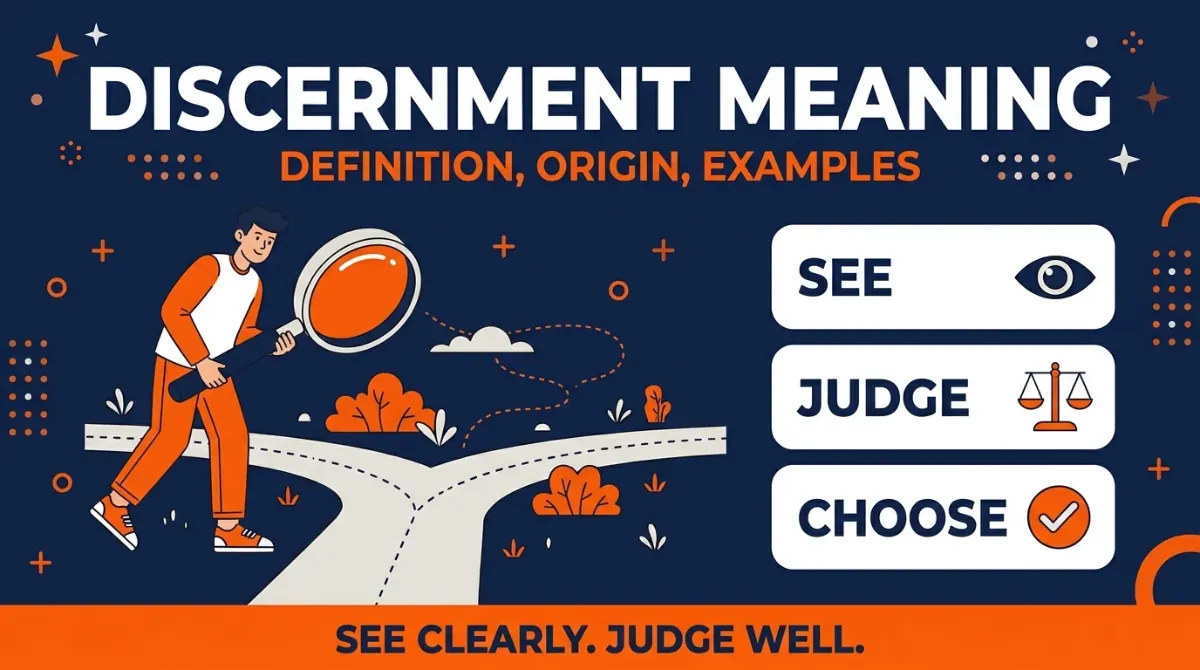
Discernment is the skill of seeing what is hidden or easy to miss and judging it well. It means telling right from wrong, true from false and good from best. A discerning person notices small details and makes sound choices based on them.
The discernment meaning sounds simple, but people use the word in very different settings. A news editor, a pastor and a hiring manager can all talk about discernment. Each means something a little different. This guide covers the dictionary definition, how to say the word, where it comes from and its closest synonyms. It also explains the Bible sense, how Ignatian decision making works and how you can build the skill.
Discernment Meaning at a Glance
| Detail | Answer |
|---|---|
| Part of speech | Noun |
| Pronunciation | di-SURN-ment (stress on the second syllable) |
| Simple meaning | The skill of judging well and seeing what others miss |
| Root | Latin discernere, meaning to separate or distinguish |
| Related verb | Discern |
| Related adjectives | Discerning, discernible |
| Close synonyms | Insight, perception, acumen, good judgment |
| Opposite | Poor judgment, naivety |
| Example | Her discernment helped her spot the scam email. |
The table gives you the short version. The sections below explain each part in more detail.
What Is the Discernment Meaning in Simple Words?
Merriam-Webster gives two senses of discernment:
- The ability to grasp and understand what is hard to see or understand, or skill in judging well.
- An act of perceiving or recognizing something.
Dictionary.com describes it as the ability to tell things apart and judge them accurately.
Think of discernment as clear sight for decisions. You look past the surface. You separate what matters from what does not. Then you choose well. People use the word in three connected ways.
Discernment as Perception
This is the act of noticing. A parent sees that a quiet child is upset, even though the child says nothing. A mechanic hears a faint sound that other drivers ignore. Perception comes first, because you cannot judge what you have not seen.
Discernment as Judgment
This is the act of deciding well once you have noticed. A buyer senses that a deal looks too good to be true and checks the facts. A friend can tell which advice is kind and which advice is only popular. Merriam-Webster’s example sentence, “decisions that require careful discernment,” uses this sense.
Discernment as Taste
This sense fits art, food, music and writing. Merriam-Webster notes that discernment can mean accuracy in reading character or appreciating art. A critic with discernment can tell a skilled painting from a merely pretty one. People often call this a discerning eye or a discerning palate.
How to Pronounce Discernment
Say di-SURN-ment. Saying the word right helps you use the discernment meaning with confidence. The stress falls on the second syllable. The “c” is silent, so the middle sounds like “sern,” not “kern.” Merriam-Webster lists the pronunciation as di-ˈsərn-mənt.
Many people add an extra “s” sound at the start. Others say dis-ER-ment. Both are common slips. Think of the word discern, then add ment.
Where the Discernment Meaning Comes From
The word has a clear path through history.
The Latin Root
Discern comes from the Latin verb discernere. Merriam-Webster traces it to dis, meaning apart, and cernere, meaning to sift or decide. The picture is a farmer sifting grain. You shake out the husks and keep the good seed.
The Path Into English
Discern entered Middle English in the 14th century through French. Discernment came later. It is discern plus the ending ment, and it may follow the Middle French word discernement. Merriam-Webster dates its first English use to 1570. The adjective discerning followed in 1589.
The Discernment Word Family
Several related words share the same root. They often get mixed up, so here is a quick guide.
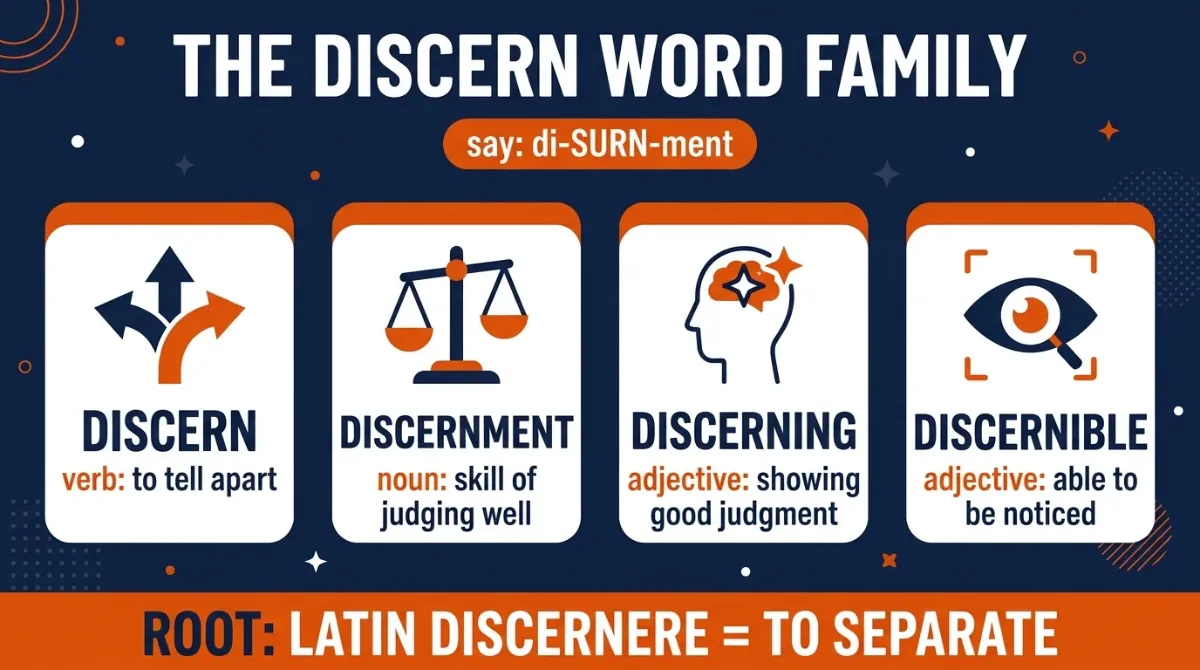
| Word | Part of speech | Meaning | Example |
|---|---|---|---|
| Discern | Verb | To recognize or tell apart | She could discern the truth. |
| Discernment | Noun | The skill of judging well | He showed great discernment. |
| Discerning | Adjective | Having good judgment | A discerning reader checks sources. |
| Discernible | Adjective | Able to be noticed | There was no discernible change. |
| Discernibly | Adverb | In a way that can be noticed | The mood shifted discernibly. |
| Discerningly | Adverb | In a careful, perceptive way | She chose discerningly. |
Merriam-Webster defines discerning as showing insight and understanding, and gives a discerning critic as an example.
Key Characteristics of Discernment
Discernment is not one talent. It is a bundle of habits. Strong discerners tend to share these traits:
- Careful observation. They notice small details before they form an opinion.
- Patience. They pause before they react, especially under pressure.
- Humility. They admit that they may be wrong.
- Curiosity. They ask questions and seek views that differ from their own.
- Honest motives. They check whether fear, pride or a wish to look right is steering them.
- Long term thinking. They weigh later effects, not only quick gains.
- Moral grounding. They measure choices against clear values.
Discernment Meaning in Everyday Life
You do not need a religious setting to use discernment. Here are common American examples.
With News and Online Claims
A reader sees a shocking headline. A discerning reader checks who published it and whether other outlets confirm it. They also look at the date, since old stories often return as if they were new.
In Friendships and Relationships
A discerning person sees which friends give honest advice and which only say what you want to hear. They notice whether someone’s actions match their words over time.
At Work
A hiring manager reviews work samples and asks about the candidate’s reasoning, not just a first impression. Merriam-Webster’s own example fits here: “a lack of discernment in selecting suitable job candidates.”
As a Shopper
A text promises a free prize. A discerning shopper pauses and checks the sender before clicking. They compare prices, read reviews that include complaints and notice when a sale price is not much of a sale.
A Real World Example
Sara, a new graduate, gets two job offers. One pays $8,000 more. The other offers a mentor and a clear path to promotion. She asks each team how often people leave. She talks with a current employee. She learns that the higher paying team has lost half its staff in a year. She takes the second job. Sara did not ignore money. She looked past it to what she could not see at first.
Why Discernment Matters
Good choices rarely come from facts alone. They come from reading the facts well.
In Leadership
Leaders hear many opinions. Discernment helps them tell which advice fits the problem. It also helps them see who is raising a real concern and who is only complaining.
In Parenting and Education
Teachers and parents face the same moment often. A child acts out. A discerning adult asks why before deciding how to respond. The cause may be hunger, fear or a hard assignment.
In Personal Finance
Scams, risky investments and impulse buys all depend on weak discernment. Pausing to ask “who gains if I say yes?” protects savings. Note that this is general guidance, not financial advice.
In Health Decisions
Online health claims vary widely in quality. A discerning reader looks for the source, the evidence and whether the claim comes with a product to sell. For personal medical choices, a qualified doctor remains the best guide.
Discernment Meaning in the Bible
For many Americans, discernment is a faith word first. The discernment meaning in the Bible is the trained ability to tell good from evil and wise from foolish. The Bible Gateway blog calls it a trained ability to judge right from wrong, or good from better and best.
Key Bible Verses on Discernment
These passages come up most often:
- Hebrews 5:14: Mature believers train themselves by constant use to distinguish good from evil.
- Philippians 1:9 and 1:10: Paul prays that love will grow in insight, so readers can discern what is best.
- 1 John 4:1: Believers should test spirits to see whether they come from God.
- 1 Corinthians 12:10: Paul lists “distinguishing between spirits” among the gifts of the Spirit.
The Greek verb often tied to this idea is diakrino. It means to separate or distinguish. The Bible Gateway article compares it to a surgeon’s careful cut between healthy and unhealthy tissue.
The Gift of Discernment
Many churches teach a spiritual gift of discernment. It comes from the 1 Corinthians 12:10 phrase above. The gift is the ability to tell whether a message, a teaching or a prompting is from God or not.
Discernment Without Being Judgmental
The Bible also warns against harsh judging. Matthew 7:1 tells readers not to judge, so they are not judged by the same standard. Bible Gateway explains that discernment lets you be discerning without being discriminatory or judgmental. The focus stays on testing ideas and actions, not on condemning hearts.
Ignatian Discernment: A Faith Based Decision Method
A second religious use comes from Saint Ignatius of Loyola, founder of the Jesuits. Marquette University describes Ignatian discernment as a way to decide by noticing inner feelings, weighing facts and praying. It suits big choices between good options, such as a career, a college or a home.
Consolation and Desolation
Two terms sit at the center:
- Consolation: an inner sense of peace, energy or being drawn toward a path.
- Desolation: an inner sense of restlessness, emptiness or distaste.
The Jesuits add that consolation moves a person toward faith, hope and love, while desolation pulls the other way. They note that neither is only about feeling good or bad.
The Three Times of Decision
Marquette outlines three situations:
- Clarity: One option feels clearly right.
- Mixed feelings: You swing between certainty and doubt.
- Calm with no pull: You list pros and cons. You can also picture how an outsider would see the choice.
Ignatius built these ideas from his own experience. While recovering from a cannonball injury, he noticed how different daydreams affected his heart.
Discernment Outside Religion
Non religious people use the same core steps. They slow down, gather facts, check their motives and test a choice before they commit. The faith language differs. The habit is the same.
Discernment Meaning in Psychology and Decision Making
Psychology explains why discernment is hard. The mind favors fast shortcuts. One strong shortcut is confirmation bias. Britannica defines it as the tendency to look for or read information in a way that agrees with what you already believe. It is mostly unintentional, and it grows stronger when an issue matters to you.
Discernment works against this pull. A discerning person asks, “What would change my mind?” They look for evidence on both sides. Britannica notes that emotional distance helps people weigh more than one view. Writing down the best argument against your plan is a simple way to create that distance.
Signs of a Discerning Person
You can often spot discernment in how a person acts. Look for these habits:
- They notice small details others skip.
- They ask questions before they decide.
- They weigh long term effects, not only quick gains.
- They can disagree without insulting people.
- They change their mind when new facts appear.
- They resist pressure from trends and loud opinions.
Discernment in Literature and Formal Writing
Writers use the discernment meaning to praise careful judgment. Merriam-Webster lists examples such as “a discerning critic” and “gifts for people with discerning tastes.” The word has a formal, slightly elevated tone. It fits essays, reviews, reports and speeches well.
In casual chat, plain words often work better. “Good judgment,” “a good eye” and “common sense” feel more natural. Use discernment when you want to stress careful, thoughtful seeing, not just a quick opinion.
Discernment in a Sentence
Seeing the word in context helps it stick.
| Context | Example sentence |
|---|---|
| News | The editor showed discernment when she questioned the unnamed source. |
| Education | Choosing a college takes discernment, not just rankings. |
| Money | His lack of discernment cost him thousands in a bad investment. |
| Faith | She prayed for discernment before accepting the new job. |
| Law | The judge praised the jury for its careful discernment. |
| Reading | A discerning reader checks the facts before sharing a story. |
| Data | There was no discernible difference between the two samples. |
| Sports | Good coaches have the discernment to spot talent early. |
Discernment Synonyms and Antonyms
Writers often swap discernment with other words. They are not exact matches. Merriam-Webster separates them by what each one stresses.
| Word | What it emphasizes |
|---|---|
| Discernment | Accuracy, such as reading character or motives |
| Discrimination | Choosing what is true, fitting or excellent |
| Perception | Quick insight, often into feelings |
| Penetration | A probing mind that looks past the surface |
| Insight | Deep discernment joined with understanding |
| Acumen | Sharp judgment with practical skill |
Dictionary.com also lists perspicacity and judgment as synonyms.
Merriam-Webster does not list antonyms. Common opposites in everyday use include poor judgment, naivety, gullibility and thoughtlessness. These show up in sentences like “a lack of discernment.”
Discernment vs Judgment
People often confuse these two. They overlap, but they are not the same.
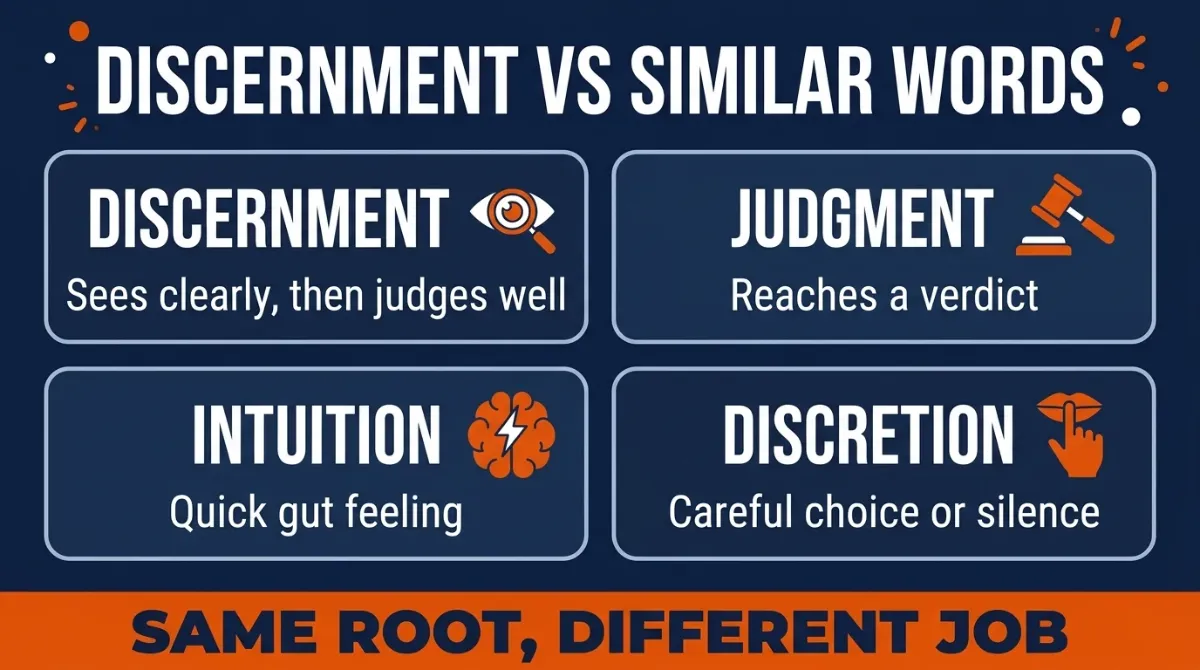
| Point | Discernment | Judgment |
|---|---|---|
| Approach | Considers all sides before deciding | Reaches a verdict, sometimes fast |
| Goal | Understanding and fairness | A decision or evaluation |
| Common risk | Overthinking | Bias or snap conclusions |
| Effect on trust | Tends to build it | Can strain it |
Here is an easy example. A manager asks the team what caused a late project before deciding who is at fault. That is discernment. A manager who blames one worker without asking is judging.
Good judgment is part of discernment. Merriam-Webster even uses the phrase skill in judging well. The difference is the care taken before the verdict.
Discernment vs Discrimination
Discrimination has two very different meanings. Merriam-Webster lists the first as treating people differently based on a category such as race, religion or gender. It lists a second sense as the quality of distinguishing finely, as in “a fastidious discrimination in her general tastes.”
| Point | Discernment | Discrimination |
|---|---|---|
| Modern tone | Positive | Usually negative |
| Most common use | Good judgment and insight | Unfair treatment of a group |
| Safe in a job reference? | Yes | Only with great care |
Use discernment when you mean good judgment. It carries no risk of confusion.
Discernment vs Intuition
Intuition is a gut feeling. Discernment uses that feeling but checks it. Notice your gut, then test it against reason, since instincts can carry bias. A discerning person listens to instinct and still asks for evidence.
| Point | Discernment | Intuition |
|---|---|---|
| Speed | Slower, deliberate | Instant |
| Basis | Facts plus instinct plus values | Pattern recognition and feeling |
| Reliability | Improves with practice | Strong in familiar areas, weak in new ones |
Discernment vs Wisdom
Wisdom is the deeper source. A Cal Poly housing guide says discernment rests on wisdom, understanding and a commitment to truth. Wisdom is the knowledge you build over time. Discernment is how you apply it to a specific choice.
Discernment vs Discretion
These two sound alike and both involve good judgment. Merriam-Webster defines discretion as good judgment, or cautious reserve about sharing information. It also means the freedom to decide, as in “I leave it to your discretion.”
| Point | Discernment | Discretion |
|---|---|---|
| Focus | Seeing and understanding clearly | Choosing carefully or staying quiet |
| Typical use | Discernment to spot a scam | Discretion to keep a secret |
| Link | You use discernment to see | You use discretion to act |
Both words come from the same Latin root. A person may show discernment in noticing a problem and discretion in how they handle it.
Discernment or Descernment: A Spelling Trap
The correct spelling is discernment. Knowing the discernment meaning is easier when you spell the word right. It starts with dis, not des. The spelling “descernment” is a common typo, and spell checkers may not always catch it.
A quick memory trick helps. Discernment shares its start with discern, discount and distinguish. Each of these also begins with dis.
How to Use Discernment Correctly in a Sentence
Follow these steps for clean, natural use.
- Confirm that a noun fits. Discernment names a skill. Do not use it as a verb. Say “she used discernment,” not “she discernment.”
- Pair it with the right verb. Common choices are show, use, exercise, lack, develop and require.
- Choose the right preposition. Use discernment in, about or between. For example, “discernment between fact and rumor.”
- Match the register. It is formal. Save it for writing and speeches where a careful tone fits.
- Check the adjective form. Use discerning for people and tastes. Use discernible for things that can be seen or noticed.
How to Develop Discernment
Discernment is a skill, so it grows with practice. These steps pull together advice from Cal Poly, the Jesuits and Bible Gateway.

- Know your values. Reflect on what you believe and what past mistakes taught you.
- Slow down. Pause before you react, especially when you feel pressure.
- Gather facts. Read, listen and talk with people who disagree with you.
- Listen first. Understand another person’s view before you judge it.
- Check your gut. Notice your instincts, then test them against reason.
- Ask for counsel. Seek trusted, mature people, then make the final call yourself.
- Examine your motives. Ask whether pride, fear or a wish to look right is driving you.
- Test the choice. Live as if you have decided before you commit, as the Jesuits suggest.
- Learn from errors. Review what went wrong without harsh self blame.
Bible Gateway adds that repeated experience builds the skill, much like a surgeon improves through repetition.
A One Week Practice Plan
Small daily habits work better than big promises.
| Day | Habit |
|---|---|
| Monday | Before you share a post, check the source. |
| Tuesday | Ask one extra question in a meeting or class. |
| Wednesday | Write the best argument against your current opinion. |
| Thursday | Sit on a purchase for 24 hours. |
| Friday | Listen to a person you disagree with, without replying. |
| Saturday | List three choices you made this week and why. |
| Sunday | Review what worked and what you would change. |
Five Questions to Ask Before a Big Choice
- What facts do I still not know?
- Who gains if I say yes?
- What would a wise friend say?
- How will I feel about this in a year?
- What is the cost of waiting?
Common Mistakes About Discernment
| Mistake | Better approach |
|---|---|
| Treating it as the same as judging | Gather facts and listen before deciding |
| Trusting gut feeling alone | Test instinct against evidence |
| Making snap calls | Pause and weigh options |
| Using Scripture as a quick slogan | Apply it thoughtfully to your own heart |
| Confusing it with discrimination | Remember that discernment means good judgment, not unfair treatment |
| Using it as a verb | Use the verb discern instead |
| Writing “descernment” | Spell it with dis at the start |
| Expecting it to be instant | Build it with repeated practice |
Discernment Meaning Quick Practice
Pick the best word, then check the answers.
- A manager who listens to all sides before deciding shows ___. (discernment or discrimination)
- A change you can barely notice is ___. (discernible or discerning)
- To tell two things apart is to ___ them. (discern or discount)
- A reader who checks sources is ___. (discerning or discernible)
- The correct spelling is ___. (discernment or descernment)
- A person who keeps a secret shows ___. (discretion or discernment)
Answers: 1. discernment. 2. discernible. 3. discern. 4. discerning. 5. discernment. 6. discretion.
Frequently Asked Questions
Key Takeaways
- Discernment is the skill of seeing clearly and judging well.
- Say it di-SURN-ment, and spell it with dis at the start.
- It comes from the Latin discernere, meaning to sift or separate.
- The discernment meaning works as perception, judgment and taste.
- It differs from judgment, discrimination, intuition and discretion.
- The Bible sense centers on telling good from evil, and Ignatian discernment adds a prayerful decision method.
- Confirmation bias is its main enemy, and curiosity is its best tool.
- Anyone can build it with slow, honest, repeated practice.
Final Thoughts
Discernment is the quiet skill behind good choices. It starts with noticing and ends with wise action. Learn the discernment meaning, use the word with care and practice the habits above. Over time, you will see more, judge better and choose with confidence.