Less Than and Greater Than Symbols: Meaning, Examples and Easy Tricks
Quick answer
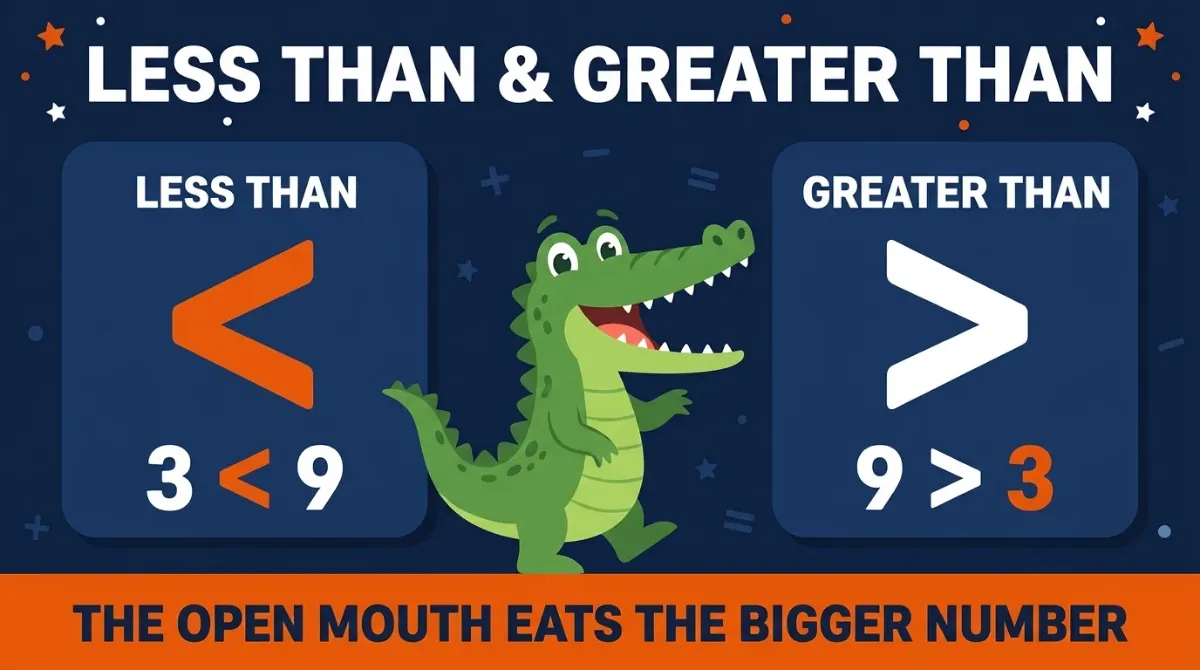
The symbol > means greater than, and < means less than. The open side always faces the larger number. The point always faces the smaller number. So 8 > 5 reads “eight is greater than five,” and 5 < 8 reads “five is less than eight.”
Most people learn less than and greater than in early grade school. Then the symbols return in algebra, spreadsheets and code. They look alike, so they are easy to flip by mistake. This guide shows what each symbol means, how to remember it and how to compare any kind of number. You will also see real examples with answers, how inequalities work and how to type each sign.
What Do Less Than and Greater Than Mean?
These two signs compare values. They tell you which number is bigger, which is smaller or whether they match. Teachers call them inequality symbols.
Less Than (<)
Less than means the first value is smaller than the second. Math Is Fun shows that 7 < 9 reads “seven is less than nine.” The point of the symbol faces the 7.
Everyday words for this sign include fewer than, below, under and smaller than.
Greater Than (>)
Greater than means the first value is larger than the second. The same site shows that 5 > 2 reads “five is greater than two.” The open end of the symbol faces the 5.
You may also hear more than, above, over or bigger than. All describe the same comparison.
Equal To (=) and Not Equal To (≠)
Equal to means both sides have the same value, as in 6 = 6. Not equal to means the sides differ, as in 6 ≠ 8. These two signs complete the set of comparison symbols in school math.
Quick Comparison Examples
| Expression | How to read it | True or false? |
|---|---|---|
| 12 > 9 | Twelve is greater than nine | True |
| 4 < 15 | Four is less than fifteen | True |
| 20 = 20 | Twenty equals twenty | True |
| 3 > 8 | Three is greater than eight | False |
| 50 < 30 | Fifty is less than thirty | False |
Less Than vs Greater Than: Key Differences
The two signs are mirror images. They carry opposite meanings, but they use the same logic.
| Point | Less than (<) | Greater than (>) |
|---|---|---|
| Meaning | First value is smaller | First value is larger |
| Open side faces | The second number | The first number |
| Point faces | The first number | The second number |
| Also means | Fewer, below, under | More, above, over |
| Example | 6 < 11 | 11 > 6 |
When to Use Each Symbol
Use less than when the left side is smaller. Use greater than when the left side is larger. You can always flip a statement by swapping the numbers and the symbol. So 11 > 6 and 6 < 11 say the same thing.
Less Than and Greater Than Symbols Chart
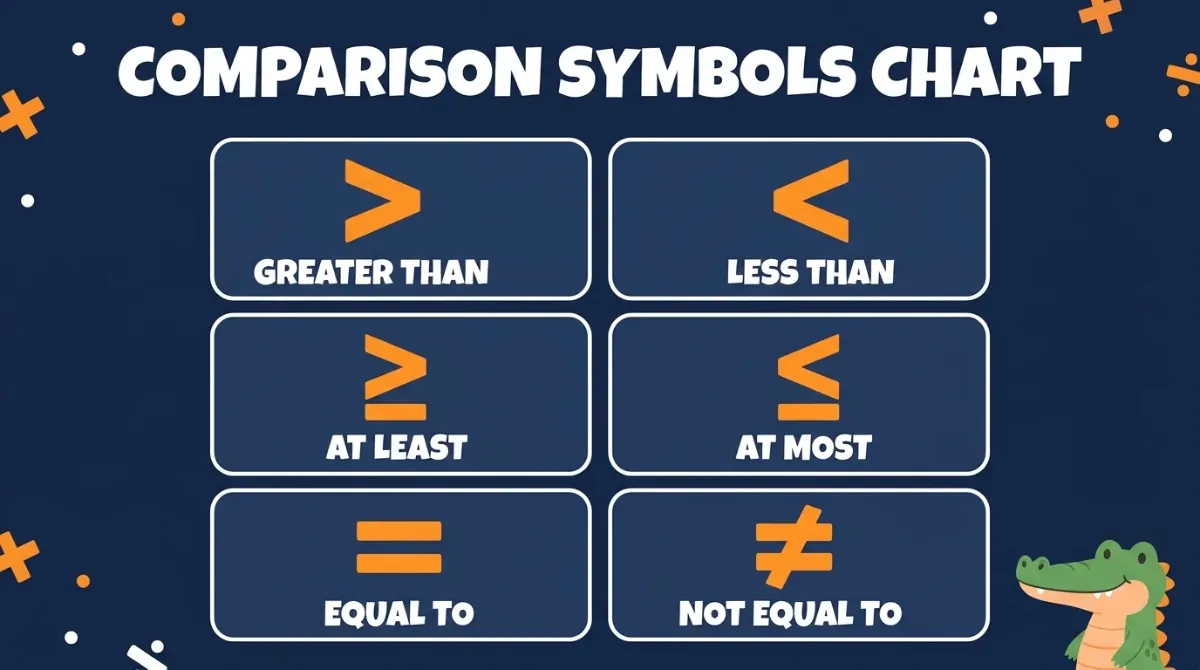
Keep this chart close when you study. It lists every comparison sign you will meet in school.
| Symbol | Name | How to read it | Example |
|---|---|---|---|
| > | Greater than | Is greater than | 9 > 4 |
| < | Less than | Is less than | 4 < 9 |
| ≥ | Greater than or equal to | Is at least | x ≥ 10 |
| ≤ | Less than or equal to | Is at most | x ≤ 10 |
| = | Equal to | Is the same as | 6 = 6 |
| ≠ | Not equal to | Is different from | 6 ≠ 8 |
Greater Than or Equal To and Less Than or Equal To
Sometimes a value can be bigger or the same. For that, you add a line under the symbol.
- ≥ means greater than or equal to. Example: x ≥ 7 means x is 7 or more.
- ≤ means less than or equal to. Example: x ≤ 3 means x is 3 or less.
Words That Match Each Symbol
Word problems use many phrases for these signs. The table below follows a guide from Helping With Math.
| Symbol | Common phrases |
|---|---|
| > | greater than, more than, above, over |
| < | less than, fewer than, below, under |
| ≥ | at least, no less than, minimum, or more |
| ≤ | at most, no more than, maximum, or less |
An example helps. A ride sign that says “riders must be at least 48 inches tall” means height ≥ 48. A sign that says “no more than 5 guests” means guests ≤ 5.
Easy Tricks to Remember Less Than and Greater Than
Many students flip the symbols by mistake. A simple memory trick fixes that. Pick the one that feels natural.
The Alligator Method
Picture the symbol as a hungry alligator mouth. The alligator always opens wide toward the bigger number, because it wants the bigger meal. Mathnasium explains that the mouth faces the larger value no matter which way the symbol points.
- 8 > 3: the mouth opens toward 8.
- 3 < 8: the mouth still opens toward 8.
Wide End Big, Point Small
The pointed end aims at the smaller value. The wide end faces the larger value. Think of an arrow that points to the little number.
The Letter L Trick
The less than sign < looks like a tilted letter L. The word less starts with L. If you can draw an L from the symbol, you have less than.
The Number Line Trick
Numbers grow as you move right on a number line. The sign opens toward the number farther right. It points to the number farther left.
Read Left to Right
Say the comparison out loud. In 12 > 5, you say “twelve is greater than five.” If the sentence is true, the symbol is right.
How to Compare Numbers Step by Step
The symbols are simple. The harder part is deciding which number is bigger. Follow these three steps for any pair.
- Compare the digits. Start at the left and look at the first digit that differs.
- Check place value. Make sure you are comparing the same places, such as tens with tens.
- Choose the symbol. Open the sign toward the larger number.
Whole Numbers
Compare from the left, starting with the highest place value. For 4,825 and 4,792, both have 4 thousands. Then 8 hundreds beats 7 hundreds. So 4,825 > 4,792.
Decimals
Line up the decimal points and compare place by place. Add zeros if it helps. For 0.7 and 0.07, write 0.70 and 0.07. Seven tenths beats seven hundredths, so 0.7 > 0.07. Length does not matter. Place value does.
Fractions
Use a common denominator, or turn each fraction into a decimal. For 3/4 and 1/2, rewrite 1/2 as 2/4. Since 3/4 is more than 2/4, 3/4 > 1/2.
Percentages
Percentages compare like whole numbers, because they share the same base of 100. So 35% < 53%, and 90% > 9%.
Negative Numbers
Negative numbers feel backward. The number farther from zero on the negative side is smaller. The Common Core standards use this idea. They say negative 3 is greater than negative 7 because it sits farther right on a number line.
A real example makes it clear. Negative 3 degrees is warmer than negative 7 degrees. So negative 3 > negative 7.
Money
Compare dollar amounts the same way. A $110 jacket costs more than a $70 jacket, so $110 > $70. Line up the cents when you compare $12.50 and $12.05. Fifty cents beats five cents, so $12.50 > $12.05.
Less Than and Greater Than on a Number Line
A number line shows inequalities as a picture. Helping With Math describes the standard markings:
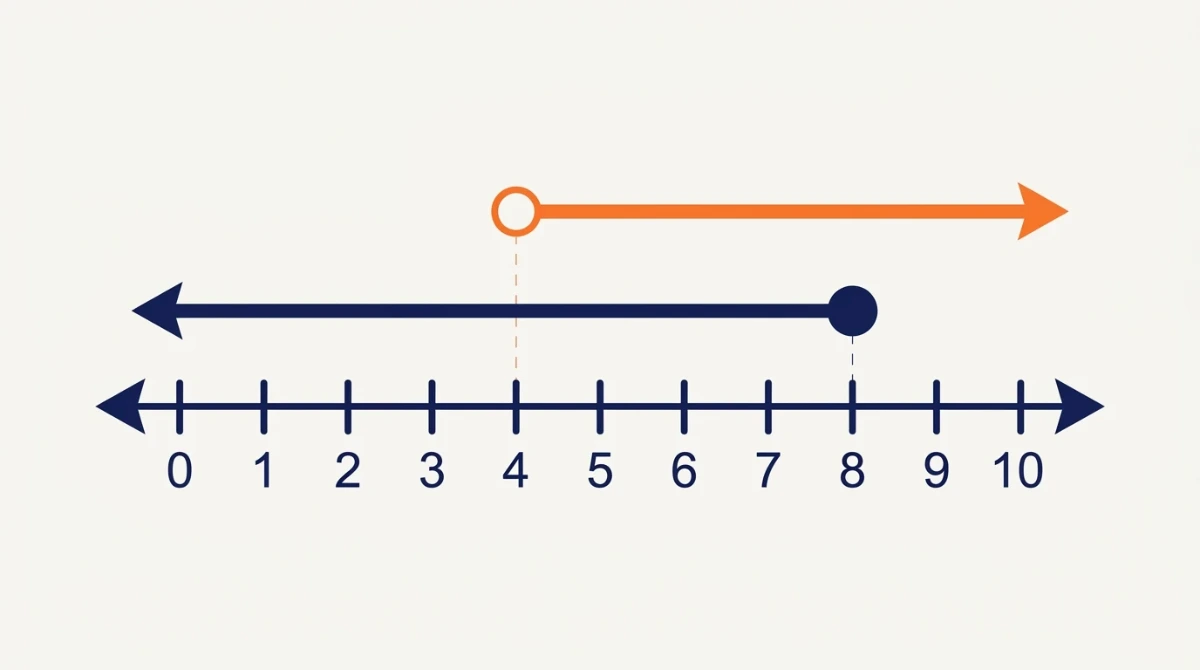
- > (greater than): open circle, shade to the right.
- < (less than): open circle, shade to the left.
- ≥ (at least): closed circle, shade to the right.
- ≤ (at most): closed circle, shade to the left.
An open circle means the endpoint is not included. A closed circle means it is included. For x ≥ 7, place a closed dot on 7 and shade everything to its right.
Less Than and Greater Than Examples With Answers
Practice makes the symbols automatic. Start with the easy set and work up.
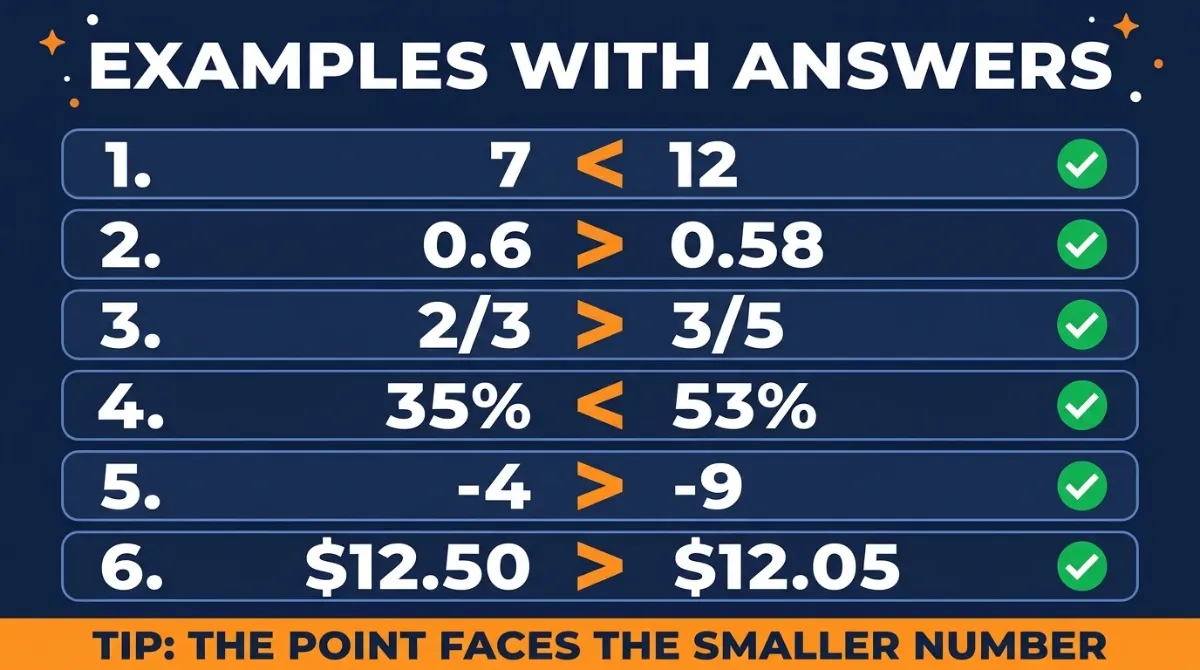
Beginner Examples
| Compare | Answer | Read it as |
|---|---|---|
| 5 and 8 | 5 < 8 | Five is less than eight |
| 12 and 9 | 12 > 9 | Twelve is greater than nine |
| 20 and 20 | 20 = 20 | Twenty equals twenty |
| 31 and 13 | 31 > 13 | Thirty one is greater than thirteen |
| 100 and 99 | 100 > 99 | One hundred is greater than ninety nine |
| 0 and 6 | 0 < 6 | Zero is less than six |
Intermediate Examples
| Compare | Answer | Why |
|---|---|---|
| 0.6 and 0.58 | 0.6 > 0.58 | 0.60 is more than 0.58 |
| 2/3 and 3/5 | 2/3 > 3/5 | About 0.67 is more than 0.60 |
| 35% and 53% | 35% < 53% | 35 is less than 53 |
| Negative 4 and negative 9 | Negative 4 > negative 9 | Negative 4 sits farther right |
| $12.50 and $12.05 | $12.50 > $12.05 | Fifty cents beats five cents |
| 1,250 and 1,205 | 1,250 > 1,205 | 5 tens beats 0 tens |
Practice Questions
Fill in each blank with >, < or =.
- 14 ___ 41
- 87 ___ 78
- 0.3 ___ 0.30
- 3/8 ___ 1/2
- 60% ___ 6%
- Negative 2 ___ negative 11
- $5.99 ___ $6.01
- 2,000 ___ 1,999
- A pool requires swimmers to be at least 10 years old. Write the rule for age a.
- Solve: x + 3 < 8
Answer Key
- 14 < 41
- 87 > 78
- 0.3 = 0.30 (a trailing zero changes nothing)
- 3/8 < 1/2 (3/8 is 0.375)
- 60% > 6%
- Negative 2 > negative 11
- $5.99 < $6.01
- 2,000 > 1,999
- a ≥ 10
- x < 5
Real Life Uses of Less Than and Greater Than
You use these ideas all day, often without writing a symbol.
Shopping Prices
A store brand cereal costs $3.49 and the name brand costs $4.29. Since $3.49 < $4.29, the store brand is cheaper. Unit prices work the same way.
Exam Scores
A class needs 70 or more to pass. A student scored 82. Since 82 ≥ 70, the student passes. A score of 69 fails because 69 < 70.
Sports Statistics
A team that scores 27 points beats a team that scores 24, because 27 > 24. Standings, batting averages and race times all rely on comparisons.
Budgeting and Finance
A family plans to spend no more than $400 on groceries. After a $385 trip, 385 ≤ 400, so they stay on budget. A $410 bill would break the rule because 410 > 400.
Age and Height Limits
Many rides, programs and jobs set limits. A ride might require height ≥ 48 inches. A child discount might apply only when age < 12.
Weather and Temperature
Forecasts compare numbers constantly. A high of 85 degrees is greater than a high of 78. A freeze warning means the low is at or below 32 degrees, or low ≤ 32.
Word Problem Phrases That Trip People Up
Careful reading matters. A few phrases cause the most errors.
| Phrase | Math meaning |
|---|---|
| x is greater than 7 | x > 7 |
| x is at least 7 | x ≥ 7 |
| x is at most 7 | x ≤ 7 |
| x is less than 7 | x < 7 |
| x more than 7 | x + 7 |
The last row is a trap. Helping With Math warns that “x more than 7” means addition, while “x is greater than 7” means a comparison. Look for the word is. It signals an inequality.
Less Than and Greater Than in Algebra
An inequality is a math statement that uses a comparison symbol with a variable. You solve it like an equation. You isolate the variable. One rule is different, though.
Basic Inequalities
Here are three simple forms:
- x > 4 means x can be any number larger than 4.
- x ≤ 9 means x can be 9 or any smaller number.
- 2 < x < 6 means x sits between 2 and 6.
Rules for Solving Inequalities
Math Is Fun lists the key rules:
- Adding or subtracting the same number on both sides keeps the symbol.
- Multiplying or dividing by a positive number keeps the symbol.
- Multiplying or dividing by a negative number flips the symbol.
- Swapping the two sides also flips the symbol.
Solved Examples
- x + 2 > 12. Subtract 2 from both sides. The answer is x > 10.
- 3y < 15. Divide by positive 3. The answer is y < 5.
- Negative 2y < negative 8. Divide by negative 2 and flip the symbol. The answer is y > 4.
Why the Symbol Flips
Test it with numbers. We know 2 < 5. Multiply both sides by negative 1. You get negative 2 and negative 5. Negative 2 is actually greater than negative 5. The order reverses, so the symbol must flip.
Graphing Inequalities
Draw the answer on a number line using the markings above. For x > 4, put an open circle on 4 and shade right. For x ≤ 9, put a closed circle on 9 and shade left.
Less Than and Greater Than in Programming and Spreadsheets
Computers use the same ideas with plain keyboard characters. Most languages share these comparison operators.
| Operator | Meaning | Example |
|---|---|---|
| < | Less than | a < b |
| > | Greater than | a > b |
| <= | Less than or equal to | a <= b |
| >= | Greater than or equal to | a >= b |
| == | Equal to | a == b |
| != | Not equal to | a != b |
Here is a short Python example:
score = 85
if score >= 70:
    print("Pass")
Spreadsheet Planet notes that Excel does not read the ≤ and ≥ glyphs as operators. Type two characters instead. The formula =IF(A1>=10,”Pass”,”Fail”) returns Pass when A1 is 10 or more.
How to Type the Symbols
You can type < and > on any keyboard. The “or equal to” signs take a little more work.
| Symbol | Windows | Mac | Web code |
|---|---|---|---|
| < | Shift + comma | Shift + comma | < |
| > | Shift + period | Shift + period | > |
| ≤ | Alt + 243 | Option + comma | ≤ |
| ≥ | Alt + 242 | Option + period | ≥ |
On Windows, turn on Num Lock and use the number pad for the Alt codes. In Word, you can also type 2264 and press Alt + X to get ≤. In Google Docs, use Insert, then Special characters.
When US Students Learn This
American schools introduce comparing numbers early. The Common Core State Standards, used in most states, set the path.
| Grade | What students learn |
|---|---|
| Kindergarten | Compare groups and compare written numbers from 1 to 10 |
| Grade 1 | Compare two digit numbers and record results with >, = and < |
| Grade 2 | Compare three digit numbers using place value and the symbols |
| Grade 6 | Order rational numbers and read inequality statements on a number line |
Kindergarten work focuses on groups of up to ten objects. Students match and count before they learn any symbol. Grades 1 and 2 add place value. Grade 6 adds negative numbers and number line reasoning.
Where the Symbols Came From
The symbols have a short but interesting history. The MacTutor history of mathematics archive credits the English mathematician Thomas Harriot with both signs. They appeared in his book Artis Analyticae Praxis, published in 1631 after his death. Some historians argue that Harriot did not write the published version. They say his own manuscripts do not use these signs.
The “or equal to” symbols came later. The French scientist Pierre Bouguer used versions with two bars under the signs in 1734. John Wallis had used similar signs with a single bar above them in 1670.
Common Mistakes and How to Avoid Them
| Mistake | Fix |
|---|---|
| Pointing the symbol at the bigger number | The point faces the smaller number |
| Mixing up at least and at most | At least is ≥. At most is ≤. |
| Reading “more than” as “greater than” in word problems | Look for the word is before choosing a symbol |
| Forgetting to flip the sign with a negative | Flip when multiplying or dividing by a negative |
| Thinking more digits means bigger | Compare place value, especially with decimals |
| Thinking negative 9 is greater than negative 2 | The number closer to zero is greater |
| Confusing ≤ with < | ≤ allows equal values, but < does not |
Tips for Parents and Teachers
Children learn these symbols best through real comparisons. Mathnasium suggests a few steps.
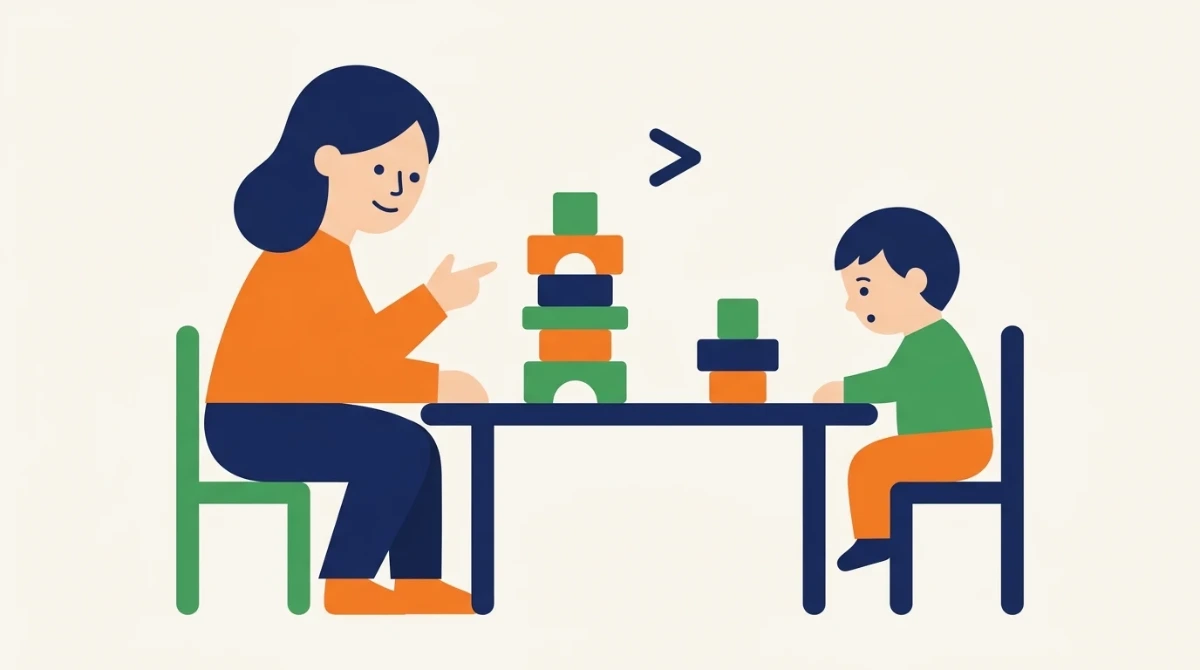
- Compare objects first. Use grapes, blocks or coins. Let the child see which group has more.
- Introduce the symbol after. The sign should describe a comparison the child already made.
- Move to written numbers. Have the child draw the symbol between two numbers.
- Swap and check. Reverse the numbers and ask whether the symbol should change.
- Keep sessions short. Calm practice works better than rushed worksheets.
Everyday practice also helps. Compare snack portions, game scores or the cost of two items at the store.
Frequently Asked Questions
Final Thoughts
Less than and greater than are small symbols with a big job. Remember one rule and the rest follows. The open side faces the larger number, and the point faces the smaller one. Use the alligator or the L trick when you feel unsure. Then practice with prices, scores and temperatures until the symbols feel automatic.