

Canceled or Cancelled: Which Spelling Is Correct? (US vs UK Guide)

Quick answer
Both spellings are correct. Use canceled (one L) in American English. Use cancelled (two Ls) in British, Canadian and Australian English. The noun is cancellation with two Ls in almost every case. Pick one style for your audience and stay consistent.
Few spelling questions come up as often as canceled or cancelled. You see both on flight boards, subscription pages and TV news. It is easy to wonder which one is a typo. Neither is. This guide explains where each spelling comes from, who uses it and how to choose.
Canceled vs Cancelled at a Glance
| Word form | American English | British English |
|---|---|---|
| Past tense | canceled | cancelled |
| Present participle | canceling | cancelling |
| Person who cancels | canceler | canceller |
| Adjective | cancelable | cancellable |
| Noun | cancellation | cancellation |
| Example | The flight was canceled. | The flight was cancelled. |
The noun is the only row that matches. Merriam-Webster lists cancellation as the main entry and cancelation as the less common variant.
Which Spelling Should You Use?
The right choice depends on who will read your writing. Neither form is more formal or more correct than the other. They are regional habits, not grammar errors.
American English: Canceled
In the United States, canceled and canceling are the usual forms. The Merriam-Webster dictionary entry gives these as the American spellings. The AP Stylebook, which many US newsrooms follow, also prefers canceled.
Use one L when you write for American readers. That covers US websites, school papers, business email and most US media.
British, Canadian and Australian English: Cancelled
In the United Kingdom, cancelled and cancelling are standard. Australia follows the same pattern. Canada is a little more mixed. Canadian writers lean toward two Ls, but you will see both forms in print.
Merriam-Webster also notes that both spellings appear in both countries. Using the less common form is not a mistake. It may just look unusual to local readers.
Writing for an International Audience
Many sites serve readers from several countries. In that case, choose one variety and use it everywhere. Mixing canceled and cancelled in one document can look careless, even though each word is correct.
Three quick habits help:
- Match the spelling to your largest audience.
- Follow your company or publication style guide if you have one.
- Set the proofing language in Word, Google Docs or your CMS so the spell checker flags the wrong variant.
Why the Spellings Differ
The split comes down to one small rule and a long history.
The Final Consonant Doubling Rule
English often doubles a final consonant before endings like ed and ing. The doubling happens when the last syllable is stressed and the vowel is short. Merriam-Webster uses these examples:
- Remit becomes remitted and remitting. The stress falls on the last syllable, so the t doubles.
- Edit becomes edited and editing. The stress falls on the first syllable, so the t stays single.
Both American and British English follow this rule for most words.
Why Cancel Breaks the Pattern
Cancel is stressed on the first syllable: CAN-sul. By the rule above, it should not double. American English follows that logic and writes canceled.
British English usually doubles a final L anyway. Dictionary.com explains that British, Australian, Canadian and Irish English almost always double a final L before an ending. That is why cancel becomes cancelled, cancelling and cancellation.
Noah Webster and the History
Many people blame Noah Webster for the American spelling. The story is a bit more complex.
British spellings largely follow Samuel Johnson’s 1755 dictionary. Webster’s 1828 American dictionary promoted simpler spellings, including a single L in words like this one. Merriam-Webster points out that Webster mostly recorded variation that already existed. His 1806 dictionary listed cancelled. His 1828 dictionary listed canceled.
American usage also took time to settle. Grammarly notes that one L did not fully replace two Ls in American writing until around the 1980s.
Google Books data points the same way. In recent American books, canceled appears about one and a half times as often as cancelled. In British books, cancelled leads by roughly four to one.
Canceling or Cancelling?
The present participle follows the past tense. American English writes canceling. British English writes cancelling.
- American: We are canceling the meeting.
- British: We are cancelling the meeting.
Choose the same variety for every form of the verb. If you write canceled in one sentence, write canceling in the next. A mix such as “canceled” with “cancelling” looks inconsistent.
Cancellation or Cancelation?
Cancellation is the safe choice everywhere. Merriam-Webster lists it as the main spelling, with cancelation as a less common variant. The word dates back to 1535 in English.
This is the one form where American writers usually keep both Ls. The AP Stylebook also uses cancellation. So even if you write canceled, you can still write cancellation.
- Correct everywhere: The cancellation fee is $25.
- Rare and best avoided: The cancelation fee is $25.
Cancelation is not wrong. It is just uncommon, and many readers will think it is a typo. Use two Ls and you avoid the problem.
Related Word Forms
A few cousins of cancel share the same split. Dictionary.com lists them together.
- Canceler or canceller: the person or thing that cancels.
- Cancelable or cancellable: able to be canceled. You often see this on booking pages, as in “free cancelable rate.”
- Uncanceled or uncancelled: not yet canceled.
The same rule applies. American writers use one L. British writers use two. Merriam-Webster accepts both.
Other Words That Follow the Same Pattern
Cancel is not alone. Many verbs that end in an unstressed el, al or il show the same split. Dictionary.com gives these examples.
| Base word | American English | British English |
|---|---|---|
| Travel | traveled, traveling, traveler | travelled, travelling, traveller |
| Label | labeled, labeling | labelled, labelling |
| Model | modeled, modeling | modelled, modelling |
| Counsel | counseled, counselor | counselled, counsellor |
| Fuel | fueled, fueling | fuelled, fuelling |
| Signal | signaled, signaling | signalled, signalling |
| Marvel | marveled, marveling | marvelled, marvelling |
| Quarrel | quarreled, quarreling | quarrelled, quarrelling |
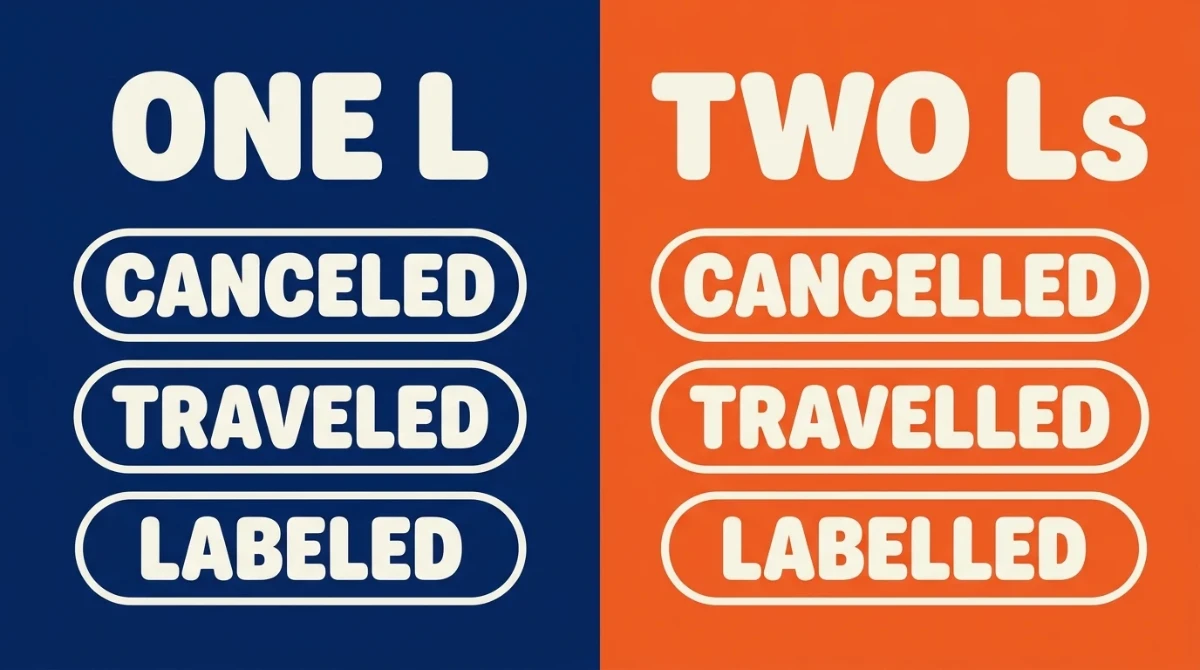
Learn the pattern once and you can predict all of them. If you write traveled, you should also write canceled.
Not every word splits. When the stress falls on the last syllable, both varieties double the L. Compel gives compelled and compelling. Rebel gives rebelled and rebelling. No regional difference applies to those.
What Does Cancel Mean?
Knowing the meaning helps you use the word with confidence. Merriam-Webster lists several senses.
- Call off: to decide not to hold a planned event, such as a concert or a flight.
- Annul: to end the force of something, such as a contract, a subscription or an order.
- Offset: to balance something out, as in “the gains cancel the losses.”
- Mark as used: to deface a stamp or ticket so no one can reuse it.
- Mathematics: to remove a common factor from a fraction or equal terms from both sides of an equation.
- Withdraw public support: to publicly turn away from a person or company, a sense now linked to social media.
Where the Word Comes From
Cancel entered Middle English in the 14th century as cancellen, from Anglo-French canceller. It traces back to Late Latin cancellare, meaning to make like a lattice. The image is crossing something out with lines until it looks like a grid. That explains why the word means to strike something out of force.
What About Cancel Culture?
The newest sense is the social media one. To cancel someone means to publicly withdraw support. The spelling rules do not change. American writers say “the show was canceled.” British writers say “the show was cancelled.” Both apply to a TV series, an event or a public figure.
Canceled or Cancelled in Everyday Writing
Here is how the spelling looks in common situations.
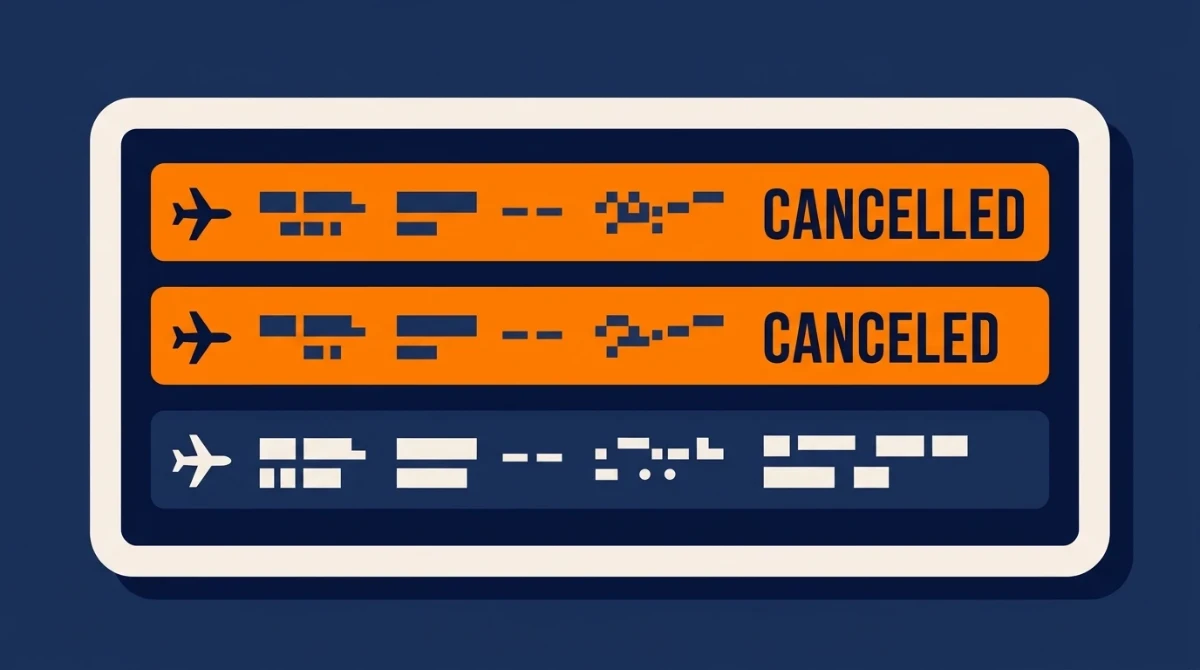
| Situation | American | British |
|---|---|---|
| Flight | Our flight was canceled. | Our flight was cancelled. |
| Subscription | I canceled my plan. | I cancelled my plan. |
| Appointment | The dentist canceled my visit. | The dentist cancelled my visit. |
| TV show | The network canceled the series. | The channel cancelled the series. |
| Order | She is canceling the order. | She is cancelling the order. |
| Fee | A cancellation fee applies. | A cancellation fee applies. |
Notice the last row. Whichever variety you choose, the noun stays the same.
Common Mistakes With Canceled and Cancelled
| Mistake | Fix | Why |
|---|---|---|
| Canceled in a British document | Cancelled | Match your audience |
| Cancelation in a formal letter | Cancellation | The standard noun |
| Canceling and cancelled in one text | Canceling and canceled | Keep one variety |
| Treating one spelling as a typo | Accept both | Each is correct in its region |
| Cancelling with American style guides | Canceling | AP prefers one L |
The biggest error is not using the wrong spelling. It is mixing the two in the same piece.
How to Remember Canceled vs Cancelled
You do not need a hard rule. These memory tricks help.
- Shorter is American. American English tends to use the shorter spelling, as in color and center. Canceled has one L.
- Longer is British. British English keeps the longer form. Cancelled has two Ls.
- Think of travel. If you write traveled in the US, write canceled. If you write travelled in the UK, write cancelled.
- Keep the noun fixed. Cancellation always works. Just double the L.
Canceled or Cancelled Quick Practice
Pick the correct spelling for an American reader, then check the answers.
- The airline ___ all morning flights. (one L or two Ls)
- Please ask about the ___ policy. (cancellation or cancelation)
- She is ___ her gym membership. (canceling or cancelling)
- Both choices are fine, but which one is more common in the UK? (one L or two Ls)
Answers: 1. canceled. 2. cancellation. 3. canceling. 4. two Ls (cancelled).