

Affect vs Effect: What’s the Difference? (Rules, Examples and Memory Tricks)
Quick answer
Affect is usually a verb that means to change or influence something. Effect is usually a noun that means the result of that change. If you can put “an” or “the” in front of the word, you almost always need effect.
Merriam-Webster lists affect and effect among the words people look up most often. Most readers know what both words mean. The trouble with affect vs effect is remembering which spelling goes where. This guide covers the main rule, the two exceptions and a few quick tests.
Affect vs Effect at a Glance
| Affect | Effect | |
|---|---|---|
| Usual part of speech | Verb | Noun |
| Core meaning | To change or influence | A result or outcome |
| Example | Stress can affect your sleep. | Stress has an effect on your sleep. |
| Less common use | Noun in psychology: a person’s visible emotion | Verb meaning “to bring about”: effect change |
| Pronunciation | uh-FEKT (verb), AF-ekt (noun) | ih-FEKT |
The example row shows the pattern in one line. The meaning barely changes. What changes is the job the word does in the sentence.
What Does Affect Mean?
Affect is an action word. When something affects you, it acts on you and changes you in some way. Merriam-Webster describes it as acting on someone or something and changing it.
- The drought affected this year’s corn harvest.
- Loud music can affect how well you focus.
- Her speech affected everyone in the room.
Each sentence has a subject doing something to an object. That is the work of a verb, and it is why affect fits.
Affect also has a second, rarer verb meaning. It can mean to put on a false manner. “He affected a British accent at the party” means he faked it. An affected smile looks forced.
Like any regular verb, it changes form with tense: affects, affected, affecting. The word “affecting” can also work as an adjective meaning emotionally moving, as in “an affecting film.”
What Does Effect Mean?
Effect names a thing, not an action. It is the result that follows a cause. You can usually put a, an, or the in front of it.
- The new medicine had no side effects.
- The effect of the storm was a flooded basement.
- Cutting caffeine had a clear effect on her sleep.
Effect also shows up in many fixed phrases:
- Cause and effect: one thing leads to another.
- In effect: in operation, or in practice. “The ban is in effect until June.”
- Take effect: start working. “The new law takes effect on Monday.”
- For effect: to create an impression. “She paused for effect.”
- Special effects and sound effects in film and music.
Every one of these uses the noun. That makes them easy to spell once you know the base rule.
The Two Exceptions That Trip People Up
The verb and noun rule covers almost every sentence you will write. Two less common uses break it, and both appear in real writing.
Effect as a Verb
As a verb, effect means to bring something about or make it happen. You will see it mostly in formal writing, and nearly always with the word change.
- “The new manager effected several changes” means she made those changes happen.
- “The new manager affected several changes” means she influenced changes that were already underway.
Both sentences are grammatical. They just say different things. That is why “effect change” is the right phrase when you mean causing change. Merriam-Webster and Grammarly both use it as their main example of effect as a verb.
Affect as a Noun
In psychology, affect is a noun for a person’s observable emotional state. It describes what feelings look like from the outside. A clinician might note that a patient has a “flat affect,” meaning their face shows very little emotion.
The stress moves when affect becomes a noun. Merriam-Webster gives the noun as AF-ekt, with the weight on the first syllable. Outside psychology and medicine, you will rarely need this meaning.
How to Remember Affect vs Effect
You do not need all of these tricks. Pick the one that sticks.
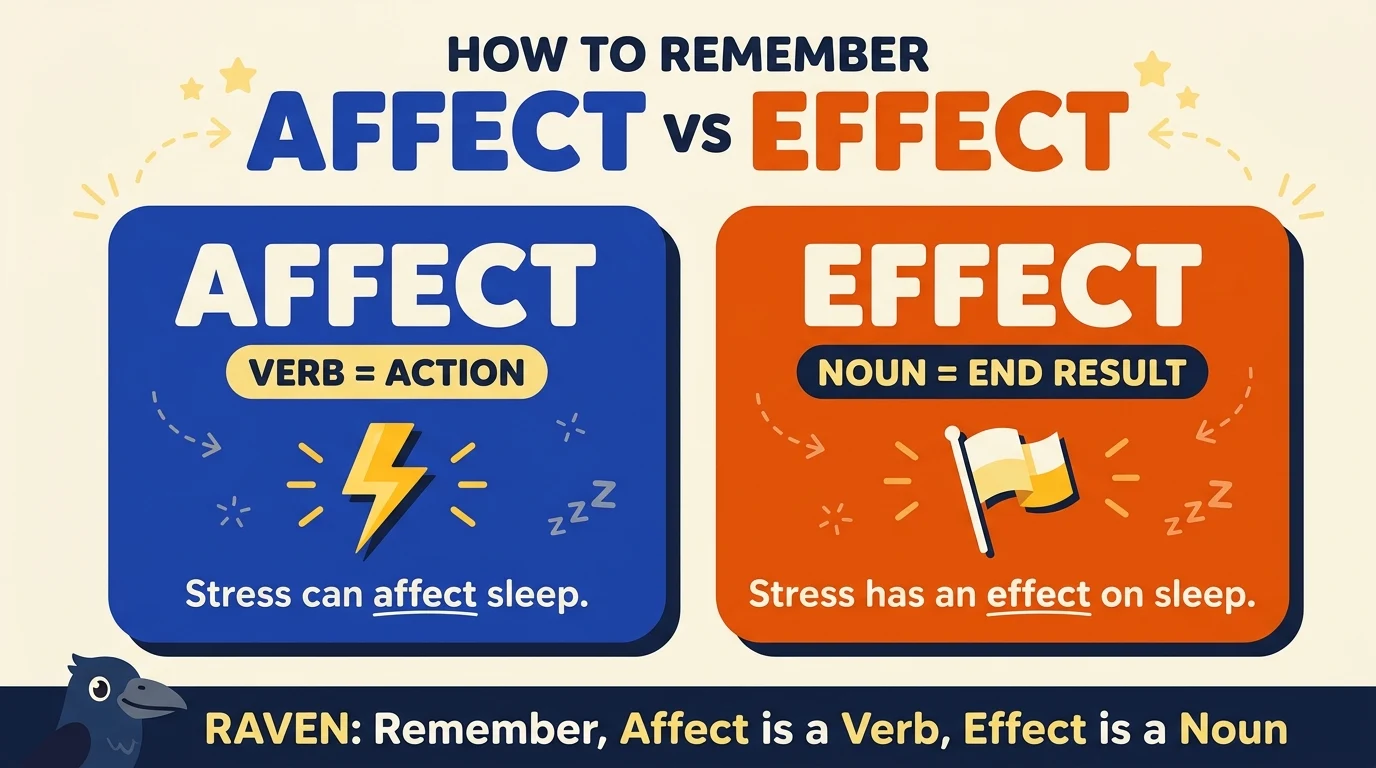
- RAVEN. Remember, Affect is a Verb, Effect is a Noun.
- A for action, E for end result. Affect starts with A, like action. Effect starts with E, like end result.
- Cause and effect. You already know this phrase. It always uses effect, because the effect is the result.
- The swap test. Replace the word with “influence.” If the sentence still works, use affect. Replace it with “result.” If that works, use effect.
- The article test. If “the,” “an,” or “a” sits right before the word, write effect.
Try the swap test on this sentence: “The cold weather will ___ our plans.” “Influence our plans” works, so the answer is affect.
Memory trick
Affect is the Action. Effect is the End result. If “the” or “an” comes right before the word, write effect.
Common Phrases: Which Spelling Is Correct?
These phrases account for most real mistakes. The pattern behind each one follows the same rule.
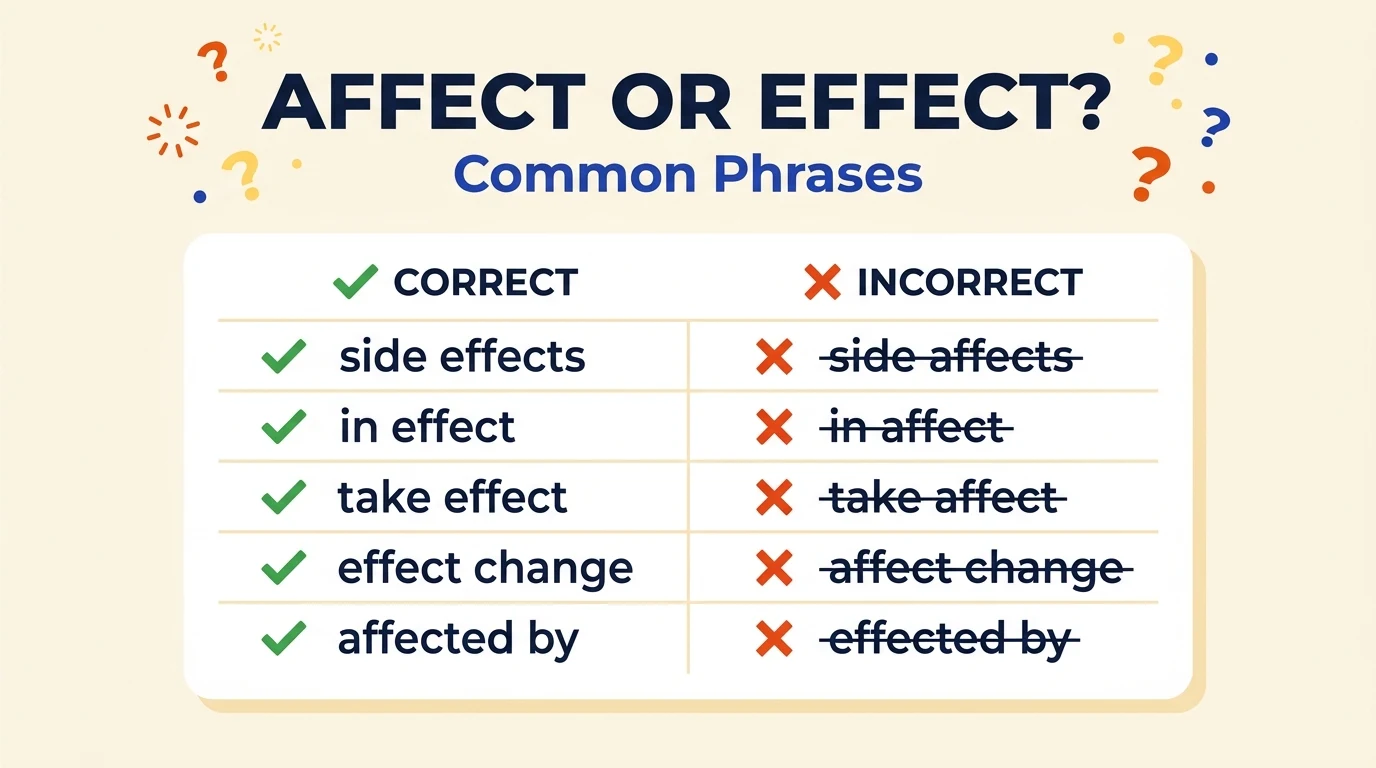
| Correct | Incorrect | Why |
|---|---|---|
| side effects | side affects | Names a result, so it needs the noun |
| in effect | in affect | Means “in operation” |
| take effect | take affect | The effect begins |
| effect change | affect change | Means “bring change about” |
| cause and effect | cause and affect | The second part is a result |
| affected by | effected by | Means “influenced by” |
| the effects of | the affects of | Plural noun after “the” |
| effective | affective | Effective means it works; affective relates to emotions |
Affected vs Effected, Affects vs Effects
The extra letters do not change the rule. They just show tense or number.
Affected is the past tense of affect. “The outage affected 3,000 homes.” It also works as an adjective: “Residents in affected areas lost power.”
Effected appears only when you mean brought about. “The treaty effected a lasting peace.” If you can swap in “caused” or “achieved,” effected is right. If “influenced” fits better, use affected.
Affects is a verb: “Caffeine affects sleep.” Effects is a plural noun: “The effects of caffeine last for hours.” A quick check is to add “the” before the word. If it reads naturally, you need effects.
Why Affect and Effect Are So Easy to Mix Up
Three things work against you.
First, the words sound almost the same. In quick speech, uh-FEKT and ih-FEKT blend together, so your ear gives you no help.
Second, they share a root. Both come from the Latin verb facere, “to do or make.” Affect traces back to afficere, “to act on.” Effect comes from effectus and efficere, “to bring about,” according to Merriam-Webster.
Third, their meanings are linked. One word names the cause in action, and the other names what follows. Merriam-Webster points out that this close relationship is part of why people keep checking them.
Once you see that one is the action and the other is the result, the choice becomes much easier.
Affect vs Effect Quick Practice
Fill in each blank, then check your answers below.
- Lack of sleep can ___ your memory.
- The ___ of the medicine wore off by noon.
- The new rules take ___ on Monday.
- Millions of people were ___ by the outage.
- Volunteers worked to ___ change in local law.
Answers: 1. affect (verb, influence). 2. effect (noun, after “the”). 3. effect (fixed phrase “take effect”). 4. affected (past tense verb). 5. effect (verb meaning bring about).