

Dialog or Dialogue: Meaning, Rules, and Examples

Quick Answer
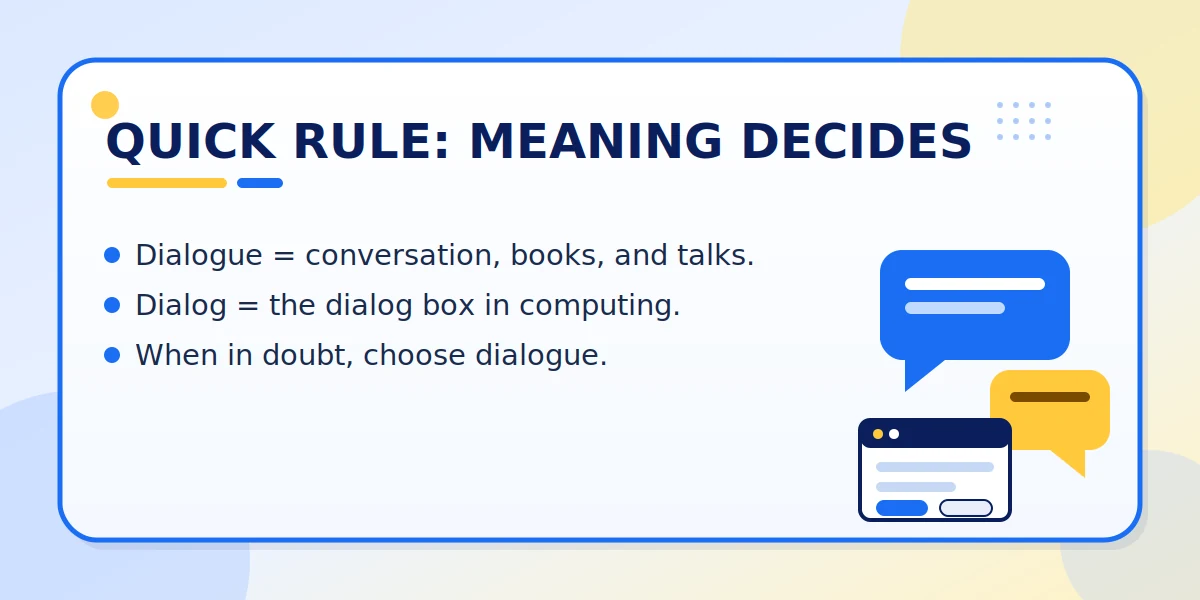
Should you write dialog or dialogue? Both spellings are correct, but they have different preferred uses.
Dialogue is the standard spelling for conversations, discussions, and character speech in both American and British English. Dialog is an accepted variant, mainly used in American computing, especially in the term dialog box.
For everyday writing, choose dialogue. If you are describing a software window in American English, use dialog box. British writers may also use dialogue box.
Table of Contents
- Dialog or Dialogue: At a Glance
- What Does Dialogue Mean?
- What Does Dialog Mean?
- Dialog vs Dialogue: What’s the Difference?
- Dialog vs Dialogue in American and British English
- Is It Dialog Box or Dialogue Box?
- What Do AP and Chicago Style Recommend?
- Can Dialogue Be Used as a Verb?
- Does Dia- Mean Two in Dialogue?
- Dialog vs Dialogue and Other -Ogue/-Og Words
- How to Choose Between Dialog and Dialogue in 10 Seconds
- How to Write Dialogue Correctly
- Common Dialog and Dialogue Mistakes
- Memory Tricks for Dialog vs Dialogue
- Dialog and Dialogue Examples in Everyday Life
- Practice Questions: Dialog or Dialogue?
- Frequently Asked Questions
- Related Guides
Dialog or Dialogue: At a Glance
The main difference in dialog or dialogue concerns their preferred contexts.
| Feature | Dialog | Dialogue |
|---|---|---|
| Correct spelling | Yes | Yes |
| General conversation | Accepted variant, but less preferred | Standard spelling |
| Character speech | Less preferred | Standard spelling |
| Formal discussions | Less preferred | Standard spelling |
| American English | Mainly used in computing | Standard for conversation |
| British English | Rare | Standard spelling |
| Computing | Common in dialog box | Also used in dialogue box |
| Formal writing | Usually avoid for conversation | Preferred |
Both spellings share one pronunciation. In British English, the pronunciation is /ˈdaɪəlɒɡ/. In American English, it is /ˈdaɪəˌlɔːɡ/.
The spelling does not change how you say the word.
What Does Dialogue Mean?
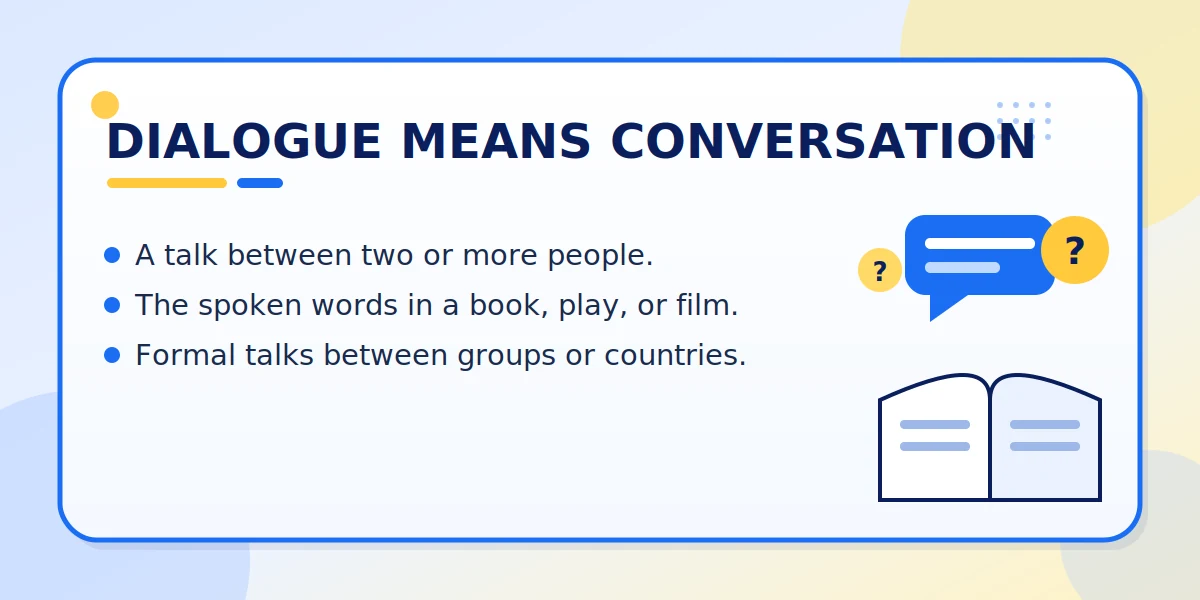
Dialogue is a noun that means a conversation or exchange of ideas between two or more people. It also describes the spoken words of characters in books, plays, and films.
Dictionaries such as Merriam-Webster, Oxford, and Cambridge recognize several uses.
Dialogue as a Conversation
Dialogue refers to an exchange of spoken words between people. It can involve two participants or a larger group.
For example:
The students had a productive dialogue about their assignments.
Honest dialogue helps people understand different opinions.
We need more dialogue between parents and teachers.
In these examples, dialogue describes communication between people.
Dialogue in Books, Plays, and Movies
Dialogue also refers to the spoken words of characters in creative works.
Writers use dialogue to reveal personalities, develop relationships, and move stories forward. It helps readers understand what characters think and feel.
Examples:
The dialogue between the main characters made the movie memorable.
The author wrote realistic dialogue for every character.
The director asked the actors to improve their dialogue.
Dialogue is different from narration. Narration describes events, while dialogue presents what characters say.
Dialogue as a Formal Discussion
Dialogue can describe a serious exchange of ideas between organizations, communities, governments, or countries.
It often appears in discussions about disagreements, policies, and negotiations.
Examples:
The two countries agreed to continue their dialogue.
The company encouraged dialogue between employees and managers.
Community leaders opened a dialogue about public safety.
This meaning often appears in professional, political, and diplomatic writing.
Dialogue as a Literary Form
A dialogue can also be a literary work written as a conversation.
For example, Plato wrote philosophical dialogues that presented ideas through exchanges between speakers.
This use is less common in everyday conversation, but it remains important in literature and philosophy.
What Does Dialog Mean?
Dialog is an accepted alternative spelling of dialogue. Dictionaries recognize it, particularly in American English.
However, the shorter spelling has a more limited preferred use in modern writing.
Dialog as a Variant of Dialogue
In general writing, dialog can refer to the same conversation or discussion as dialogue.
For example:
The dialog between the characters was interesting.
We need an open dialog about the problem.
These sentences are understandable, and the spelling is not automatically incorrect. However, dialogue is the standard and more widely recommended choice for these contexts.
If you are writing an essay, article, novel, or professional document, choose dialogue.
Dialog in American Computing
The spelling dialog is particularly common in American computing terminology.
A dialog box is a small window in a graphical user interface. It displays information or asks users to respond.
Examples:
A dialog box appeared when I tried to save the document.
The application opened a dialog asking for permission.
Click OK to close the dialog box.
This is the main context where American writers should prefer dialog.
Dialog vs Dialogue: What’s the Difference?
When you compare dialog or dialogue, the difference is mainly conventional. Both can refer to a conversation, but dialogue is the standard choice.
| Comparison | Dialog | Dialogue |
|---|---|---|
| Basic status | Accepted variant | Standard spelling |
| General conversation | Less preferred | Preferred |
| Character speech | Less preferred | Preferred |
| Formal discussions | Less preferred | Preferred |
| American computing | Common | Also possible |
| British conversation | Rare | Standard |
| Pronunciation | Same | Same |
| Best general choice | Specific computing contexts | General writing |
Do not assume the two spellings have separate meanings in ordinary conversation.
For example, dialogue does not automatically mean an abstract discussion. Likewise, dialog does not specifically mean scripted speech.
The dictionary definitions support the same basic meaning. The main distinction concerns spelling conventions and context.
Dialog vs Dialogue in American and British English
American and British English do not follow a simple rule where one spelling belongs to each variety.
Both use dialogue for ordinary conversation. The shorter form has a more specific role in American computing. The choice in dialog or dialogue depends on context, not on which side of the Atlantic you write.
American English
American writers generally use dialogue for conversations, discussions, and fictional speech.
They commonly use dialog in software terminology.
Examples:
The dialogue between the characters felt natural.
We should encourage dialogue between departments.
A dialog box appeared on my screen.
If you are writing for an American audience, remember this distinction.
British English
British writers also use dialogue for ordinary conversation.
In computing, dialogue box is an established British form. However, dialog box also appears in software terminology.
Examples:
The dialogue in the play was excellent.
The two groups continued their dialogue.
A dialogue box appeared when I opened the application.
Canadian and Australian English
Canadian and Australian English strongly favor dialogue in ordinary writing.
Writers should not treat dialog as the standard spelling for every American English context or apply that assumption to other English varieties.
For software terminology, follow the product’s established spelling.
Which Spelling Should International Writers Use?
Choose dialogue when writing for an international audience.
It is widely recognized in American, British, Canadian, and Australian English. It also works in formal writing, education, literature, and everyday communication.
For computing terms, follow the terminology used by your software or publication.
Table: American vs British Spelling
| English variety | Conversation | Computing term |
|---|---|---|
| American | Dialogue | Dialog box |
| British | Dialogue | Dialogue box or dialog box |
| Canadian | Dialogue | Follow product terminology |
| Australian | Dialogue | Follow product terminology |
| International | Dialogue | Dialog box is widely recognized |
Is It Dialog Box or Dialogue Box?
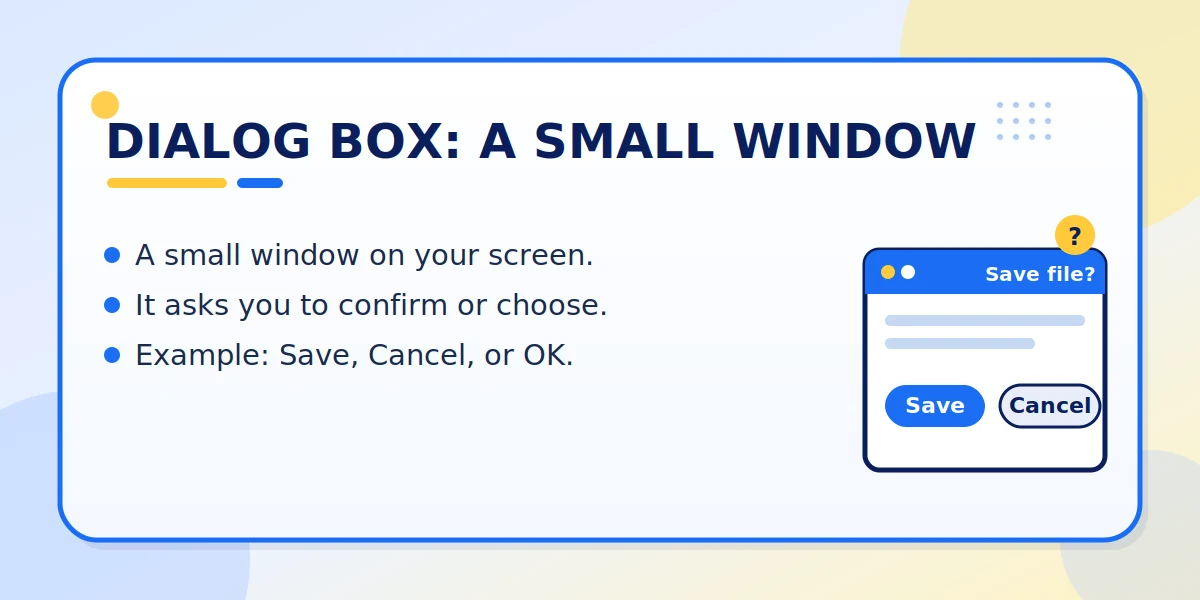
Both dialog box and dialogue box exist. However, their preferred usage depends on the English variety and writing context. The question of dialog or dialogue often comes down to this one phrase.
What Is a Dialog Box?
A dialog box is a small window that appears within a software application.
It communicates information or asks users to make a choice. It may also request information before an action continues.
Common examples include:
- A confirmation window asking whether you want to delete a file.
- A settings window allowing you to change application preferences.
- A file dialog asking where you want to save a document.
Dialog boxes help users interact with software.
When to Write Dialog Box
Use dialog box in American computing contexts.
It is a common term in software documentation and user interface discussions.
Examples:
The dialog box asks you to confirm the deletion.
Select a folder in the dialog box.
Close the dialog box before opening another window.
When to Write Dialogue Box
Dialogue box is also an established spelling, particularly in British English.
Examples:
The dialogue box appeared after I selected the option.
Enter your details in the dialogue box.
Merriam-Webster also provides an example using dialogue box. Therefore, it would be inaccurate to call this form universally incorrect.
The HTML Dialog Element
Web developers may encounter the HTML <dialog> element.
This element represents a dialog box or interactive dialog within a web page. Developers can use it for confirmation windows, messages, and other interactive content.
The HTML spelling is dialog, which matches the shorter American computing form.
What Do AP and Chicago Style Recommend?
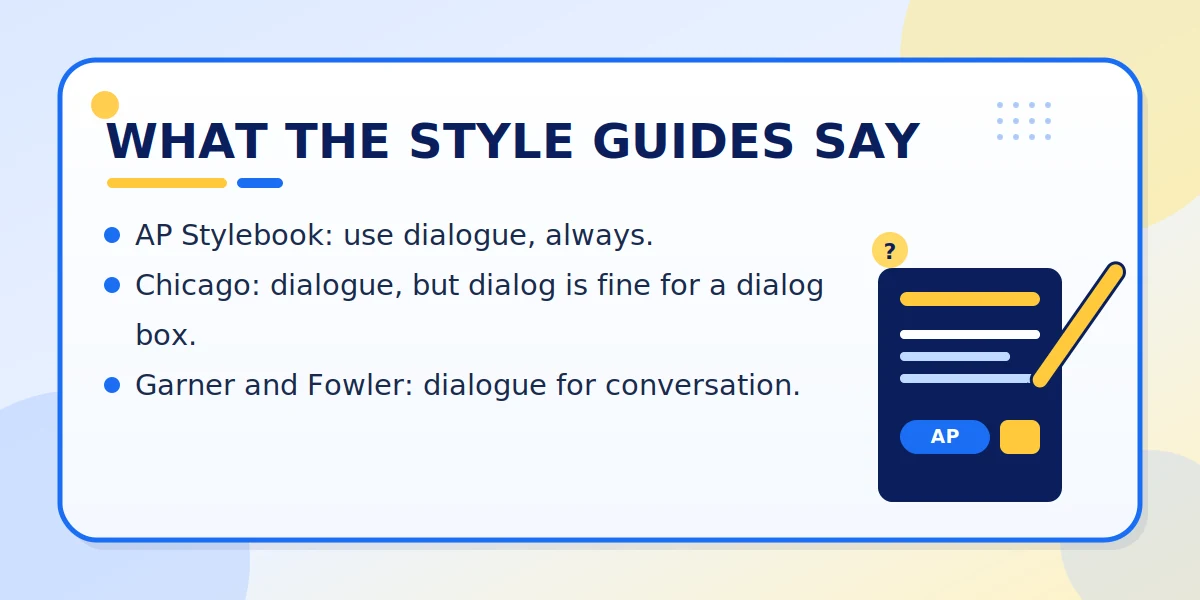
Style guides help writers maintain consistent spelling across articles, books, publications, and professional documents.
Their recommendations can differ slightly, especially for computing terminology. Style guides settle many questions about dialog or dialogue.
AP Stylebook
The AP Stylebook reportedly recommends dialogue regardless of meaning.
This includes situations where a writer refers to a software dialog box.
Writers following AP guidance should therefore use dialogue consistently, including in computing contexts.
Chicago Manual of Style
The Chicago Manual of Style generally uses dialogue throughout its publications.
However, its FAQ allows the shorter spelling dialog when referring to a dialog box.
This distinction matters because Chicago recognizes the shorter computing form without replacing dialogue as its general preference.
Garner’s Modern American Usage and Fowler’s
Garner’s Modern American Usage favors dialogue for conversation.
Fowler’s also identifies dialogue as the preferred spelling for ordinary conversation.
Both support using the longer spelling in general writing.
Which Style Should You Follow?
Follow your publication’s house style whenever one exists.
Otherwise, use these practical recommendations:
- Choose dialogue for conversations and discussions.
- Choose dialogue for character speech in books and films.
- Use dialog box for standard American computing terminology.
- Follow AP or Chicago guidance when writing for publications that require those styles.
Consistency and context matter more than choosing the shortest spelling.
Can Dialogue Be Used as a Verb?
Yes. Dialogue can function as a verb, although many editors and readers dislike this usage.
The verb means to engage in a dialogue or discuss differences through communication. The verb question is a small part of the dialog or dialogue choice.
For example:
The managers decided to dialogue with employees about the changes.
The sentence is grammatically possible, but it sounds awkward to many readers.
Dialogues, Dialogued, and Dialoguing
The verb has several forms.
| Form | Usage |
|---|---|
| Dialogue | Base form |
| Dialogues | Third person singular |
| Dialogued | Simple past and past participle |
| Dialoguing | Present participle |
These forms exist in dictionaries, but their existence does not mean they are always good writing choices.
Why Is the Verb Often Avoided?
The verb has attracted criticism from usage authorities and editors.
Forms such as dialoguing and dialogued can sound unnatural. They may also make simple sentences unnecessarily complicated.
Consider these alternatives:
| Less natural | Better alternative |
|---|---|
| The managers are dialoguing about the problem. | The managers are discussing the problem. |
| We dialogued about the changes. | We talked about the changes. |
| The team will dialogue with customers. | The team will communicate with customers. |
In most situations, choose discuss, talk, or communicate instead.
Does Dia- Mean Two in Dialogue?
No. The prefix dia- does not mean two.
It comes from Greek and means through, across, or between. The confusion often comes from mixing up dia- with di-, which can mean two.
The Greek Origin of Dialogue
The word dialogue comes from the Greek word dialogos, meaning conversation or dialogue.
Its development includes several related forms:
Greek dialogos, meaning conversation.
Greek dialegesthai, meaning to converse.
Latin dialogus.
Old French dialoge.
Middle English dialoge.
The Greek elements help explain the word’s meaning.
Dia-: Through, across, or between.
Legein: To speak.
Logos: Word, speech, or reason.
The prefix does not limit the number of speakers.
Why Dialogue Does Not Mean Two People
Dialogue can involve two people or many participants.
A group discussion can still be called a dialogue. The word describes an exchange of communication, not a fixed number of speakers.
The mistaken explanation confuses dia- with di-.
Monologue, Duologue, Trialogue, and Quadrilogue
These related words help explain the difference.
| Word | Meaning |
|---|---|
| Monologue | Speech by one person |
| Duologue | Conversation between two people |
| Dialogue | Conversation between two or more people |
| Trialogue | Conversation involving three people |
| Quadrilogue | Conversation involving four people |
A monologue focuses on one speaker. A duologue specifically describes an exchange between two people.
A dialogue can include any number of participants.
Dialog vs Dialogue and Other -Ogue/-Og Words
The spelling difference in dialog or dialogue appears in other English words too.
Some words have both shorter American forms and longer British forms.
Table: -Ogue and -Og Spelling Variations
| British spelling | American spelling |
|---|---|
| Dialogue | Dialog |
| Analogue | Analog |
| Catalogue | Catalog |
| Monologue | Monolog |
| Homologue | Homolog |
For example, British writers commonly use catalogue, while American writers often choose catalog.
Similarly, analogue and analog are recognized spelling variants.
Words That Usually Keep -Ogue
Not every word follows this spelling pattern.
Several words retain their longer spelling in American English.
Examples include:
- Demagogue
- Pedagogue
- Synagogue
Do not assume that every word ending in -ogue has an accepted shorter American form.
Check the spelling of each word when in doubt.
How to Choose Between Dialog and Dialogue in 10 Seconds
You can make the correct choice by considering what you are writing about. This quick test settles dialog or dialogue in seconds.
Follow these simple steps:
- Writing about a conversation? Use dialogue.
- Describing characters speaking in a novel or film? Use dialogue.
- Discussing formal talks or negotiations? Use dialogue.
- Writing American software documentation? Use dialog box.
- Writing for a British audience? Use dialogue for conversation and consider dialogue box for computing.
- Writing for an international audience? Use dialogue for general communication.
The easiest rule is to use dialogue whenever you mean a conversation or discussion.
Use dialog mainly when referring to American computing terminology.
How to Write Dialogue Correctly
Choosing the right spelling is only one part of writing dialogue. Proper punctuation and paragraph structure also make conversations easier to follow.
Here are three basic rules for writing dialogue.
Put Spoken Words Inside Quotation Marks
American English generally uses double quotation marks around direct speech.
For example:
"I enjoyed our conversation," Maria said.
Place the punctuation inside the closing quotation marks according to standard American conventions.
Start a New Paragraph When the Speaker Changes
Give each speaker a separate paragraph.
For example:
"Are you ready for the meeting?" James asked.
"Yes, I finished the report," Maria replied.
This structure helps readers identify who is speaking.
Use Dialogue Tags Correctly
Dialogue tags identify the speaker and explain how a line fits into the conversation.
Common tags include:
- Said
- Asked
- Replied
- Whispered
- Explained
Examples:
"I agree with your suggestion," Anna said.
"Can we discuss it tomorrow?" Mark asked.
Remember that these punctuation rules concern written conversations. They do not change the spelling choice between dialog and dialogue.
Common Dialog and Dialogue Mistakes
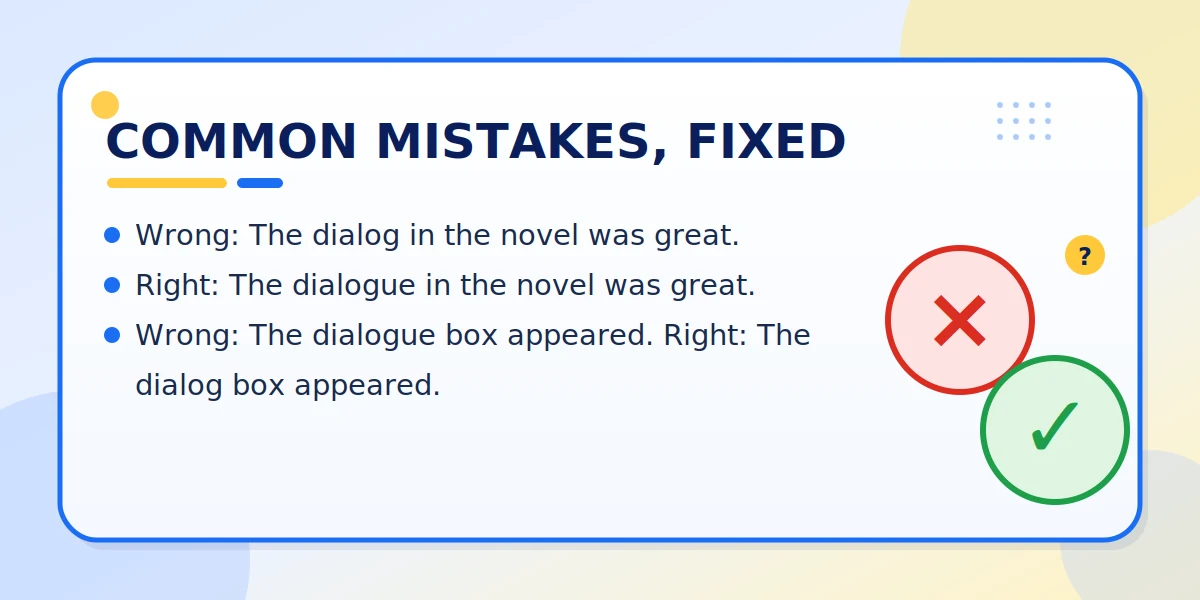
Writers sometimes confuse regional conventions, computing terminology, and ordinary conversation.
The following table shows common mistakes and their better alternatives.
Table: Common Mistakes and Fixes
| Mistake | Better version | Explanation |
|---|---|---|
| The dialog in the novel was realistic. | The dialogue in the novel was realistic. | Dialogue is standard for literary speech. |
| We need more dialog between the teams. | We need more dialogue between the teams. | Dialogue is preferred for discussions. |
| The dialogue box appeared on my screen. | The dialog box appeared on my screen. | Preferred American computing form. |
| Dialogue always means two people speaking. | Dialogue involves two or more people. | Dia- does not mean two. |
| Dialog and dialogue have different pronunciations. | Both share the same pronunciation. | The difference is spelling. |
| Dialog is always incorrect in American English. | Dialog is accepted in computing. | It is a recognized variant. |
| Dialogue is only British English. | Dialogue is standard in both varieties. | It is not exclusively British. |
| The team is dialoguing about the problem. | The team is discussing the problem. | The verb form is often best avoided. |
One common misconception deserves special attention.
Dialog is not automatically wrong in American English. However, using it for ordinary conversations is generally less appropriate than choosing dialogue.
Memory Tricks for Dialog vs Dialogue
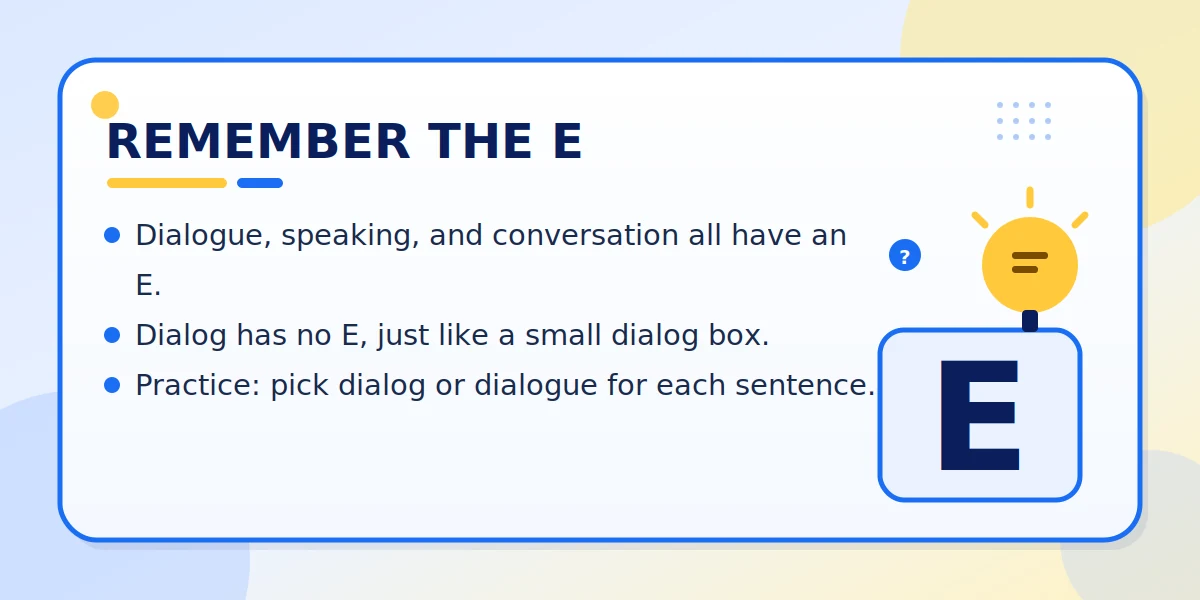
A simple memory trick can help you remember which spelling to choose.
The E Trick
Remember that dialogue contains the letter E.
The words speaking and conversation also contain E.
When writing about people talking, choose the spelling with E.
This trick is useful for essays, stories, emails, and everyday writing.
The Computing Trick
Associate the shorter spelling dialog with a computer dialog box.
Think of a small software window appearing on your screen.
This makes the distinction easier to remember:
Dialogue means conversation.
Dialog box means a software window in American computing.
When you are unsure, choose dialogue for general writing.
Dialog and Dialogue Examples in Everyday Life
Examples make the difference easier to understand.
Here are sentences showing how both spellings work in different situations.
Dialogue Examples in Conversation
The neighbors started a friendly dialogue about the parking rules.
Honest dialogue can help people understand different opinions.
Our teacher encouraged dialogue during the classroom discussion.
The team opened a dialogue about improving communication.
Dialogue Examples in Books and Movies
The dialogue in the novel sounded natural.
The director wanted more realistic dialogue between the characters.
Good dialogue can make a movie more engaging.
The playwright revised the dialogue before the final performance.
Dialogue Examples in Business and Formal Discussions
The company encouraged dialogue between employees and managers.
The two organizations continued their dialogue about the agreement.
Open dialogue helped resolve the disagreement.
The leaders agreed to begin a dialogue about future cooperation.
Dialog Examples in Computing
A dialog box appeared after I clicked Save.
Close the dialog box to return to the main screen.
The application displayed a dialog asking for permission.
Select your preferred option in the dialog box.
These examples show why context matters. Use dialogue for communication and dialog for the common American computing term.
Practice Questions: Dialog or Dialogue?
Test your understanding with these 10 questions.
Choose dialog, dialogue, or the appropriate alternative for each sentence.
- The actors practiced their ______ before filming the scene.
- A small ______ box appeared when I tried to close the program.
- The two countries agreed to continue their peaceful ______.
- Which spelling is standard for ordinary conversation in American English?
A. Dialog
B. Dialogue
C. Both are equally preferred - Is dialog always incorrect in American English?
A. Yes
B. No - Complete the sentence: The software displayed a ______ asking me to confirm the changes.
- True or false: The prefix dia- means two, so dialogue must involve exactly two people.
- Which spelling is standard for a conversation between characters in a British novel?
A. Dialog
B. Dialogue - Rewrite this sentence using the preferred American computing spelling: "The dialogue box asked me to save the file."
- Choose the better sentence for formal American writing:
A. We need more dialog between the departments.
B. We need more dialogue between the departments.
Answer Key
| Question | Correct answer | Explanation |
|---|---|---|
| 1 | Dialogue | Character speech in a film is dialogue. |
| 2 | Dialog | Dialog box is the common American computing term. |
| 3 | Dialogue | Formal discussions use dialogue. |
| 4 | B. Dialogue | Dialogue is standard for conversation in American English. |
| 5 | B. No | Dialog is an accepted spelling variant, especially in computing. |
| 6 | Dialog | The sentence describes a software interface. |
| 7 | False | Dia- means through, across, or between. |
| 8 | B. Dialogue | Dialogue is standard in British English. |
| 9 | The dialog box asked me to save the file. | Dialog box is the preferred American computing spelling. |
| 10 | B. We need more dialogue between the departments. | Dialogue is preferred for formal discussions. |
Frequently Asked Questions
Is dialog or dialogue correct?
Both dialog and dialogue are correct spellings. However, dialogue is the standard choice for conversations, discussions, and character speech. Dialog is mainly used in American computing, especially in the term dialog box.
Can I use dialogue in American English?
Yes. Dialogue is the standard spelling for conversations and discussions in American English. It is also widely used in British English. American writers commonly use dialog specifically when referring to software windows or dialog boxes.
Is it dialog box or dialogue box?
Dialog box is the common American computing term. Dialogue box is also used, particularly in British English. Both forms are understandable, but American software documentation generally favors dialog box for consistency.
Is there a pronunciation difference between dialog and dialogue?
No. Dialog and dialogue have the same pronunciation. The difference is purely in spelling and usage. Both forms sound alike when spoken, so listeners cannot identify which spelling someone intends.
Can dialogue be used as a verb?
Yes. Dialogue can function as a verb, with forms such as dialogues, dialogued, and dialoguing. However, many editors dislike this usage. In most writing, discuss, talk, or communicate sounds more natural.
Can I mix dialog and dialogue in the same document?
Yes. You can use both when they serve different purposes. Use dialogue for conversations and dialog box for American computing. Keep each meaning consistent, and do not swap spellings for the same meaning.
Which spelling should I use in academic writing?
Use dialogue in academic writing when discussing conversations, literary speech, or exchanges of ideas. If your paper follows a specific style guide, check its requirements and maintain consistent spelling throughout the document.
Related Guides
Want to learn more about American and British spelling differences? Explore these ClarifyWords guides: Gray vs Grey, Judgment vs Judgement, Defense vs Defence, Toward vs Towards, Aluminium or Aluminum, Mold vs Mould, Canceled or Cancelled, Cannot vs Can Not, and Spelling Differences.
Final Takeaway
Use dialogue for conversations, discussions, and character speech in both American and British English. Use dialog box for American computing terminology. Both spellings are correct, but context determines the better choice. That is the whole answer to dialog or dialogue in one line.