

Cannot vs Can Not: Which Spelling Is Correct?
Cannot is the standard one-word spelling of the negative form of can. Can not is also correct, but only in certain grammatical situations.
The difference depends on how the sentence works, not simply how you want it to sound. Understanding the difference will help you choose the right spelling every time.
Quick Answer: Cannot vs Can Not
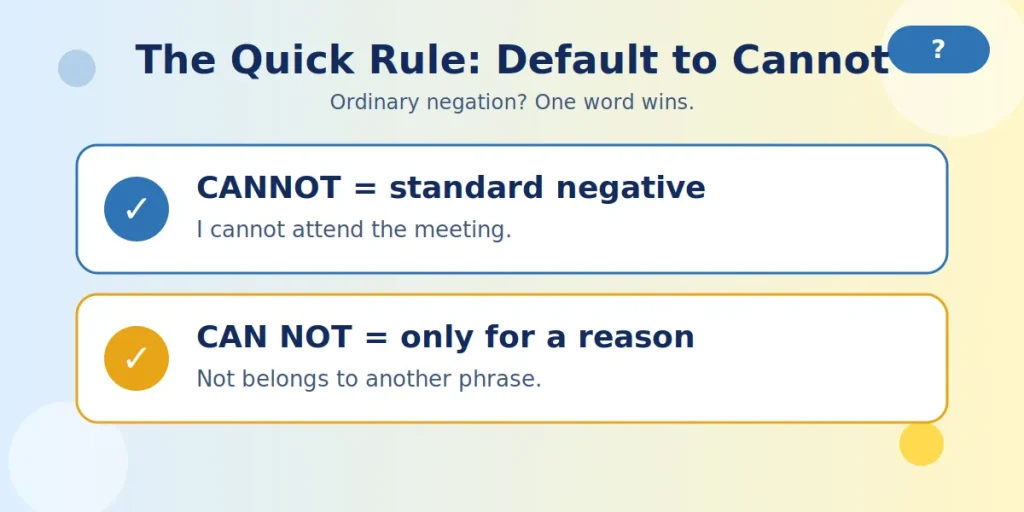
Use cannot for ordinary negative statements. Use can not only when not belongs to another phrase, when it expresses the choice not to act, or when a question places the subject between can and not. Use can’t as the informal contraction of cannot. When you check cannot vs can not in your own writing, start with cannot and split the words only for a clear grammatical reason.
Table of Contents
- Cannot vs Can Not: What’s the Difference?
- What Does Cannot Mean?
- When Should You Use Cannot?
- When Is Can Not Correct?
- Cannot vs Can Not: Examples That Change the Meaning
- Can’t vs Cannot: What’s the Difference?
- Cannot But vs Cannot Help vs Cannot Help But
- Common Mistakes With Cannot and Can Not
- How to Remember Cannot vs Can Not
- Cannot vs Can Not Examples in Everyday Writing
- Practice: Cannot or Can Not?
- Frequently Asked Questions
- Conclusion
Cannot vs Can Not: What’s the Difference?
The main difference is grammatical. Cannot expresses the negative of can, while can not keeps can and not separate. In ordinary negative statements, use cannot. It means someone is unable to do something, lacks permission, or faces an impossible situation. However, can not is correct when not has a separate role in the sentence. This includes constructions such as not only…but also, the choice not to act, and certain negative questions. This is the core question in cannot vs can not, and the answer turns on sentence structure.
| Form | Meaning | When to use it | Example |
|---|---|---|---|
| Cannot | Negative form of can | Ordinary negative statements | I cannot swim. |
| Can not | Can followed by a separate not | Special grammatical constructions | We can not only plan but also organize. |
| Can’t | Contraction of cannot | Informal writing and conversation | I can’t swim. |
Is Cannot One Word or Two?
The standard spelling is cannot, written as one word. Merriam-Webster defines it as the negative form of can. Cambridge Dictionary also treats it as a single word and the full negative form of can. Correct: I cannot understand the instructions. Incorrect for ordinary negation: I can not understand the instructions. The second spelling may be correct in a different sentence structure. However, it does not replace cannot in ordinary negative statements. Remember that cannot is not a contraction. The shortened form is can’t.
What Does Cannot Mean?
Cannot is the negative form of the modal verb can. It expresses a lack of ability, permission, or possibility. This section sets out the meanings you need before you judge cannot vs can not in a sentence. The exact meaning depends on the sentence. It can also express a strong conclusion about something that seems impossible.
1. Cannot Means Unable to Do Something
Use cannot when someone lacks the ability or capacity to perform an action. Examples: My brother cannot swim. I cannot solve this math problem. She cannot drive because she has not learned. We cannot finish the project without more time.
2. Cannot Means Not Allowed to Do Something
Cannot can also express a restriction or prohibition. Examples: You cannot park your car in front of this entrance. Students cannot use their phones during the exam. Visitors cannot enter the building after closing. Employees cannot share confidential information.
3. Cannot Means Something Is Impossible
Use cannot when something is impossible or cannot happen under certain conditions. Examples: This plan cannot work without enough funding. Water cannot remain liquid at every temperature. The meeting cannot start until everyone arrives. We cannot complete the task in five minutes.
4. Cannot Expresses a Negative Deduction
You can use cannot when you strongly believe something is not true. Examples: That cannot be the right address. He cannot be serious about quitting his job. This cannot be the same person I met yesterday. She cannot have finished the assignment already.
5. Cannot Can Express Unwillingness
Sometimes cannot communicates a refusal or unwillingness to do something. Examples: I cannot accept those conditions. We cannot support a decision that harms others. She cannot agree to the proposed changes.
When Should You Use Cannot?
Use cannot whenever you want to make an ordinary negative statement with the modal verb can. It is the safest default spelling in standard American English. Merriam-Webster identifies it as the standard negative form of can.
Use Cannot in Formal and Academic Writing
The full form is generally a better choice when your writing needs a formal tone, for example in school essays and research papers, business reports and professional documents, formal emails and letters, academic presentations, and official instructions and policies. Examples: The available evidence cannot support this conclusion. Students cannot submit assignments after the deadline. Our department cannot approve the request. This study cannot establish a direct connection between the two events. Grammarly also recommends the full form in formal writing. It treats can’t as a more informal alternative.
Use Cannot in Ordinary Negative Statements
When you simply want to say that something is not possible, use the one-word form. Examples: I cannot find my car keys. She cannot attend the appointment. We cannot change the schedule. They cannot understand the instructions. He cannot remember her name.
Use Cannot When You Want to Emphasize a Negative
You do not need to separate can and not just to make a sentence stronger. Keep cannot together and place vocal stress on the negative when speaking. In writing, italics can show emphasis. Examples: I cannot believe you forgot! You absolutely cannot enter this room. We cannot allow this mistake to happen again. She cannot possibly finish everything today. Some grammar references discuss can not as an emphatic alternative. However, recommendations differ. For standard writing, emphasis alone does not require two words.
When Is Can Not Correct?
Although cannot is the standard negative, can not has legitimate grammatical uses. The key is understanding what not modifies. It must belong to a separate phrase or construction, rather than simply negating can. There are three main situations to remember, plus other separate-not phrases.
1. Use Can Not With Not Only…But Also
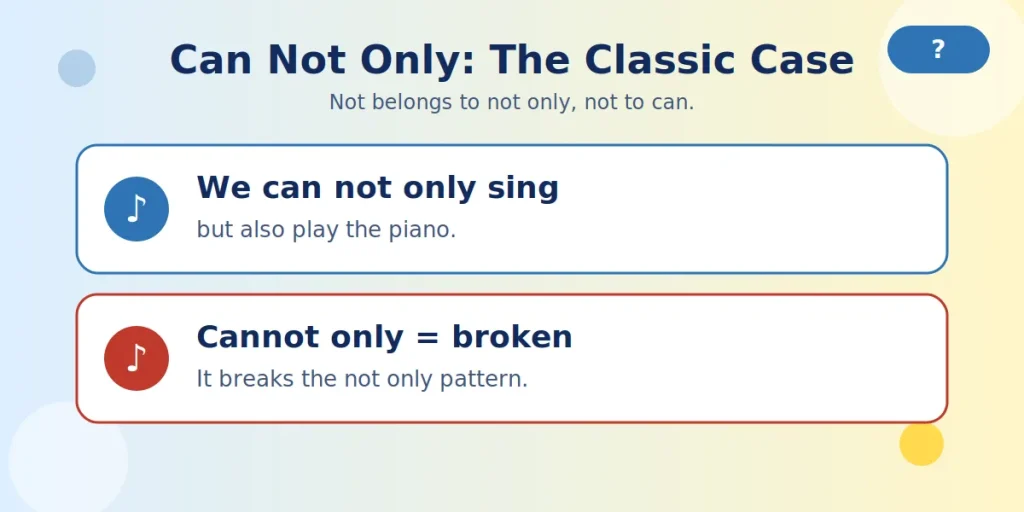
The first important exception involves the correlative conjunction not only…but also. When can comes before this construction, write can not as two words. Examples: She can not only speak Spanish but also write it. We can not only save money but also reduce waste. This course can not only improve your grammar but also strengthen your writing. The new software can not only organize files but also protect important information. He can not only cook dinner but also prepare dessert. Notice that not begins the phrase not only. It does not simply make can negative. Cannot only does not create the same correlative construction. Compare: She can not only sing but also dance (correct not only…but also). She cannot sing (unable to sing). She cannot only sing but also dance (does not form the intended construction). Merriam-Webster specifically identifies this construction as an exception to the usual one-word spelling.
2. Use Can Not When Someone Has the Choice Not to Act
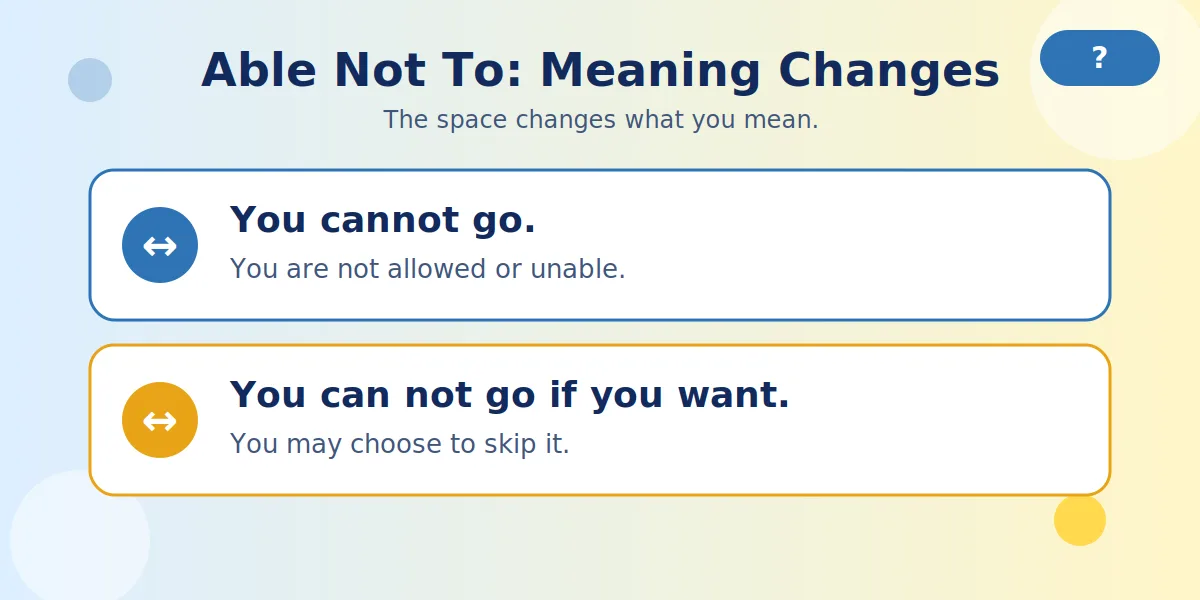
You can also separate the words when you mean someone has the ability or option not to perform an action. Here, can expresses ability or permission. The word not belongs to the following verb. Examples: You can not go to the party if you would rather stay home. She can not participate if she prefers to watch. We can choose not to accept the offer. He can enter the competition, or he can not enter it. You can not answer the question if you are uncomfortable. Compare: You cannot go to the party (unable or not allowed) versus You can not go to the party if you prefer (option to stay home). She cannot participate (unable or not permitted) versus She can not participate if she chooses (option to decline). The Canadian Language Portal explains this distinction through an example involving someone who can choose not to act.
3. Use Can Not in Certain Negative Questions
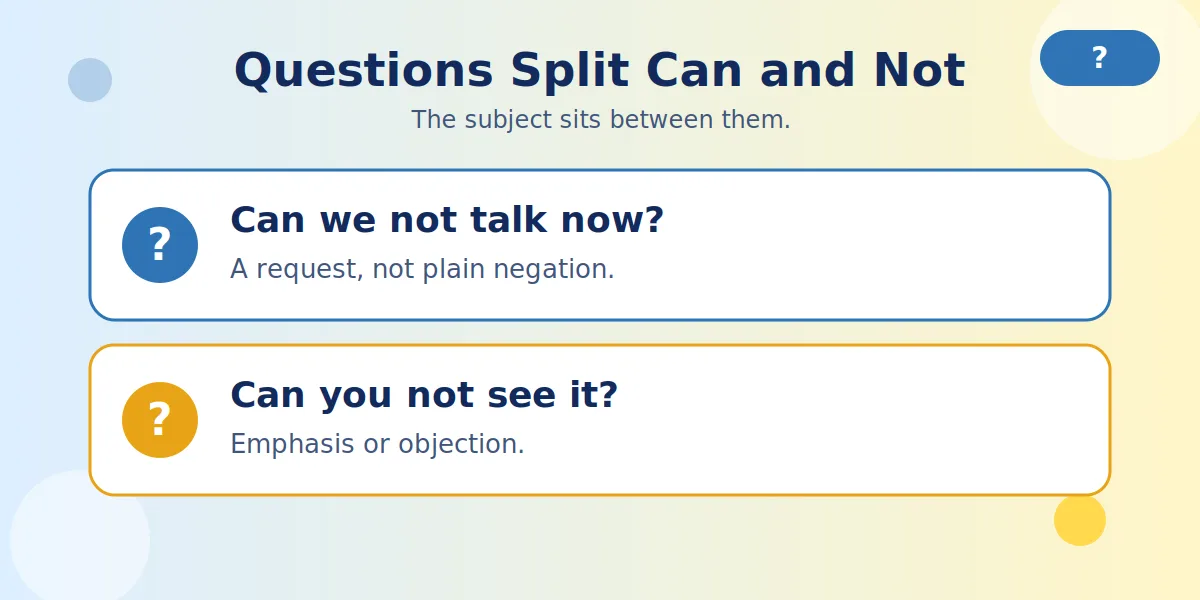
The third situation involves questions where the subject appears between can and not. Word order: Can + subject + not + verb? This structure can express a request, suggestion, objection, or frustration. Examples: Can we not discuss this today? Can you not see the problem? Can they not wait until tomorrow? Can she not attend the meeting? Can we not find another solution? Compare: Can’t we discuss this today? (informal contraction) versus Can we not discuss this today? (full negative question). YourDictionary also identifies this question structure as a legitimate use of can not.
4. Other Phrases Where Not Has a Separate Role
Not only is not the only case. The same rule applies when not belongs to another phrase in the sentence, as long as the grammar supports the separation. Examples: She can not yet do the task unaided (not belongs to not yet). The room can not merely hold the class, it can also host the workshop (not belongs to not merely). You can choose not to reply (not belongs to choose, not to can). Do not treat these as automatic exceptions. Check the sentence first: if not negates can itself, use cannot. This check is part of deciding cannot vs can not correctly in longer sentences.
Cannot vs Can Not: Examples That Change the Meaning
In ordinary negative statements, cannot negates the ability, permission, or possibility expressed by can. With can not, the sentence can express an available choice not to perform an action.
| Cannot | Can not | Difference |
|---|---|---|
| You cannot go. | You can not go if you prefer to stay home. | Prohibition or inability versus choice. |
| She cannot attend. | She can attend or not attend. | Inability versus freedom to choose. |
| He cannot enter the building. | He can enter or not enter the building. | Restriction versus an available choice. |
| I cannot worry about this anymore. | I can not worry about this for a while. | Inability to stop worrying versus choosing not to worry. |
| They cannot participate. | They can choose not to participate. | Lack of permission or ability versus a voluntary decision. |
Why Does the Space Matter?
The space helps show which part of the sentence receives the negative meaning. In cannot, the negative applies to the modal verb can. In can not, the negative can apply to the following action instead. Example: You cannot attend the event (impossible or not permitted). You can not attend the event if you prefer (permission to skip it). Remember that context matters. A space alone does not automatically change a sentence’s meaning. That is why cannot vs can not is a grammar question, not just a spelling question.
Can’t vs Cannot: What’s the Difference?
Can’t is the contraction of cannot. Both forms generally communicate the same negative meaning. The main difference is their level of formality. Cannot is the complete form. Can’t is shorter and more conversational.
| Feature | Cannot | Can’t |
|---|---|---|
| Spelling | One word | One word with an apostrophe |
| Grammatical role | Negative form of can | Contraction of cannot |
| Meaning | Unable, not permitted, or impossible | Generally the same |
| Tone | More formal or neutral | More conversational |
| Common setting | Reports, essays, and formal emails | Texts, chats, and casual conversations |
When Should You Use Can’t?
Use can’t when a relaxed, conversational tone fits your writing. Examples: I can’t come to dinner tonight. She can’t find her phone. We can’t wait until Friday. He can’t drive without his glasses. They can’t attend the event.
When Should You Use Cannot?
Choose cannot when you want the full form, especially in formal documents and academic writing. Examples: I cannot attend the scheduled appointment. Our team cannot approve the request. The report cannot confirm these findings. Students cannot use outside resources during the exam. We cannot guarantee delivery by Monday. Grammarly recommends cannot when contractions are unsuitable. Collins also identifies cannot as the full negative form of can.
Is Cannot a Contraction?
No. Cannot is the full negative form of can. The contraction is can’t. Do not assume that can’t expands to can not simply because other contractions work that way. For example, don’t expands to do not. However, can’t expands to cannot.
Cannot But vs Cannot Help vs Cannot Help But
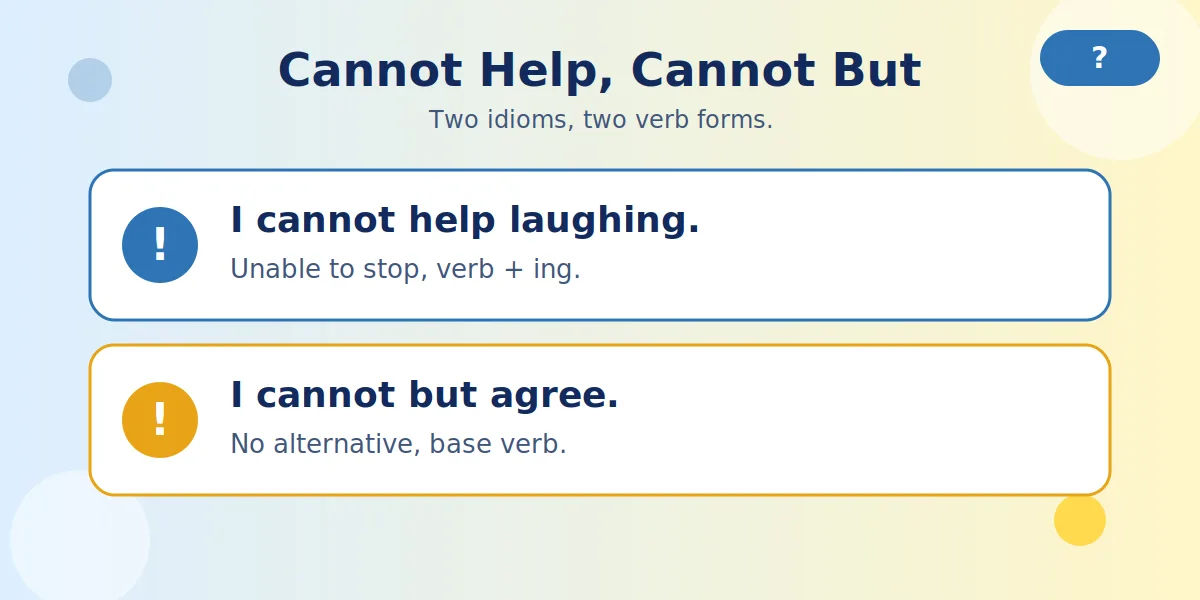
These three expressions look similar, but they follow different grammatical patterns. They all relate to being unable to avoid something or having no alternative.
1. Cannot Help + Verb Ending in -ing
Use cannot help followed by a gerund (verb ending in -ing). It means you cannot stop yourself from doing something. Examples: I cannot help laughing at that joke. She cannot help worrying about her family. He cannot help thinking about the future. We cannot help admiring her determination.
2. Cannot But + Base Verb
The expression cannot but means that someone cannot do otherwise than perform an action. It is relatively formal and sometimes sounds old-fashioned. Examples: I cannot but agree with your decision. We cannot but admire their courage. She cannot but wonder what happened. You cannot but notice the difference. Cambridge Dictionary identifies cannot but as a formal expression.
3. Cannot Help But + Base Verb
The expression cannot help but means being unable to avoid doing something, followed by the base form of a verb. Examples: I cannot help but smile. She cannot help but notice the mistake. We cannot help but appreciate your support. He cannot help but laugh at the situation. This construction is widely accepted in modern English. Collins Dictionary also explains that both cannot help and cannot help but are established expressions.
| Expression | Verb pattern | Meaning |
|---|---|---|
| Cannot help laughing | Help + gerund | Unable to stop laughing |
| Cannot but agree | But + base verb | Cannot do otherwise than agree |
| Cannot help but agree | Help but + base verb | Unable to avoid agreeing |
For general writing, cannot help + gerund is a clear and reliable choice. However, do not automatically label cannot help but incorrect. It is an established expression with wide modern use.
Common Mistakes With Cannot and Can Not
Writers often confuse these forms because they look similar. A few simple rules can prevent most errors, and each one below is a common trap in cannot vs can not.
1. Using Can Not for Every Negative Sentence
The most common mistake is separating can and not in ordinary negative statements. Incorrect: I can not understand the question. Correct: I cannot understand the question. Use the one-word form when you simply want to negate can.
2. Confusing Cannot Only With Can Not Only
Incorrect: She cannot only speak French but also write it. Correct: She can not only speak French but also write it. The second sentence uses the correlative construction not only…but also.
3. Confusing Cant With Can’t
The apostrophe changes the word. Can’t is the contraction of cannot. Cant is a separate, uncommon noun. It can refer to insincere or conventional language, or specialized language or jargon. Examples: I can’t attend the meeting. The politician’s speech was full of cant. Collins Dictionary recognizes these as separate entries with different meanings.
4. Writing Cann’t Instead of Can’t
Cann’t is not a standard English spelling. The correct contraction is can’t. Incorrect: I cann’t understand him. Correct: I can’t understand him.
5. Writing Couldnot Instead of Could Not
The negative form of could always uses two words. Unlike cannot, could not does not combine into one word. Incorrect: She couldnot attend the meeting. Correct: She could not attend the meeting. You can also use the contraction couldn’t in informal writing.
6. Confusing Can’t Not With Cannot
The expression can’t not can be grammatically correct. It means someone cannot avoid doing something, even when they might otherwise choose not to. Example: I can’t not help my best friend when she needs me. This means helping feels unavoidable. However, this construction can confuse readers. You can often rewrite it more clearly: “I have to help my best friend when she needs me.”
| Incorrect or misunderstood form | Correct form or explanation |
|---|---|
| Can not understand | Cannot understand |
| Cannot only sing but also dance | Can not only sing but also dance |
| Cant attend | Can’t attend |
| Cann’t attend | Can’t attend |
| Couldnot finish | Could not finish |
| Can’t not help | Grammatically possible, but sometimes clearer when rewritten |
How to Remember Cannot vs Can Not
The easiest way to remember the spelling is to treat cannot as your default choice. Only separate the words when the sentence structure gives not a separate grammatical role.
The Simple Memory Trick
Remember these three rules: 1. Cannot: Use one word for ordinary negative statements. 2. Can not: Use two words for constructions such as not only…but also, the ability not to act, and certain negative questions. 3. Can’t: Use the contraction when an informal tone is appropriate.
| Form | Memory example |
|---|---|
| Cannot | I cannot attend. |
| Can not | We can not only plan but also organize. |
| Can’t | I can’t attend. |
A Three-Step Decision Test
Step 1: Are you simply making can negative? If yes, write cannot. Example: She cannot drive. Step 2: Does not belong to a separate phrase or express a choice not to act? If yes, write can not. Example: You can not go if you prefer to stay home. Step 3: Is the sentence a negative question with the subject between can and not? If yes, keep the words separate. Example: Can we not talk about this tomorrow? If none of these situations applies, cannot is usually the right choice for ordinary negation. This simple test makes the distinction in cannot vs can not easier to remember.
Cannot vs Can Not Examples in Everyday Writing
Examples in Everyday Conversations
| Sentence | Usage |
|---|---|
| I cannot believe you won! | Emphasizing disbelief |
| She cannot find her glasses. | Expressing inability |
| You can not come if you feel tired. | Giving someone a choice |
| Can we not talk about work tonight? | Asking to avoid a subject |
| He can’t understand the instructions. | Informal negative statement |
Examples in Text Messages
- I can’t make it tonight.
- I cannot answer your call right now.
- You can not come if you have other plans.
- She can’t wait to see you.
- Can we not discuss this over text?
Examples in Professional Emails
- I cannot attend the scheduled meeting.
- We cannot approve your request without additional documents.
- The company cannot guarantee delivery by Friday.
- Our team can not only review the proposal but also provide recommendations.
- You can choose not to participate in the optional training session.
Examples in Academic Writing
- The results cannot prove the original hypothesis.
- Students cannot submit assignments after the deadline.
- This study cannot establish a direct relationship between the variables.
- The research can not only identify the issue but also suggest possible solutions.
- The available evidence cannot support that conclusion.
Examples in Negative Questions
- Can we not finish this tomorrow?
- Can you not see the difference?
- Can they not wait another hour?
- Can she not join us later?
- Can we not try a different approach?
Remember that negative questions can express different intentions. When you review cannot vs can not in questions, check where the subject sits.
Practice: Cannot or Can Not?
Now test your understanding with these 10 fill-in-the-blank questions. Choose the correct form for each sentence: cannot, can not, can’t, or not (where the blank itself is the word not).
- I ______ attend the meeting because I have another appointment.
- She can ______ only speak Spanish but also write it.
- You can ______ go to the party if you would rather stay home.
- Can we ______ talk about this tomorrow?
- He ______ drive because he has never learned.
- We ______ accept the proposal under these conditions.
- They can ______ only reduce expenses but also increase efficiency.
- I ______ believe how quickly the year passed!
- I ______ come to dinner tonight because I have other plans.
- The museum ______ allow visitors inside after closing.
Answer Key and Explanations
| No. | Answer | Explanation |
|---|---|---|
| 1 | Cannot | Ordinary negative statement expressing inability. |
| 2 | Not | Begins the phrase not only…but also. |
| 3 | Not | Expresses the option not to attend. |
| 4 | Not | Negative question with the subject between can and not. |
| 5 | Cannot | Expresses a lack of ability. |
| 6 | Cannot | Ordinary negative statement expressing refusal or inability. |
| 7 | Not | Begins the not only…but also construction. |
| 8 | Cannot | Ordinary negative statement with emphasis. |
| 9 | Can’t | Informal contraction of cannot. |
| 10 | Cannot | Expresses a restriction on visitors. |
How did you do? If you answered all 10 correctly, you understand the main spelling rules. If you missed a few, review the decision test and the meaning-changing examples above.
Frequently Asked Questions
1. Is Cannot One Word or Two?
Cannot is normally one word in standard English. It is the negative form of can. The two-word spelling is correct only in certain grammatical situations, such as not only constructions, choices not to act, and negative questions.
2. Is Can Not Grammatically Correct?
Yes, can not is grammatically correct when not belongs to another phrase or expresses the choice not to act. It also works in negative questions where the subject appears between can and not.
3. Is Can’t the Contraction of Cannot?
Yes, can’t is the contraction of cannot. Both generally express the same negative meaning. The apostrophe marks the shortened form, and cannot itself is not a contraction. Use can’t in casual writing and cannot in formal writing for tone.
4. Is Cannot More Formal Than Can’t?
Generally, yes. Cannot is the full form and works well in academic papers, reports, and professional emails. Can’t is shorter and fits casual conversation, text messages, and informal writing. Choose cannot for formal work.
5. Is Cant the Same as Can’t?
No. Can’t means cannot and requires an apostrophe. Cant is a separate noun that can describe insincere language or specialized jargon, so the apostrophe changes the meaning completely. Check the apostrophe before you send a message.
6. Is Couldnot Ever Correct?
No. Couldnot is not a standard English spelling. Write could not as two separate words. You can also use the contraction couldn’t in informal writing. This rule stays the same in formal and casual writing.
7. Can You Write Can Not for Emphasis?
Emphasis alone does not require two words. Write cannot and emphasize the negative through speech or italics. Separating the words changes the grammar, so it should only follow a valid construction.
Conclusion
The main rule is simple. Cannot is the standard one-word negative form of can. Use can not when not belongs to another grammatical construction. The main examples include not only…but also, the ability not to act, and certain negative questions. Use can’t when you want a shorter, more conversational form. When checking cannot vs can not, focus on the sentence’s meaning and structure. If you are simply expressing an ordinary negative, cannot is the correct choice.
Related Guides
- Which vs That: https://clarifywords.com/which-vs-that/
- A vs An: https://clarifywords.com/a-vs-an/
- Lead or Led: https://clarifywords.com/lead-or-led/
- Fewer vs Less: https://clarifywords.com/fewer-vs-less/
- Canceled or Cancelled: https://clarifywords.com/canceled-or-cancelled/
- Spelling Differences category: https://clarifywords.com/category/spelling-differences/