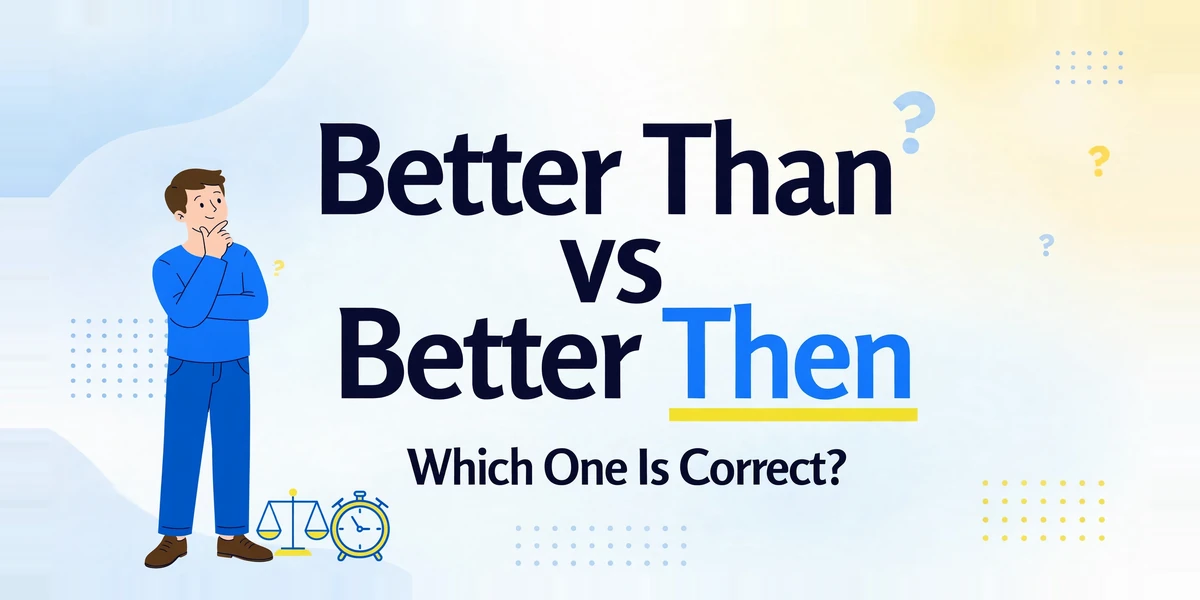
Better Than or Better Then: Which One Is Correct?
Quick answer: When comparing two things, use “better than.” Use “better then” only when then refers to a time or sequence. If you are unsure about better than or better then, remember this simple rule: Than introduces a comparison, while then usually refers to time, order, or a result.
- Correct: This book is better than the last one.
- Incorrect: This book is better then the last one.
- Correct: Things were better then.
- Correct: Things were better then than they are now.
The last example uses both words correctly. Then refers to the past, while than introduces the comparison with the present.
Table of Contents
- Better Than vs Better Then at a Glance
- What “Better Than” Means
- When “Better Then” Is Actually Right
- Why People Mix Them Up
- How to Remember Than vs Then
- Then in Full: More Than Just Time
- The Than Family: Other Phrases That Take Than
- Better Than I or Better Than Me?
- Time Comparisons Still Take Than
- Common Than and Then Mistakes
- Examples in Real Sentences
- A Quick Memory Trick
- Practice Questions
- Frequently Asked Questions
- Final Takeaway
- Related Guides
Better Than vs Better Then at a Glance
The question of better than or better then comes down to meaning. Than connects parts of a comparison. Then usually tells readers when something happened or what happened next.
| Word or phrase | Part of speech or role | Meaning | Quick test | Example |
|---|---|---|---|---|
| Than | Conjunction or preposition | Introduces a comparison | Does it mean “compared with”? | Mia is taller than Sam. |
| Then | Usually an adverb | Refers to a time | Does it mean “at that time”? | Mia was shorter then. |
| Then | Adverb | Shows what happens next | Does it mean “after that”? | Mia grew taller, then joined the team. |
| Then | Adverb | Shows a result or conclusion | Does it mean “in that case”? | If Mia agrees, then we can begin. |
Purdue OWL also separates the words this way. It lists comparison, preference, and quantity uses for than. It lists time, sequence, and logical conclusions for then.
The easiest way to tell them apart
Try replacing the word with a similar expression:
- If “compared with” makes sense, use than.
- If “at that time” makes sense, use then.
- If “after that” makes sense, use then.
- If “in that case” makes sense, use then.
For example:
- This route is better than the old one. This route is better compared with the old one.
- The route was better then. The route was better at that time.
What “Better Than” Means
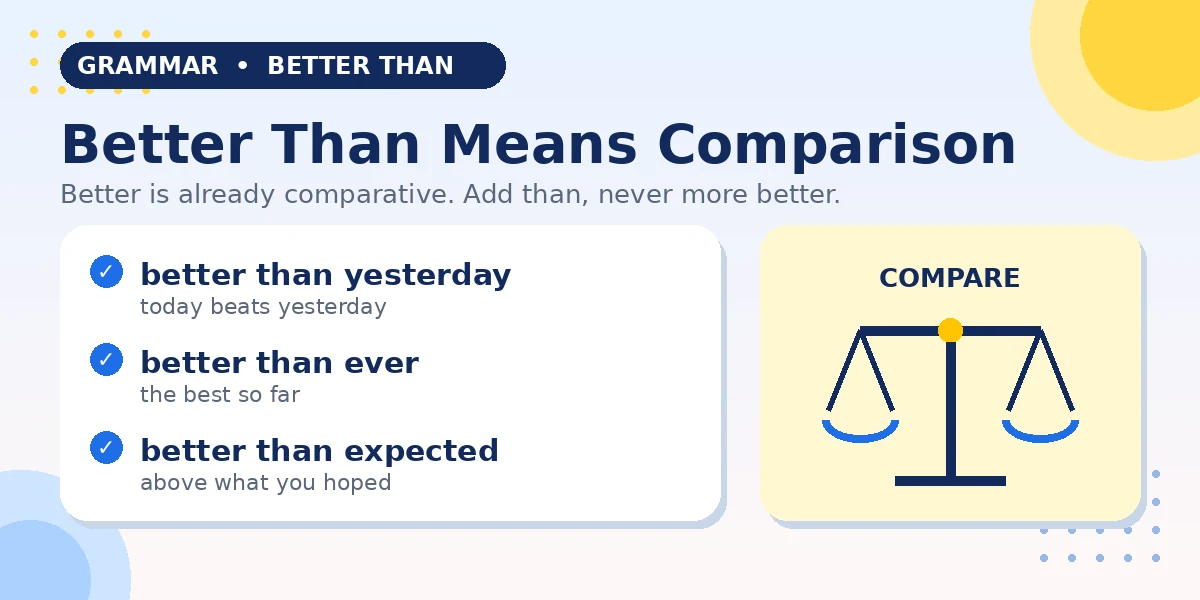
“Better than” is the correct phrase when you compare one person, thing, choice, or situation with another. Most searches about better than or better then are really asking about this comparison use. The word better is the comparative form of good or well. The word than introduces the second part of the comparison.
For example:
- This phone is better than my old one.
- Her explanation was better than mine.
- The weather is better than yesterday.
- Your results are better than expected.
- I feel better than before.
- This option is better than nothing.
In each sentence, than connects two things being compared.
Why “better” needs “than”
Comparative adjectives show that one thing has more or less of a quality than another. Cambridge Grammar notes that a comparative adjective is followed by than when introducing the second part of a comparison.
Consider these examples:
- My new laptop is better than my old laptop.
- This lesson is easier than the last one.
- The blue shirt is cheaper than the black shirt.
- Her second attempt was worse than her first.
The same pattern works with better.
Correct: The new plan is better than the original plan.
Incorrect: The new plan is better then the original plan.
The second sentence uses a time word where a comparison word belongs.
Is “more better” correct?
No. Avoid “more better” in standard English.
Better already expresses comparison. Adding more repeats the comparative meaning.
Use:
- Correct: This version is better than the first.
- Incorrect: This version is more better than the first.
The superlative form is best. Use it when identifying the highest degree among a group.
- This is the best option.
- She is the best player on the team.
When “Better Then” Is Actually Right
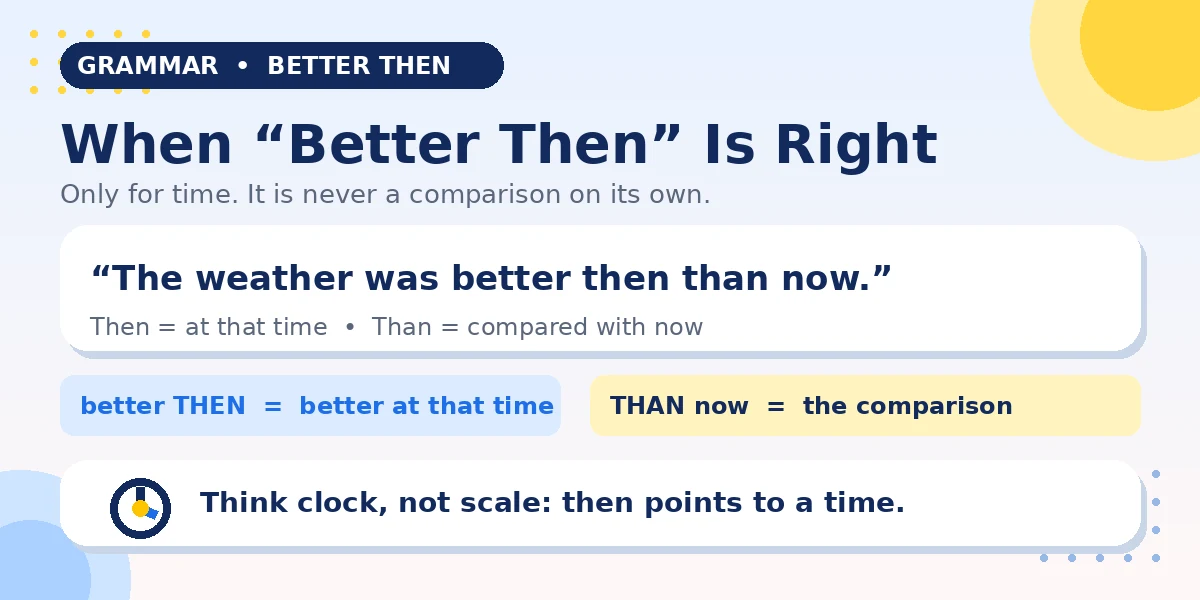
Although “better then” is usually wrong in comparisons, the two words can appear together correctly. This point answers the heart of better than or better then. This happens when then refers to a particular time.
For example:
The weather was better then.
Here, then means “at that time.” The sentence compares nothing directly. It simply describes the weather during that period.
Other examples include:
- Life seemed better then.
- I was much happier then.
- The service was better then than it is today.
- Things were better then, before the company changed its rules.
Why “better then than now” is correct
Look closely at this sentence:
Things were better then than they are now.
Both words are correct because they have different jobs.
- Then means “at that time.”
- Than introduces the comparison between the past and the present.
The sentence compares two periods: the past and now.
Here is another example:
The roads were better then than they are today.
The first word refers to the past. The second word connects the comparison.
“Then” can also show what happened next
Sometimes then follows a statement about improvement or change. It shows the next event.
For example:
- I felt better, then I returned to work.
- She got better, then she started training again.
- The situation improved, then it changed again.
These sentences do not use then to introduce a comparison. It shows the order of events.
Why People Mix Them Up
People searching for better than or better then may find the choice confusing. The words look similar and can sound alike in everyday speech.
A few factors make the mistake easier.
They differ by only one letter
The words have nearly identical spelling:
- Than has an a.
- Then has an e.
When typing quickly, it is easy to choose the wrong word.
They can sound similar
In some accents and fast speech, the difference between their vowel sounds may be less noticeable.
That makes the mistake harder to catch by listening alone. Reading the sentence for meaning is more reliable.
Both words are real words
Spellcheck tools may not flag the wrong choice. Both than and then are correctly spelled English words.
A spelling checker may accept this sentence:
This laptop is better then my old one.
But the word choice is wrong. The sentence needs than because it compares two laptops.
Their meanings are different but sometimes appear close together
A sentence can use both words naturally:
I was happier then than I am now.
This can make the distinction seem confusing. Remember that then points to a time, while than introduces the comparison.
How to Remember Than vs Then
You can use a few quick checks to choose the right word. These checks settle better than or better then in seconds.
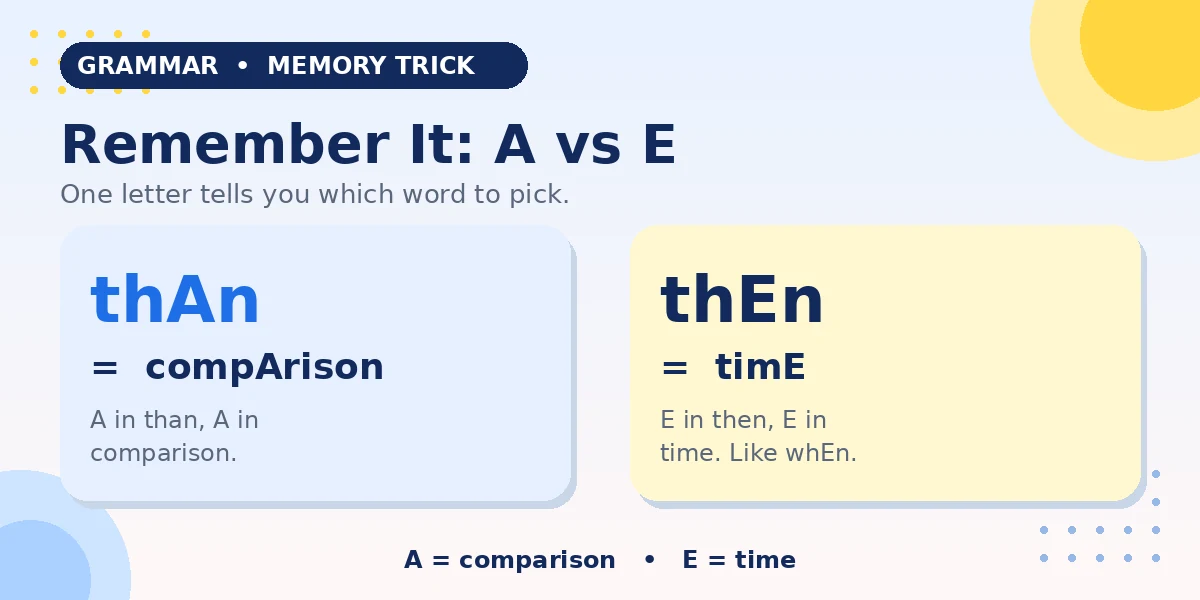
1. Use the A and E memory trick
Remember:
- ThAn = compArison.
- ThEn = timE.
The letter A in than can remind you of comparison. The letter E in then can remind you of time.
Examples:
- My room is cleaner than yours.
- My room was smaller then.
2. Try the replacement test
Replace the word with a phrase that has the same meaning.
Use than if “compared with” fits.
- This restaurant is better than that one.
- This restaurant is better compared with that one.
Use then if “at that time” fits.
- The restaurant was better then.
- The restaurant was better at that time.
If neither replacement works, check whether then means “after that” or “in that case.”
3. Look for a comparative word
Words such as better, worse, faster, slower, more, and less often introduce comparisons.
They commonly take than when naming the second person or thing.
Examples:
- faster than a train
- worse than before
- more useful than expected
- less expensive than the alternative
- better than the original
This is a helpful clue, not a rule that replaces checking the sentence’s meaning.
4. Look for an order of events
If a sentence describes what happened first and what happened next, use then.
For example:
- First, read the instructions. Then, start the test.
- We ate dinner, then watched a movie.
- She finished her work and then went home.
Here, then means “after that.”
Then in Full: More Than Just Time
The word then has several uses beyond referring to a past time. Knowing them helps you answer better than or better then with confidence. Understanding them helps you avoid confusing it with than.
Then means “at that time”
Use then to refer to a time already mentioned or understood.
Examples:
- I lived in Chicago then.
- Things were different back then.
- We did not know each other then.
- The store was open until 9 p.m. then.
Then means “next” or “after that”
Use then to show the order of events or steps.
Examples:
- Wash the vegetables, then cut them.
- She checked the address and then called a taxi.
- First, submit the form. Then, wait for confirmation.
Then can mean “in addition”
In some contexts, then adds another point to what someone has said.
Examples:
- The hotel is expensive, and then there are parking fees.
- He missed the meeting, and then he forgot to send the report.
This use often adds emphasis to another detail.
Then can show a result or conclusion
Use then to introduce a result, conclusion, or logical next step.
Examples:
- If you finish early, then you can leave.
- If the store is closed, then we will come back tomorrow.
- You have the correct address, so then you should find the building easily.
In these examples, then is close in meaning to “in that case.”
Then can follow “but”
The phrase but then can introduce a contrast, explanation, or change in thought.
Examples:
- I wanted to leave, but then the rain stopped.
- The plan sounds expensive, but then it could save time.
- I thought the task was difficult, but then I tried it.
Then can work as a noun
In some expressions, then refers to a particular time.
Examples:
- I have not seen her since then.
- We will discuss the details until then.
- Things have changed a lot since then.
Then can work as an adjective
The adjective then describes someone or something as it existed at a past time.
Examples:
- The then president introduced a new policy.
- The then manager approved the request.
- The then owner had a different plan.
In these sentences, then means “who was president, manager, or owner at that time.”
These different uses explain why then can appear in many sentence structures. They do not make it a substitute for than.
The Than Family: Other Phrases That Take Than
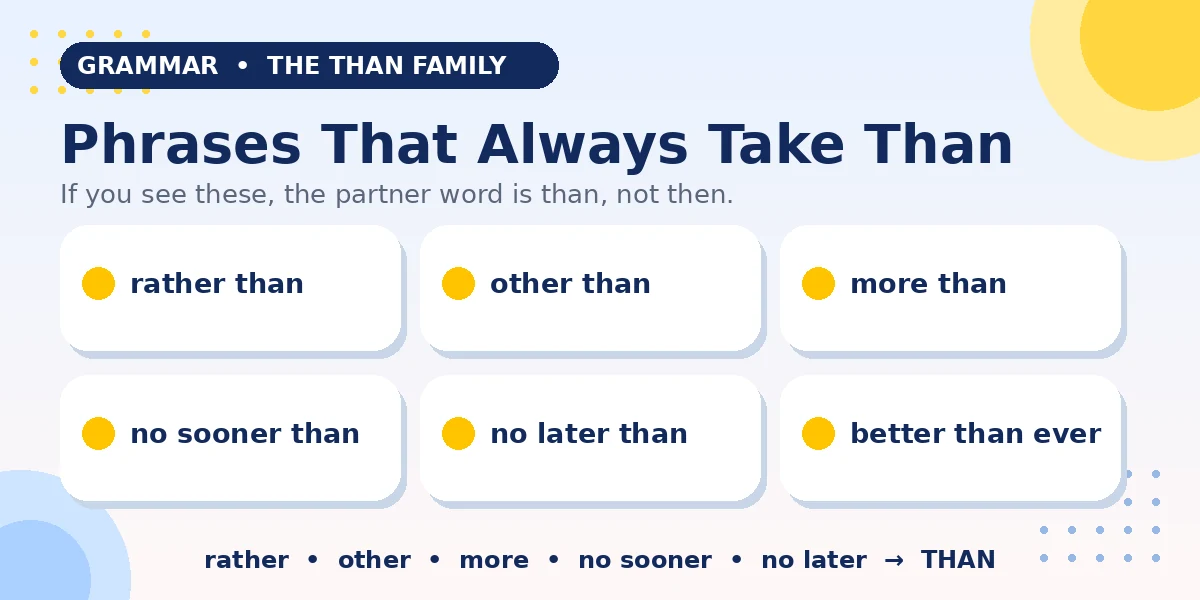
The word than appears in several common expressions. Each one also helps explain better than or better then, because than always signals a comparison here. These phrases express comparisons, preferences, exceptions, or contrasts.
More than and less than
Use more than and less than to compare amounts, numbers, or degrees.
Examples:
- The box weighs more than five pounds.
- We waited less than an hour.
- She has more experience than I do.
- The repair costs less than expected.
Incorrect: The box weighs more then five pounds.
Rather than
Use rather than to express a preference or choice.
Examples:
- I would walk rather than drive.
- She chose tea rather than coffee.
- We should call rather than send another email.
Incorrect: I would walk rather then drive.
Other than
Use other than to mean “except,” “apart from,” or “besides.”
Examples:
- I have no plans other than studying.
- Everyone agreed other than Mark.
- The room was empty other than a small table.
Incorrect: I have no plans other then studying.
No sooner than
The expression no sooner than connects two events. It often shows that one event happened immediately after another.
Examples:
- No sooner had I arrived than the meeting began.
- No sooner did she sit down than the phone rang.
No later than
Use no later than to set a deadline or latest acceptable time.
Examples:
- Please submit your application no later than Friday.
- The payment must arrive no later than noon.
- We need your response no later than tomorrow.
Better than ever and better than expected
These phrases compare something with an earlier state or an expectation.
Examples:
- The business is doing better than ever.
- The food tasted better than expected.
- Her performance was better than before.
- The result was better than we had hoped.
Common expressions with than
Several familiar expressions also use than.
| Expression | Meaning | Example |
|---|---|---|
| Better late than never | Doing something late is better than not doing it | He finally apologized. Better late than never. |
| Better safe than sorry | Taking care is wiser than risking a problem | Save a copy. Better safe than sorry. |
| Easier said than done | Something is easier to talk about than to do | Staying calm is easier said than done. |
| More than meets the eye | Something has hidden details | There is more to this story than meets the eye. |
Remember the spelling in each phrase. These expressions use than because they involve comparisons or contrast.
Better Than I or Better Than Me?
Both “better than I” and “better than me” can be correct. The best choice depends on the sentence structure and intended meaning.
In everyday English, “better than me” is natural and widely accepted. In more formal writing, you may use a subject pronoun with a complete clause.
When to use “better than me”
Use me when than functions as a preposition and introduces an object.
Examples:
- She is better than me at chess.
- This phone is better than mine.
- He runs faster than her.
- You are a better cook than me.
Cambridge says personal pronouns after than normally use the object form, such as me, him, and them.
When to use “better than I am”
Use I when it begins a clause with an understood or written verb.
Examples:
- She is better at chess than I am.
- He is more experienced than I am.
- They are more prepared than we are.
In formal writing, the complete clause makes the grammar clear.
Why “than I” and “than me” can change the meaning
Look at this example:
Ruth likes Jerry better than I.
This means Ruth likes Jerry more than I like Jerry. The implied words are like Jerry.
Now compare:
Ruth likes Jerry better than me.
This means Ruth likes Jerry more than she likes me.
The pronoun changes the meaning because it plays a different role in the comparison. The Government of Canada’s Language Portal supports this distinction.
If you want to avoid confusion, write the full clause:
- Ruth likes Jerry more than I do.
- Ruth likes Jerry more than she likes me.
Time Comparisons Still Take Than
A sentence can compare two times and still need than. This trap confuses many searches about better than or better then. The fact that a sentence mentions time does not automatically make then correct.
Use than when comparing dates, periods, durations, or expectations.
Examples:
- Today is warmer than yesterday.
- I arrived later than expected.
- She finished sooner than I did.
- The meeting lasted longer than planned.
- This year feels better than last year.
Common time-related phrases
| Phrase | Correct example |
|---|---|
| Later than | We arrived later than the others. |
| Earlier than | The store opened earlier than usual. |
| Sooner than | The package arrived sooner than expected. |
| Longer than | The trip took longer than planned. |
| Better than yesterday | I feel better than yesterday. |
| No later than | Send the form no later than Monday. |
| No sooner than | No sooner had we started than it began to rain. |
Compare these two sentences:
- Correct: I felt better then.
- Correct: I felt better than yesterday.
The first refers to a past time. The second compares how you felt with how you felt yesterday.
Common Than and Then Mistakes
When checking better than or better then, identify what the sentence means. Does it compare two things, or describe time and sequence?
Use this table as a quick reference.
| Incorrect sentence | Correct sentence | Why |
|---|---|---|
| I like apples better then oranges. | I like apples better than oranges. | It compares two foods. |
| This phone is better then mine. | This phone is better than mine. | It compares two phones. |
| I’m better then him at tennis. | I’m better than him at tennis. | It compares skill. |
| The test was harder then I expected. | The test was harder than I expected. | It compares difficulty with an expectation. |
| I’d rather read then watch TV. | I’d rather read than watch TV. | It expresses a preference. |
| More then 50 people attended. | More than 50 people attended. | It describes a quantity. |
| Other then the price, I like it. | Other than the price, I like it. | It means “apart from the price.” |
| She is a better editor then her predecessor. | She is a better editor than her predecessor. | It compares two editors. |
| Eat now, than have dessert. | Eat now, then have dessert. | It shows the order of actions. |
| We mixed the samples, than labeled them. | We mixed the samples, then labeled them. | Labeling happened next. |
| More then ever, I enjoy reading. | More than ever, I enjoy reading. | It compares the present with earlier times. |
| No later then Friday. | No later than Friday. | It sets a deadline. |
| Winter arrives later then autumn. | Winter arrives later than autumn. | It compares seasons. |
Watch out for the reverse mistake
People sometimes use than when they need then. This error usually appears in instructions or descriptions of events.
For example:
Incorrect: Finish your homework, than go outside.
Correct: Finish your homework, then go outside.
The second action follows the first. That is why then is correct.
Examples in Real Sentences
These examples show how to use the two words in everyday writing, schoolwork, and professional communication. They also show better than or better then in real contexts.
In everyday conversation
- My new shoes are more comfortable than my old ones.
- I was happier then, before I moved.
- This coffee tastes better than the one I had yesterday.
- We watched a movie, then ordered dinner.
- You are better at drawing than I am.
In school and academic writing
- The second answer is more accurate than the first.
- The results were better than the researchers expected.
- Read the chapter first, then answer the questions.
- The class performed better than it did last semester.
- The earlier experiment was more successful than the later one.
In emails and professional messages
- The updated report is clearer than the previous version.
- Please review the document, then send your comments.
- The new process is faster than the old one.
- The meeting ended earlier than expected.
- The system worked better then, before the latest update.
Quick wrong-and-right examples
| Wrong | Right |
|---|---|
| This is better then I thought. | This is better than I thought. |
| She is taller then her brother. | She is taller than her brother. |
| I will call you than. | I will call you then. |
| We talked, than left. | We talked, then left. |
| Things were better then than now. | Things were better then than now. |
The final example is already correct. Then refers to the past, while than introduces the comparison with now.
A Quick Memory Trick
Keep this short rule in mind for better than or better then:
A for comparison, E for time.
- ThAn = compArison.
- ThEn = timE.
Then ask yourself one question before choosing the word:
Am I comparing something or describing what happened when?
- Comparing two things? Choose than.
- Referring to a time? Choose then.
- Showing what happens next? Choose then.
- Introducing a result? Choose then.
For example, write “better than yesterday” when comparing two days. Write “better then” when describing a past time.
Practice Questions: Than or Then?
Test your understanding of better than or better then with these 10 questions. Choose the correct word for each blank.
- This movie is better _____ the one we watched last week.
- I was much happier _____, before I changed jobs.
- Finish your dinner, _____ you can have dessert.
- The journey took longer _____ we expected.
- She is a better singer _____ her brother.
- We visited the museum and _____ went to lunch.
- This explanation is clearer _____ the previous one.
- Things were better _____ than they are now.
- No sooner had I arrived _____ the meeting started.
- I would rather stay home _____ go out tonight.
Answer key
- Than. The sentence compares two movies.
- Then. It refers to a particular time in the past.
- Then. It shows what happens after dinner.
- Than. It compares the journey’s length with an expectation.
- Than. It compares two singers.
- Then. It shows the order of two activities.
- Than. It compares two explanations.
- Then. It refers to an earlier time. The comparison uses the second word, than.
- Than. The expression is the fixed construction no sooner than.
- Than. The phrase rather than expresses a preference.
If you missed any questions, review the comparison and sequence tests. They will help you choose the right word next time.
Frequently Asked Questions
1. Is it better than or better then?
“Better than” is correct when comparing two things. Use then only when referring to a time or sequence. For example, “This phone is better than mine” compares phones. “Things were better then” refers to the past.
2. Is it better than I or better than me?
Both forms can be correct, depending on the sentence. “Better than me” is natural in everyday English. “Better than I am” uses a complete clause and often suits formal writing. Choose the form that expresses your intended meaning.
3. Is “better then ever” correct?
No. The standard expression is “better than ever.” It compares the current state with earlier conditions. For example, “Her business is doing better than ever.” Use then only when it refers to a particular time.
4. Can than and then ever be used interchangeably?
No. The words have different meanings and grammatical roles. Than introduces comparisons, while then refers to time, sequence, or a result. Replacing one with the other can make a sentence incorrect or change its meaning.
5. Is it rather than or rather then?
The correct expression is “rather than.” It introduces a preference or choice between options. For example, “I would rather walk than drive.” Use then for sequence, not when expressing this kind of preference.
6. Is it more than or more then?
Use “more than” when comparing amounts, numbers, or degrees. For example, “More than 100 people attended the event.” Use then when describing what happens next or referring to a particular time.
7. How can I remember than vs then easily?
Remember A for comparison and E for time. The letter A in than reminds you of comparison. The letter E in then reminds you of time. You can also replace each word with “compared with” or “at that time.”
Final Takeaway
The choice between better than or better then depends on what your sentence means.
Use than when comparing people, objects, amounts, or situations. Use then when referring to a time, showing a sequence, or introducing a result.
Remember these examples:
- Better than: This version is better than the old one.
- Better then: Things were better then.
- Both words: Things were better then than they are now.
When unsure about better than or better then, check the meaning instead of relying only on spelling or sound. That simple habit will help you choose the right word.
Related Guides
Explore more grammar guides from ClarifyWords:
- Fewer vs Less: https://clarifywords.com/fewer-vs-less/
- Which vs That: https://clarifywords.com/which-vs-that/
- A vs An: https://clarifywords.com/a-vs-an/
- Lead or Led: https://clarifywords.com/lead-or-led/
- Lay or Laid: https://clarifywords.com/lay-or-laid/
- Choose or Chose: https://clarifywords.com/choose-or-chose/
- May vs Might: https://clarifywords.com/may-vs-might/
- Analysis vs Analyses: https://clarifywords.com/analysis-vs-analyses/
- Grammar category: https://clarifywords.com/category/grammar/