DW Meaning in Text: What Does DW Mean in a Text Message?
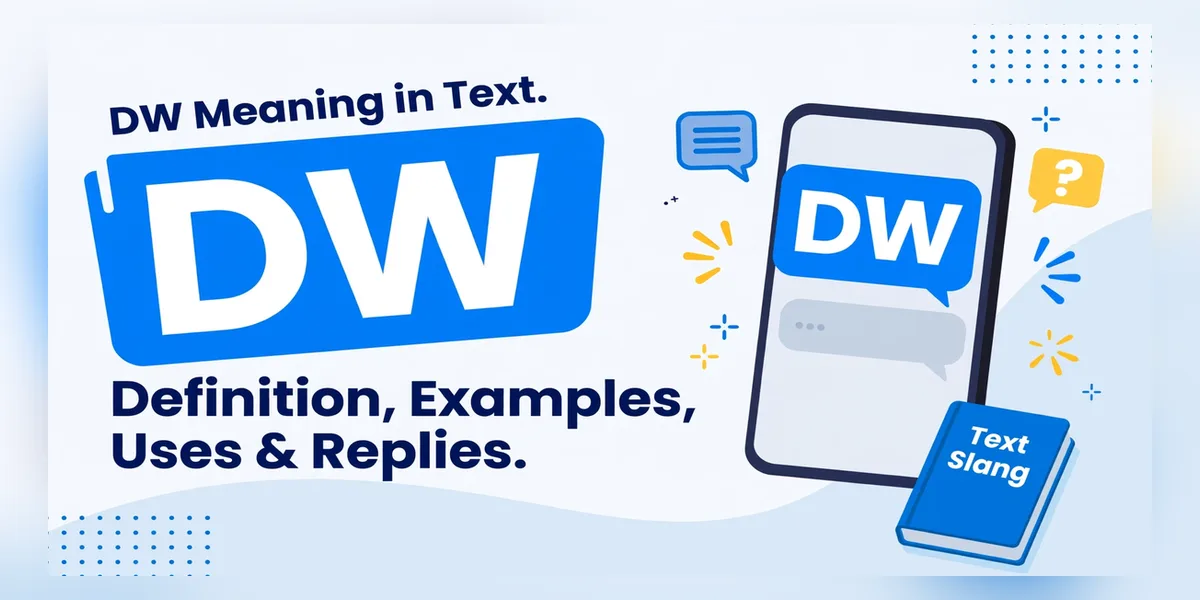
If someone texts you "dw," they usually mean "don’t worry." It is a casual way to reassure someone, accept a small apology, or make a problem seem less serious. For the dw meaning in text, this guide explains its common uses, tone, and replies.
However, DW has another meaning in marriage and parenting forums. It can stand for "dear wife" or "darling wife." In those places, DW refers to a person, not a reassuring message.
Table of Contents
- Quick Answer
- What DW Stands For
- DW at a Glance
- How to Tell Which Meaning DW Has
- Common Uses of DW in Text Messages
- What Does DW About It Mean?
- Does DW Sound Warm, Flat, or Cold?
- DW Meaning on Different Platforms
- How to Reply When Someone Texts DW
- DW vs. No Worries, NP, NBD, and All Good
- Other Meanings of DW
- When Not to Use DW
- Common Mistakes When Understanding DW
- Where Did DW Come From?
- An Easy Memory Trick for DW
- Practice Questions With Answer Key
- Frequently Asked Questions
- Final Takeaway
Quick Answer
DW means "don’t worry" in text messages and online chats. People use it to reassure someone, respond to an apology, or make a small problem seem less serious.
In marriage and parenting forums, DW can also mean "dear wife" or "darling wife." Context tells you which meaning fits.
If you searched for the dw meaning in text, the short answer is usually "don’t worry." Check the surrounding message to make sure.
What DW Stands For
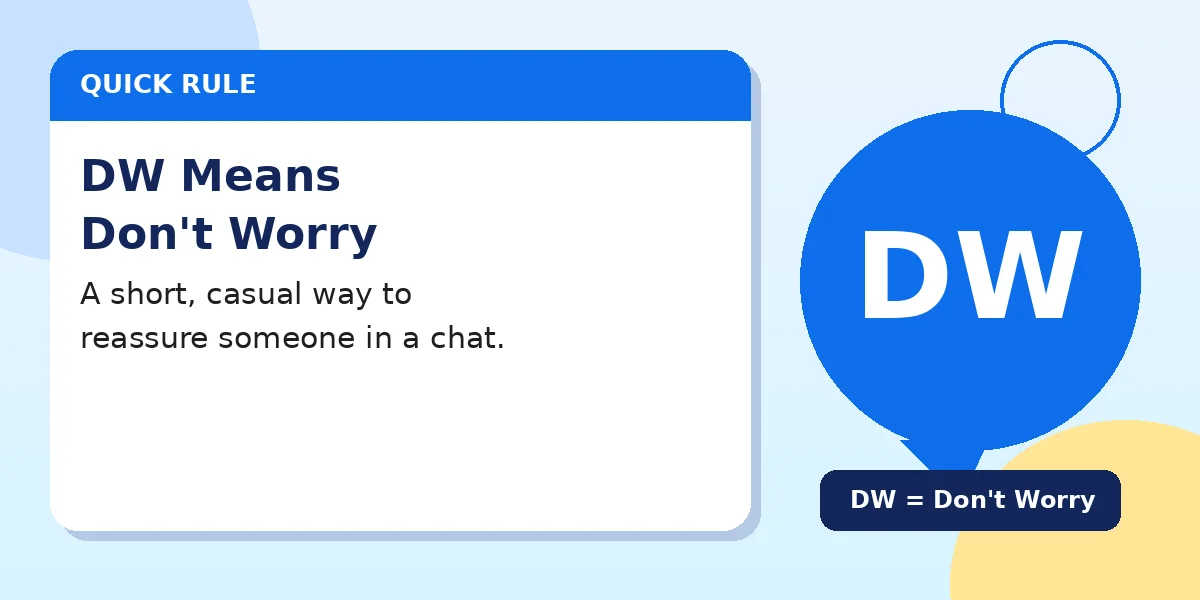
DW is an initialism made from the first letters of "don’t worry." People use it as a quick way to tell someone not to worry.
For example, a friend might apologize for replying late. You can answer "dw" to show that you are not upset.
DW Means Don’t Worry in Everyday Texting
The main texting meaning of DW is "don’t worry." It works as a short, reassuring response in casual chats.
People commonly use it when:
- Someone apologizes for a small mistake.
- A friend worries about arriving late.
- Someone feels nervous about an upcoming event.
- A person thinks they have caused an inconvenience.
- Someone needs reassurance about a minor problem.
DW can also appear before another sentence. For example, "DW, I’ll bring the extra tickets" reassures someone and offers a solution.
When people ask about the dw meaning in text, they usually want to know whether the sender is offering reassurance. In everyday messages, that is usually the case.
DW Can Also Mean Dear Wife or Darling Wife
In marriage and parenting forums, DW can refer to someone’s wife. People use it affectionately when discussing their spouse or family life. You may also see related abbreviations:
- DH: Dear husband or darling husband.
- DS: Dear son or darling son.
- DD: Dear daughter or darling daughter.
For example: "My DW planned our anniversary dinner." Here, DW refers to the writer’s wife. It does not mean "don’t worry."
Is DW an Initialism or an Acronym?
DW is an initialism because you say its letters individually. You pronounce it as "D-W," not as one word.
An acronym forms a word from its initial letters. NASA is one example.
When DW means "don’t worry," it also works as a short imperative expression. It tells someone not to worry.
DW at a Glance
| Abbreviation | Full meaning | Common context |
|---|---|---|
| DW / dw | Don’t worry | Text messages and online chats |
| DW | Dear wife | Marriage and parenting forums |
| DW | Darling wife | Family and spouse discussions |
The meaning "don’t worry" is the natural choice in ordinary texting. This table sums up the dw meaning in text at a glance. The wife-related meanings appear in family and forum contexts.
Dictionary entries may list these meanings in different orders. That does not mean their order reflects how often people use each meaning in texting.
How to Tell Which Meaning DW Has
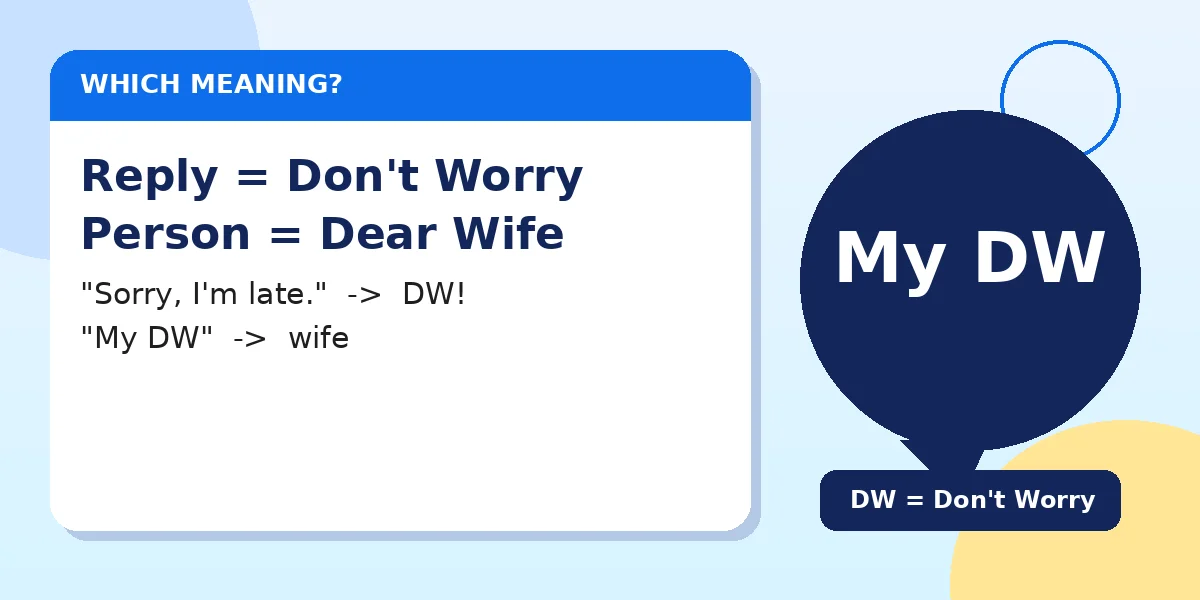
You can usually understand DW by looking at its place in the sentence. Check whether the sender uses DW as a reply or as a reference to a person.
When working out the dw meaning in text, start with the sentence structure. It often tells you more than the abbreviation alone.
1. Check Whether DW Is a Reply or a Reference
If DW answers an apology, concern, or question, it probably means "don’t worry." If it describes someone’s family member, it probably means "dear wife" or "darling wife."
Compare these examples: "Sorry I forgot your birthday!" "DW, it’s okay." Meaning: Don’t worry. "My DW made a great dinner." Meaning: Dear wife.
2. Look for Words Such as "My" and "And I"
Words around DW can reveal whether it refers to a person. For example: "My DW loves gardening." DW refers to someone’s wife. "DW and I are going shopping." DW refers to a spouse. "DW, you didn’t do anything wrong." DW means don’t worry.
The word "my" is a useful clue. It often signals that DW names a person.
3. Check What Comes Before and After DW
The sentence structure can help you identify the intended meaning.
| Text message | Likely meaning | Reason |
|---|---|---|
| "Sorry I’m late." "DW!" | Don’t worry | Reassuring reply |
| "My DW made dinner." | Dear wife | Refers to a person |
| "DW and I are visiting." | Dear wife | Part of the sentence subject |
| "I’m nervous about tomorrow." "DW, you’ll do great." | Don’t worry | Offers reassurance |
| "Picking up DW, then heading home." | Dear wife | Refers to someone being picked up |
4. Use the Conversation History
Sometimes a message does not provide enough information by itself. Read the previous messages before deciding what DW means. Consider the topic, relationship, and sender.
If the conversation is about an apology, "don’t worry" makes sense. If it discusses someone’s spouse, "dear wife" or "darling wife" may fit better.
Common Uses of DW in Text Messages
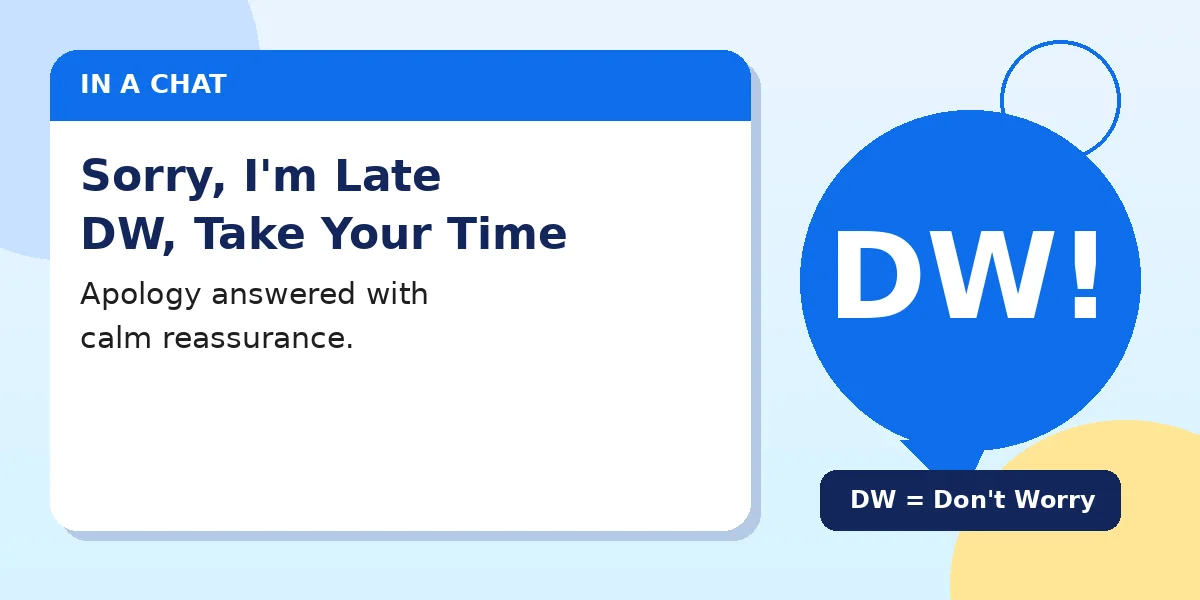
People use DW in everyday conversations to make others feel more comfortable. These cases show the dw meaning in text in action. Here are common situations.
If you’re learning the dw meaning in text, these examples show how people use it in everyday conversations.
When Someone Apologizes
DW can show that you accept a small apology. It tells the other person that you are not upset.
Example: Alex: "Sorry I forgot to send you the pictures." Jamie: "DW, you can send them later." Here, Jamie uses DW to remove pressure from Alex.
When Someone Is Running Late
You can use DW to reassure someone who cannot arrive on time.
Example: Mia: "Sorry, traffic is terrible. I’ll be 15 minutes late." Sam: "DW, take your time. I’m still at home." The reply shows that the delay is not a problem.
When Someone Makes a Small Mistake
DW can make someone feel better after a minor mistake.
Example: Chris: "I accidentally sent you the wrong document." Taylor: "DW, I found the correct one." The response keeps the conversation relaxed.
When Someone Feels Nervous or Worried
A friend may use DW to offer simple reassurance before an important event.
Example: Jordan: "I’m nervous about my driving test tomorrow." Riley: "DW, you’ve practiced so much. You’ll be fine." Here, DW introduces a supportive message.
When Someone Has Handled a Task
DW can also tell someone that they do not need to worry about a responsibility.
Example: Alex: "Did you remember to book the tickets?" Jamie: "DW, I already booked them." This response provides reassurance and confirms that the task is complete. However, DW alone does not confirm that a task is finished. The rest of the message must provide that detail.
For another useful texting abbreviation, see our guide to MYF meaning in text: https://clarifywords.com/myf-meaning-in-text/
What Does "DW About It" Mean?
"DW about it" means "don’t worry about it." It reassures someone that a particular problem or situation is not a concern. The phrase makes the intended meaning clearer than DW alone. It is a common next question once readers know the dw meaning in text.
DW vs. DW About It
| Expression | Meaning | Example |
|---|---|---|
| DW | Don’t worry | "DW, it’s fine." |
| DW about it | Don’t worry about it | "DW about it. I can fix it." |
| DW, it’s okay | Don’t worry, everything is fine | "DW, mistakes happen." |
Example conversation: Mia: "Sorry I spilled some water on the table." Alex: "DW about it. I’ll clean it up." Alex uses the longer expression to reassure Mia about the spill.
Other DW Variations
You may see DW alongside other words or shortened expressions.
- dw abt it: Shortened form of "don’t worry about it."
- dw lol: A casual way to reassure someone.
- dw, all good: Reassurance that everything is okay.
- DWBH: Can stand for "don’t worry, be happy."
These variations depend on the sender and conversation. They are not all equally common or universal.
Does DW Mean Don’t Wait?
"Don’t wait" is not a verified standard meaning of DW in texting. You should not assume someone means "don’t wait" when they send DW. The established everyday interpretation is "don’t worry."
You may also encounter DWU, meaning "don’t wait up," in some informal conversations. That is a separate expression.
Does DW Sound Warm, Flat, or Cold?
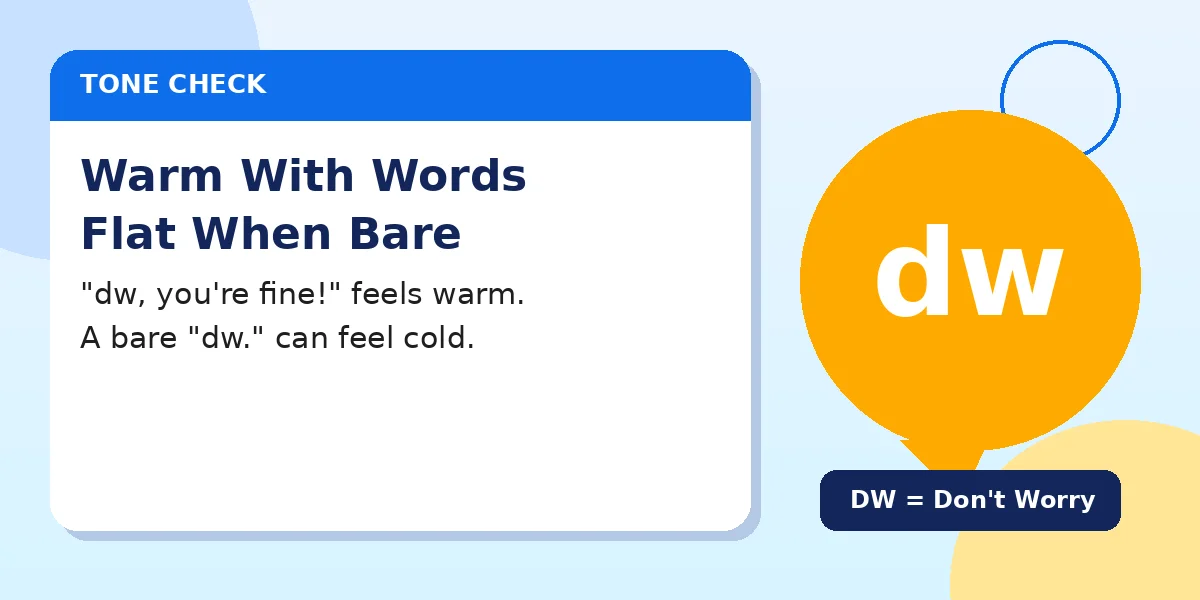
DW usually sounds casual and reassuring. Tone is a big part of the dw meaning in text, because two letters carry little detail on their own. However, the same two letters can feel different depending on the message and the situation. Your relationship with the sender also matters.
When DW Sounds Warm and Reassuring
DW can sound friendly when someone uses it to comfort you. For example:
- "dw, you’re totally fine!"
- "DW, I’ll help you with that."
- "dw, it happens to everyone."
Additional words make the reassurance clearer. They also show that the sender wants to help.
When DW Sounds Neutral or Casual
A simple "dw" can be a normal response between friends. For example: You: "Sorry I forgot to call." Friend: "dw" The sender may simply mean that everything is fine. A short reply does not automatically indicate anger.
When DW Sounds Cold or Dismissive
DW can feel dismissive when someone shares a serious problem. A two-letter response may seem too brief. For example: You: "I’m really worried about my job interview tomorrow." Friend: "dw." You might expect more encouragement or support. However, do not assume the sender is being rude. They may simply prefer short messages.
Does Capitalization Change DW’s Meaning?
No. Capitalization alone does not establish a different meaning.
| Form | Meaning or impression |
|---|---|
| dw | Casual, informal spelling |
| DW | Same meaning, often used in uppercase |
| Dw | Same possible meaning |
All three forms can mean "don’t worry." Context still determines whether DW refers to someone’s wife.
Does Punctuation Change the Tone?
Punctuation can affect how a short message feels. "dw!" can feel energetic and friendly. "dw." may feel flat or abrupt. "dw…" may suggest hesitation or uncertainty. "dw lol" can make the message feel more relaxed. These are possible interpretations, not fixed rules.
Can an Emoji Make DW Sound Friendlier?
Yes. An emoji can add emotional context to a short reply. For example: "dw" sounds simple and neutral. "dw haha" can sound playful. "dw, you’re good!" sounds more supportive. The sender’s usual texting style also matters. One message alone cannot always reveal their feelings.
DW Meaning on Different Platforms
The meaning of DW does not automatically change between messaging platforms. It usually means "don’t worry" in everyday chats.
If you are checking the dw meaning in text on a specific app, the surrounding conversation still matters. The platform alone does not create a new meaning.
DW Meaning on WhatsApp
On WhatsApp, people use DW in private messages and group chats. It often appears when someone apologizes or worries about a small problem.
Example: Mia: "Sorry, I couldn’t answer your call." Alex: "DW, I’ll call you later." Here, Alex reassures Mia that the missed call is not a problem.
DW Meaning on Snapchat
On Snapchat, DW usually means "don’t worry" in casual chats. Someone might send it after a friend apologizes for missing a snap or replying late.
Example: You: "Sorry, I forgot to reply to your snap." Friend: "dw, it’s fine." It keeps the conversation relaxed and friendly.
DW Meaning on Instagram
On Instagram, DW can appear in direct messages, comments, and casual conversations. People may use it to reassure someone or accept an apology.
Example: "DW, your secret is safe with me." The sender is telling the other person not to worry.
DW Meaning on TikTok
TikTok users may use DW in comments and direct messages. It can appear when someone asks a question, expresses concern, or apologizes.
Example: User 1: "Sorry for asking so many questions." User 2: "DW, ask anything!" The second user makes the conversation feel welcoming.
DW in Group Chats
DW is useful in group chats when someone makes a small mistake or arrives late.
Example: Alex: "Sorry, I forgot to add everyone to the group." Jamie: "DW, we can add them now." It can also help keep group planning relaxed. However, a longer message may work better when several people need clear instructions.
DW in Gaming Chats and Discord
Gamers may use DW during multiplayer games and Discord conversations. It can reassure teammates after a mistake or an unsuccessful round.
Example: Player 1: "Sorry, I missed that shot." Player 2: "DW, we’ll get the next one." DW can also appear in discussions about games with the initials DW. That meaning depends on the topic. It does not replace "don’t worry" in ordinary chat.
DW in Ironic Captions and Social Media Posts
Some people use DW in captions to sound playful, ironic, or deliberately casual. For example: "dw, the link is in my bio." "dw. I already checked." "dw, everything is under control." A short caption with a period may sound dry or sarcastic. A longer caption may sound more reassuring. These are stylistic choices, not additional dictionary definitions.
You may also see other abbreviations in social posts. For example, learn about PMO meaning in text: https://clarifywords.com/pmo-meaning-in-text/ to understand another expression used in online conversations.
How to Reply When Someone Texts DW
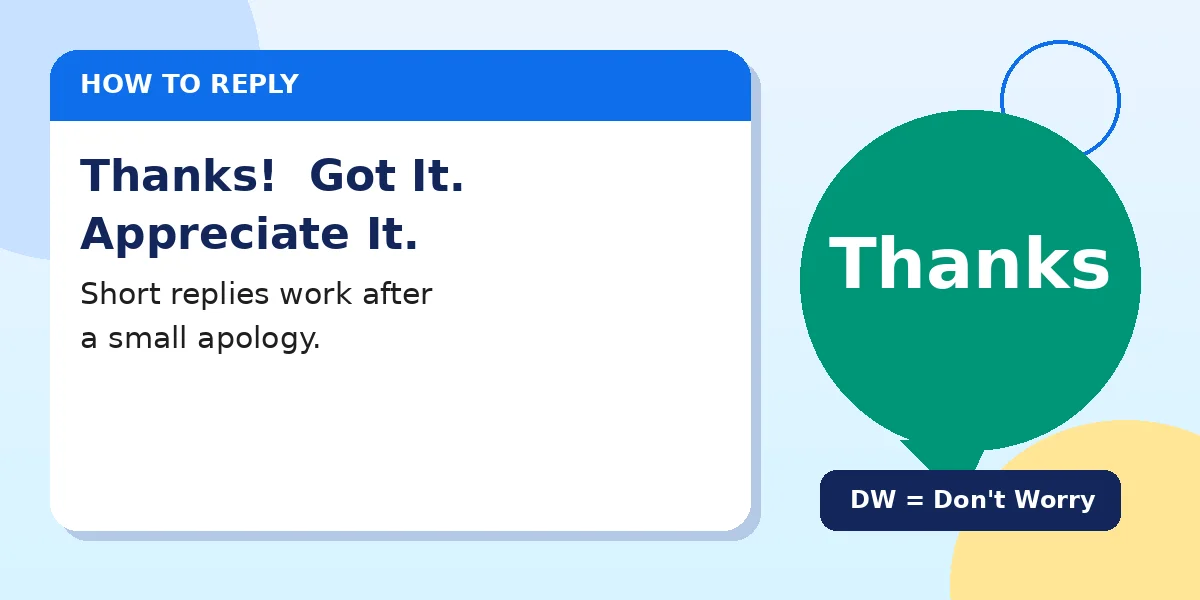
Your response depends on why the person sent DW. You can keep it short, show appreciation, or ask for more detail.
When deciding how to respond, remember what the dw meaning in text is in that conversation. A simple thank-you may be enough, but a serious concern may need a fuller reply.
Short and Casual Replies
Use these when someone reassures you about a minor issue.
- "Thanks!"
- "Okay, got it."
- "Appreciate it."
- "All good!"
- "Sounds good."
Warm and Appreciative Replies
Choose a warmer response when someone offers genuine support.
- "Thanks, I appreciate that."
- "That’s really kind of you."
- "Thanks for understanding."
- "I needed to hear that."
- "You’re the best!"
When Someone Says DW but You’re Still Worried
You do not have to pretend everything is fine. Try one of these replies:
- "Thanks, but I’m still a little concerned."
- "I appreciate it. Can we talk about it?"
- "I hope so. I’m just nervous."
- "Thanks for reassuring me."
These responses let you explain how you feel.
When DW Does Not Confirm a Plan
Remember that reassurance and confirmation are different. If someone says DW about a task, you may still need a clear answer. For example: You: "Are you sure the tickets are booked?" Friend: "DW!" You: "Thanks! Just confirming, are they booked?" This avoids confusion about important plans.
When DW Feels Dismissive
If the message feels too short, ask for clarification. You could say:
- "I appreciate it, but can we talk about it?"
- "I know you mean well, but I’m still worried."
- "Can you explain what you mean?"
- "I just need a little more reassurance."
A clear response can prevent misunderstandings.
DW vs. No Worries, NP, NBD, and All Good
DW is similar to several common texting expressions. This comparison helps place the dw meaning in text beside similar replies. However, each phrase has a slightly different use.
| Expression | Full meaning | Main use |
|---|---|---|
| DW | Don’t worry | Reassures someone about a concern |
| NW | No worries | Accepts an apology or dismisses a minor issue |
| NP | No problem | Responds to thanks or an apology |
| NBD | No big deal | Shows that something is not important |
| All good | Everything is okay | Gives clear, conversational reassurance |
When Should You Use Each Expression?
DW: Use it when someone feels worried or apologizes. Example: "DW, you’re not bothering me." NW: Use it when someone apologizes for a minor inconvenience. Example: "NW, it happens." NP: Use it when someone thanks you or apologizes. Example: "NP, happy to help." NBD: Use it when you want to show that something is not a big issue. Example: "NBD, I can do it tomorrow." All good: Use it when you want a natural, friendly response. Example: "All good, we’ve got plenty of time."
If you want to learn more texting abbreviations, explore our guides to WTV meaning: https://clarifywords.com/wtv-meaning/ and NVM meaning: https://clarifywords.com/nvm-meaning/
You can also read about SMH meaning in text: https://clarifywords.com/smh-meaning-in-text/ , GTS meaning in text: https://clarifywords.com/gts-meaning-in-text/ , and TYSM meaning: https://clarifywords.com/tysm-meaning/
For another common short reply, see our guide to OFC meaning in text: https://clarifywords.com/ofc-meaning-in-text/
Other Meanings of DW
DW has several meanings outside ordinary texting. The topic and sentence help you identify them.
| Meaning | Context | Explanation |
|---|---|---|
| Don’t worry | Texting and messaging | Common reassuring expression |
| Dear wife | Marriage and parenting forums | Refers to someone’s wife |
| Darling wife | Family discussions | Affectionate reference to a spouse |
| Doctor Who | Entertainment | British science-fiction television series |
| Deutsche Welle | News and media | German international broadcaster |
| Data warehouse | Technology | System used to store and analyze data |
| Dishwasher | Real estate and property | Abbreviation used in property descriptions |
| Disney World | Travel discussions | Informal shorthand in some contexts |
| Deep Web | Internet discussions | Refers to online content outside standard search indexing |
These alternatives are not equally common. That range is why the dw meaning in text needs context, not just the letters. Most are specialized meanings rather than everyday texting meanings.
Why Do Dictionaries List DW Differently?
Different dictionaries organize DW’s meanings in different ways.
Dictionary.com lists "dear (or darling) wife" as a numbered sense. It mentions "don’t worry" in a separate internet usage note.
Longman lists only "darling wife" in its DW entry.
Some secondary guides report that Oxford Advanced Learner’s Dictionary includes both meanings, with darling wife or dear wife first, followed by don’t worry. That listing was not verified first hand in this research, so treat it as reported, not confirmed.
This difference matters because dictionary order does not necessarily reflect everyday texting frequency.
DW vs. DWI: Are They the Same?
No. DWI is a separate legal abbreviation, not another form of DW. DWI can mean "driving while intoxicated" or "driving while impaired," depending on the jurisdiction. DW, by contrast, usually means "don’t worry" in ordinary texting.
DW vs. IDW
IDW means "I don’t want." It is different from DW. For example: "DW, I’ll handle it." means "Don’t worry, I’ll handle it." "IDW to go out tonight." means "I don’t want to go out tonight." Do not treat "don’t want" as a verified standalone meaning of DW.
When Not to Use DW and What to Say Instead
DW works well in casual conversations. Knowing when to skip it is part of using the dw meaning in text well. However, it is not suitable for every situation.
Avoid DW in Formal Work Emails
Your manager, client, or coworker may not understand informal texting abbreviations. Instead of writing: "DW, I’ll send the report tomorrow." Write: "Please don’t worry. I’ll send the report tomorrow." A complete sentence sounds clearer and more professional.
For example, furlough is a formal workplace term with a different meaning. It describes a temporary leave from work, often without pay. See furlough meaning: https://clarifywords.com/furlough-meaning/ to see how formal workplace vocabulary differs from casual texting slang.
Avoid DW in Serious or Emotional Conversations
A person discussing grief, anxiety, or a difficult situation may need more than two letters. Instead of replying only "dw," acknowledge their feelings. For example: "I understand why you’re worried. I’m here if you need to talk."
Avoid DW When Messaging Someone New
Someone unfamiliar with texting slang may not understand DW. Spell out "don’t worry" when clarity matters. This is especially helpful in professional or unfamiliar conversations.
Professional Alternatives to DW
| Situation | Better alternative |
|---|---|
| Responding to an apology | "No problem at all." |
| Reassuring a coworker | "Please don’t worry about it." |
| Confirming a completed task | "I’ve taken care of it." |
| Responding to a serious concern | "I understand why you’re concerned." |
| Reassuring a client | "Everything is under control." |
| Accepting a small mistake | "It’s completely fine." |
| Offering support | "I’m happy to help." |
These alternatives communicate the same general reassurance. They also provide more detail when needed.
For other word meanings and language guides, visit the ClarifyWords Text Meanings category: https://clarifywords.com/category/text-meanings/
You can also explore WYF meaning in text: https://clarifywords.com/wyf-meaning-in-text/ and WYLL meaning in text: https://clarifywords.com/wyll-meaning-in-text/
Common Mistakes When Understanding DW
Even though DW is short, people can misunderstand it. Here are common mistakes to avoid.
If you are unsure about the dw meaning in text, avoid deciding from the letters alone. Look at the sentence, topic, and relationship before choosing a meaning.
1. Assuming DW Always Means Don’t Worry
The texting meaning is usually "don’t worry." However, DW can mean "dear wife" or "darling wife" in marriage and parenting forums. Always check the sentence and topic.
2. Confusing DW With Dear Wife in Ordinary Text Messages
Not every DW refers to someone’s spouse. For example, "Sorry I’m late." "DW!" is a reassuring reply. It does not refer to a wife.
3. Assuming Capital Letters Change the Meaning
DW, dw, and Dw can all represent the same abbreviation. Capitalization alone does not establish a different definition.
4. Thinking DW Means Don’t Want
"Don’t want" is not a verified standalone meaning of DW. The abbreviation IDW means "I don’t want." Do not confuse the two.
5. Confusing DW With DWI
DWI is a separate legal abbreviation. It is not a longer version or alternative spelling of DW.
6. Assuming DW Means a Problem Is Solved
DW offers reassurance, but it does not always confirm that someone has completed a task. For example, "DW" does not tell you whether someone booked the tickets. Ask for confirmation when you need it.
7. Using DW in Every Serious Conversation
A short response may not provide enough emotional support. If someone shares a serious concern, use a thoughtful sentence instead. Make sure your response addresses their feelings.
Where Did DW Come From?
DW developed as part of the wider use of shortened expressions in online communication. That general background frames the dw meaning in text without inventing a start date. However, its exact coinage date has not been established.
DW and Early Internet Messaging
People began using short forms more often as online chats and messaging became popular. Chatrooms, internet forums, and instant messaging encouraged quick written exchanges.
Abbreviations such as TBH and AFK also became familiar in online conversations. AOL Instant Messenger and other early chat services helped spread short forms. DW fits this history of shortened digital expressions. However, that background does not identify its first use.
The Phrase "Don’t Worry" Predates the Abbreviation
The phrase "don’t worry" existed long before modern texting. Bobby McFerrin’s 1988 song "Don’t Worry, Be Happy" is a well-known example of the phrase’s earlier use. However, the song does not prove that DW originated in 1988. It provides background on the phrase, not proof of DW’s origin.
What About the Reported Urban Dictionary Entry From 2003?
Some online articles report a 2003 Urban Dictionary entry for DW. How-To Geek mentions this date in its discussion of the abbreviation. However, this is second-hand reporting. It does not independently establish the first recorded use of DW.
Therefore, it is better to avoid assigning DW a precise invention date. The available evidence supports a general history of internet abbreviations, not a single origin date.
An Easy Memory Trick for DW
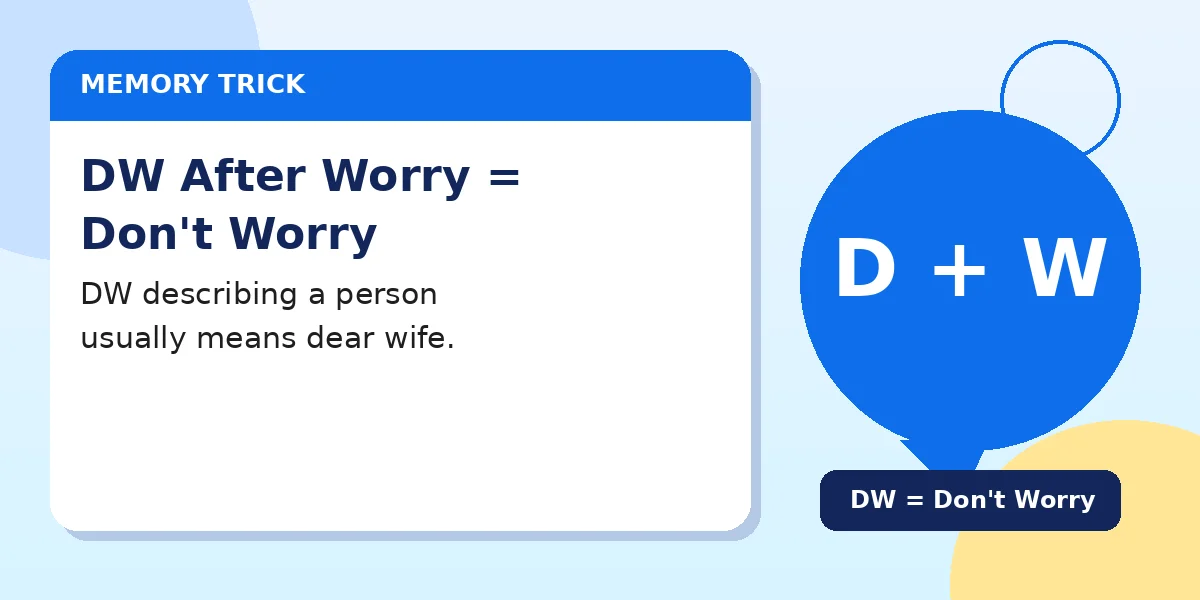
The easiest way to remember DW is to connect each letter with its everyday texting meaning. Use it whenever the dw meaning in text feels unclear in a chat.
D + W = Don’t Worry
Here is another helpful trick: DW after an apology usually means "don’t worry." "My DW" usually means "my dear wife." DW describing a spouse usually means "dear wife" or "darling wife."
One-sentence memory rule: DW reassures someone when it answers a worry, but it refers to a wife when it describes a person.
Practice Questions With Answer Key
Use these 10 questions to test what you have learned about the dw meaning in text. Choose the meaning that best fits each message.
Practice Questions
- Your friend texts, "Sorry I forgot to call you yesterday." You reply, "DW, it’s okay." What does DW mean?
- Someone writes, "My DW made breakfast this morning." What does DW mean?
- A friend says, "I’m nervous about my exam." You reply, "DW, you’ve studied hard." What does DW mean?
- Someone texts, "DW about it. I’ll clean the table." What does the phrase mean?
- A person writes, "DW and I are going on vacation." What does DW most likely mean?
- Your teammate says, "Sorry I missed that shot." You reply, "DW, we’ll try again." What does DW mean?
- Someone texts, "IDW to go shopping today." Does IDW mean the same thing as DW?
- A friend sends only "dw." after you share a serious concern. Does the period prove that they are angry?
- Someone writes, "The DW in this property has been replaced." Which meaning is most likely?
- A friend texts, "DW, I already booked the tickets." Does this message confirm that the tickets are booked?
Answer Key
| Question | Correct answer | Explanation |
|---|---|---|
| 1 | Don’t worry | It reassures someone after an apology. |
| 2 | Dear wife | It refers to someone’s spouse. |
| 3 | Don’t worry | It offers reassurance before an exam. |
| 4 | Don’t worry about it | The full phrase dismisses a minor concern. |
| 5 | Dear wife | DW is part of the sentence subject. |
| 6 | Don’t worry | It reassures a teammate after a mistake. |
| 7 | No | IDW means "I don’t want." |
| 8 | No | Punctuation alone cannot prove anger. |
| 9 | Dishwasher | DW can appear as a property abbreviation. |
| 10 | Yes | The words "I already booked the tickets" confirm the action. |
If you understood all 10, you can recognize DW in most common conversational contexts.
Frequently Asked Questions
These answers cover the dw meaning in text questions readers ask most.
1. What Does DW Mean in Texting?
DW usually means "don’t worry" in texting. People use it to reassure someone, accept a small apology, or reduce concern about something. In family forums, it can also mean "dear wife" or "darling wife."
2. Does DW Mean the Same Thing From a Girl or a Guy?
Yes. DW has the same standard meaning regardless of who sends it. A girl or guy can use it to mean "don’t worry." The conversation and context matter more than sender’s gender.
3. Is DW Rude or Disrespectful?
No, DW is not inherently rude. It usually sounds friendly or casual. However, a short response may feel dismissive in a serious conversation. A longer, supportive message works better when someone needs real comfort.
4. Can DW Mean Dear Wife?
Yes. DW can mean "dear wife" or "darling wife" in marriage and parenting forums. Someone might write "My DW planned dinner" to refer to their wife. In ordinary texting, DW usually means "don’t worry" instead.
5. Does DW Mean the Same Thing on Snapchat and Instagram?
Yes. DW usually means "don’t worry" on Snapchat and Instagram. People use it in direct messages, comments, and casual chats. The platform does not change the meaning, but the conversation context still matters.
6. What Does DW About It Mean?
"DW about it" means "don’t worry about it." Someone may use this phrase after a small mistake or apology. It reassures the other person that the issue is minor and does not need further worry.
7. Is DW the Same as DWI?
No. DW usually means "don’t worry" in texting. DWI is a separate legal abbreviation for driving while intoxicated or impaired. The two terms are not interchangeable, despite their similar letters.
Final Takeaway
The main dw meaning in text is "don’t worry." It is a simple way to reassure someone, accept an apology, or downplay a minor problem.
In marriage and parenting forums, DW can also mean "dear wife" or "darling wife." Check the sentence and topic before choosing a meaning.
Remember these three points:
- DW after an apology: Don’t worry.
- My DW: Dear wife or darling wife.
- DW in professional writing: Use a complete phrase instead.
Once you understand the context, recognizing DW in everyday messages becomes much easier. That context check is the simplest habit for the dw meaning in text.