

Rain or Shine: Meaning, Examples, and Correct Usage
Quick Answer
The expression rain or shine means something will happen regardless of the weather or circumstances. It can describe an outdoor event that continues in different weather or someone who keeps a promise despite difficulties.
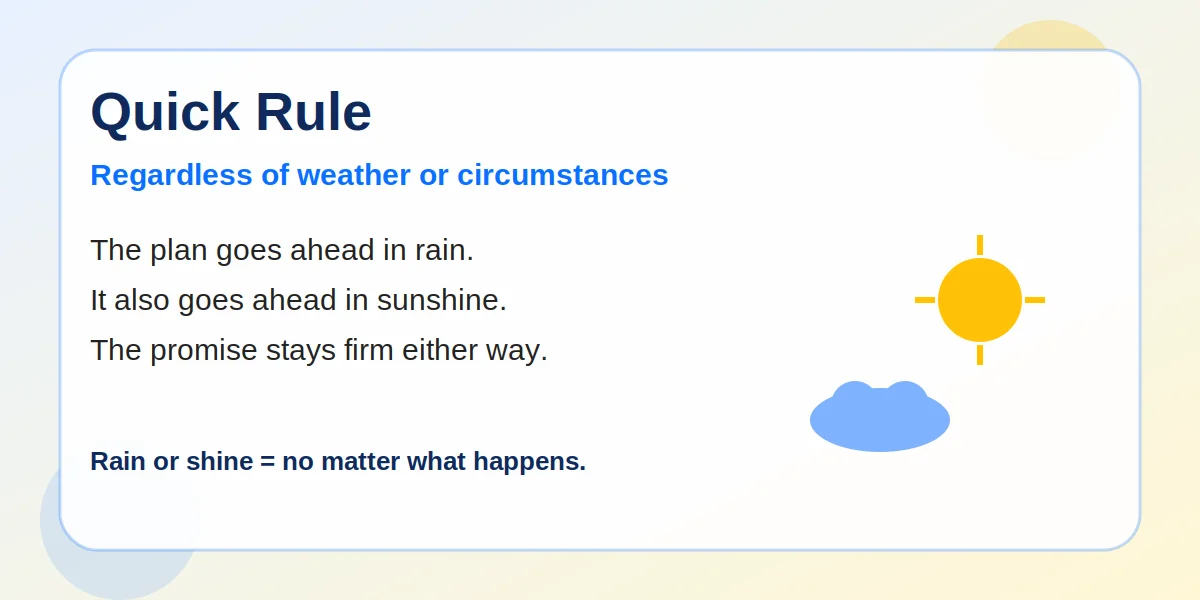
Table of Contents
What Does It Mean? / Origin and History / How to Use It in a Sentence / Variations and Related Phrases / It vs Similar Expressions / US vs UK Usage / What It Does Not Mean / Common Mistakes / Invitation Wording That Works / Saying It Naturally in Conversation / Why the Weather Image Works / For Writers and Students / Events, Habits, and Promises in More Detail / Memory Trick / Practice Questions / FAQs
What Does It Mean?
The expression means regardless of the weather or circumstances. People use it when discussing outdoor events, daily routines, personal promises, and responsibilities.

Literal Meaning
Rain and shine refer to two common weather conditions. The literal picture is simple. The event continues in rain. It also continues in sunshine.
Figurative Meaning
The figurative meaning is broader. It describes commitment, persistence, and reliability. A person may support a friend in good times and hard times. A worker may complete a task despite delays. A team may finish a project despite problems.
What Does It Mean for Outdoor Events?
When an organizer advertises an outdoor event with this expression, the announcement communicates an intention to proceed despite ordinary weather changes.
Origin and History
The origin is not firmly established. No single source proves the first use with certainty. The idiomatic sense is recorded by 1905 in Christine Ammer’s idiom dictionaries. This date gives a reliable reference point for modern use.
How the Expression Became Popular
The longer variant come rain or come shine became widely known through the 1946 song by Harold Arlen and Johnny Mercer, written for St. Louis Woman. The song popularized the longer form. It did not create the shorter phrase.
History Timeline
| Before 1905 | Exact first use is uncertain |
| By 1905 | Idiomatic sense recorded in Ammer’s dictionaries |
| 1946 | Longer variant popularized by Arlen and Mercer song |
| Today | Used for events, promises, habits, and commitments |
How to Use It in a Sentence
The phrase works in different sentence positions. It can appear at the start, in the middle, or at the end.

Sentence Position Table
| Start | Rain or shine, the market opens on Saturday. | Strong opening promise |
| Middle | We will meet, rain or shine, at noon. | Clear commitment |
| End | The walk goes ahead rain or shine. | Simple closing promise |
Examples
- Rain or shine, the farmers market opens every Saturday.
- We will hold the picnic in any weather.
- The team trains in all conditions.
- She visits her grandmother every week, without fail.
- The delivery service runs every day, in all conditions.
- We will finish the project on time, no matter what.
- They walk to school in all conditions.
- The festival continues rain or shine.
- He practices piano in any weather.
- We will support you whatever happens.
Variations and Related Phrases
Come Rain or Shine vs Come Rain or Come Shine
Both forms express the same core idea. The shorter form is more common in everyday speech. The longer form sounds more emphatic and musical.
| Come rain or shine | Regardless of weather or events | Direct and common |
| Come rain or come shine | Regardless of weather or events | Emphatic and lyrical |
Hyphenated Form: Rain-or-Shine Events
Use hyphens when the phrase describes a noun. For example, a rain-or-shine event means an event planned to continue in different weather. Do not hyphenate the phrase in a normal sentence.

Related Phrases
- Come hell or high water: a stronger promise despite serious obstacles.
- Through thick and thin: support during good and bad times.
- No matter what: a general promise without a weather image.
- In any weather: a plain description of outdoor activity.
It vs Similar Expressions
The expression is softer than come hell or high water. It fits everyday plans and promises. It does not suggest danger or extreme hardship.
Tone and Synonym Comparison Table
| This idiom | Regardless of weather or circumstances | Neutral to informal | Events, habits, promises |
| Come hell or high water | Despite serious obstacles | Strong and informal | Serious commitments |
| Through thick and thin | In good and bad times | Warm and personal | Relationships |
| No matter what | Without exception | Direct and neutral | General promises |
| Regardless of the weather | Despite weather changes | Neutral and formal | Formal writing |
US vs UK Usage
Both US and UK speakers use the expression. The meaning is the same in both regions. The spelling is also the same. Minor differences appear in context, not in meaning.
US vs UK Table
| United States | Events, sports, and daily routines | Very common in event notices |
| United Kingdom | Events, promises, and routines | Common, often in informal speech |
What It Does Not Mean
The phrase does not promise safety in dangerous weather. It does not mean an event must continue in a storm. It does not remove the need for safety checks.
Event Planning Limits
Organizers can delay or cancel an event for lightning, flooding, high winds, or unsafe roads. Safety rules override a rain-or-shine notice. Visitors should check updates before travel.
Common Mistakes
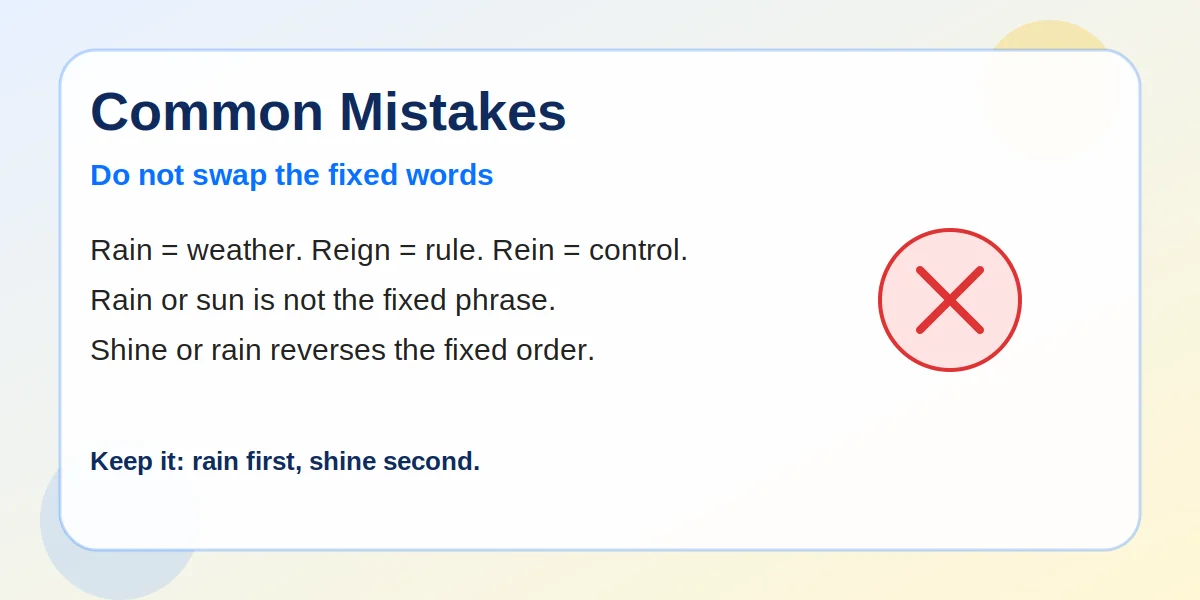
| Rain vs reign vs rein | Reign means rule. Rein means control. | Rain refers to weather. |
| Rain or sun | Sun is not the fixed idiom form. | Use the fixed form. |
| Rain and shine | And changes the meaning. | Or shows two possible conditions. |
| Adding extra words | Extra words weaken the fixed phrase. | Keep the phrase short and clear. |
Invitation Wording That Works
Event notices use this expression for a simple reason. It tells guests the plan is firm. It also tells them to prepare for weather. A short notice works best. State the date and time first. State the place next. Add the expression last. Then add a practical note about shelter or parking. For example, an organizer can write that a market opens at nine on Saturday and will go ahead in any weather. A second sentence can say that stalls move under cover if rain starts. That pair of sentences gives guests certainty and comfort. It avoids a false promise. It also avoids confusion about refunds or start times. A wedding invitation needs a softer tone. The couple can say the ceremony will go ahead whatever the weather brings. They can then name the covered space for rain. Guests then know what to wear and where to go. They do not need to guess or call the venue. A sports notice needs a different note. A coach can say practice continues in light rain. The same notice can say practice moves indoors for lightning. That distinction matters. Parents and players can plan with confidence. They also know safety comes first. Ticket pages need clear terms too. A ticket page can say the show goes ahead in ordinary rain. It should also say what happens in severe weather. It should say whether tickets transfer to a new date. It should say whether refunds apply. Clear terms protect both the organizer and the buyer. They also reduce complaints on the day.
Saying It Naturally in Conversation
In speech, this expression sounds best at the end of a short promise. A speaker can say, “I will be there in any weather.” That sentence is clear. The idiom adds warmth when it closes the promise. It signals reliability without sounding formal. At the start of a sentence, it adds emphasis. A speaker can open with it and then state the plan. That order works for a strong promise to a friend. It also works for a team talk before a big task. The speaker should keep the rest of the sentence short. A long sentence after a strong opening can sound heavy. In the middle of a sentence, it works as a pause for commitment. A speaker can name the plan, add the phrase between commas, and then name the time. That pattern suits a routine. It suits a daily walk, a weekly market, or a regular class. The rhythm stays natural because the phrase is short. Learners should avoid using it in every sentence. One use in a conversation is enough. Repeated use can sound forced. It can also hide the main point. A good rule is to use it once for the key promise. Use plain words for the rest of the talk. Tone also matters in conversation. The phrase sounds friendly and steady. It does not sound angry or harsh. It does not sound like a threat. It sounds like a person who keeps a word. That tone suits friends, family, coworkers, and neighbors.
Why the Weather Image Works
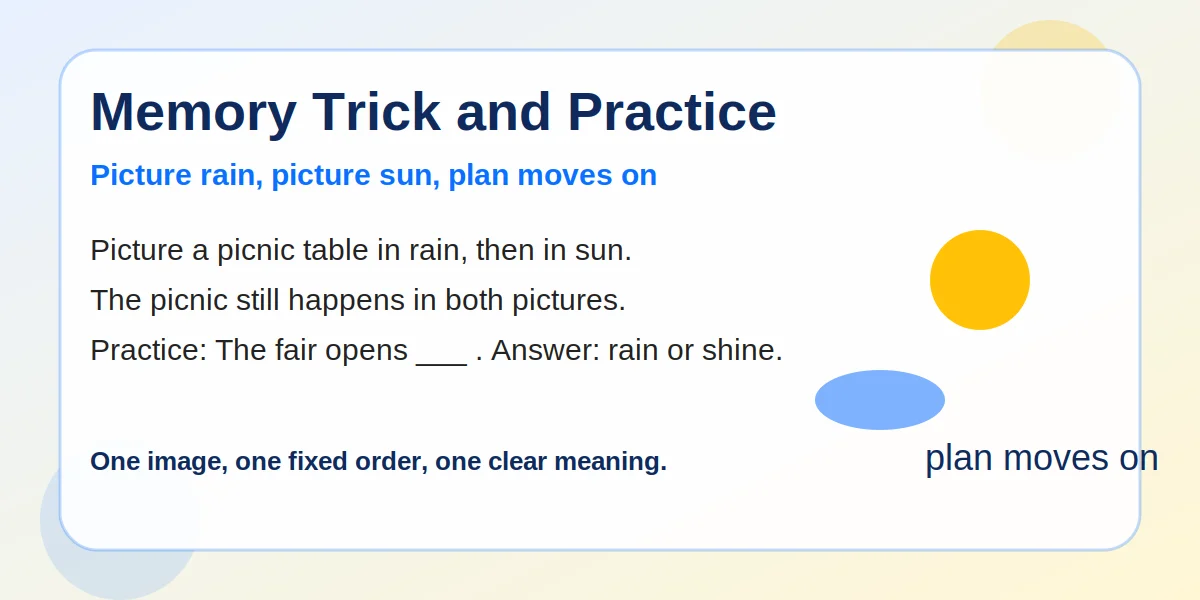
Weather is a shared experience. Everyone has faced rain on a planned day. Everyone has enjoyed sunshine on a good day. The phrase pairs those two extremes. It covers every case in between. That is why listeners grasp it at once. The image also carries a feeling of effort. Rain suggests delay and discomfort. Sunshine suggests ease and comfort. A plan that survives both feels strong. A promise that survives both feels trustworthy. The image does that work in only three words. Other languages use weather images in the same way. English speakers use storms to describe trouble. They use sunshine to describe success. They use clouds to describe doubt. This phrase fits that pattern. It turns a weather contrast into a promise. Teachers can use the image to help learners remember it. A learner can picture a picnic table in rain. The same table can sit in sunshine. The picnic still happens in both pictures. That picture links the words to the meaning. It also helps the learner recall the fixed order.
For Writers and Students
Writers should place this expression where it adds value. It adds value in a promise, a notice, or a routine. It adds little value in a weather report. A weather report needs exact facts about rain and sun. A promise needs a clear commitment. The writer should choose the right tool for the job. Students can use it in essays about habits or plans. They should use it once, not in every paragraph. They should also check the tone of the essay. A personal essay can carry it well. A formal research paper may need a plainer phrase. A good replacement is “regardless of the weather” or “no matter what happens.” Writers should also watch the grammar around it. The phrase does not need a verb of its own. It attaches to the main verb of the sentence. It answers the question “under what conditions?” A writer can test a sentence by removing it. If the sentence still makes sense, the phrase is working as an adverbial phrase. If the sentence breaks, the writer should rebuild it. Punctuation needs care too. A comma should follow it at the start of a sentence. Commas should surround it in the middle of a sentence. No comma is needed when it ends a short sentence after a verb. Those small choices keep the writing clean and easy to read.
Events, Habits, and Promises in More Detail
Events give the clearest use case. A market, a fair, a concert, and a parade all face weather risk. An organizer who uses this expression tells guests to come anyway. Guests can then bring a coat or an umbrella. They can also plan travel with less worry. That clarity helps attendance. Habits give a second clear use case. A daily walk, a morning run, and a weekly class all test commitment. A person who keeps a habit in rain and in sunshine shows discipline. The phrase captures that discipline in a short form. It also encourages the listener to keep going. Promises give a third use case. A friend who says they will help in hard times gives comfort. A worker who says they will finish on time gives confidence. A team that says it will stay loyal gives strength. In each case, the phrase turns a simple plan into a firm word. These three uses share one idea. The plan does not depend on perfect conditions. It depends on a decision. That decision is the heart of the meaning. Learners who grasp that idea can use the phrase well in many settings.
Common Mistakes in More Detail
The rain, reign, and rein confusion deserves extra care. All three words sound the same. Only one fits weather. Reign belongs to kings and queens. It also belongs to a period of rule. Rein belongs to horses and control. A writer who picks the wrong word can change the meaning of a sentence. A reader may still understand the intent, but the error looks careless. The “rain or sun” error is also common. Sun feels like the natural opposite of rain. Shine feels less obvious at first. Yet shine is the fixed partner in this phrase. Shine here means sunny weather in a general sense. It does not mean the sun as an object. Learners should learn the pair as one fixed unit. Word order errors are easy to avoid once the rule is clear. Rain always comes first. Shine always comes second. No other order sounds natural to a native speaker. A learner can test this by saying both orders aloud. The correct order will sound familiar from songs, notices, and speech. A final mistake is to use the phrase for a plan that is still unsure. If a plan may change, the speaker should say so plainly. They can say they hope to go, weather permitting. They should not use a firm phrase for a soft plan. Honest wording builds more trust than a strong phrase used loosely.
Memory Trick
Picture two weather symbols. One shows rain. One shows sunshine. The event sits between them. It moves forward under both symbols. This image links the words to the meaning: the plan continues in either condition.
Practice Questions
- What does this expression mean? A. Only in rain B. Regardless of weather or circumstances C. Only in sunshine D. After the rain stops
- Which sentence uses the phrase correctly? A. The fair opens rain or shine. B. The fair opens rain and shine. C. The fair opens rain or sun. D. The fair opens rain or reign.
- When should the phrase be hyphenated? A. In every sentence B. When it describes a noun C. At the end of a sentence D. Never
- Which phrase is closest in meaning? A. Once in a while B. No matter what C. Under the weather D. A ray of sunshine
- Can an organizer cancel a rain-or-shine event in dangerous weather? A. No, never B. Yes, for safety reasons C. Only if it rains lightly D. Only on weekends
- Which order is correct? A. Shine or rain B. Rain or shine C. Sun or rain D. Rain and shine
- Which word belongs in the idiom? A. Reign B. Rein C. Rain D. Range
- What is the best formal replacement in an essay? A. Come hell or high water B. Regardless of the weather C. Through thick and thin D. Under the weather
- What did the 1946 Arlen and Mercer song do? A. It created the phrase B. It popularized the longer variant C. It changed the meaning D. It made the phrase formal only
- When does the phrase fit best? A. For an unsure plan B. For a firm commitment that will go ahead C. For a weather forecast D. For a cancelled event
Answer Key
- B
- A
- B
- B
- B
- B
- C
- B
- B
- B
FAQs
1. What does this expression mean?
It means something will happen regardless of the weather or other circumstances. It can describe an outdoor event, regular habit, personal promise, or commitment that continues under different conditions in every season.
2. Is it an idiom?
Yes, it is an English idiom. Its meaning goes beyond literal weather conditions. People also use it to express determination, loyalty, and commitment despite difficulties or unexpected changes in daily life.
3. What is the difference between the short form and come rain or shine?
Both expressions mean regardless of what happens. The shorter form is common in everyday speech, while come rain or shine often sounds more emphatic, especially when expressing a personal promise or firm plan.
4. Is come rain or come shine correct?
Yes, come rain or come shine is an established longer variant. It became widely associated with the 1946 song by Harold Arlen and Johnny Mercer, written for St. Louis Woman.
5. Should it be hyphenated?
Use hyphens when the expression describes a noun, as in a rain-or-shine event. Leave it unhyphenated in ordinary sentences, such as when saying a concert will happen in any weather.
6. Is it formal or informal?
The expression has a neutral to slightly informal tone. It works in conversations, invitations, and workplace messages. For highly formal writing, alternatives like regardless of the weather may sound more precise.
Related Guides
For more vocabulary guides, see Yes or No, True or False, Win or Lose, All or Nothing, and Black or White, and the Vocabulary category.
Final Takeaway
The phrase means a plan continues regardless of weather or circumstances. It works for events, habits, promises, and commitments. It does not override safety needs in severe weather.