

On-Site or Onsite: Which Spelling Is Correct?

Quick Answer: Is It On-Site or Onsite?
Both on-site and onsite are correct. They mean the same thing in most sentences. The choice is a matter of spelling and style, not meaning. Use on-site when you want the hyphenated form. Use onsite when you want the closed form. Use on site when you describe a location in two words. For the question on-site or onsite, either spelling can be correct. The safest choice is to follow your house style and use one form throughout a document.
Table of Contents
- Quick Answer
- What Do On-Site, Onsite, and On Site Mean?
- Onsite vs On-Site vs On Site: Key Differences
- When Should You Use On-Site, Onsite, or On Site?
- Is Onsite an Adjective or an Adverb?
- What Do Merriam-Webster, Cambridge, and Collins Say?
- Do AP Stylebook and Chicago Prefer On-Site or Onsite?
- Is Onsite One Word in American and British English?
- On-Site vs Off-Site: What Is the Difference?
- Common Mistakes When Using Onsite, On-Site, and On Site
- Examples of Onsite, On-Site, and On Site in Different Contexts
- Easy Memory Trick: How to Remember Onsite vs On-Site vs On Site
- Practice Questions: Onsite, On-Site, or On Site?
- Frequently Asked Questions
- Related Guides
- Final Takeaway: Choose Onsite or On-Site Consistently
Introduction
Many writers pause before they type this word. They want to know if the hyphen matters. They also want to avoid a spelling error in a job post, an email, or a report.
The answer is simple. Both forms are accepted. The two-word phrase on site is also correct in the right sentence. When readers search for on-site or onsite, they usually want to know whether the hyphen changes the meaning.
This guide explains each form in plain English. It gives clear rules, real examples, and a short practice test. By the end, you will know which form to use and why.
What Do On-Site, Onsite, and On Site Mean?
What Does On-Site Mean?
On-site means at a particular place, especially a place of business. It can describe a person, a service, or an event. For example, on-site parking means parking at the site. On-site training means training held at the workplace. The term is clear and direct. Readers understand it at once.
What Does Onsite Mean?
Onsite has the same core meaning as on-site. It is the closed form of the word. It can describe a service, a visit, or a work location. For example, onsite support means support provided at the site. Onsite staff means staff who work at the site. The closed form is common in job listings and tech writing.
What Does On Site Mean?
On site is a two-word phrase. It describes a location. It often appears after a verb. The nurse is on site. The engineer arrived on site early. The team will work on site tomorrow. It is a clear way to say that someone is at a particular place.
Onsite vs On-Site vs On Site: Key Differences
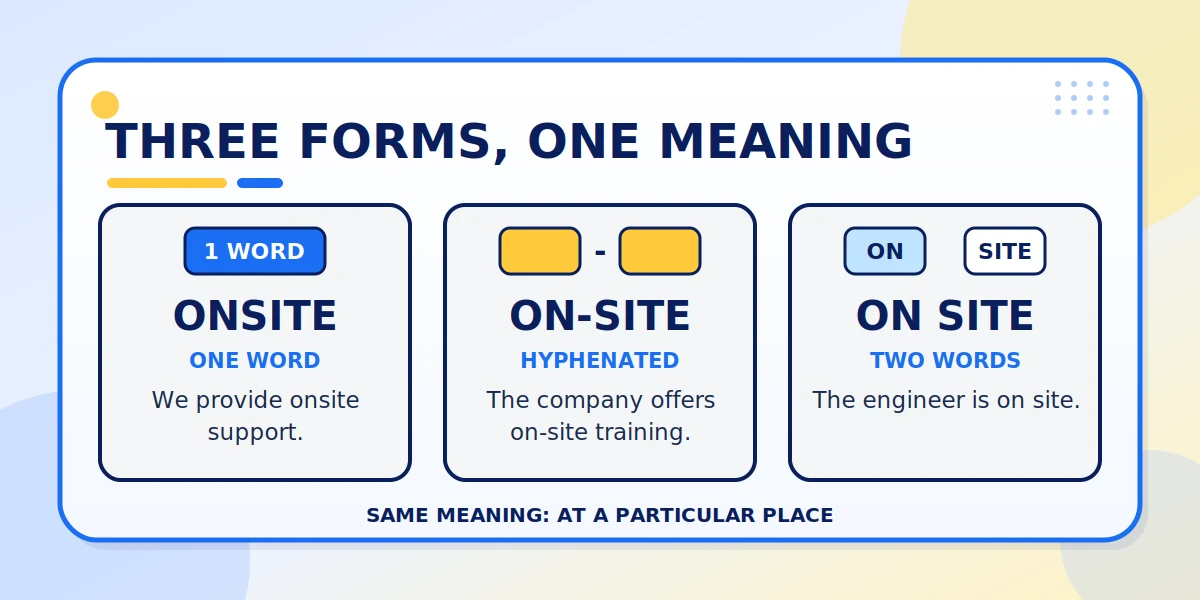
The table below shows the three forms side by side.
| Form | Spelling | Common use | Example |
|---|---|---|---|
| Onsite | One word | Adjective or adverb in grammatical analysis | We provide onsite support. |
| On-site | Hyphenated | Adjective or adverb in grammatical analysis | The company offers on-site training. |
| On site | Two words | Location phrase | The engineer is on site. |
The choice between on-site or onsite is mainly a spelling preference, not a difference in meaning.
All three forms point to the same idea. They describe being at a particular place. The main difference is form, not meaning. Onsite and on-site can act as modifiers. On site often follows a verb and names a location. The context will guide your choice. A house style guide can make the choice for you.
When Should You Use On-Site, Onsite, or On Site?
Use On-Site or Onsite Before a Noun
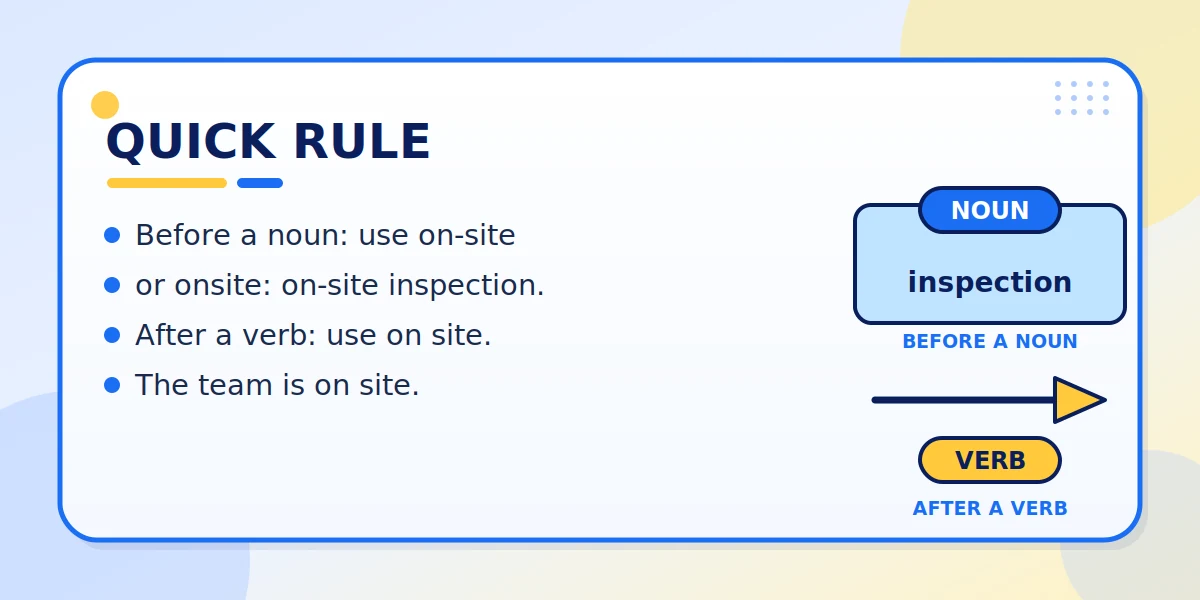
Use either spelling before a noun when you describe that noun. Examples include on-site inspection, onsite inspection, on-site employee, onsite employee, on-site training, and onsite training. The hyphen in on-site makes the link clear. The closed form onsite is also clear. Both forms are accepted in this position. Choose one form and use it in the same way each time.
Use On Site After a Verb When Describing a Location
Use on site after a verb when you describe where someone is. Examples include: The manager is on site. The workers arrived on site. The support team works on site. This pattern is common and easy to read. It works well in plain writing. It also matches the way many people speak.
Can Onsite and On-Site Be Used Interchangeably?
Yes, in most cases they can. They share the same core meaning. They can both modify a noun. They can both describe where work happens. The difference is style, not sense. A reader will understand either form. Pick the form that fits your style guide. Then use it in the same way throughout the text.
Is Onsite an Adjective or an Adverb?
Onsite and On-Site as Adjectives
An adjective describes a noun. Onsite and on-site can both do this job. Examples include onsite services, on-site parking, onsite medical care, and on-site inspection. In each case, the word tells us more about the noun. It tells us where the service or care takes place.
Onsite and On-Site as Adverbs
An adverb can describe where an action happens. Onsite and on-site can both do this job in grammatical analysis. Examples include: The technician works onsite. The inspection takes place on-site. Support is available onsite. In each case, the word tells us where the action takes place.
On Site as a Location Phrase
On site is a two-word phrase that names a location. It often follows a verb such as is, works, or arrived. Examples include: The team is on site. The contractor remained on site. The event staff arrived on site. This form is useful when you want to stress the place itself.
What Do Merriam-Webster, Cambridge, and Collins Say?
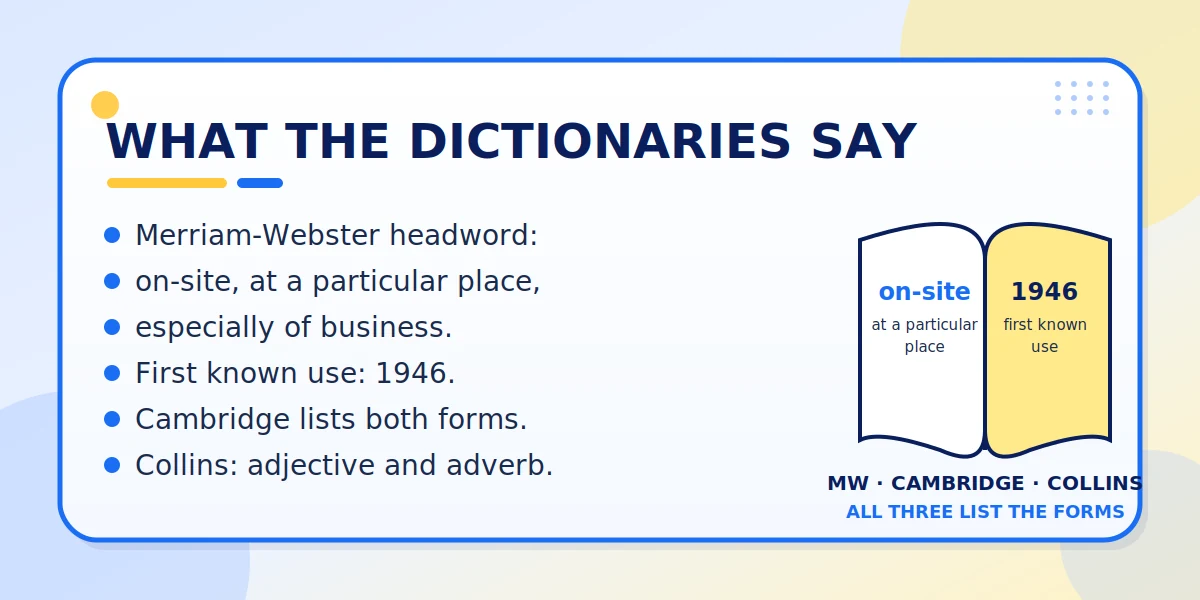
Dictionaries do not all list the forms in the same way. The table below gives the verified facts.
| Dictionary | Entry | Verified fact |
|---|---|---|
| Merriam-Webster | on-site | Headword “on-site”, defined as “at a particular place especially of business”, first known use 1946. |
| Merriam-Webster | onsite | A live “onsite” entry with the same definition. |
| Cambridge Dictionary | onsite | Lists an “onsite” entry with corpus examples. |
| Cambridge Dictionary | on-site | Lists an “on-site” entry with corpus examples. |
| Collins English Dictionary | on-site | Lists “on-site” as adjective and adverb. Word origin 1955-60. |
| Collins English Dictionary | on site | Includes a separate two-word phrase referring to a particular area or group of buildings. |
Only Collins is cited here for the adjective/adverb label for “on-site”. Merriam-Webster and Cambridge are cited only for the verified facts in the table above. Other adjective/adverb uses in this article are grammatical analysis, not dictionary labels.
What Is the First Known Use of On-Site?
Merriam-Webster gives 1946 as the first known use of on-site. Collins gives a word-origin date of 1955-60 for one of its on-site entries. These are different dictionary records. They do not conflict. Each source uses its own method to date a word. Do not use these dates to claim that one source is wrong.
Do AP Stylebook and Chicago Prefer On-Site or Onsite?
What Does AP Style Say?
AP (2019) gives general guidance: no hyphen is needed in a compound modifier if the modifier is commonly recognized as one phrase and the meaning is clear and unambiguous without the hyphen. This is general guidance about compound modifiers. It is not a word-specific ruling for on-site or onsite. Do not claim that AP requires one of these spellings.
What Does the Chicago Manual of Style Say?
Chicago gives general guidance: hyphenate compound adjectives before a noun, usually no hyphen after the noun. This is also general guidance. It does not settle the spelling of this particular word. Do not present it as a Chicago ruling for on-site or onsite.
Which Spelling Should You Choose in Formal Writing?
Check the style guide used by your employer, school, publisher, or client. If no rule is given, choose either onsite or on-site. Use the same spelling in the whole document. Do not mix forms in one document. Keep on site when you use the two-word location phrase. Consistency matters more than the choice itself.
This section uses only the verified general guidance above. Competitor pages disagree about AP and Chicago on this word, so their style-guide tables should not be treated as settled fact.
Is Onsite One Word in American and British English?
Cambridge lists both onsite and on-site. Collins includes American and British English entries for on-site. These facts do not prove a firm split between the United States and the United Kingdom. Do not claim that Americans always use onsite or that British writers always use on-site. The evidence does not support that rule. Check the style guide for your publication instead.
Key takeaway: both spellings have dictionary support. The available evidence does not justify a strict regional rule. Writers in both countries use both forms.
Related Guides
For more spelling pairs that differ by region or form, see gray vs grey (https://clarifywords.com/gray-vs-grey/), judgment vs judgement (https://clarifywords.com/judgment-vs-judgement/), defense vs defence (https://clarifywords.com/defense-vs-defence/), toward vs towards (https://clarifywords.com/toward-vs-towards/), aluminium or aluminum (https://clarifywords.com/aluminium-or-aluminum/), and mold vs mould (https://clarifywords.com/mold-vs-mould/). For the full set, visit the Spelling Differences category (https://clarifywords.com/category/spelling-differences/).
On-Site vs Off-Site: What Is the Difference?
What Does On-Site Mean?
On-site means at the relevant workplace, facility, or activity location. Examples include on-site training, onsite technical support, and an on-site inspection. The work or event takes place at the site.
What Does Off-Site Mean?
Off-site means away from the main workplace or designated location. Examples include off-site training, off-site storage, and an off-site meeting. The work or event takes place somewhere else.
On-Site, Off-Site, Remote, and Hybrid Work
On-site work takes place at the employer’s workplace or designated location. Off-site work takes place away from the relevant site. Remote work is performed away from the employer’s usual workplace, often from home or another location. Hybrid work combines on-site and remote arrangements. Employers may use these labels in slightly different ways, so read the job post with care.
Note on the suspended hyphen: when the two terms share a word, you can write “on- and off-site” (for example, “on- and off-site training”). The hyphen after “on-” shows that “site” applies to both parts.
Common Mistakes When Using Onsite, On-Site, and On Site
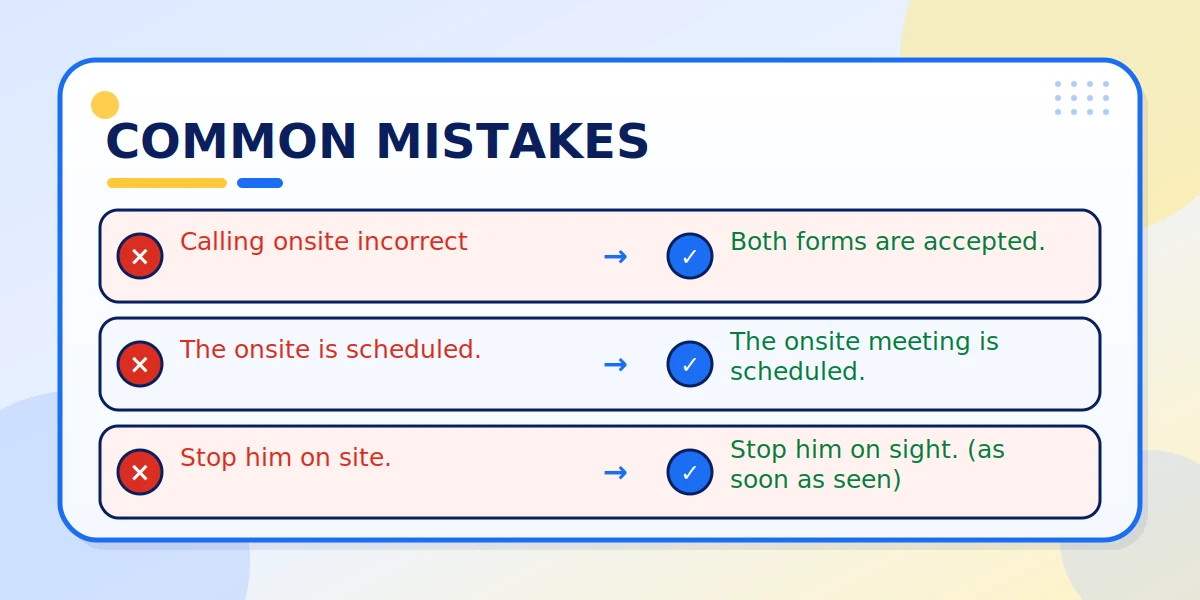
Treating Onsite as Incorrect
Do not treat onsite as a spelling error. Major dictionaries recognize it. It is a valid closed form. Use it with care, and use it in the same way each time.
Assuming On-Site Is Always Required Before a Noun
Both on-site and onsite can modify a noun. The hyphen is common, but it is not the only correct form. Onsite inspection and on-site inspection are both clear. Choose one form for your document.
Assuming On Site Is Always Required After a Verb
The two-word phrase is common after a verb, but it is not the only option. Dictionary evidence recognizes adverbial uses of onsite and on-site as well. The after-verb position does not force you to use two words. Use the form that fits your style guide.
Using Onsite as a Noun
Do not use onsite as a standalone noun. Dictionaries treat it as an adjective or adverb in grammatical analysis, not as a noun. Use a full noun phrase instead, such as onsite visit, onsite inspection, or onsite meeting.
Confusing On Site With On Sight
On site means at a particular location. On sight means as soon as someone or something is seen. Examples: The technician is on site. The guard was told to stop the intruder on sight. These phrases have different meanings. They cannot replace each other.
Assuming One Spelling Is Exclusively American or British
The dictionary evidence does not support a strict regional divide. Both forms appear in American and British sources. Do not base your choice on a national rule. Use your publication’s style guide.
Examples of Onsite, On-Site, and On Site in Different Contexts
Workplace and Business Examples
The company offers onsite employee support. The new policy requires on-site attendance twice a week. The manager is on site today. These examples show the three forms in normal business writing. Each one is clear. Each one fits its sentence.
IT and Technical Support Examples
An onsite technician repaired the network. We provide on-site technical support. The engineer will be on site during installation. IT teams use these forms every day. The meaning stays the same. The form changes with the sentence.
Construction and Engineering Examples
The contractor completed an on-site inspection. Onsite engineers checked the equipment. The safety officer remained on site. Construction writing needs clear terms. These forms give that clarity.
Healthcare Examples
The clinic offers onsite medical services. On-site treatment is available during the event. The healthcare team is on site. Healthcare writing must be clear and direct. These forms meet that need.
Events and Training Examples
The conference provides onsite registration. On-site training begins next Monday. Event staff must arrive on site early. Events use these terms in signs, emails, and guides. Clear terms help staff and guests.
Job Listings and Workplace Location Examples
Job ads use onsite and on-site to describe work location. Examples: Onsite position: employees work at the employer’s location. On-site role: the job requires attendance at a designated workplace. Remote position: employees work away from the employer’s regular location. Hybrid position: employees split their time between workplace and remote settings. A job listing’s use of onsite or on-site does not change the basic meaning. The listing should explain the actual attendance expectations.
Easy Memory Trick: How to Remember Onsite vs On-Site vs On Site

Use this simple trick. Picture the hyphen as a bridge that joins two parts before a noun. Picture onsite as one compact word with no gaps. Picture on site as a person standing on a site.
This is a memory aid, not a strict grammar rule. Both onsite and on-site can function as adjectives and adverbs in grammatical analysis. Use the trick to recall the forms, then check your sentence.
Three-line example:
Onsite support is available.
On-site support is available.
The support team is on site.
Practice Questions: Onsite, On-Site, or On Site?
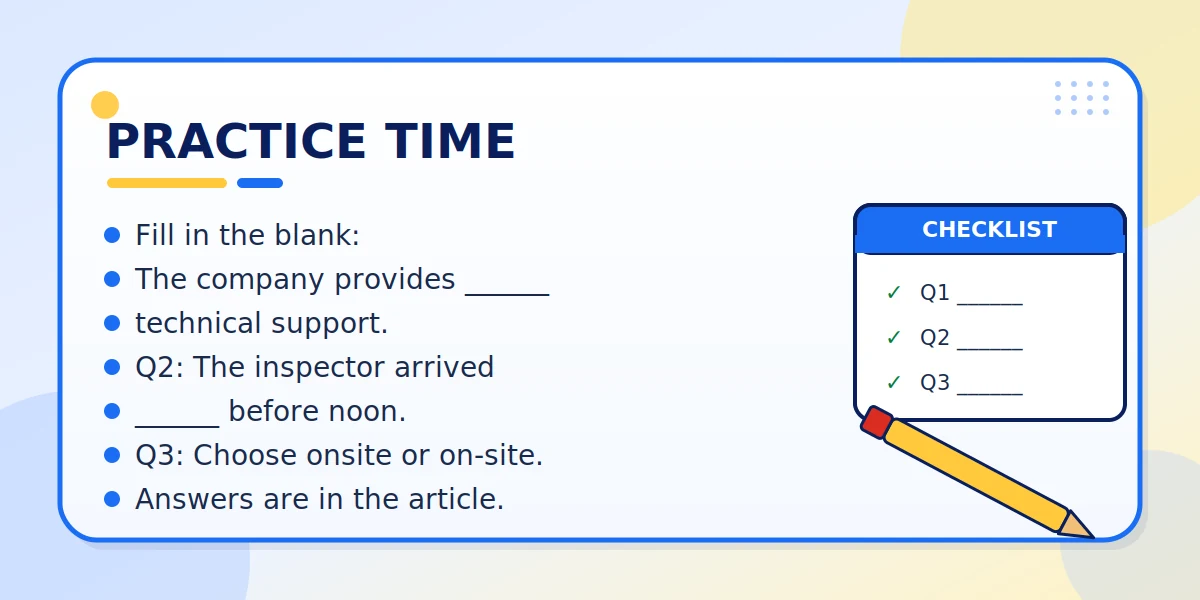
Use the examples to check whether you understand on-site or onsite in different sentence patterns.
- The company provides ______ technical support.
- The inspector arrived ______ before noon.
- Our employees can work ______ three days a week.
- The clinic offers ______ medical services.
- The contractor is ______ today.
- Choose the accepted spelling: onsite or on-site.
- Correct the sentence: “The onsite is scheduled for Friday.”
- Choose the correct phrase: “The guard will stop the intruder on site / on sight.”
- The conference includes ______ registration.
- Explain why both onsite and on-site can be correct in a sentence.
Answer Key
- onsite or on-site (both accepted before a noun)
- on site (location phrase after a verb; onsite / on-site are also accepted as adverbs in grammatical analysis)
- onsite or on-site (both accepted; on site is also used)
- onsite or on-site (both accepted before a noun)
- on site (location phrase after a verb)
- Both onsite and on-site are accepted spellings.
- The onsite meeting is scheduled for Friday. (Onsite needs a noun; use a full noun phrase.)
- On sight, if the meaning is “as soon as seen”. Use on site only if the meaning is “at the location”.
- onsite or on-site (both accepted before a noun)
- Both forms share the same core meaning and have dictionary support. The choice is a matter of spelling and house style, not meaning.
Frequently Asked Questions About On-Site or Onsite
Is Onsite One Word or Two?
Onsite is one word, while on-site uses a hyphen and the phrase on site has two words. The forms share a core meaning, so your sentence and style guide should decide which form to use.
Is Onsite or On-Site Correct?
Both spellings are correct. Merriam-Webster, Cambridge, and Collins provide evidence for the accepted forms. Your employer or publisher may prefer one spelling, so follow its house style and use that choice consistently.
Should On-Site Be Hyphenated Before a Noun?
On-site is a common form before a noun, as in on-site training. However, onsite is also accepted. Check your style guide, then use your chosen spelling consistently throughout the document.
Can You Write “Work Onsite”?
Yes. Work onsite is an accepted way to describe work performed at a particular location. You may also see work on-site or work on site. Follow your publication’s preferred style.
Is Onsite More Common in American or British English?
Available dictionary evidence does not establish a firm American-versus-British spelling divide. Both onsite and on-site are recognized. Check the intended publication’s style guide instead of relying on a national spelling rule.
What Is the Difference Between On-Site and Off-Site?
On-site means at the relevant workplace or location. Off-site means away from it. For example, on-site training happens at the workplace, while off-site training takes place elsewhere, so check the location before you travel.
Final Takeaway: Choose Onsite or On-Site Consistently
Onsite and on-site are both accepted spellings. On site is also correct as a two-word location phrase. For most everyday writing, on-site or onsite is a consistency choice rather than a question of right or wrong.
The forms share the same basic location meaning, but their sentence structures can differ. No firm US-versus-UK spelling rule is established by the available evidence. AP and Chicago should not be cited as requiring one spelling without a verified, word-specific ruling. When no house style applies, choose one accepted spelling and use it consistently.