

Well vs Good: What’s the Difference and When to Use Each?
Should you say I feel good or I feel well? Both expressions are correct, but they can carry slightly different meanings. The well vs good difference depends on how each word functions in a sentence.
Good is generally an adjective that describes a person, place, or thing. Well is generally an adverb that describes how someone performs an action. However, well can also be an adjective meaning healthy.
For example, you can say, “She is a good singer” and “She sings well.” You can also say, “I feel good” or “I feel well.”
Understanding these rules will help you choose the right word in everyday conversations and formal writing.
Quick Answer: Well vs Good
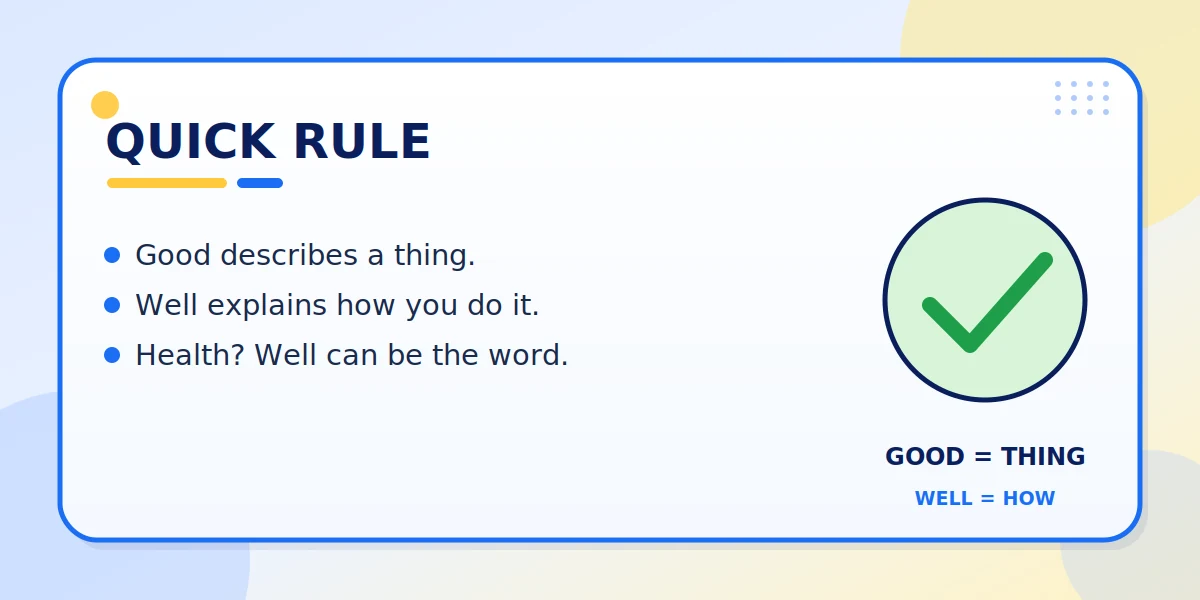
The main difference between well vs good is their grammatical function.
Good is usually an adjective that describes a noun or pronoun.
Well is usually an adverb that describes a verb, adjective, or another adverb.
Well can also be an adjective meaning healthy.
Good can follow linking verbs to describe someone’s condition, appearance, or feelings.
Consider these examples:
| Word | Main use | Example |
|---|---|---|
| Good | Adjective | She is a good teacher. |
| Well | Adverb | She teaches well. |
| Well | Health adjective | He is well today. |
| Good | Predicate adjective | The food tastes good. |
Remember that both “I feel good” and “I feel well” are standard, grammatically correct expressions.
Table of Contents
- Good vs Well: What’s the Difference?
- When to Use Good
- When to Use Well
- Good vs Well After Linking Verbs
- Feel Good vs Feel Well
- I’m Good vs I’m Well
- Do Good vs Do Well
- Good vs Well in Formal and Informal Writing
- Better vs Best
- Other Expressions with Good and Well
- Common Mistakes with Good and Well
- How to Remember the Difference
- Practice Questions
- Frequently Asked Questions
- Final Takeaway
Good vs Well: What’s the Difference?
The easiest way to understand this well vs good pair is to identify the part of speech each word represents.
Good generally functions as an adjective. It describes the quality or condition of someone or something.
Well generally functions as an adverb. It explains how someone performs an action.
For example:
She is a good writer. (Good describes the writer.)
She writes well. (Well describes how she writes.)
The Core Rule: Good Describes, Well Explains How
Use good when describing a person, place, object, or condition.
Use well when explaining how someone performs an action.
Here are more examples:
| Sentence | Explanation |
|---|---|
| He is a good student. | Good describes the student. |
| He studies well. | Well describes how he studies. |
| They bought a good house. | Good describes the house. |
| They maintained the house well. | Well describes how they maintained it. |
| She gave a good presentation. | Good describes the presentation. |
| She presented her ideas well. | Well describes how she presented them. |
This well vs good rule works in most everyday situations. However, it has important exceptions.
How to Identify an Adjective or Adverb
An adjective describes a noun or pronoun. It answers questions such as what kind or which one.
Examples:
A good movie.
A good friend.
The food is good.
An adverb modifies a verb, adjective, or another adverb. It often answers the question how.
Examples:
She speaks well.
He performed very well.
The instructions were surprisingly well written.
A useful test is to identify the word being described. If good describes a person or thing, it works as an adjective. If well explains how an action happens, it works as an adverb.
For more grammar guidance, explore our articles about who vs whom and fewer vs less.
When to Use Good
Use good when you want to describe someone’s qualities, something’s condition, or the value of an experience.
Good has several grammatical uses.
Good as an Adjective
Good is most commonly an adjective. It describes nouns and pronouns.
Examples:
She is a good doctor.
We watched a good movie.
This restaurant serves good food.
He has a good attitude.
They had a good experience.
In each sentence, good describes a person, object, or experience.
Good After Linking Verbs
Good can follow linking verbs because it describes the subject.
Examples:
You look good.
The flowers smell good.
The soup tastes good.
Your idea sounds good.
I feel good.
In these sentences, good is a predicate adjective. It describes the subject rather than modifying the verb.
Good as a Noun
Good can also function as a noun. It can mean something beneficial, valuable, or morally right.
Examples:
She wants to do good in her community.
The organization works for the common good.
He believes there is good in everyone.
Exercise does a lot of good for your body.
In these examples, good refers to beneficial actions or qualities.
Good as an Informal Adverb
Some speakers use good as an adverb in casual conversation.
Examples:
She sings good.
I did good on the test.
Everything is going good.
These expressions are common in informal speech. However, well is generally preferred in standard edited writing when describing how someone performs an action.
For example:
Informal: She sings good.
Standard edited English: She sings well.
Merriam-Webster documents this informal adverbial use. It also explains why it does not make “I feel good” incorrect.
When to Use Well
Use well when describing how someone performs an action. Well also has an important adjective meaning related to health.
Well as an Adverb
Well is an adverb when it explains how an action happens.
Examples:
She writes well.
He speaks English well.
They performed well.
You handled the situation well.
The children behaved well.
Well can also modify adjectives and other adverbs.
Examples:
The project is well organized.
She is well prepared.
He is well aware of the problem.
In each example, well adds information about the quality or degree of something.
Well as an Adjective Meaning Healthy
Well can function as an adjective meaning healthy or not sick.
Examples:
I am well today.
She feels well after her treatment.
He looks well.
The patient is well enough to return home.
This use explains why well can follow linking verbs such as feel, look, and seem.
Well as a Noun, Verb, and Interjection
Well has other grammatical uses beyond adjectives and adverbs.
| Part of speech | Meaning | Example |
|---|---|---|
| Noun | A deep hole that supplies water or oil | The farm has a water well. |
| Verb | To rise or flow | Tears began to well in her eyes. |
| Interjection | Introduces a response or thought | Well, let’s try again. |
These uses show why the word’s role depends on its context.
Good vs Well After Linking Verbs
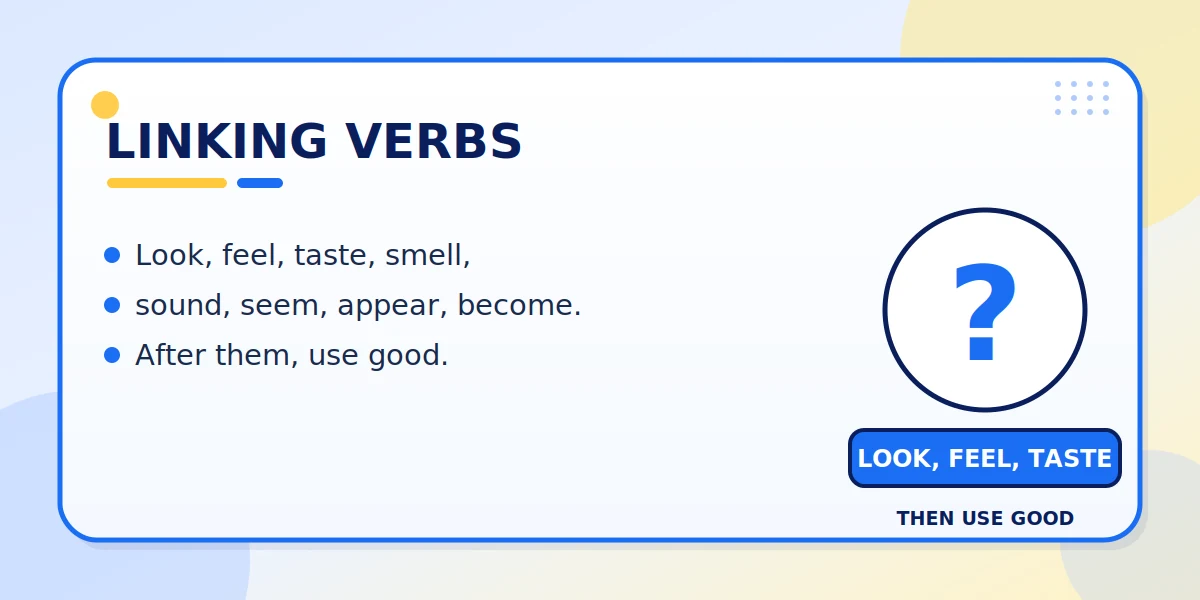
Linking verbs cause most well vs good confusion. Linking verbs connect a subject to information that describes it. They do not always express an action.
Common linking verbs include look, feel, taste, smell, sound, seem, appear, and become.
After these verbs, adjectives can describe the subject. This is why good often works correctly.
Well can also follow linking verbs when it means healthy.
Here is how each verb works.
1. Look Good vs Look Well
Use good to describe someone’s appearance or overall impression.
Use well when describing someone’s health.
Examples:
You look good in that jacket.
She looks good in her new haircut.
He looks well after his recovery.
Your grandmother looks well today.
The first two sentences describe appearance. The last two suggest good health.
2. Feel Good vs Feel Well
Both expressions are correct.
Use good to describe your general condition, emotions, or physical state. Use well when emphasizing health.
Examples:
I feel good about my decision.
She feels good after exercising.
I feel well enough to go outside.
He feels well after his treatment.
Remember that American English also commonly uses feel good when discussing health.
3. Taste Good vs Taste Well
Use good when describing the flavor of food or drinks.
Use well when describing someone’s ability to recognize flavors.
Examples:
The soup tastes good.
This cake tastes really good.
The chef can taste different spices well.
She can taste subtle flavors well.
Notice the difference. In the first two sentences, taste connects the food to its flavor. In the last two, taste describes an action.
4. Smell Good vs Smell Well
Use good to describe an odor or scent.
Use well when describing someone’s ability to detect smells.
Examples:
These flowers smell good.
Your perfume smells good.
The dog smells well.
Dogs can smell well enough to detect certain scents.
The meaning changes with the verb’s function. In “The flowers smell good,” smell is a linking verb. In “The dog smells well,” it describes the dog’s ability to smell.
5. Sound Good vs Sound Well
Use good to describe how something sounds or how an idea seems.
Use well when describing someone’s apparent health through their voice.
Examples:
Your plan sounds good.
That song sounds good.
You sound well today.
She sounds well after her illness.
Good describes the impression or quality. Well suggests that someone appears healthy.
6. Seem Good vs Seem Well
Use good when describing the quality or suitability of something.
Use well when describing someone’s health.
Examples:
This seems like a good idea.
The solution seems good.
She seems well after her illness.
The patient seems well enough to leave.
Both words describe the subject after the linking verb seem.
7. Appear Good vs Appear Well
Use good to describe an idea, situation, or condition.
Use well when referring to someone’s health.
Examples:
The proposal appears good.
This appears to be a good solution.
He appears well after his recovery.
The patient appears well today.
The intended meaning determines which adjective works best.
8. Become Good vs Become Well
Use good when describing a positive quality or improvement in someone’s ability.
Use well when describing recovery or good health.
Examples:
She became a good manager.
He became good at playing the guitar.
The patient became well after treatment.
She hopes to become well soon.
The first two examples describe ability or quality. The last two describe health.
Feel Good vs Feel Well: Which Is Correct?
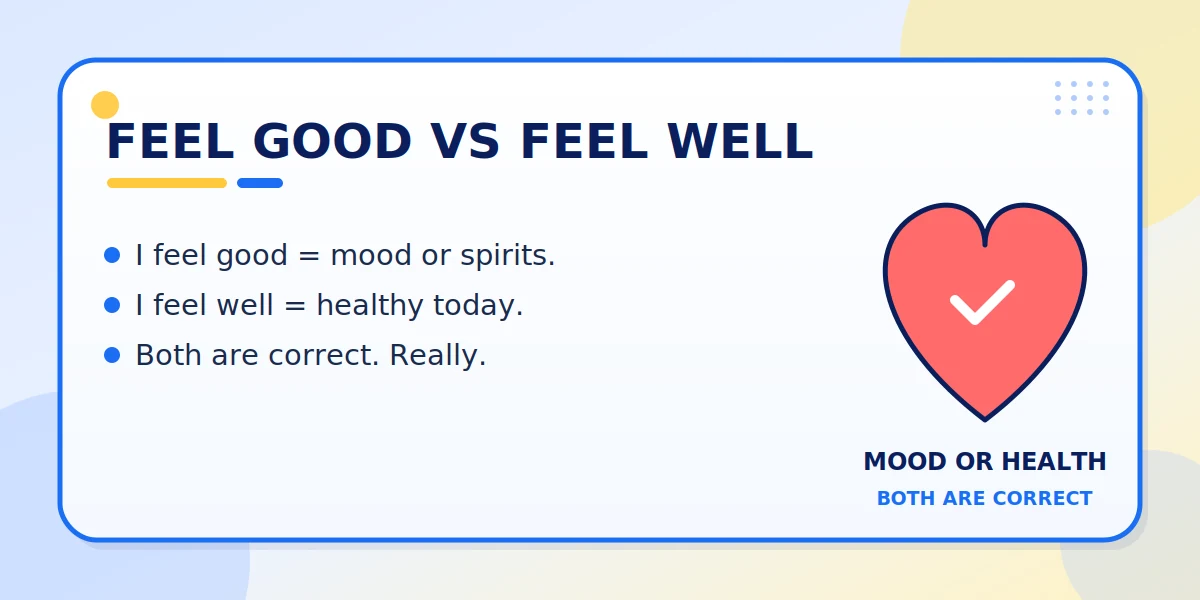
Both “feel good” and “feel well” are correct English expressions.
It is the most searched well vs good question.
This is one of the most misunderstood differences between the two words.
According to Merriam-Webster’s usage guide, both expressions are standard in English.
Is Feel Good Grammatically Correct?
Yes. Feel good is grammatically correct.
Some people believe good only describes morality or quality. They think well must describe physical health.
However, that belief is incorrect.
Feel is a linking verb in this construction. It connects the subject to an adjective describing its condition or feelings.
Examples:
I feel good about my new job.
She feels good today.
He feels good after his workout.
I haven’t been feeling good lately.
Good can describe emotional well-being and physical condition.
When Should You Use Feel Well?
Use feel well when you want to emphasize physical health.
Examples:
I feel well today.
She doesn’t feel well enough to travel.
He feels well after his treatment.
My grandmother is feeling well again.
Well is an adjective here. It describes the subject’s health.
Feel Good vs Feel Well Comparison
| Expression | Meaning | Correct? |
|---|---|---|
| I feel good. | General condition, mood, or health | Yes |
| I feel well. | Physical health | Yes |
| I feel good about my decision. | Positive feelings | Yes |
| I feel well after surgery. | Good health or recovery | Yes |
| I feel badly today. | Usually not the intended way to describe poor health | Usually no |
Avoid treating feel good as an error. Both expressions are standard, although their meanings can carry slightly different emphasis.
I’m Good vs I’m Well
Both “I’m good” and “I’m well” are correct. However, they can communicate different things.
When to Say I’m Good
“I’m good” is a common, informal response in American English.
It can mean that you feel fine, are satisfied, or do not need anything.
Examples:
How are you? I’m good, thanks.
Would you like more coffee? No, I’m good.
Do you need help? I’m good.
This expression works naturally in everyday conversations.
When to Say I’m Well
“I’m well” usually emphasizes someone’s physical health.
Examples:
I’m well after a few days of rest.
Thank you for asking. I’m well.
I’m feeling well enough to return to work.
It is also a perfectly acceptable response to someone asking how you are.
American English vs British English
There is a regional difference worth understanding.
American English commonly uses “I’m good” as a casual response. British English has traditionally favored “I’m well” in this context.
However, these preferences are not strict rules. Cambridge Dictionary notes that the American use of good in this context is also appearing in British English.
Do Good vs Do Well: What’s the Difference?
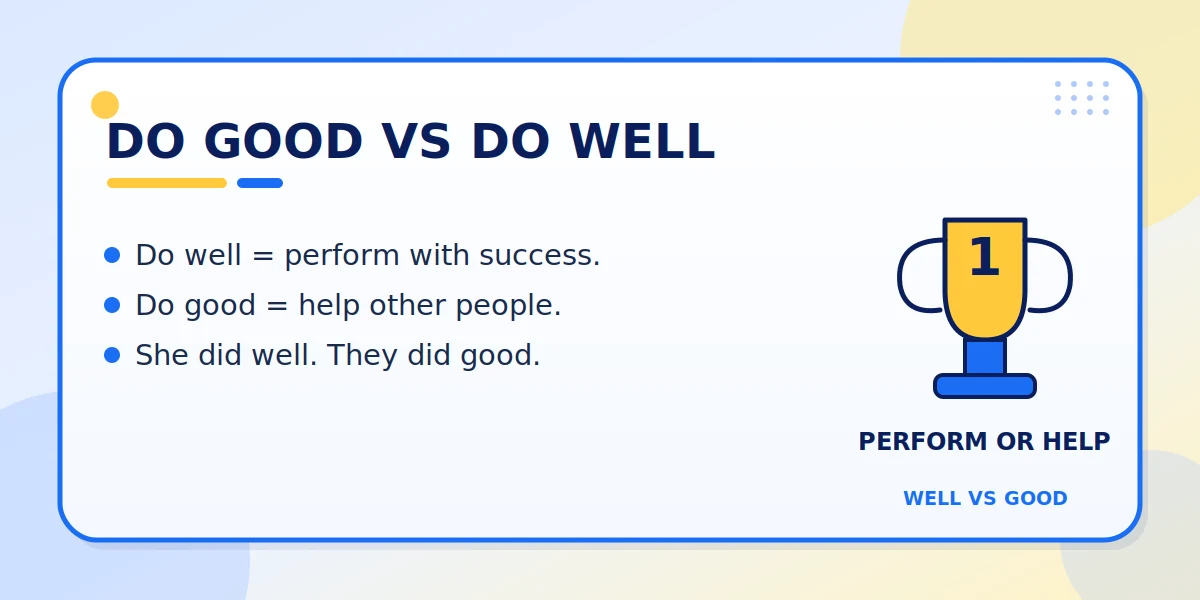
In the well vs good pair, do good and do well have different meanings.
Do well usually means performing successfully or achieving good results.
Do good usually means doing something beneficial or helpful.
When to Use Do Well
Use do well when discussing performance, progress, or success.
Examples:
She did well on her examination.
The business is doing well.
He does well under pressure.
The students did well in their competition.
Your team is doing well this season.
In these examples, well explains how someone performs.
When to Use Do Good
Use do good when describing beneficial actions or positive effects.
Examples:
The charity does good in the community.
She wants to do good for others.
Volunteers do good work every weekend.
The organization hopes to do good through its programs.
Here, good refers to something beneficial.
Did Good vs Did Well
These expressions also depend on the intended meaning.
| Expression | Meaning | Example |
|---|---|---|
| Did well | Performed successfully | She did well on the test. |
| Did good | Performed beneficial actions | He did good for the community. |
| Did a good job | Completed something successfully | She did a good job. |
You may hear “I did good on the test” in casual conversation. However, “I did well on the test” is the standard choice in edited writing.
Going Good vs Going Well
Use going well when describing progress or how a situation develops.
Examples:
How is your new job going? It’s going well.
The project is going well.
Everything is going well at school.
The business is going well this year.
“Going good” also appears in informal speech. However, going well is the preferred standard expression.
Good vs Well in Formal and Informal Writing
In well vs good choices, the right word often depends on the grammatical function and the situation.
Good and Well in Formal Writing
In formal and edited writing, follow these general guidelines:
Use good to describe nouns and pronouns.
Use well to describe how actions happen.
Use well as an adjective when referring to health.
Use good after linking verbs when describing the subject.
Examples:
She performed well during the presentation.
He submitted a good report.
The food tastes good.
I hope this email finds you well.
These constructions are natural and grammatically appropriate.
Good and Well in Everyday Conversation
Informal conversations sometimes use good as an adverb.
Examples:
I did good on my test.
She sings good.
Everything is going good.
These expressions are widely understood. However, well is generally the better choice in edited writing when describing performance.
Avoiding Hypercorrection
Hypercorrection happens when someone changes a correct expression because they believe another form must be more grammatical.
For example, some people replace “I feel good” with “I feel well” in every situation.
That correction is unnecessary.
Both expressions are correct. The word feel acts as a linking verb, so an adjective can follow it.
Choose the word that expresses your intended meaning. Do not replace good with well automatically.
Better vs Best: Comparative Forms of Good and Well
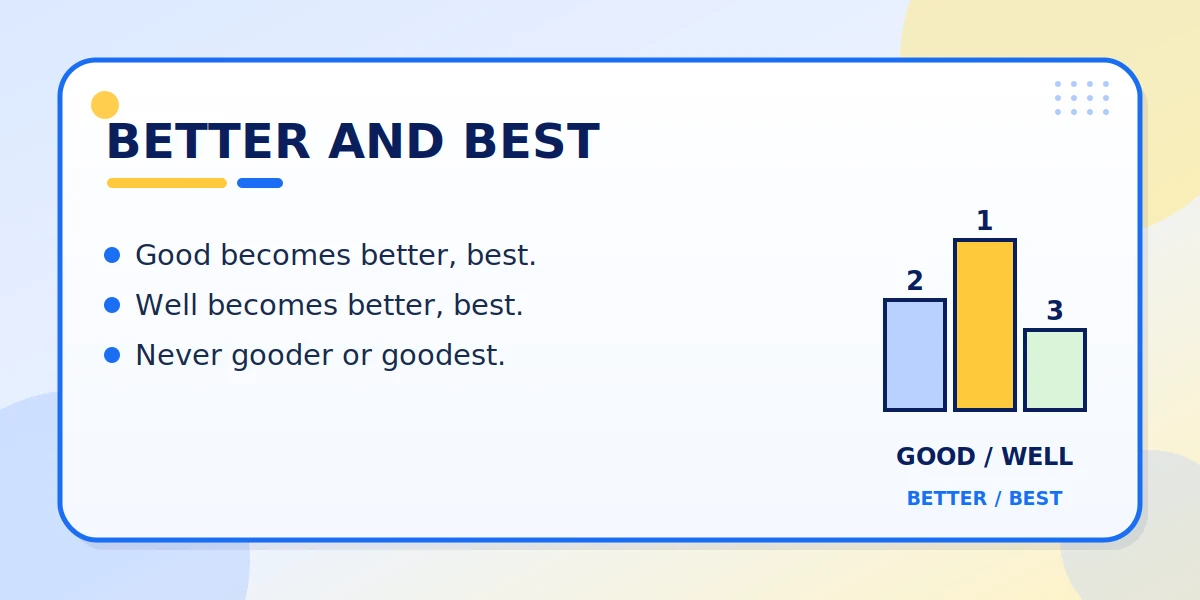
The well vs good pair shares the same comparative and superlative forms.
Their forms are:
Positive: Good or well
Comparative: Better
Superlative: Best
Good, Better, Best
When good functions as an adjective, use better to compare two things. Use best to identify the highest quality among three or more.
| Form | Example |
|---|---|
| Good | This is a good book. |
| Better | This book is better than the other one. |
| Best | This is the best book in the series. |
Well, Better, Best
When well functions as an adverb, the comparative and superlative forms remain the same.
| Form | Example |
|---|---|
| Well | She writes well. |
| Better | She writes better now. |
| Best | She writes best when she has time. |
Do not use gooder, goodest, weller, or wellest in standard English.
Other Expressions with Good and Well
Well vs good expressions appear in many common phrases. Learning these phrases will help you understand everyday English.
Common Expressions with Good
| Expression | Meaning | Example |
|---|---|---|
| Good for nothing | Useless or worthless | The broken machine was good for nothing. |
| In good spirits | Happy or cheerful | She was in good spirits. |
| For the good of | For someone’s benefit | They acted for the good of the community. |
| Good old days | A nostalgic reference to the past | He often talks about the good old days. |
| Good as new | In excellent condition again | The repaired phone looks good as new. |
Common Expressions with Well
| Expression | Meaning | Example |
|---|---|---|
| All is well | Everything is fine | Don’t worry. All is well. |
| All well and good | Acceptable, but sometimes incomplete | That’s all well and good, but we need a solution. |
| As well | Also or in addition | She speaks French as well. |
| For good | Permanently | They moved away for good. |
| Well-being | Health and happiness | Exercise supports overall well-being. |
| Well-done | Properly completed or cooked | The steak was well-done. |
| Well worth it | Valuable enough to justify the effort | The trip was well worth it. |
Common Well-Compound Adjectives
Well also appears in compound adjectives. These expressions describe the condition or quality of someone or something.
Examples:
Well-known author.
Well-behaved child.
Well-written article.
Well-organized office.
Well-prepared student.
When a compound adjective comes before a noun, a hyphen often connects its words. When it follows the noun, the hyphen may be unnecessary.
For example:
She is a well-known author.
The author is well known.
Common Mistakes with Good and Well
Many people confuse this well vs good pair because the words share positive meanings. However, their grammatical functions are different.
Use this table to recognize common mistakes and correct them.
| Common mistake | Better choice | Reason |
|---|---|---|
| She sings good. | She sings well. | Well describes how she sings. |
| He did good on the exam. | He did well on the exam. | Well describes performance. |
| The soup tastes well. | The soup tastes good. | Good describes the soup’s flavor. |
| I feel badly today. | I feel bad today. | Bad describes the person’s condition. |
| The project is going good. | The project is going well. | Well describes progress. |
| She is a well singer. | She is a good singer. | Good describes the singer. |
| He speaks English good. | He speaks English well. | Well modifies speaks. |
| I feel good, so my sentence is wrong. | I feel good. | This is a standard expression. |
Remember that some informal expressions appear in everyday speech. The suggested alternatives are generally better for standard edited writing.
Also, “I feel badly” can have a literal meaning related to the sense of touch. However, it is not the usual way to describe feeling unwell.
How to Remember the Difference Between Good and Well
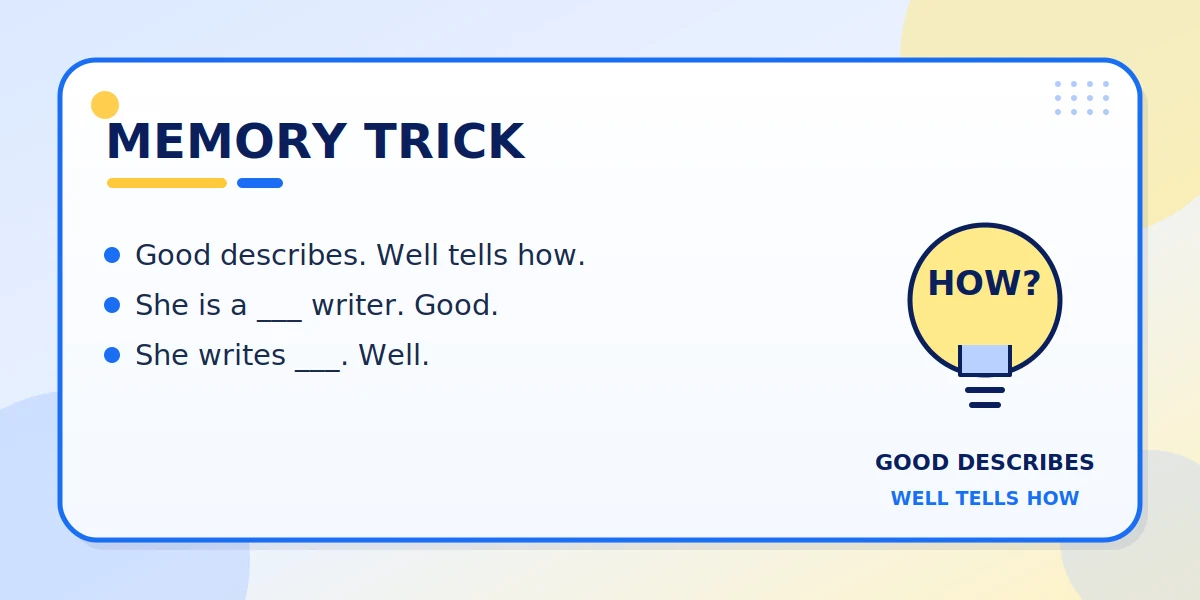
You do not need to memorize complicated grammar rules to choose correctly. A simple memory trick can help you settle the well vs good choice.
The Simple Memory Trick
Good describes. Well explains how.
Think about these examples:
A good student.
A student who studies well.
A good performance.
She performed well.
Remember one important exception:
Well can also mean healthy.
For example:
I am well.
She feels well.
He looks well.
The Three-Step Good vs Well Test
When choosing between these words, follow three simple steps.
Step 1: Identify what the word describes.
If it describes a person, place, or thing, good may be the right choice.
Example: She is a good teacher.
Step 2: Check whether it describes an action.
If it explains how someone performs an action, use well.
Example: She teaches well.
Step 3: Check whether it follows a linking verb.
If the word describes someone’s health, well is correct. Good can also be correct in American English.
Example: I feel good. I feel well.
This method works for most everyday sentences.
Practice Questions: Good or Well?
Test your well vs good understanding with these 10 questions. Choose the correct word for each blank.
- She is a very _____ student.
- He performed _____ in the competition.
- The flowers smell _____.
- I do not feel _____ today.
- The children behaved _____ during the trip.
- She did _____ on her final examination.
- The soup tastes _____.
- The patient appears _____ after treatment.
- He speaks English very _____.
- The organization wants to do _____ for the community.
Answer Key and Explanations
| No. | Answer | Explanation |
|---|---|---|
| 1 | Good | Good describes the noun student. |
| 2 | Well | Well modifies the verb performed. |
| 3 | Good | Good describes the flowers’ scent. |
| 4 | Good or well | Both are correct. They can carry slightly different emphasis. |
| 5 | Well | Well describes how the children behaved. |
| 6 | Well | Well describes her performance. |
| 7 | Good | Good describes the soup’s flavor. |
| 8 | Well | Well describes the patient’s health. |
| 9 | Well | Well modifies the verb speaks. |
| 10 | Good | Good is a noun meaning beneficial actions. |
How did you do?
If you missed a few questions, review the core rule and linking verb examples. Pay special attention to the difference between describing an action and describing someone’s condition.
Frequently Asked Questions
These well vs good questions come from real searches.
1. Is It “I Feel Good” or “I Feel Well”?
Both expressions are correct. “I feel good” can describe general condition, mood, or health. “I feel well” often emphasizes physical health. Merriam-Webster recognizes both as standard English expressions, so you can use either one with confidence.
2. Is “I Feel Good” Grammatically Wrong?
No, “I feel good” is grammatically correct. Feel acts as a linking verb, so an adjective can follow it. Good describes the subject’s condition, feelings, or general health in everyday English.
3. Should I Say “I’m Good” or “I’m Well”?
Both are correct. “I’m good” is a common, informal American response to a greeting or offer. “I’m well” usually emphasizes physical health. Choose the expression that best communicates your meaning.
4. Is It “Did Good” or “Did Well”?
Use “did well” when discussing someone’s performance or results. “Did good” can describe beneficial actions and also appears in informal speech. For standard edited writing, choose “did well” when discussing performance.
5. Should I Say “Do Good” or “Do Well”?
“Do good” means performing beneficial or helpful actions. “Do well” means performing successfully or making progress. For example, volunteers do good, while students do well on examinations and in school every day.
6. Is It “Sleep Good” or “Sleep Well”?
“Sleep well” is the standard expression because well describes how someone sleeps. You may hear “sleep good” in casual conversation, but “sleep well” is preferred in formal and edited writing.
7. What Are the Comparative and Superlative Forms of Good and Well?
Both words share the same comparative and superlative forms: better and best. Use good, better, and best for adjectives. Use well, better, and best for adverbs in everyday sentences as well.
Final Takeaway
The main difference between well vs good is their grammatical function.
Use good as an adjective to describe people, places, things, and conditions. Use well as an adverb to explain how someone performs an action.
Remember that well can also mean healthy. Good can also follow linking verbs and describe someone’s feelings or condition.
Most importantly, both “I feel good” and “I feel well” are correct. Understanding the context will help you choose the right expression.
For more practical grammar lessons, visit the ClarifyWords Grammar category.