

Desert vs Dessert: Meaning, Difference, and Examples

Quick Answer: Desert vs Dessert
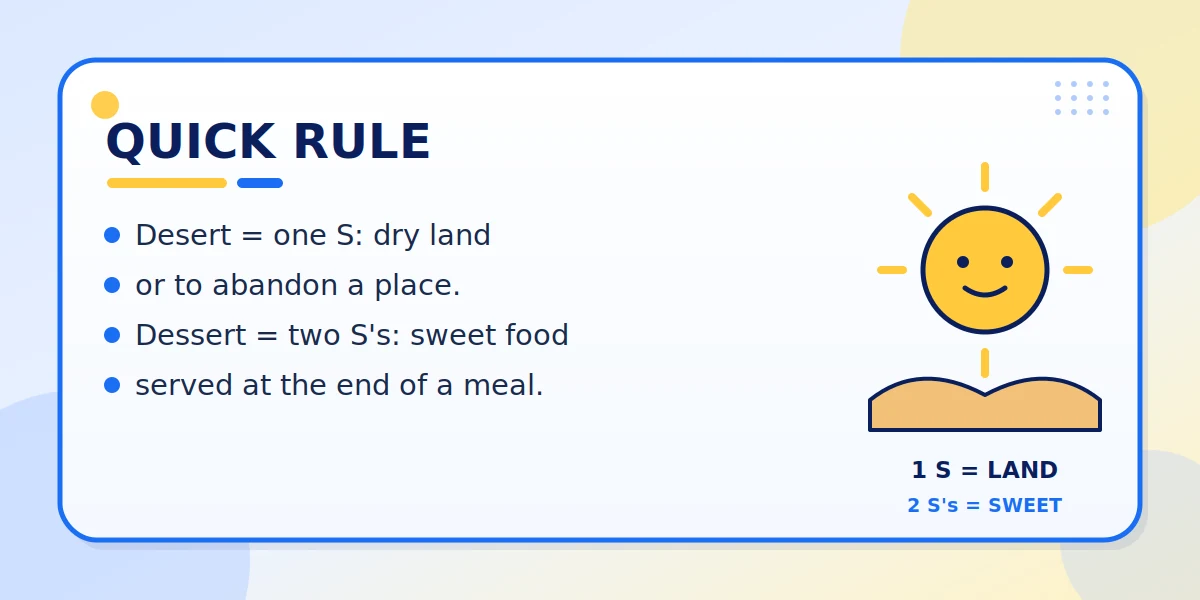
The main difference between desert vs dessert is their meaning and spelling.
- Desert has one S. It means a dry region of land. It can also mean to abandon someone or something.
- Dessert has two S's. It means the sweet course served at the end of a meal.
- Just deserts is a special expression meaning what someone deserves, usually a fair reward or punishment.
Memory trick: Dessert has two S's because you might want seconds. Desert has one S, like the single S in sand.
Table of Contents
- Desert vs Dessert at a Glance
- What Does Desert Mean?
- What Does Dessert Mean?
- Desert vs Dessert Pronunciation
- Is It Just Deserts or Just Desserts?
- Desert and Dessert Word Origins
- Desert vs Dessert Example Sentences
- Memory Tricks for Desert vs Dessert
- Common Mistakes
- Practice Questions and Answer Key
- Frequently Asked Questions
Desert vs Dessert at a Glance
Both words look and sound similar, but they have different meanings. Their grammatical roles also help you tell them apart.
| Word or phrase | Part of speech | Meaning | American pronunciation | Example |
|---|---|---|---|---|
| Desert | Noun | A dry region with little rainfall and sparse vegetation | /ˈdez.ɚt/ | The hikers crossed the desert. |
| Desert | Verb | To abandon someone or something | /dɪˈzɝːt/ | He would never desert his family. |
| Desert | Adjective | Related to a desert, or remote and uninhabited | /ˈdez.ɚt/ | They explored a desert island. |
| Just deserts | Noun phrase | A deserved reward or punishment | /dɪˈzɝːts/ | The dishonest player got his just deserts. |
| Dessert | Noun | A usually sweet course served at the end of a meal | /dɪˈzɝːt/ | We ordered cake for dessert. |
The dry land noun and adjective have first syllable stress. The verb desert and the word dessert have second syllable stress.
What Does Desert Mean?
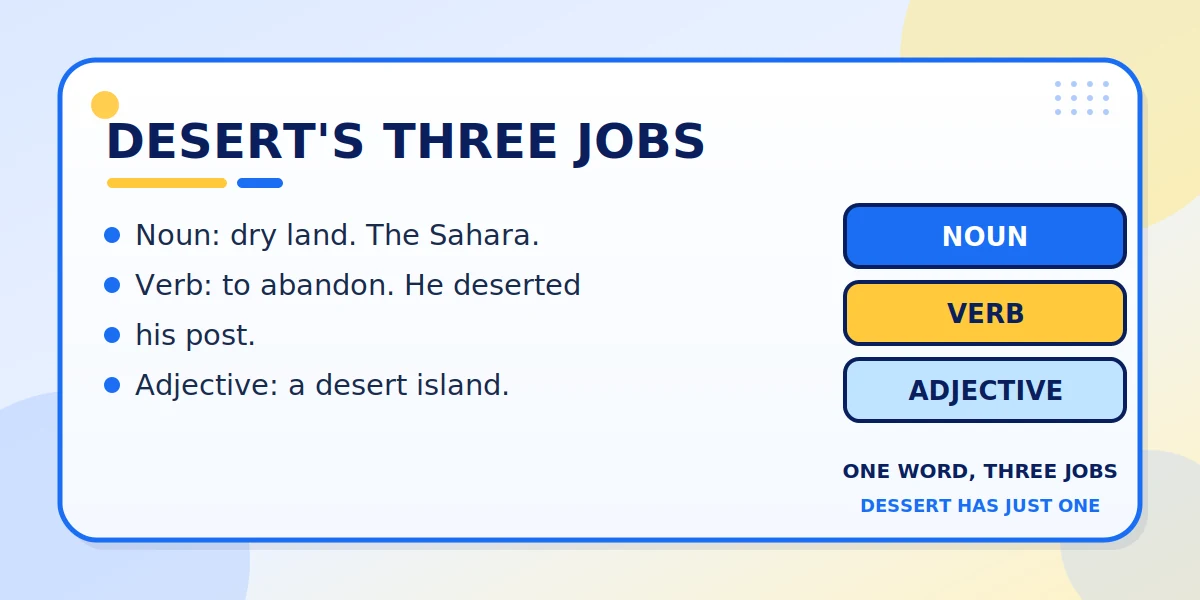
Desert has several meanings. It can function as a noun, verb, or adjective. The correct meaning depends on how the word works in a sentence.
Desert as a Noun: A Dry Region
A desert is a dry area that receives little rainfall. It usually has sparse vegetation. Deserts are not always hot or covered with sand. Some are cold, rocky, or covered with gravel. Well known examples include: The Sahara Desert in Africa; The Gobi Desert in Asia; The Mojave Desert in the United States; The Atacama Desert in South America. The word also appears in expressions with figurative meanings. For example, a food desert is an area where people have limited access to affordable, nutritious food. A cultural desert describes a place with few cultural activities or resources.
Examples of desert as a noun:
- The Sahara is a vast desert.
- Some plants survive in the desert with very little water.
- The travelers prepared carefully before crossing the desert.
- The small town felt like a cultural desert.
Desert as a Verb: To Abandon or Leave
Desert can also be a verb. It means to abandon someone or something, leave a place, or give up a responsibility. It can describe someone who leaves a military post or service without permission.
The verb has several common forms:
| Verb form | Example |
|---|---|
| Desert | Do not desert your responsibilities. |
| Deserts | He deserts his friends when they need him. |
| Deserted | The soldiers deserted their posts. |
| Deserting | She was accused of deserting her team. |
The word deserted can also describe a place that people have left.
Examples of desert as a verb:
- A loyal friend would not desert you during a difficult time.
- The soldiers were warned not to desert their posts.
- He refused to desert his family.
- The town was deserted after the factory closed.
Notice the difference between the verb and its related adjective: They deserted the village. This describes an action. The village was deserted. This describes the village's condition.
Desert as an Adjective: Related to a Desert or Uninhabited
Desert can also work as an adjective. It describes something related to a desert or something remote and uninhabited. The expression desert island is a familiar example. It refers to an isolated island with no permanent residents. Other examples include: Desert climate; Desert plants; Desert landscape; Desert island.
Examples of desert as an adjective:
- They dreamed of spending a week on a desert island.
- The researchers studied plants in a desert environment.
- The region has a dry desert climate.
Do not confuse desert with deserted. A desert island is isolated or uninhabited. A deserted island is an island that people have left.
What Does Dessert Mean?
Dessert is a noun. It usually means the sweet course served at the end of a meal. It has two S's in its spelling. Dessert can refer to an entire course or one particular sweet dish. It does not have to follow dinner. It can be the final course of lunch or another meal.
Examples of Dessert Foods
Common desserts include: Cake; Pie; Cookies; Ice cream; Pudding; Fudge; Fresh fruit. The word can describe one dish or several sweet dishes.
Examples:
- We had chocolate cake for dessert.
- She made an apple pie for dessert.
- The restaurant offers several desserts.
- Would you like dessert after lunch?
- Fresh fruit was served as dessert.
Merriam-Webster defines dessert as a usually sweet course or dish. Cambridge Dictionary also defines dessert as the sweet course served after the main course. In British English, the sweet course is often called pudding or afters, and Merriam-Webster also records a British sense of fresh fruit served after the sweet course.
Desert vs Dessert Pronunciation
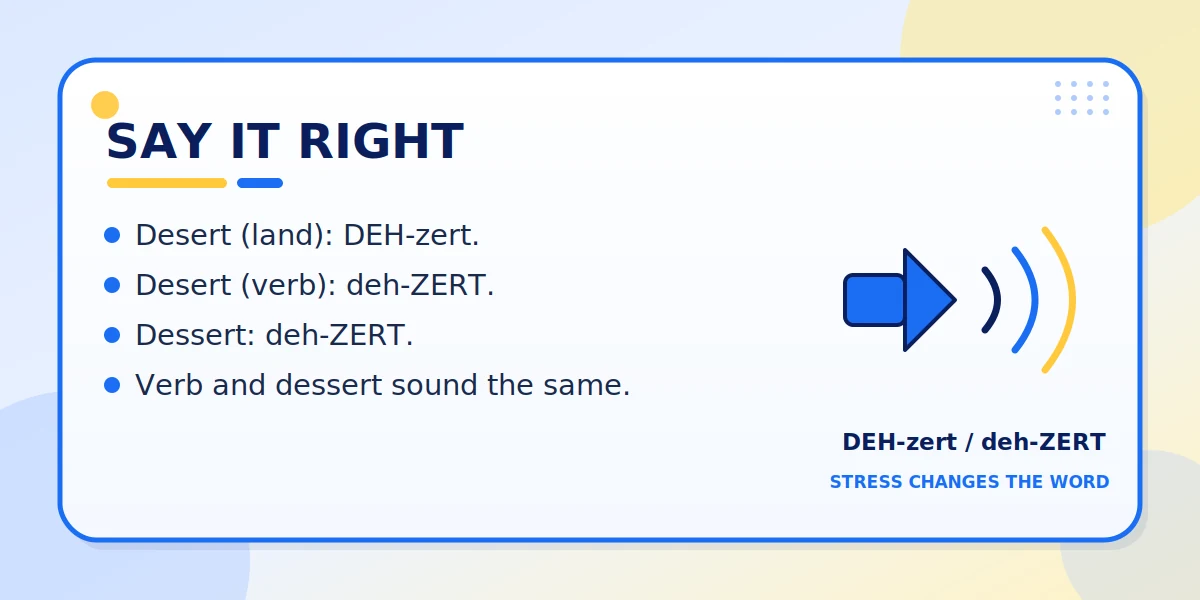
The pronunciation of these words can make their spelling confusing. In American English, the dry land noun desert sounds different from the verb desert. The word dessert sounds like the verb. The main difference is syllable stress.
American English Pronunciation Table
| Word or use | IPA | Stress pattern | Simple pronunciation guide |
|---|---|---|---|
| Desert, dry region | /ˈdez.ɚt/ | First syllable | DEZ-ert |
| Desert, to abandon | /dɪˈzɝːt/ | Second syllable | dih-ZURT |
| Deserts, in just deserts | /dɪˈzɝːts/ | Second syllable | dih-ZURTS |
| Dessert, sweet course | /dɪˈzɝːt/ | Second syllable | dih-ZURT |
Merriam-Webster and Cambridge Dictionary distinguish the noun and verb pronunciations of desert.
Why Does Desert Have Two Pronunciations?
The noun desert, meaning a dry region, has stress on its first syllable. The verb desert, meaning to abandon, has stress on its second syllable. This pronunciation matches dessert.
Compare these sentences:
- The DESert is very dry.
- Do not deSERT your friends.
- We ordered deSSERT after dinner.
The first word has first syllable stress. The other two have second syllable stress.
How to Hear the Difference
Listen for the stressed syllable when you speak. If you mean a dry region, stress the first syllable. If you mean a sweet course, stress the second syllable. The verb desert also has second syllable stress. Context tells you whether the word means abandon or a sweet course.
Is It Just Deserts or Just Desserts?
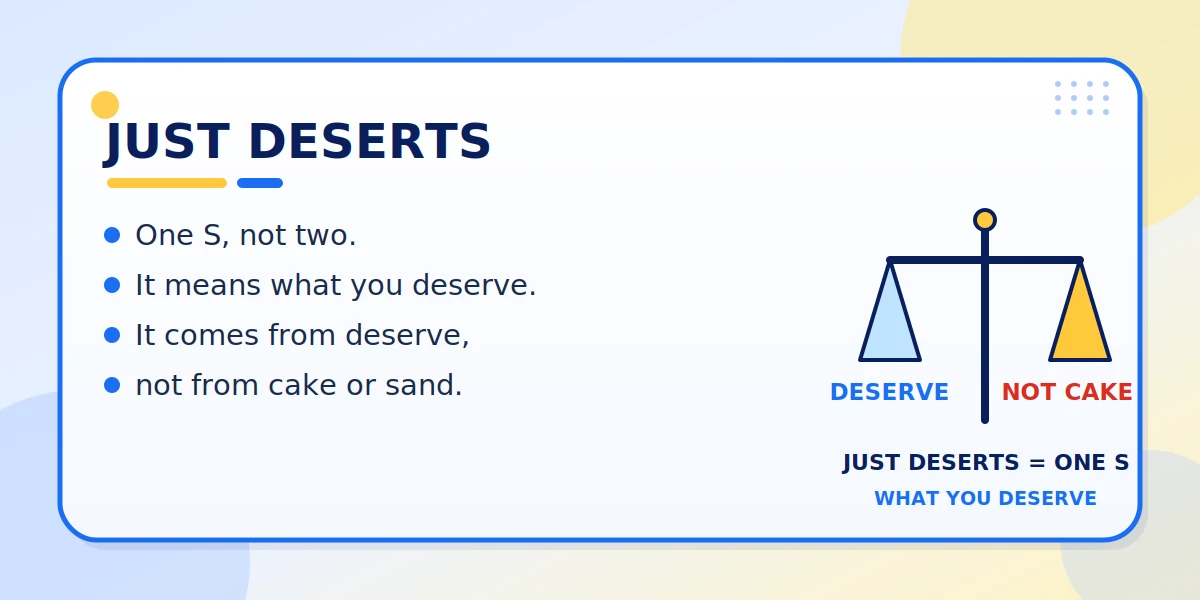
The correct expression is just deserts, with one S in the middle. It means what someone deserves. It often refers to a fair punishment or consequence, but it can also mean a deserved reward.
What Does Just Deserts Mean?
The word deserts in this expression is a noun related to the verb deserve. It does not refer to dry land. It also does not refer to a sweet dish.
For example:
- The dishonest player finally got his just deserts.
- After years of hard work, she received her just deserts.
- The unfair manager got his just deserts when the truth came out.
The expression can describe either a good or bad outcome. Its meaning depends on what the person deserves.
Why Is Just Deserts Spelled with One S?
The spelling comes from the older noun meaning something deserved. It is not related to dessert, the sweet course served after a meal. The phrase can confuse writers because deserts and desserts sound alike here.
Remember this distinction:
- Just deserts: What someone deserves.
- Just desserts: An incorrect spelling of the expression.
Desert and Dessert Word Origins
The histories of these words help explain their different meanings. However, they do not all follow one simple path. There are three word histories to understand.
The Dry Land Noun and the Verb Desert
The dry land noun and the verb desert have a history connected to the Latin verb dēserere, meaning to abandon or forsake. The verb still carries the idea of leaving or abandoning someone or something. The geographical noun developed through earlier language forms. Its history is distinct from the modern food word.
The Deserving Noun in Just Deserts
The noun deserts in just deserts is connected with the idea of deserving something. It comes through French forms related to deservir, meaning to deserve. This older noun survives in the familiar expression just deserts. It means a reward or punishment that someone deserves.
Dessert and Its French Connection
The English word dessert comes from French dessert. It is connected with desservir, meaning to clear the table. The word refers to the course served after the main meal. Merriam-Webster gives 1600 as the first known use of dessert in English.
Three Word Histories at a Glance
| Word history | Origin or development | Modern meaning |
|---|---|---|
| Desert, dry land and abandonment | Connected with Latin dēserere | A dry region, or to abandon |
| Deserts in just deserts | Related to French deservir and the idea of deserving | A deserved reward or punishment |
| Dessert | From French dessert, linked to desservir, meaning to clear the table | The sweet course of a meal |
These histories explain why the words have different meanings and spellings. They also explain why just deserts is not spelled like the food word.
Desert vs Dessert Example Sentences
Examples make the difference easier to understand. Read each sentence and notice how the meaning determines the spelling.
Desert as a Noun
- The Sahara is one of the world's best known deserts.
- The hikers carried extra water across the desert.
- Few plants grow in this dry desert region.
- The town lacked cultural events and felt like a cultural desert.
Desert as a Verb
- A good friend will not desert you.
- The soldiers were punished for deserting their posts.
- She promised never to desert her children.
- The residents deserted the town after the storm.
Desert as an Adjective
- They explored a remote desert island.
- Desert plants can survive in dry conditions.
- The researchers studied the desert landscape.
Dessert as a Noun
- We ordered chocolate cake for dessert.
- My favorite dessert is vanilla ice cream.
- The children shared two desserts.
- She prepared a fruit dessert for the guests.
Desert and Dessert in the Same Sentence
- After crossing the desert, the travelers celebrated with a delicious dessert.
- The hikers packed extra water for the desert and saved their chocolate bars for dessert.
- Living in a desert can be challenging, but enjoying dessert after dinner is easy.
- They explored the desert during the day and enjoyed dessert at the hotel.
For more help with confusing word pairs, read our guides to loose vs lose (https://clarifywords.com/loose-vs-lose/) and affect vs effect (https://clarifywords.com/affect-vs-effect/).
Easy Memory Tricks for Desert vs Dessert
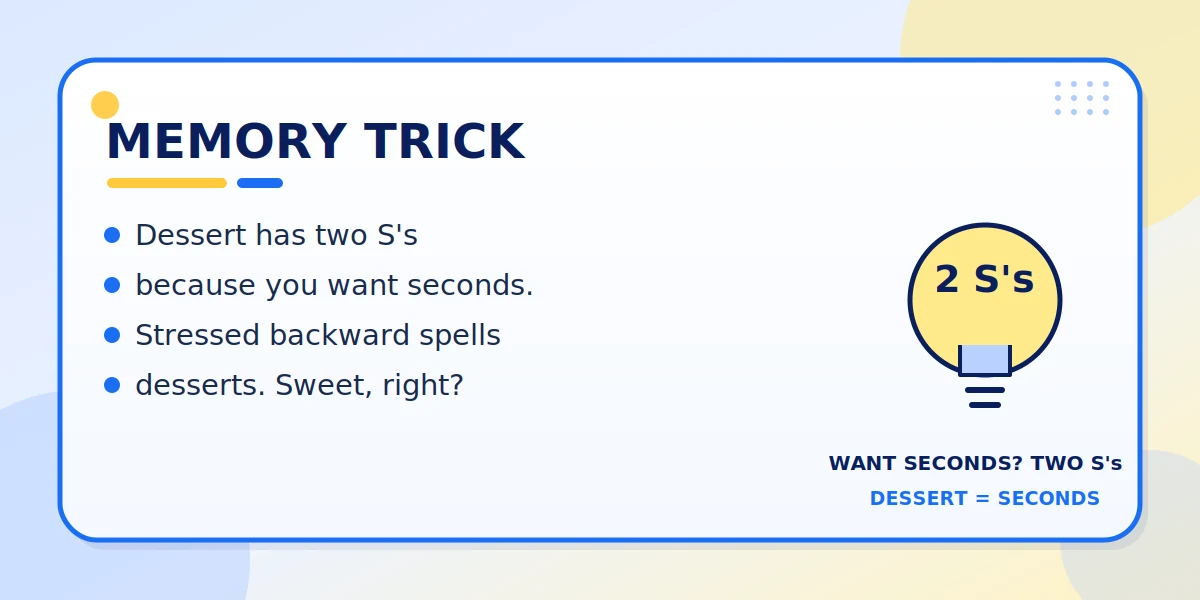
A simple memory trick can help you remember which spelling to use.
Dessert Has Two S's Because You Want Seconds
The word dessert has two S's. Think of wanting a second helping of cake or ice cream. The extra S can remind you that dessert has two S's because you might want seconds.
Desert Has One S for Sand
The geographical word desert has one S. Think of the single S in sand. This trick helps you remember the spelling of the dry region noun.
Remember Just Deserts Through Deserve
The expression just deserts has one S in the middle. Connect it with deserve. Both words relate to what someone earns or deserves.
Use Meaning and Stress Together
Check the meaning before choosing a spelling.
- Dry region: desert, with first syllable stress.
- Abandon: desert, with second syllable stress.
- Sweet course: dessert, with second syllable stress.
- Deserved reward or punishment: just deserts.
Common Mistakes with Desert and Dessert
Writers often confuse these words because their spellings are similar. Their meanings and grammatical roles are different, so check the meaning first.
1. Using Desert When You Mean Dessert
Incorrect: We ordered chocolate cake for desert. Correct: We ordered chocolate cake for dessert. Use dessert when you mean a sweet course or dish.
2. Using Dessert When You Mean Desert
Incorrect: The travelers crossed the dessert. Correct: The travelers crossed the desert. Use desert when you mean a dry region of land.
3. Writing Just Desserts Instead of Just Deserts
Incorrect: He finally got his just desserts. Correct: He finally got his just deserts. The correct expression uses deserts, the noun related to deserving something.
4. Assuming Every Use of Desert Has the Same Pronunciation
The dry land noun and the verb have different stress patterns. The noun stresses the first syllable. The verb stresses the second syllable. The verb desert and the food word dessert sound alike in American English.
5. Confusing Desert and Deserted
These words are related, but they do not have the same grammatical role.
- The soldiers deserted their posts. This describes an action.
- The posts were deserted. This describes their condition.
Use desert as the base verb. Use deserted when describing something abandoned or left empty.
For other common spelling and usage problems, explore our guides to principal vs principle (https://clarifywords.com/principal-vs-principle/) and complement vs compliment (https://clarifywords.com/complement-vs-compliment/).
Practice: Desert or Dessert?
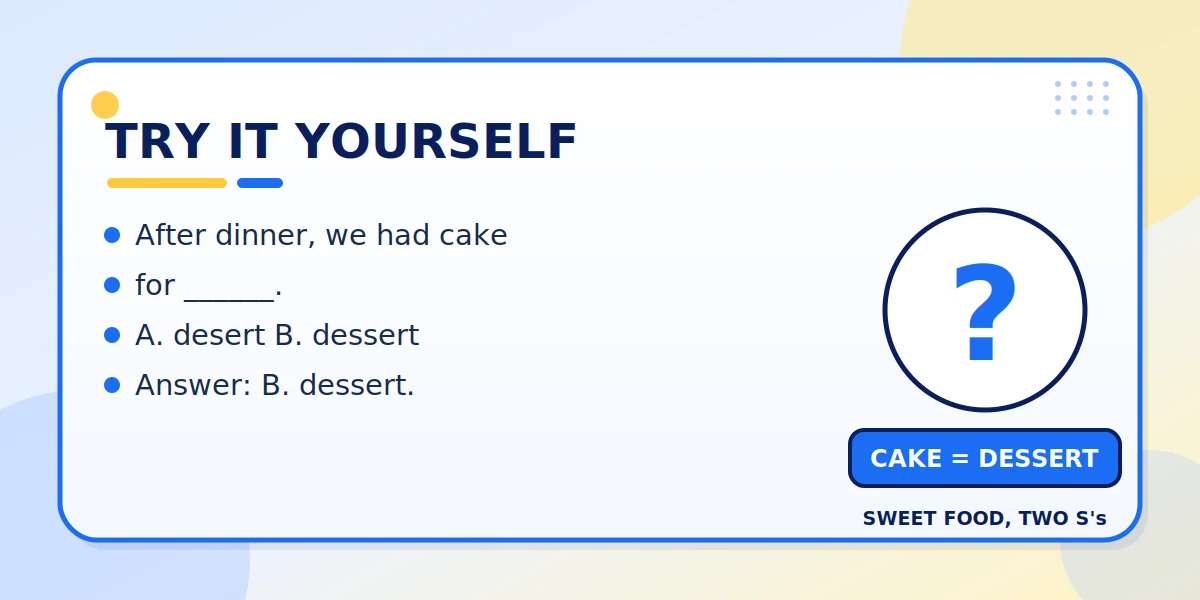
Test your understanding with these ten questions. Choose the correct word or form for each blank.
Practice Questions
- The travelers crossed the hot ______ before sunset.
- Would you like ice cream for ______?
- He would never ______ his family in a difficult situation.
- The restaurant serves several homemade ______.
- The soldiers were accused of trying to ______ their posts.
- They spent their vacation on a remote ______ island.
- The dishonest player finally got his just ______.
- The small town was almost ______ after the factory closed.
- We packed water and food before entering the ______.
- After exploring the ______ all afternoon, we enjoyed cake for ______.
Answer Key with Explanations
- Desert. It is a noun meaning a dry region of land.
- Dessert. It means a sweet course served after a meal.
- Desert. It is a verb meaning to abandon someone.
- Desserts. This is the plural form of the noun for sweet dishes.
- Desert. It is a verb meaning to leave a duty or post.
- Desert. It is an adjective describing a remote or uninhabited island.
- Deserts. The expression just deserts means what someone deserves.
- Deserted. It describes a town that people have mostly left.
- Desert. It refers to a dry geographical region.
- Desert; dessert. The first means dry land. The second means a sweet course.
Frequently Asked Questions
What Is the Difference Between Desert and Dessert?
Desert means a dry region of land or to abandon someone or something. Dessert means a usually sweet course served after a meal. The extra S changes the spelling and meaning.
Is Dessert Spelled with One S or Two?
Dessert is spelled with two S's. It refers to a sweet course or dish served at the end of a meal. Remember the seconds trick: you might want a second helping, so use two S's.
Is It Just Deserts or Just Desserts?
The correct expression is just deserts, with one S in the middle. It means what someone deserves, often a fair punishment or reward. The noun deserts is related to deserve.
How Do You Pronounce Desert and Dessert?
The dry land noun desert stresses its first syllable. The verb desert and the noun dessert stress their second syllables. The verb and food word sound alike in American English.
Can Desert Be Used as a Verb?
Yes. Desert can mean to abandon someone, leave a place, or give up a responsibility. For example, a soldier might desert a post, and a friend might desert someone in trouble.
Can Desert Be Used as an Adjective?
Yes. Desert can describe something related to a desert or something remote and uninhabited. For example, a desert island is isolated. The word also appears in phrases such as desert climate.
Why Does Dessert Have Two S's?
Dessert comes from French dessert, which is connected to desservir, meaning to clear the table. A useful spelling trick is to remember that you might want seconds. Merriam-Webster gives 1600 as the first known use.
Final Takeaway: Remember Desert vs Dessert
The difference between desert vs dessert comes down to spelling, meaning, and context.
- Desert: One S. It means a dry region, to abandon, or something related to a desert.
- Dessert: Two S's. It means the sweet course served at the end of a meal.
- Just deserts: One S in the middle. It means what someone deserves.
When you are unsure, check the meaning first. Remember the extra S in dessert by thinking about seconds.
Related Guides
- Whose vs Who's (https://clarifywords.com/whose-vs-whos/)
- Its vs It's (https://clarifywords.com/its-vs-its/)
- Loose vs Lose (https://clarifywords.com/loose-vs-lose/)
- Affect vs Effect (https://clarifywords.com/affect-vs-effect/)
- Principal vs Principle (https://clarifywords.com/principal-vs-principle/)
- Complement vs Compliment (https://clarifywords.com/complement-vs-compliment/)
- Then vs Than (https://clarifywords.com/then-vs-than/)
- Anytime vs Any Time (https://clarifywords.com/anytime-vs-any-time/)
- Confused Words category (https://clarifywords.com/category/confused-words/)