Holistic or Wholistic: Which Spelling Is Correct?
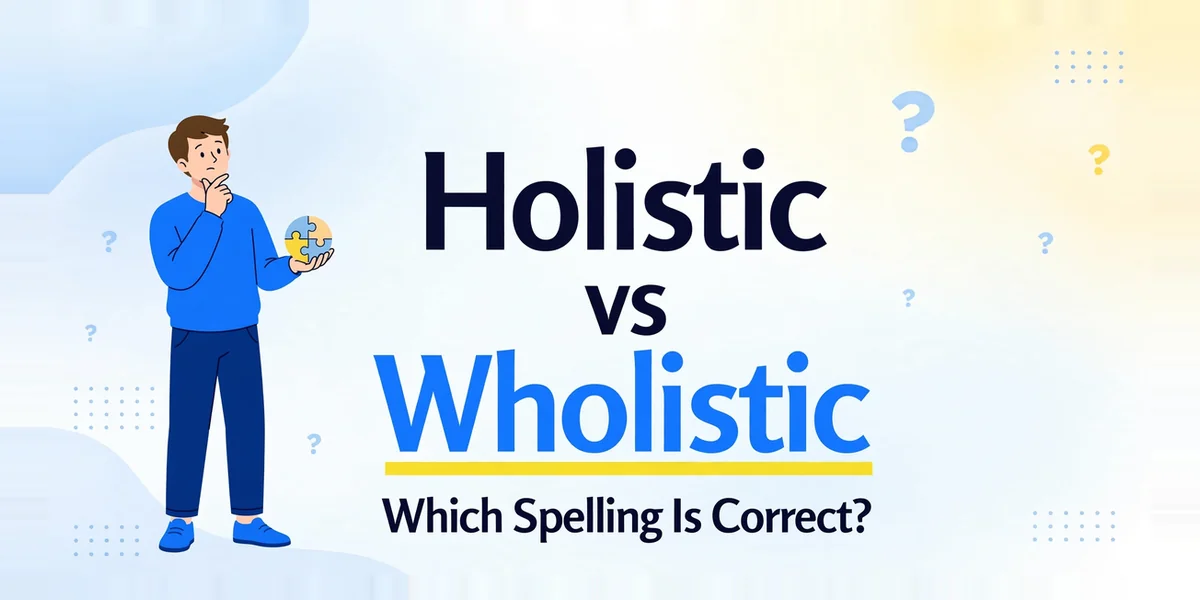
If you are unsure whether to write holistic or wholistic, choose holistic. It is the standard spelling in modern English and the best choice for everyday, professional, academic, and formal writing.
Wholistic is also a recognized variant spelling. It has the same general meaning, but it is much less common. Most readers and editors will expect to see holistic.
Both forms describe an approach that considers something as a complete whole rather than focusing on separate parts. However, holistic is the safer and more widely accepted choice. This guide settles the holistic or wholistic question with dictionary evidence, clear examples, and a simple rule you can use every time.
Table of Contents:
- Quick Answer: Holistic or Wholistic?
- Holistic vs. Wholistic: What’s the Difference?
- What Does Holistic Mean?
- What Does Wholistic Mean?
- Why Is Holistic Spelled Without a W?
- How Do You Pronounce Holistic and Wholistic?
- When Should You Use Holistic?
- When Should You Use Wholistic?
- Common Mistakes to Avoid
- Related Words and Forms
- How to Remember the Correct Spelling
- Practice: Holistic or Wholistic?
- Frequently Asked Questions
- Related Guides
Quick Answer: Holistic or Wholistic?
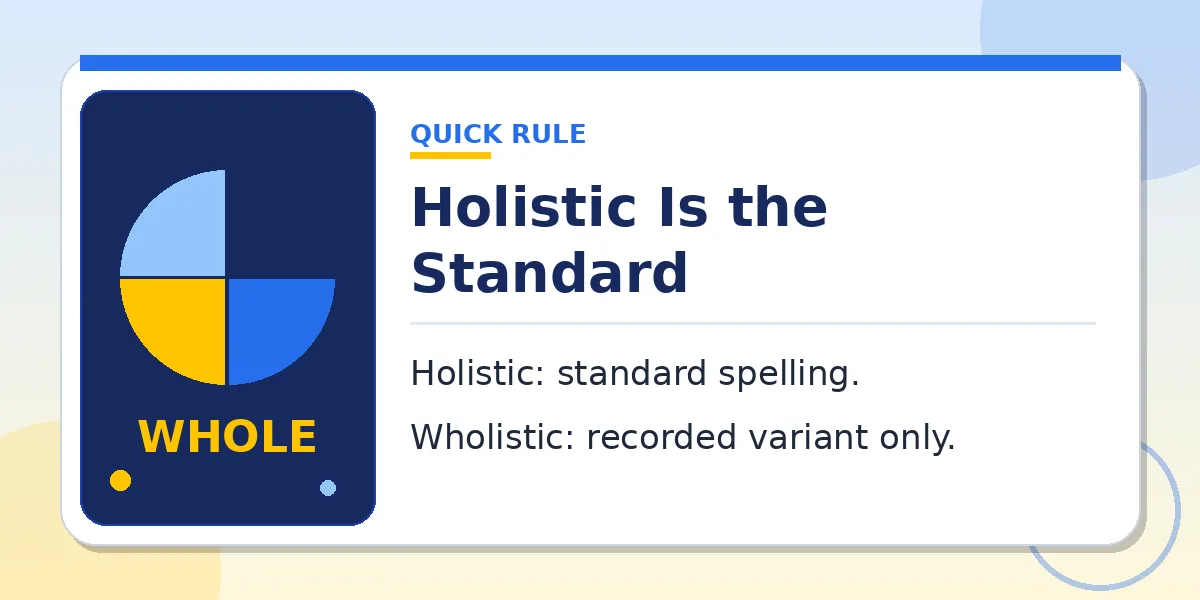
Holistic is the preferred spelling. Use it when describing an approach that considers all parts of a person, situation, or system.
Wholistic is a variant spelling with the same general meaning. Dictionaries such as Collins and Dictionary.com recognize it as a variant of holistic.
Here is the simple rule: Holistic: Standard spelling. Use it in formal and everyday writing. Wholistic: Recognized but less common variant. Use it when preserving a name, quotation, or established spelling.
For example: Correct standard usage: The doctor recommended a holistic approach to care. Less common variant: The center promotes wholistic wellness.
If you are writing an essay, report, email, or professional document, choose holistic.
Holistic vs. Wholistic: What’s the Difference?
The main difference is spelling and common usage. Both words describe an approach that considers the complete picture. When you compare holistic or wholistic side by side, the meaning does not change. Only the spelling and its acceptance change.
| Feature | Holistic | Wholistic |
|---|---|---|
| Spelling | Standard spelling | Variant spelling |
| General meaning | Considering the whole | Considering the whole |
| Pronunciation | Usually three syllables | Usually the same |
| Common usage | Widely used | Much less common |
| Formal writing | Recommended | Usually avoid |
| Dictionary status | Established standard form | Recognized variant |
The two spellings do not have a reliable difference in meaning. You should not use one to describe the whole person and the other to describe every part separately.
In most situations, holistic communicates the intended meaning clearly. It is also the form readers are more likely to recognize.
What Does Holistic Mean?
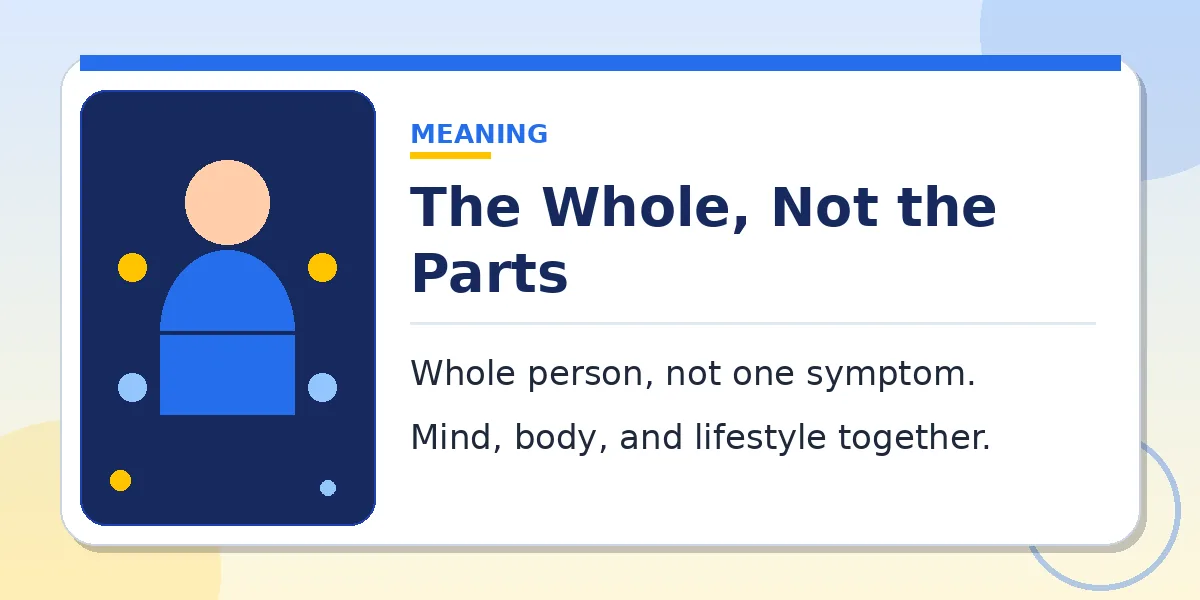
Holistic is an adjective that describes an approach focused on the whole rather than individual parts.
It looks at how different elements connect and affect one another. Instead of examining one issue alone, a holistic approach considers the wider situation.
For example, a holistic view of health considers more than physical symptoms. It may also consider emotional well-being, lifestyle, relationships, and social factors.
The word is not limited to healthcare. People also use it in education, business, environmental studies, and everyday discussions.
Examples of Holistic in Sentences
- The school uses a holistic approach to student development.
- Her doctor discussed a holistic treatment plan.
- The company needs a holistic strategy for improving customer service.
- Environmental protection requires a holistic understanding of local ecosystems.
- A holistic view of the problem revealed several connected causes.
In each sentence, the word describes a broad approach. It considers how different parts work together.
What Does Wholistic Mean?
Wholistic is a recognized variant spelling of holistic. It describes the same general idea: considering something as a complete whole.
The spelling may look more logical because it resembles the familiar English word whole. However, its similarity to whole does not make it the standard form.
For example: The organization offers wholistic wellness services. She believes in a wholistic approach to personal growth. These examples communicate the same general idea as sentences using holistic.
Is Wholistic a Real Word or a Misspelling?
Wholistic is a real, recorded variant. It is not accurate to say that dictionaries never recognize it. However, recognition does not mean both spellings are equally common or equally suitable for every situation. Holistic remains the established standard form. For general writing, use holistic. You may encounter wholistic in business names, wellness materials, and informal writing.
Why Is Holistic Spelled Without a W?
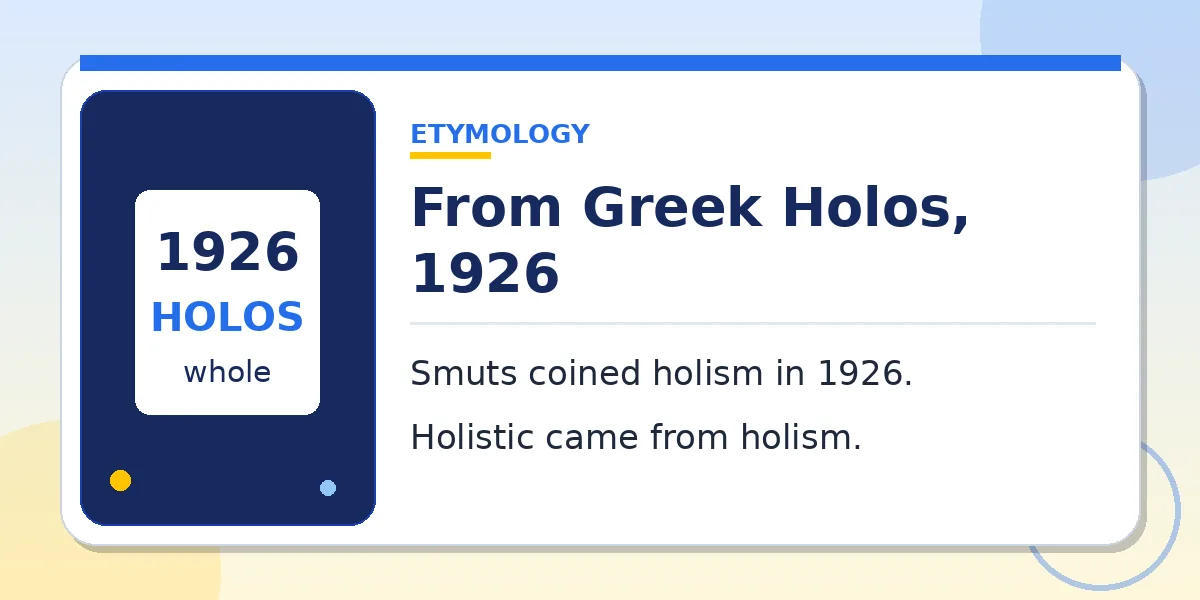
The spelling comes from the word holism, not directly from the English word whole.
The Greek word holos means “whole” or “complete.” The term holism was introduced by South African philosopher Jan Christiaan Smuts in his 1926 book, Holism and Evolution.
The book explored how separate parts can form integrated wholes. The adjective holistic developed from holism. Etymonline explains this word history, including the connection to Greek holos.
The variant wholistic appeared later. Etymonline dates it to 1941 and describes its formation as a blend of holistic and whole. This history explains why the standard spelling does not contain a W. It developed from holism, not from the modern spelling of whole.
This is also why the holistic or wholistic debate is about spelling history, not about two different ideas. The W was added later because whole looks familiar, not because the meaning changed.
How Do You Pronounce Holistic and Wholistic?
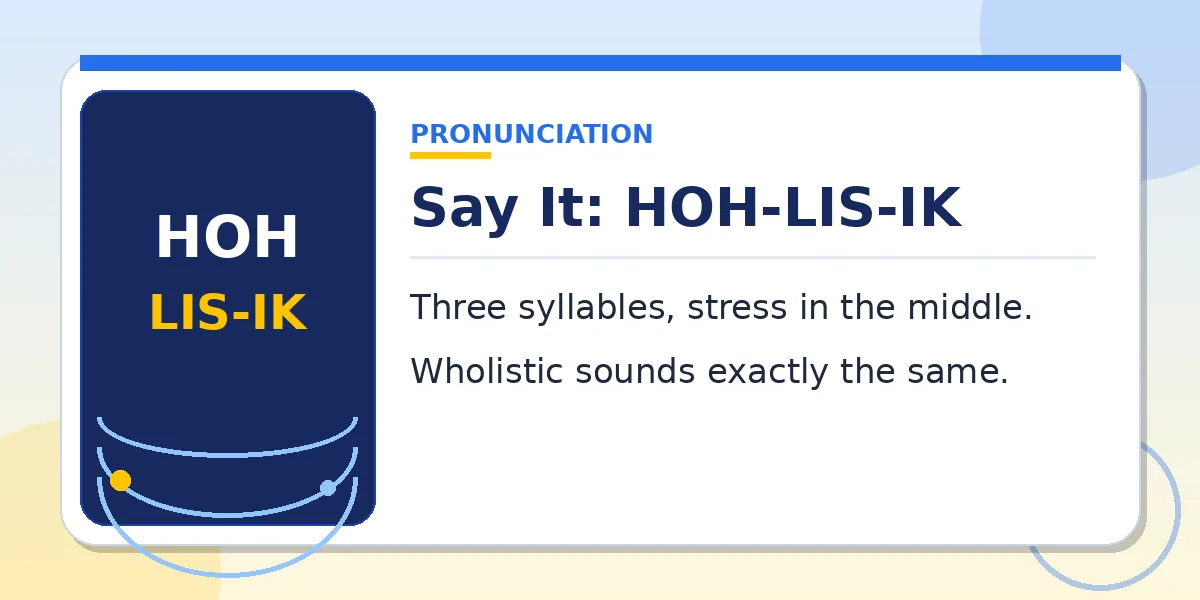
Both spellings generally have the same pronunciation. Each word has three syllables, with stress on the middle syllable.
Say it as HOH-LIS-IK. That readable form matches the dictionary pronunciation for holistic.
Cambridge Dictionary gives these pronunciations for holistic: American English: /hoʊlˈɪs.tɪk/ . British English: /həˈlɪs.tɪk/ .
The spelling difference does not usually create a different spoken word. Whether someone writes holistic or wholistic, the intended pronunciation is generally the same.
When Should You Use Holistic?
Use holistic whenever you want to describe an approach that considers the complete picture. It works across many subjects and writing styles.
1. Medicine and Healthcare
In healthcare, a holistic approach considers the person as a whole. It may include physical health, mental well-being, lifestyle, and social circumstances. For example: The clinic takes a holistic approach to patient care. Her treatment plan considers sleep, nutrition, and emotional health. The term does not describe one specific treatment. It describes a broader way of considering health and care.
2. Education
A holistic approach to education considers more than test scores or classroom performance. It may include a student’s social, emotional, creative, and intellectual development. For example: The school supports holistic student development. Teachers use holistic assessments to understand each learner’s progress. This approach recognizes that students have different needs and strengths.
3. Business
Businesses use holistic thinking when they consider how different departments, goals, and decisions affect one another. For example: The company needs a holistic marketing strategy. A holistic business plan considers customers, employees, and long-term goals. This wider view can help teams understand problems that involve several parts of an organization.
4. Environmental Studies
Environmental researchers often consider how living things interact with their surroundings. A holistic view can include ecosystems, climate, human activity, and natural resources. For example: A holistic environmental policy considers the needs of local communities. The research takes a holistic view of ecosystem health. This approach helps explain connections that a narrow study might overlook.
5. Everyday Writing
You can also use holistic in ordinary conversations and general writing. It is useful when someone considers all relevant factors before making a decision. For example: We need a holistic solution to this problem. She takes a holistic view of personal growth. A holistic review helped us understand the situation. The word works whenever the focus is on the complete picture.
When Should You Use Wholistic?
In most cases, you should choose holistic instead. However, there are a few situations where keeping wholistic makes sense.
1. Preserving a Brand or Business Name
Some businesses and organizations use wholistic in their official names. Keep their chosen spelling when referring to them. Changing a registered or established name could make it inaccurate.
2. Quoting Someone Directly
If a source uses wholistic, preserve that spelling in a direct quotation. Do not silently change the original wording. You can still use holistic in your own explanation.
3. Discussing the Variant Spelling
You may need wholistic when explaining spelling differences or discussing how the word appears in published writing. For example: The dictionary lists wholistic as a variant of holistic. Some wellness businesses use the spelling wholistic.
4. Formal and Academic Writing
For essays, research papers, reports, and professional documents, use holistic unless you have a specific reason to preserve the variant. It is the more familiar and established spelling. It also helps keep your writing consistent with standard dictionary usage.
Common Mistakes to Avoid
A few misunderstandings can make this spelling choice confusing. Keep these points in mind.
- Calling wholistic completely nonexistent: It is a recorded variant, although it is less common.
- Assuming the words have different meanings: They share the same general meaning in standard dictionary descriptions.
- Using wholistic in every formal document: Choose holistic for general professional and academic writing.
- Thinking holistic comes directly from whole: Its history connects to holism and Greek holos.
- Assuming holistic only relates to medicine: The word also applies to education, business, nature, and other fields.
- Inventing an American and British spelling rule: The standard spelling is holistic in both varieties of English.
- Mixing both spellings without a reason: Choose one form and use it consistently throughout your writing.
Related Words and Forms
Understanding related words makes the spelling easier to remember. It also helps you use the correct form in a sentence.
| Word | Part of Speech | Meaning |
|---|---|---|
| Holism | Noun | The idea of considering something as a whole. |
| Wholism | Noun | A variant spelling of holism. |
| Holistic | Adjective | Considering the whole system or person. |
| Wholistic | Adjective | A variant spelling of holistic. |
| Holistically | Adverb | In a way that considers the whole. |
| Wholistically | Adverb | A variant form of holistically. |
Holistically: The Correct Adverb
Use holistically when describing how someone approaches or considers something. For example: The team evaluated the project holistically. The therapist considers each patient’s needs holistically. The standard adverb comes from holistic. It describes an action or approach that considers the whole.
Holism vs. Holistic
These words are related, but they serve different grammatical purposes. Holism is a noun. It names the idea or principle. Holistic is an adjective. It describes something based on that idea. For example, you can say, “The course explores holism” or “The course takes a holistic approach.”
How to Remember the Correct Spelling
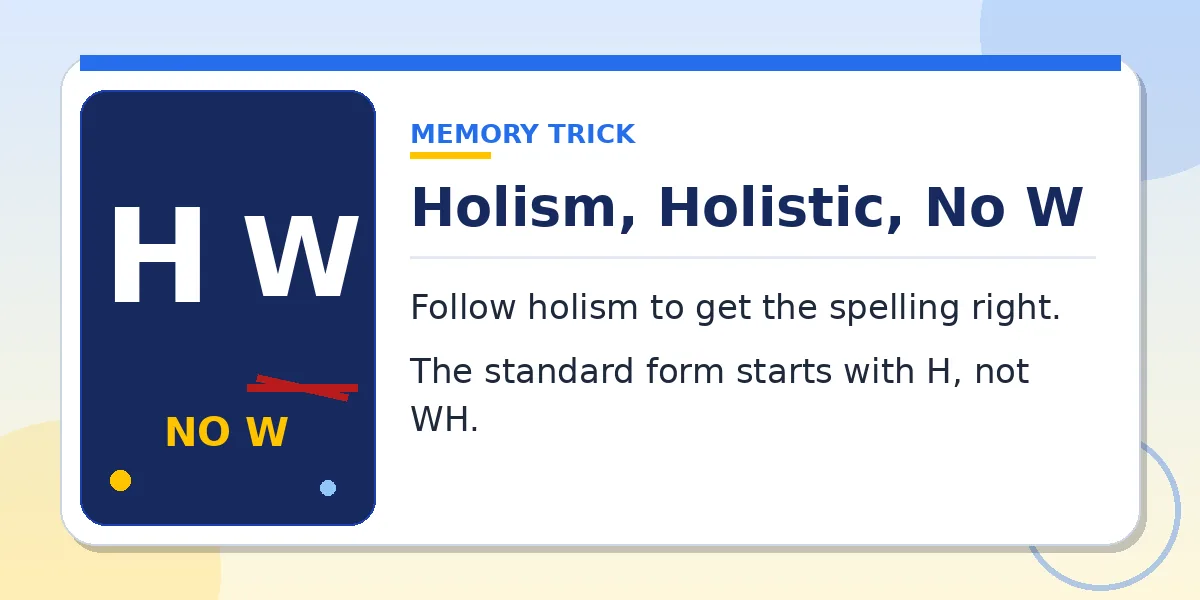
The easiest way to remember holistic is to connect it with holism.
Both words come from the Greek root holos, meaning whole or complete. The adjective follows the noun: Holism, then Holistic, then No W.
Remember that the standard spelling begins with H, not WH.
You can also connect holistic with the phrase “the whole picture.” The meaning relates to the whole, but the spelling follows holism.
This simple connection can help you avoid adding an unnecessary W. It also settles the holistic or wholistic choice in one step: follow holism, and you will land on holistic.
Practice: Holistic or Wholistic?
Choose the spelling that best fits each sentence. Use the standard form unless the sentence gives you a reason to preserve a variant.
- The hospital takes a ______ approach to patient care.
- Our teacher believes in ______ student development.
- The company needs a ______ plan for long-term growth.
- The dictionary identifies ______ as a variant spelling.
- The research team studied the ecosystem ______.
- The clinic’s name is Wholistic Wellness, so we write ______ Wellness in the report.
- She quoted the author exactly: “a ______ view of health.”
- The school board wants a ______ review of the whole program.
- His CV should describe a ______ approach to project management.
- The editor changed every ______ to the standard spelling in the essay.
Answer Key:
- Holistic: The hospital takes a holistic approach to patient care.
- Holistic: Our teacher believes in holistic student development.
- Holistic: The company needs a holistic plan for long-term growth.
- Wholistic: The dictionary identifies wholistic as a variant spelling.
- Holistically: The research team studied the ecosystem holistically.
- Wholistic: The clinic’s name is Wholistic Wellness, so we write Wholistic Wellness in the report.
- Wholistic: She quoted the author exactly, so the original spelling stays in the quotation.
- Holistic: The school board wants a holistic review of the whole program.
- Holistic: His CV should describe a holistic approach to project management.
- Wholistic: The editor changed every wholistic to the standard spelling in the essay.
The first three sentences use the standard adjective. The fourth discusses the variant itself. The fifth needs the standard adverb. The remaining answers test brand names, quotations, and formal writing.
Frequently Asked Questions
1. Is Wholistic a Real Word?
Yes. Wholistic is a recognized variant spelling of holistic. Dictionaries such as Collins and Dictionary.com record it as a variant. However, it is much less common, so holistic remains the better choice for most writing.
2. Is Wholistic Correct, or Is It a Misspelling?
Wholistic is a recorded variant, not simply an invented spelling. However, it is not the standard choice for general writing. Use holistic in essays, professional documents, business communication, and everyday writing instead.
3. Do Holistic and Wholistic Have Different Meanings?
No established meaning difference separates the two spellings in standard dictionaries. Both generally describe an approach that considers the whole rather than separate parts. Holistic is simply the preferred form in modern standard English today.
4. Is Holistic American or British English?
Holistic is the standard spelling in both American and British English. It is not a regional spelling choice like some words that differ between the two varieties. Use holistic confidently in either form of English.
5. Can I Use Wholistic in a CV or Academic Essay?
It is better to use holistic in a CV, academic essay, or professional report. Although wholistic is a recorded variant, the standard spelling is more familiar and widely accepted by readers, editors, and examiners alike.
6. Why Does Wholistic Look More Logical Than Holistic?
Wholistic looks familiar because it resembles the English word whole, which readers already know well. However, holistic developed from holism, which comes from Greek holos, meaning whole or complete, without a W.
7. How Do You Pronounce Holistic?
Holistic has three syllables, with stress on the middle syllable, and it is pronounced HOH-LIS-IK. Wholistic is generally pronounced the same way, so the spelling difference does not change how the word sounds in speech.
Final Takeaway
When you face this spelling choice, the answer stays simple. Use holistic as your default in every kind of writing. Keep wholistic only for a brand name, a direct quotation, or a discussion of the variant itself. That one habit keeps your spelling standard, consistent, and easy for every reader to trust.