

Shine or Shone: Which Is Correct?
Both shone and shined are correct past tense forms of shine. Traditionally, use shone when something emits or reflects light without a direct object. Use shined when someone polishes something or directs a light at an object. American English allows more variation. For example: The sun shone brightly through the clouds. He shined his shoes before the interview. She shined the flashlight on the map. The easiest way to choose between shine or shone is to look at the verb’s meaning and its object. There is one firm exception. If you polish something, never use shone. This guide explains the traditional rule, American and British usage, pronunciation, and common exceptions.
Quick Answer: Shine or Shone?
The traditional distinction is straightforward: Shone describes something that emitted or reflected light. It also describes someone who performed exceptionally well. Shined describes someone polishing an object or directing a light toward something. American English sometimes uses either form for light related meanings. British English generally uses shone for light and shined for polishing. When polishing something, always use shined. Compare these sentences: The moon shone over the lake. The moon reflected light without a direct object. He shined his shoes. His shoes received the polishing action. She shined the flashlight on the map. The flashlight was directed toward an object. The student shone during the presentation. The student performed exceptionally well. If you are deciding between shine or shone as part of a sentence, first identify what the verb describes. The traditional object test will usually give you the answer. Most shine or shone questions are answered by this test.
| Form | Traditional use | Example |
|---|---|---|
| Shone | Light appears or reflects | The moon shone brightly. |
| Shined | Someone polishes something | He shined his shoes. |
| Shined | Someone directs light | She shined the flashlight at the map. |
Table of Contents
- What Does Shine Mean?
- The Transitive and Intransitive Object Test
- When to Use Shone
- When to Use Shined
- Shone vs. Shined: Comparison Table
- Past Participle and Perfect Tenses
- American vs. British English
- Tricky Sentences, Decided
- Common Mistakes
- Shone vs. Shown
- Common Idioms With Shine
- Easy Memory Trick
- Practice Questions
- Frequently Asked Questions
- Quick Recap
What Does Shine Mean?
The verb shine has several meanings. It can describe light, polishing, or someone’s ability to perform exceptionally well. Understanding these meanings makes choosing between shine or shone easier. The meaning matters more than the spelling alone.
1. Shine Means to Emit or Reflect Light
When something produces light or appears bright through reflection, shine is usually intransitive. An intransitive verb does not take a direct object. The thing producing or reflecting light is the subject. Examples: The sun shines brightly every morning. The moon shines over the quiet lake. The stars shine in the night sky. Her eyes shine with happiness. The polished chrome shines in the sunlight. A small lamp shines beside the front door. The lighthouse shines across the dark water. For these meanings, shone is the traditional past tense. For example: The full moon shone over the field. The moon is the subject. It reflects light, but it does not act on a direct object. That is why shone fits the traditional pattern.
2. Shine Means to Polish or Direct Light
The verb can also describe making something bright through polishing. It can describe directing a beam of light toward something. These meanings are transitive because they take direct objects. Examples: He shines his shoes every Sunday. She shines the silverware before dinner. The officer shines a flashlight toward the entrance. The caretaker shines the brass handles each morning. The mechanic shines the chrome on the motorcycle. For these meanings, use shined in the past tense. Examples: He shined his shoes before the ceremony. She shined the silver until it sparkled. The officer shined a flashlight toward the entrance. The caretaker shined the brass handles before the guests arrived. In each sentence, someone performs an action on an object. The shoes, silver, flashlight, and handles receive the action.
3. Shine Means to Excel or Perform Well
Shine also has a figurative meaning. It describes someone who stands out because of talent, skill, or achievement. Examples: She shines in mathematics. David shines during team presentations. The young athlete shines under pressure. My sister shines when she works with children. The new employee shines when solving difficult problems. This figurative meaning traditionally follows the intransitive light related pattern. Therefore, shone is the traditional past form. Examples: She shone in mathematics. David shone during the presentation. The young athlete has shone throughout the competition. My sister shone when she helped the younger students. The figurative meaning does not involve literal light. It describes someone whose abilities become noticeable.
The Transitive and Intransitive Object Test
The easiest way to understand the difference between shine or shone is through transitive and intransitive verbs. These grammar terms sound complicated, but the idea is simple. A direct object receives the action of a verb.
What Is an Intransitive Verb?
An intransitive verb does not need a direct object to complete its meaning. With shine, something simply emits or reflects light. Examples: The sun shone brightly. The moon shone over the water. Her eyes shone with excitement. The stars shone through the clouds. The distant lighthouse shone through the fog. The morning sunlight shone across the garden. Notice that none of these sentences has a direct object. The sun does not shine something. It simply shines. The moon does not shine the water. It reflects light across the water. That is why shone is the traditional choice. A sentence can contain other details without having a direct object. For example, The moon shone over the lake does not make the lake a direct object.
What Is a Transitive Verb?
A transitive verb takes a direct object. The object receives the action. With shine, someone may polish an object or direct a light toward something. Examples: He shined his shoes. She shined the silverware. The guard shined his flashlight toward the gate. The worker shined the brass railing. The search team shined a light into the cave. In these sentences, ask what the person shined. He shined what? His shoes. She shined what? The silverware. The guard shined what? His flashlight. The worker shined what? The brass railing. The search team shined what? A light. Each sentence contains a direct object. That makes shined the traditional choice.
The Five Second Test: Ask Shined What?
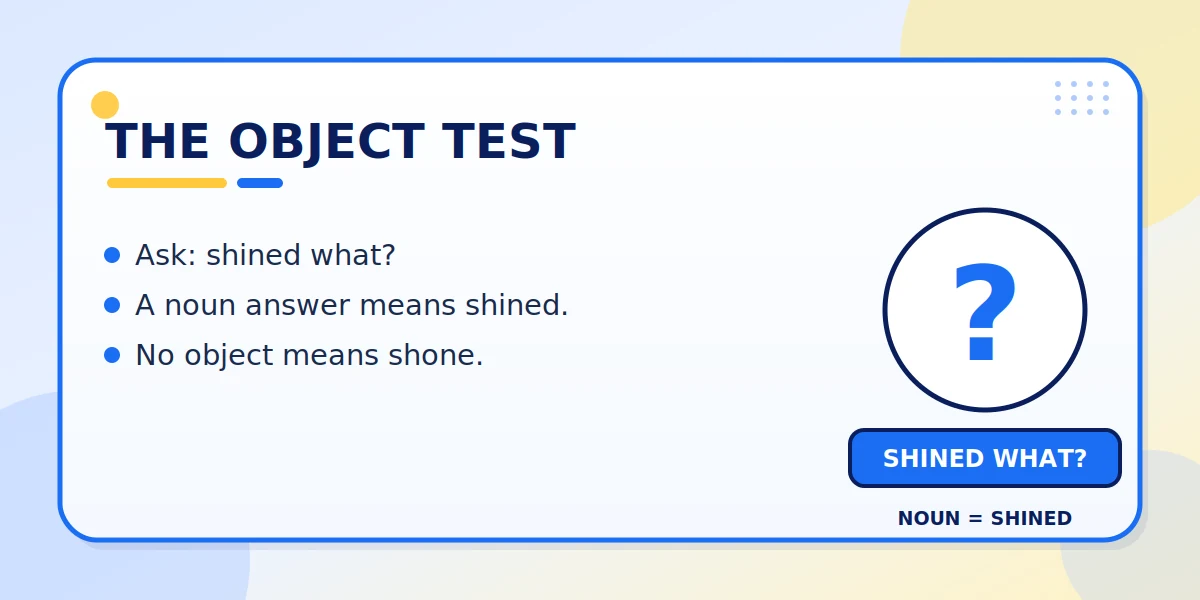
Use this simple test whenever you are unsure. 1. Find the verb shine in your sentence. 2. Ask whether it describes light appearing or someone acting on an object. 3. If something simply emits or reflects light, choose shone. 4. If someone polishes something, choose shined. 5. If someone directs a flashlight or another light source, traditionally choose shined. Here are some examples:
| Sentence | Object test | Traditional choice |
|---|---|---|
| The moon shone brightly | No direct object | Shone |
| He shined his shoes | His shoes | Shined |
| The stars shone overhead | No direct object | Shone |
| She shined the flashlight | The flashlight | Shined |
| Her face shone with joy | No direct object | Shone |
| The guard shined a light | A light | Shined |
Remember that this is the traditional distinction. American English sometimes accepts both forms for light related meanings. The object test is a useful starting point, not a rule that explains every American usage. Pay attention to meaning first.
When to Use Shone
Use shone as the traditional simple past and past participle when something emits or reflects light. It also works when describing someone who performs exceptionally well. This is the most common half of the shine or shone question.
Shone for Emitting or Reflecting Light
Use shone when describing natural light or reflected brightness. Examples: The sun shone brightly throughout the afternoon. The moon shone over the quiet lake. The stars shone through the dark clouds. The full moon shone over the field. Her eyes shone with excitement. The chrome on the classic Jaguar shone in the sunlight. A lantern shone beside the cabin door. The morning light shone through the curtains. In each sentence, the subject produces or reflects light. No direct object receives the action. Notice that the subject does not have to be the sun or moon. A person’s eyes, a lantern, or a reflective surface can also shine.
Shone for Figurative Excellence
Use shone when someone stands out through talent, performance, or achievement. Examples: David shone in his new role. You really shone during yesterday’s meeting. She shone in her English class. The student shone during the competition. The young musician shone at the school concert. Her leadership shone during a difficult project. This meaning follows the traditional intransitive pattern. The person is not literally producing light. Instead, the sentence compares their performance to something bright and noticeable.
Shone in Different Tense Constructions
You can use shone in simple past and perfect tense sentences. Simple past: The sun shone brightly yesterday. The moon shone through my bedroom window. Her talent shone during the final performance. Present perfect: The sun has shone all day. Her talent has shone throughout the competition. The stars have shone brightly tonight. Past perfect: The moon had shone before the clouds appeared. She had shone in previous performances. The lighthouse had shone across the water for hours. The verb form stays shone. The helping verb changes to show the tense.
When to Use Shined
The other half of the shine or shone question is the transitive side. Use shined when someone makes an object bright through polishing or directs a light toward something. It is a correct past tense and past participle form of shine.
Shined When Someone Polishes Something
This is the clearest use of shined. Examples: He shined his shoes before the interview. She shined her necklace until it sparkled. The butler shined the silver. The soldiers shined their boots before inspection. My father shined the car’s chrome trim. The hotel worker shined the brass door handles. I shined the old trophy before displaying it. In every example, someone makes an object brighter through polishing. Important: Never use shone for the polishing meaning. For example: Incorrect: He shone his shoes before the ceremony. Correct: He shined his shoes before the ceremony. The same rule applies to boots, silverware, jewelry, metal fixtures, and other objects someone polishes.
Shined When Someone Directs a Light
Use shined when someone directs a flashlight or another light source toward something. Examples: She shined the flashlight on the map. He shined his flashlight down the dark staircase. The guard shined a light toward the entrance. The police officer shined a flashlight into the vehicle. The camper shined a lantern toward the path. The worker shined a light beneath the machine. The person directs the light toward a particular object or place. The sentence focuses on what someone does with the light source. That differs from a sentence in which light simply appears.
Is Shined Ever Correct for Emitting Light?
Yes. American English allows shined in some intransitive light related sentences. This is the part of the shine or shone question where American and British usage split. For example: The moon shone brightly over the water. The moon shined brightly over the water. Both forms occur in American English. However, shone remains the traditional and generally preferred choice. British English generally uses shone for this meaning. The important distinction is that shined is not restricted to polishing in every American context. However, polishing always requires shined. If you are writing for a broad audience, shone is a dependable traditional choice for the sun, moon, stars, and other sources of light.
Shone vs. Shined: Comparison Table
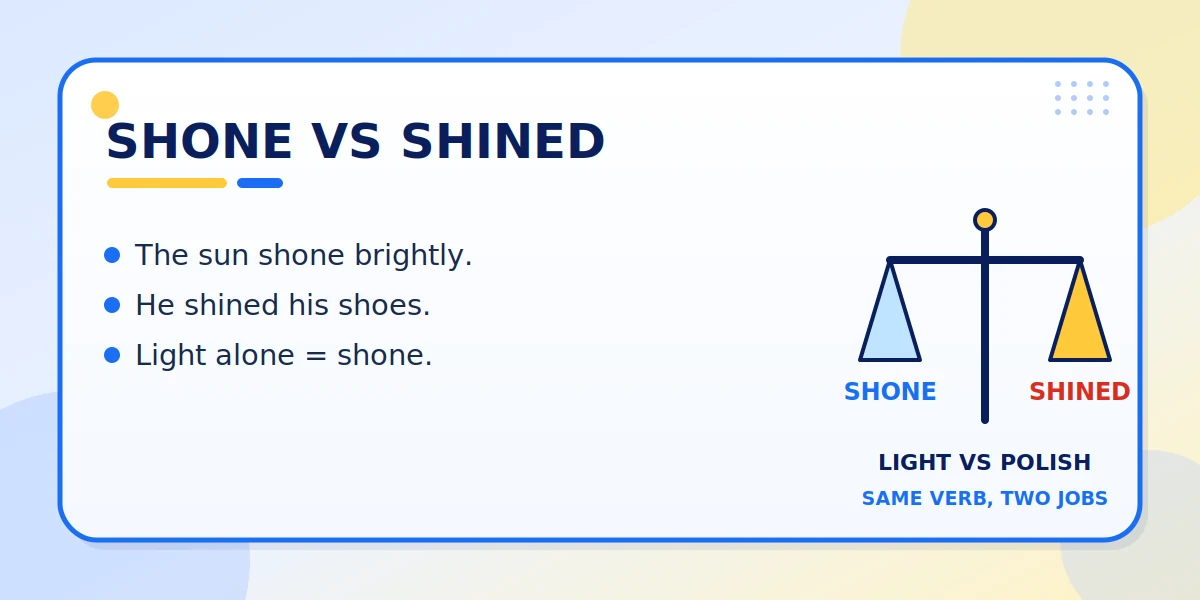
This table sums up the whole shine or shone choice at a glance.
| Feature | Shone | Shined |
|---|---|---|
| Base verb | Shine | Shine |
| Simple past | Shone | Shined |
| Past participle | Shone | Shined |
| Emitting light | Traditional choice | Accepted in some American usage |
| Reflecting light | Traditional choice | Accepted in some American usage |
| Polishing objects | Incorrect | Correct |
| Directing a light | Less traditional | Traditional choice |
| Figurative excellence | Traditional choice | Some American variation |
| British light related usage | Preferred | Less common |
| American polishing usage | Incorrect | Correct |
The simplest distinction is this: Shone: Something emitted or reflected light. Shined: Someone polished something or directed a light at an object. When describing someone who excels, shone is the traditional choice. For example, The singer shone on stage describes a strong performance. It does not describe polishing.
Past Participle and Perfect Tenses
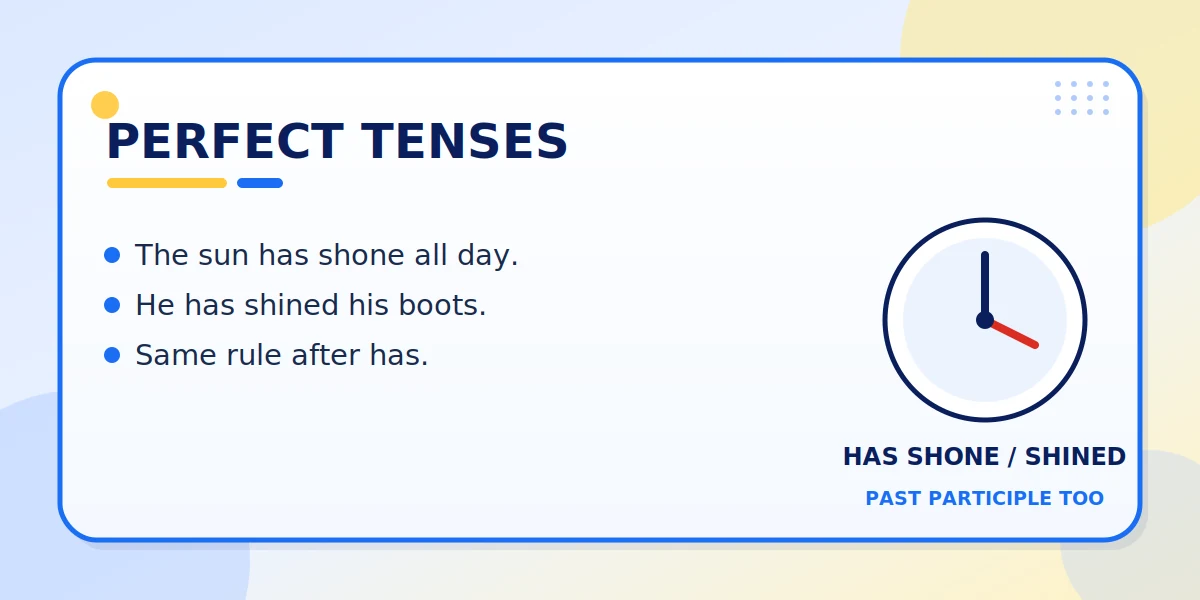
The shine or shone choice does not stop at the simple past. The past participle of shine can be either shone or shined. The correct choice depends on the meaning and usage. A past participle works with helping verbs such as has, have, and had. It can also appear in passive constructions.
Has Shone or Has Shined?
Both constructions are correct, but they traditionally serve different meanings. Use has shone for light related and figurative intransitive meanings. Examples: The sun has shone all afternoon. The stars have shone brightly tonight. She has shone in every competition. His eyes have shone with happiness. The lighthouse has shone across the bay all night. Use has shined when someone has polished something or directed light. Examples: He has shined his boots. She has shined the silverware. The officer has shined a flashlight toward the road. The caretaker has shined the brass fixtures.
Had Shone or Had Shined?
Use had shone for traditional intransitive light and figurative meanings. Use had shined for polishing and directing light. Examples: The moon had shone before the clouds covered it. She had shone in previous competitions. He had shined his shoes before leaving home. They had shined the silver before the guests arrived. The guard had shined a flashlight into the storage room. The helping verb had signals an action or condition completed before another past event. For example, The moon had shone before the clouds appeared places the moonlight before the clouds arrived.
Was Shined or Was Shone?
These forms can also appear in passive voice. Passive voice places the object receiving the action at the beginning of the sentence. Examples: The shoes were shined before the ceremony. The silverware was shined until it sparkled. The flashlight was shined toward the entrance. The brass handles were shined before the guests arrived. These sentences describe polishing or directing light. Shone can also appear in passive constructions involving light, although such sentences may sound less natural. For example: The light was shone through the window. A clearer alternative is: Someone shone the light through the window. Use active voice when it makes your meaning easier to understand. Active sentences often identify who performed the action.
Complete Conjugation of Shine
Here are the principal forms behind the shine or shone choice.
| Verb form | Conjugation |
|---|---|
| Base form | Shine |
| Third person singular | Shines |
| Present participle | Shining |
| Simple past | Shone or shined |
| Past participle | Shone or shined |
Examples: Present: The sun shines every morning. Present continuous: The sun is shining. Simple past: The sun shone yesterday. Present perfect: The sun has shone all afternoon. Past perfect: The sun had shone before sunset. The present participle is always shining. It does not change to shone or shined.
American vs. British English
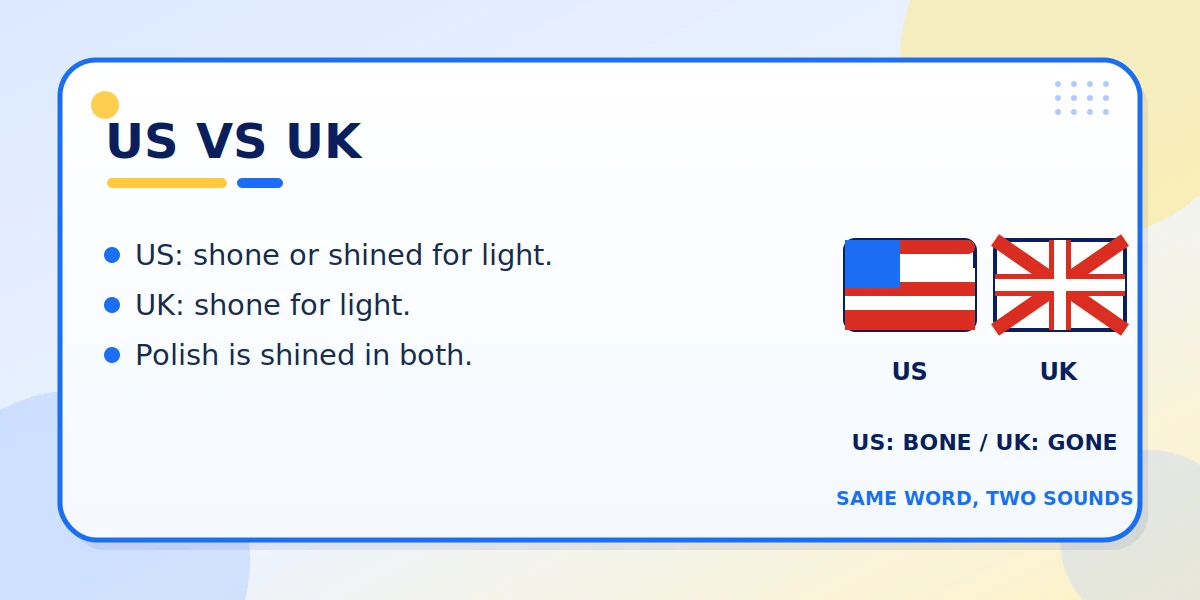
Regional habits explain much of the shine or shone confusion. The difference between American and British English is important. American English is more flexible with the past forms of shine. British English generally maintains the traditional distinction more consistently. This regional difference helps explain why readers may encounter both forms in American writing. It also explains why the same sentence can look different in American and British writing.
| Meaning | American English | British English |
|---|---|---|
| The sun emits light | Shone or shined | Shone |
| The moon reflects light | Shone or shined | Shone |
| Polishing shoes | Shined | Shined |
| Polishing silver | Shined | Shined |
| Directing a flashlight | Shined or shone | Shone is the traditional form |
| Performing exceptionally well | Shone is traditional | Shone |
Which Form Should American Writers Choose?
American writers can encounter both shone and shined in light related contexts. However, shone remains a safe, traditional choice when something emits or reflects light. Use shined when polishing something or directing a flashlight. For example: The sun shone brightly. He shined his shoes. She shined the flashlight toward the door. The young performer shone during the show. The same guidance works when you are unsure which form to choose for a general American audience. If the sentence describes someone excelling, shone is the traditional choice. If it describes polishing, shined is required.
Which Form Should British Writers Choose?
British English generally prefers shone when something emits or reflects light. Use shined when someone polishes an object. For example: The moon shone over the village. The stars shone through the clouds. He shined his shoes before the ceremony. The silverware was shined before dinner. Following this distinction is a sensible choice for British audiences.
How Do You Pronounce Shone?
The pronunciation of shone differs between American and British English.
| Variety | IPA pronunciation | Rhymes with |
|---|---|---|
| American English | /ʃoʊn/ | Bone, shown, lone |
| British English | /ʃɒn/ | Gone, on |
The other principal forms have these pronunciations: Shine: /ʃaɪn/. Shined: /ʃaɪnd/. Notice that the spelling does not change between American and British English. Only the vowel sound in shone differs. This difference can be useful when listening to English speakers from different regions. An American speaker uses a vowel similar to the vowel in bone. A British speaker generally uses the vowel in gone.
Tricky Sentences, Decided
The shine or shone decision gets harder with figurative sentences and direct objects. Some sentences are harder because they involve direct objects, figurative meanings, or regional variation. Here are several common examples and their preferred forms.
| Sentence | Recommended form | Explanation |
|---|---|---|
| The moon shined over the water | The moon shone over the water | Traditional intransitive light use |
| He shone his shoes | He shined his shoes | Polishing requires shined |
| The sun shined brightly | The sun shone brightly | Shone is the traditional choice |
| She shone the flashlight on the wall | She shined the flashlight on the wall | Shined is the traditional transitive choice |
| The stars have shined all night | The stars have shone all night | Shone is the traditional perfect form |
| Her smile shined with happiness | Her smile shone with happiness | Shone follows the traditional figurative pattern |
| The investigation shined a light on corruption | Both forms occur | American English allows variation in this expression |
| She shined the silver until it gleamed | Shined | The sentence describes polishing |
| The lighthouse shined across the bay | The lighthouse shone across the bay | Shone is the traditional choice for emitted light |
| He shined a flashlight beneath the car | Shined | He directed a light toward an area |
Shine a Light On: Literal and Figurative Meanings
The expression shine a light on has two related meanings. Literal meaning: Direct a light toward something so it becomes visible. Example: She shined a light on the dark hallway. Figurative meaning: Reveal something, explain an issue, or draw attention to a problem. Examples: The investigation shone a light on the company’s corruption. The investigation shined a light on the company’s corruption. The report shone a light on an overlooked problem. The documentary shone a light on the challenges facing local families. Both shone and shined occur in American English for this expression. The traditional preference is shone. The expression can describe uncovering information that people did not previously understand. It does not always involve a physical light.
Shine a Light On vs. Shed Light On
These expressions have similar meanings, but their wording differs.
| Expression | Meaning | Example |
|---|---|---|
| Shine a light on | Reveal or draw attention to something | The report shone a light on the problem |
| Shed light on | Make something easier to understand | The evidence shed light on the mystery |
Both expressions can help explain complicated subjects. However, shed light on uses the separate verb shed. Its past form is also shed. For example: The new evidence shed light on the missing records. Do not change shed to shone or shined. The expressions use different verbs.
Common Mistakes With Shine, Shone, and Shined
Most mistakes with shine or shone come from confusing the past forms or mistaking an adjective for a verb. The best way to avoid these errors is to identify the meaning before choosing the form.
| Incorrect or confusing sentence | Better sentence | Explanation |
|---|---|---|
| He shone his shoes | He shined his shoes | Polishing takes shined |
| The sun shined brightly | The sun shone brightly | Shone is the traditional form |
| The moon shined over the water | The moon shone over the water | Traditional intransitive use |
| The stars have shined all night | The stars have shone all night | Shone is the traditional past participle |
| She shone the flashlight on the wall | She shined the flashlight on the wall | Shined is the traditional transitive choice |
| Yesterday, the moon has shone brightly | Yesterday, the moon shone brightly | Use simple past with a finished past time |
| The sun shown through the clouds | The sun shone through the clouds | Shown belongs to show |
| The sun is very shine today | The sun is very shiny today | Shiny is the adjective |
Why He Shone His Shoes Is Incorrect
This mistake happens when writers assume shone is always the past tense of shine. However, the sentence describes polishing. The shoes receive the action, so the correct form is shined. Correct: He shined his shoes before the interview. The same rule applies to a sentence about polishing a watch, a metal surface, or silverware.
Why The Sun Shined Is Usually Changed to The Sun Shone
The sentence The sun shined brightly appears in American usage. However, shone is the traditional choice for this meaning. A writer following the traditional distinction should write: The sun shone brightly. This form is also a dependable choice for readers familiar with British English.
Shine vs. Shiny
Shine and shiny are related, but they have different grammatical jobs. Shine can be a verb or a noun. Examples: The stars shine at night. The table has a beautiful shine. Her eyes shine with happiness. Shiny is an adjective. It describes something with a bright or reflective surface. Examples: She bought shiny new shoes. The car has a shiny finish. The child held a shiny silver coin. Remember that shining is the present participle of the verb. For example: The sun is shining through the window.
Shone vs. Shown
The shine or shone question is sometimes confused with a different pair. Shone and shown sound identical in American English, but they come from different verbs. Shone is a past form of shine. It describes emitting or reflecting light. Shown is the past participle of show. It describes something demonstrated, displayed, or presented. Here is a simple comparison.
| Word | Base verb | Grammatical form | Example |
|---|---|---|---|
| Shone | Shine | Simple past and past participle | The moon shone brightly |
| Showed | Show | Simple past | She showed me the photograph |
| Shown | Show | Past participle | The results have shown improvement |
Examples of Shone
The sun shone through the window. Her eyes shone with excitement. The stars had shone all night. The lighthouse shone across the bay.
Examples of Shown
The teacher showed us the correct answer. The results have shown significant improvement. The evidence was shown to the jury. The photographs have shown the building’s progress. Remember these differences: Shine, shone, shone. Show, showed, shown. Never use shown when you mean that something emitted light. For example: Incorrect: The moon shown brightly. Correct: The moon shone brightly.
Common Idioms With Shine
The verb shine appears in several everyday English expressions. Understanding these idioms helps you recognize the word beyond its literal meaning.
Rise and Shine
Meaning: Wake up and get ready for the day. Example: Rise and shine! It’s time to get ready for school. This expression is often used to encourage someone to get out of bed.
Take a Shine to Someone
Meaning: Develop an immediate liking for someone. Example: The new student quickly took a shine to her teacher. It describes a friendly or positive feeling toward another person.
Shine a Light On Something
Meaning: Reveal something or draw attention to an issue. Example: The documentary shone a light on an overlooked problem. The expression can refer to literal light or a clearer understanding of an issue.
Come Rain or Shine
Meaning: Regardless of the weather or circumstances. Example: We go for a walk every morning, come rain or shine. It means the activity will happen whether conditions are pleasant or difficult.
Shine Forth
Meaning: Become clearly visible or noticeable. Example: Her natural talent shone forth during the performance. These expressions show how shine can describe light, personality, and attention.
Easy Memory Trick
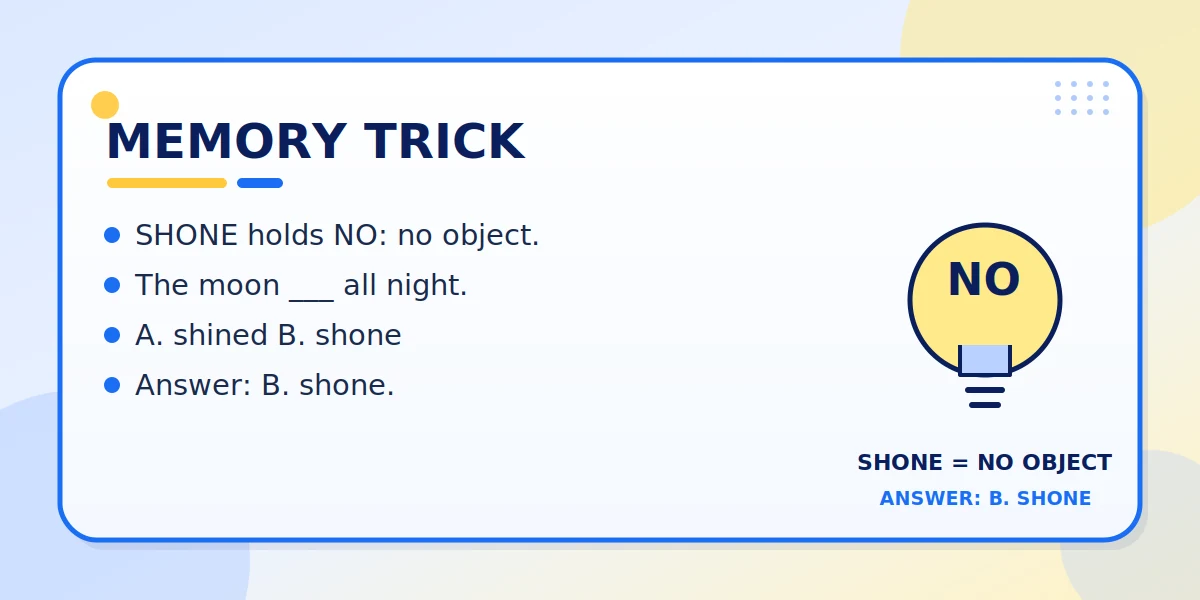
Remembering the difference between shine or shone becomes easier with two simple tricks.
Sun vs. Shoes
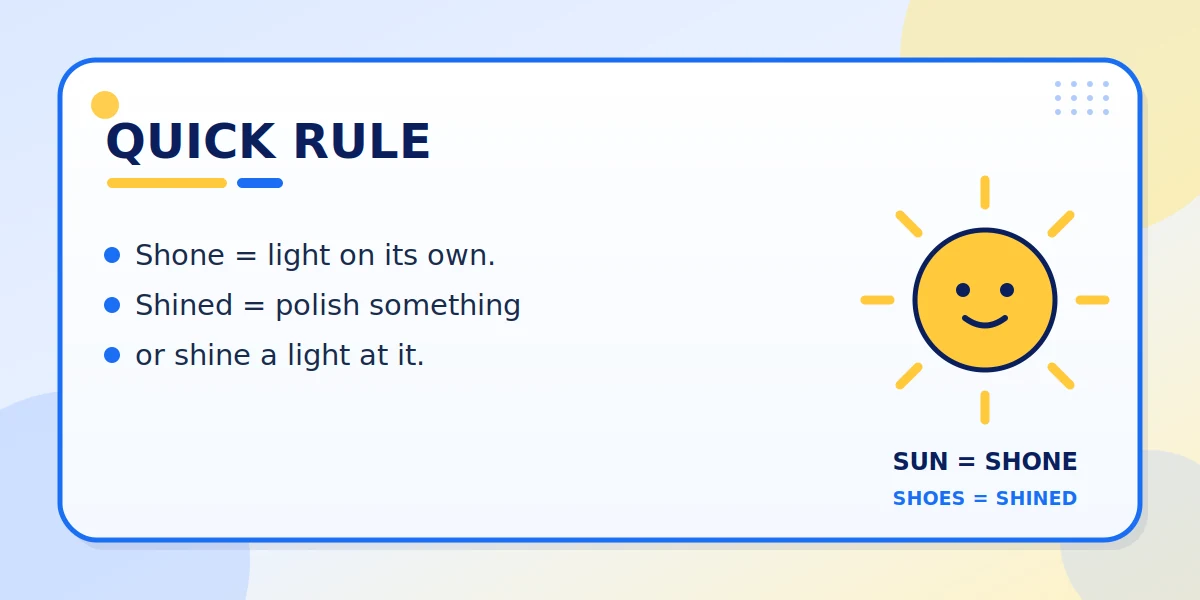
Connect shone with the sun and shined with shoes. Sun = shone. Shoes = shined. Examples: The sun shone brightly. He shined his shoes. This trick helps you remember the traditional distinction. When you think of the sun, imagine light appearing without an object receiving an action. When you think of shoes, imagine someone polishing them.
NO in Shone Means No Direct Object
Another useful trick is to connect the letters in shone with the word no. Think of shone as describing light without a direct object. For example: The moon shone brightly. There is no object receiving the action. For shined, think about someone polishing shoes or directing a flashlight. Remember that this is a learning aid. American English sometimes allows shined in other light related uses. Most importantly, polishing always takes shined. If you are still unsure about shine or shone, remember the sun and shoes example. It gives you a quick starting point before you check the sentence structure.
Practice Questions
Use these questions to test your shine or shone judgment. Choose shone or shined to complete each sentence. Follow the traditional distinction unless the question specifically tests American variation.
- The sun _____ brightly over the hills yesterday.
- He _____ his shoes before the job interview.
- The stars had _____ throughout the night.
- She _____ the flashlight toward the doorway.
- Her eyes _____ with excitement.
- The butler has _____ the silverware.
- David has really _____ in his new position.
- The moon _____ over the lake last night.
- They had _____ their boots before the inspection.
- The investigation _____ a light on the company’s problems.
Answer Key and Explanations
- Shone: The sun emitted light without a direct object. Shone is the traditional choice.
- Shined: The shoes are the objects being polished. Polishing always takes shined.
- Shone: The stars emitted light without a direct object. Shone is the traditional past participle.
- Shined: The flashlight is the direct object. Shined is the traditional choice for directing light.
- Shone: The sentence describes eyes appearing bright with excitement. This is an intransitive figurative use.
- Shined: The silverware received the polishing action. Shined is the correct past participle.
- Shone: The sentence describes David’s excellent performance. Shone is the traditional figurative form.
- Shone: The moon reflected light without a direct object. Shone is the traditional choice.
- Shined: The boots were polished before inspection. Shined is required for the polishing meaning.
- Shone or shined: Both forms occur in American English. Shone follows the traditional pattern for this figurative expression.
Frequently Asked Questions
1. What Is the Past Tense of Shine?
Both shone and shined are correct past tense forms of shine. Shone traditionally describes emitting or reflecting light. Shined describes polishing something or directing light toward an object. American English allows additional variation.
2. Is Shined a Real Word?
Yes, shined is a standard English word. It serves as the past tense and past participle of shine. Writers use it when someone polishes shoes, silverware, or directs a flashlight.
3. When Should I Use Shined Instead of Shone?
Use shined when someone polishes an object or directs light toward something. Use shone for traditional light related and figurative meanings. In American English, both forms of shine or shone sometimes appear in light related contexts.
4. Is It Has Shone or Has Shined?
Both forms are correct, depending on meaning. Use has shone for traditional light related and figurative uses. Use has shined when someone has polished something or directed a light toward an object.
5. Is It Shone or Shown?
Shone comes from shine and describes emitting or reflecting light. Shown is the past participle of show and means demonstrated or displayed. Although they sound alike in American English, their meanings differ.
6. How Do You Pronounce Shone?
In American English, shone rhymes with bone and uses the pronunciation /ʃoʊn/. In British English, it rhymes with gone and uses /ʃɒn/. The spelling remains identical in both varieties of English.
7. Is Shined or Shone Correct in American English?
Both forms occur in American English. Shone is the traditional choice for emitting or reflecting light. Shined is standard for polishing and directing light, but American usage also permits variation in some light related sentences.
Related Guides
Quick Recap
The difference between shine or shone depends on meaning, sentence structure, and regional usage. Remember these essential points: Shone: Traditional past tense and past participle for emitting or reflecting light without a direct object. Shined: Past tense and past participle for polishing something or directing a light at an object. Figurative excellence: Shone is the traditional choice when someone performs exceptionally well. American English: Both forms can appear in light related uses. British English: Shone is generally preferred for light, while shined is used for polishing. Polishing exception: Always use shined, never shone. Pronunciation: American shone rhymes with bone. British shone rhymes with gone. Different verb: Shown belongs to show, not shine. The easiest memory trick is simple: the sun shone, but someone shined their shoes. Both forms are correct. Choose the one that matches your intended meaning and audience.