

Lay or Laid: Which One Is Correct?

Is it lay or laid? The correct choice depends on when an action happens. Lay is the present tense of the verb meaning to put something down. Laid is its past tense and past participle.
For example:
- Present: I lay my phone on the desk every morning.
- Past: I laid my phone on the desk yesterday.
- Present perfect: I have laid my phone on the desk.
Both forms need a direct object when they describe placing something. The confusion often comes from another verb, lie, which means to recline. Its past tense is also lay.
Quick Answer: Lay vs. Laid
| Word | Meaning | Example |
| Lay | Present tense of put or place | I lay the book on the table. |
| Lays | Present tense with he, she, or it | She lays the book on the table. |
| Laying | Ongoing action of placing something | He is laying the book down. |
| Laid | Past tense of lay | I laid the book on the table. |
| Laid | Past participle of lay | I have laid the book on the table. |
Remember: use lay for a present placement action and laid for a completed one. That table answers lay or laid at a glance. Never use layed in modern standard English. One important exception involves lie, meaning to recline. Its past tense is lay, and its past participle is lain.
Table of Contents
- Lay vs. Laid: The Main Difference
- What Does Lay Mean?
- What Does Laid Mean?
- Lay vs. Lie: The Common Grammar Trap
- Is It Layed or Laid?
- How to Know Whether to Use Lay, Laid, or Lie
- Laying vs. Lying: What’s the Difference?
- Common Phrasal Verbs and Idioms With Lay and Laid
- Common Mistakes When Using Lay and Laid
- Easy Memory Tricks to Remember Lay or Laid
- Practice Questions: Lay or Laid?
- Frequently Asked Questions
- Final Takeaway
Lay vs. Laid: The Main Difference
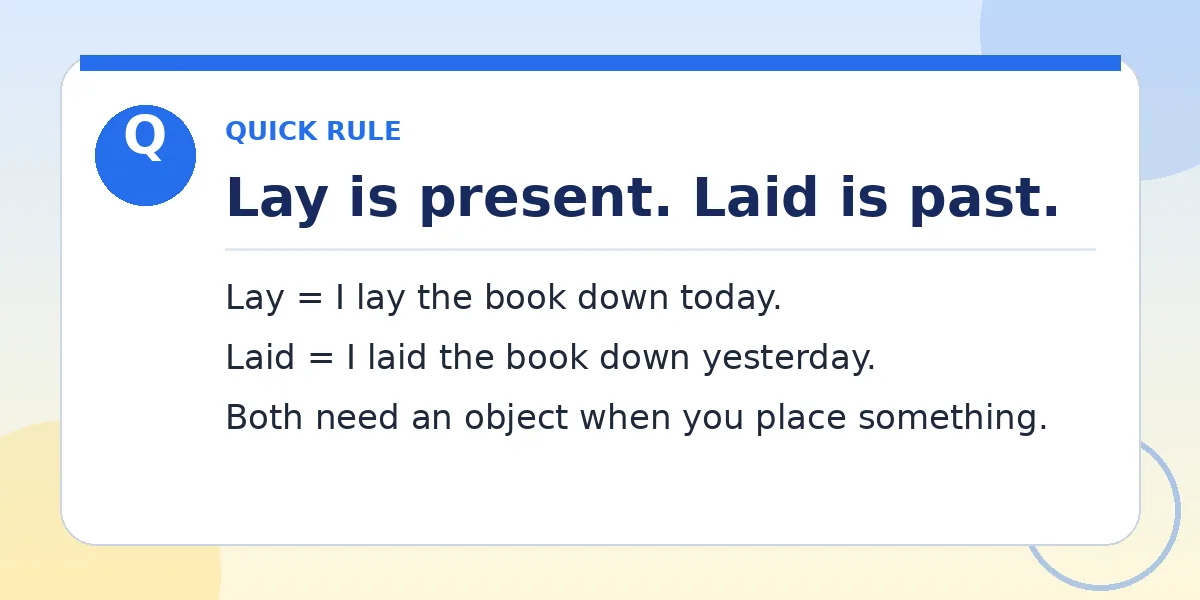
Lay and laid are two forms of the same irregular verb. Both describe putting or placing something somewhere. The main difference is their tense. Lay describes a present action or regular habit. Laid describes an action that happened in the past.
When to Use Lay (Present Tense)
Use lay when someone puts or places something down. This verb needs a direct object in this meaning. The direct object answers the question, “What is being placed?”
Examples:
- I lay my keys beside the door every evening.
- Please lay the documents on my desk.
- They lay fresh towels on the beds.
- We lay the bricks in a straight line.
Use lays with a singular third person subject, such as he, she, or it.
For example:
- She lays her clothes on the chair.
- The worker lays each brick carefully.
- The hen lays an egg every morning.
Use laying for an ongoing placement action.
For example:
- I am laying the books on the shelf.
- She is laying the baby in the crib.
When to Use Laid (Past Tense)
Use laid when someone placed something down in the past. It is the simple past form of lay.
Examples:
- I laid my phone beside the computer.
- She laid the blanket on the bed.
- They laid the papers on the table.
- He laid the foundation last year.
Notice that each sentence describes a completed action. The word laid also takes an object in this active placement meaning.
Lay vs. Laid Comparison Table
| Verb form | Grammatical use | Example |
| Lay | Present tense | I lay the book down. |
| Lays | Present, third person singular | He lays the book down. |
| Laying | Present participle | She is laying the book down. |
| Laid | Simple past | I laid the book down. |
| Laid | Past participle | I have laid the book down. |
According to the irregular verb forms listed by Purdue OWL, the principal forms are lay, laid, laid. The pattern is similar to other irregular verbs. For example, pay becomes paid, not payed. Likewise, lay becomes laid, not layed.
What Does Lay Mean?
Lay means to put, place, or set something down. This section settles the first half of the lay or laid question. It is an irregular verb in this meaning. It usually needs a direct object. That means the sentence identifies what someone places.
Lay Means to Put or Place Something Down
Use lay when someone moves an object into a particular position.
Examples:
- Please lay your coat on the chair.
- I lay my notebook beside the laptop.
- She lays the baby gently in the crib.
- We lay the plates on the table.
In each example, the object receives the action. The coat, notebook, baby, and plates are being placed.
Present Tense Forms of Lay
The present tense has three common forms.
| Form | When to use it | Example |
| Lay | With I, you, we, and they | I lay the book here. |
| Lays | With he, she, and it | She lays the book here. |
| Laying | With forms of be | She is laying the book here. |
Remember that lay is also used after helping verbs such as will and can.
Examples:
- I will lay the papers on your desk.
- You can lay the blanket on the sofa.
- They may lay the groundwork tomorrow.
Other Common Uses of Lay
The verb lay appears in several everyday expressions.
- Lay an egg: A hen produces an egg.
- Lay bricks: A worker places bricks during construction.
- Lay plans: Someone prepares plans for an activity.
- Lay claim: Someone asserts a right to something.
- Lay the groundwork: Someone prepares for future work.
These expressions use the same spelling pattern. Their past forms use laid.
What Does Laid Mean?
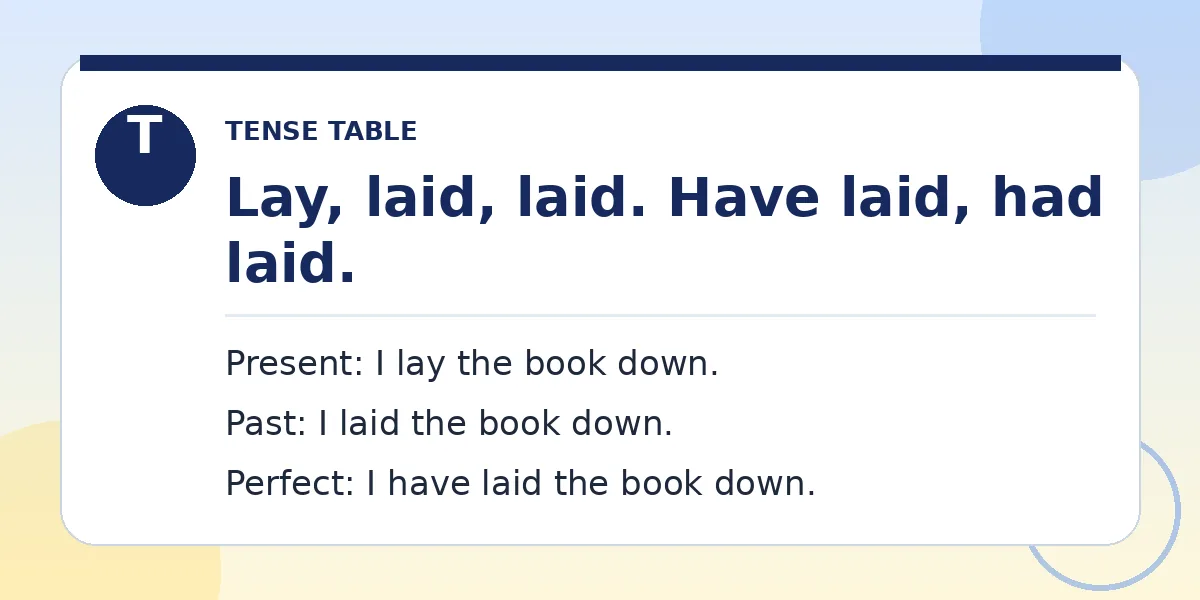
Laid is the simple past and past participle of lay. It describes placing something down or completing that action. This section settles the second half of the lay or laid question.
For example:
- I laid the book on the shelf.
- She laid the baby in the crib.
- They have laid the foundation.
- We had laid the documents on the desk.
The meaning depends on the helping verb and sentence structure.
Laid as the Simple Past of Lay
Use laid for a completed placement action.
Examples:
- I laid my jacket on the sofa.
- She laid the keys near the door.
- He laid the tools on the workbench.
- We laid the table before dinner.
These sentences describe actions that happened earlier.
Laid as the Past Participle
A past participle works with helping verbs. For lay, the past participle is also laid.
Examples:
- I have laid the book on the desk.
- She has laid the foundation for the project.
- They had laid the documents in order.
- The workers have laid the new flooring.
The form stays the same after have, has, and had.
Have Laid vs. Had Laid
Both expressions are grammatically correct. They describe different relationships between past actions. Have laid uses the present perfect tense. It connects an earlier action to the present. Example: I have laid all the papers on your desk. Had laid uses the past perfect tense. It describes an action completed before another past event. Example: I had laid the papers on your desk before you arrived.
Was Laid and Were Laid: Passive Voice
Use was laid and were laid when the sentence focuses on the thing receiving the action.
Examples:
- The book was laid on the table.
- The bricks were laid carefully.
- The foundation was laid last year.
- The documents were laid beside the computer.
Compare these active and passive sentences:
- Active: The workers laid the bricks.
- Passive: The bricks were laid by the workers.
Both sentences are correct. The active version focuses on the workers. The passive version focuses on the bricks.
Lay vs. Laid in Different Tenses
Here are common tense forms of the placement verb.
| Tense | Example |
| Simple present | I lay the book down. |
| Present continuous | I am laying the book down. |
| Simple past | I laid the book down. |
| Past continuous | I was laying the book down. |
| Present perfect | I have laid the book down. |
| Past perfect | I had laid the book down. |
| Future | I will lay the book down. |
| Future perfect | I will have laid the book down. |
The important pattern is simple. Use lay as the base form and laid as the past and past participle forms.
Lay vs. Lie: The Common Grammar Trap
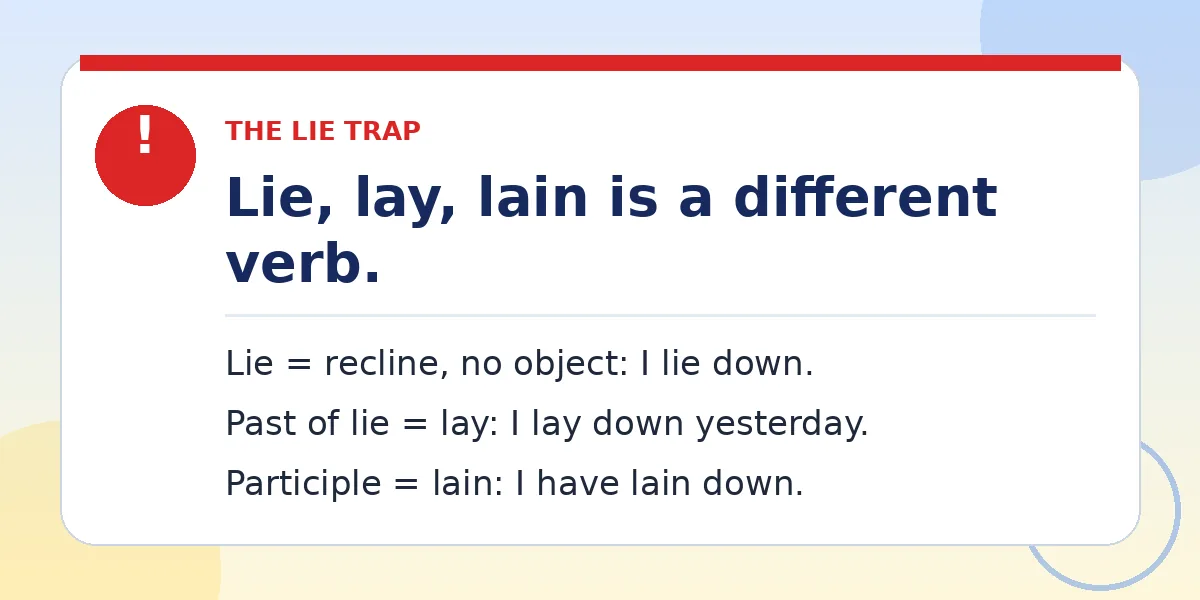
The confusion does not end with lay and laid. This trap is why the lay or laid question feels hard. Another verb, lie, means to recline or rest. Unlike placement lay, reclining lie does not take a direct object.
Its forms are different:
- Present: lie
- Past: lay
- Past participle: lain
- Present participle: lying
Lie Means to Recline or Rest
Use lie when someone rests in a horizontal position. The person or animal does not place a separate object somewhere.
Examples:
- I lie on the couch after work.
- She lies in bed every morning.
- The dog is lying on the floor.
- We lie on the grass during lunch.
Notice that none of these sentences needs a direct object.
The Past Tense of Lie Is Lay
This is where many people become confused. The past tense of reclining lie is lay.
Examples:
- I lay on the couch yesterday.
- She lay in bed all afternoon.
- The dog lay beside the fireplace.
- We lay on the grass after lunch.
These sentences are correct because they describe past reclining actions.
Compare these two sentences:
- I lay the book on the desk every morning.
- I lay on the couch yesterday.
The first uses lay as the present tense of placing something. The second uses lay as the past tense of reclining lie. The surrounding words help you identify the correct meaning.
Lie, Lay, Lain: The Reclining Verb’s Forms
| Verb form | Tense or function | Example |
| Lie | Present | I lie on the sofa. |
| Lay | Simple past | I lay on the sofa yesterday. |
| Lain | Past participle | I have lain on the sofa. |
| Lying | Present participle | I am lying on the sofa. |
Remember this pattern: Lie, lay, lain, lying refers to reclining. Lay, laid, laid, laying refers to placing something.
Lay vs. Laid vs. Lain
These three words belong to two different verb families.
| Word | Verb family | Example |
| Lay | Present of placement lay | I lay the blanket down. |
| Laid | Past of placement lay | I laid the blanket down. |
| Laid | Past participle of placement lay | I have laid the blanket down. |
| Lay | Past of reclining lie | I lay down yesterday. |
| Lain | Past participle of reclining lie | I have lain down. |
Consider these examples:
Incorrect: I laid down for a nap yesterday. Correct: I lay down for a nap yesterday. Incorrect: I have laid in bed all morning. Correct: I have lain in bed all morning.
However, “I laid myself down for a nap” is correct. The word myself acts as the direct object.
Lie vs. Lay: The Untruth Meaning
The verb lie also means to say something untrue. This meaning has a different conjugation.
Its forms are:
| Verb form | Example |
| Lie | He lies about his age. |
| Lied | She lied to her parents. |
| Lied | They have lied before. |
| Lying | He is lying about the results. |
Do not confuse lied with laid. They belong to different verbs and have different meanings.
Is It Layed or Laid?
Laid is correct. Layed is not correct in modern standard English. That answer ends the spelling side of the lay or laid question. The past tense and past participle of lay are both spelled laid. This rule applies to standard American and British English.
Why Laid Is the Correct Spelling
The verb lay is irregular. Its past forms do not follow the usual pattern of adding ed.
For example:
- Lay becomes laid.
- Pay becomes paid.
- Say becomes said.
Therefore, you should write laid, not layed, when describing a past placement action. You might encounter layed in old texts. However, it is not an accepted modern spelling.
Layed vs. Laid: Incorrect and Correct Examples
| Incorrect | Correct |
| I layed the book down. | I laid the book down. |
| She has layed the baby down. | She has laid the baby down. |
| They layed the foundation. | They laid the foundation. |
| He layed the papers out. | He laid the papers out. |
| We had layed the table. | We had laid the table. |
Is Layed Ever Acceptable in Modern English?
No. Use laid in modern standard English. Historical texts may contain the spelling layed. That does not make it an accepted alternative today. If you are writing an email, school assignment, article, or professional document, choose laid.
How to Know Whether to Use Lay, Laid, or Lie
You can choose the correct word by checking its meaning and tense. A simple decision process can prevent most mistakes. The lay or laid choice becomes easy once you check tense first, then meaning.
Use the Object Test
Ask yourself: What is being placed?
If the sentence describes putting something somewhere, look for a direct object.
Examples:
- I lay the book on the desk. What do I lay? The book.
- She laid the keys on the counter. What did she lay? The keys.
- They are laying the bricks. What are they laying? The bricks.
If someone simply rests or reclines, use the lie family instead.
Examples:
- I lie on the couch.
- I lay on the couch yesterday.
- I have lain on the couch all afternoon.
Follow This Simple Lay vs. Laid Decision Flow
Use these questions when you are unsure. This flow settles the lay or laid question in four steps.
Step 1: Are you describing placing something down? If yes, use the placement verb lay. Step 2: Is the action happening now or regularly? Use lay or lays. Example: She lays her phone on the desk every morning. Step 3: Did the placement action happen in the past? Use laid. Example: She laid her phone on the desk yesterday. Step 4: Are you describing reclining without placing an object? Use the lie family.
- Present: I lie down.
- Past: I lay down.
- Past participle: I have lain down.
This method works for most everyday sentences.
When the Object Test Needs More Context
The object test works best for the placement meaning of lay. Some dictionary uses have different sentence patterns. For example, “The hen lays an egg” uses an object. The verb describes producing an egg. Passive sentences also need special attention. In “The book was laid on the shelf”, the book receives the action. It is the subject, not a direct object. Always consider the meaning and sentence structure together.
Lay vs. Set and Lie vs. Sit: An Extra Memory Trick
The verbs set and sit can also help you remember the difference.
- Set: Put something somewhere. It normally takes an object.
- Sit: Take a seated position. It does not need an object.
Compare:
- I set the book on the desk.
- I sit on the chair.
Think of lay as the placement partner of set. Think of reclining lie as a member of the same general group as sit. This is a memory trick, not a complete substitute for learning the verb forms.
Laying vs. Lying: What’s the Difference?
Laying and lying sound similar, but they describe different actions. They are a separate pair from lay or laid, so do not mix the two pairs. Use laying for placing something. Use lying for reclining or telling an untruth.
When to Use Laying
Laying is the present participle of lay. It describes an ongoing placement action.
Examples:
- She is laying the book on the desk.
- He is laying the baby in the crib.
- They are laying bricks outside.
- I am laying the clothes on the bed.
Each sentence includes something receiving the action.
When to Use Lying
Lying is the present participle of lie. When it means reclining, it describes someone or something resting without placing a separate object.
Examples:
- He is lying on the sofa.
- The cat is lying under the table.
- I was lying in bed.
- They are lying on the grass.
Lying can also describe telling an untruth. Example: She is lying about what happened.
Laying vs. Lying Comparison Table
| Laying | Lying |
| She is laying the book down. | She is lying on the bed. |
| He is laying the baby in the crib. | He is lying beside the baby. |
| They are laying the bricks. | They are lying on the grass. |
| I am laying the clothes out. | I am lying on the couch. |
The easiest way to remember the difference is to check what the subject is doing. Placing something means laying. Reclining means lying.
Common Phrasal Verbs and Idioms With Lay and Laid
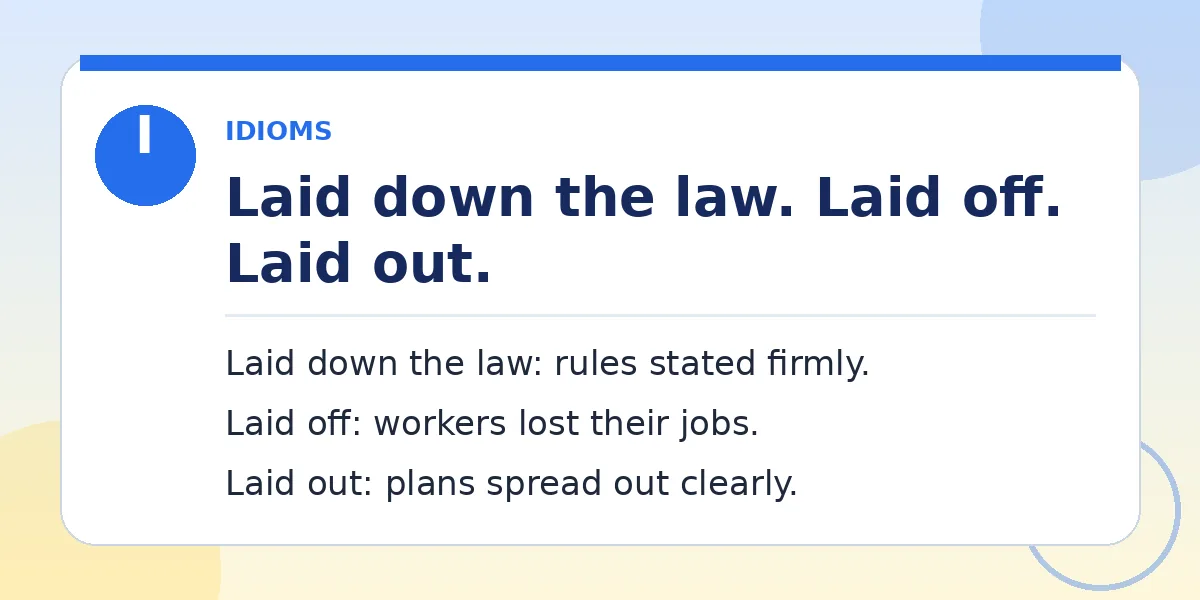
The verb lay appears in many everyday expressions. Their past forms use laid, not layed.
Lay Down the Law
To lay down the law means to state rules or expectations firmly.
Examples:
- The manager lays down the law about workplace behavior.
- The teacher laid down the law during class.
Lay Off
Lay off has two common meanings. In employment, it means stopping someone’s employment, usually because of business needs. Example: The company laid off several workers last month. Informally, it can mean stopping an activity or leaving someone alone. Example: Please lay off the criticism.
Lay Out
Lay out means to spread something across a surface or present information clearly.
Examples:
- She lays out her clothes every evening.
- He laid out his plans during the meeting.
- The designer laid out the documents on the desk.
Lay Claim
Lay claim means to state that something belongs to you or that you have a right to it.
Examples:
- They lay claim to the property.
- He laid claim to the family inheritance.
Lay the Groundwork
Lay the groundwork means to prepare for something that will happen later.
Examples:
- The team lays the groundwork for a new project.
- They laid the groundwork for future success.
Lay the Blame
Lay the blame means to assign responsibility for a problem or mistake.
Examples:
- She lays the blame on her coworker.
- He laid the blame on the wrong person.
Lay the Table
Lay the table means to arrange plates, forks, spoons, and other items for a meal.
Examples:
- I lay the table before dinner.
- She laid the table before the guests arrived.
In American English, set the table is also a familiar expression.
Lay an Egg
Lay an egg means to produce an egg, usually when referring to a bird or hen.
Examples:
- The hen lays an egg every morning.
- Our chicken laid an egg yesterday.
The expression can also mean performing badly, especially in sports or entertainment. Example: The comedian laid an egg during the performance.
Laid to Rest
Laid to rest is a fixed expression that means buried. It can also mean ending doubts, concerns, or rumors.
Examples:
- The soldier was laid to rest.
- The new evidence laid the rumors to rest.
Other Expressions Worth Knowing
Laid up: Confined to bed or unable to move around because of illness or injury. Example: He was laid up with the flu. Laid back: Relaxed and easygoing. Example: She has a laid back personality. Lay low: Stay hidden or avoid attention. Example: He decided to lay low for a few days. Lay by: Save something for future use. Example: They lay by money for emergencies.
Common Mistakes When Using Lay and Laid
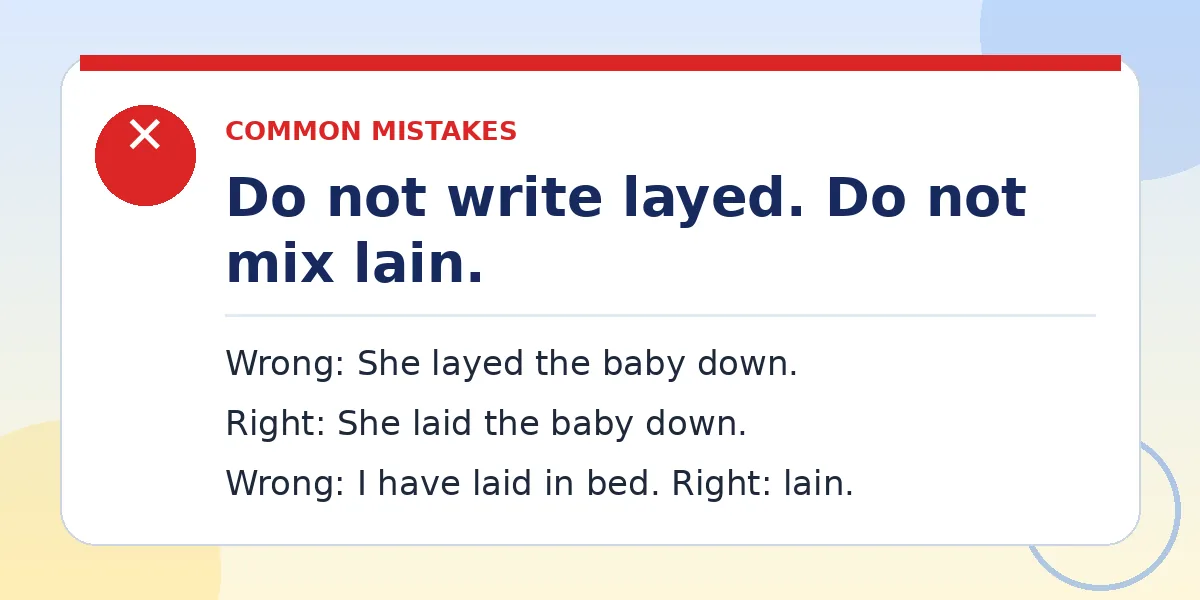
Many grammar mistakes happen because people mix up tense or confuse the two verbs. Most lay or laid errors come from the lie trap, not from the past form itself. The following table shows common errors and their corrections. These examples also show how the lay or laid choice changes with tense.
| Incorrect sentence | Correct sentence | Why? |
| I laid the book here every day. | I lay the book here every day. | Use present tense for a regular action. |
| She layed the baby down. | She laid the baby down. | Laid is the correct past form. |
| I laid down for an hour. | I lay down for an hour. | Lay is the past tense of reclining lie. |
| I have lay the papers down. | I have laid the papers down. | Use laid after have. |
| He has lain the book down. | He has laid the book down. | Lain belongs to reclining lie. |
| She is laying on the sofa. | She is lying on the sofa. | Use lying for reclining. |
| They were layed off. | They were laid off. | Laid is the correct spelling. |
| I had layed the foundation. | I had laid the foundation. | Use laid after had. |
Why These Mistakes Happen
The main problem is that lay has two different roles. First, it is the present tense of the placement verb. Second, it is the past tense of reclining lie. This overlap makes the forms confusing. The best way to avoid mistakes is to check the meaning first. Then check whether the action is present or past.
Easy Memory Tricks to Remember Lay or Laid
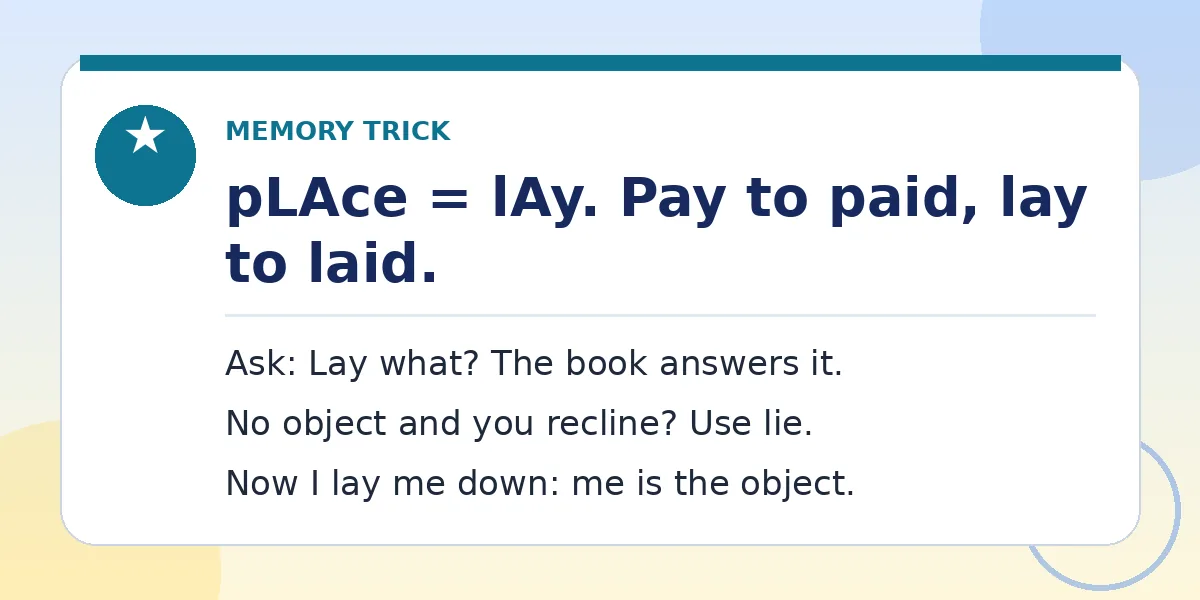
You do not need to memorize complicated grammar rules. A few simple tricks can help you choose the right form in any lay or laid sentence. The lay or laid tricks below work in everyday writing.
Remember That Lay Means Place
Think of pLAce when you see lay. Both words contain the letters LA. This can help you remember that lay means putting something somewhere. Example: I lay my phone on the desk.
Remember That Laid Is the Past Form
Compare these two irregular verbs:
- Pay becomes paid.
- Lay becomes laid.
Both verbs change their spelling in the past tense.
Example:
- I pay the bill today.
- I paid the bill yesterday.
- I lay the book down today.
- I laid the book down yesterday.
Ask Yourself What Is Being Placed
Ask the question, “Lay what?” If you can identify the object, the placement verb is likely correct. Example: I lay the jacket on the chair. What do I lay? The jacket. For reclining, there is no separate object. Example: I lie on the chair.
Remember Lie, Lay, Lain
For reclining, memorize these three forms:
- Today: I lie down.
- Yesterday: I lay down.
- Before now: I have lain down.
This helps prevent the common mistake of using laid for reclining.
Use the Familiar Sentence: Now I Lay Me Down to Sleep
The familiar sentence uses lay correctly. The word me is the direct object. It receives the action of laying oneself down. This makes the sentence a useful reminder of the placement meaning of lay.
Practice Questions: Lay or Laid?
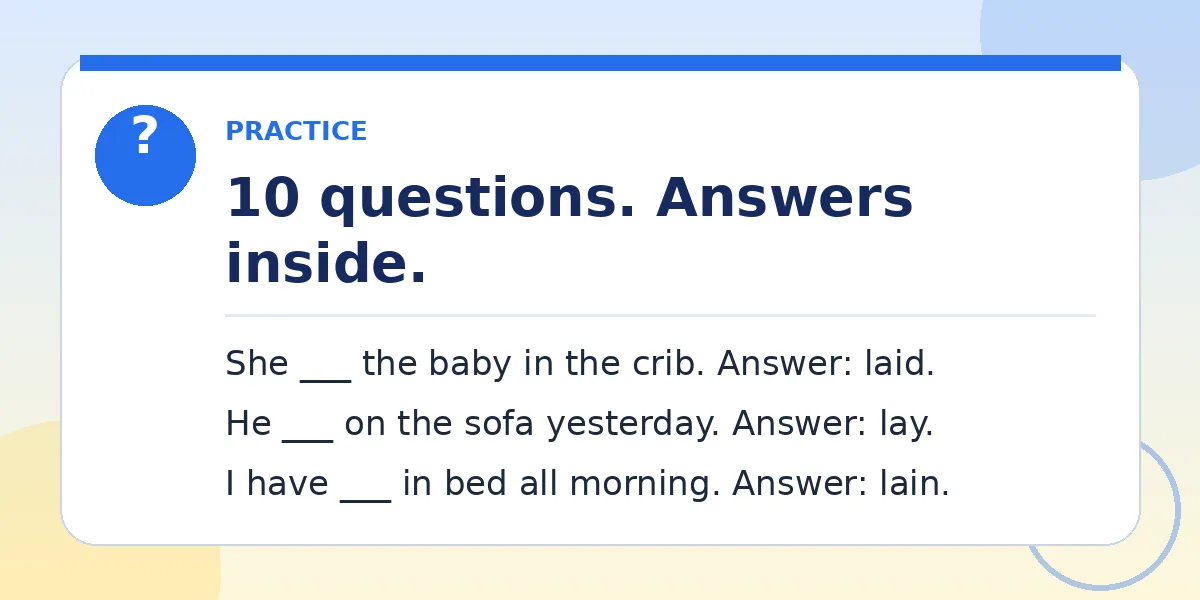
Test your understanding with these 10 questions. Choose the correct word or verb form for each sentence.
Part 1: Fill in the Blanks
- I always _____ my keys on the kitchen counter. a. laid b. lay
- She _____ the baby in the crib last night. a. layed b. laid
- We have _____ the documents on your desk. a. laid b. lay
- He _____ on the couch for two hours yesterday. a. laid b. lay
- The workers have _____ the new flooring. a. lain b. laid
Part 2: Choose the Correct Verb
- Which sentence is correct? a. I have laid in bed all morning. b. I have lain in bed all morning.
- Choose the correct sentence. a. She is laying on the sofa. b. She is lying on the sofa.
- The company _____ off several employees last month. a. layed b. laid
- Which sentence uses the present tense correctly? a. He lays the book on the table every morning. b. He laid the book on the table every morning.
- Choose the correct sentence. a. I had layed the foundation before the project started. b. I had laid the foundation before the project started.
Answer Key With Explanations
| Question | Correct answer | Explanation |
| 1 | b. lay | Lay describes a regular present action. |
| 2 | b. laid | Laid is the past tense of placement lay. |
| 3 | a. laid | Have requires the past participle laid. |
| 4 | b. lay | Lay is the past tense of reclining lie. |
| 5 | b. laid | Laid is the past participle of placement lay. |
| 6 | b. lain | Lain is the past participle of reclining lie. |
| 7 | b. lying | Lying describes reclining. |
| 8 | b. laid | Laid is the correct spelling in laid off. |
| 9 | a. He lays | Lays is the present form for he, she, or it. |
| 10 | b. I had laid | Had takes the past participle laid. |
If you answered all 10 correctly, you understand the main differences between these verb forms.
Frequently Asked Questions
1. What Is the Past Tense of Lay?
The past tense of lay is laid. Use laid when you describe something placed earlier, such as a book, a phone, or a set of keys. For example, you can say, “I laid my phone on the desk yesterday.”
2. Is Layed a Word?
Layed is not correct in modern standard English. The correct spelling is laid, and it applies in both American and British English. You might see layed in older historical texts, but never use it in modern writing.
3. Is It Laid Out or Layed Out?
Laid out is correct. It is the past form of the phrasal verb lay out, which means to spread something out or present information clearly. For example, “She laid out her plans yesterday.” The spelling layed out is wrong.
4. Is It Laid Down or Layed Down?
Laid down is correct when you describe something placed on a surface. For example, “He laid down the book.” For reclining in the past, use lay down instead, as in “I lay down yesterday.” Check the object first.
5. Can Laid Be Used Without an Object?
In its placement meaning, laid normally takes an object in active sentences. For example, “She laid the book down.” Passive sentences work differently, because the thing placed becomes the subject. For example, “The book was laid on the table.”
6. Is It I Laid Down or I Lay Down for a Nap?
Say “I lay down for a nap” when you describe a past reclining action. Lay is the past tense of lie in that meaning. Use “I laid myself down” only when yourself is the object.
7. What Is the Difference Between Laid and Lain?
Laid is the past tense and past participle of placement lay. Lain is the past participle of reclining lie. For example, say “I laid the book down” for placing, and “I have lain down” for reclining.
Final Takeaway: Lay Is Present, Laid Is Past
The difference between lay and laid becomes simple when you check the tense. So, lay or laid? Check tense first, then check for an object. Use lay for the present action of placing something. Use laid for its past tense and past participle.
Remember the separate reclining verb:
- Present: I lie down.
- Past: I lay down.
- Past participle: I have lain down.
And remember one final spelling rule: Laid is correct. Layed is not correct in modern standard English. With these forms in mind, you can choose the right word in everyday conversations, schoolwork, and professional writing.