

Nosey vs Nosy: Which Spelling Is Correct?
Table of Contents
- Quick Answer: Nosy or Nosey?
- What Does Nosy Mean?
- What Does Nosey Mean?
- Why Are There Two Spellings?
- Nosy vs Nosey in American and British English
- What Do Dictionaries Say?
- Pronunciation of Nosy and Nosey
- Word Forms of Nosy
- Nosy vs Noisy vs Noisey
- Nosy vs Curious vs Inquisitive
- Synonyms, Antonyms, and Polite Alternatives
- Origin and History of Nosy and Nosey
- What Does Nosy Parker Mean?
- Common Spelling Mistakes
- When Should You Use Nosy or Nosey?
- A Simple Memory Trick
- Examples in Sentences
- Practice Questions and Answer Key
- Frequently Asked Questions
Quick Answer: Nosy or Nosey?
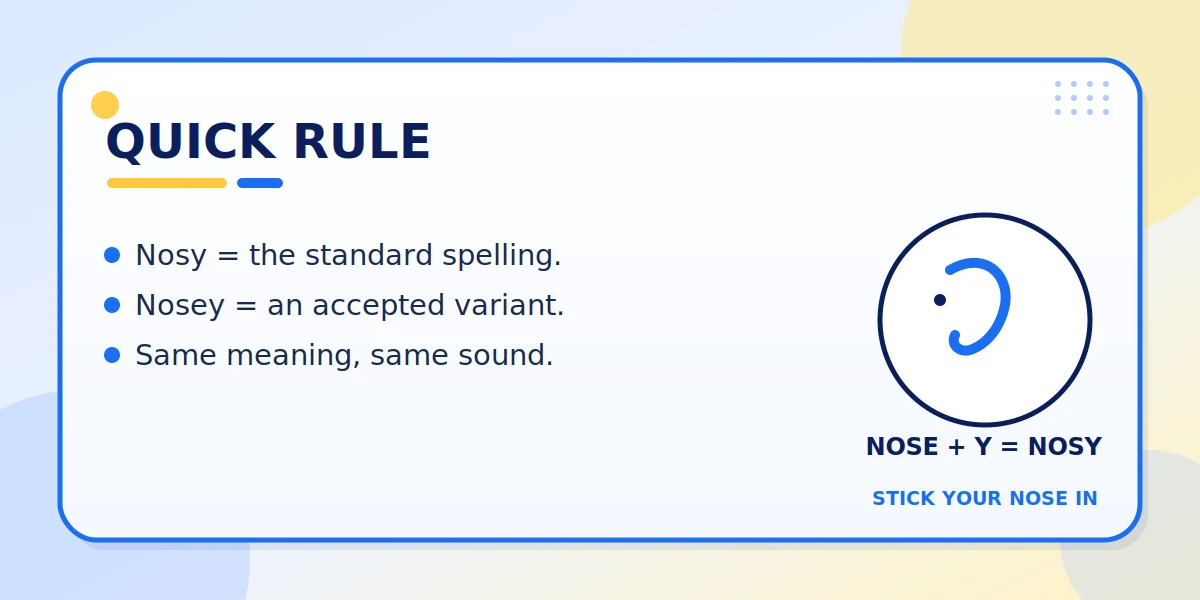
The nosey vs nosy question has a simple answer. Both spellings are correct, but nosy is the preferred standard form, especially in American English.
| Spelling | Is it correct? | Best use |
|---|---|---|
| Nosy | Yes | Standard choice for US writing |
| Nosey | Yes | Accepted alternative spelling |
| Noisy | Yes, but different word | Describes something loud |
| Noisey | Usually incorrect | Use noisy instead |
The main difference is the extra letter e. It does not change the word’s meaning or pronunciation. For school assignments, professional documents, and general US writing, use nosy. If you see nosey in a quotation or a British text, it is usually an accepted variant, not an error.
What Does Nosy Mean?
Nosy is an adjective that describes someone who takes too much interest in other people’s private business. The word usually has a negative or disapproving tone. However, people sometimes use it playfully with friends and family.
Nosy as an adjective
A person may be nosy when they:
- Ask questions about private relationships or family matters.
- Try to discover information that someone wants to keep private.
- Watch what other people do without a good reason.
- Interfere in personal decisions or conversations.
- Keep asking questions after someone has shown discomfort.
Consider these examples:
- My nosy neighbor always asks who visits my house.
- The reporter asked several nosy questions about the actor’s family.
- Stop being nosy and let them solve the problem.
- A nosy coworker wanted to know how much everyone earned.
- The children were nosy about the surprise party.
In each sentence, the person shows more interest than the situation calls for.
Is nosy always an insult?
Not necessarily. The word often criticizes someone’s behavior, but the speaker’s tone matters. For example, a friend might say, “I’m just being nosy, but how did your date go?” This can sound light and friendly. However, calling a stranger nosy may sound rude. It suggests that the person is ignoring boundaries. The context makes a difference:
| Situation | Possible meaning |
|---|---|
| A friend asks about your weekend | Playful curiosity |
| A stranger asks about your income | Intrusive behavior |
| A neighbor watches your visitors | Unwanted attention |
| A child asks many questions | May be innocent curiosity |
| A coworker investigates private matters | Unprofessional interest |
The word describes behavior, not necessarily someone’s entire personality.
What Does Nosey Mean?
Nosey has the same meaning as nosy. It describes someone who is overly curious about other people’s affairs. Major dictionaries recognize it as an alternative spelling. It is not a separate word with a different definition. That shared meaning is the heart of the nosey vs nosy question. For example:
- Her nosey cousin wanted to know every wedding detail.
- The nosey reporter asked about their personal lives.
- I do not mean to sound nosey, but are you feeling better?
- A nosey coworker kept asking about the private meeting.
- The nosey guests looked through the open door.
You could replace nosey with nosy in every example. The meaning would stay the same.
Is nosey a real word?
Yes. Nosey is a real and accepted spelling variant. Merriam-Webster, Collins, Cambridge, and Oxford recognize it as a variant of nosy. Some dictionaries list nosy as the main entry and identify nosey as an alternative. This is why nosy is the standard choice for most US writing. You may encounter nosey in informal messages, fiction, British writing, and other English-language publications.
Why Are There Two Spellings?
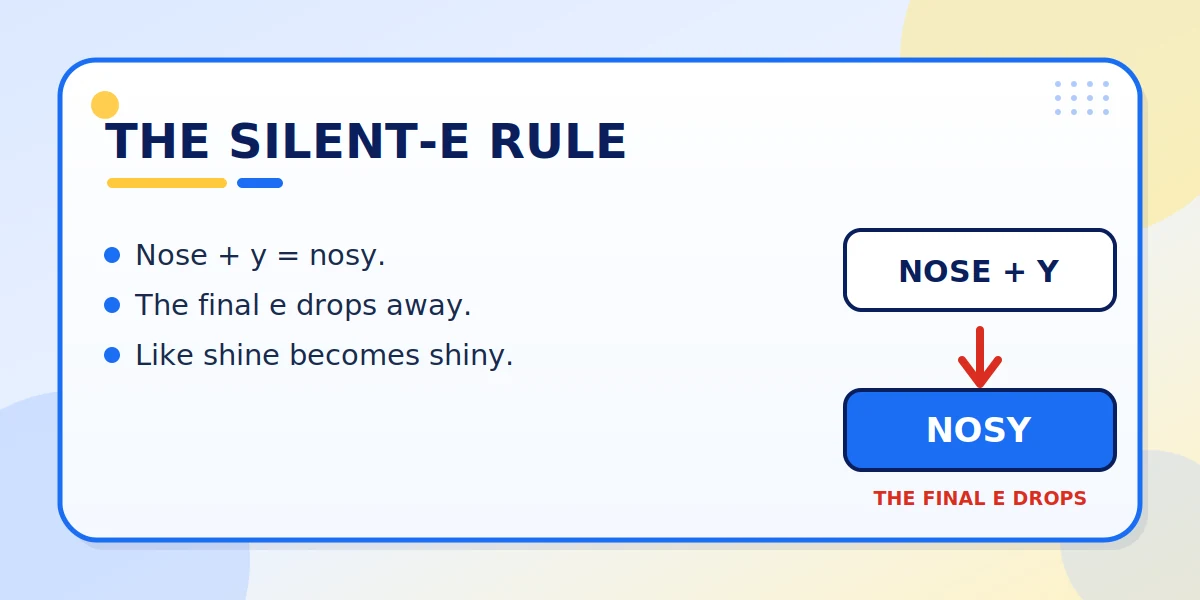
The nosey vs nosy split comes from one word, nose. Both forms refer to someone who seems to put their nose into other people’s business. The difference comes from how writers handle the final silent e when adding the suffix -y.
The silent-e spelling rule
English often drops a silent final e before adding a suffix that begins with a vowel. This helps explain the standard spelling. The basic pattern looks like this:
| Base word | New word | What happens |
|---|---|---|
| Nose | Nosy | The final e is dropped |
| Shine | Shiny | The final e is dropped |
| Spice | Spicy | The final e is dropped |
| Rose | Rosy | The final e is dropped |
The word nosy follows this familiar spelling pattern: Nose + y = nosy. However, English spelling has many exceptions and established variants. Nosey has remained in use as an accepted variant.
Why does nosey keep the extra e?
The spelling nosey preserves the final e from the word nose. Although nosy follows the usual spelling pattern, nosey keeps a visible link to its root word. That distinction matters. A spelling can differ from the most common pattern without being incorrect. You should therefore avoid treating nosey as a simple typing error. It is recognized by major dictionaries.
Nosy vs Nosey in American and British English
The nosey vs nosy choice changes a little by region. Both spellings appear in American and British English. However, nosy is the safer standard choice for US readers. British dictionaries also recognize nosy. They do not establish a strict rule that British writers must use nosey.
American English
In American English, nosy is the standard spelling to choose in most situations. It is the main headword in major American dictionary references. It also follows the familiar silent-e pattern. Use nosy for:
- School assignments and exams.
- Workplace emails and reports.
- News articles and general publications.
- Business websites and professional blogs.
- Everyday writing when you want the safest standard form.
Nosey is still understandable and accepted. However, nosy is the more dependable choice when writing for a US audience.
British English
British English recognizes both nosy and nosey. The spelling nosy is not limited to American English. British dictionaries also record the informal expression have a nosy. It means to look around or investigate something out of curiosity. For example:
- We had a nosy around the new shop.
- Let’s have a nosy and see what is happening.
This noun use is especially useful to know if you read British books, websites, or conversations.
What about Canada, Australia, and New Zealand?
Neither spelling should be assigned exclusively to one country without reliable evidence. Readers may encounter both forms in Canada, Australia, and New Zealand. However, the available dictionary evidence does not show a strict regional split. For practical writing, follow the publication’s preferred dictionary or house style. If no preference is stated, use nosy as the default.
US vs UK spelling comparison
| Context | Recommended guidance |
|---|---|
| American English | Prefer nosy |
| British English | Nosy is standard; nosey is accepted |
| Canadian English | Both forms may appear; follow local style |
| Australian English | Both forms may appear; follow local style |
| New Zealand English | Both forms may appear; follow local style |
| International writing | Prefer nosy for consistency |
These spelling differences are similar to other accepted variations in English. For more examples, see our guides to gray vs grey, judgment vs judgement, and defense vs defence. You can also explore toward vs towards and aluminium or aluminum for other regional spelling differences.
What Do Dictionaries Say About Nosy and Nosey?
The nosey vs nosy dictionary entries agree on the core meaning. Major dictionaries recognize nosy as the main spelling and nosey as an accepted variant.
| Dictionary | Main spelling | Treatment of nosey | Useful information |
|---|---|---|---|
| Merriam-Webster | Nosy | Lists it as a variant | Gives pronunciation, definition, and word forms |
| Dictionary.com | Nosy | Notes “or nosey” | Defines the word as overly curious or prying |
| Collins | Nosy | Recognizes nosey | Gives informal usage and comparative forms |
| Cambridge | Nosy | Recognizes nosey | Provides UK and US pronunciation |
| Oxford | Nosy | Recognizes nosey | Labels the word informal and disapproving |
| Etymonline | Nosy, also nosey | Records both forms | Explains the word’s historical development |
Which dictionary spelling should US writers follow?
For American writing, choose nosy. It is the main entry spelling in Merriam-Webster and several other dictionaries. That recommendation does not make nosey incorrect. It simply gives writers a consistent default. Dictionary headwords also do not establish every publisher’s house style. If an editor or organization prefers nosey, follow that style.
Do AP Stylebook and Chicago Manual of Style require nosy?
Do not assume that a stylebook has a specific rule unless you can check its actual entry. There is no need to claim that the AP Stylebook or Chicago Manual of Style explicitly mandates nosy. For everyday US writing, nosy remains the straightforward choice.
Pronunciation of Nosy and Nosey
The nosey vs nosy pronunciation is the same for both spellings. The extra e in nosey does not create another syllable.
| Variety | IPA pronunciation |
|---|---|
| American English | /ˈnoʊzi/ |
| British English | /ˈnəʊzi/ |
Both forms have two syllables, with the main stress on the first syllable. For example:
- She sounded nosy when she asked about my salary.
- The nosey neighbor wanted to know who had moved in.
The pronunciation stays the same when you change the spelling. You do not need a different pronunciation for nosey.
Word Forms of Nosy
The nosey vs nosy family of words includes nosier, nosiest, nosiness, and nosily. The standard spelling has several related forms. Learning them helps you use the word correctly in different contexts.
| Word form | Spelling | Meaning or use |
|---|---|---|
| Base adjective | Nosy | Overly curious or intrusive |
| Alternative adjective | Nosey | Accepted variant of nosy |
| Comparative | Nosier | More nosy |
| Superlative | Nosiest | Most nosy |
| Noun | Nosiness | The quality of being nosy |
| Adverb | Nosily | In a nosy manner |
| Informal verb form | Nosying | Looking around or interfering out of curiosity |
Is it nosier or noseier?
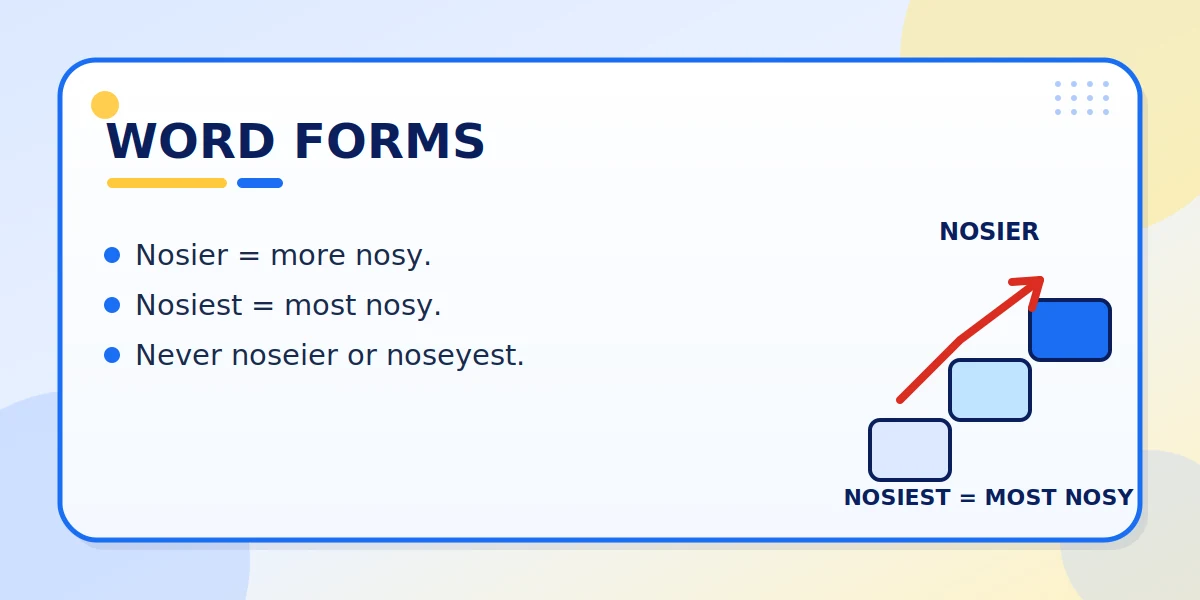
The standard comparative form is nosier. When adding -er to nosy, the final y changes to i:
- Nosy becomes nosier.
- Nosy becomes nosiest.
Avoid noseier and noseyest in standard writing. The accepted base variant does not mean every related form keeps the e.
What does nosiness mean?
Nosiness is a noun. It describes the habit or quality of being too interested in other people’s private affairs. Examples:
- Her nosiness annoyed the entire office.
- His nosiness made the family uncomfortable.
- I tried to ignore their nosiness.
What does nosily mean?
Nosily is an adverb. It describes an action done in an overly curious or intrusive way. Example: The visitor looked nosily through the open doorway. This form is less common in everyday conversation, but it is a recognized derivative.
What does nosying mean?
Nosying is an informal verb form. It refers to looking around, investigating, or interfering out of curiosity. Example: The children were nosying around the garden shed. You may also encounter noseying. However, use the form that matches your dictionary or publication’s house style.
What does have a nosy mean?
In British informal English, have a nosy means to look around or investigate something out of curiosity. Examples:
- We had a nosy around the new house.
- Do you want to have a nosy inside?
- I had a quick nosy at the display.
Here, nosy works as a noun in an informal expression. It does not describe a person.
Nosy vs Noisy vs Noisey
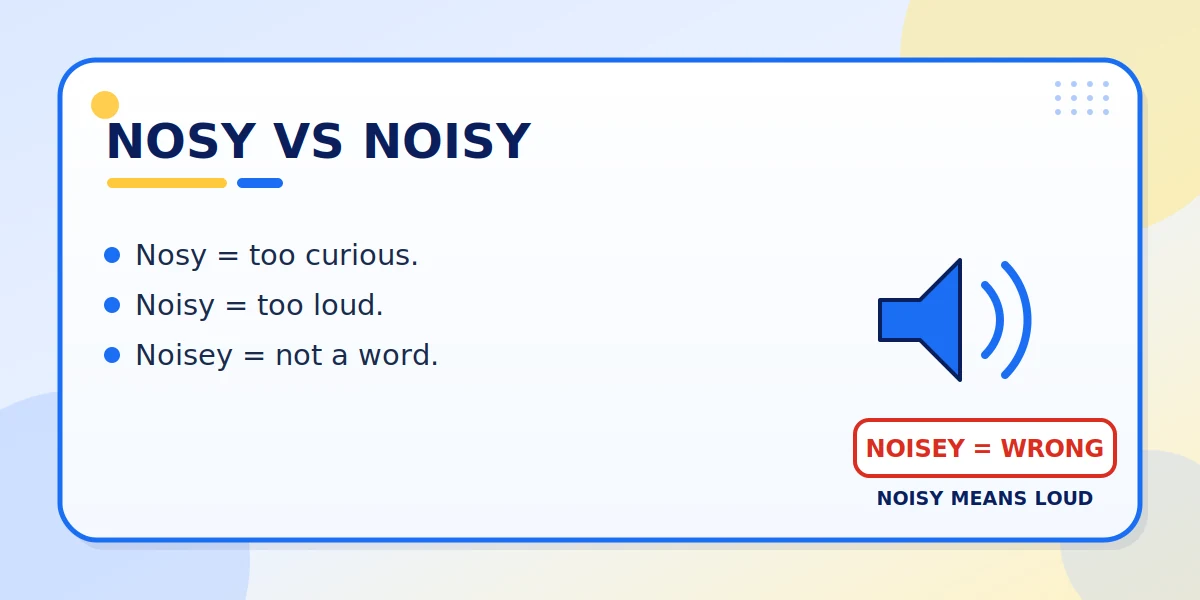
These spellings look similar, but they do not all mean the same thing. Nosy describes someone who takes too much interest in private matters. Noisy describes something that makes a lot of sound. Nosey is an accepted variant of nosy. Noisey is generally a misspelling of noisy in standard writing.
| Word | Meaning | Example |
|---|---|---|
| Nosy | Too interested in other people’s business | My nosy neighbor asks personal questions. |
| Nosey | Alternative spelling of nosy | A nosey stranger interrupted our conversation. |
| Noisy | Loud or full of sound | The noisy classroom distracted me. |
| Noisey | Usually a misspelling of noisy | Write noisy in standard English. |
How can you remember the difference?
Think about the meaning behind each word:
- Nosy: Someone puts their nose into your business.
- Noisy: Something makes noise.
- Nosey: An accepted alternative spelling of nosy.
- Noisey: Usually an incorrect spelling of noisy.
For example, a person who asks private questions is nosy. A machine that makes loud sounds is noisy. Do not replace one with the other. They describe different things.
Nosy vs Curious vs Inquisitive
Nosy, curious, and inquisitive all relate to wanting information. However, they carry different shades of meaning.
Nosy
Nosy usually has a negative or teasing tone. It suggests that someone wants information they do not need. Example: My coworker was nosy about my personal finances.
Curious
Curious usually describes a healthy desire to learn. It is often neutral or positive. Example: The curious student asked how the machine worked. A curious person wants to understand something. That interest does not necessarily invade anyone’s privacy.
Inquisitive
Inquisitive describes someone who likes asking questions or investigating ideas. It often suggests a genuine interest in learning. Example: The inquisitive student asked thoughtful questions during class. However, an inquisitive person can also become intrusive if they ignore personal boundaries.
Comparison table
| Word | Usual tone | Meaning |
|---|---|---|
| Nosy | Negative or teasing | Too interested in private matters |
| Curious | Neutral or positive | Eager to know or learn |
| Inquisitive | Usually positive or neutral | Interested in asking questions |
| Prying | Negative | Intrusively seeking private information |
| Meddlesome | Negative | Interfering in other people’s affairs |
The main difference is how the person seeks information. Curiosity can be respectful. Nosiness usually crosses a line. The nosey vs nosy pair stays negative, while curious and inquisitive usually stay neutral or positive.
Synonyms, Antonyms, and Polite Alternatives for Nosy
Choosing another word can help you express the right tone. The nosey vs nosy synonyms below help you choose the right tone for each situation. Some alternatives sound stronger or more critical than others.
Common synonyms for nosy
| Synonym | Meaning or tone |
|---|---|
| Prying | Trying to discover private information |
| Intrusive | Entering someone’s personal space or affairs |
| Meddlesome | Interfering in other people’s matters |
| Snoopy | Overly curious about private details |
| Inquisitive | Interested in asking questions |
| Overcurious | More curious than a situation requires |
| Interfering | Becoming involved without being invited |
| Obtrusive | Unwelcome or too noticeable |
| Busybody | A person who interferes in others’ affairs |
| Gossipy | Tending to share other people’s private business |
Curious and inquisitive are often gentler alternatives. Prying and meddlesome usually sound more critical.
Antonyms of nosy
An antonym has an opposite or contrasting meaning. Useful antonyms include:
- Discreet: Careful about private information.
- Reserved: Not eager to ask personal questions.
- Respectful: Mindful of other people’s boundaries.
- Unobtrusive: Not interfering or attracting unwanted attention.
- Private: Keeping personal matters to oneself.
- Uninterested: Not showing interest in a particular matter.
- Incurious: Not especially interested in learning about something.
The best choice depends on what you want to describe. Respectful is useful when discussing someone’s behavior toward others.
Polite alternatives to calling someone nosy
Calling someone nosy can sound harsh. If you want to set a boundary, try a more respectful expression. Here are some useful alternatives:
- “I’d rather keep that private.”
- “I’m not sure that’s something I can discuss.”
- “That’s a personal matter.”
- “I appreciate your concern, but I have it handled.”
- “Let’s give them some privacy.”
- “I’m not comfortable sharing those details.”
- “I’d prefer not to get into that.”
These expressions work in conversations with friends, coworkers, relatives, and strangers. They address the behavior without name-calling.
Origin and History of Nosy and Nosey
The nosey vs nosy history explains why both spellings still exist today. The word nosy comes from nose and the suffix -y. Its development is connected to the figurative idea of putting your nose into other people’s business. However, dictionaries report different dates. Those dates need careful explanation because they do not all refer to the same sense.
A timeline of the word’s history
| Source | Date or period | What it records |
|---|---|---|
| Etymonline | 1610s | An earlier sense describing someone with a prominent nose |
| Merriam-Webster | 1828 | Its recorded first-known-use date for the entry |
| Etymonline | 1882 | The inquisitive or prying sense |
| Dictionary.com | 1880-85 | Its recorded period for the modern entry |
| Collins | 1880-85 | Its recorded period for the modern entry |
These dates should not be treated as competing claims about one exact invention date.
Why do the dates differ?
A word can develop several meanings over time. A dictionary may record an early use of one sense and a later use of another. Etymonline records an earlier meaning connected to having a prominent nose. It gives 1882 for the inquisitive sense. Merriam-Webster gives 1828 as its first-known-use date. Dictionary.com and Collins record 1880-85 for the modern entry. These records do not establish a single, undisputed year when the modern word was first created. The differences reflect different senses and sources.
Is nosy older than nosey?
The available evidence does not support a simple claim that one spelling was definitely invented first. Etymonline records both forms. Major dictionaries also recognize both spellings today. The practical point is more useful than an uncertain ranking of their ages: nosy is the standard dictionary-first spelling.
What does the history tell us about the spelling choice?
The word’s history explains why both spellings exist. It does not mean they have different definitions. For modern American writing, choose nosy unless you have a specific reason to preserve nosey.
What Does Nosy Parker Mean?
Nosy Parker is part of the wider nosey vs nosy story. It is an informal expression for someone who is excessively curious or interferes in other people’s affairs. It works much like busybody. The phrase is often used to criticize someone who asks unwanted questions. Example: Don’t be such a Nosy Parker. Let them handle their own business.
What is the origin of Nosy Parker?
The exact origin of the expression remains uncertain. Historical sources provide evidence of its use by 1890. A printed example appeared in Belgravia Magazine in May 1890. A 1907 postcard also used the phrase in its caption, “The Adventures of Nosey Parker.” These examples help establish that the expression was in use by that period. They do not reveal who coined it.
Was Nosy Parker named after Archbishop Matthew Parker?
One popular story connects the phrase to Matthew Parker, an archbishop of Canterbury. However, this explanation lacks convincing historical support. The documented phrase appears centuries after Parker lived.
Was it named after a park keeper?
Another explanation links the expression to a park keeper who watched visitors or interfered with their business. This story is also unproven. It should be treated as speculation, not established etymology. The safest conclusion is simple: Nosy Parker is a documented expression, but its precise origin remains uncertain.
Common Spelling Mistakes
The nosey vs nosy mistakes below are the ones writers make most. Even though both main spellings are accepted, writers sometimes confuse them with unrelated or incorrect forms.
Mistake 1: Saying nosey is always wrong
This is incorrect. Major dictionaries recognize nosey as a variant of nosy. Use nosy as your default for American writing, but do not automatically label nosey a misspelling.
Mistake 2: Saying nosey is only British
This is too broad. The spelling appears in different varieties of English. British dictionaries recognize both forms.
Mistake 3: Assuming the spellings have different meanings
They do not. Both forms describe someone who is too interested in other people’s affairs.
Mistake 4: Confusing nosy with noisy
A nosy person asks intrusive questions. A noisy person or object makes loud sounds. Remember that noisy relates to noise, not private information.
Mistake 5: Writing nosie, nozy, or nossey
These are not standard spellings of the adjective. Use nosy or the accepted variant nosey instead.
Mistake 6: Writing noisey instead of noisy
The standard spelling for something loud is noisy. Do not add an extra e.
Mistake 7: Using the wrong comparative form
The standard forms are nosier and nosiest. Avoid noseier and noseyest in ordinary standard writing.
Mistake 8: Assuming nosy is always playful
The word usually carries a negative or disapproving tone. It can sound playful among friends, but context matters.
When Should You Use Nosy or Nosey?
The nosey vs nosy decision depends on your audience and writing context. Both spellings are accepted, but your choice should reflect the audience. For most US readers, nosy is the clearest default. It is the main dictionary spelling and fits formal and informal writing.
A decision table by writing context
| Writing context | Recommended spelling | Why |
|---|---|---|
| US school exams | Nosy | Safest standard American form |
| Formal writing | Nosy | Main dictionary-first spelling |
| US business writing | Nosy | Clear and consistent for US readers |
| UK fiction | Either | Both forms are recognized |
| Global blog | Nosy | Broadly recognized standard form |
| Informal messages | Either | Both forms are understandable |
| Direct quotations | Original spelling | Preserve the source’s wording |
Should you use nosey in formal writing?
Nosey is a recognized variant, so it is not automatically incorrect in formal writing. However, nosy is the more dependable choice for formal US documents. It is the standard dictionary-first spelling. If a publisher has a preferred dictionary or house style, follow that guidance.
Which spelling should you use in exams?
For US school assignments and exams, choose nosy. It is the safest option when you want to follow standard spelling. Although nosey is recognized, an exam may follow a particular dictionary or classroom spelling preference.
What if a spell-checker flags nosey?
Spell-checkers do not always recognize every accepted variant. Their dictionaries may prefer one spelling over another. If your software flags nosey, check a trusted dictionary before changing it. Do not assume that every flag means the word is wrong. For a US document, changing it to nosy is usually sensible. For a quotation, character voice, or publication style, keep nosey.
Should you change nosey to nosy when editing?
Use the publication’s style guide when one exists. If no preference is stated, standardize to nosy in US content. Do not change a spelling inside a direct quotation without a clear editorial reason. Also consider preserving the author’s voice.
For more spelling comparisons, explore our guides to spelt or spelled, mold vs mould, and donut or doughnut. You can also read about dialog or dialogue, holistic or wholistic, and ageing vs aging.
A Simple Memory Trick for Nosy
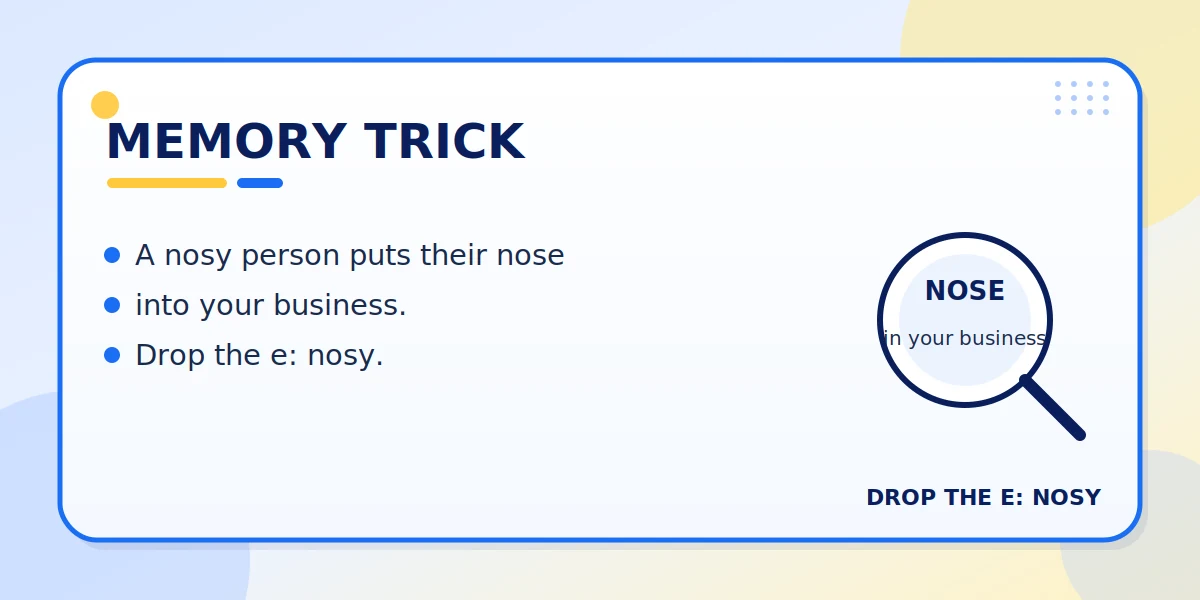
The nosey vs nosy memory trick is simple. Use this easy reminder: A nosy person puts their nose into your business. The standard spelling drops the silent e from nose. That gives you nosy. Remember these three points:
- Nosy: The preferred standard spelling.
- Nosey: An accepted alternative.
- Noisy: Something that makes noise.
This trick helps you remember the spelling without confusing it with noisy. It also reminds you that nosy and nosey mean the same thing.
Examples of Nosy and Nosey in Sentences
These nosey vs nosy examples show both spellings in everyday sentences. Remember that the meaning stays the same in both forms.
Examples using nosy
- My nosy neighbor always asks about my visitors.
- The manager disliked the nosy questions during the meeting.
- I did not mean to sound nosy when I asked.
- A nosy stranger tried to read the private letter.
- The children were nosy about the surprise party.
- His nosy coworker wanted details about his weekend.
- The reporter became too nosy about the family’s private life.
- She gave the nosy guest a polite but firm answer.
Examples using nosey
- Her nosey cousin wanted to know every wedding detail.
- The nosey reporter asked about their personal lives.
- I am not trying to be nosey, but is everything okay?
- A nosey coworker kept asking about the meeting.
- The nosey guests looked through the open doorway.
- My nosey neighbor wanted to know why I moved.
- He sounded nosey when he asked about her salary.
- The children became nosey when they saw the wrapped gifts.
Examples using related word forms
- Nosier: My younger brother is nosier than my older sister.
- Nosiest: That was the nosiest question anyone asked all day.
- Nosiness: Her nosiness made the conversation uncomfortable.
- Nosily: The visitor looked nosily through the window.
- Nosying: The children were nosying around the garage.
- Have a nosy: We had a nosy around the new store.
Practice Questions: Nosy vs Nosey
These nosey vs nosy practice questions test what you learned. Choose the best answer for each question.
- Which spelling is the safest choice for standard American English? A. Nosey B. Nosy C. Noisey
- Are nosy and nosey accepted spellings of the same word? A. Yes B. No C. Only in American English
- Which word describes someone who asks unwanted personal questions? A. Noisy B. Nosy C. Noisey
- Which spelling means making a lot of sound? A. Nosy B. Nosey C. Noisy
- What is the standard comparative form of nosy? A. Noseier B. Nosier C. Nosyer
- What does the informal British expression “have a nosy” mean? A. Make a loud sound B. Have a look around C. Ask someone to leave
- Which word usually has a more negative tone? A. Nosy B. Curious C. Inquisitive
- Which sentence uses the standard spelling for American English? A. My noisey neighbor asked personal questions. B. My nosey neighbor asked personal questions. C. My nosy neighbor asked personal questions.
- Which word is usually a more positive alternative to nosy? A. Prying B. Curious C. Meddlesome
- What should you do if a publication prefers nosey? A. Change every instance to noisy. B. Follow the publication’s style consistently. C. Treat the spelling as a mistake.
Answer Key
- B. Nosy. It is the preferred standard spelling for American English.
- A. Yes. Both forms have the same meaning and pronunciation.
- B. Nosy. It describes someone who takes too much interest in private matters.
- C. Noisy. It describes something that makes a lot of sound.
- B. Nosier. The standard comparative changes the final y to i before -er.
- B. Have a look around. It is an informal British expression.
- A. Nosy. It usually suggests intrusive or unwanted curiosity.
- C. My nosy neighbor asked personal questions. Nosy is the preferred US spelling.
- B. Curious. It often describes a positive or neutral desire to learn.
- B. Follow the publication’s style consistently. Both spellings are recognized, so house style can guide the choice.
Frequently Asked Questions
These nosey vs nosy FAQs answer the questions readers ask most.
Are nosy and nosey the same word?
Yes. Nosy and nosey are accepted spellings of the same adjective. Both describe someone who takes too much interest in other people’s private affairs, and both sound the same when you say them aloud.
Which spelling is correct, nosy or nosey?
Both spellings are correct, but nosy is the preferred standard form. It is the safest choice for American English, for school work, and for formal writing, so use it as your default.
Is nosey a real word or a misspelling?
Nosey is a real word and a recognized spelling variant of nosy. Major dictionaries record it as an accepted alternative, so it is not a mistake. Still, nosy remains the preferred standard spelling in American English.
Is nosy American or British English?
Nosy is used in both American and British English, so it is a safe standard spelling for US readers. British dictionaries also recognize nosey as a variant, but nosy works well in both varieties of English.
Is being nosy a bad thing?
Being nosy usually means showing too much interest in private matters, so the word often sounds critical. It can be playful among close friends, but the tone depends on the situation and the people involved.
What is the comparative and superlative of nosy?
The standard comparative is nosier, and the superlative is nosiest. For example, you can say, “My brother is nosier than my sister.” Avoid the forms noseier and noseyest in standard writing.
What does have a nosy mean?
Have a nosy is an informal British expression meaning to look around or investigate something out of curiosity. For example, you might say, “We had a nosy around the new shop” after a quick visit.
Final Takeaway: Choose Nosy for Standard US Writing
The nosey vs nosy answer is simple. Both nosy and nosey are correct spellings. They share the same meaning and pronunciation, but they are not equally standard in US writing. For American English, choose nosy as your default. It is the standard dictionary-first form and works well in formal and informal writing. Use nosey when it matches a publication’s style, a quotation, or your intended voice. Just remember that consistency matters. For more spelling guidance, visit the ClarifyWords Spelling Differences category.