SMH Meaning in Text: What Does SMH Mean?
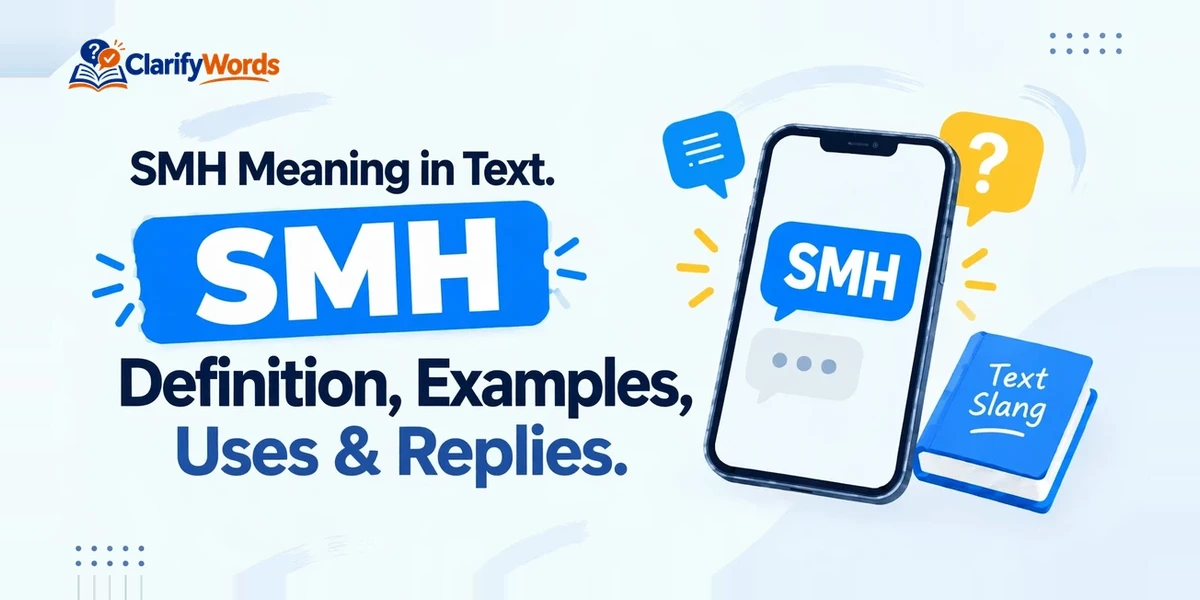
Quick Answer: What Does SMH Mean?
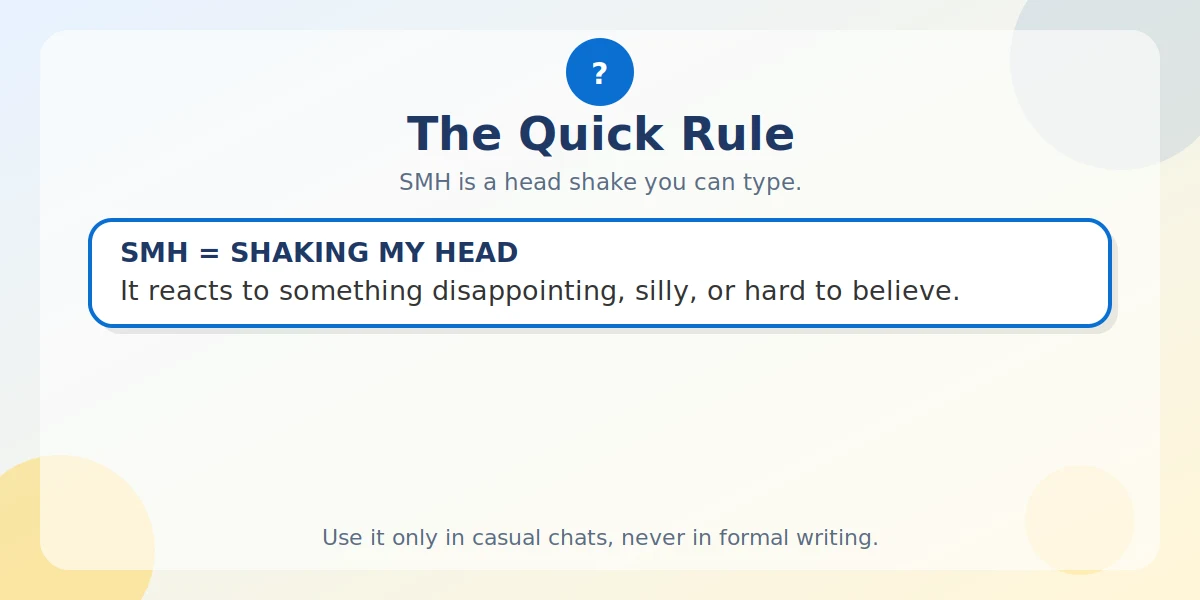
SMH means “shaking my head.” People use it in texts and online conversations to express disappointment, disbelief, frustration, or disapproval. It is the written version of shaking your head at something. For example:
Friend: “He forgot his wallet again, even after I reminded him.”
You: “SMH. How does that keep happening?”
In this example, SMH shows that you find the situation frustrating or ridiculous. It does not mean you are physically shaking your head at that moment. The smh meaning in text is usually a reaction rather than a complete statement. It adds emotion to a message without requiring a long explanation. That is the smh meaning in text in one short reaction.
Table of Contents
- SMH Meaning at a Glance
- What Does SMH Mean in Simple Words?
- Five Feelings SMH Can Express
- How to Use SMH in a Text
- SMH Examples in Real Chats
- What Does SMH Mean on Different Platforms?
- How to Reply to SMH
- Is SMH Rude?
- Common SMH Variations and Their Meanings
- SMH vs. Similar Text Reactions
- When Should You Avoid Using SMH?
- The History and Origin of SMH
- Other Possible Meanings of SMH
- Can You Use SMH About Yourself?
- An Easy Way to Remember SMH
- Test Your Understanding: 10 Practice Questions
- Frequently Asked Questions
- Final Takeaway
SMH Meaning at a Glance
Here is a quick overview of the abbreviation and how people use it.
| Detail | Answer |
|---|---|
| Full form | Shaking my head |
| Main meaning | Disappointment, disbelief, or disapproval |
| Common tone | Annoyed, unimpressed, frustrated, or amused |
| Where it appears | Text messages, social media, comments, and online chats |
| Typical placement | At the beginning or end of a message, or alone |
| Formal or informal? | Informal |
| Is it a swear word? | No |
| Related forms | SMDH, SMFH, and SMMFH |
| Common pronunciation | The letters “S-M-H” or the full phrase |
The smh meaning in text is usually clear when you consider the surrounding message. It communicates a reaction without a long explanation. For example, compare these responses: “That was a careless decision.” and “SMH, that was a careless decision.” The second version adds a stronger sense of disappointment. It tells the reader how you feel about the situation. SMH is useful because it is brief. However, its short format can also make the sender’s tone difficult to read. A recipient may need the surrounding message to understand whether it is playful or serious.
What Does SMH Mean in Simple Words?
SMH is short for “shaking my head.” To understand the smh meaning in text, start with that gesture. It describes the reaction people show when something disappoints, annoys, or surprises them. Imagine your friend tells you they missed an important meeting because they forgot to set an alarm. You might shake your head in real life. In a text, you can simply write: “SMH, you really forgot again?” The abbreviation communicates the reaction without describing the physical gesture. The smh meaning in text is closely connected to this everyday gesture. People use it to show what they think about a situation without writing a full sentence.
Why Do People Use SMH?
People use SMH because it is short and easy to understand in casual conversations. It can communicate several feelings at once. Common reasons include:
- Reacting to a mistake: Someone makes an avoidable error.
- Showing disbelief: A story or explanation seems unbelievable.
- Expressing frustration: Something keeps going wrong.
- Showing disapproval: Someone behaves in an inconsiderate way.
- Making a playful comment: A friend does something silly.
The exact tone comes from the surrounding words, relationship, and situation. For instance, “SMH, you forgot again” may sound annoyed. “SMH, you’re too funny” may sound playful. The abbreviation alone does not tell the whole story.
Is SMH an Acronym or an Initialism?
SMH is technically an initialism. Each letter represents the first letter of a word, and people usually say the letters separately. An acronym is generally pronounced as a word, like NASA. An initialism is spoken letter by letter, like SMH. In everyday conversation, people may call SMH an acronym. However, initialism is the more precise term.
Five Feelings SMH Can Express
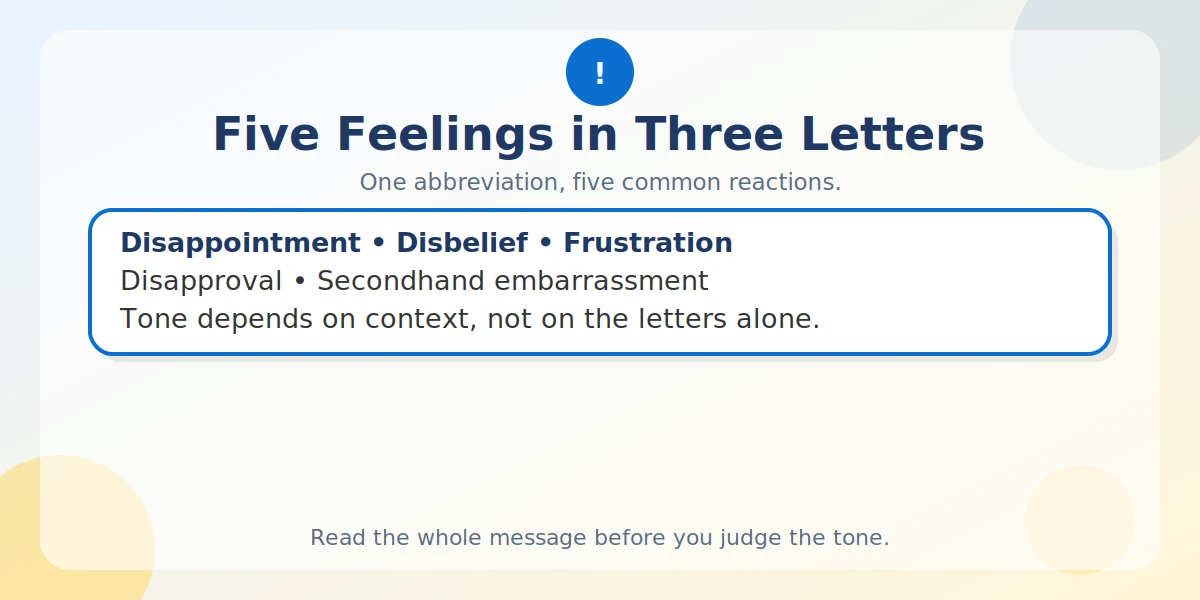
The abbreviation does not have one fixed emotional meaning. It can communicate different reactions depending on the message and the relationship. Understanding these feelings helps you interpret a short reply. It also helps you choose whether SMH is appropriate for your own message. Here are five common feelings behind the smh meaning in text.
1. Disappointment
SMH often expresses disappointment when someone makes a poor choice or fails to meet expectations.
Example:
Friend: “I studied all night, but I forgot to submit the assignment.”
You: “SMH, you did all that work for nothing.”
The response shows disappointment about the missed submission. It may also suggest that the mistake was avoidable. This use can sound caring or critical. A close friend might use it as gentle teasing. Someone who is already upset may take it more seriously.
2. Disbelief
People use SMH when something sounds surprising or difficult to believe.
Example:
Friend: “He said he finished the project, but he never opened the file.”
You: “SMH, seriously?”
Here, the abbreviation communicates disbelief. You cannot believe someone made such a claim without doing the work. It can also react to an unexpected event. For example, someone might send SMH after hearing an unbelievable excuse or seeing a surprising post.
3. Frustration
SMH can show irritation when the same problem happens repeatedly.
Example:
Friend: “The internet stopped working again.”
You: “SMH, this happens every single day.”
The response expresses frustration with a recurring problem. It does not necessarily blame the person who mentioned it. You can also use it when a plan goes wrong or something takes longer than expected.
4. Disapproval
Sometimes, SMH signals that you think someone’s behavior is wrong or inconsiderate.
Example:
Friend: “He laughed when she dropped all her books.”
You: “SMH, that was really rude.”
In this case, the abbreviation communicates disapproval. It makes your negative reaction clear. This use can sound serious because it judges someone’s behavior. If the person being discussed is part of the conversation, it may feel more personal.
5. Mild Judgment or Secondhand Embarrassment
SMH can also show that someone has done something awkward, careless, or embarrassing.
Example:
Friend: “I waved at someone who wasn’t waving at me.”
You: “SMH, that must have been awkward.”
This use is often playful between close friends. However, it can sound judgmental if the other person feels embarrassed about what happened. You might also use it when someone tells an awkward story about themselves. The surrounding message helps show whether the tone is teasing or critical. Remember: SMH does not always express anger. It can be serious, playful, disappointed, or mildly amused. Read the whole message before deciding what it means.
How to Use SMH in a Text
You can use SMH in several positions within a message. The placement, capitalization, punctuation, and surrounding words can change how it sounds. The smh meaning in text remains the same across these writing styles. What changes is the emphasis and the impression the message gives.
Where Should You Place SMH?
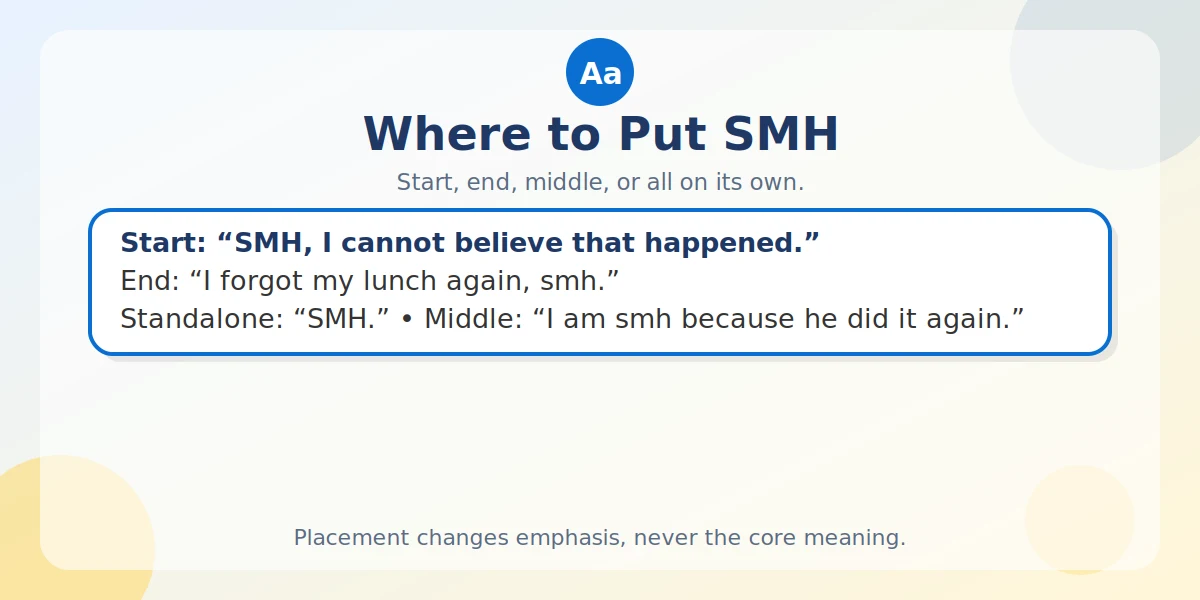
There is no strict grammar rule for placing SMH. These are the most common patterns.
- At the beginning: Use it to show your reaction before explaining the situation. “SMH, he left his keys inside the car again.”
- At the end: Place it after a statement to add a reaction. “She canceled at the last minute again, smh.”
- As a standalone message: Send it alone when the situation already explains your reaction. Friend: “I accidentally deleted the document.” You: “SMH.”
- In the middle of a sentence: You can also place it between two parts of a casual message. “I was ready to leave, smh, and then it started raining.”
All four patterns are common in informal digital conversations. You do not need to follow a special punctuation rule.
Should You Write SMH or smh?
Both uppercase and lowercase forms are widely understood. The difference is mostly stylistic.
- smh: Casual and relaxed. Example: “smh, not again”
- SMH: Standard or more emphatic. Example: “SMH, that was careless”
- SMH.: More final or serious. Example: “You forgot again. SMH.”
- SMHHH: Exaggerated reaction. Example: “SMHHH, I can’t believe it”
These impressions are not strict rules. People have different texting habits, so capitalization alone cannot reveal the sender’s exact mood. Lowercase letters often appear in quick messages. Uppercase letters may make the reaction stand out. Repeating the final letter can add emphasis in casual chats.
Does Punctuation Change the Meaning?
Punctuation can affect the tone of a message.
- “SMH.”: May sound firm, disappointed, or dismissive.
- “SMH!”: Can make the reaction feel stronger.
- “SMH…”: May suggest disbelief, frustration, or speechlessness.
- “SMH?”: Can show confusion or question someone’s decision.
Consider the difference: “SMH.” and “SMH… I don’t even know what to say.” The first is brief and potentially cold. The second gives more context and may sound less confrontational. Punctuation does not create a new definition. It gives readers clues about the sender’s intended mood.
Can You Use SMH With Emojis?
Yes. People sometimes combine SMH with emojis to make their intended tone clearer. The emoji pairing can soften, strengthen, or change the reaction. Emoji pairings are described in words only in this article.
- SMH with a laughing face emoji: Playful disbelief. Example: “You really did that? SMH”
- SMH with a facepalm emoji: Embarrassment or disappointment. Example: “SMH, I sent it to the wrong person”
- SMH with an eye-roll emoji: Annoyance or sarcasm. Example: “SMH, here we go again”
- SMH with a crying face emoji: Overwhelmed or dramatic reaction. Example: “SMH, why does this keep happening?”
- SMH with no emoji: Neutral, serious, or unclear. Example: “SMH, that was unnecessary”
These combinations depend on context. An emoji does not guarantee that a message is friendly or sarcastic. For example, a laughing face may soften a comment between friends. The same pairing could feel mocking if someone is discussing a serious problem.
How Do You Pronounce SMH?
Most people pronounce SMH by saying each letter separately: “S-M-H.” You can also say the complete phrase, “shaking my head.” People generally do not pronounce it as one ordinary word. When reading a text aloud, use whichever version sounds natural in the conversation. Spoken or written, the smh meaning in text stays the same.
SMH Examples in Real Chats
Seeing the abbreviation in realistic conversations makes its meaning easier to understand. Here are six examples showing different situations. Notice how the same three letters can express different reactions depending on the context. Each example below shows the smh meaning in text in action.
Example 1: Someone Makes a Careless Mistake
Alex: “I left my lunch at home again.”
Jordan: “SMH, you do this every Monday.”
Meaning: Jordan is expressing mild frustration or playful disappointment.
Example 2: Someone Shares Unbelievable News
Mia: “He told everyone he was sick, but I saw him at the concert.”
Sam: “SMH, that’s unbelievable.”
Meaning: Sam cannot believe what happened and disapproves of the dishonesty.
Example 3: A Friend Acts Thoughtlessly
Chris: “She borrowed my laptop and returned it with a cracked screen.”
Taylor: “SMH, she should have been more careful.”
Meaning: Taylor is disappointed with the person’s behavior.
Example 4: A Repeated Problem
Riley: “The delivery is late for the third time.”
Morgan: “SMH, this company needs to get organized.”
Meaning: Morgan is frustrated by the repeated delay.
Example 5: A Silly Situation
Jamie: “I spent ten minutes looking for my phone. It was in my hand.”
Casey: “SMH, that’s so you.”
Meaning: Casey is teasing Jamie in a friendly way.
Example 6: Making Fun of Your Own Mistake
Avery: “I just called my teacher by the wrong name.”
Quinn: “SMH, I’d want to disappear.”
Meaning: Quinn understands the embarrassment and responds playfully.
These examples show that SMH can be directed at a person, an event, or the sender’s own actions. The surrounding conversation determines the exact feeling.
What Does SMH Mean on Different Platforms?
For the smh meaning in text, the platform does not change the definition. SMH has the same basic meaning across messaging apps and social platforms. It stands for “shaking my head,” whether someone uses it in a private text or a public comment. The platform does not give the abbreviation a completely different meaning. However, the audience and conversation style can affect how it sounds.
SMH on Snapchat
On Snapchat, people use SMH in direct messages, group chats, and story replies. For example: “SMH, you sent that snap to the wrong person.” It can express playful embarrassment, frustration, or disbelief.
SMH on TikTok
TikTok users often place SMH in comments or captions. They may use it to react to a video, an unexpected event, or someone’s opinion. For example: “SMH, why would anyone think that was a good idea?” The tone depends on the video and the comment thread.
SMH on Instagram
On Instagram, SMH can appear in comments, direct messages, captions, and story replies. For example: “SMH, people really need to read the instructions first.” It usually expresses disapproval or disbelief about something shown in a post.
SMH on WhatsApp and iMessage
In private messaging apps, friends and family use SMH as a quick reaction. For example:
Person 1: “I forgot to charge my phone before leaving.”
Person 2: “SMH, now what?”
It can feel more personal because the sender and recipient often know each other’s communication style.
SMH on X, Reddit, and Discord
On discussion platforms, people may use SMH to react to opinions, comments, news, or community behavior. For example: “SMH, that argument ignores the main point.” In public discussions, this can sound dismissive. It may also make a disagreement more personal.
Does the meaning change by platform? No. The core definition stays the same. The conversation, audience, and relationship determine the tone.
How to Reply to SMH
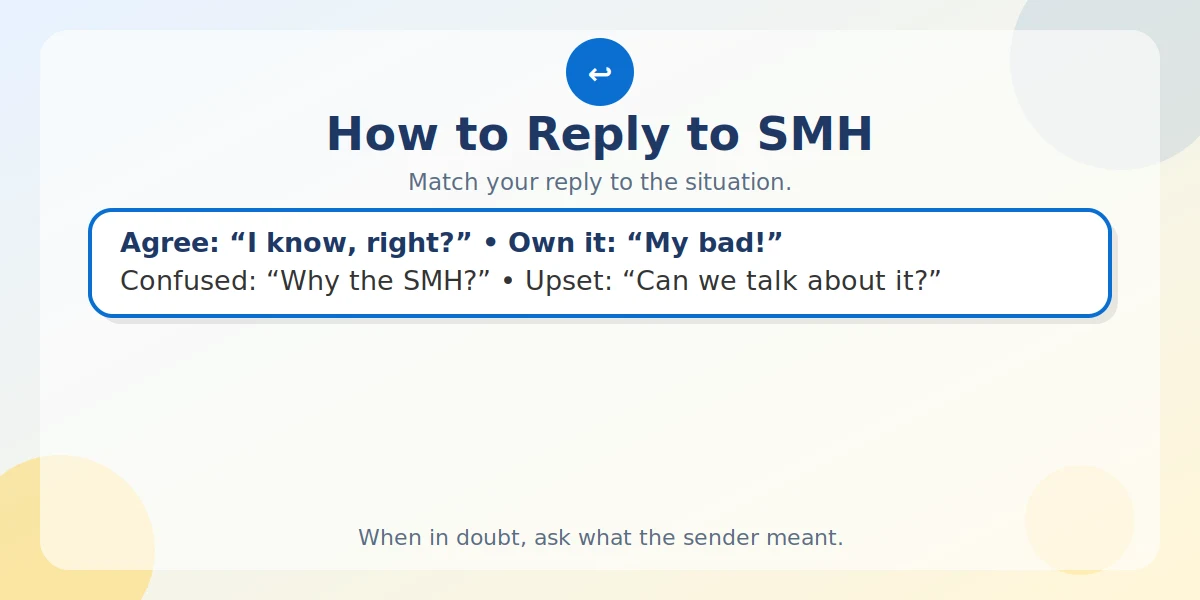
Your response should depend on why the other person sent SMH. They might agree with you, tease you, express disappointment, or react to a situation. You do not need one standard reply for every situation. First, consider what happened and whether the sender seems playful or serious. The smh meaning in text is only a reaction, so your reply should fit the moment.
1. When You Agree With Their Reaction
If someone uses SMH about a situation you also find frustrating, agree with them. Possible replies: “I know, right?”, “Exactly. It makes no sense.”, “I was thinking the same thing.”, “Seriously, I can’t believe it.”
Example:
Friend: “He canceled again. SMH.”
You: “I know, it’s getting ridiculous.”
2. When You Made a Mistake
If someone sends SMH because you made an error, acknowledge it without becoming defensive. Possible replies: “I know, that was my fault.”, “You’re right. I should have checked.”, “I won’t make that mistake again.”, “My bad.”
Example:
Friend: “You forgot the tickets? SMH.”
You: “I know, my bad. I’ll sort it out.”
3. When They Are Joking With You
If the conversation is playful, you can respond with humor. Possible replies: “Don’t judge me.”, “I know, I’m a mess.”, “It happens!”, “You would do the same.”
Example:
Friend: “You put your shirt on backward. SMH.”
You: “Fashion has no rules.”
4. When You Do Not Understand Their Reaction
If the message feels unclear, ask what they mean. Possible replies: “What’s wrong?”, “What happened?”, “Why the SMH?”, “Did I miss something?”
Example:
Friend: “SMH.”
You: “Wait, what happened?”
5. When They Seem Upset With You
If the abbreviation sounds critical, invite an honest explanation. Possible replies: “Did I do something wrong?”, “Can you explain what bothered you?”, “I didn’t mean to upset you.”, “Let’s talk about it.”
Example:
Friend: “You didn’t tell me about the change. SMH.”
You: “I’m sorry. I should have told you earlier.”
6. When Their Message Feels Disrespectful
You do not have to accept a dismissive response. You can ask them to communicate more clearly. Possible replies: “If something is wrong, tell me directly.”, “I’d rather discuss this without sarcasm.”, “Can we talk about the issue?”, “Please explain what you mean.”
7. When No Reply Is Needed
Sometimes SMH is only a reaction. The other person may not expect an answer. If the conversation has naturally ended, you can leave it there. A short reaction does not always require another message.
Is SMH Rude?
SMH is not automatically rude. It is an informal expression that can sound playful, disappointed, annoyed, or judgmental. The smh meaning in text does not change when the sender intends a different tone. Instead, the situation affects how the message feels. For example, a close friend might send “smh” after you make a silly mistake. You may understand it as friendly teasing. However, a coworker who sends “SMH” after your work mistake may sound disrespectful. The same abbreviation can feel different in each setting.
When Does SMH Sound Harmless?
SMH is more likely to feel harmless when: you are talking with close friends; everyone understands the joke; the situation is minor; the message is clearly playful; the sender is reacting to a situation, not attacking a person.
For example:
Friend: “I put my coffee in the fridge and my milk in the cupboard.”
You: “SMH, you need more sleep.”
The response is likely friendly if both people enjoy this kind of teasing. In that case, the smh meaning in text is playful, not critical.
When Can SMH Sound Rude?
It may sound rude when: someone uses it to criticize another person’s mistake; the recipient is already upset or embarrassed; the message dismisses someone’s feelings; it appears during a serious disagreement; the sender uses it to mock someone publicly.
For example:
Person 1: “I made a mistake during my presentation.”
Person 2: “SMH.”
The short reply may make Person 1 feel judged rather than supported.
Is SMH a Bad Word or a Swear Word?
No. SMH itself is not a swear word. It stands for “shaking my head” and contains no profanity. However, some stronger variations include profanity. SMDH contains “damn,” while SMFH contains an offensive word. If you want to keep your message clean and neutral, use SMH rather than those stronger forms.
Common SMH Variations and Their Meanings
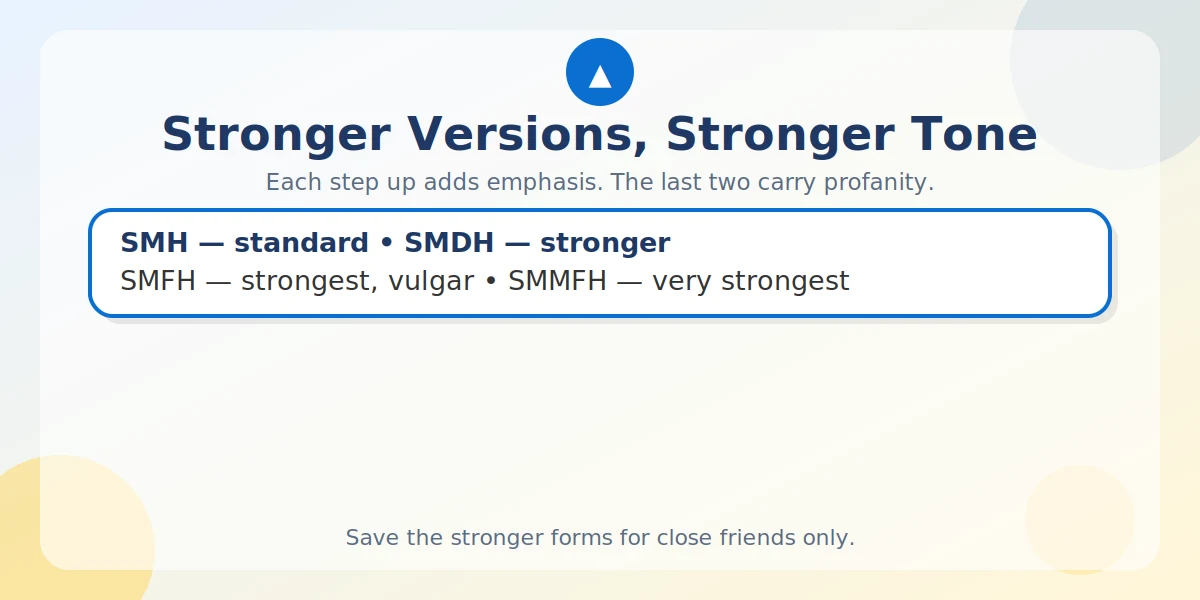
People sometimes add letters or words to SMH to make the reaction stronger or more specific. Some forms are widely recognized. Others are informal or rare. The smh meaning in text stays connected to “shaking my head” in its common variations. Added words or letters usually change the strength, not the basic idea. The table below separates common variations from less established ones. All of them build on the smh meaning in text.
Common and Recognized Variations
| Form | Full form | Tone |
|---|---|---|
| SMH | Shaking my head | Disappointment or disbelief |
| SMDH | Shaking my damn head | Stronger frustration |
| SMFH | Shaking my f***ing head | Strong frustration or disbelief |
| SMMFH | Shaking my motherf***ing head | Very strong frustration |
SMDH and SMFH intensify the original reaction. They are more forceful and less suitable for polite or professional conversations.
Informal and Contextual Variations
| Form | Meaning |
|---|---|
| SMH RN | Shaking my head right now: adds immediacy |
| Big SMH | A strong reaction of disbelief or disapproval: informal emphasis |
| SMH my head | A deliberately redundant joke: repeats the idea of shaking one’s head |
“SMH my head” is intentionally repetitive because the phrase already includes “my head.” People use it for humor, not for a formal definition.
Rare or Joke Variations
You may encounter unusual forms such as SMBH, SMHF, SMHO, SMUH, SMHAM, SMHIDB, and SMHS. These are niche, playful, or context-specific variations. Their meanings are not consistently established, so you should not treat them as standard texting vocabulary. If you see an unfamiliar version, ask the sender what they mean. Guessing an expansion could lead to confusion.
SMH vs. Similar Text Reactions
SMH is not the only abbreviation people use to express a reaction. Several other expressions communicate surprise, embarrassment, or disbelief. However, they do not all mean the same thing. Choosing the right one helps you communicate the reaction you intend. The smh meaning in text is the starting point for each comparison below.
| Expression | Meaning | Feeling |
|---|---|---|
| SMH | Shaking my head | Disappointment or disbelief |
| SMDH | Shaking my damn head | Stronger frustration |
| SMFH | Shaking my f***ing head | Very strong frustration |
| LOL | Laughing out loud | Amusement |
| OMG | Oh my God | Surprise or shock |
| Facepalm | Covering the face with a hand | Embarrassment or disbelief |
| Eye roll | A gesture showing annoyance | Irritation or impatience |
| I can’t even | Having no words or feeling overwhelmed | Speechlessness |
| WTF | What the f*** | Strong shock or confusion |
| Seriously? | Questioning something | Disbelief or frustration |
SMH vs. SMDH
SMH means “shaking my head.” SMDH means “shaking my damn head.” The second version adds stronger language. It usually communicates more frustration or disbelief.
SMH vs. LOL
SMH expresses disapproval, disappointment, or disbelief. LOL usually expresses laughter or amusement. A person might use both when something is funny but also ridiculous.
SMH vs. OMG
OMG expresses surprise or shock. It can be positive or negative. SMH usually carries a more judgmental or disappointed reaction.
SMH vs. Facepalm
Facepalm describes a gesture people make when something is embarrassing, frustrating, or difficult to believe. It is closely related to SMH, but it often suggests stronger embarrassment or secondhand embarrassment.
SMH vs. Eye Roll
An eye roll shows annoyance, impatience, or disbelief. SMH communicates a similar reaction through the idea of shaking your head. Both can sound dismissive when directed at another person.
When Should You Avoid Using SMH?
Although SMH is common online, it does not fit every conversation. It is best suited to casual messages and informal discussions. In serious or professional situations, it may make you sound impatient or disrespectful. Knowing the smh meaning in text helps you judge when a clearer sentence works better.
1. Avoid SMH in Professional Emails
Do not use SMH in job applications, resumes, formal emails, or business documents. A reader may see it as careless or unprofessional. It can also make your message seem dismissive. For example, avoid writing: “SMH, the report was not completed on time.” A better version is: “I noticed the report was not completed by the agreed deadline. Could you share an update?” The revised message explains the issue without sounding judgmental.
2. Be Careful in Workplace Chats
Even casual workplace chats require some care. Your coworkers may not share your sense of humor. Avoid sending SMH when discussing: a colleague’s mistake; a missed deadline; a customer complaint; a sensitive management decision; a problem affecting someone’s job. If you need to address a problem, explain it directly and respectfully.
3. Avoid It During Serious or Sensitive Situations
SMH can seem cold when someone shares difficult news. Avoid using it as a response to messages about illness, grief, personal crises, or serious emotional problems. A person who needs support may interpret it as judgment or indifference. Instead, respond with empathy. For example: “I’m sorry you’re dealing with this. Is there anything I can do to help?”
4. Do Not Use It to Shame Someone Publicly
Posting SMH under someone’s mistake can embarrass them. It may also turn a small disagreement into a public argument. If you disagree with someone, explain your point without mocking them.
Professional Alternatives to SMH
Choose a replacement based on what you want to communicate.
| Situation | Say instead |
|---|---|
| You disagree | “I see this differently.” |
| You are disappointed | “That’s disappointing.” |
| You are confused | “Could you clarify this?” |
| You are frustrated | “This issue is becoming difficult to resolve.” |
| You noticed a mistake | “I think there may be an error here.” |
| You need an explanation | “Could you help me understand what happened?” |
| You want to address repeated behavior | “Can we discuss how to prevent this from happening again?” |
These alternatives keep the conversation clear. They also focus on solving the problem instead of judging someone.
The History and Origin of SMH
SMH became a familiar part of online language through early internet discussions and later social media. However, its exact origin is not confirmed. It is important to separate documented examples from claims about when or where the abbreviation was invented. That honest gap is part of the smh meaning in text story, because the evidence is documented without a known inventor.
Early Documented Use: The 1990s
Merriam-Webster reports that SMH was in use by the early 1990s. It also points to a Usenet post dated July 15, 1994. That post lists SMH as an abbreviation for “shaking my head.” This is an early dated example of the abbreviation in online communication. It does not prove that someone first invented it on that date.
February 14, 2004: An Early Online Dictionary Entry
An entry for SMH appeared on Urban Dictionary on February 14, 2004. This record helped document the expression in online slang. It is an early online dictionary entry, not evidence that the term was invented in 2004. Dictionary.com and Know Your Meme also discuss this 2004 milestone.
By 2007: Wider Spread on Twitter
Dictionary.com notes that SMH had spread on Twitter by 2007. Social media gave people more opportunities to use short reactions in public posts and conversations. The abbreviation became more visible as online communication grew.
The 2010s: More Mainstream Attention
During the 2010s, online slang explainers and social media discussions helped introduce SMH to a wider audience. Publications such as Vice and Bustle discussed internet expressions for readers who wanted to understand changing online language. The abbreviation also appeared in headlines and everyday online writing without always needing an explanation.
Who Invented SMH?
There is no confirmed individual inventor or agreed-upon place of origin. Dictionary.com discusses the possibility that SMH may have been an innovation of Black internet users. This is a tentative discussion, not a confirmed fact. The available historical records show that the abbreviation was in use by the early 1990s. They do not establish who coined it or where it first appeared.
Other Possible Meanings of SMH
“Shaking my head” is the most familiar meaning of SMH in casual online conversations. However, the letters can have other meanings in different contexts. The smh meaning in text is usually the intended one in an ordinary private message. Still, the subject can point to a different interpretation. The surrounding words and topic usually make the intended meaning clear.
1. Scratching My Head
Some people use SMH to mean “scratching my head.” This interpretation suggests confusion rather than disapproval. The sender may not understand something or may be trying to solve a problem. For example: “SMH, I can’t figure out why the app keeps crashing.” The sender may mean they are puzzled by the problem. Merriam-Webster also notes this alternative interpretation.
2. So Much Hate
In some online discussions, SMH can stand for “so much hate.” This meaning may appear in conversations about criticism, arguments, or negative comments. For example: “There’s so much SMH in that comment section.” This is a less common interpretation. Check the topic before assuming it is the intended meaning.
3. So Much Hype
Some sources and informal discussions use SMH to mean “so much hype.” This is a minor or joking interpretation, not the standard definition. Do not assume someone means it unless the conversation makes that meaning clear.
4. Sydney Morning Herald
In Australian news or media discussions, SMH can refer to the Sydney Morning Herald, a newspaper. For example: “I read the report in the SMH this morning.” The reference to news or journalism makes this meaning more likely than the texting definition.
5. Organization or Institution Names
SMH can also appear as initials for organizations, institutions, or other named groups. For example, it may refer to the Society for Military History or St. Marks Hospital in a relevant context. These meanings are specific to their subjects. They are not common alternatives in ordinary text messages.
How can you tell which meaning someone intends? Look at the topic. A casual message about a mistake probably uses “shaking my head.” A news discussion probably refers to a newspaper or organization. That context test is how you confirm the smh meaning in text in any message.
Can You Use SMH About Yourself?
Yes. You can use SMH to react to your own mistake, poor decision, or embarrassing moment. This is called a self-directed use. Instead of criticizing someone else, you are making fun of your own actions. For example: “I walked into the wrong classroom. SMH.” The abbreviation shows that you recognize your mistake and feel embarrassed or amused.
Self-Directed vs. Person-Directed SMH
- Self-directed: “I forgot my own password. SMH.”: I cannot believe I did that.
- Person-directed: “You forgot the password again. SMH.”: I am disappointed in your mistake.
- Situation-directed: “The bus is late again. SMH.”: This situation is frustrating.
Self-directed SMH often feels lighter because you are the target of the joke. Person-directed SMH can feel more critical. It may sound like you are judging someone. Situation-directed SMH focuses on an event or problem rather than a person.
Why Self-Directed SMH Can Sound Different
When you use SMH about yourself, you show that you recognize your own mistake. This can make the message sound humorous or self-aware. For example: “I just spent twenty minutes looking for my glasses. SMH.” The sender is not blaming another person. They are reacting to their own absent-minded moment. However, self-directed SMH does not always mean the person is joking. Someone may use it to express genuine frustration with themselves. If a friend seems upset, avoid assuming they want to be teased. A supportive reply may be more helpful.
An Easy Way to Remember SMH
The easiest way to remember SMH is to connect it with a physical gesture. Think about what you do when someone says something unbelievable. You might shake your head because you feel disappointed or surprised. Now connect the gesture to the letters: S = Shaking, M = My, H = Head. That gives you “shaking my head.” When you see SMH in a message, imagine someone reacting to a frustrating or surprising situation by shaking their head. This simple connection can help you remember the abbreviation without memorizing a long definition. It is the fastest way to recall the smh meaning in text. You can also remember it by thinking of a familiar situation. Someone makes an avoidable mistake, and you shake your head in response.
Test Your Understanding: 10 Practice Questions
Try these questions to check whether you understand the smh meaning in text and its common uses.
- What does SMH usually stand for? A. So Much Happiness B. Shaking My Head C. Send Me Help D. Something Must Happen
- What feeling does SMH commonly express? A. Disappointment B. Excitement C. Gratitude D. Celebration
- Is SMH a swear word? A. Yes, always B. Only on social media C. No D. Only in uppercase
- What does SMDH usually stand for? A. Send My Daily Homework B. Shaking My Damn Head C. So Much Daily Happiness D. Sorry, My Dear Human
- What does SMH suggest in this message? “I missed my train because I left home too late. SMH.” A. The sender is celebrating B. The sender is reacting to their own mistake C. The sender is asking for directions D. The sender is making a formal request
- Does SMH have a different basic meaning on Snapchat and TikTok? A. Yes B. No C. Only on private accounts D. Only in comments
- Which response is suitable when a friend sends SMH after making a mistake? A. “My bad. I’ll fix it.” B. “Never speak to me again.” C. “I refuse to explain.” D. “That is your problem.”
- Which situation is least suitable for using SMH? A. A joke between close friends B. A silly personal mistake C. A formal email to a manager D. A frustrating everyday problem
- What does SMH usually communicate when someone uses it about their own mistake? A. Self-directed embarrassment or disbelief B. A request for money C. An invitation D. A formal apology
- What is known about the origin of SMH? A. One person definitely invented it in 2004 B. It began on TikTok C. Its exact origin is unclear, but it was documented by the 1990s D. It was first used in a newspaper headline
Answer Key
- B, SMH stands for “shaking my head.”
- A, It often expresses disappointment, disbelief, or disapproval.
- C, SMH contains no profanity.
- B, SMDH means “shaking my damn head.”
- B, The sender is reacting to their own avoidable mistake.
- B, Its basic meaning stays the same across platforms.
- A, Acknowledging the mistake is a clear, constructive response.
- C, SMH is informal and usually unsuitable for formal emails.
- A, Self-directed SMH can show embarrassment or disbelief about your own actions.
- C, Early 1990s use is reported, but the exact origin is unknown.
Frequently Asked Questions
1. What does SMH stand for in texting?
SMH stands for “shaking my head.” People use it in texts and online conversations to express disappointment, disbelief, frustration, or disapproval. It is a short reaction that shows how the sender feels about a situation.
2. What does SMH mean from a girl or a guy?
SMH has the same basic meaning whether a girl or a guy sends it. It stands for “shaking my head.” The sender’s gender does not change its meaning. Tone depends on context and relationship.
3. Is SMH rude or a bad word?
SMH is not a swear word, and it is not automatically rude. However, it can sound dismissive or judgmental when directed at a person, especially during a disagreement or a sensitive conversation.
4. What is the difference between SMH and SMDH?
SMH means “shaking my head,” while SMDH means “shaking my damn head.” SMDH adds stronger language and usually expresses more frustration. It is also less suitable for polite or professional messages.
5. What does “SMH my head” mean?
“SMH my head” is a deliberately repetitive internet expression. SMH already means “shaking my head,” so adding “my head” repeats the idea. People use it in texting for humor or emphasis.
6. How should you respond when someone texts SMH?
First, consider why the person sent it. You can agree, apologize, joke back, or ask what happened. If their message feels dismissive, ask them to explain it clearly and directly.
7. When did people start using SMH?
Merriam-Webster reports SMH was in use by the early 1990s and cites a July 15, 1994 Usenet example. An Urban Dictionary entry followed on February 14, 2004. Its exact origin remains unclear.
Final Takeaway
SMH means “shaking my head.” In short, the smh meaning in text is a quick reaction to something disappointing, unbelievable, or frustrating. It is a common informal expression used to show disappointment, disbelief, frustration, or disapproval. People use it in text messages, social media comments, and online chats. Its meaning stays consistent across platforms. A message between close friends may feel playful. The same abbreviation directed at a coworker or someone facing a serious problem may feel critical. Use SMH when a casual reaction fits the conversation. Choose clear, respectful wording in professional or sensitive situations.
Related Guides
Want to understand more online abbreviations and everyday terms? Explore these ClarifyWords guides: