

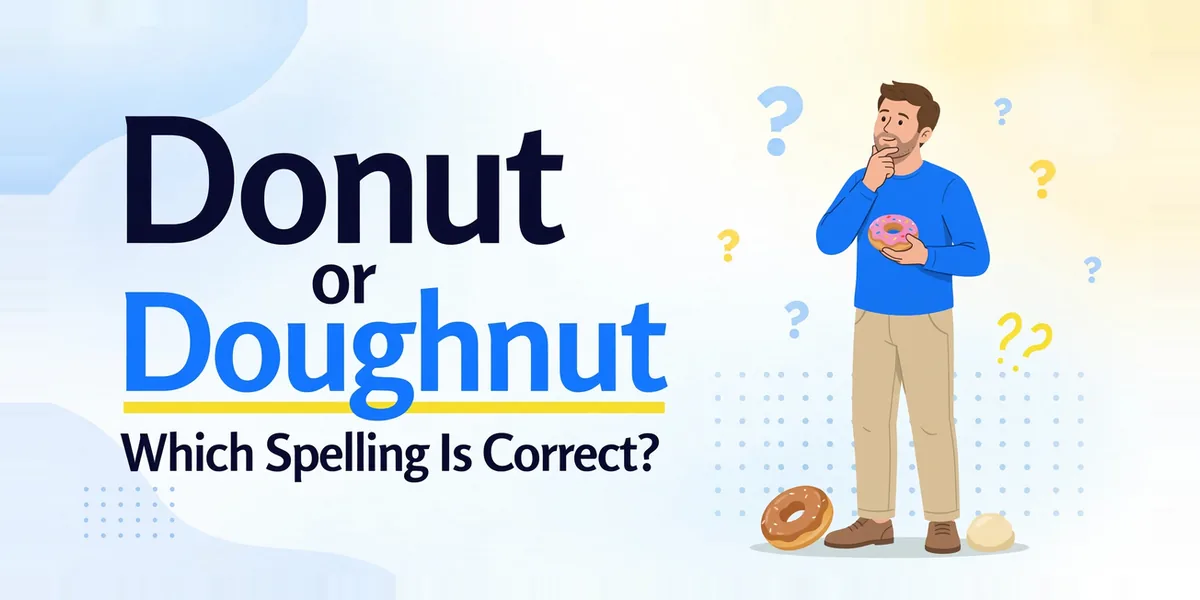
Donut or Doughnut: Which Spelling Is Correct?
Quick Answer
Doughnut: the traditional spelling and the main dictionary entry. Donut: an accepted shorter variant, widely used in the United States. Meaning: both words describe the same kind of sweet fried dough. Pronunciation: the spellings are pronounced alike. Best choice: use donut for ordinary US writing if you prefer it. Choose doughnut for a traditional or international style. Neither spelling is wrong. The choice is about audience, style, and consistency.
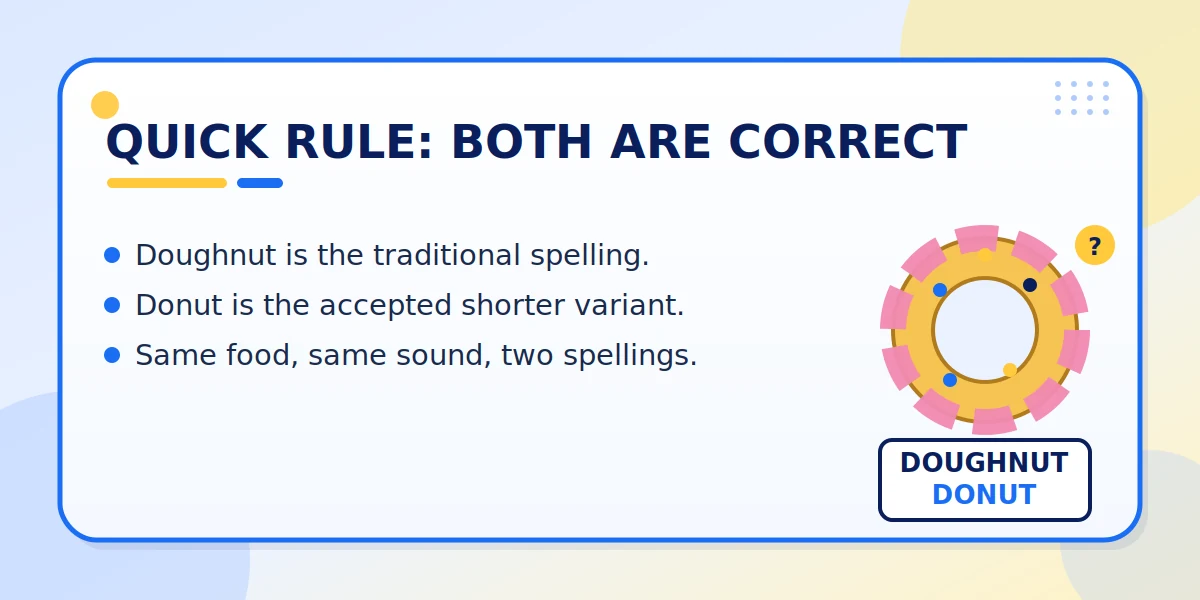
Table of Contents
- What Do Donut and Doughnut Mean?
- Donut vs. Doughnut: What Is the Difference?
- Regional Spelling: US, UK, Canada, and Australia
- Which Spelling Should You Use?
- What Do Dictionaries and Style Guides Say?
- The History of Donut and Doughnut
- Brand Names: Dunkin’ and Krispy Kreme
- Other Meanings and Uses
- Common Spelling Mistakes
- An Easy Memory Trick
- Practice: Choose the Correct Spelling
- FAQs
What Do Donut and Doughnut Mean?
Doughnut: The Traditional Spelling
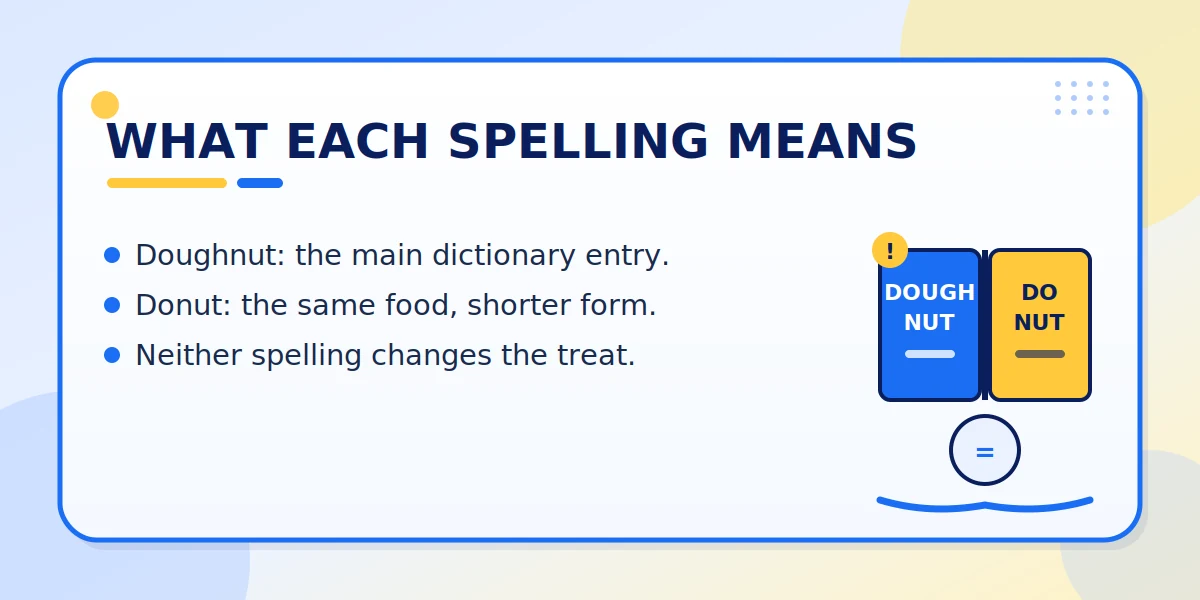
A doughnut is a small cake made from sweet dough and fried in hot fat or oil. It may have a hole in the middle or come filled with jam, cream, or another sweet filling. The word also describes objects with a thick ring shape. In mathematics, that shape is called a torus. Dictionaries commonly use doughnut as the main entry. Merriam-Webster lists donut as a less common spelling, and its word-history explainer treats it as accepted. It is the longer and more traditional spelling.
Donut: The Accepted Shorter Variant
A donut is the same food as a doughnut. The shorter spelling does not describe a different recipe, shape, or flavor. It is a recognized spelling, especially in American English. You will see it in everyday writing, menus, advertisements, and business names. For example: I bought a glazed donut on my way to work. The bakery sells chocolate doughnuts every morning. Would you like a jelly donut or a cinnamon doughnut? All three sentences use correct spelling.
Do Donut and Doughnut Mean the Same Thing?
Yes. Both words name the same treat. The only difference is spelling, not meaning, taste, or shape. A glazed ring from a bakery can be called a donut or a doughnut, and both names are correct.
Donut vs. Doughnut: What Is the Difference?
The question donut or doughnut is a spelling choice, not a difference in meaning. Both forms name the same food and share the same pronunciation.
| Feature | Doughnut | Donut |
|---|---|---|
| Meaning | Sweet fried dough | Sweet fried dough |
| Pronunciation | Same as donut | Same as doughnut |
| Dictionary status | Traditional main entry | Accepted variant |
| Regional use | Common internationally and in the UK | Especially common in the US |
| Tone | Traditional or conservative | Familiar and everyday in the US |
| Plural | Doughnuts | Donuts |
How Do You Pronounce Them?
The two spellings have the same pronunciation within each English variety. Cambridge Dictionary gives the UK pronunciation as /ˈdəʊ.nʌt/ and the US pronunciation as /ˈdoʊ.nʌt/. The spelling doughnut does not make the word sound longer. The letters ough work together as part of the spelling.
Which Spelling Is More Common in the United States?
Donut is widely used in everyday American English. It is especially visible in shop names, menus, packaging, and advertising. However, doughnut remains common and correct. It often appears in traditional recipes, formal writing, and publications that prefer the longer form. When people search donut or doughnut, they are usually asking which form suits American writing. The broad trend in American printed usage has favored donut in more recent decades. The available research does not support a precise percentage that applies to all writing. The safest conclusion is simple: both spellings remain in use.
Regional Spelling: US, UK, Canada, and Australia
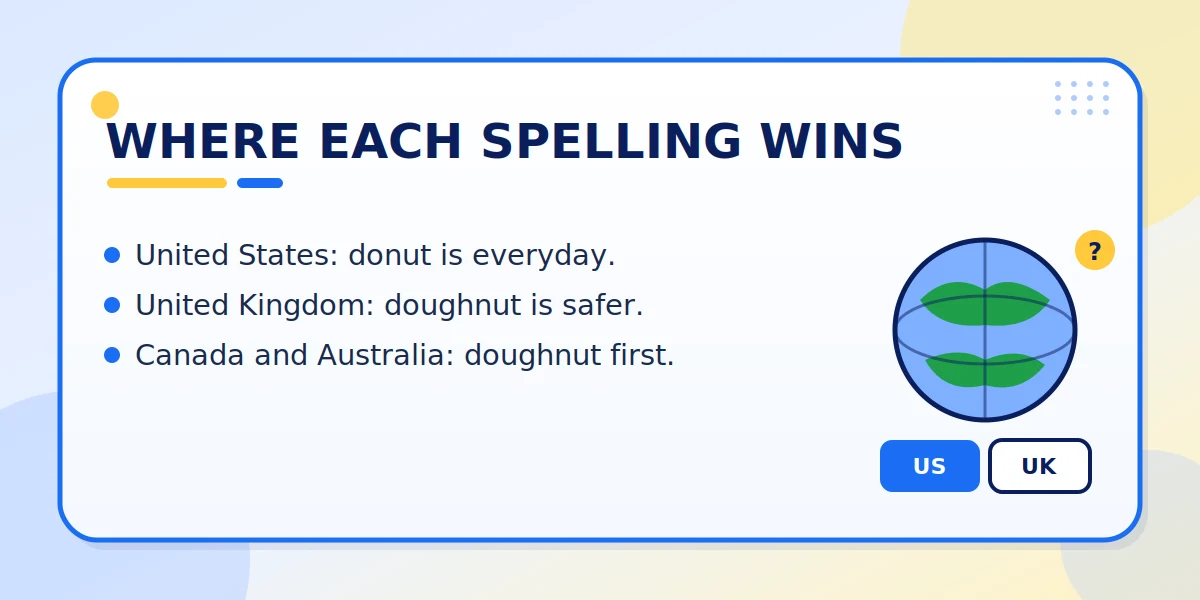
English spelling preferences can change by region. A donut or doughnut choice is not always an official rule. It often reflects local publishing habits and familiar usage.
American English
Both forms are accepted in the United States. Donut is especially common in everyday writing and commercial names. Doughnut is also correct and suits readers who prefer the traditional form.
British English
Doughnut is the safer and more established choice in the United Kingdom. British dictionaries recognize donut, but it is often viewed as an American variant. British doughnuts may be ring-shaped or filled with jam or cream. These food traditions do not create a spelling rule. Either shape can be called a doughnut.
Canadian English
Doughnut is a safe conventional choice for Canadian readers. You may also encounter donut, especially in business names and writing influenced by American usage. There is no reason to call the shorter form incorrect. Follow the spelling used by the publication or organization you are writing for.
Australian and New Zealand English
Doughnut is the safer traditional choice in Australia and New Zealand. The shorter spelling is also recognizable and appears in advertising and brand names. Local usage can vary. If a publication has a house style, follow it rather than assuming one form is required everywhere.
| Region | Safer choice | Other spelling accepted? |
|---|---|---|
| United States | Donut for everyday use; doughnut for a traditional style | Yes |
| United Kingdom | Doughnut | Yes, often seen as American |
| Canada | Doughnut | Yes |
| Australia | Doughnut | Yes |
| New Zealand | Doughnut | Yes |
| International audience | Doughnut | Yes, but donut may look more US-focused |
Which Spelling Should You Use?
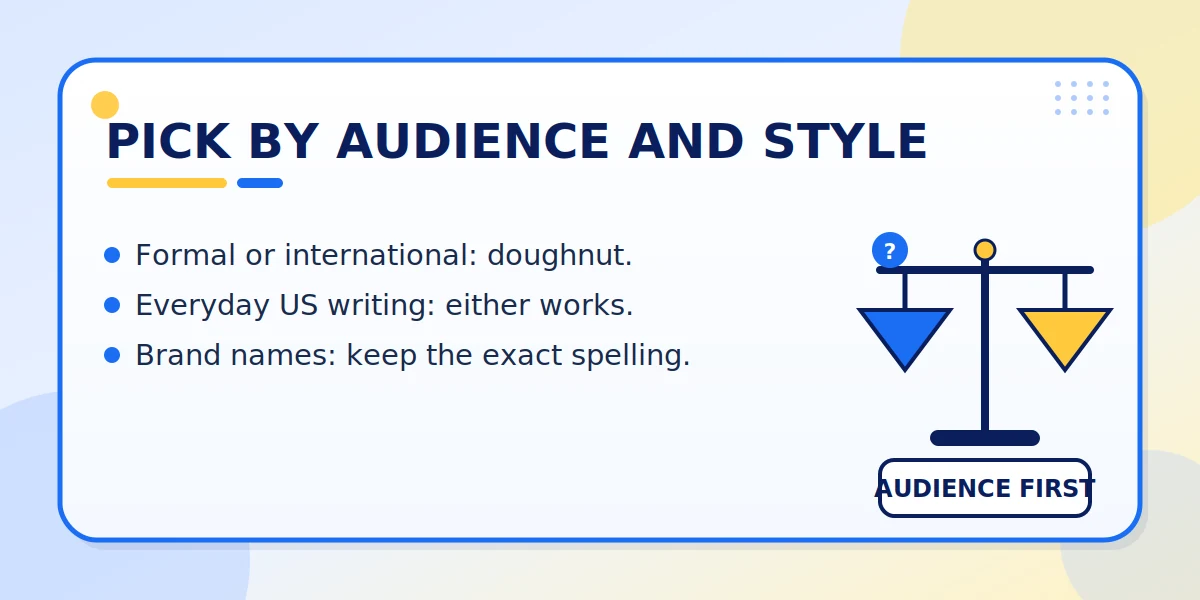
Your audience and writing situation should guide your choice. If you are unsure about donut or doughnut, use this table for a quick decision.
| Audience | Formality | Region | Best choice |
|---|---|---|---|
| General readers | Everyday | United States | Donut or doughnut |
| School assignment | Formal | United States | Doughnut is the safer traditional choice |
| Business or editorial writing | Formal | United States | Follow the house style |
| General readers | Everyday | United Kingdom | Doughnut |
| International readers | Any | Global | Doughnut |
| Canadian readers | Any | Canada | Doughnut is the safer conventional choice |
| Australian or New Zealand readers | Any | Australia or New Zealand | Doughnut is the safer traditional choice |
| A named business or product | Any | Any region | Use the brand’s exact spelling |
Keep One Spelling Consistent
Choose one spelling for ordinary prose. Do not switch between donut and doughnut without a reason. This consistency rule is the simplest answer to many donut or doughnut questions. Consistency helps readers and makes your writing look polished. It also prevents confusion when the word appears several times. There are two useful exceptions:
- Keep the spelling in a proper name, such as Dunkin’ Donuts.
- Preserve the spelling in a direct quotation or official product name.
For example, an article may use doughnut throughout while still referring to the company Dunkin’ Donuts by its official name.
What Do Dictionaries and Style Guides Say?
Dictionaries confirm that both spellings are valid. They do not all present the entries in the same way. Their entries help explain why donut or doughnut can both be correct.
| Source | What it says |
|---|---|
| Merriam-Webster | Lists doughnut as the main entry and donut as a less common spelling. Its word-history explainer treats donut as an accepted spelling. |
| Cambridge Dictionary | Lists donut as a US form of doughnut. It also gives the same regional pronunciation for both spellings. |
| Oxford Learner’s Dictionaries | Recognizes donut, especially in North American English, alongside doughnut. |
| Associated Press Stylebook | Secondary sources report that AP prefers doughnut. The primary stylebook entry was not publicly verified for this article. |
| Chicago Manual of Style | No specific preference is stated here because a reliable public rule could not be verified. |
Merriam-Webster’s entry label does not mean donut is wrong. A less common spelling can still be standard. For school or workplace writing, check the required style guide. If no guide applies, doughnut is a conservative choice. In everyday US writing, donut is entirely suitable.
The History of Donut and Doughnut
The two spellings developed over time. The history of donut or doughnut includes different kinds of evidence, so the dates should not be treated as one simple first-use answer.
Why Is It Called a Doughnut?
The traditional spelling combines dough and nut. The word nut once referred to a small, rounded cake or lump. It did not always mean the edible seed from a tree. That older meaning appears in other food names, such as ginger nut. Early doughnuts were often small, round pieces of fried dough. They did not always have the familiar hole. Some accounts suggest that nuts were added to early dough. That explanation is not established as the word’s origin. The rounded-cake meaning is the better-supported explanation.
The Dutch Connection
Dutch settlers brought fried-dough foods to New Amsterdam, now New York. One related food was called olykoek or olikoek, meaning “oil cake.” Washington Irving later connected doughnuts with olykoeks in his writing about early New York. Modern Dutch oliebollen, meaning “oil balls,” are related in name and food tradition. This history shows an important Dutch influence. It does not prove that every fried-dough pastry came from one country or tradition.
Doughnut: 1782, 1808, and 1809
Several dates appear in accounts of the word’s early history:
1782: Thomas Hazard’s diary records a form written as donotes. Merriam-Webster also gives 1782 as the first known use of doughnut. This is an early diary record, not a published literary example.
1808: A reported short story includes the spelling dough-nuts. This is another early printed example.
1809: Washington Irving used dough-nuts in A History of New York and connected them with olykoeks. These dates describe different kinds of evidence. The 1782 diary form is an early written attestation. The 1808 and 1809 examples show the spelling in print. Therefore, it is more accurate to describe the word’s early record as dating from the late 1700s to the early 1800s.
Donut: 1870, 1900, and Later Use
The shorter spelling also has a layered history. Etymonline’s entry for donut records an American alternate spelling by 1870 and notes its later use in bakery names:
1870: Etymonline records donut as an alternate American spelling by this year, citing an example associated with Josh Billings.
1900: A literary example appears in George Wilbur Peck’s writing. This is a later printed example, not proof that the spelling began in 1900.
Around 1920: Etymonline says the spelling became common in bakery names around this period.
Mid-20th century: Merriam-Webster’s word-history explainer notes the form in published edited text by this period. The dates do not conflict once the evidence is separated. An early appearance, a literary example, use in business names, and wider use in edited publications are different milestones.
Did Dunkin’ Invent the Spelling Donut?
No. The shorter spelling existed before the company opened. Dunkin’s published history says Bill Rosenberg opened the Open Kettle restaurant in Quincy, Massachusetts, in 1948. He renamed it Dunkin’ Donuts in 1950. The first franchise opened in 1955. The brand helped make the shorter spelling familiar to many Americans. It did not invent the word or its spelling. The story that Hanson Gregory invented the ring-shaped doughnut in 1847 is also widely repeated. Treat it as a popular origin story, not a settled historical fact.
Spelling Reform and the Shorter Form
Donut fits the broader American interest in simplified spellings. Noah Webster and Benjamin Franklin both supported spelling reform. They wanted English spelling to match sounds more closely. The letters ough can sound many ways, as in tough, though, and through. A shorter form like donut removes that confusion. It follows the same spirit as color for colour and center for centre.
Brand Names: Dunkin’ and Krispy Kreme
Brand names keep their official spelling, even when it differs from the spelling used in your article. That rule matters whenever you discuss donut or doughnut brands. Dunkin’ Donuts: The company used this name after the 1950 renaming. The brand later adopted the shorter name Dunkin’. Krispy Kreme Doughnuts: The company uses Doughnuts in its menu and product wording. Do not change a brand’s spelling to match your preferred style. For example, write Dunkin’ Donuts when referring to the former brand name, not Dunkin’ Doughnuts.
Other Meanings and Uses
The word can describe more than a sweet fried treat.
Donut-Shaped or Doughnut-Shaped
Both forms can describe something shaped like a thick ring. For example: The road forms a doughnut-shaped loop around the park. The mechanic noticed a donut-shaped mark on the surface. The spelling may follow your chosen style. In technical writing, define the shape clearly if readers may not know the term torus.
Do Donuts
The phrase do donuts describes a vehicle spinning in tight circles. The tires usually lose traction as the driver turns the car around a central point. This use is commonly written with donuts. It is a separate meaning from the food, so do not assume every use follows the same spelling preference.
Doughnut Holes
A doughnut hole can mean the small piece removed from the center of a ring doughnut. It can also refer to a small round fried treat sold on its own. Some companies use special product names. Dunkin’ calls its bite-sized treats Munchkins. Tim Hortons uses Timbits. Keep these brand names as written.
Hair Doughnut
A hair doughnut is a soft, ring-shaped accessory used to make a bun. The shorter form hair donut is also used, especially in American English.
Common Spelling Mistakes
Avoid these mistakes when writing about the food:
- Treating donut as incorrect: it is an accepted spelling, not a spelling error.
- Assuming the words have different meanings: both forms refer to the same food.
- Changing a brand name: keep official names such as Dunkin’ Donuts unchanged.
- Mixing forms without a reason: choose one spelling for ordinary text.
- Writing do doughnuts for every car skid reference: the driving phrase is commonly written do donuts.
- Using do-nut: the standard spellings are donut and doughnut.
If you are comparing other spelling variants, see our guides to gray vs grey, judgment vs judgement, defense vs defence, mold vs mould, holistic or wholistic, leafs or leaves, requester vs requestor, ageing vs aging, cannot vs can not, and dialog or dialogue.
An Easy Memory Trick
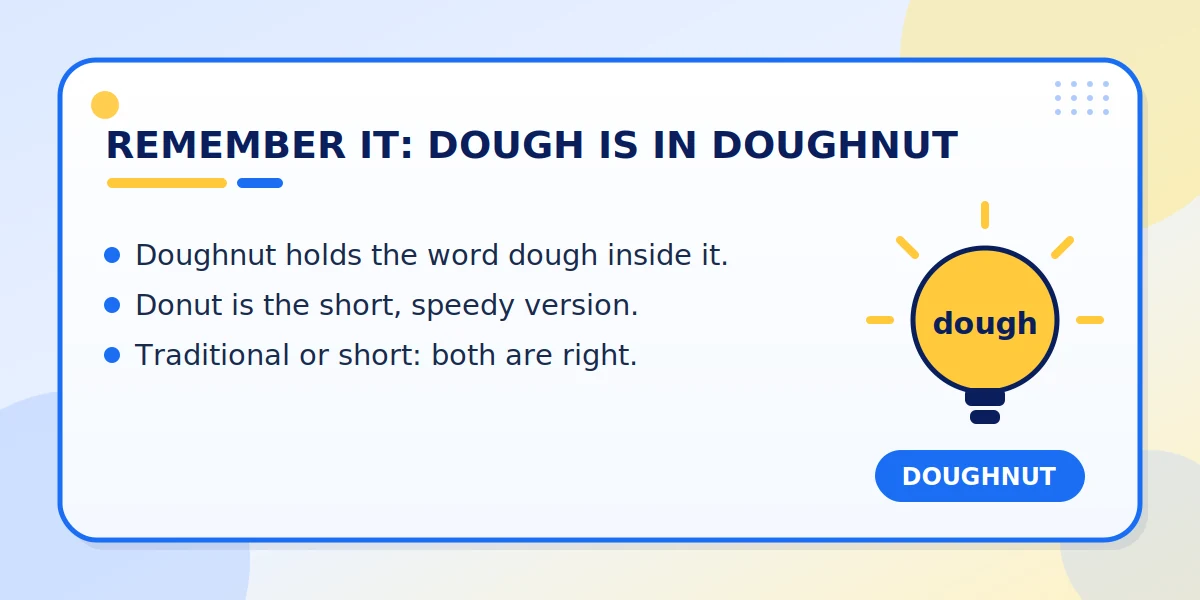
Use the spelling that matches the style you want: Doughnut includes dough, which reminds you that the treat is made from dough. Donut is shorter and is common in American shops and everyday writing. Think of doughnut as the traditional form and donut as its accepted shorter variant. Both are correct. For more spelling comparisons, browse the ClarifyWords Spelling Differences category. You may also find spelt or spelled, toward vs towards, and aluminium or aluminum helpful.
Practice: Choose the Correct Spelling
Choose the best spelling for each sentence. In some questions, both forms are acceptable. Use the context to decide which one fits best.
- The bakery sells fresh glazed ______ every morning.
- For this British audience, use the traditional spelling ______.
- I bought a chocolate ______ on my lunch break.
- The company name is written as Dunkin’ ______.
- The recipe makes twelve jelly-filled ______.
- The driver began to ______ in the empty lot.
- A ______-shaped road circles the lake.
- The menu lists a jam ______.
- For an international school paper, choose ______ as the conservative form.
- The hair accessory is called a hair ______.
Answer Key
- Doughnuts or donuts. Both are correct.
- Doughnut. It is the safer traditional choice in British English.
- Donut or doughnut. Either works in American English.
- Donuts. Preserve the official name Dunkin’ Donuts.
- Doughnuts or donuts. Both plural forms are correct.
- Do donuts. This is the common spelling for the driving maneuver.
- Doughnut or donut. Both forms can describe the shape.
- Doughnut or donut. Both spellings are accepted.
- Doughnut. It is the more traditional international choice.
- Doughnut or donut. Both forms are used for the hair accessory.
FAQs
Which is correct, donut or doughnut?
Both are correct. Doughnut is the traditional spelling and the main dictionary entry. Donut is an accepted variant, especially in American English. They have the same meaning and pronunciation in everyday English.
Is donut a real word?
Yes. Donut is a standard variant spelling, not merely slang or a mistake. Major dictionaries recognize it. It is especially common in the United States, including in menus, advertisements, and business names.
Is donut American and doughnut British?
That is a useful general guide, but it is not an absolute rule. Americans use both spellings, while British writers usually favor doughnut. British dictionaries also recognize donut as an American variant.
Which spelling should I use in formal writing?
Use doughnut if you want the traditional and more internationally familiar spelling. In the United States, donut is still correct. If your school, employer, or publisher has a style guide, follow it.
How do you spell donut in Canada and Australia?
Doughnut is the safer conventional choice in both Canada and Australia. However, donut is also recognized and appears in commercial use. Follow the spelling used by your publication or organization.
Why is it spelled doughnut if it does not contain nuts?
The word combines dough with an older meaning of nut: a small, rounded cake or lump. Early doughnuts were often round balls of fried dough, so the name did not require tree nuts.
Did Dunkin’ create the word donut?
No. The shorter spelling appeared before Dunkin’ opened. The company began as Open Kettle in 1948 and adopted the name Dunkin’ Donuts in 1950. Its brand helped popularize the spelling, but did not invent it.
Final Takeaway
Both donut and doughnut are correct. If someone asks donut or doughnut, explain that either spelling works. Use donut for familiar everyday American writing if that is your preference. Choose doughnut for a traditional, formal, or international style. Keep your spelling consistent, and always preserve official brand names. For more help with spelling choices, explore the Spelling Differences guides on ClarifyWords.