

Gray vs Grey: What’s the Difference?

Quick Answer
Gray and grey are two correct spellings of the same color. Both describe a neutral shade between black and white, and both have the same pronunciation.
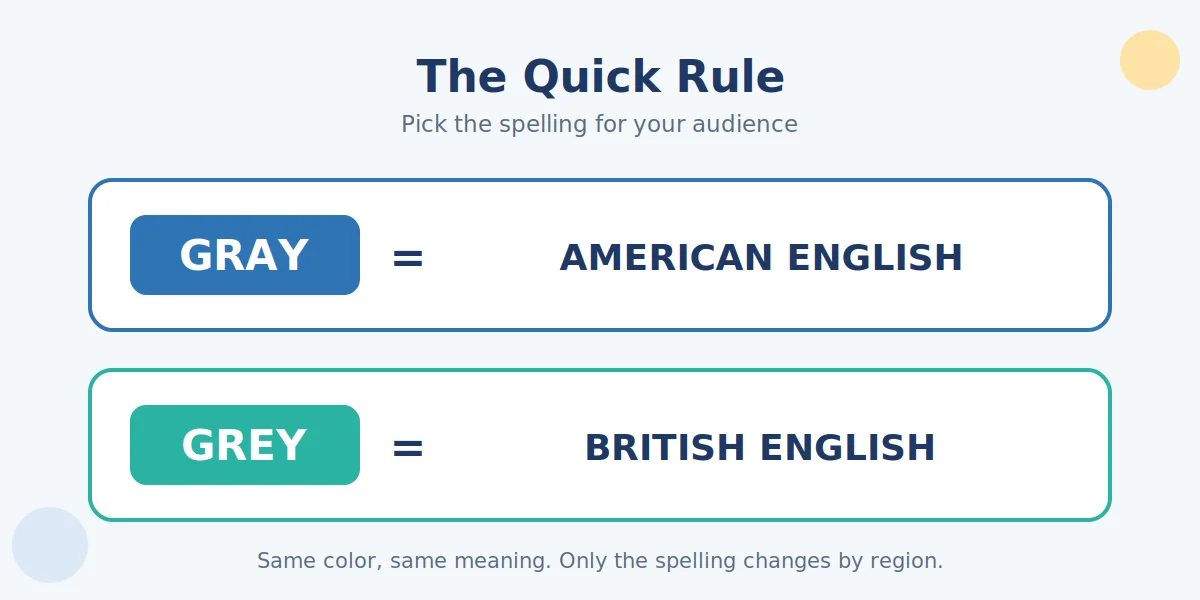
The gray vs grey question has a simple answer. The difference is regional. Gray is the preferred spelling in American English. Grey is preferred in British, Canadian, Australian, and New Zealand English.
If you are writing for a US audience, choose gray. If you are following British or other regional English conventions, choose grey. The color and meaning stay the same.
Table of Contents
- Gray vs Grey at a Glance
- When to Use Gray
- When to Use Grey
- Do Gray and Grey Have the Same Meaning?
- Gray and Grey as Nouns, Adjectives, and Verbs
- Names and Terms That Keep Their Spelling
- Why Are There Two Spellings?
- An Easy Way to Remember the Difference
- Practice Questions
- Frequently Asked Questions
Gray vs Grey at a Glance
| Feature | Gray | Grey |
|---|---|---|
| Status | Correct spelling | Correct spelling |
| Preferred region | United States | UK, Canada, Australia, New Zealand |
| Meaning | Neutral color between black and white | Same |
| Pronunciation | /ɡreɪ/ | /ɡreɪ/ |
| Part of speech | Noun, adjective, verb | Noun, adjective, verb |
| Example | The sky looks gray. | The sky looks grey. |
The main difference is spelling preference, not meaning. Neither version is more correct everywhere.
When to Use Gray
Use gray when writing in American English. It is the standard spelling in US dictionaries, newspapers, schools, and most American publications.
For example:
- The walls in our living room are light gray.
- My grandfather’s hair is turning gray.
- She wore a gray sweater to school.
- The clouds made the afternoon look gray.
American English also uses the a spelling in related word forms:
- Grayer
- Grayest
- Grayed
- Graying
- Grayish
For example, an American writer would usually write, “His hair is getting grayer.”
If your readers are mainly in the United States, choose gray throughout your article or document. This keeps your spelling consistent with American conventions.
You may also notice the same regional pattern in other words. For example, American English uses canceled, while British English often uses cancelled. See our guide to canceled vs cancelled for more details.
When to Use Grey
Use grey when following British English conventions. It is also the preferred spelling in Canadian, Australian, and New Zealand English.
Here are some examples:
- The cat has soft grey fur.
- She bought a grey coat for winter.
- The sky turned grey before the rain.
- His beard is almost completely grey.
Related forms generally keep the e:
- Greyer
- Greyest
- Greyed
- Greying
- Greyish
For example, a British writer might say, “The weather is getting greyer.”
Remember that regional preferences are not absolute rules for every person or publication. Some British writers use gray, and some American writers use grey. However, the regional patterns above are the usual choices.
Do Gray and Grey Have the Same Meaning?
Is gray vs grey a matter of meaning? No. Gray and grey have exactly the same meaning in standard modern English.
Both words describe a neutral color between black and white. The shade can range from very light to very dark.
For example, these sentences mean the same thing:
- The dog has gray fur.
- The dog has grey fur.
The spelling does not change the color, pronunciation, or meaning.
Is Grey Lighter or Bluer Than Gray?
No. There is no standard modern rule that makes grey lighter, darker, warmer, or bluer than gray.
Some writers have tried to give the spellings different color meanings in the past. However, those distinctions never became standard English usage.
Today, the choice depends on regional spelling conventions. If someone describes a blue gray wall, the color comes from the words describing the shade, not from choosing gray over grey.
Gray and Grey as Nouns, Adjectives, and Verbs
Both spellings can work as nouns, adjectives, and verbs. Their grammatical roles do not change with the spelling.
1. As a Noun
A noun names the color or something that has that color.
- Gray: Gray is a popular choice for office furniture.
- Grey: She prefers grey over bright colors.
2. As an Adjective
An adjective describes a person, place, animal, or object.
- Gray: He wore a gray jacket.
- Grey: A grey cloud covered the sun.
3. As a Verb
A verb describes the process of becoming gray or making something gray.
- Gray: His hair began to gray in his thirties.
- Grey: Her hair started to grey with age.
The spelling of related forms usually follows the same regional pattern.
| Word form | American English | British English |
|---|---|---|
| Base form | Gray | Grey |
| Comparative | Grayer | Greyer |
| Superlative | Grayest | Greyest |
| Past tense | Grayed | Greyed |
| Present participle | Graying | Greying |
| Related adjective | Grayish | Greyish |
Choose the forms that match your main spelling style. Avoid switching between graying and greying in the same piece unless a proper name or quotation requires it.
Names and Terms That Keep Their Spelling
Some words, titles, and technical terms have fixed spellings. Their spelling does not change just because you are writing for a different country.
| Name or term | Correct spelling | Explanation |
|---|---|---|
| Greyhound | Greyhound | The animal breed uses grey. |
| Earl Grey | Earl Grey | The tea name always uses Grey. |
| Grey’s Anatomy | Grey’s Anatomy | The television series uses Grey. |
| Fifty Shades of Grey | Fifty Shades of Grey | The book and film title use Grey. |
| Gray (Gy) | Gray | The scientific unit uses gray. |
| Grayling | Grayling | The fish name uses gray. |
| Gray’s Anatomy | Gray’s Anatomy | The medical textbook uses Gray. |
| The Picture of Dorian Gray | The Picture of Dorian Gray | Oscar Wilde’s novel uses Gray. |
A Note About the Gray Unit
The scientific term gray, symbolized by Gy, is the SI unit of absorbed radiation dose. One gray equals one joule of absorbed energy per kilogram.
The National Institute of Standards and Technology (NIST) confirms this definition. The International Bureau of Weights and Measures also lists the gray as the unit for absorbed dose.
This technical spelling remains gray, even in British English. Always preserve the spelling used in official names, titles, and scientific terms.
Why Are There Two Spellings?
Both spellings have a long history. The word comes from Old English grǣg, which described a gray color. Different spellings developed over time as English changed.
During the Middle English period, writers used several forms. These included spellings that eventually developed into both gray and grey.
The two versions remained in use for centuries. Over time, regional preferences became more established.
Did Noah Webster Invent Gray?
No. Noah Webster did not invent the word gray or create the only spelling difference.
However, Webster helped standardize American English spelling. His dictionaries supported spelling preferences that became common in the United States. The a spelling eventually became the usual American form.
British English generally retained grey. This is why modern American and British publications often choose different spellings.
Merriam-Webster lists both spellings as correct. Its dictionary identifies gray as more common in US English and grey as preferred in Canada, the UK, and elsewhere.
An Easy Way to Remember the Difference
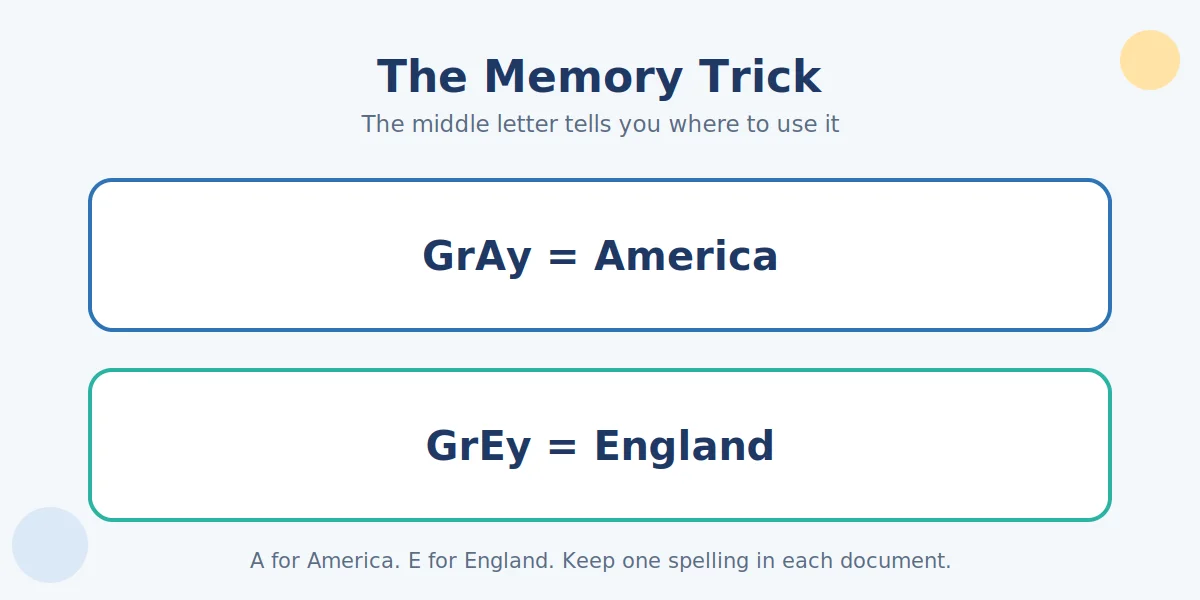
Use this simple memory trick:
- GrAy = America
- GrEy = England
The letter A in gray can remind you of America. The letter E in grey can remind you of England.
This trick is useful when you need to choose a spelling quickly. It also helps students remember the most common regional preference. That is the whole gray vs grey rule in one line.
Keep Your Spelling Consistent
Once you choose a spelling, use it throughout your writing.
For example, if you are writing an American school essay, use gray, grayer, and graying. If you are writing for a British audience, use grey, greyer, and greying.
Do not change fixed names, book titles, or technical terms to match your chosen style. Their established spellings stay the same.
For more examples of regional spelling choices, explore other common spelling differences in our Spelling Differences category.
Practice Questions: Gray or Grey?
Test what you have learned. Choose the correct spelling for each sentence or identify the mistake.
Beginner
- Which spelling is preferred in American English?
a) Grey
b) Gray - Which spelling is preferred in British English?
a) Gray
b) Grey - True or false: Gray and grey have different pronunciations.
- Fill in the blank: The elephant has ______ skin. (American English)
Intermediate
- Choose the correct word: Her hair is becoming ______ with age. (British English)
a) Grayer
b) Greyer - Which spelling is correct for the radiation unit?
a) Grey
b) Gray - Complete the sentence using American English: The sky is ______ today.
- Which title is spelled correctly?
a) Fifty Shades of Gray
b) Fifty Shades of Grey
Correct the Mistake
- Correct the spelling for a US audience: “The grey house has a white door.”
- Correct the spelling of this book title: “The Picture of Dorian Grey.”
Answer Key
| Question | Correct answer | Explanation |
|---|---|---|
| 1 | b) Gray | American English prefers gray. |
| 2 | b) Grey | British English prefers grey. |
| 3 | False | Both spellings have the same pronunciation. |
| 4 | Gray | This sentence follows American English. |
| 5 | b) Greyer | British English generally uses the e form. |
| 6 | b) Gray | The scientific unit is spelled gray. |
| 7 | Gray | American English uses gray. |
| 8 | b) Fifty Shades of Grey | The title keeps its established spelling. |
| 9 | The gray house has a white door. | Use the American spelling. |
| 10 | The Picture of Dorian Gray. | The novel’s title uses Gray. |
Frequently Asked Questions
1. Is gray or grey correct?
Both are correct spellings. Gray is preferred in American English, while grey is common in British, Canadian, Australian, and New Zealand English. Choose the version that matches your audience and keep it consistent.
2. Is grey British and gray American?
Yes, that is the usual regional distinction. American English generally uses gray, while British English generally uses grey. Canada, Australia, and New Zealand also tend to prefer grey, though individual usage can vary.
3. Do gray and grey mean the same thing?
Yes. Both words describe the same neutral color between black and white. They also have the same pronunciation and grammatical uses. The spelling difference reflects regional preferences, not a difference in color or meaning.
4. Is grey a lighter shade than gray?
No. Modern English does not assign different shades to these spellings. Both can describe light, medium, or dark versions of the color. The choice between them depends on regional spelling conventions.
5. How do you pronounce gray and grey?
Both spellings are pronounced the same way: /ɡreɪ/. The word has one syllable and rhymes with day, say, and play. Changing the final vowel letter does not change its pronunciation.
6. Should I use gray or grey in professional writing?
Use the spelling preferred by your audience or your organization’s style guide. For US publications, choose gray. For British, Canadian, Australian, or New Zealand readers, grey is usually the better choice. Stay consistent.
Final Takeaway
The difference between gray vs grey is simple: both spellings are correct, and both have the same meaning. Use gray for American English and grey for British, Canadian, Australian, and New Zealand English. Keep your spelling consistent, and preserve the established spelling of names and technical terms.