Whose vs. Who’s: What’s the Difference?
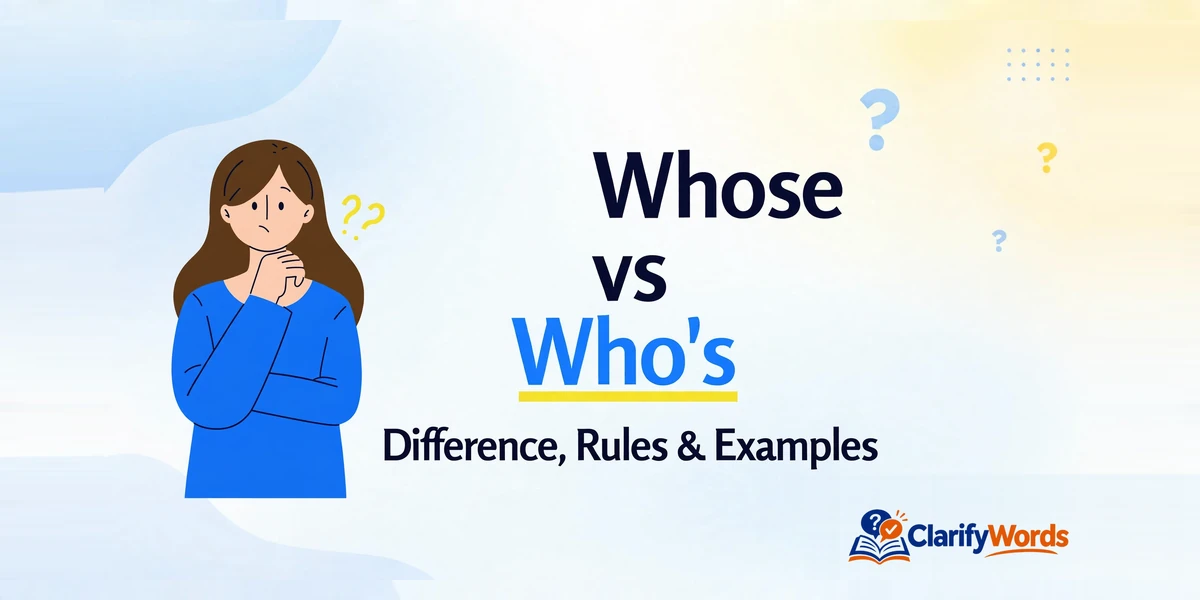
Whose shows possession or a connection to someone or something. Who’s is a contraction of who is or who has.
Here is the easiest way to tell them apart:
- Whose asks who something belongs to or describes a connection. Example: Whose jacket is this?
- Who’s replaces who is or who has. Example: Who’s coming to dinner?
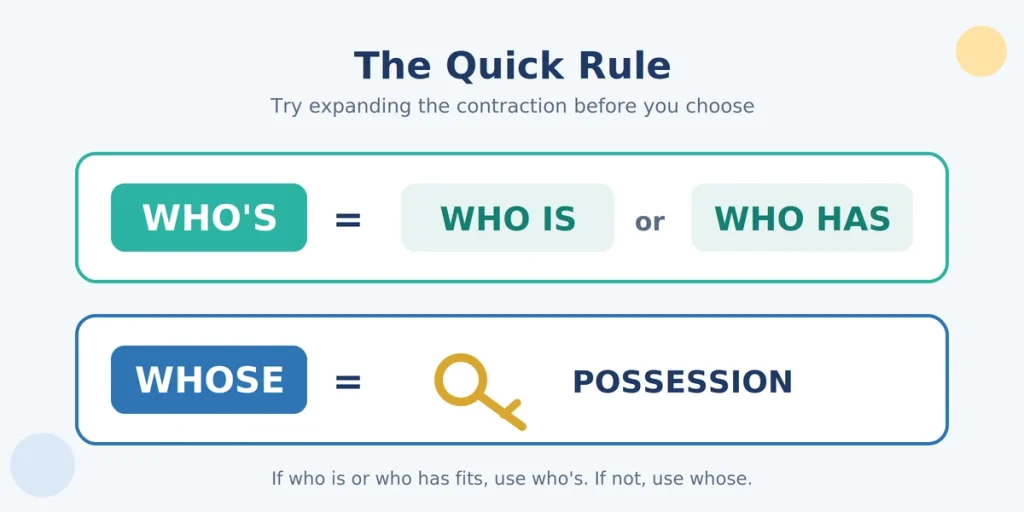
Try expanding who’s in your sentence. If who is or who has makes sense, use who’s. If you mean ownership or association, use whose.
Whose vs. Who’s at a Glance
The difference between these two words is their meaning and grammatical job. This table gives you a quick side-by-side view.
| Feature | Whose | Who’s |
|---|---|---|
| Meaning | Shows possession or association | Short form of who is or who has |
| Grammar job | Possessive form of who | Contraction |
| Expansion | Cannot be expanded | Who is or who has |
| Apostrophe | No apostrophe | Has an apostrophe |
| Main use | Asking who something belongs to | Asking or saying who is or who has |
| Example | Whose keys are these? | Who’s at the door? |
Remember this simple rule: whose shows a connection; who’s replaces two words.
When to Use Whose
Use whose when you want to show who owns, has, or is connected to something. It is the possessive form of who. It can appear in questions, statements, and relative clauses. It does not always describe legal ownership.
Whose Shows Possession
Use whose before a noun when asking who something belongs to.
Examples:
- Whose phone is ringing?
- Whose shoes are by the door?
- Whose idea was it to order pizza?
- I found a wallet, but I don’t know whose it is.
- The teacher asked whose homework was missing.
In each example, whose points to the person connected to an object, idea, or responsibility.
Whose Can Stand Alone Without a Noun
You do not always need to put a noun after whose. It can stand alone when the thing being discussed is already clear.
Examples:
- This umbrella is mine. Whose is that?
- I know which coat is yours, but whose is the blue one?
- The choice is yours. Whose will it be?
In these sentences, the reader understands what whose refers to from the surrounding context.
Whose Can Describe People, Animals, and Things
Many people think whose only refers to people. That is not true. You can use it for animals and things, too. It often shows a feature, part, or connection rather than direct ownership.
Examples:
- The dog whose owner lives next door is very friendly.
- We visited a house whose windows faced the ocean.
- She bought a phone whose screen was badly cracked.
- They repaired a car whose engine had stopped working.
Using whose for things is accepted English. Some style guides describe it as more formal in certain contexts, but it is not wrong. Merriam-Webster includes examples with inanimate objects.
Whose in Relative Clauses
A relative clause adds information about a person or thing. Whose can introduce one when you need to show a relationship or connection.
Examples:
- I met a woman whose son attends my school.
- They bought a house whose roof needs repairs.
- The student whose answer was correct received a prize.
The clause beginning with whose gives more information about the noun before it.
You may also see whose in nonessential information set off by commas:
My neighbor, whose garden won an award, grows beautiful roses.
Whose in Indirect Questions
An indirect question reports or includes a question inside a statement. It does not always use the same word order as a direct question.
Compare these examples:
| Direct question | Indirect question |
|---|---|
| Whose bag is this? | I wonder whose bag this is. |
| Whose car did you borrow? | Do you know whose car you borrowed? |
| Whose idea was it? | She asked whose idea it was. |
Notice the word order. In the indirect questions, the subject comes before the verb. You do not write I wonder whose is this bag when you mean I wonder whose bag this is.
When to Use Who’s
Who’s is a contraction. A contraction combines words and leaves out one or more letters. The apostrophe marks the missing letters. There are two possible expansions: who is and who has.
Who’s Means Who Is
Use who’s when you can replace it with who is without changing the sentence’s meaning.
Examples:
- Who’s at the front door? → Who is at the front door?
- Who’s responsible for this report? → Who is responsible for this report?
- Do you know who’s coming tonight? → Do you know who is coming tonight?
- She’s the person who’s in charge. → She’s the person who is in charge.
Who’s can appear in the middle of a sentence, not just at the beginning of a question.
Who’s Also Means Who Has
Who’s can also replace who has. This often happens with a past participle or in phrases such as who’s got.
Examples:
- Who’s finished the assignment? → Who has finished the assignment?
- Who’s been to New York? → Who has been to New York?
- Who’s got my keys? → Who has got my keys?
- She’s the only person who’s seen the message. → She’s the only person who has seen the message.
The surrounding sentence tells you whether who’s means who is or who has.
How to Remember Whose vs. Who’s
A quick memory trick and a simple sentence test can help you choose the right word.
The His and Hers Memory Trick
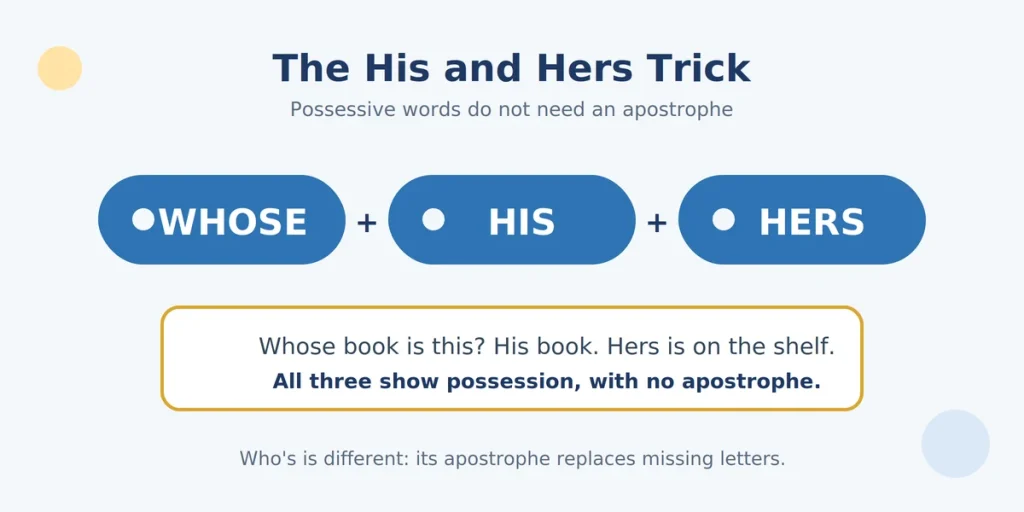
Think of whose alongside his and hers. All three can show possession:
- Whose book is this?
- His book is on the table.
- Hers is on the shelf.
The possessive words his, hers, and whose do not need apostrophes. By contrast, who’s has an apostrophe because it is a shortened form of who is or who has.
Remember: Whose belongs with his and hers. Who’s belongs with who is and who has.
Use the Expansion Test
When you are unsure, try these steps:
- Read the sentence with who’s.
- Replace it with who is.
- If that does not work, try who has.
- If neither fits and you mean possession or association, use whose.
Try it with these examples:
- Who’s calling? becomes Who is calling? It works, so use who’s.
- Who’s finished? becomes Who has finished? It works, so use who’s.
- Who’s jacket is this? becomes Who is jacket is this? It does not work. You mean possession, so write Whose jacket is this?
The test is a helpful shortcut. Always check the meaning of the full sentence, too.
Common Whose vs. Who’s Mistakes
These words sound alike, so it is easy to mix them up. The examples below show common errors and the correct forms.
Incorrect and Correct Examples
| Incorrect | Correct | Why |
|---|---|---|
| Who’s name is on the list? | Whose name is on the list? | You are asking about possession or association. |
| Who’s car is parked outside? | Whose car is parked outside? | You are asking who owns the car. |
| Whose coming to lunch? | Who’s coming to lunch? | It means who is coming. |
| Who’s turn is next? | Whose turn is next? | You are asking whose turn it is. |
| Whose responsible for this? | Who’s responsible for this? | It means who is responsible. |
| Whose’s bag is this? | Whose bag is this? | Whose does not need another apostrophe. |
Common Phrases to Remember
Some everyday phrases make the difference easier to spot.
Use whose:
- Whose name
- Whose turn
- Whose fault
- Whose idea
- Whose side
- Whose responsibility
Use who’s:
- Who’s next
- Who’s coming
- Who’s in charge
- Who’s responsible
- Who’s been there
- Who’s got the answer
Both Words Can Be Correct, but the Meaning Changes
Sometimes both forms are grammatically correct. They simply ask different questions.
Compare:
- Who’s home? means Who is home?
- Whose home? asks who owns or is connected to the home.
Another pair:
- Who’s next? means Who is next?
- Whose next turn? asks who has the next turn.
You can even use both words in one sentence:
I don’t know whose bag this is, but I know who’s carrying it.
The first word shows possession. The second means who is.
Whose vs. Who’s: Quick Practice
Test what you have learned. Choose whose or who’s for each blank. The first five questions are beginner level. The next five require a little more thought. The final three ask you to spot a mistake.
Beginner Practice
- ______ jacket is hanging by the door?
- ______ coming to the party tonight?
- Do you know ______ notebook this is?
- ______ ready to start the lesson?
- ______ turn is it to wash the dishes?
Intermediate Practice
- I wonder ______ been using my computer.
- The author, ______ book won an award, gave a speech.
- ______ got the extra ticket?
- Can you tell me ______ idea this was?
- She’s the manager ______ responsible for the new project.
Mixed Practice: Correct the Mistake
Each sentence below contains one mistake. Rewrite it correctly.
- Who’s phone is ringing?
- I don’t know whose coming to dinner.
- The student who’s answer was correct received a prize.
Answer Key
- Whose. It asks who the jacket belongs to.
- Who’s. It means who is coming.
- Whose. It asks who owns the notebook.
- Who’s. It means who is ready.
- Whose. It asks who has the next turn.
- Who’s. It means who has been using.
- Whose. It shows the author’s connection to the book.
- Who’s. It means who has got the ticket.
- Whose. It asks who had the idea.
- Who’s. It means who is responsible.
- Whose phone is ringing? The sentence asks who the phone belongs to.
- I don’t know who’s coming to dinner. Here, who’s means who is.
- The student whose answer was correct received a prize. The word shows the student’s connection to the answer.
If you missed a few, review the expansion test. Ask whether who is or who has fits. If not, check whether the sentence shows possession or association.
Frequently Asked Questions
1. What Is the Difference Between Whose and Who’s?
Whose is the possessive form of who. It shows ownership or association. Who’s is a contraction of who is or who has. Use the expansion test to check whether the apostrophe belongs.
2. Is It Whose or Who’s?
It depends on what you mean. Use whose when asking who something belongs to. Use who’s when you mean who is or who has. Read the sentence aloud with either expansion to check.
3. Is It Whose Name or Who’s Name?
The correct phrase is whose name. You are asking which person the name belongs to or identifies. For example, write, “Whose name is on the invitation?” Do not use an apostrophe in this phrase.
4. Can Whose Be Used for Things, Not Just People?
Yes. Whose can refer to animals and things as well as people. For example, “We bought a house whose windows face the sea.” It shows a connection, not always direct ownership.
5. Why Doesn’t Whose Have an Apostrophe?
Whose is already a possessive form, so it does not need an apostrophe. The apostrophe in who’s marks missing letters in who is or who has. Possessive meaning does not always require an apostrophe.
6. How Do You Remember the Difference Between Whose and Who’s?
Remember that whose belongs with his and hers because all three can show possession. Who’s belongs with who is and who has. The apostrophe signals a contraction, not ownership.
7. How Do You Use Whose in a Sentence?
Use whose to ask who something belongs to or to describe a connection. For example, “Whose keys are these?” or “I met a writer whose stories are popular.” It works in questions and statements.
Who, Whom, Whose, and Who’s: What’s the Difference?
The words who, whom, and whose are related, but each has a different grammatical job. Who’s is different because it is a contraction, not another form of the pronoun.
| Word | Grammar job | Example |
|---|---|---|
| Who | Subject | Who called you? |
| Whom | Object | Whom did you invite? |
| Whose | Possessive | Whose coat is this? |
| Who’s | Contraction | Who’s calling? |
Purdue OWL explains the traditional pronoun cases this way: who is subjective, whom is objective, and whose is possessive.
Learn More About Who vs. Whom
The difference between who and whom can be confusing, too. A useful shortcut is the he/him test. Use who when he fits, and whom when him fits. Read our guide to who vs whom for simple rules and more examples.
More Commonly Confused Words
English has many words that look or sound alike but have different meanings. Their differences matter in writing. Explore more guides in the Confused Words category. You can also read our guide to affect vs effect to learn when to use each word.
The key takeaway: Use whose for possession or association. Use who’s when you mean who is or who has. When in doubt, try expanding the contraction before you choose.