Yes or No: Meaning, Grammar, and How to Answer Clearly
The words yes and no help us express agreement, disagreement, acceptance, and refusal. They also play an important role in questions.
But what does "yes or no" mean? How do you form yes/no questions? And how should you answer negative questions correctly?
This guide explains the meaning of both words, their grammatical uses, and how to use them naturally. You will also learn common mistakes, polite alternatives, and simple question patterns.
Quick Answer
The phrase "yes or no" asks for a direct choice between an affirmative and a negative response. It is often used when someone wants a clear answer.
Yes means an affirmative response. It can show agreement, acceptance, confirmation, or attention.
No means a negative response. It can show disagreement, refusal, or denial.
A yes/no question expects a yes or no answer. Examples include:
- Are you ready?
- Do you like coffee?
- Can you swim?
The answer usually matches the auxiliary verb in the question. For example, "Are you ready?" becomes "Yes, I am" or "No, I am not."
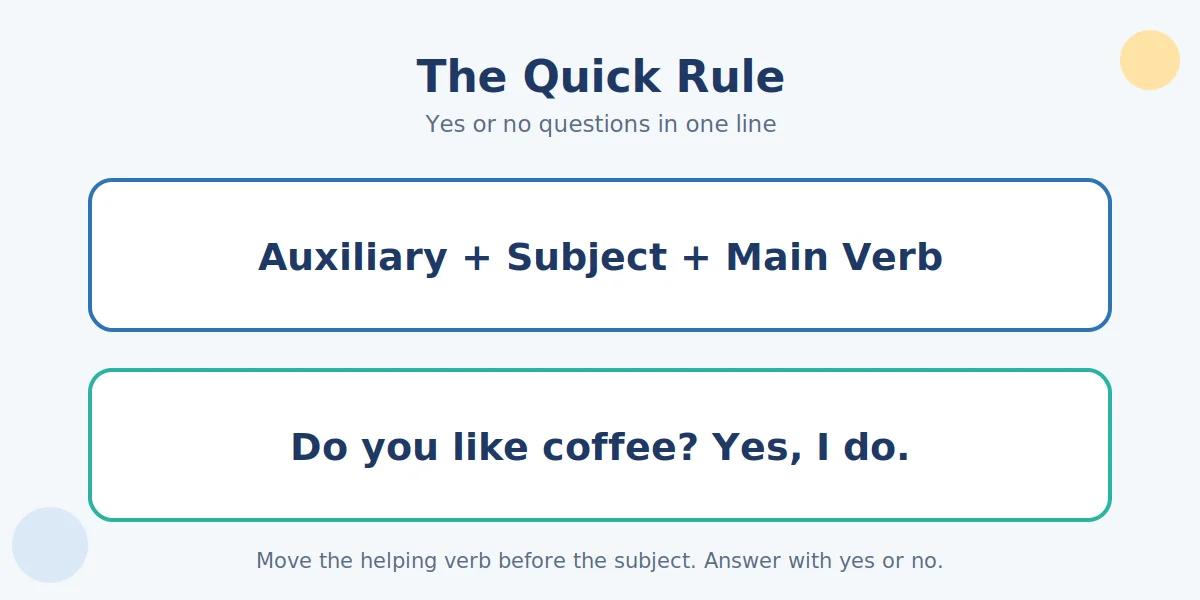
Table of Contents
- What Does "Yes or No" Mean?
- What Does Yes Mean?
- What Does No Mean?
- Yes vs No: What’s the Difference?
- What Is a Yes/No Question?
- How to Form Yes/No Questions in English
- How to Answer Yes/No Questions Correctly
- Yes/No Questions vs Wh-Questions
- How to Answer Negative Yes/No Questions
- What Are Tag Questions?
- Polite Ways to Say Yes and No
- Common Yes/No Question Mistakes and How to Fix Them
- An Easy Trick to Remember Yes and No
- Practice Questions
- Frequently Asked Questions
- Final Takeaway
What Does "Yes or No" Mean?
The phrase "yes or no" asks someone to choose between an affirmative response and a negative response. It is a common expression in everyday English. It often appears when someone wants a direct answer without extra detail.
Example:
Is the answer correct, yes or no?
The phrase asks for clarity. It does not ask for a long explanation. It asks for one of two options.
Yes or No as a Direct Answer
A person can ask for a yes or no answer when a decision is needed. The question often sounds direct, but it is not rude. It simply requests a clear choice.
Example:
Are you coming, yes or no?
The expected answer is short. It can be "Yes" or "No."
Yes or No as a Choice Between Two Options
Sometimes "yes or no" describes a choice rather than a question. In this case, it means someone must accept or reject a statement, offer, or idea.
Example:
The vote was a simple yes or no decision.
Here, the phrase refers to two possible outcomes. It does not describe a grammatical question type.
Examples of "Yes or No" in Everyday Conversation
- Is it true, yes or no?
- Just give me a yes or no answer.
- Do you agree, yes or no?
Each example asks for a clear response. The speaker does not want a vague answer.
What Does Yes Mean?
Yes is an affirmative word. It shows agreement, acceptance, or confirmation. Merriam-Webster defines yes as an affirmative answer to a question or request. Cambridge Dictionary also defines it as a positive response.
But yes does not always mean agreement. It can also show attention or politeness. Context helps you understand the exact meaning.
Yes as an Affirmative Answer
Yes confirms a statement or answers a question positively.
Examples:
- Are you ready? Yes.
- Do you live in New York? Yes, I do.
- Is this your bag? Yes, it is.
In each case, yes gives a positive response.
Yes to Show Agreement or Acceptance
People use yes to agree with a statement. They also use it to accept an offer or request.
Examples:
- That sounds like a good idea. Yes.
- Would you like some water? Yes, please.
- Can you help me? Yes, of course.
In these examples, yes accepts an offer, a request, or an idea.
Other Uses of Yes in English
Yes can show that a listener is paying attention. For example, a person may say "Yes?" when someone calls their name. It can also correct a negative statement.
Example:
You do not like tea, do you?
Yes, I do.
In this case, yes contradicts the negative idea. It does not simply agree with the question.
Yes can also be a noun. In a vote, a yes means a vote in favor of a proposal.
Example:
The proposal received ten yes votes.
Examples of Yes in Sentences
- Yes, I can help you tomorrow.
- Yes, that answer is correct.
- Yes, I understand the question.
- Yes, I would like to join you.
Each sentence uses yes as a positive response.
What Does No Mean?
No is a negative word. It shows disagreement, refusal, or denial. Merriam-Webster defines no as a negative answer to a question or request. Cambridge Dictionary also defines it as a negative response.
But no is not only a negative answer. It has other grammatical uses. It can act as a determiner, an adverb, or a noun. This wider meaning is important for learners.
No as a Negative Answer
No gives a negative response to a question. It can deny a statement or disagree with an idea.
Examples:
- Are you ready? No.
- Do you like coffee? No, I do not.
- Is this your bag? No, it is not.
In each case, no gives a negative response.
No to Refuse an Offer or Request
No can refuse an invitation, offer, or request. The refusal can be polite or direct. Tone and context affect how it sounds.
Examples:
- Would you like more food? No, thank you.
- Can you stay late today? No, I am sorry.
- Do you want to join us? No, not today.
Each example refuses an offer or request.
Other Uses of No in English
No can also act as a determiner. A determiner comes before a noun. It shows that the noun is absent.
For example, there is no milk.
No can also act as an adverb. It can describe a verb or an adjective. For example, "no longer" means something does not continue.
Example:
She no longer works here.
No can also be a noun. In a vote, a no means a vote against a proposal.
Example:
The proposal received five no votes.
No also appears in signs and rules. For example, "No smoking" means smoking is not allowed.
Examples of No in Sentences
- No, I cannot help you today.
- No, that answer is not correct.
- No, I do not understand the question.
- No, I would not like to join you.
Each sentence uses no as a negative response.
Yes vs No: What’s the Difference?
Yes and no are opposites. One gives a positive response. The other gives a negative response. The table below shows the main difference.
| Word | Meaning | Main Use | Example |
|---|---|---|---|
| Yes | Affirmative | Agreement, acceptance, or confirmation | Yes, I can. |
| No | Negative | Disagreement, refusal, or denial | No, I cannot. |
A simple rule helps:
Yes means an affirmative response.
No means a negative response.
What Is a Yes/No Question?
A yes/no question is a question that expects a yes or no answer. It is also called a polar question. It is a type of closed question. A closed question limits the answer to a small set of options.
The phrase "yes or no" is not the same as the grammatical term "yes/no question." The first is an everyday expression. The second is a grammar term for a question type.
What Are Yes/No Questions Called?
Yes/no questions are also called polar questions. The word polar refers to two opposite poles. In this case, the poles are yes and no. They are also called closed questions because the answer is limited.
Examples of Yes/No Questions
- Are you ready?
- Do you live here?
- Can you swim?
- Is she your friend?
- Did they arrive?
Each question expects a yes or no answer.
When Do We Use Yes/No Questions?
We use yes/no questions to check information. We also use them to confirm facts, ask permission, or make requests.
Examples:
- To check information: Are you coming tomorrow?
- To confirm a fact: Is this your book?
- To ask permission: Can I use your phone?
- To make a request: Will you help me?
- To find out the truth: Did you finish your work?
How to Form Yes/No Questions in English
Yes/no questions use subject-auxiliary inversion. This means the auxiliary verb moves before the subject. An auxiliary verb is a helping verb. Common auxiliary verbs include be, do, have, and modal verbs.
The structure is simple:
Auxiliary verb + subject + main verb
Yes/No Questions with Be
Move am, is, or are before the subject. Use was or were for the past.
Examples:
- She is happy. → Is she happy?
- They are ready. → Are they ready?
- He was busy. → Was he busy?
Yes/No Questions with Do and Does
Use do and does in present simple questions. The main verb stays in its base form.
Examples:
- You work here. → Do you work here?
- She likes coffee. → Does she like coffee?
Common mistake: Does she likes coffee? This sentence is incorrect. The verb must stay as like.
Yes/No Questions with Did
Use did for past simple questions. The main verb returns to its base form.
Examples:
- They arrived early. → Did they arrive early?
- She called you. → Did she call you?
Common mistake: Did she called you? This sentence is incorrect. The verb must stay as call.
Yes/No Questions with Have and Has
Use have and has as auxiliary verbs in present perfect questions.
Examples:
- You have finished. → Have you finished?
- She has arrived. → Has she arrived?
Have can also be a main verb. In that case, do or does may be used.
Example:
Do you have time?
Yes/No Questions with Modal Verbs
Modal verbs include can, could, will, would, and should. Move the modal verb before the subject.
Examples:
- You can drive. → Can you drive?
- She will come. → Will she come?
- They should leave. → Should they leave?
Yes/No Questions with Multiple Auxiliary Verbs
When a sentence has more than one auxiliary verb, only the first one moves.
Example:
She has been working. → Has she been working?
The second auxiliary stays in place.
How to Answer Yes/No Questions Correctly
A short answer usually follows this pattern:
Yes/No + subject + auxiliary or modal verb
The answer must match the question. This rule is important for grammar and clarity.
How to Give Short Answers
Examples:
- Are you ready? Yes, I am. / No, I am not.
- Do you work here? Yes, I do. / No, I do not.
- Can you swim? Yes, I can. / No, I cannot.
Match the Auxiliary Verb in Your Answer
Use the same auxiliary or modal verb from the question.
Examples:
- Are you a teacher? Yes, I am.
- Do you like tea? No, I do not.
- Did you call? Yes, I did.
- Have you finished? No, I have not.
- Will you come? Yes, I will.
Use the Correct Subject Pronoun
The subject pronoun changes when you answer. It depends on who is speaking.
Example:
Are you ready?
Yes, I am.
The answer "Yes, you are" would be incorrect here. The speaker must change you to I.
Short Answers vs Full Answers
A short answer is enough in many conversations. A full answer gives more detail.
Short answer: Yes, I am.
Full answer: Yes, I am ready for the meeting.
Use a full answer when clarity matters. Use a short answer in casual conversation.
Can You Answer Without Saying Yes or No?
Yes, context can show the answer. A response may imply yes or no without using the word.
Example:
Do you know Sarah?
We have worked together for years.
This answer implies yes. It does not use the word yes.
Yes/No Questions vs Wh-Questions
Wh-questions ask for specific information. They begin with words like who, what, when, where, why, and how.
Yes/no questions ask for an affirmative or negative answer. Wh-questions ask for details.
What Are Wh-Questions?
Wh-questions request information. They do not expect a yes or no answer.
Examples:
- Who is she?
- What is your name?
- Where do you live?
- Why are you late?
- How do you get to work?
Key Differences Between Yes/No and Wh-Questions
| Yes/No Question | Wh-Question |
|---|---|
| Do you live here? | Where do you live? |
| Is she your sister? | Who is she? |
| Did they leave? | When did they leave? |
| Can you drive? | How do you drive? |
When Should You Use Each Type?
Use a yes/no question when you need a direct answer. Use a wh-question when you need details. The choice depends on the information you want.
How to Answer Negative Yes/No Questions
Negative yes/no questions often confuse learners. They use forms like do not, does not, did not, is not, and have not.
What Are Negative Yes/No Questions?
A negative question includes a negative auxiliary form. It still expects a yes or no answer.
Examples:
- Didn’t you receive my message?
- Isn’t she coming?
- Haven’t they finished?
Does Yes Mean the Same Thing in a Negative Question?
Yes and no do not simply copy the question. They refer to the fact itself.
Example:
Question: Didn’t you receive my email?
Yes, I did. = I received your email.
No, I did not. = I did not receive your email.
Focus on the meaning of your answer. Do not copy the negative form in the question.
Common Mistakes When Answering Negative Questions
A common mistake is to answer based on the question form, not the fact. For example, a learner may say "Yes" to mean "I did not receive it." This is incorrect in English.
Always check the fact first. Then choose yes or no.
What Are Tag Questions?
Tag questions are a related form of yes/no questioning. They are not the same as standard yes/no questions. They often seek confirmation.
A tag question adds a short question to the end of a statement. The tag usually has an opposite polarity to the statement.
Positive Statements with Negative Tags
Examples:
- You’re coming, aren’t you?
- She is ready, isn’t she?
Negative Statements with Positive Tags
Examples:
- You aren’t busy, are you?
- He hasn’t left, has he?
How to Answer Tag Questions
Yes and no show agreement or disagreement with the statement. Intonation and context can affect the meaning.
Example:
You’re coming, aren’t you?
Yes. = I am coming.
No. = I am not coming.
Polite Ways to Say Yes and No
Basic yes and no answers are clear, but they can sound short. Polite alternatives help in work, school, and formal settings. Tone also matters.
Polite Ways to Say Yes
- Absolutely.
- Certainly.
- Of course.
- Yes, please.
- I would be happy to.
- Sure.
The words sure and of course fit offers and requests well. For example, "Can you help me?" can be answered with "Sure." The phrase "Of course" also works well for accepting a request.
Polite Ways to Say No
- No, thank you.
- I am afraid not.
- Unfortunately, no.
- I would love to, but I cannot.
- I am sorry, but I cannot.
These phrases soften a refusal. They sound more polite than a single no.
Casual Ways to Say Yes and No
- Yeah.
- Yep.
- Sure.
- Nope.
- Nah.
These words are common in casual conversation. They are less suitable for formal writing.
How to Say No Without Sounding Rude
Add a short reason, thanks, or alternative. This approach softens the refusal.
Examples:
- No, thank you. I already ate.
- I am sorry, but I cannot stay late today.
- I would love to help, but I have another meeting.
Common Yes/No Question Mistakes and How to Fix Them
| Incorrect | Correct | Explanation |
|---|---|---|
| Does she knows? | Does she know? | Use the base verb after does. |
| Did they arrived? | Did they arrive? | Use the base verb after did. |
| Does she be ready? | Is she ready? | Invert be directly. |
| Yes, you are. | Yes, I am. | Change the pronoun when answering about yourself. |
| Has been she working? | Has she been working? | Move only the first auxiliary. |
| Not. | No. | Use no as a standalone negative answer. |
An Easy Trick to Remember Yes and No
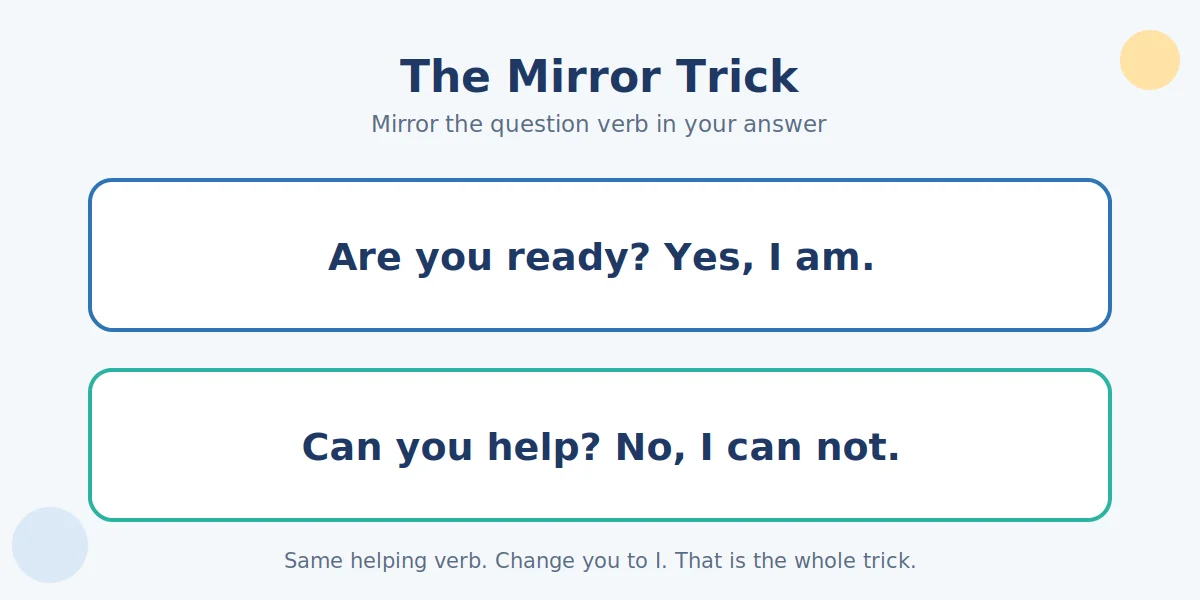
Think of a simple rule:
Yes = positive.
No = negative.
Do not confuse the answer with the wording of a negative question. Match the auxiliary verb in short answers. This trick helps you answer clearly and correctly.
Practice Questions
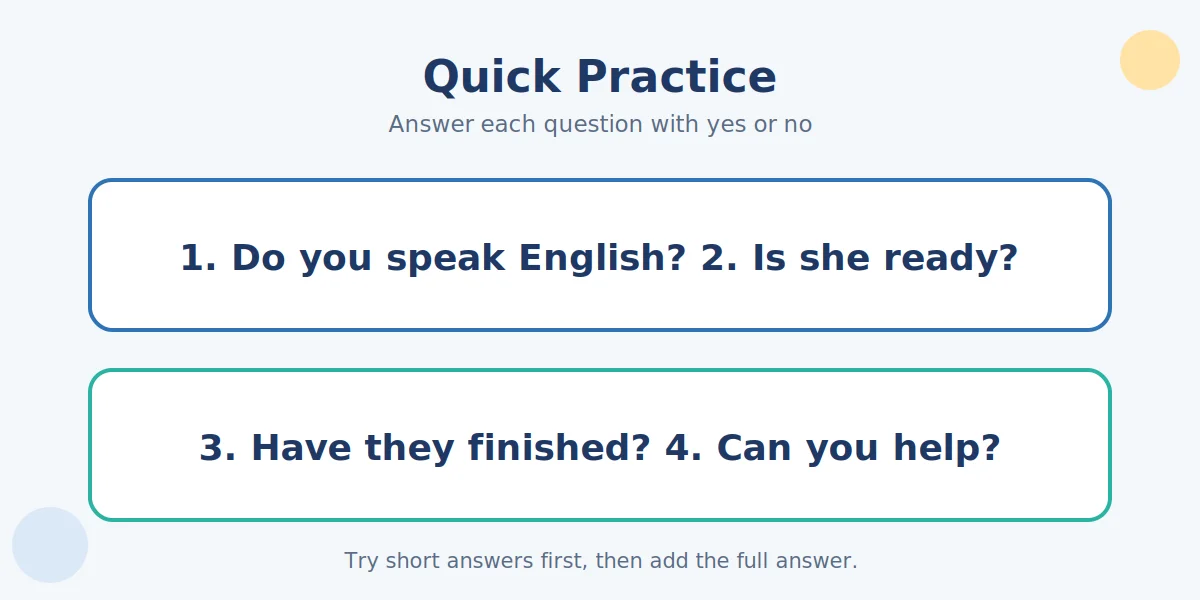
- Choose the correct answer: Are you ready?
a) Yes, you are.
b) Yes, I am.
c) Yes, I do. - Complete the question: ___ she like coffee?
a) Do
b) Does
c) Is - Correct the question: Did she called you?
a) Did she call you?
b) Did she called you?
c) Does she call you? - Choose the correct short answer: Do you work here?
a) Yes, I am.
b) Yes, I do.
c) Yes, I have. - Answer the negative question: Didn’t you receive my email?
a) Yes, I did. (I received it.)
b) Yes, I did not. (I did not receive it.)
c) No, I did. (I received it.) - Identify the wh-question:
a) Are you ready?
b) Where do you live?
c) Can you swim? - Select a polite refusal:
a) No.
b) No, thank you.
c) Not. - Correct the inversion: Has been she working?
a) Has she been working?
b) Has been she working?
c) She has been working?
Answer Key
- b) Yes, I am. The pronoun changes from you to I.
- b) Does. Use does with she in the present simple.
- a) Did she call you? Use the base verb after did.
- b) Yes, I do. Match the auxiliary do.
- a) Yes, I did. Yes confirms the positive fact.
- b) Where do you live? It asks for specific information.
- b) No, thank you. It softens the refusal.
- a) Has she been working? Move only the first auxiliary.
Frequently Asked Questions
What does "yes or no" mean?
It asks for a direct choice between an affirmative and a negative response. Use it when you want a clear answer without extra detail. It can appear as a question, a request, or a simple choice between two outcomes.
Is "yes or no" a question?
The phrase itself is not always a question, but it can request a direct answer in conversation. A yes/no question is different. It is a grammar term for a question that expects yes or no as its answer.
What is another name for a yes/no question?
It is also called a polar question. It is a type of closed question because it limits the expected answer to yes or no. Both terms describe the same question type in grammar.
How do you form a yes/no question in English?
Move the auxiliary verb before the subject. Use do, does, or did when no other auxiliary is present. Keep the main verb in its base form. This pattern works for be, have, and modal verbs too.
What is the difference between yes/no and wh-questions?
Yes/no questions expect an affirmative or negative answer. Wh-questions ask for specific information instead. They ask about a person, place, time, reason, or method, so a simple yes or no cannot answer them.
How do you answer a negative yes/no question?
Focus on the fact, not the negative wording. Yes confirms the positive fact, while no confirms the negative fact. For example, in answer to Didn’t you receive my email, Yes, I did means you received it.
Final Takeaway
Yes gives a positive answer. No gives a negative answer. A yes/no question puts the helping verb first, and a good short answer mirrors that verb.
When a question is negative, answer by the facts, not by the wording. Add a polite phrase when you refuse, and a clear reason when it helps.
For more practical English guides, explore our Vocabulary guides. You can also read Who vs Whom, Fewer vs Less, Gray vs Grey, and Whose vs Who’s.