

Fewer vs Less: What’s the Difference?
Choosing between fewer and less can be confusing. Both words describe a smaller quantity, but they do not always work the same way.
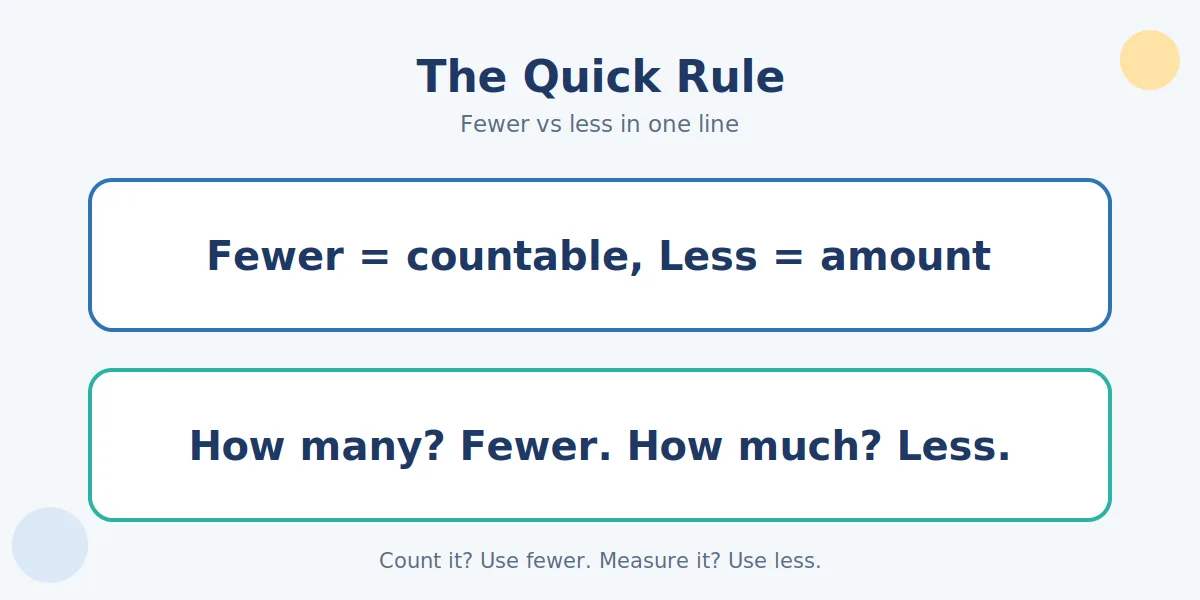
The basic rule is simple: Use fewer for countable things and less for amounts you cannot count individually.
For example, say "fewer books" but "less water." However, time, money, measurements, and certain expressions have exceptions.
This guide explains the difference with simple examples, practical rules, and a quick memory trick.
Quick Answer: Fewer vs Less
Fewer means a smaller number of individual things. Use it with plural countable nouns.
Less means a smaller amount or quantity. Use it with uncountable nouns.
For example:
- We have fewer employees this year.
- We have less work this year.
Remember: Fewer answers "How many?" Less answers "How much?"
Table of Contents
- Fewer vs Less at a Glance
- What Does Fewer Mean?
- What Does Less Mean?
- The Countable vs Uncountable Rule
- Singular vs Plural: What’s the Difference?
- Exceptions to the Fewer vs Less Rule
- Common Mistakes and Corrections
- Is "10 Items or Less" Correct?
- A Brief History of the Rule
- An Easy Memory Trick
- Practice Questions
- Frequently Asked Questions
Fewer vs Less at a Glance
Both words compare quantities, but they usually describe different types of nouns.
| Feature | Fewer | Less |
|---|---|---|
| Meaning | Not as many | Not as much |
| Common use | Countable nouns | Uncountable nouns |
| Question | How many? | How much? |
| Noun form | Usually plural | Usually uncountable |
| Example | Fewer books | Less information |
| Another example | Fewer people | Less traffic |
The noun determines which word you should normally choose.
What Does Fewer Mean?
Fewer is the comparative form of few. It means a smaller number of individual things or people.
Use fewer with plural countable nouns. These are nouns you can count separately.
For example:
- Fewer students attended the class.
- She made fewer mistakes in her essay.
- We need fewer chairs for the meeting.
- The company received fewer applications.
- There are fewer opportunities this month.
Fewer also works with abstract ideas when you can count them individually.
Examples include:
- Fewer questions
- Fewer problems
- Fewer responsibilities
- Fewer ideas
You do not need to touch or see something to count it. You only need to identify its individual units.
What Does Less Mean?
Less is the comparative form of little. It means a smaller amount, degree, or quantity.
Use less with uncountable nouns. These nouns usually describe substances, materials, or general concepts.
For example:
- I need less sugar in my coffee.
- We have less time than expected.
- She spends less money on clothes.
- There is less traffic today.
- He has less experience than his manager.
Common uncountable nouns include:
- Water
- Rice
- Furniture
- Equipment
- Information
- Homework
- Stress
- Patience
You normally measure these things rather than count them individually.
The Countable vs Uncountable Rule
The easiest way to choose between fewer and less is to identify the noun. Ask yourself whether you can count its individual units.
Ask "How Many?"
Use how many with countable nouns. These nouns have individual units and usually have singular and plural forms.
Examples:
- How many books? Fewer books.
- How many students? Fewer students.
- How many mistakes? Fewer mistakes.
- How many chairs? Fewer chairs.
If you can count each item separately, fewer is generally the right choice.
Ask "How Much?"
Use how much with uncountable nouns. These nouns describe amounts rather than separate units.
Examples:
- How much water? Less water.
- How much money? Less money.
- How much information? Less information.
- How much sugar? Less sugar.
If you measure the overall quantity, less is generally the right choice.
Compare Individual Units With Overall Amounts
Sometimes, the same subject can take either word. The noun you choose makes the difference.
| Countable units | Uncountable amount |
|---|---|
| Fewer bottles of water | Less water |
| Fewer cups of coffee | Less coffee |
| Fewer grains of rice | Less rice |
| Fewer packets of sugar | Less sugar |
| Fewer vehicles | Less traffic |
For example, you can count bottles, but you cannot normally count water itself. This distinction makes the correct choice easier.
Singular vs Plural: What’s the Difference?
Countable nouns can appear in singular or plural forms.
- Singular: One book, one student, one mistake.
- Plural: Books, students, mistakes.
Fewer generally goes with plural countable nouns. Less can appear with singular countable nouns in established constructions.
Compare these examples:
- One less problem to solve.
- One less person in the room.
- Two fewer problems to solve.
- Three fewer people attended.
Notice the difference between one and two or more. The conventional expression is one less, while fewer normally describes multiple countable items.
Exceptions to the Fewer vs Less Rule
The countable-versus-uncountable rule is a useful starting point. However, English has several established exceptions.
Less With Time
We normally use less when treating time as a measured quantity.
Examples:
- Less than two hours.
- Less than ten minutes.
- We have less time today.
Less With Money
Money is usually treated as an overall amount rather than separate countable units.
Examples:
- Less than $50.
- She spent less money this month.
- The repair cost less than expected.
Less With Distance
Use less when describing a measured distance.
Examples:
- Less than five miles.
- The journey takes less than an hour.
- The destination is less than ten kilometers away.
Less With Weight
Weight is another measured quantity. Less commonly describes a smaller amount of weight.
Examples:
- Less than ten pounds.
- The package weighs less than five kilograms.
- This bag weighs less than the other one.
Less With Percentages
We often use less with percentages, even when the percentage refers to countable people or things.
Examples:
- Less than 10 percent of applicants qualified.
- Less than 5% of the population participated.
The percentage expresses a single proportion. That is why less sounds natural here.
However, use fewer when counting individual units directly:
- Fewer than 50 applicants qualified.
- Fewer than 20 students attended.
One Less or One Fewer?
Use one less in ordinary expressions involving a single countable item.
Examples:
- One less problem to worry about.
- One less employee on the team.
- One less thing to remember.
For larger numbers, use fewer:
- Two fewer employees.
- Three fewer problems.
- Four fewer items.
The distinction follows an established English construction. It is a useful exception to remember.
Common Mistakes and Corrections
Writers sometimes confuse fewer and less because they focus on the general quantity. Instead, look at the noun.
Here are common mistakes and their corrections.
| Incorrect | Correct | Reason |
|---|---|---|
| Less people attended. | Fewer people attended. | People are countable. |
| Less books were available. | Fewer books were available. | Books are countable. |
| Fewer water is needed. | Less water is needed. | Water is uncountable. |
| Fewer information was provided. | Less information was provided. | Information is uncountable. |
| Less mistakes were made. | Fewer mistakes were made. | Mistakes are countable. |
| Fewer money was spent. | Less money was spent. | Money is treated as an amount. |
| Less students passed. | Fewer students passed. | Students are countable. |
| Fewer traffic was reported. | Less traffic was reported. | Traffic is uncountable. |
Remember that some informal expressions differ from traditional grammar preferences. The table shows the standard choices for ordinary formal writing.
Is "10 Items or Less" Correct?
You have probably seen the phrase "10 items or less" at a supermarket checkout.
But is it correct?
According to the traditional grammar rule, "10 items or fewer" is preferred. The word items refers to individual, countable objects.
However, "10 items or less" is also a well-established expression in everyday English. Less has long appeared with plural countable nouns in certain idiomatic constructions.
Here is the practical difference:
- 10 items or fewer: Follows the traditional countable-noun rule.
- 10 items or less: Reflects established everyday usage.
For formal writing, choose "10 items or fewer." In everyday conversation, you will commonly encounter both.
The important point is not to treat every use of less with a plural noun as an equally serious grammatical error.
A Brief History of the Fewer vs Less Rule
The distinction became a subject of grammatical debate in the eighteenth century.
In 1770, English writer Robert Baker published Remarks on the English Language. In his discussion of less, he expressed a preference for fewer when referring to numbers.
He considered "no fewer than a hundred" more elegant and proper than "no less than a hundred."
Notice his wording. He described what he personally considered better usage. He did not establish an absolute law of English grammar.
His preference helped shape the traditional rule taught in many grammar guides today.
An Easy Memory Trick
Here is a simple way to remember the difference:
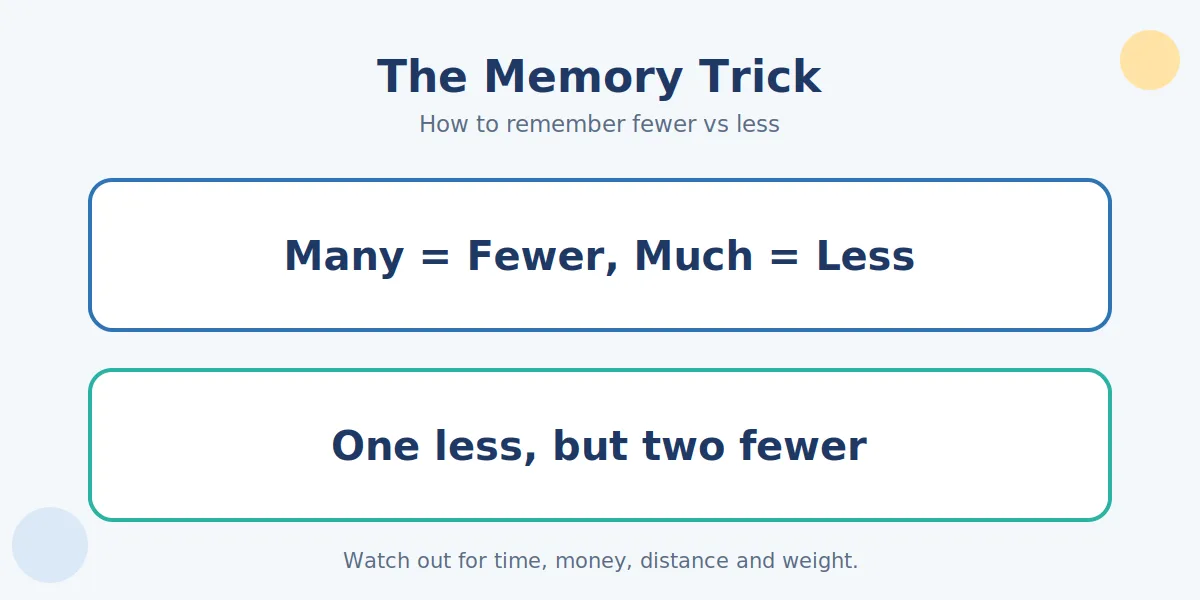
Many = Fewer. Much = Less.
| Fewer | Less |
|---|---|
| Many books | Much water |
| Many people | Much time |
| Many mistakes | Much information |
| Many questions | Much money |
Ask yourself two questions:
- Can I ask "How many?" Use fewer for ordinary plural countable nouns.
- Can I ask "How much?" Use less for ordinary uncountable nouns.
Remember the exceptions involving measurements, percentages, and one less.
Practice Questions: Fewer or Less?
Test your understanding with these five sentences. Choose the correct word for each blank.
- There are ___ students in the classroom today.
- I need ___ sugar in my tea.
- We spent ___ than $100 on groceries.
- She made ___ mistakes in her second essay.
- I have one ___ thing to worry about.
Answer Key
- Fewer: Students are individual, countable people.
- Less: Sugar is an uncountable substance.
- Less: Money is treated as an overall amount.
- Fewer: Mistakes are individual, countable things.
- Less: One less is the conventional expression.
If you answered all five correctly, you understand the main distinction and some important exceptions.
Frequently Asked Questions
Is it fewer people or less people?
Fewer people is the traditional grammatically preferred expression. People refers to individual, countable individuals. You may hear less people in informal speech, but fewer people is the safer choice in formal writing.
Is it less than or fewer than?
Both expressions are correct. Use fewer than before ordinary plural countable nouns, such as fewer than ten students. Use less than with amounts, measurements, time, and money, such as less than an hour.
Can less be used with countable nouns?
Yes. English speakers commonly use less with some plural countable nouns in informal speech and established expressions. Examples include "10 items or less" and "25 words or less." Formal writing often favors fewer.
Is it one less or one fewer?
One less is the conventional expression in everyday English. For example, say "one less problem" or "one less person." Use fewer instead with plural quantities, such as "two fewer problems."
Is "10 items or less" grammatically correct?
It is an established expression in everyday English. However, "10 items or fewer" follows the traditional countable-noun rule. Choose the latter when you want to follow conventional formal grammar guidance.
Why do we say less than two hours?
We treat time as a measured quantity in this expression. Therefore, less than two hours is the natural construction. The same pattern also applies to distance, weight, and monetary amounts.
Final Takeaway
The fewer vs less difference comes down to what you count or measure.
Use fewer for individual, countable things and less for overall amounts. Remember the common exceptions, especially measurements, percentages, and one less.
When in doubt, ask yourself: "How many?" or "How much?" That simple test will help you choose correctly in most situations.
For more practical English grammar explanations, explore our Grammar guides. You can also read our guide to who vs whom to understand another commonly confused pair.