Toward vs Towards: Which Spelling Is Correct?
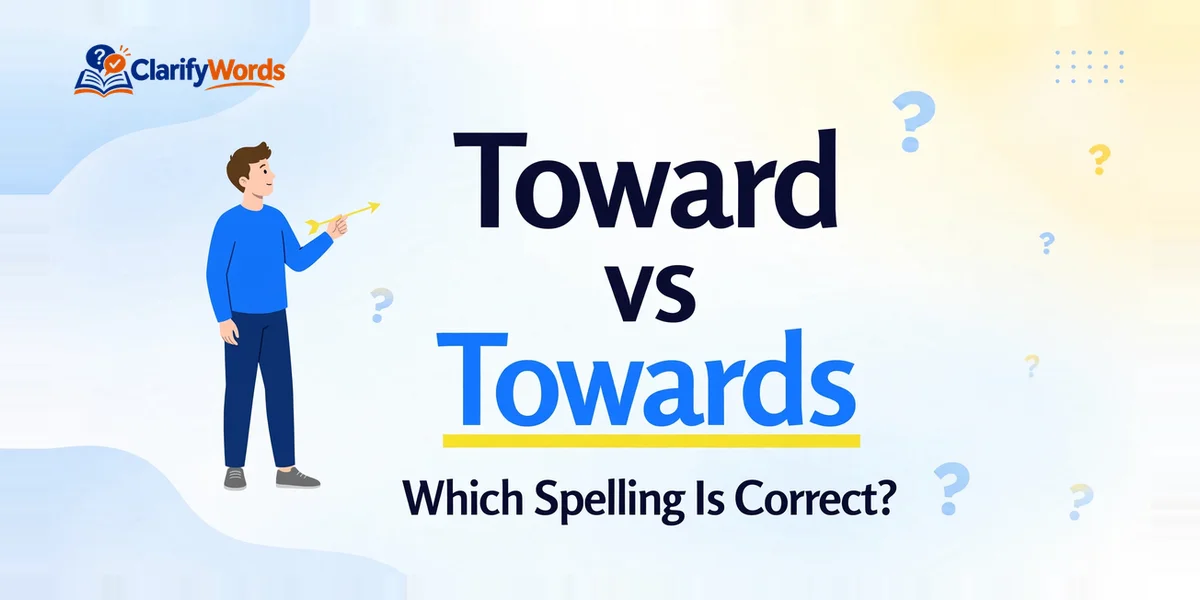
Is it toward or towards? Both spellings are correct, and they have exactly the same meaning. The difference comes down to regional spelling preferences.
For American English, use toward. For British English, use towards. This guide explains the rule, shows clear examples, and helps you choose the right form every time.
Quick Answer
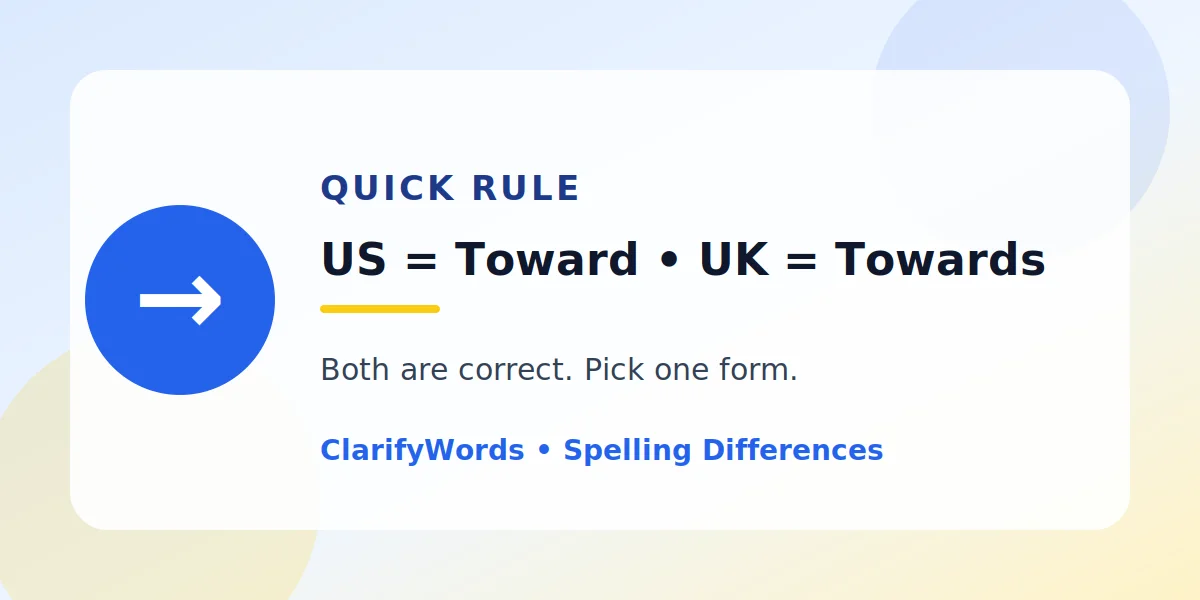
In American English, use toward.
In British English, use towards.
Both spellings are correct.
The meaning is the same.
The choice depends on your audience and style guide.
For US writing, toward is the safer choice.
Use toward for US school, work, and formal writing. Use towards for UK writing when you want the common British form. Do not mix both spellings in one document.
Table of Contents
- What Does Toward Mean?
- What Does Towards Mean?
- Toward vs To
- A Simple Comparison
- Is Towards Correct?
- Regional Rules: American vs British English
- What Do Style Guides Say?
- The -Ward Family: Related Words
- Adjective Before a Noun: A Key Rule
- Afterward vs Afterwards: The Adverb Exception
- Toward as an Adjective and Untoward
- Common Phrases Using Toward
- Editing Rules for Toward and Towards
- Common Mistakes About Toward vs Towards
- Memory Trick: How to Remember the Rule
- Practice Questions
- FAQs: Toward vs Towards
- Related Articles
What Does Toward Mean?
Toward is a preposition. It shows direction, position, time, attitude, or purpose.
In American English, toward is the preferred spelling. In British English, towards is more common. Both forms express the same ideas.
Direction: She walked toward the station.
Position or proximity: He stood toward the back of the room.
Time: The meeting moved toward noon.
Attitude or relation: Her feelings toward her teacher were warm.
Purpose or contribution: The money went toward a new school library.
What Does Towards Mean?
Towards is also a preposition. It has the same meaning as toward. It shows direction, position, time, attitude, or purpose.
Towards is the preferred form in British English. It is also understood in American English, but it is less common in edited US writing.
Direction: She walked towards the station.
Position or proximity: He stood towards the back of the room.
Time: The meeting moved towards noon.
Attitude or relation: Her feelings towards her teacher were warm.
Purpose or contribution: The money went towards a new school library.
Toward vs To
Toward shows direction without arrival. To shows arrival or a result.
He walked toward the school. He may not have arrived.
He walked to the school. He arrived.
She moved toward a new job. The move is in progress.
She moved to a new job. The move is complete.
Use toward when the focus is on direction. Use to when the focus is on arrival or a clear result.
A Simple Comparison
| Feature | Toward | Towards |
|---|---|---|
| Meaning | Same | Same |
| Spelling | No final s | Ends in s |
| Preferred in the US | Yes | Less common |
| Preferred in the UK | Accepted | Yes |
| Style guides in the US | AP, Chicago, and Garner prefer toward | Less preferred in edited US writing |
| Example | She walked toward the door. | She walked towards the door. |
Is Towards Correct?
Yes. Towards is correct. It is the preferred form in British English. It is also understood in American English.
In edited US writing, toward is the better choice. It matches US style guides. It also matches US dictionaries. Use toward for school, work, and formal writing in the US. This toward vs towards guide recommends toward for US readers.
Regional Rules: American vs British English
American English: Use Toward
In American English, use toward. This is the standard form. It is used in schools, newsrooms, and offices. It is also the form listed first in US dictionaries. Canada follows the same preference as the US for toward and towards.
Example: The team is working toward a solution.
British English: Use Towards
In British English, use towards. This is the common form. Toward is also accepted, but it is less common in everyday British writing.
Example: She walked towards the river.
Mixed or International Audience
For a mixed or international audience, use toward. It is the simpler global choice. It is also clear to UK readers. Stay consistent. Do not switch between forms in one document.
What Do Style Guides Say?
| Style Guide or Dictionary | Preferred Form | Notes |
|---|---|---|
| AP Stylebook | Toward | AP prefers toward, not towards. |
| Chicago Manual of Style | Toward | Chicago prefers toward in American English. |
| Garner’s Modern English Usage | Toward | Garner calls toward the standard US form. |
| Merriam-Webster | Toward | Toward is the main entry. Towards is listed as a variant. |
| Oxford English Dictionary | Towards | Both forms are accepted. Towards is more common in the UK. |
| Cambridge Dictionary | Towards | Both forms are listed. Towards is common in the UK. |
| MLA and APA (US academic) | Toward | US academic writing follows US spelling. |
The -Ward Family: Related Words
The same US and UK pattern applies to other ward words.
| Word Pair | US Preference | UK Preference | Notes |
|---|---|---|---|
| Toward / Towards | Toward | Towards | Same meaning |
| Forward / Forwards | Forward | Forwards | Forward is standard in the US |
| Backward / Backwards | Backward | Backwards | Backward is the adjective form |
| Onward / Onwards | Onward | Onwards | Onward is preferred in the US |
| Upward / Upwards | Upward | Upwards | Upward is preferred in the US |
| Downward / Downwards | Downward | Downwards | Downward is preferred in the US |
| Inward / Inwards | Inward | Inwards | Inward is preferred in the US |
| Outward / Outwards | Outward | Outwards | Outward is preferred in the US |
| Homeward / Homewards | Homeward | Homewards | Homewards is the UK adverb preference |
| Afterward / Afterwards | Afterward | Afterwards | Afterward is preferred in the US |
Both forms coexisted since the 9th century, from Old English toweard. American edited English later dropped the s more often. This explains the modern US and UK split.
Adjective Before a Noun: A Key Rule
Use the form without s before a noun. Never use the s form as an adjective before a noun.
Correct: a forward pass
Correct: a backward glance
Correct: an upward trend
Incorrect: a forwards pass
Incorrect: a backwards glance
Incorrect: an upwards trend
This rule applies to the whole ward family. The s form is used as an adverb, not as an adjective before a noun.
Afterward vs Afterwards: The Adverb Exception
Afterward and afterwards are adverbs only. They are not adjectives.
In American English, use afterward.
In British English, afterwards is more common.
Correct: We met afterward.
Correct (UK): We met afterwards.
Incorrect: an afterward meeting
Incorrect: an afterwards meeting
Toward as an Adjective and Untoward
In modern writing, toward and towards are prepositions. Do not use them as adjectives in current English.
Merriam-Webster lists an old adjective sense of toward, marked obsolete, meaning quick to learn or apt. Treat that sense as history only. It is not a rule for writing today.
Untoward is a separate adjective. It means unexpected, unfortunate, or inappropriate. It has no s form. Example: There was an untoward delay in the project. Do not confuse untoward with toward or towards.
Common Phrases Using Toward
Work toward a goal: She is working toward her degree.
Count toward a total: These essays count toward your final grade.
Lean toward a choice: He leans toward the cheaper plan.
Move toward a solution: The talks moved toward an agreement.
Go toward a cause: The proceeds go toward a new playground.
Toward the end: We met toward the end of the day.
Attitude toward someone: Her attitude toward her coach stayed positive.
Editing Rules for Toward and Towards
Stay consistent in one document. Pick one form and use it throughout. Do not mix toward and towards in the same text.
Never alter a quotation’s spelling. Keep the original spelling in a direct quote. This rule applies even if the quote uses the other form.
Use find and replace with care. A global change can alter quotes. It can also change proper names. Check each change before you accept it.
For a mixed or international audience, use toward. It is clear to all readers. It is also the safer global choice. A final toward vs towards check helps you stay consistent.
Common Mistakes About Toward vs Towards
Mistake 1: Towards is always wrong.
Towards is correct in British English. It is also understood in American English. It is simply less common in edited US writing.
Mistake 2: Toward and towards have different meanings.
They do not. The meaning is exactly the same. The difference is spelling and region.
Mistake 3: Toward is a verb.
Toward is a preposition. It is not a verb. It shows direction, position, time, attitude, or purpose.
Mistake 4: You need s to make it plural.
Toward and towards are not nouns. They have no plural form. The s does not make them plural.
Mistake 5: Towards is more formal than toward.
Formality does not come from the s. It comes from region and style guide. In the US, toward is the formal choice. In the UK, towards is the common choice.
Memory Trick: How to Remember the Rule
Think US and short. Toward is the shorter form. It has no s. US style guides prefer the shorter form.
Think UK and longer. Towards is the longer form. It has an s. UK writing often keeps the s.
If you write for the US, drop the s. If you write for the UK, keep the s. This simple check will help you choose the right form.
Practice Questions
- Choose the correct form for US writing: She walked ___ the door.
- Choose the correct form for UK writing: He walked ___ the station.
- Choose the correct form for US academic writing: The study points ___ a new conclusion.
- Rewrite for UK writing: She moved toward the exit.
- Choose the correct form for US writing: The team is working ___ a solution.
- Which form does AP prefer? (toward/towards)
- Choose the common UK form: She walked ___ the river.
- Fix this US sentence: He is heading towards Chicago.
- Choose the correct US form: The money went ___ a new library.
- Choose the correct US form: She moved ___ the door.
Answer Key
- Toward
- Towards
- Toward
- Towards
- Toward
- Toward
- Towards
- Toward
- Toward
- Toward
Frequently Asked Questions About Toward vs Towards
Is Towards Correct in American English?
Yes, towards is correct in American English, but it is less common in edited US writing. It is understood, and it is not an error. Use toward for US style guides, school work, and formal writing.
Is It Toward or Towards?
Both spellings are correct, and they have exactly the same meaning. The difference comes down to regional spelling preferences. Use toward in the US and towards in the UK. Pick one form for a whole document.
What Is the Grammatical Difference Between Toward and Towards?
There is no grammatical difference. Both forms are prepositions. They both show direction, position, time, or relation. The only difference is spelling. Both words work the same way in a sentence.
Does AP Style Prefer Toward or Towards?
AP style prefers toward rather than towards. This follows American editorial convention. This choice matches US newsrooms and schools. Keep the original wording in direct quotes, even if a quote uses the other spelling form.
Is Towards Wrong in British English?
No. Towards is the preferred form in British English. It is fully correct there. Toward is also accepted, but it is less common in everyday British writing. Use toward only when you want a global audience.
Is It Afterwards or Afterward in American English?
In American English, use afterward. Afterwards is the more common British form. Both words are adverbs only. Neither form is used as an adjective before a noun. Afterward stays an adverb in both forms always.
What Is the Difference Between Toward and To?
Toward shows direction without a clear arrival. To shows arrival or a result. For example, “walk toward the store” does not prove you entered it. “Walk to the store” does.