

Spelt or Spelled: Meaning, Difference, Examples, and Easy Memory Trick

Have you ever wondered whether to write spelt or spelled? Both are correct past tense forms of the verb spell, but their use depends on the type of English you follow. In American English, spelled is the standard and preferred form. In British English, both spelled and spelt are accepted, although spelt is common. There is another meaning to remember. Spelt is also the name of an ancient type of wheat. This guide explains their meanings, differences, grammar rules, and examples so you can choose the right word.
Quick Answer: Spelt or Spelled?
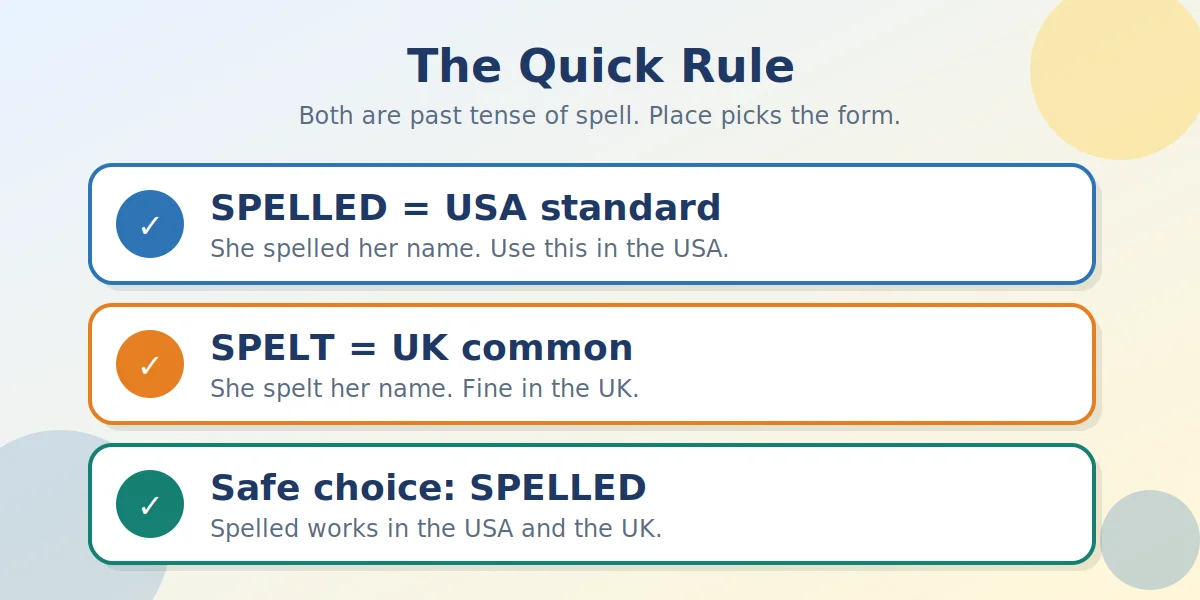
Spelled is the standard past tense and past participle of spell in American English. Spelt is also a correct verb form, especially in British English, where both versions are accepted.
Here is the basic difference:
| Word | Meaning and Usage |
|---|---|
| Spelled | Standard American English past tense and past participle of spell |
| Spelt | Common British English past tense and past participle of spell |
| Spelt | An ancient type of wheat in both American and British English |
Examples:
- American English: She spelled my name correctly.
- British English: She spelt my name correctly.
- Wheat: This recipe uses spelt flour.
If you are writing for an American audience, use spelled. It is also the safest choice for Canadian English.
Table of Contents
- What Does Spell Mean?
- What Does Spelled Mean?
- What Does Spelt Mean?
- Spelt or Spelled: Comparison Table
- Past Simple vs. Past Participle
- Conjugation of the Verb Spell
- American vs. British English
- How to Choose in 3 Steps
- Spelt as a Noun: Ancient Wheat
- Spell Out and Spell Trouble
- Misspelled vs. Misspelt
- Other Verbs with -ed and -t Forms
- Spelt or Spelled in Sentences
- Common Mistakes and Corrections
- Easy Memory Trick
- Practice Questions and Answer Key
- Frequently Asked Questions
- Final Takeaway
What Does Spell Mean?
Spell is a verb that means writing or saying the letters of a word in the correct order. It can also describe how someone writes a word or expresses something.
For example:
- Can you spell your last name?
- I always spell this word correctly.
- Please spell the address for me.
- The teacher asked us to spell difficult words.
The verb spell also appears in common expressions. For example, spell out means to explain something clearly or state every letter. According to Merriam-Webster’s dictionary, the verb has several meanings related to writing, understanding, and expressing words.
Its main forms include:
- Base form: Spell
- Third-person singular: Spells
- Present participle: Spelling
- Past tense: Spelled or spelt
- Past participle: Spelled or spelt
The choice between the two past forms depends mainly on regional English preferences.
What Does Spelled Mean?
Spelled is the past tense and past participle of the verb spell. It describes an action that happened earlier or works with helping verbs to form perfect tenses and passive constructions. American English uses spelled as its standard form.
Spelled as the Past Tense
Use spelled when describing a completed action in the past.
Examples:
- She spelled my name correctly.
- I spelled the word incorrectly yesterday.
- The student spelled every word on the test.
- He spelled my last name with two Ls.
Each example describes an action that already happened.
Spelled as the Past Participle
Use spelled with helping verbs such as has, have, and had. It also appears in passive sentences.
Examples:
- I have spelled your name correctly.
- She had spelled the word incorrectly.
- They have spelled every answer correctly.
- His name was spelled incorrectly on the form.
In each sentence, spelled works as a past participle.
Spelled in Everyday Writing
You will commonly see spelled in:
- School assignments and spelling tests.
- Business emails and professional documents.
- Names, addresses, and official forms.
- Instructions and educational materials.
For American readers, spelled is the natural choice in these situations.
What Does Spelt Mean?
Spelt has two main meanings in English. First, it is a past tense and past participle form of the verb spell. This usage is particularly common in British English. Second, it is a noun that names an ancient type of wheat.
Spelt as a Verb
In British English, spelt is an accepted alternative to spelled. It can describe both completed past actions and actions used with helping verbs.
Examples:
- She spelt my name correctly.
- I spelt the difficult word yesterday.
- He has spelt the word correctly.
- Her surname was spelt incorrectly.
These sentences are grammatically correct in British English. American writers generally prefer spelled instead.
Is Spelt a Correct Word?
Yes, spelt is a recognized English word. It works as a past tense and past participle form of spell, especially in British English. It also names an ancient grain. Its correct use depends on context and regional preference. Some American spell checkers may flag spelt when used as a verb. This reflects their language settings, not a universal spelling rule.
Spelt or Spelled: Comparison Table
The following table shows how the two forms differ.
| Feature | Spelled | Spelt |
|---|---|---|
| Part of speech | Verb form | Verb form or noun |
| Past tense | Yes | Yes |
| Past participle | Yes | Yes |
| American English | Standard and preferred | Less common as a verb |
| Canadian English | Standard choice | Less common as a verb |
| British English | Accepted | Common and accepted |
| Meaning as wheat | No | Yes |
| Safest choice for US writing | Yes | No, when used as a verb |
The main difference is regional preference, not meaning. Both forms can describe the same action. However, American writers should generally choose spelled. Remember that spelt has a separate meaning as a type of wheat. That meaning is correct in every English variety.
Past Simple vs. Past Participle
Both spelled and spelt can function as the past simple and past participle of spell. However, these grammatical forms serve different purposes.
Past Simple of Spell
The past simple describes an action that happened and finished in the past.
Examples:
- I spelled the word yesterday.
- She spelled my name correctly.
- The child spelled the difficult word.
These sentences describe completed actions.
Past Participle of Spell
The past participle usually appears with a helping verb. It helps form perfect tenses and passive constructions.
Examples:
- I have spelled this word before.
- She had spelled my name incorrectly.
- The word was spelled correctly.
- His name has been spelled incorrectly.
Here, spelled works with another verb to complete the sentence.
Spelled vs. Spelt in Perfect Tenses
Both forms can appear in perfect tenses, depending on the English variety.
| Tense | American English | British English |
|---|---|---|
| Present perfect | Have spelled | Have spelled / have spelt |
| Past perfect | Had spelled | Had spelled / had spelt |
| Future perfect | Will have spelled | Will have spelled / will have spelt |
For example:
- American: I have spelled your name correctly.
- British: I have spelt your name correctly.
Both sentences are grammatically correct.
Conjugation of the Verb Spell
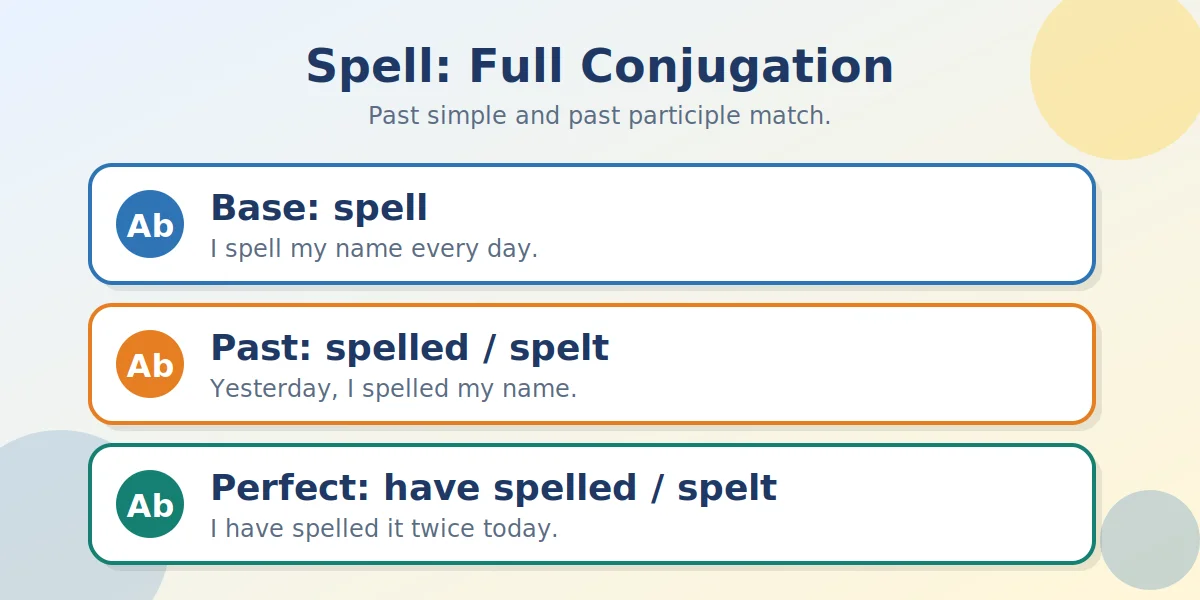
The verb spell has regular and alternative past forms. Here is its complete basic conjugation:
| Verb Form | Conjugation |
|---|---|
| Base form | Spell |
| Third-person singular | Spells |
| Present participle | Spelling |
| Past simple | Spelled / Spelt |
| Past participle | Spelled / Spelt |
Notice that the present participle remains spelling in both American and British English.
Examples:
- I spell my name with two Ls.
- She spells difficult words correctly.
- He is spelling the word now.
- They spelled the word yesterday.
- I have spelled it correctly.
American writers should use spelled for both past forms.
Spelt or Spelled in American and British English
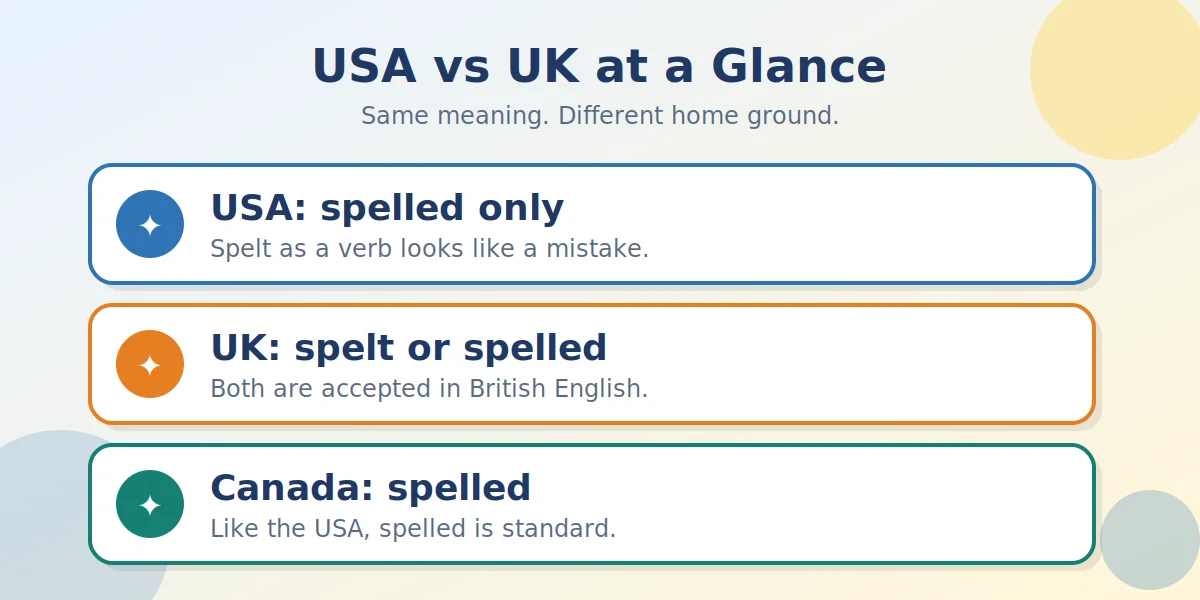
English spelling can change between countries. The preferred form of spell is one example.
American English: Spelled Is the Preferred Form
American English uses spelled as the standard past tense and past participle form. It is the best choice for:
- School essays and assignments.
- Business writing and emails.
- Professional documents.
- American publications and websites.
- Standardized writing assessments.
Examples:
- She spelled the word correctly.
- I have spelled your name correctly.
- The address was spelled incorrectly.
Although dictionaries recognize spelt, it is less common as an American verb form.
British English: Both Forms Are Accepted
British English accepts both spelled and spelt. However, spelt is a common British alternative.
Examples:
- She spelled my name correctly.
- She spelt my name correctly.
- I have spelled the word before.
- I have spelt the word before.
The two forms have the same meaning in these sentences.
What About Canadian English?
Canadian English has its own spelling conventions. However, for this verb, spelled is the standard choice, as in American English. Canadian writers should use spelled in schoolwork, professional documents, and general writing.
Should You Use Spelt or Spelled in Formal Writing?
Your audience and preferred style guide should determine your choice. For American formal writing, use spelled. For British writing, either form is acceptable. Choose one form and maintain consistency throughout your document.
How to Choose Between Spelt and Spelled in 3 Steps
Follow these three simple steps whenever you are unsure.
Step 1: Identify Your Audience
First, consider who will read your writing.
- American readers: Use spelled.
- Canadian readers: Use spelled.
- British readers: Use either spelled or spelt.
Step 2: Check the Meaning
Ask yourself whether you are using the word as a verb or noun.
- Verb: Choose the regional preference.
- Wheat: Always use spelt.
For example, "She spelled my name correctly" uses the verb. However, "She bought spelt flour" uses the noun.
Step 3: Stay Consistent
Once you choose an English variety, follow it throughout your writing. Avoid mixing American and British verb forms without a reason. For example, use spelled, learned, and burned in standard American writing. For British writing, spelt, learnt, and burnt may be appropriate.
Quick decision guide:
| Situation | Correct Choice |
|---|---|
| American school essay | Spelled |
| American business email | Spelled |
| Canadian article | Spelled |
| British article | Spelled or spelt |
| Recipe mentioning ancient wheat | Spelt |
Spelt as a Noun: What Is Spelt Wheat?
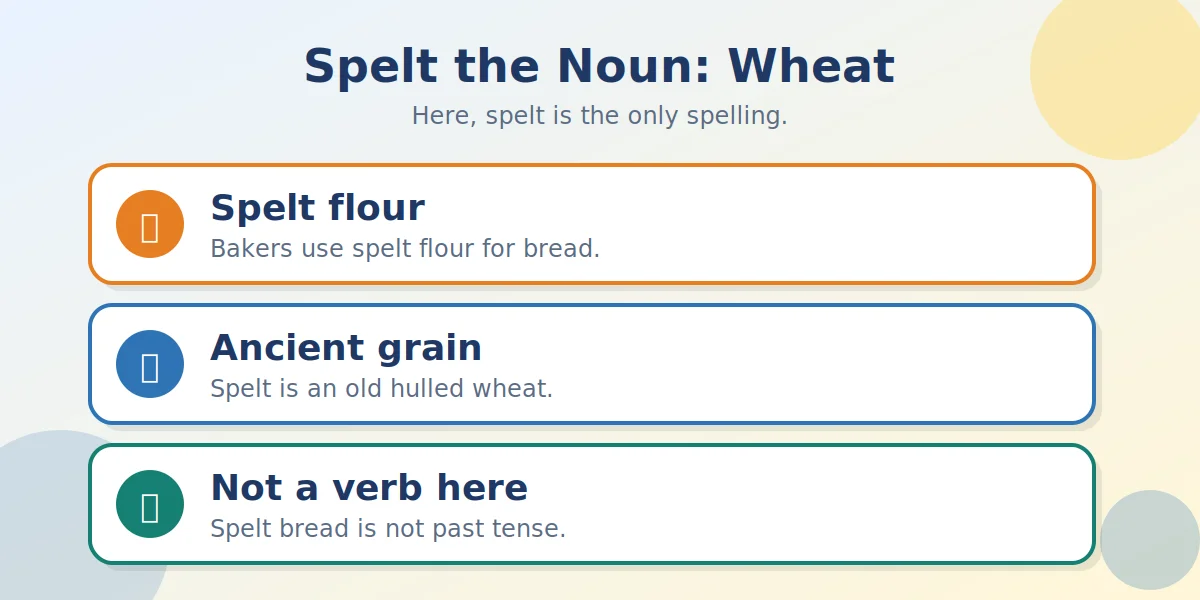
Spelt is also the name of an ancient type of wheat. It is a grain that people have cultivated for centuries. You may find it in bread, pasta, cereals, and other foods. Its scientific name appears in botanical references as Triticum spelta or Triticum aestivum subsp. spelta, depending on the taxonomic classification.
Spelt vs. Spelled: The Wheat Difference
When referring to the grain, spelt is always the correct spelling.
Examples:
- Spelt flour is used in some bread recipes.
- The recipe calls for whole spelt grains.
- Spelt is an ancient type of wheat.
- She prefers baking with spelt flour.
You should never write "spelled flour" when referring to this grain.
Why Context Matters
The meaning of spelt depends on how you use it. Consider these examples:
- She spelt my name correctly. This is a British verb form.
- She bought spelt flour. This refers to wheat.
- The farmer grows spelt. This also refers to wheat.
The surrounding words make the meaning clear.
Spell Out and Spell Trouble
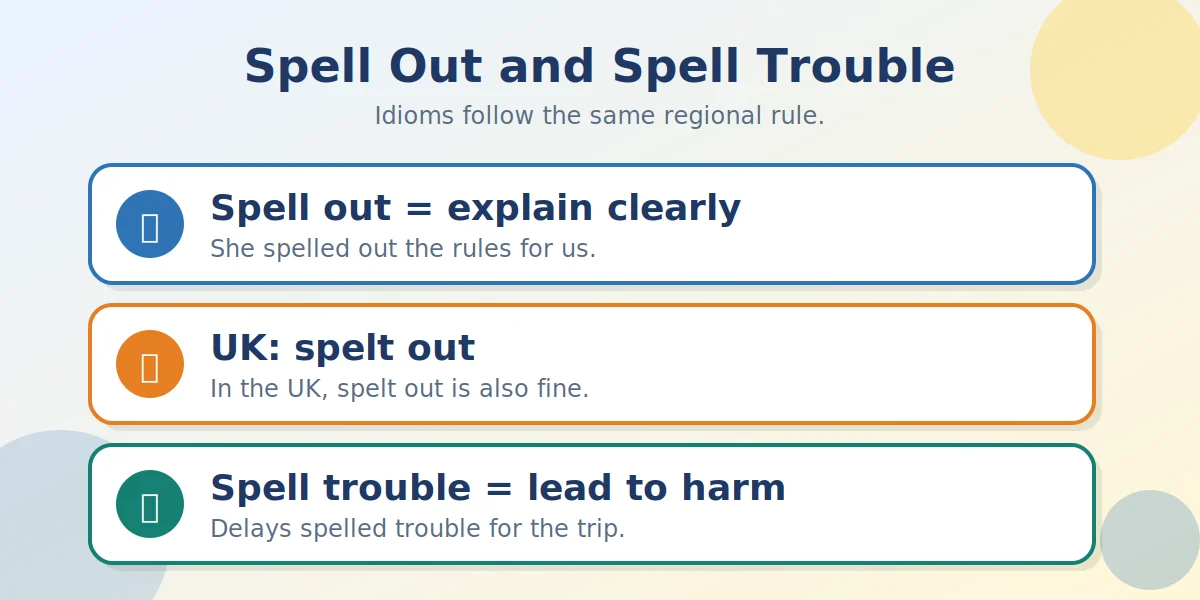
The verb spell appears in several common expressions. These expressions also have past forms. The same regional preferences apply to spelled and spelt.
Spell Out vs. Spelled Out and Spelt Out
Spell out has two common meanings:
- To say or write each letter of a word.
- To explain something clearly and fully.
Examples:
- Please spell out your full name.
- The teacher spelled out the instructions.
- She spelled out every letter.
- The teacher spelt out the instructions.
Spelled out is standard in American English. British English accepts both spelled out and spelt out.
Spell Trouble or Spell Disaster
Spell trouble and spell disaster mean that something may cause a bad result. The verb takes different forms depending on the sentence.
Examples:
- This decision could spell trouble for the company.
- His careless actions spelled trouble for the team.
- The unexpected delay spelled disaster for the project.
- His poor planning spelt disaster for the business.
American English prefers spelled when describing a past result. British English also accepts spelt in these expressions.
Misspelled vs. Misspelt
Misspelled and misspelt are past tense and past participle forms of misspell. The verb misspell means to write a word incorrectly. The regional preferences are similar to those for spell.
- Misspelled: Standard American English form.
- Misspelt: Common British English alternative.
Misspelled Examples
Use misspelled in standard American writing.
Examples:
- I misspelled your name on the form.
- The student misspelled three words.
- She has misspelled the same word twice.
- His surname was misspelled in the email.
Misspelt Examples
British writers may use misspelt instead.
Examples:
- She misspelt the word in her essay.
- He had misspelt my name.
- Several words were misspelt in the report.
Both forms communicate the same meaning.
Mispell or Mispelled: Common Spelling Errors
Be careful not to confuse misspell with mispell. The correct spelling contains two Ss after the prefix mis.
Here are the correct forms:
| Incorrect | Correct |
|---|---|
| Mispell | Misspell |
| Mispelled | Misspelled |
| Mispelling | Misspelling |
| Mispelt | Misspelt |
Remember that mispell, mispelled, mispelling, and mispelt are not correct standard spellings.
Other Verbs with -ed and -t Forms
Spell belongs to a group of English verbs with different past forms. Some verbs have a regular -ed form and an alternative -t form. American English generally prefers the -ed versions in the following pairs.
| Base Verb | American English | Common British Alternative |
|---|---|---|
| Spell | Spelled | Spelt |
| Misspell | Misspelled | Misspelt |
| Learn | Learned | Learnt |
| Burn | Burned | Burnt |
| Dream | Dreamed | Dreamt |
| Smell | Smelled | Smelt |
| Spill | Spilled | Spilt |
| Kneel | Kneeled | Knelt |
Why Do These Verb Forms Differ?
English has both regular and irregular verb forms. Regular verbs usually form their past tense by adding -ed.
For example:
- Learn becomes learned.
- Burn becomes burned.
- Spell becomes spelled.
Some verbs also have alternative forms ending in -t. These forms are especially common in British English. However, the preferred form can vary by verb and English variety.
You can explore similar spelling differences in these ClarifyWords guides:
Spelt or Spelled in Sentences
Examples make the difference easier to understand. Here are sentences showing how each form works.
Spelled in American English
- I spelled your name correctly on the application.
- She spelled the difficult word without help.
- The student spelled every word correctly.
- He spelled my last name with two Ls.
- I have spelled this word incorrectly before.
- The teacher spelled out the instructions.
- Her name was spelled incorrectly on the certificate.
- They spelled the word together during class.
Spelt in British English
- She spelt my name correctly.
- The child spelt the difficult word.
- I have spelt this word before.
- His surname was spelt incorrectly.
- The teacher spelt out the answer.
- She had spelt the word correctly.
- The name was spelt differently in the letter.
- He spelt the word without any help.
Spelt as a Noun
- Spelt flour is used in some bread recipes.
- The recipe calls for whole spelt grains.
- Spelt is an ancient type of wheat.
- Some bakeries offer bread made with spelt flour.
- She bought spelt to prepare a healthy meal.
Spelled vs. Spelt in Questions
Both forms can appear in questions.
Examples:
- Have you spelled the word correctly?
- Have you spelt the word correctly?
- Is this name spelled with one L or two?
- Is this name spelt with one L or two?
The first versions are standard choices for American English. The second versions are also accepted in British English.
Common Spelt and Spelled Mistakes
Some mistakes happen because writers confuse verb forms or regional preferences. Use this correction table to avoid common errors.
| Incorrect or Unsuitable Usage | Better Form | Reason |
|---|---|---|
| I spelt my name wrong. (US context) | I spelled my name wrong. | American English preference |
| She have spelled it correctly. | She has spelled it correctly. | Incorrect helping verb |
| I have spell the word. | I have spelled the word. | Past participle required |
| He spelleded the word. | He spelled the word. | Incorrect extra ending |
| I mispelled the name. | I misspelled the name. | Incorrect spelling of misspell |
| She mispelled the word. | She misspelled the word. | Missing second S |
| I bought spelled flour. | I bought spelt flour. | Incorrect wheat noun |
Some examples are only unsuitable for American English. British writers can correctly use spelt as a verb. Always consider the meaning and intended audience before correcting a word.
Easy Memory Trick: How to Remember Spelt or Spelled
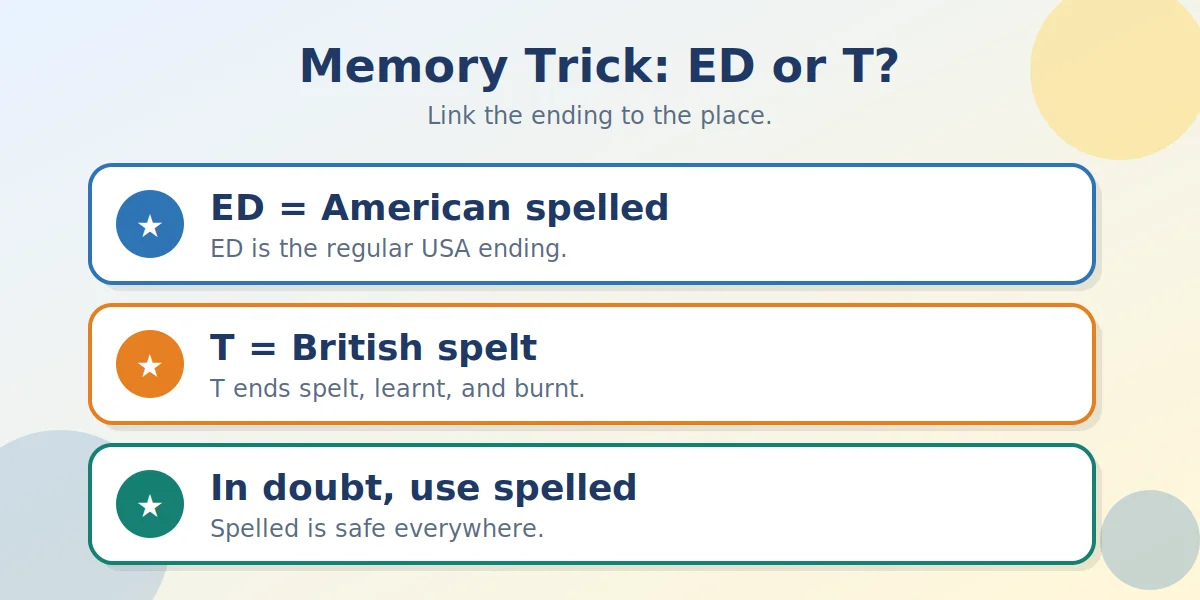
A simple memory trick can help you remember the difference.
Remember the Extra -ed
Think of spelled as the standard American form. The word ends with -ed, just like many regular past tense verbs.
Example: She spelled the word correctly.
Remember the British -t Form
Think of spelt as the common British alternative. Its final T can remind you of other British forms, such as learnt and burnt.
Example: She spelt the word correctly.
Remember the Wheat
When you see words about flour, grains, bread, or farming, think of spelt. The wheat noun always ends with T.
Easy memory sentence: For American writing, use spelled. For British writing, spelt is also an option. For wheat, always use spelt.
Practice Questions: Spelt or Spelled?
Test your understanding with these ten questions. Choose the correct word or verb form for each sentence.
- She ______ my name correctly on the form. (American English)
- I have ______ this word many times. (American English)
- The teacher ______ the difficult word yesterday. (American English)
- In British English, ______ is a common alternative to spelled.
- He has ______ my surname incorrectly. (American English)
- The recipe uses ______ flour.
- Please ______ out your full address.
- His careless decision ______ trouble for the company. (American English)
- She ______ the word incorrectly in her school assignment. (American English)
- The student had ______ the word before the spelling test. (American English)
Answer Key with Explanations
- Spelled. American English uses spelled as the standard past tense form.
- Spelled. The present perfect requires a past participle after have.
- Spelled. The sentence describes a completed past action.
- Spelt. This is a common British alternative to spelled.
- Misspelled. This is the standard American past form of misspell.
- Spelt. The sentence refers to the ancient wheat grain.
- Spell. The sentence uses the base form after please.
- Spelled. The past form describes the result of the decision.
- Misspelled. American English uses misspelled.
- Spelled. The past perfect uses had followed by the past participle.
For British English, the corresponding verb answers may use spelt or misspelt where appropriate.
Frequently Asked Questions
1. Is It Spelt or Spelled in American English?
Spelled is the standard and preferred form in American English. Although dictionaries recognize spelt as a verb form, it is less common in American writing. Use spelled in schoolwork, business documents, and professional communication.
2. Is Spelt a Real Word and Is It Grammatically Correct?
Yes, spelt is a recognized English word. It works as the past tense and past participle of spell, especially in British English. It also names an ancient wheat grain. Its correctness depends on context and regional usage.
3. Is Spelt Correct in British English?
Yes, spelt is correct and common in British English. Writers can also use spelled without making a grammatical mistake. Both forms describe the past tense and past participle of the verb spell.
4. What Is the Past Tense of Spell?
The past tense of spell is spelled or spelt. American English generally prefers spelled, while British English commonly accepts both forms today. The same alternatives can function as past participles in perfect tenses.
5. Is It Misspelled or Misspelt?
Both misspelled and misspelt are accepted past forms of misspell. American English prefers misspelled, while British English commonly uses either form in everyday writing. Both mean that someone wrote a word incorrectly.
6. What Is the Difference Between Spelt and Spelled Wheat?
Spelt is the correct name of an ancient type of wheat. Spelled is a past tense or past participle form of the verb spell. The two words have different meanings and grammatical functions.
Final Takeaway: Should You Use Spelt or Spelled?
The choice between spelt and spelled depends on your audience and meaning. Remember these three rules:
- Spelled: The standard and preferred form in American and Canadian English.
- Spelt: A common, accepted alternative in British English.
- Spelt: Always the correct spelling for the ancient wheat grain.
If you are writing for an American audience, choose spelled. It is clear, familiar, and appropriate for everyday and professional writing.
For more spelling help, explore our Spelling Differences guides.
Related ClarifyWords Guides
- Gray vs Grey
- Judgment vs Judgement
- Canceled or Cancelled
- Learn or Learned