

Aluminium or Aluminum: Which Spelling Is Correct?
Quick answer: In American English, aluminum is the standard form. In British English, aluminium is the standard form. The two forms developed from the same element. They do not describe different metals. That question is the focus of aluminium or aluminum, and the answer is simpler than the history suggests.
In this guide, you will learn how the two spellings differ. You will see how each form is pronounced. You will also learn when to use each form. The article uses American English as its default. It uses aluminium only when British usage or international scientific naming is the topic.
Table of Contents:
- What Is the Difference?
- Which Spelling Should You Use?
- Spelling by Country
- Why Are There Two Spellings?
- A History Timeline
- How Do You Pronounce Aluminum and Aluminium?
- Example Sentences
- What Do Dictionaries and Style Guides Say?
- Is There a Chemical Difference?
- Does the Spelling Matter When Buying Metal?
- Common Mistakes With Aluminum and Aluminium
- Memory Trick: Aluminum or Aluminium?
- Test Your Knowledge: Aluminum or Aluminium?
- Frequently Asked Questions
- Related Guides
What Is the Difference?
The short answer is that aluminium or aluminum names the same element. It has the symbol Al and the atomic number 13. It is a light, strong metal. It is used in cans, aircraft, and building materials. The spelling does not change those uses.
Same element, different spelling
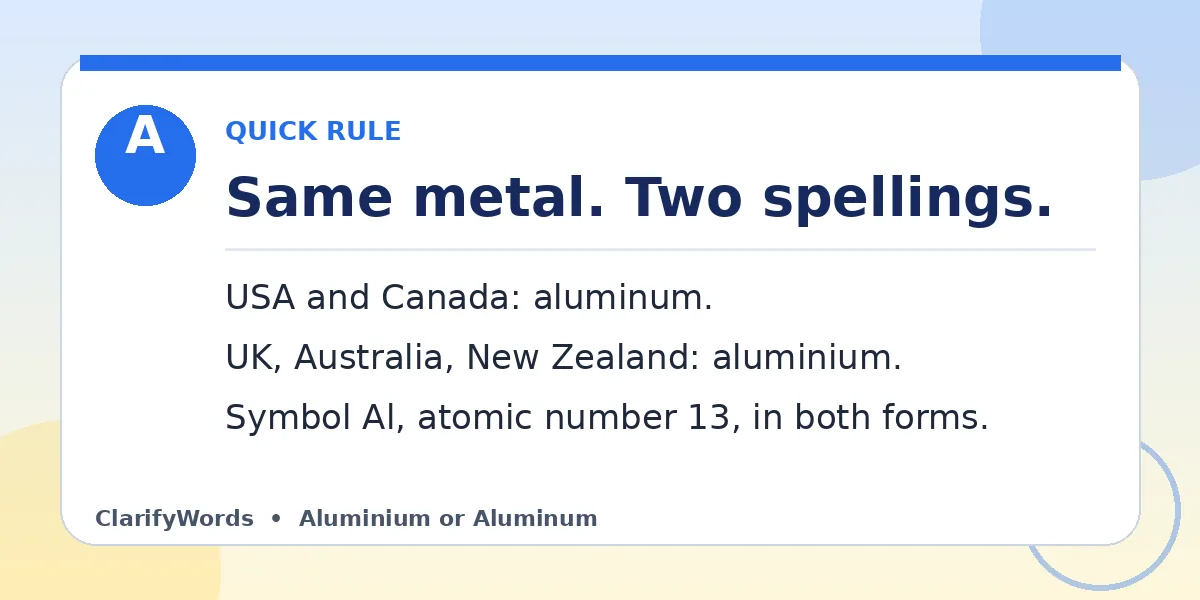
Both forms refer to one chemical element. The difference is spelling. Aluminum is the standard American English form, while aluminium is the standard British English form. Neither form is a misspelling. The choice depends on the audience and the publication style.
What is aluminum?
Aluminum is the American English spelling. It is used in the United States and Canada. It appears in product labels, school textbooks, and business documents. Examples include aluminum foil, aluminum cans, and aluminum siding.
What is aluminium?
Aluminium is the British English spelling. It is used in the United Kingdom, Australia, and New Zealand. It also appears in international scientific naming. In those contexts, aluminium is the preferred form. The meaning stays the same.
Which Spelling Should You Use?
The question of aluminium or aluminum usually comes down to audience. For a US audience, use aluminum. For a UK audience, use aluminium. For an international audience, follow the publication style. Do not mix both forms in one document.
For a US audience
Use aluminum in American school work, business writing, and websites. Use it in headings, body text, and captions. Use it in product names that follow American English. Consistency helps readers trust the text.
For a UK audience
Use aluminium in British school work, business writing, and websites. Use it in headings, body text, and captions. Use it in product names that follow British English. Consistency helps readers trust the text.
What if your audience is international?
Follow the house style of the publication. If no house style exists, choose the form that matches the main audience. For readers in different countries, aluminium or aluminum can both appear in search results. Introduce both forms once at the start if that helps. Then choose one form and stay with it. Keep direct quotations unchanged. Keep official product names unchanged. Keep titles unchanged. Those rules matter more than a general spelling preference.
Spelling by Country
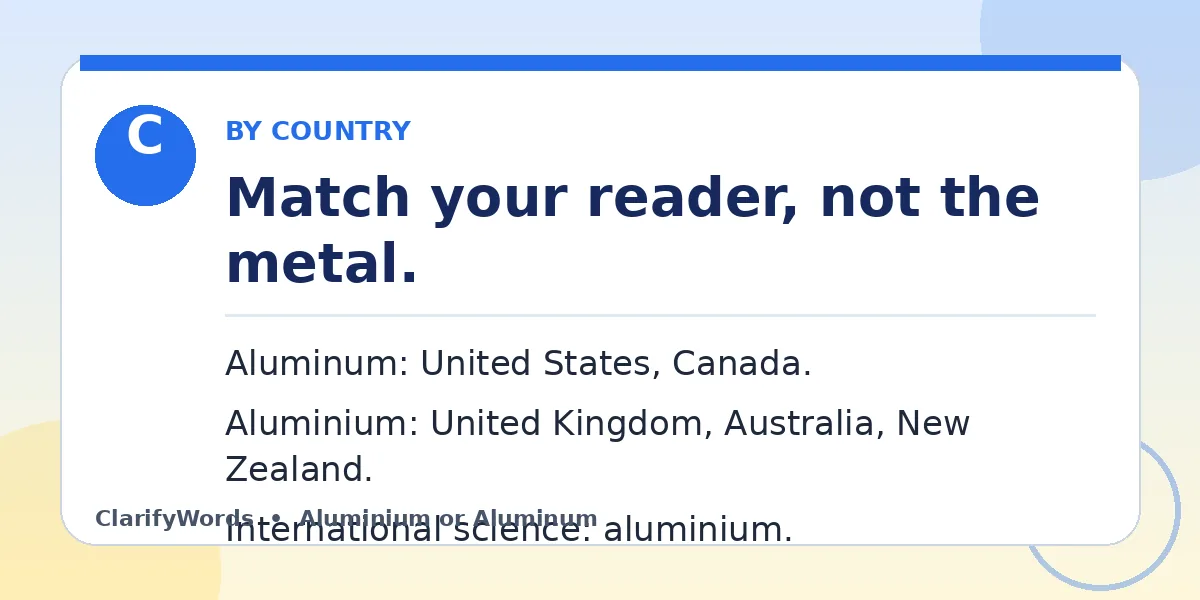
The table below shows the standard form in each region. It helps writers choose quickly.
| United States | Aluminum |
| Canada | Aluminum |
| United Kingdom | Aluminium |
| Australia | Aluminium |
| New Zealand | Aluminium |
| International science | Aluminium |
Does Canada use aluminum or aluminium?
In Canada, the answer to aluminium or aluminum is aluminum. Canadian English often follows American spelling for this word. Some Canadian publications follow their own house styles. In most cases, aluminum is the safe choice for Canadian readers.
Why does the spelling differ by country?
American and British English developed different spelling norms. Dictionaries played a large role. Scientific bodies also played a large role. The result is two accepted forms for one element.
Why Are There Two Spellings?
The history of aluminium or aluminum shows how two spellings grew from one element. The story starts with alum, a chemical compound. It continues with early chemists. It ends with modern dictionaries and scientific bodies.
From alum to alumina
Alum has been known for centuries. Alumina is aluminum oxide. Early chemists studied alumina and tried to isolate the metal inside it. The name of the element grew from those early terms.
Humphry Davy and alumium
Humphry Davy was a British chemist. In 1808, he proposed the name alumium. He had not yet isolated the pure metal. His proposal was an early step, not the final name.
How aluminium emerged
Other chemists preferred a different ending. In 1811, aluminium appeared in scientific writing. The -ium ending matched sodium, potassium, and magnesium. That pattern made aluminium feel more scientific.
How aluminum became standard in the US
Davy later used aluminum in his 1812 book, Elements of Chemical Philosophy. American dictionaries followed that form. Noah Webster used aluminum in his 1828 dictionary. The American Chemical Society adopted aluminum in 1925. That decision fixed the US standard.
A History Timeline
| Before 1800 | Alum and alumina were known, but the metal had not been isolated. |
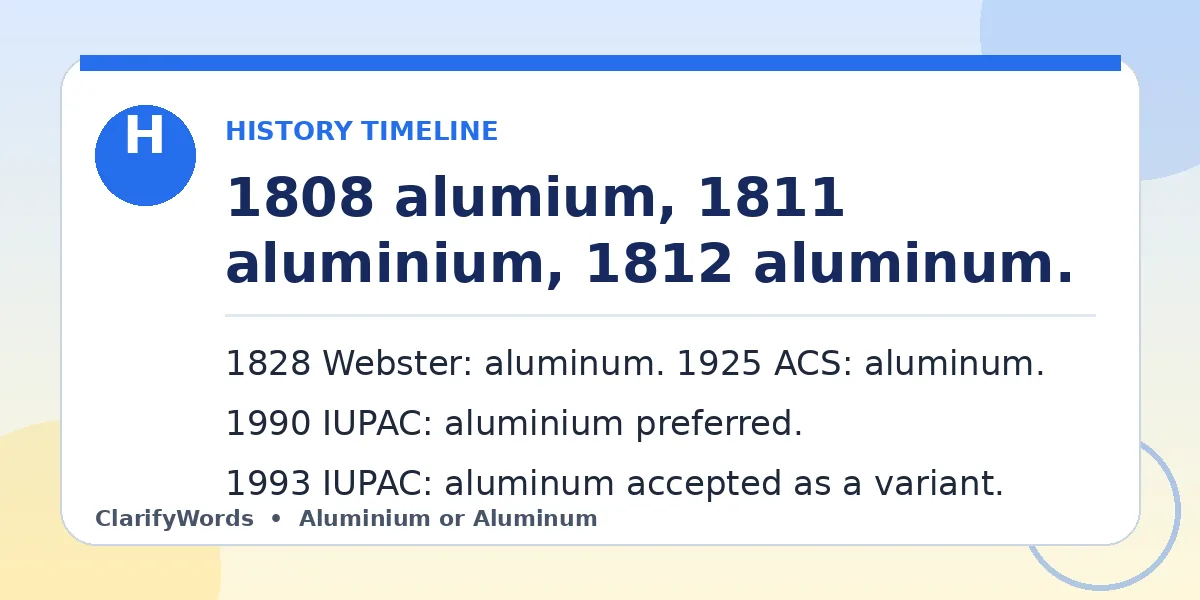
| 1808 | Humphry Davy proposed the name alumium. |
| 1811 | Aluminium appeared in scientific writing. |
| 1812 | Davy used aluminum in his published work. |
| 1825 | Hans Christian Oersted produced an early sample of the metal. |
| 1827 | Friedrich Wohler improved the preparation of the metal. |
| 1828 | Noah Webster used aluminum in his American dictionary. |
| 1886 | The Hall-Heroult process made aluminum production more practical. |
| 1925 | The American Chemical Society adopted aluminum as the US standard. |
| 1990 | IUPAC adopted aluminium as the preferred international name. |
| 1993 | IUPAC recognized aluminum as an acceptable variant. |
| 2005 | The IUPAC Red Book gave further guidance on inorganic names. |
The timeline shows a clear pattern. The US form came from Davy and Webster. The British form came from the -ium pattern. IUPAC later chose aluminium for international use.
How Do You Pronounce Aluminum and Aluminium?
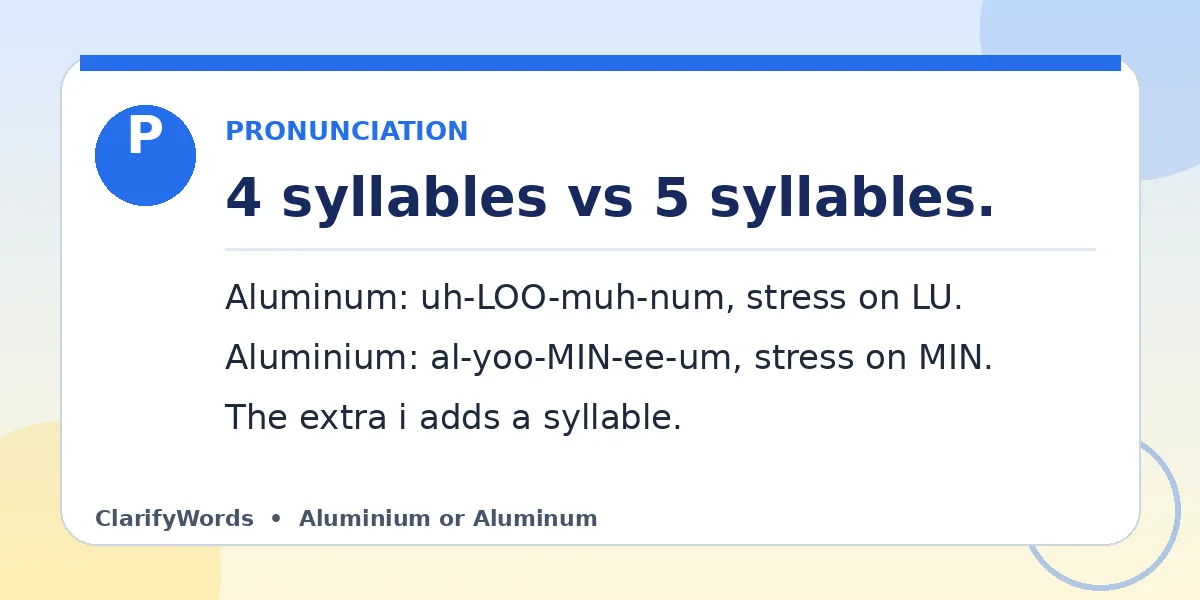
Pronunciation is another part of aluminium or aluminum that causes confusion. The US form has four syllables. The UK form has five syllables. The stress also falls on a different syllable.
How to pronounce aluminum
In American English, say uh-LOO-muh-num. The stress falls on the second syllable. The IPA form is /əˈluː.mə.nəm/. The word has four syllables.
How to pronounce aluminium
In British English, say al-yoo-MIN-ee-um. The stress falls on the third syllable. The IPA form is /ˌæl.jʊˈmɪn.i.əm/. The word has five syllables.
Pronunciation comparison
| Main use | American English | British English |
| Syllables | 4 | 5 |
| Pronunciation | uh-LOO-muh-num | al-yoo-MIN-ee-um |
| IPA | /əˈluː.mə.nəm/ | /ˌæl.jʊˈmɪn.i.əm/ |
| Main stress | Second syllable | Third syllable |
The extra i in aluminium adds a syllable. It also shifts the stress. That is why the two forms sound different.
Example Sentences
Examples help writers use each form with confidence. The sentences below show the same ideas in both forms.
Aluminum examples in American English
- The water bottle is made from lightweight aluminum.
- We wrapped the leftovers in aluminum foil.
- Aluminum cans are easy to recycle.
- The builder installed new aluminum windows.
- This plane uses aluminum alloys in several parts.
Aluminium examples in British English
- The water bottle is made from lightweight aluminium.
- We wrapped the leftovers in aluminium foil.
- Aluminium cans are easy to recycle.
- The builder installed new aluminium windows.
- This plane uses aluminium alloys in several parts.
Common expressions
| Aluminum foil | Aluminium foil |
| Aluminum oxide | Aluminium oxide |
| Aluminum alloy | Aluminium alloy |
| Aluminum sheet | Aluminium sheet |
| Aluminum cans | Aluminium cans |
The products are the same. Only the spelling changes.
What Do Dictionaries and Style Guides Say?
Dictionaries and style guides confirm the regional split. They do not treat either form as wrong. They treat each form as correct in its own region.
Merriam-Webster
Merriam-Webster lists aluminum as the American English form. It gives the pronunciation and the etymology. It traces the word to alumina and the Latin word alumen, which means alum. The first known use of aluminum dates to 1812.
Oxford English Dictionary
The Oxford English Dictionary lists aluminium as the British English form. It notes aluminum as the American form. That distinction matches current British usage.
What does IUPAC say?
IUPAC is the International Union of Pure and Applied Chemistry. It uses aluminium as its preferred English name. It also recognizes aluminum as an acceptable variant. That rule applies to international scientific naming. It does not make American usage incorrect.
What does the American Chemical Society say?
The American Chemical Society uses aluminum. It adopted that form in 1925. That choice guides US chemical writing. It does not change IUPAC international naming.
What about APA and Chicago style?
Follow the publisher or institution house style. For general American English writing, use aluminum. Do not assume a word-specific rule from APA or Chicago. Check the current style guide or house rules when in doubt.
Is There a Chemical Difference?
No. There is no chemical difference. Both forms name the same element. The symbol is Al. The atomic number is 13. The metal has the same properties in both spellings.
Same symbol, same element
The chemical facts are clear. The metal has the symbol Al. It has the atomic number 13. It sits in group 13 of the periodic table. Spelling does not change its place.
Same properties
Aluminum is light. It conducts heat and electricity well. It resists corrosion because of a thin oxide layer. It is easy to shape. Those facts apply to aluminium as well.
Same alloys
Alloy names do not change with spelling. A 6061 alloy is the same alloy in both forms. A 6063 alloy is also the same. The alloy code defines the material, not the spelling.
Does the Spelling Matter When Buying Metal?
Spelling alone does not define a product. Alloy and standard define a product. Buyers should check those details, not just the word form.
Check the alloy, not just the spelling
Ask for the alloy code. Ask for the temper. Ask for the product form. Those details matter more than aluminum or aluminium.
Understand ASTM and EN standards
ASTM B85 covers aluminum-alloy die castings in the US system. EN 1706 covers aluminium alloy castings in the European system. The two systems use different codes. They do not always match one to one.
Are A380 and ADC12 the same alloy?
No, not exactly. A380 is closest to ADC10, not ADC12. ADC12 is closest to A383. Treat alloy equivalents as approximate. Always name the governing standard. Check the composition before you order.
Common Mistakes With Aluminum and Aluminium
Many errors come from treating the two forms as different metals. Others come from mixing forms or using the wrong symbol.
Thinking they are different metals
Aluminum and aluminium are not two metals. They are two spellings for one metal. The chemical symbol is Al in both cases.
Mixing both spellings in one document
Mixing forms looks careless. Choose one form for a document. Use it in headings and body text. Use it in captions and tables too.
Writing AI instead of Al
The symbol is Al, with a capital A and a lowercase l. AI is not the symbol. AI can also mean artificial intelligence. That confusion can cause errors in technical writing.
Confusing aluminum with alumina
Alumina is aluminum oxide, Al2O3. It is not the metal itself. Aluminum is the metal. Alumina is a compound of aluminum and oxygen.
Confusing foil with aluminized film
Aluminum foil is a thin sheet of metal. Aluminized film is plastic film with a thin metal coating. The two products are different. Do not use the terms as if they were the same.
Assuming IUPAC makes aluminum wrong
IUPAC prefers aluminium for international naming. That does not make aluminum incorrect. American English still uses aluminum. Both forms have a valid place.
Memory Trick: Aluminum or Aluminium?
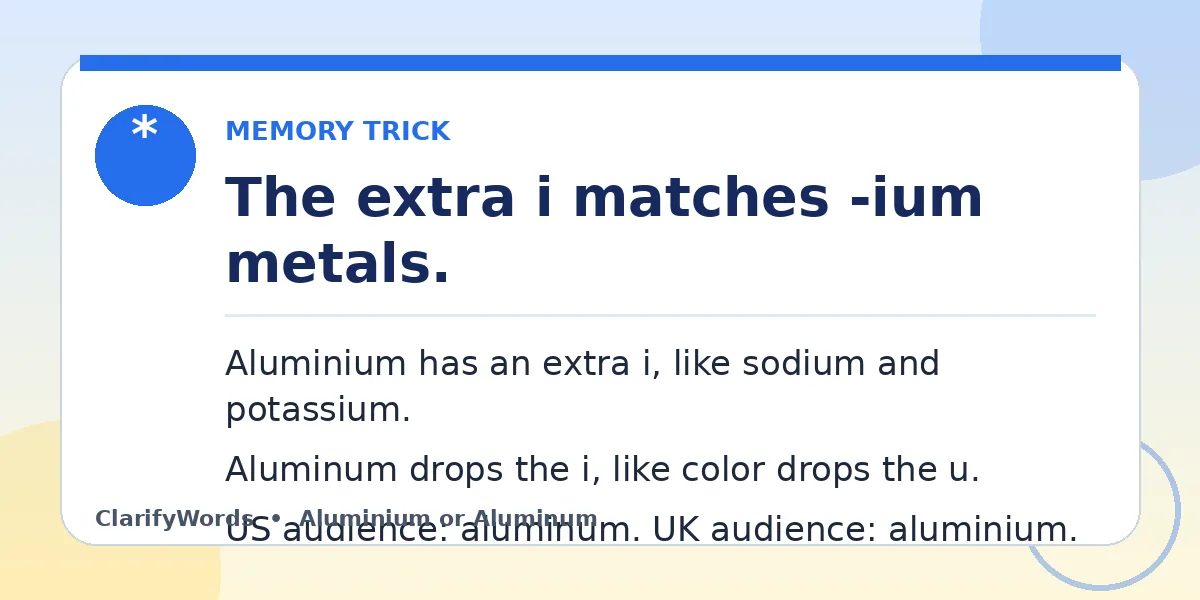
A simple memory trick can settle aluminium or aluminum in most cases. Think of the extra i. Aluminium has an extra i before the ending. That i matches the -ium ending in sodium and potassium.
For American spelling, think of the shorter form. Aluminum drops the extra i. That matches the US habit of shorter spellings, such as color instead of colour. The trick is a memory aid, not a spelling rule.
Use this quick check:
- US audience: use aluminum.
- UK audience: use aluminium.
- International science: use aluminium, unless the publisher says otherwise.
- One document: use one form throughout.
Test Your Knowledge: Aluminum or Aluminium?
Answer each question. Then check the answer key below.
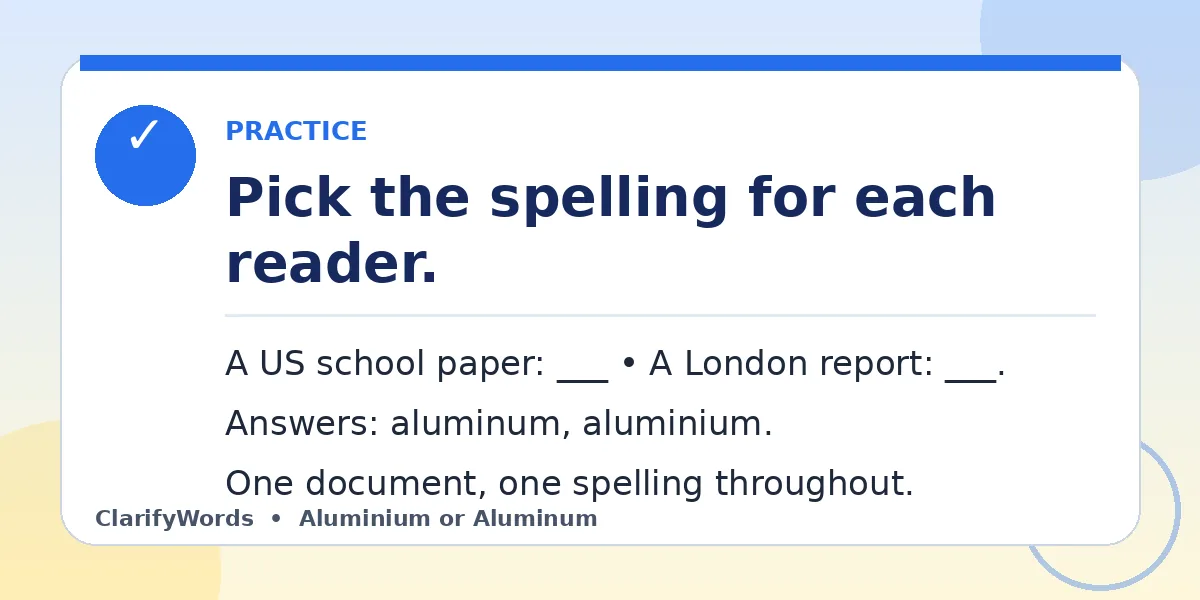
- Which spelling should you use in an American school assignment?
- Which spelling is standard in British English?
- Do aluminum and aluminium refer to different chemical elements?
- What is the chemical symbol for aluminum?
- Which spelling appears in IUPAC’s English periodic table?
- How many syllables does aluminum have in American English?
- How many syllables does aluminium have in British English?
- Who proposed the name alumium in 1808?
- Which year did the American Chemical Society adopt aluminum?
- Which spelling should you use for a UK audience?
Answer Key
- Aluminum. It is the standard American English form.
- Aluminium. It is the standard British English form.
- No. Both forms name the same element.
- Al. The symbol uses a capital A and a lowercase l.
- Aluminium. IUPAC prefers that form for international naming.
- Four. The stress falls on the second syllable.
- Five. The stress falls on the third syllable.
- Humphry Davy. He proposed alumium in 1808.
- 1925. That year fixed the US standard.
- Aluminium. It is the standard British English form.
Frequently Asked Questions
1. Is aluminium or aluminum correct?
Both forms are correct. Aluminum is the standard form in American English. Aluminium is the standard form in British English. Neither form is a misspelling. The choice depends on the audience and the publication style.
2. Why do Americans say aluminum?
Americans use aluminum because of early US dictionary choices. Davy used aluminum in 1812. Webster used it in 1828. The American Chemical Society adopted it in 1925. That history fixed aluminum as the US standard form.
3. Why do British people say aluminium?
British speakers use aluminium because of the -ium naming pattern. That pattern matches sodium, potassium, and magnesium. Other chemists proposed aluminium in 1811. British science and publishing then kept that form as the standard.
4. Which came first, aluminum or aluminium?
Alumium came first in 1808. Aluminium appeared in 1811. Aluminum followed in 1812. Davy used aluminum in his 1812 book. The British form aluminium then became standard in the UK.
5. How do you pronounce aluminum and aluminium?
Aluminum is pronounced uh-LOO-muh-num, with four syllables and stress on the second syllable. Aluminium is pronounced al-yoo-MIN-ee-um, with five syllables and stress on the third syllable. The extra i changes both the syllable count and the stress.
6. Does Canada use aluminum or aluminium?
Canada uses aluminum. Canadian English follows the American form for this word. Some Canadian publications follow their own house styles. In most cases, aluminum is the correct choice for Canadian readers and writers.
7. What does IUPAC say about aluminum and aluminium?
IUPAC prefers aluminium as its international English name. It also recognizes aluminum as an acceptable variant. That distinction applies to scientific naming, not regional spelling rules. For international scientific writing, use aluminium unless a publisher asks otherwise.
Related Guides
For more spelling differences, see these ClarifyWords guides:
You can also browse the Spelling Differences category page for more guides in this series.
Putting it together
The spelling question has a clear answer for most writers. Use aluminum for a US audience. Use aluminium for a UK audience. Follow the house style for international or scientific writing. Keep one spelling throughout a document. That simple rule avoids most errors.