

Lie vs Lay: What’s the Difference and When to Use Each?

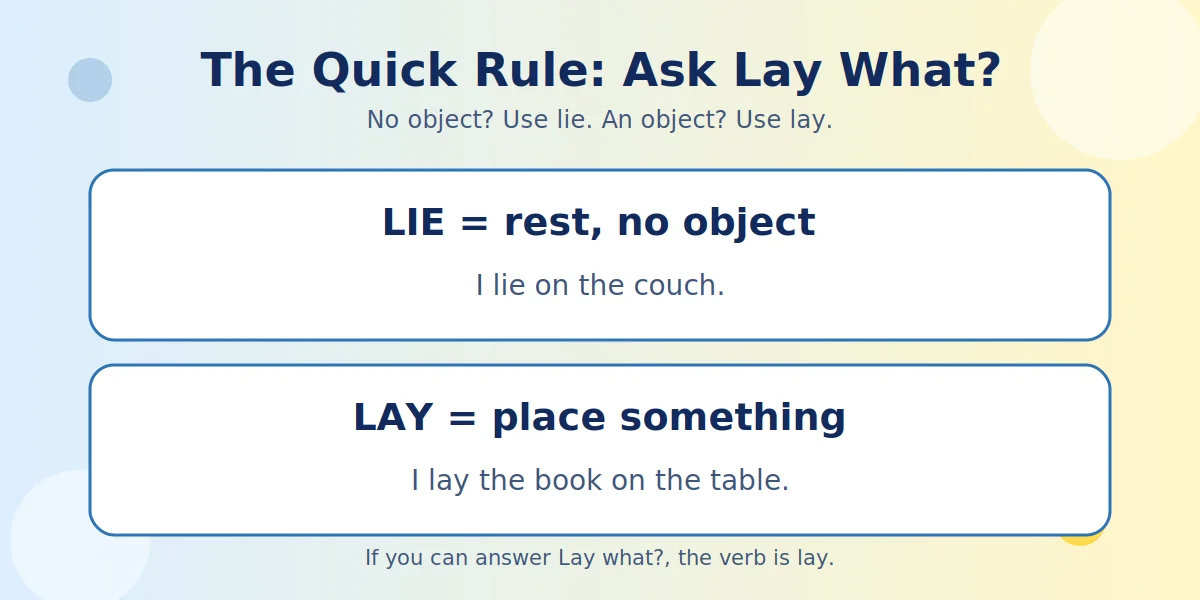
The difference between lie and lay comes down to one simple question: Is someone or something resting, or is someone placing something down? Use lie when a person or thing reclines or rests in a position. Use lay when someone places something somewhere. For example:
- Lie: I lie on the couch after work.
- Lay: I lay my phone on the table.
- Lie, past tense: Yesterday, I lay on the couch after work.
- Lay, past tense: Yesterday, I laid my phone on the table.
Once you understand the direct object rule, these words become much easier to use.
Quick Answer: Lie vs Lay
| Word | Meaning | Does it take a direct object? | Example |
|---|---|---|---|
| Lie | To recline, rest, or be situated | No | I lie on the sofa. |
| Lay | To put or place something down | Yes | I lay the book on the desk. |
| Lay | Past tense of lie, meaning reclined | No | I lay on the sofa yesterday. |
| Laid | Past tense and past participle of lay | Yes | I laid the book on the desk. |
| Lain | Past participle of lie, meaning reclined | No | I have lain here all morning. |
| Lied | Past tense and past participle of lie, meaning to tell an untruth | No direct object required in the usual construction | He lied about his age. |
The easiest rule to remember in any lie vs lay choice: Lie means to recline. Lay means to place something down. The past tense creates most of the confusion.
Table of Contents
- The Direct Object Test
- Lie and Lay Conjugation Table
- Why the Past Tense Is Confusing
- Laid vs Lain
- Lie Down vs Lay Down
- Laying vs Lying
- When Things Lie in a Place
- Other Uses of Lay and Lie
- Common Lie and Lay Mistakes
- Easy Ways to Remember the Difference
- Everyday Examples
- Practice Quiz: Test Your Knowledge
- Frequently Asked Questions
The Direct Object Test
The direct object test is the easiest way to settle a lie vs lay choice. A direct object receives the action of the verb. Lay takes a direct object when it means putting or placing something down. Lie does not take a direct object in its reclining meaning.
Try asking yourself, "Lay what?"
- I lay the keys on the counter. What do I lay? The keys.
- I lie on the couch. What do I lie? Nothing. I am resting.
The first sentence needs lay because "the keys" receive the action. The second needs lie because the subject is resting.
How to Apply the Test
Use these steps when you are unsure:
- Find the verb in your sentence.
- Ask whether someone is putting something down.
- If so, ask "what?" or "whom?" after the verb.
- If the sentence has a direct object, use lay for the placing meaning.
- If the subject is resting or reclining, use lie.
You can also try replacing the verb with place or put. If the replacement makes sense, lay is usually correct. For example:
- Please lay the folder beside the computer.
- Please place the folder beside the computer.
Both sentences work. The folder is the direct object.
Now consider this sentence:
- Please lie beside me.
- Please place beside me.
The second sentence does not express the intended meaning. The subject is reclining, so lie is correct.
Do Prepositional Phrases Count as Direct Objects?
No. A phrase that tells you where someone rests does not become a direct object. In "I lie on the bed," the phrase "on the bed" tells you where I lie. It does not receive the action.
| Sentence | Direct object | Correct verb |
|---|---|---|
| I lie on the grass. | None | Lie |
| I lay the blanket on the grass. | The blanket | Lay |
| She lies in bed. | None | Lies |
| She lays her phone in bed. | Her phone | Lays |
This distinction also explains why "I am laying on the couch" is not the standard choice. The sentence describes resting, not placing an object.
Lie and Lay Conjugation Table
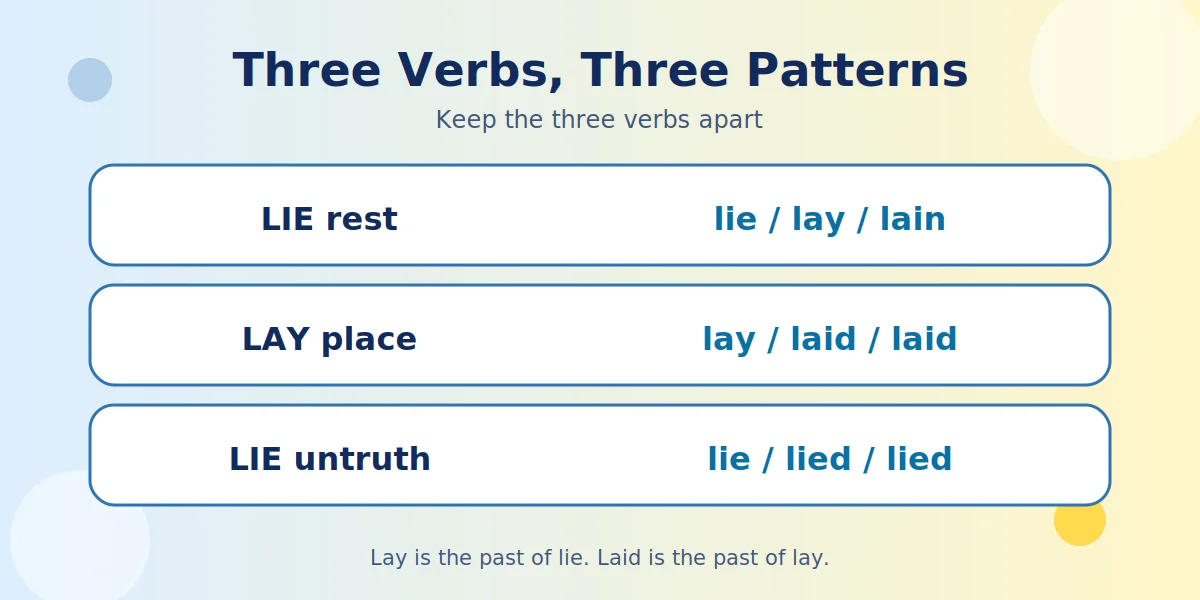
The past tense creates the biggest problem in lie vs lay. The word lay belongs to two different verb patterns. It is the present tense of lay, meaning to place, and the past tense of lie, meaning to recline. There is also a separate verb lie, meaning to tell an untruth. Its forms are different.
| Verb and meaning | Present | Present participle | Past tense | Past participle |
|---|---|---|---|---|
| Lie, to recline | Lie / lies | Lying | Lay | Lain |
| Lay, to place | Lay / lays | Laying | Laid | Laid |
| Lie, to tell an untruth | Lie / lies | Lying | Lied | Lied |
Notice the difference between the two meanings of lie:
- Recline: lie, lay, lain
- Tell an untruth: lie, lied, lied
The Cambridge Dictionary’s grammar guide confirms these forms and explains the object rule. The Oxford Advanced Learner’s Dictionary also identifies laid as both the past tense and past participle of lay.
Examples in Different Tenses
| Tense | Lie, to recline | Lay, to place | Lie, to tell an untruth |
|---|---|---|---|
| Simple present | I lie down after lunch. | I lay the book down. | I lie about my age. |
| Third person present | She lies on the sofa. | She lays the book down. | He lies to his friends. |
| Present progressive | I am lying down. | I am laying the book down. | He is lying about it. |
| Simple past | I lay down yesterday. | I laid the book down yesterday. | I lied yesterday. |
| Past progressive | I was lying down. | I was laying the book down. | He was lying about it. |
| Present perfect | I have lain here before. | I have laid the book down. | I have lied before. |
| Past perfect | I had lain there for hours. | I had laid the book down. | I had lied to them. |
| Future | I will lie down later. | I will lay the book down. | I will not lie to you. |
Why the Past Tense Is Confusing
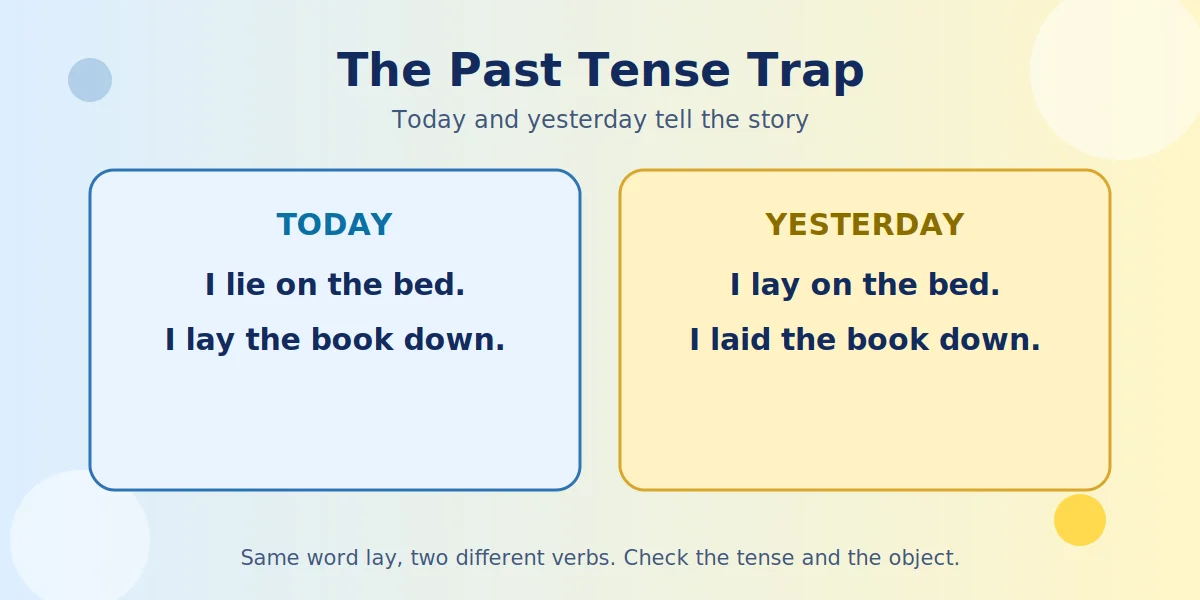
The lie vs lay past tense problem is that lay has two jobs.
First, it is the present tense of the verb meaning to put something down:
- I lay my jacket on the chair every evening.
Second, it is the past tense of the verb meaning to recline:
- I lay on the chair yesterday.
Both sentences are grammatically correct. Their meanings and verb patterns are different.
Compare these examples:
| Meaning | Present | Past |
|---|---|---|
| Recline | I lie on the bed. | I lay on the bed. |
| Place something | I lay the blanket on the bed. | I laid the blanket on the bed. |
The subject in the first pair rests. The second pair describes someone placing a blanket. The CDC’s 2025 writing guide explains this same past tense problem with practical examples.
Laid vs Lain
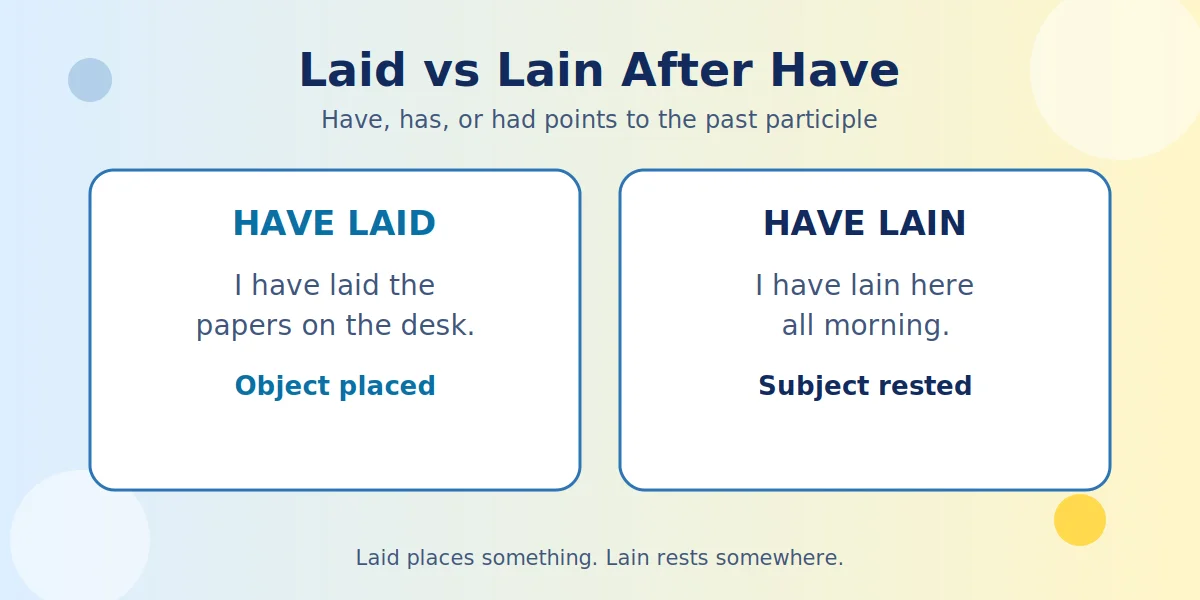
Laid and lain cause a common lie vs lay mix-up. Both are past participles, but they belong to different verbs. Use laid when someone has placed something down. Use lain when someone or something has reclined or remained in a position.
| Word | Verb | Meaning | Example |
|---|---|---|---|
| Laid | Lay | Put or placed something down | I have laid the papers on the desk. |
| Lain | Lie | Reclined or remained in a position | I have lain on this sofa all morning. |
When to Use Laid
Use laid when the sentence describes placing an object. Examples:
- She has laid the baby in the crib.
- We had laid the tools on the floor.
- The workers have laid the new carpet.
- The foundation was laid last year.
Each example has an object or describes something that was placed.
When to Use Lain
Use lain when the subject has rested or remained somewhere. It does not take a direct object in this meaning. Examples:
- I have lain awake all night.
- She had lain on the beach for hours.
- The book had lain unopened on the desk.
- He has lain in bed since breakfast.
Lain is correct, but it sounds formal and is uncommon in everyday conversation. You can often use a more conversational form. For example, "I have been lying here all morning" sounds more conversational than "I have lain here all morning."
Lie Down vs Lay Down
The lie vs lay choice for resting is simple. Use lie down when you mean to recline or rest. Use lay down when you mean to put something down. Compare:
- I need to lie down for a few minutes.
- Please lay down your backpack.
- She wants to lie down after dinner.
- He will lay down the blanket before the guests arrive.
The first and third examples describe resting. The second and fourth describe placing an object.
Is "I’m Going to Lay Down" Correct?
In standard edited English, write "I’m going to lie down." The subject is going to recline. There is no direct object. You may hear "I’m going to lay down" in casual conversation. Many speakers use lay this way, but lie is the standard choice in formal writing.
Why Is "Now I Lay Me Down to Sleep" Correct?
The familiar line "Now I lay me down to sleep" uses lay correctly. The word me is the direct object. The speaker is placing themselves in a resting position. This is a reflexive construction. Other correct examples include:
- I lay myself down for a nap.
- She laid herself down on the sofa.
- He laid his head on the pillow.
The reflexive pronoun or body part supplies the object. That is why lay works in these sentences.
Lie Down or Lay Down as a Command
Use the verb that matches the action:
- Lie down! means to recline.
- Lay the blanket down! means to place the blanket.
- Lay your head down! means to put your head in a resting position.
The MLA Style Center’s explanation of laying versus lying also uses the direct object test to distinguish these forms.
Laying vs Lying
Laying versus lying is another lie vs lay spelling trap. Use laying when someone is placing something down. Use lying when someone or something is reclining or resting.
| Word | Meaning | Example |
|---|---|---|
| Laying | Placing an object | She is laying the papers on the desk. |
| Lying | Resting or reclining | She is lying on the sofa. |
| Lying | Telling an untruth | He is lying about the result. |
Why Is "Lieing" Incorrect?
The correct spelling is lying, not lieing. When the verb lie takes the -ing ending, the final ie changes to y. Examples:
- I am lying in bed.
- The dog is lying by the door.
- She is lying about what happened.
The same spelling applies to both meanings of lie. Context tells you whether it means resting or telling an untruth.
When Things Lie in a Place
In lie vs lay, the verb lie does not only describe people resting. It can also describe where objects, places, or abstract ideas are situated. These uses still follow the intransitive pattern. The subject occupies a position or condition. It does not take a direct object.
Physical Objects and Places
Examples:
- The book lies on the table.
- The keys lie beside the front door.
- A small town lies near the river.
- The papers were lying across the desk.
These sentences describe location. None uses a direct object after lie.
Abstract Ideas and Situations
You can also use lie for ideas, responsibilities, and possibilities. Examples:
- The answer lies in the final paragraph.
- Her greatest strengths lie in communication.
- The responsibility lies with the manager.
- The hardest part lies ahead of us.
These examples use lie to describe where something exists or where responsibility belongs. The Cambridge Dictionary entry for lie includes these location and abstract meanings.
Other Uses of Lay and Lie
Both verbs appear in common expressions, and this lie vs lay range goes beyond resting or placing. Their meanings can extend beyond resting or putting something down.
Common Uses of Lay
| Expression | Meaning | Example |
|---|---|---|
| Lay eggs | Produce eggs | The hen lays eggs every morning. |
| Lay the foundation | Create a starting base | The team laid the foundation for success. |
| Lay the groundwork | Prepare for future work | We laid the groundwork for the project. |
| Lay down the law | State rules firmly | The coach laid down the law. |
| Lay blame | Assign responsibility for a problem | Do not lay all the blame on her. |
| Lay claim | Assert ownership or a right | He laid claim to the property. |
| Lay out | Arrange or present something | She laid out the documents. |
| Lay to rest | Settle a concern or bury someone | The new evidence laid the rumor to rest. |
| Lay off | Stop employing someone | The company laid off several workers. |
Common Uses of Lie
| Expression | Meaning | Example |
|---|---|---|
| Lie in wait | Stay hidden while waiting | The cat lay in wait for the mouse. |
| Lie low | Avoid attention | He decided to lie low for a while. |
| Lie ahead | Be in the future | Better opportunities lie ahead. |
| Lie around | Remain unused or out of place | The clothes were lying around the room. |
| Let sleeping dogs lie | Avoid bringing up an old problem | It is better to let sleeping dogs lie. |
| Take something lying down | Accept something without resisting | She refused to take the insult lying down. |
One useful distinction is lie around versus lay around. In standard edited English, use lie around when something remains in a place or when a person spends time relaxing.
Common Lie and Lay Mistakes
These lie vs lay examples show common errors and their standard corrections.
| Incorrect | Correct | Why |
|---|---|---|
| I am laying on the couch. | I am lying on the couch. | The subject is reclining. |
| I laid on the bed yesterday. | I lay on the bed yesterday. | Lay is the past tense of reclining lie. |
| She has laid in bed all day. | She has lain in bed all day. | Lain is the past participle of reclining lie. |
| I have lay down. | I have lain down. | The present perfect needs the past participle. |
| Please lie the book on the desk. | Please lay the book on the desk. | The book is a direct object. |
| He lay the keys on the counter. | He laid the keys on the counter. | This is the past tense of placing lay. |
| The dog is laying under the table. | The dog is lying under the table. | The dog is resting without an object. |
| I am lieing down. | I am lying down. | The correct spelling is lying. |
| She layed the blanket on the bed. | She laid the blanket on the bed. | The correct past form is laid. |
| I lied down after lunch. | I lay down after lunch. | Lied means told an untruth. |
Easy Ways to Remember the Difference
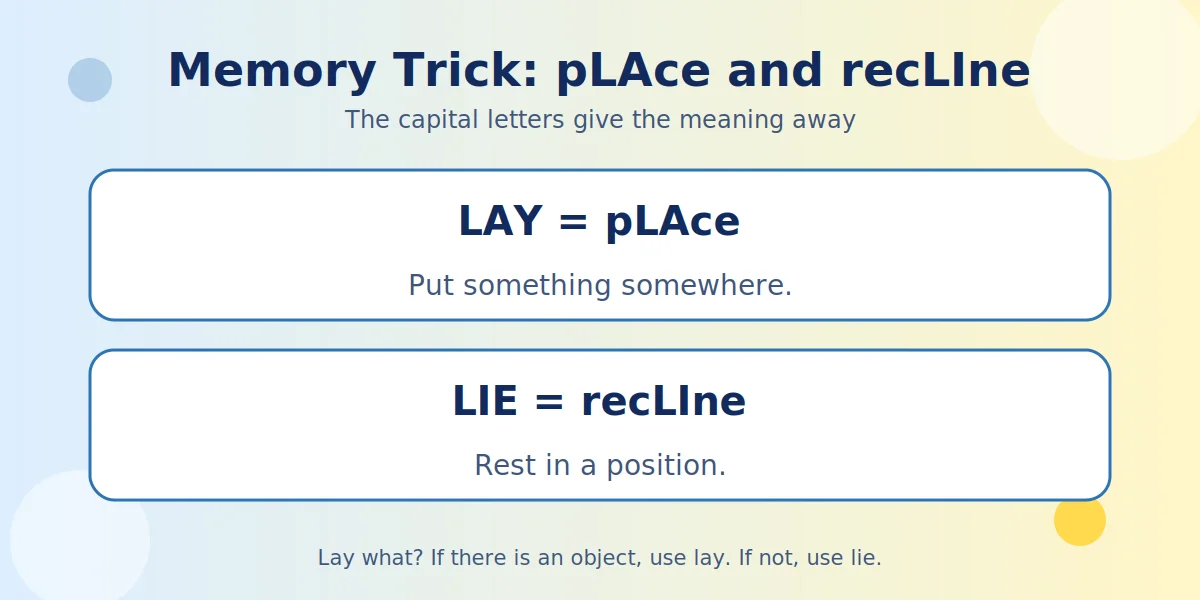
A few simple lie vs lay memory tricks can help you choose the right verb.
1. Remember "Lay" and "Place"
Lay and place share the same idea: putting something somewhere. The mnemonic pLAce has LA in it, just like lay. If you can replace lay with place, you probably need lay.
- Lay the phone on the desk.
- Lay the towel on the chair.
- Lay the book beside the lamp.
2. Remember "Lie" and "Recline"
Think of lie as the word for reclining. When the subject rests, use lie. The mnemonic recLIne has LI in it, just like lie.
- I lie on the sofa.
- She lies in bed.
- The dog lies near the fireplace.
3. Use the "What?" Question
Ask yourself, "Lay what?" If you can identify an object, use lay for the placing meaning.
- I laid what? The folder.
- She laid what? The blanket.
- He laid what? His phone.
If there is no object and the subject is resting, use lie or its correct tense.
4. Learn the Two Past Tense Patterns
Memorize these forms together:
- Lie: lie, lay, lain
- Lay: lay, laid, laid
The first lay is the past tense of reclining lie. The second is the present tense of placing lay.
5. Remember "Now I Lay Me Down to Sleep"
This familiar phrase helps explain the reflexive exception. The word me is the object of lay. You can also remember that pay changes to paid, just as lay changes to laid.
Everyday Examples
Here are more lie vs lay examples from everyday situations.
At Home
- I usually lie down after dinner.
- Please lay the remote on the table.
- The cat is lying near the window.
- I laid the clean towels on the bed.
At Work or School
- The report lies on the manager’s desk.
- Please lay your notes beside the textbook.
- The teacher laid the papers in a neat stack.
- The answer lies in the instructions.
When Talking About the Past
- I lay awake for most of the night.
- She laid her coat on the chair.
- We have lain on that beach before.
- They have laid the new flooring.
Practice Quiz: Test Your Knowledge
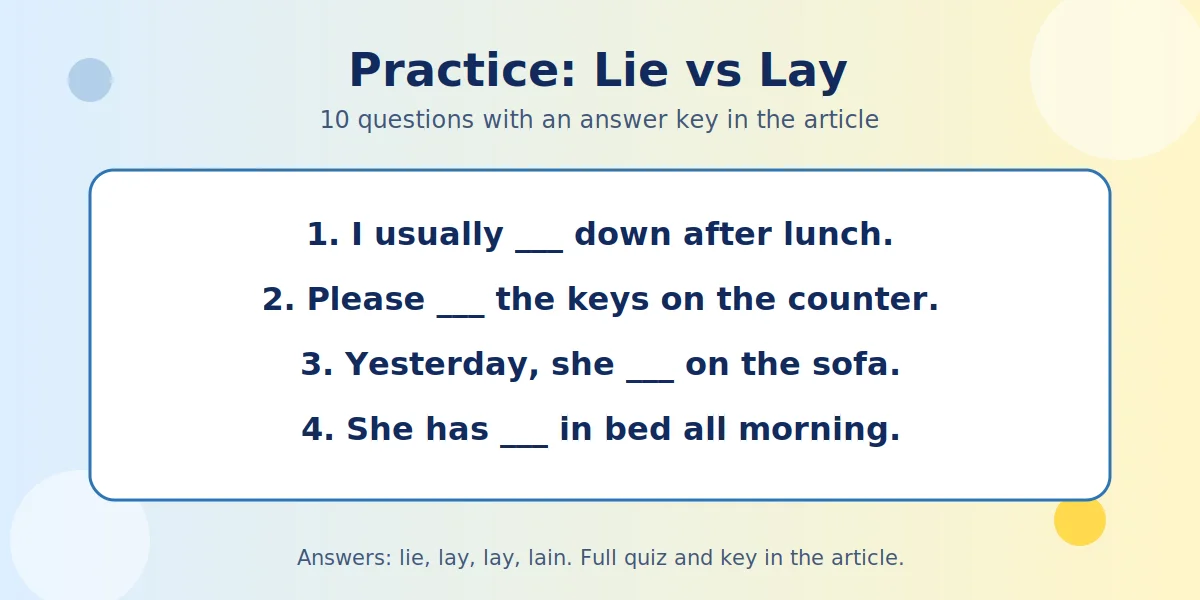
This lie vs lay quiz tests the rules above. Choose the correct word for each sentence. Check your answers below.
- I usually _____ down for a short nap after lunch. a) lay b) lie
- Please _____ your phone on the kitchen counter. a) lie b) lay
- Yesterday, she _____ on the sofa and watched television. a) lay b) laid
- He has _____ in bed since early morning. a) laid b) lain
- The workers have _____ the new carpet in the hallway. a) lain b) laid
- The dog is _____ beside the fireplace. a) laying b) lying
- The hen _____ three eggs yesterday. a) lay b) laid
- I am _____ the books on the shelf. a) laying b) lying
- She _____ to her friend about the broken vase. a) lay b) lied
- Please _____ yourself down and relax. a) lie b) lay
Answer Key and Explanations
- b) lie. The speaker is resting. There is no direct object.
- b) lay. The phone is the direct object. Someone is placing it down.
- a) lay. This describes a past action of reclining. The past tense of lie is lay.
- b) lain. The present perfect uses the past participle of reclining lie.
- b) laid. The workers placed the carpet. Laid is the past participle of lay.
- b) lying. The dog is resting. No object follows the verb.
- b) laid. The hen produced eggs. The past tense of lay is laid.
- a) laying. The books are the direct object. Someone is placing them on the shelf.
- b) lied. This sentence means she told an untruth. The past tense is lied.
- b) lay. The reflexive pronoun yourself is the direct object, so lay is correct.
Frequently Asked Questions
1. What is the difference between lie and lay?
Lie means to recline, rest, or be situated somewhere. Lay means to put or place something down and takes a direct object. If you can ask, "Lay what?" and get an answer, use lay. If not, use lie.
2. Is it lie down or lay down?
Use lie down when you mean to rest or recline. Use lay down when you place something down. For example, say "I need to lie down" but "Lay the book down."
3. What is the past tense of lie?
The past tense of lie, meaning to recline, is lay. For example, "I lie down every afternoon" becomes "I lay down yesterday." When lie means telling an untruth, its past tense is lied.
4. What is the past tense of lay?
The past tense of lay, meaning to put or place something down, is laid. For example, "I lay the keys on the counter" becomes "I laid the keys there yesterday." Its past participle is also laid.
5. Should I use laid or lain?
Use laid when someone placed an object somewhere. Use lain when someone or something reclined or remained in a position. For example, "I have laid the book down" and "I have lain here."
6. Is it lying or laying down?
Use lying down when you mean resting without placing an object. Use laying down when you are placing something down. "She is lying down" is correct, while "She is laying the blanket down" is also correct.
7. Is layed a real word?
Layed is not the standard modern spelling of the past tense or past participle of lay. The correct form is laid. Write "She laid the book down," not "She layed the book down."
Conclusion
Lie is for resting, and lay is for placing something down. Check for a direct object, then check the tense. That one habit clears up lie, lay, laid, and lain in most sentences.
Related Grammar Guides
Want to clear up more commonly confused words? Explore these guides:
- Affect vs Effect: https://clarifywords.com/affect-vs-effect/
- Whose vs Who’s: https://clarifywords.com/whose-vs-whos/
- Its vs It’s: https://clarifywords.com/its-vs-its/
- Loose vs Lose: https://clarifywords.com/loose-vs-lose/
- Principal vs Principle: https://clarifywords.com/principal-vs-principle/
- Complement vs Compliment: https://clarifywords.com/complement-vs-compliment/
- Then vs Than: https://clarifywords.com/then-vs-than/
- Advice vs Advise: https://clarifywords.com/advice-vs-advise/
Browse more lessons in our Confused Words category: https://clarifywords.com/category/confused-words/