

One or Two: Meaning, Usage, Grammar, and Examples
Quick Answer: What Does One or Two Mean?
The expression one or two usually means a few or a small number. It does not always refer to exactly one or two items. For example, “I have one or two questions” means the speaker has a few questions. However, “Do you want one or two tickets?” asks for a choice between exactly one and exactly two. The context determines which meaning applies.
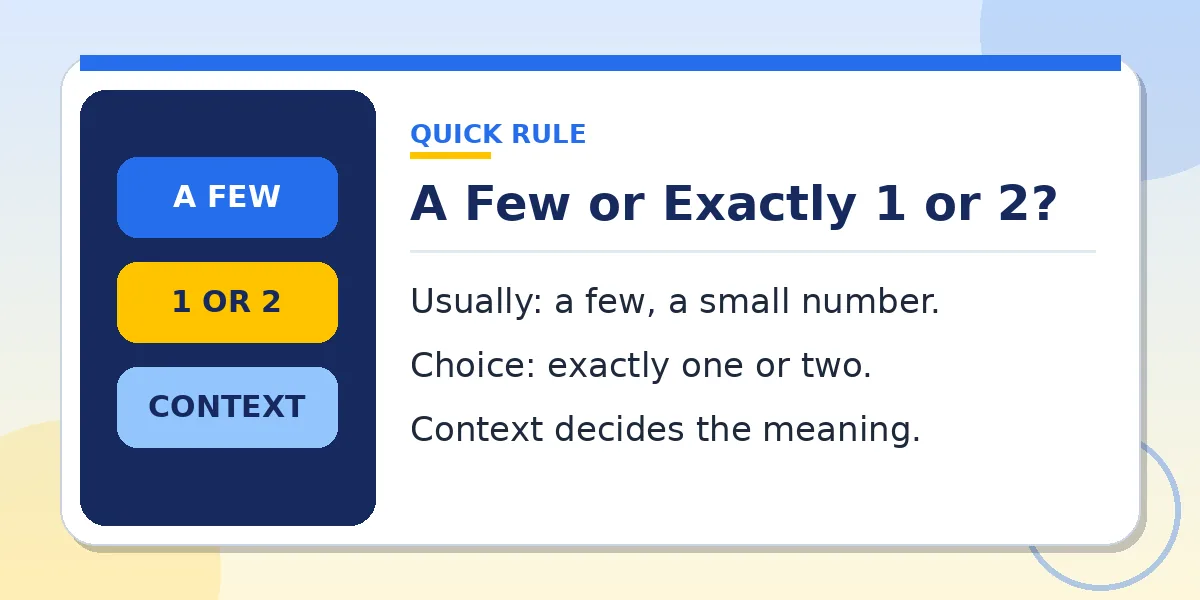
Table of Contents
- What Does One or Two Mean? Two Main Interpretations
- How to Use One or Two in a Sentence
- One or Two in Time Expressions
- Grammar Rules for One or Two
- One or Two vs. Similar Expressions
- Examples of One or Two in Different Contexts
- Common Mistakes to Avoid
- Memory Trick
- Practice Questions
- Frequently Asked Questions
- Final Takeaway
- Related Guides
What Does One or Two Mean? Two Main Interpretations
This expression has two main interpretations. One describes an approximate quantity, while the other describes an exact choice.
Idiomatic Meaning: A Few or a Small Number
In everyday English, the phrase often means a few. It describes a small, unspecified quantity rather than an exact count. Examples: “We may need one or two changes.” “I have one or two questions about the lesson.” “There were one or two problems with the plan.” In these examples, the speaker does not focus on the precise number. The main point is that only a small number is involved. This meaning is common in conversations, written messages, and everyday explanations.
Literal Meaning: Exactly One or Two
The expression can also refer to the numbers one and two literally. In this case, it presents two possible quantities. Examples: “Would you like one or two tickets?” “Take one or two cookies.” “You can bring one or two guests.” Here, the speaker means exactly one or exactly two. The intended quantity depends on the choice or instruction. This use does not rely on the idiomatic meaning of a few. It follows the ordinary meanings of the numbers.
How Can You Tell Which Meaning Is Intended?
Look at the purpose of the sentence and its surrounding words. A useful clue is whether the speaker needs a precise quantity. If the exact count matters, the literal meaning is more likely.
| Sentence type | Meaning | Example |
|---|---|---|
| General statement | A few or a small number | I have one or two concerns. |
| Request for a choice | Exactly one or two | Do you want one or two copies? |
| Approximate description | An unspecified small quantity | We made one or two changes. |
| Direct instruction | One or exactly two | Bring one or two notebooks. |
How to Use One or Two in a Sentence
This expression fits many situations involving small quantities. You can use it in questions, statements, and instructions.
Use It Before Plural Countable Nouns
- I have one or two books to return.
- She asked one or two questions.
- We noticed one or two spelling errors.
- They invited one or two friends.
The noun takes a plural form because the expression refers to one item or more than one item.
Use It When the Exact Quantity Is Not Important
- I need one or two things from the store.
- We made one or two changes to the schedule.
- He mentioned one or two reasons for leaving.
The listener understands that the quantity is small. The speaker does not need to provide an exact number.
Use It to Make Suggestions Sound Less Forceful
- I have one or two small suggestions.
- There are one or two details we could improve.
- I noticed one or two areas that need attention.
In these sentences, the speaker presents feedback gently. This effect comes from context, not a fixed dictionary rule.
Use It in Questions and Instructions
- Would you like one or two copies?
- Can you bring one or two notebooks?
- Please invite one or two guests.
- Should I print one or two extra pages?
These examples may refer to exact quantities. The surrounding situation makes the intended meaning clear.
One or Two in Time Expressions
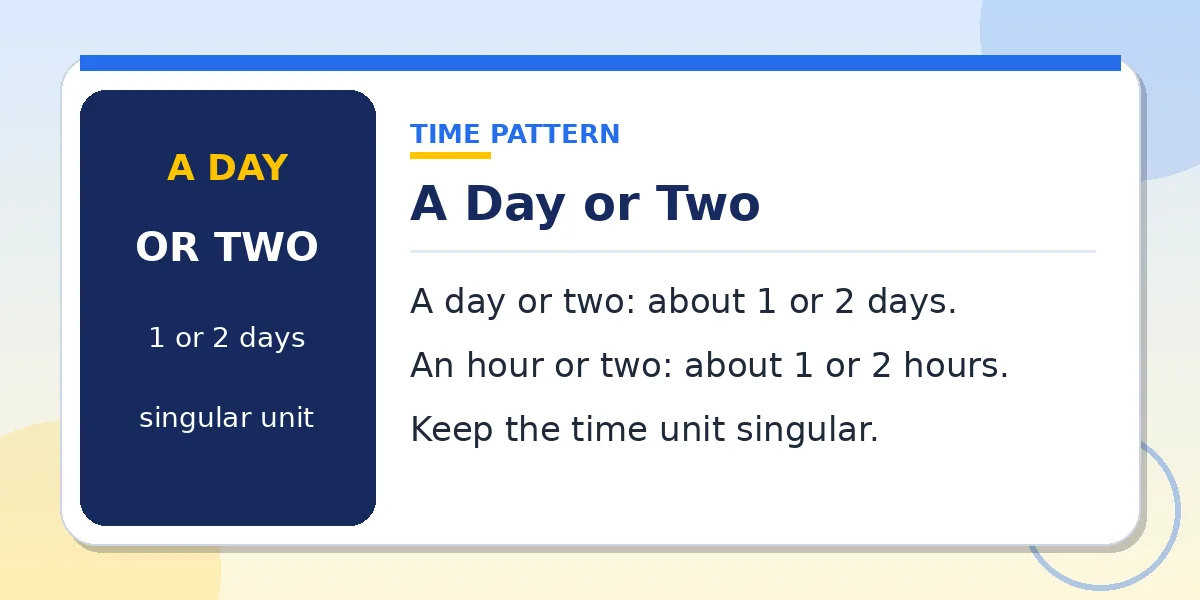
English uses a related pattern to describe an approximate period. It combines an article, a singular time unit, and “or two.”
A Day or Two
“A day or two” means approximately one or two days. Example: “I need a day or two to finish the assignment.” The speaker needs a short period but does not give an exact deadline.
An Hour or Two
“An hour or two” means approximately one or two hours. Example: “Give me an hour or two to prepare for the meeting.” Use “an” because “hour” begins with a vowel sound.
A Minute or Two
“A minute or two” describes a short period of approximately one or two minutes. Example: “Please wait a minute or two before opening the door.”
A Week or Two and a Year or Two
- We should receive an update in a week or two.
- She plans to move in a year or two.
- They expect to finish the work in a month or two.
These expressions give an approximate timeframe. They do not promise an exact duration.
A Day or Two vs. One or Two Days
Both patterns describe approximately the same period. However, their grammar differs.
| Pattern | Structure | Example |
|---|---|---|
| A day or two | Article plus singular time unit plus or two | I will return in a day or two. |
| One or two days | Numbers plus plural noun | I will return in one or two days. |
| An hour or two | Article plus singular time unit plus or two | Wait an hour or two. |
| One or two hours | Numbers plus plural noun | Wait one or two hours. |
Remember that the first pattern keeps the time unit singular. The second pattern uses a plural noun. Do not write “a days or two.” Also, use “a day or two” instead of the awkward construction “one day or two.”
Grammar Rules for One or Two
Understanding the grammar helps you avoid common writing mistakes. Pay attention to noun forms, verb agreement, and hyphenation.
Should the Noun Be Singular or Plural?
Use a plural countable noun after this expression in its normal quantity pattern. Correct: one or two days, questions, people, suggestions, problems. Incorrect: one or two day, question, person. The plural noun covers the possibility of more than one item. This pattern remains standard even when the actual number could be one.
Should You Use Was or Were?
- One or two students were absent.
- One or two problems were reported.
- One or two employees have requested changes.
The plural verb matches the usual meaning of the expression. It is the clearest choice for everyday writing. Singular agreement is also attested in some established constructions, so do not mark every singular use as simply wrong. When writing for clarity, prefer plural verb forms when the phrase refers to multiple things.
One or Two in There Is and There Are Sentences
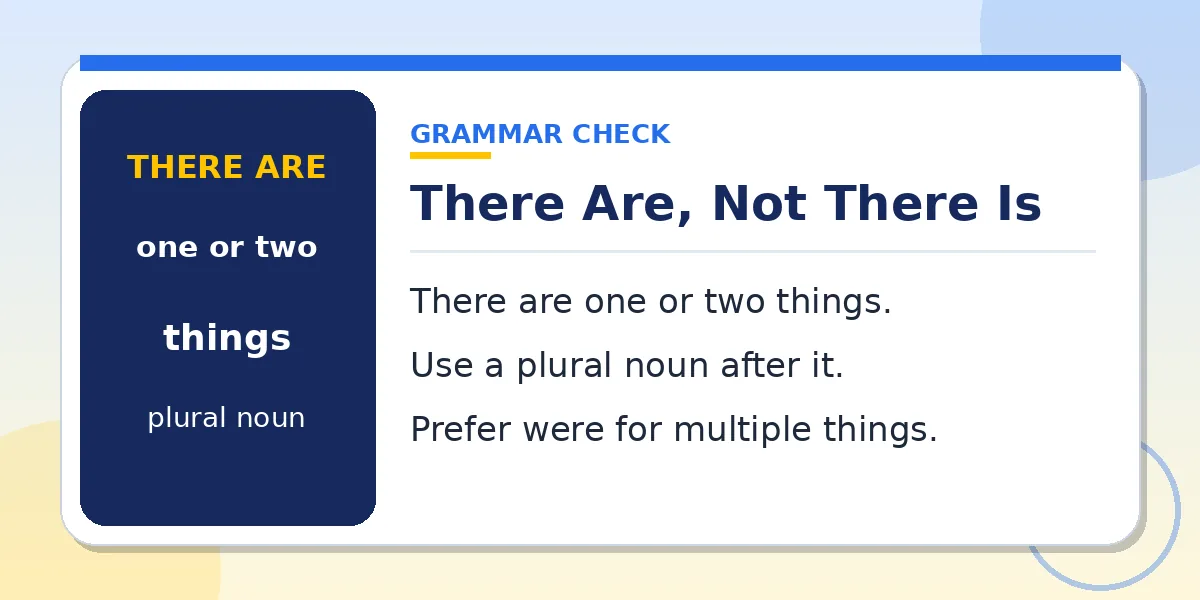
- There are one or two things I want to discuss.
- There have been one or two changes.
- There are one or two errors in the document.
Avoid “There is one or two things” in ordinary writing. The word “there” does not determine subject agreement. The noun phrase that follows the verb helps explain the agreement.
One or Two vs. One of Two
These expressions look similar, but they communicate different ideas. One or two means a few or presents a choice between one and two. Example: “I have one or two ideas for the project.” One of two identifies a single item from a pair or group. Example: “This is one of two possible solutions.” The second construction follows the pattern “one of plus plural noun.” Its subject is singular. Examples: One of the students is absent. One of the options is correct. One of the two answers was accepted. Do not write “There are one of two things” when you mean a small number of things. Choose based on meaning: “There are one or two things to discuss” (a small number) versus “There is one of the two things I want to discuss” (one item from a pair).
Should You Hyphenate One or Two?
Write the ordinary expression without hyphens. Correct: one or two questions, changes, days. Incorrect: one-or-two questions, changes. However, compound adjectives can use a suspended hyphen when they share a final word. Examples: a one- or two-page document; a one- or two-year agreement. The hyphen after “one” signals that the word “page” or “year” applies to both numbers. Use this construction only when the sentence needs a compound modifier. Otherwise, keep the expression open.
One or Two vs. Similar Expressions
English has several expressions for describing small quantities. They may seem interchangeable, but their meanings differ.
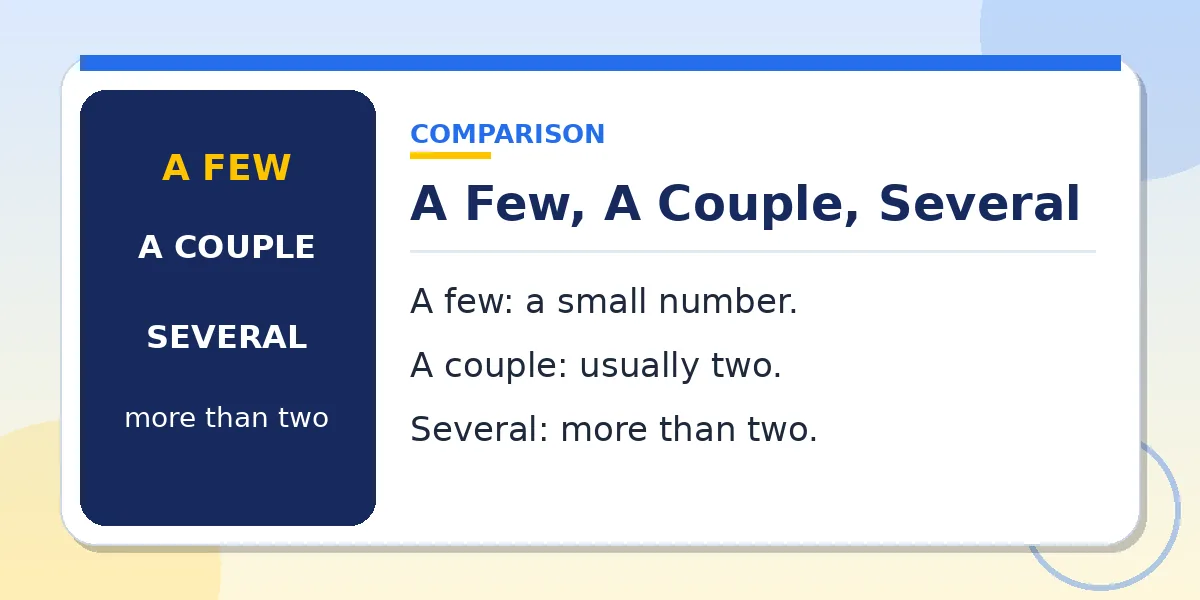
| Expression | Meaning | Example |
|---|---|---|
| One or two | A few or a small number; can also mean exactly one or two | I have one or two questions. |
| A few | Some; a small number; does not specify an exact count | I have a few questions. |
| A couple | Usually two; can loosely describe a small number | I will be there in a couple of minutes. |
| Several | More than two; usually suggests a number greater than a couple | Several students attended. |
| A handful | A small number; emphasizes a limited group or quantity | Only a handful of people came. |
One or Two vs. A Few
Both expressions can describe a small, unspecified quantity. Neither requires an exact count. However, the first expression can also describe exactly one or two items. “A few” does not offer that literal choice.
One or Two vs. A Couple
“A couple” usually means two. In everyday conversation, people also use it loosely for a small number. Examples: I will be back in a couple of minutes. I will be back in one or two minutes. We bought a couple of books. The expressions can overlap in casual situations. However, “a couple” has a stronger connection to the number two.
One or Two vs. Several
“Several” generally describes more than two people or things. It often suggests a larger quantity than “one or two.” Examples: Several employees attended the meeting. Several customers requested a refund. Several books were missing from the shelf. The exact quantity depends on context. Avoid treating “several” as a fixed numerical range.
One or Two vs. A Handful
“A handful” describes a small, limited quantity. It often emphasizes how few people or things are involved. Examples: Only a handful of students joined the club. I have a handful of ideas for the presentation. Both expressions can describe small quantities. However, “a handful” creates a stronger impression of a limited group.
Other Expressions Related to One or Two
- A thing or two: a small amount of knowledge or experience. Example: “She knows a thing or two about photography.”
- In ones and twos: people or things arriving or moving in small groups, often gradually. Example: “The guests arrived in ones and twos.”
- One of two: a single item from a pair. Example: “One of two applicants will receive the position.”
These expressions share words or ideas, but their grammatical functions differ.
Examples of One or Two in Different Contexts
Workplace and Professional Communication
- I have one or two points to add to the meeting agenda.
- We need one or two changes before submitting the report.
- I noticed one or two issues in the final draft.
- There are one or two details we should review.
- She asked one or two questions during the presentation.
School and Education
- Ask me one or two questions after class.
- I have one or two assignments left this week.
- There are one or two topics I still need to review.
- The teacher suggested one or two useful books.
- I made one or two mistakes on the test.
Everyday Conversations
- I need one or two things from the grocery store.
- We invited one or two friends over for dinner.
- I have one or two errands to run.
- Can you bring one or two extra chairs?
- I need one or two minutes to get ready.
Feedback and Suggestions
- I have one or two small suggestions for your presentation.
- There are one or two details we could improve.
- I noticed one or two areas that need more attention.
- Your essay has one or two points worth revising.
These sentences can sound gentle because they present feedback as limited. The effect depends on context.
Time and Scheduling
- Give me a minute or two.
- I will call you in an hour or two.
- We may need a day or two to decide.
- The repairs should take a week or two.
- She plans to return in a month or two.
Literal Numerical Choices
- Do you want one or two tickets?
- Choose one or two books from the shelf.
- Bring one or two printed copies.
- You may invite one or two guests.
- Would you like one or two extra chairs?
In these sentences, the listener must choose or provide exactly one or two items.
Common Mistakes to Avoid
Assuming It Always Means Exactly Two
The phrase does not always describe a precise number. Incorrect interpretation: “I have one or two questions” must mean exactly two questions. Better understanding: The speaker may have a few questions without specifying the exact count. Always consider surrounding context.
Confusing One or Two With One of Two
Incorrect: “There are one of two things I want to discuss.” Correct: “There are one or two things I want to discuss.” Use “one of the two things” when identifying a single item from a pair.
Using a Singular Noun After the Expression
Incorrect: “I have one or two question.” Correct: “I have one or two questions.”
Using It Directly With Uncountable Nouns
Incorrect: one or two water; one or two information. Correct: one or two bottles of water; one or two pieces of information. You can also say “a little water” or “a bit of information.”
Using It When an Exact Number Is Required
Approximate language can create confusion when precision matters. For example, a delivery order needs a specific quantity. A deadline also needs a clear date or time. Instead of saying “Send one or two copies,” specify the required number when the instruction demands precision.
Writing One Day or Two Instead of A Day or Two
The usual time pattern uses an article before the singular time unit. Incorrect: “I will return in one day or two.” Better: “I will return in a day or two.” You can also write “I will return in one or two days.” Both standard patterns communicate an approximate period.
Adding Unnecessary Hyphens
Incorrect: “We discussed one-or-two ideas.” Correct: “We discussed one or two ideas.” Remember the compound adjective exception, such as “a one- or two-page document.”
Treating Numerical Estimates as Grammar Rules
Do not assume that “a few,” “several,” or “a handful” always represents a fixed number. These expressions depend on context. Their meanings can overlap, and speakers may interpret them differently. Use them according to the situation rather than following unsupported numerical formulas.
Memory Trick: How to Remember One or Two
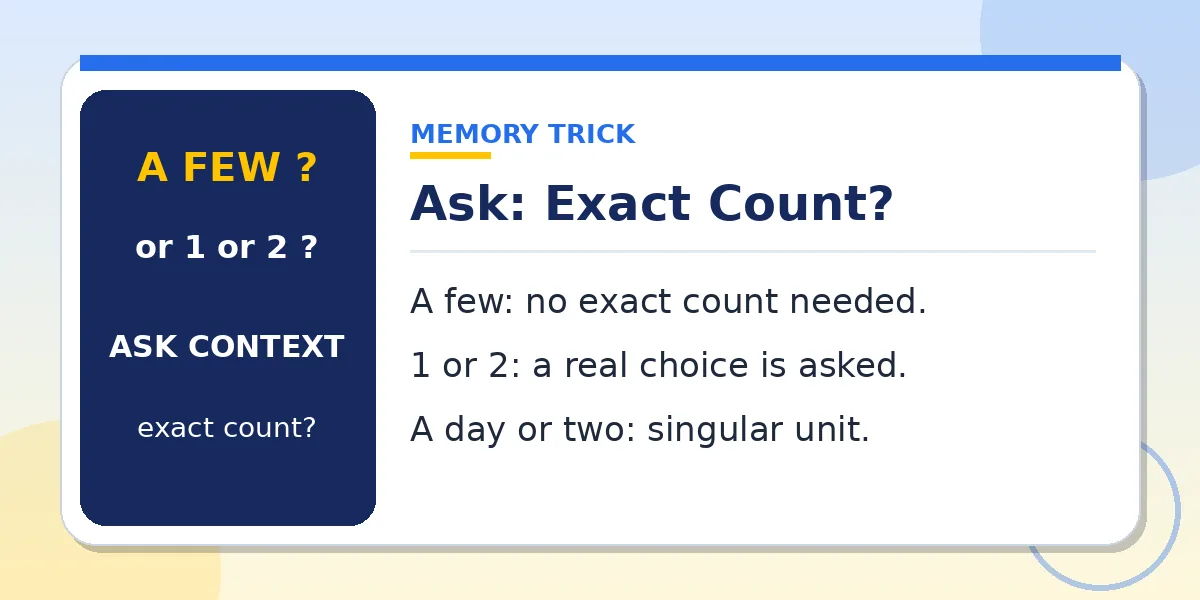
Think of “a few” for an approximate quantity and “1 or 2” for an exact choice. “I have one or two questions.” This means a few questions. “Choose one or two tickets.” This means exactly one or two tickets. Remember these two grammar patterns: A day or two uses a singular time unit. One or two days uses a plural noun. The easiest way to remember the difference is to check the context. Ask yourself whether the speaker needs an exact count.
Practice Questions: Test Your Understanding
- “I have one or two suggestions for your essay.” What does the phrase mean here? A. No suggestions B. A few suggestions C. Exactly ten suggestions
- “There are one or two _____ left to complete.” Which word fits? A. task B. tasks C. task’s
- “I need _____ to finish this.” Which phrase fits? A. a hour or two B. an hour or two C. one hour or two
- “This is one of two available options.” What does it mean? A. A few options B. One option from a pair C. Several options
- Which sentence is correct? A. There is one or two problems. B. There are one or two problems. C. There are one or two problem.
- Which sentence uses hyphenation correctly? A. I have one-or-two questions. B. She prepared a one- or two-page document. C. We discussed one-or-two ideas.
- “Would you like one or two copies?” What does it ask? A. A few copies without a specific number B. Exactly one or exactly two copies C. Several copies
- Which expression usually means two but can also be used loosely? A. A handful B. A couple C. Several
- “We should receive an update in a _____.” Which phrase fits? A. week or two B. weeks or two C. one week or two
- Which sentence is correct? A. One of the students are absent. B. One of the students is absent. C. One of the student is absent.
Answer Key
- B. It describes a few suggestions without giving an exact count.
- B. Use the plural noun “tasks.”
- B. “An” comes before “hour” because it begins with a vowel sound.
- B. “One of two” identifies one item from a pair.
- B. “There are” agrees with the plural noun “problems.”
- B. The suspended hyphen connects the shared word “page” to both numbers.
- B. The question asks the listener to choose exactly one or two copies.
- B. “A couple” usually means two but can have a looser meaning.
- A. “A week or two” uses a singular time unit.
- B. “One” is singular, so it takes the singular verb “is.”
Frequently Asked Questions
What does one or two mean?
It usually means a few or a small number, not an exact count. In a question or instruction, it can also mean exactly one item or exactly two items. The surrounding sentence shows which meaning is intended.
Does one or two mean exactly two?
No, it does not always mean exactly two. In most everyday statements, it describes an approximate small quantity, such as a few questions or changes. It means exactly two only in a clear choice between one and two.
Is one or two grammatically correct?
Yes, it is a standard English expression used by dictionaries and speakers. It normally appears before a plural countable noun, such as questions, days, or suggestions. Use it for a small quantity, and choose an exact number when precision matters.
Should I use was or were with one or two?
Use were in ordinary sentences about multiple people or things, such as one or two students were absent. Singular was is also attested in some established constructions, but plural agreement is the clearer everyday choice. For there sentences, use are.
Is one or two hyphenated?
No, the ordinary expression uses spaces and no hyphens, as in one or two questions. Use a suspended hyphen only in a compound modifier, such as a one- or two-page document. Otherwise, keep the expression open.
What is the difference between one or two and a few?
Both can describe a small, unspecified quantity. The difference is that one or two can also present an exact choice between one and two. A few does not offer that literal choice, so use it for approximate quantity only.
What is another way to say one or two?
You can say a few, a small number, or sometimes a couple, depending on context. A few is the closest replacement for the approximate meaning. A couple usually means two, so use it only when that loose meaning fits.
Final Takeaway
The expression one or two usually means a few or a small number. It can also refer to exactly one or two. Remember: use plural countable nouns after the expression; prefer plural verbs when referring to multiple things; use “a day or two” for approximate time periods; keep the ordinary expression free of hyphens; use “one of two” when identifying a single item from a pair; choose exact numbers when accuracy matters. The most important lesson is simple: context determines whether the expression describes an approximate amount or an exact numerical choice.