

Weather vs Whether: Meaning, Rules, and Examples
Quick Answer
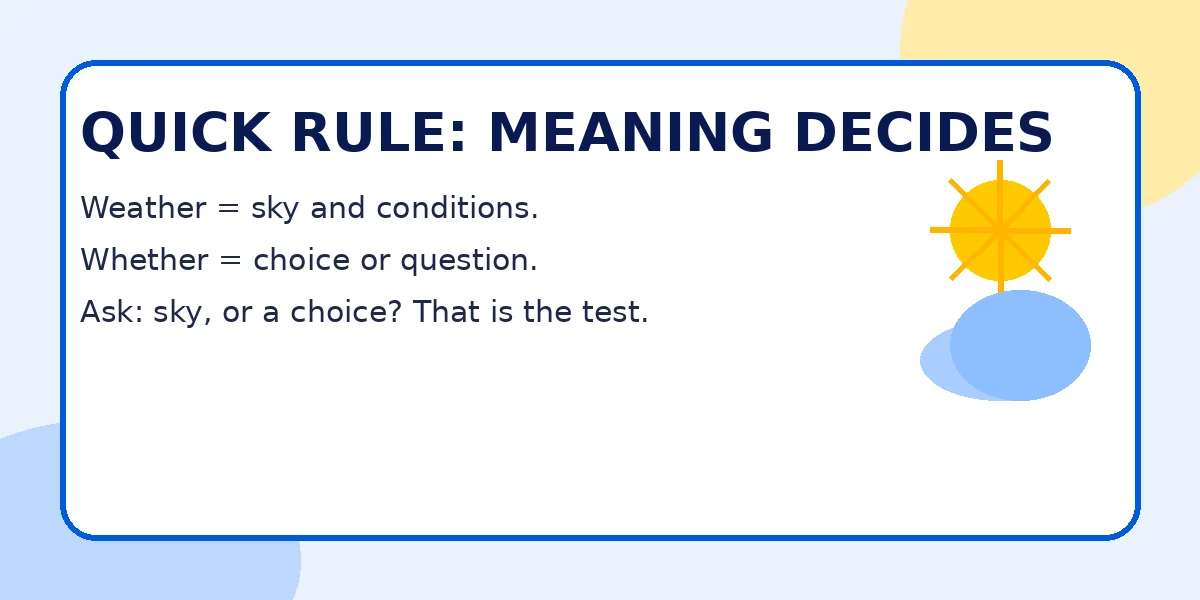
Weather refers to atmospheric conditions, such as rain, sunshine, wind, and temperature. Whether introduces a choice, alternatives, or an indirect yes or no question. Both words sound alike, but their meanings and spellings are different.
- Weather: The weather looks beautiful today.
- Whether: I wonder whether it will rain tomorrow.
Use weather when you talk about atmospheric conditions or enduring a difficult situation. Use whether when you introduce a choice, uncertainty, or an indirect question. Learning the difference between weather vs whether starts with meaning, not sound.
Table of Contents
- At a Glance
- What Does Weather Mean?
- What Does Whether Mean?
- Key Differences
- How to Choose in 10 Seconds
- Weather as a Verb
- How to Use Whether Correctly
- Whether vs If
- What Does Wether Mean?
- Common Mistakes
- Memory Tricks
- Examples in Everyday Sentences
- Practice Questions and Answer Key
- Frequently Asked Questions
- Related Guides
At a Glance
The easiest way to understand these words is to look at their meanings and grammatical roles.
| Feature | Weather | Whether |
|---|---|---|
| Part of speech | Noun or verb | Conjunction |
| Main meaning | Atmospheric conditions or enduring difficulty | Choice, alternatives, or uncertainty |
| Typical context | Rain, sunshine, wind, and temperature | Decisions and indirect questions |
| Example | The weather is warm today. | I cannot decide whether to go. |
| Memory clue | Atmosphere | Either or |
Both words are homophones. They have the same pronunciation but different meanings and spellings. You cannot identify the correct spelling by sound alone. You must understand what the sentence means. If you remember only one idea from this guide to weather vs whether, remember this: meaning decides the spelling.
What Does Weather Mean?
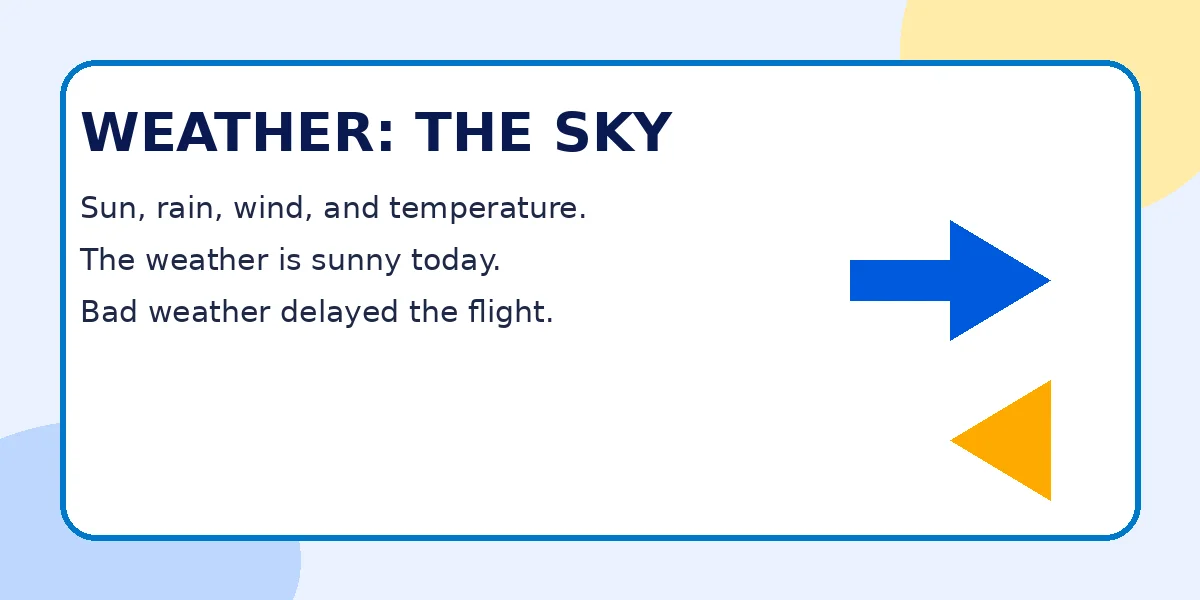
Weather is a noun that describes the atmospheric conditions at a particular place and time. It includes temperature, precipitation, humidity, wind, and cloud cover. These conditions can change by location and time.
- The weather is pleasant this afternoon.
- Heavy rain caused several travel delays.
- Our weather forecast predicts strong winds tonight.
- The children stayed indoors because of the cold weather.
In these sentences, weather describes conditions in the atmosphere.
Weather as an Uncountable Noun
Weather is generally an uncountable noun in everyday English. This means you do not normally use a or an before it.
- Correct: We had bad weather during our vacation.
- Incorrect: We had a bad weather during our vacation.
The natural expression is bad weather, not a bad weather. You can describe weather with adjectives such as good weather, beautiful weather, stormy weather, cold weather, and unpredictable weather. If you want to describe a particular period, you can use an expression such as a spell of good weather.
Common Expressions With Weather
| Expression | Meaning |
|---|---|
| Weather forecast | A prediction of upcoming atmospheric conditions |
| Bad weather | Unpleasant or dangerous atmospheric conditions |
| Sunny weather | Weather with plenty of sunshine |
| Severe weather | Dangerous conditions, such as storms |
| Cold weather | Weather with low temperatures |
These expressions appear often in conversations, news reports, and everyday writing.
What Does Whether Mean?
Whether is a conjunction. It introduces alternatives, choices, doubt, or indirect yes or no questions. It helps explain when someone is unsure about something or must consider different possibilities.
- I cannot decide whether to study tonight.
- She asked whether we wanted lunch.
- We need to determine whether the plan will work.
- He wondered whether his application was accepted.
In each sentence, whether introduces uncertainty or a question. That choice meaning is the second half of weather vs whether.
Whether for Choices and Alternatives
Use whether when someone must consider two or more possibilities. The alternatives can be stated directly or understood from the context.
- I cannot decide whether to walk or drive.
- She asked whether we preferred coffee or tea.
- They must choose whether to accept the invitation.
- We discussed whether the event should happen indoors.
Notice how whether introduces a decision or a choice.
Whether in Indirect Questions
An indirect question reports or expresses a question without asking it directly. Whether often introduces indirect questions that expect a yes or no answer.
| Direct question | Indirect question |
|---|---|
| Is he available? | I wonder whether he is available. |
| Did she call? | He asked whether she had called. |
| Will the store open? | We need to know whether the store will open. |
Indirect questions use normal statement word order. Write “I wonder whether she is ready.” Do not write “I wonder whether is she ready.”
Key Differences
The main difference is what each word communicates. Weather describes atmospheric conditions or the act of enduring something. Whether introduces alternatives or uncertainty. This contrast is the heart of weather vs whether, and it guides every example in this guide.
| Comparison | Weather | Whether |
|---|---|---|
| Meaning | Atmospheric conditions | Choice or uncertainty |
| Grammar | Noun and verb | Conjunction |
| Refers to rain or sunshine | Yes | No |
| Introduces alternatives | No | Yes |
| Appears in indirect questions | No | Yes |
| Example | The weather changed suddenly. | I asked whether she agreed. |
Remember these basic distinctions:
- Use weather when discussing the atmosphere.
- Use weather as a verb when describing endurance or gradual environmental change.
- Use whether when expressing a choice or uncertainty.
- Use whether to introduce indirect yes or no questions.
The correct word depends on the meaning of the sentence, not its pronunciation.
How to Choose in 10 Seconds
You can choose the correct spelling by asking one simple question. Use this two-test method for weather vs whether whenever you pause over the spelling.
Use the Atmosphere Test for Weather
Ask yourself: “Does this sentence discuss atmospheric conditions or surviving a difficult situation?” If the answer is yes, use weather.
- The weather looks cloudy.
- We expect warm weather this weekend.
- The business weathered a difficult financial period.
The first two examples describe atmospheric conditions. The third uses weather as a verb.
Use the If or Choice Test for Whether
Ask yourself: “Does this sentence introduce a choice, alternative, or indirect question?” If the answer is yes, use whether.
- I cannot decide whether to buy the blue shirt.
- She asked whether the meeting was canceled.
- We must determine whether to continue.
Each sentence expresses a decision or uncertainty.
Compare Both Words in One Sentence
Sometimes both words appear in the same sentence. Consider this example: “I do not know whether the weather will improve.”
Here, whether introduces uncertainty. Weather refers to atmospheric conditions. This pair shows the distinction in a single, natural sentence.
Weather as a Verb
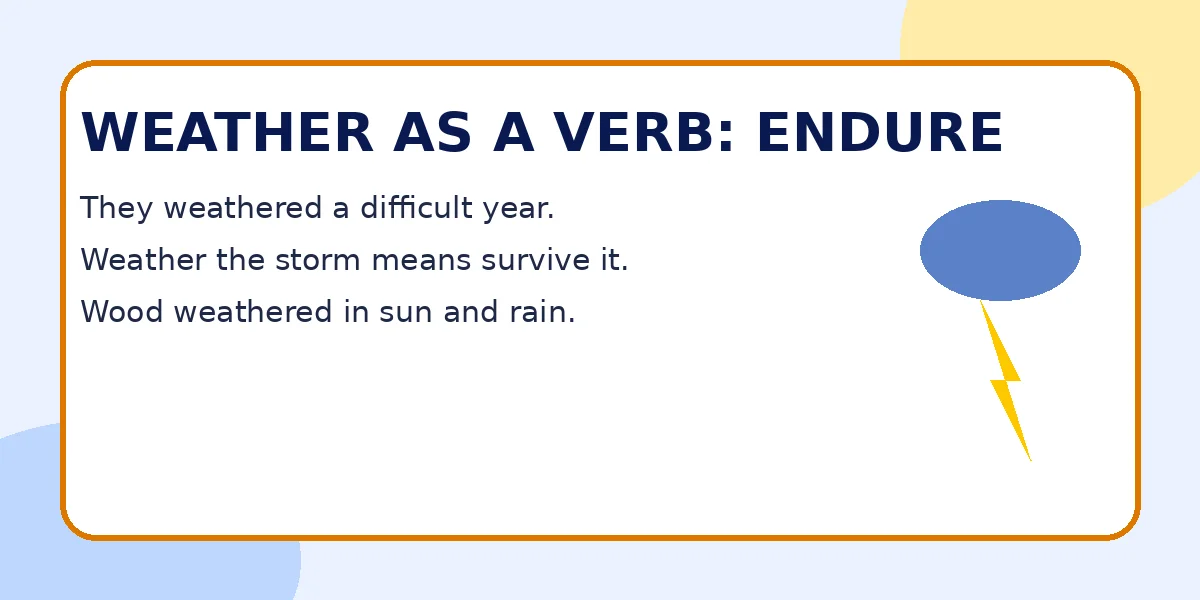
Weather is not only a noun. It can also function as a verb with two important meanings. Verb use often confuses readers, so weather vs whether needs this extra check.
Weather Means to Endure a Difficult Situation
As a verb, weather can mean to survive or deal successfully with a difficult experience. It often appears in discussions about challenges, financial problems, and personal struggles.
- The company weathered the economic downturn.
- She weathered several professional setbacks.
- Our family weathered a difficult year.
A common expression is weather the storm. It means to survive a difficult period without giving up or failing. For example: “The small business worked hard to weather the storm.” The sentence does not describe actual rain. It describes overcoming a challenge.
Weather Means to Change Through Exposure
Weather can also describe how materials change after exposure to environmental conditions. Sun, rain, wind, and temperature changes can gradually affect their color or shape.
- The wooden fence weathered over time.
- Rain and sunlight weathered the old stone building.
- The outdoor furniture weathered after years in the garden.
The word weathered describes the resulting condition or appearance.
Weather vs Whether in Verb Constructions
Remember that whether cannot replace weather in these expressions.
| Correct expression | Meaning |
|---|---|
| Weather the storm | Survive a difficult situation |
| Weather a crisis | Deal successfully with a crisis |
| Weather difficult conditions | Endure challenging circumstances |
| Weathered wood | Wood changed through exposure |
For example, “The team weathered the pressure” is correct. “Whether the pressure” does not communicate the same meaning.
How to Use Whether Correctly
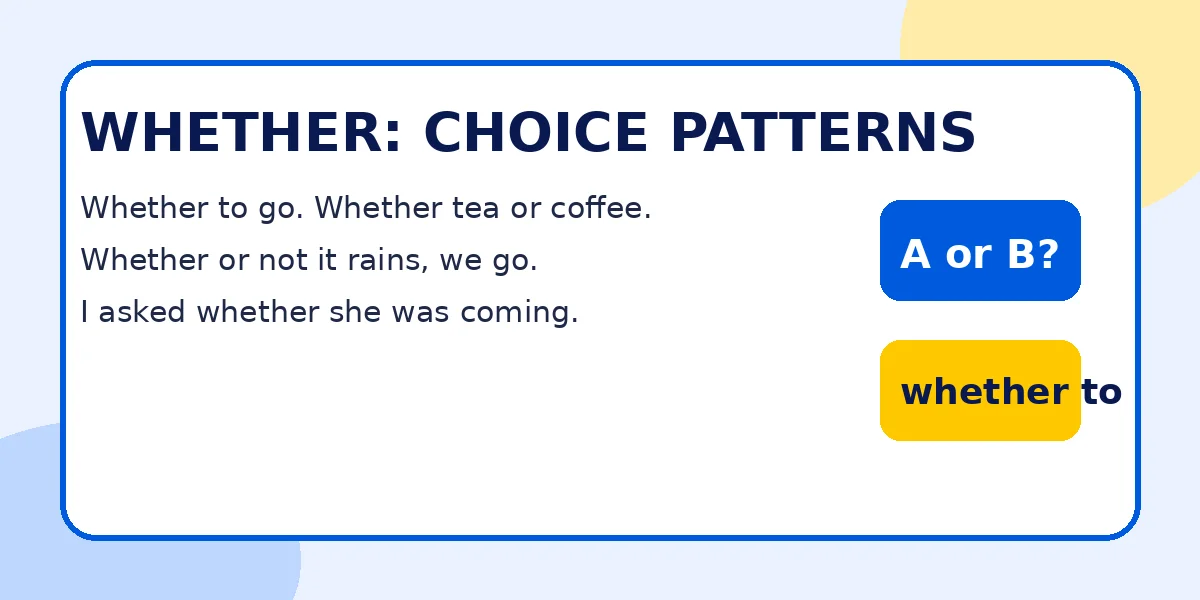
Whether appears in several common grammatical patterns. Understanding them will help you use it correctly.
Whether To + Verb
Use whether to introduce a decision about taking an action. The basic structure is: whether + to + base verb.
- I cannot decide whether to apply.
- She wondered whether to accept the invitation.
- We discussed whether to postpone the trip.
This construction is especially useful when the person making the decision is also the person taking the action.
Whether … Or …
Use whether … or … to introduce two or more alternatives.
- I cannot decide whether to stay or leave.
- She asked whether we wanted pizza or pasta.
- The manager must decide whether the team should work remotely or in the office.
Keep the alternatives grammatically balanced. For example, “whether to stay or to leave” is parallel. Both alternatives use an infinitive.
Whether or Not
The expression whether or not introduces uncertainty or shows that something applies regardless of the outcome. It can appear in different sentence positions.
Placement 1: Whether or not together
- I do not know whether or not the store is open.
- Whether or not we receive approval, we must prepare.
- She will attend whether or not her friends come.
Placement 2: Whether … or not separated
- Whether he agrees or not, we need to finish.
- We will continue whether the weather improves or not.
- She plans to travel whether her family approves or not.
Both placements are grammatically correct. The meaning depends on the surrounding sentence. Sometimes the expression presents uncertainty. In other cases it shows that the main statement applies regardless.
Whether in Indirect Questions
Use whether when reporting a question that expects a yes or no answer.
- I asked whether the office was open.
- He wants to know whether his package arrived.
- They wondered whether the teacher had received their assignments.
Notice that the word order remains the same as in a statement. Correct: “She asked whether I was available.” Incorrect: “She asked whether was I available.” Cambridge English Grammar also explains that whether introduces indirect yes or no questions.
Whether vs If
Whether and if sometimes have the same meaning, but they are not interchangeable in every situation. This section closes a common gap in weather vs whether guides: when if can and cannot replace whether. Both can introduce indirect yes or no questions. However, whether is more suitable in several specific constructions.
When Whether and If Are Interchangeable
Both words can introduce many indirect questions.
- I wonder whether she is coming.
- I wonder if she is coming.
Both sentences are correct. Another example:
- He asked whether I had finished.
- He asked if I had finished.
Both versions report the same indirect question. Whether often sounds more formal in written English.
When Whether Is Preferred or Required
Use whether in these important situations.
- Before an infinitive with to. Correct: “I cannot decide whether to accept the offer.” Do not use “if to” in this construction.
- After a preposition. Correct: “It depends on whether they approve.” Whether is the standard choice after a preposition in this construction.
- When presenting alternatives. Example: “We must decide whether to travel by car or take the train.” Whether clearly introduces the available options.
- When expressing an outcome that does not matter. Example: “Whether you agree or disagree, the decision remains final.” This construction emphasizes that the main statement applies either way.
When If Expresses a Condition
If also has an important conditional meaning. It introduces a condition that must happen before another event or result.
| Sentence | Meaning |
|---|---|
| If it rains, we will cancel the picnic. | Rain is the condition for canceling. |
| We do not know whether it will rain. | The speaker is uncertain about the forecast. |
The first sentence describes a condition. The second expresses uncertainty. This distinction helps you choose the right word in more complicated sentences.
What Does Wether Mean?
Wether is a real English word, but it has a specialized farming meaning. A wether is a castrated male sheep. Some dictionaries also include a castrated male goat.
Example: “The farmer moved the wether into a separate enclosure.”
Wether is not another spelling of weather or whether.
| Word | Meaning |
|---|---|
| Weather | Atmospheric conditions or to endure |
| Whether | Introduces alternatives or uncertainty |
| Wether | A castrated male sheep |
Most everyday writers will rarely need wether. However, recognizing it can prevent confusion when reading farming or historical texts.
Common Mistakes
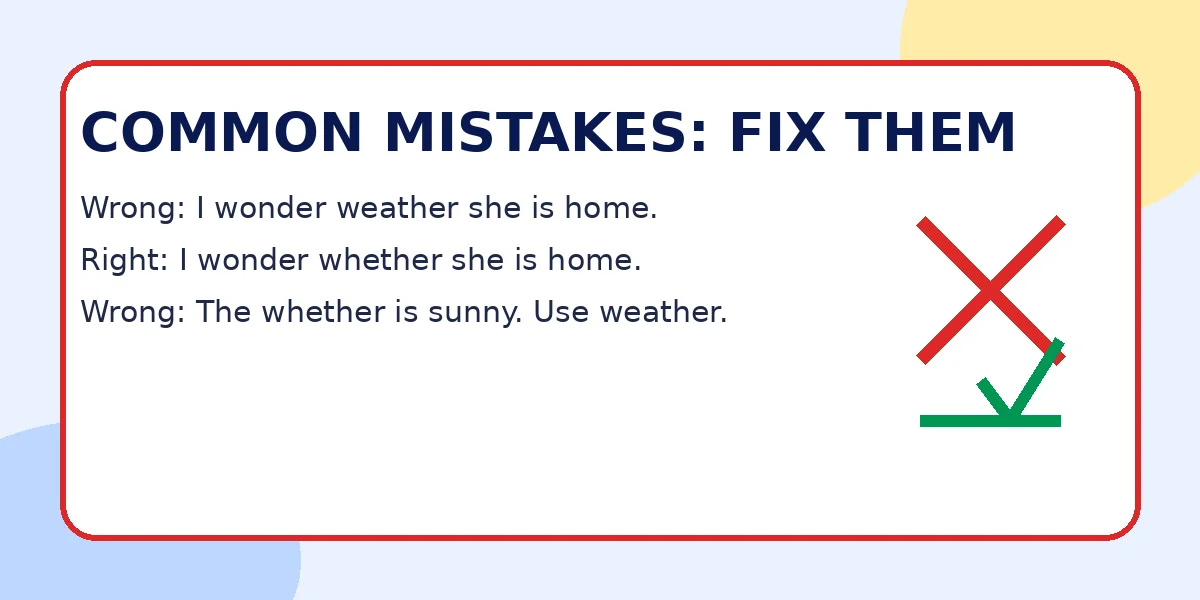
These mistakes often happen because the words sound alike. The best solution is to check the meaning of the sentence before choosing a spelling. Many of these errors come from the same confusion at the center of weather vs whether, so a quick meaning check fixes most of them.
| Incorrect | Correct | Explanation |
|---|---|---|
| I wonder weather she is home. | I wonder whether she is home. | Introduces an indirect question. |
| The whether is sunny. | The weather is sunny. | Refers to atmospheric conditions. |
| We must whether the storm. | We must weather the storm. | Uses weather as a verb. |
| I do not know weather to go. | I do not know whether to go. | Introduces a decision. |
| Weather or not you agree, come along. | Whether or not you agree, come along. | Expresses an outcome independent of agreement. |
| We had a bad weather. | We had bad weather. | Weather is generally uncountable. |
Mistakes in Everyday Conversations
People often confuse these words in messages and casual writing.
- Incorrect: “I hope the whether stays nice.”
- Correct: “I hope the weather stays nice.”
- Incorrect: “Let me know weather you are coming.”
- Correct: “Let me know whether you are coming.”
Mistakes in School Writing
Students may confuse the words in essays, assignments, and examination answers.
- Incorrect: “The essay discusses weather students should study abroad.”
- Correct: “The essay discusses whether students should study abroad.”
- Incorrect: “The teacher asked weather we understood.”
- Correct: “The teacher asked whether we understood.”
Mistakes in Workplace Writing
These spelling mistakes can also appear in professional emails and reports.
- Incorrect: “Please confirm weather the meeting is canceled.”
- Correct: “Please confirm whether the meeting is canceled.”
- Incorrect: “The team must whether the pressure.”
- Correct: “The team must weather the pressure.”
Always check the meaning of the sentence before sending important written communication.
Memory Tricks
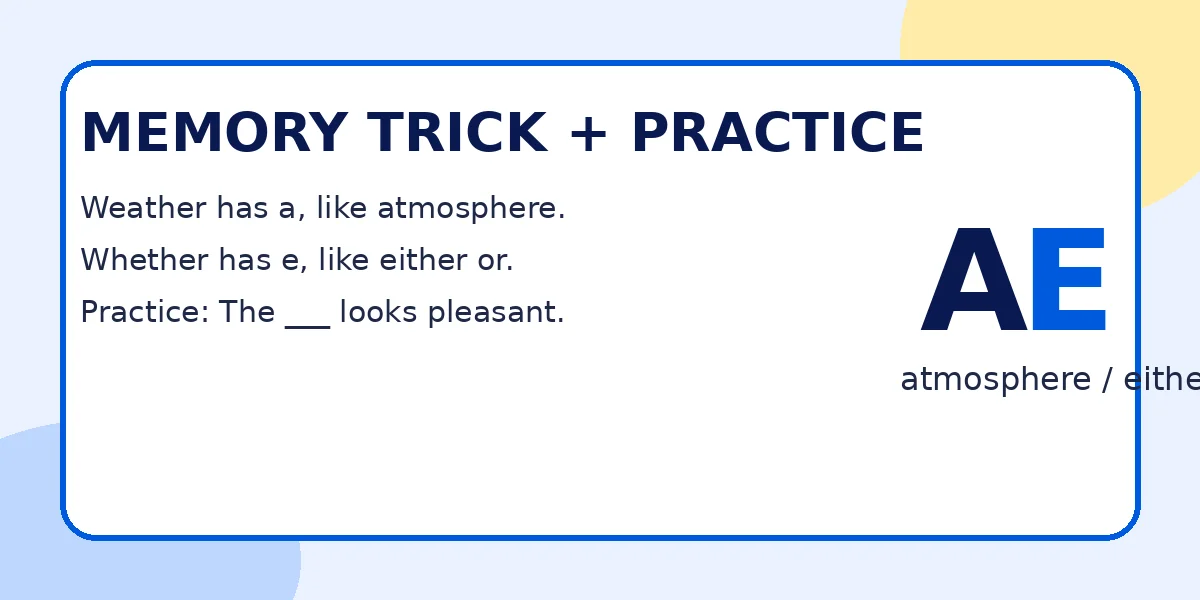
A few simple spelling associations can help you remember these words. Treat them as memory aids, not as formal grammar rules. These aids make weather vs whether easier to recall under time pressure.
Remember Weather With Atmosphere
Weather contains the letter a. Connect that letter with atmosphere. Both words relate to conditions such as rain, sunshine, wind, and temperature.
Remember Weather With Sea
Weather contains the letters “ea,” just like sea. Think about how wind, rain, and sunshine affect the sea. This association can help you remember the atmospheric meaning of weather.
Remember Whether With Either or
Whether contains the letter “e,” like either. Both words can help you think about choices and alternatives. Remember this pattern: “Whether to choose this or that.”
The Simplest Memory Rule
Keep these three associations in mind:
- Weather = Atmosphere.
- Whether = Choice.
- Wether = Sheep.
When you remember the meanings, choosing the correct spelling becomes much easier.
Examples in Everyday Sentences
The sentences below show weather vs whether in work, school, and everyday life.
Weather Examples
- The weather forecast predicts heavy rain tomorrow.
- We enjoyed the warm weather during our vacation.
- Bad weather forced the school to cancel its outdoor event.
- The company managed to weather a difficult financial year.
- Sunlight gradually weathered the wooden door.
Whether Examples
- I cannot decide whether to order lunch or dinner.
- She asked whether the library was still open.
- We need to determine whether the proposal is realistic.
- Whether you win or lose, keep practicing.
- He wondered whether his application had been approved.
Weather and Whether in the Same Sentence
Both words can appear naturally in one sentence.
- I wonder whether the weather will improve before our trip.
- We must decide whether to cancel the event because of the weather.
- Whether the weather stays warm or turns cold, the tournament will continue.
- She asked whether the weather forecast included a chance of snow.
In these examples, weather describes atmospheric conditions. Whether introduces a question or alternative.
Practice Questions and Answer Key
Test your understanding by choosing the correct word for each sentence. Fill each blank with weather, whether, or wether. Use these questions to test your grasp of weather vs whether before you move on.
- The ______ looks pleasant, so we should eat outside.
- I wonder ______ the new student will join our class.
- The small business managed to ______ the financial crisis.
- She cannot decide ______ to accept the job.
- We will attend the picnic ______ or not it rains.
- The old wooden fence has ______ badly over the years.
- He asked ______ we preferred coffee or tea.
- We will cancel the outdoor event if the ______ becomes dangerous.
- The farmer placed the ______ with the other sheep.
- I do not know ______ the ______ will improve tomorrow.
Answer Key With Explanations
- Weather: This sentence describes atmospheric conditions. Weather is the correct noun.
- Whether: The sentence expresses uncertainty about an indirect yes or no question.
- Weather: Here, weather is a verb meaning to survive or overcome a difficult situation.
- Whether: Use whether before an infinitive when introducing a decision.
- Whether: The expression whether or not introduces an outcome that does not change the main situation.
- Weathered: This verb describes gradual changes caused by exposure to environmental conditions.
- Whether: The sentence introduces two alternatives, coffee and tea.
- Weather: This noun refers to atmospheric conditions that could make the event unsafe.
- Wether: This farming term refers to a castrated male sheep.
- Whether, weather: Whether introduces uncertainty, while weather refers to atmospheric conditions.
Frequently Asked Questions
What Is the Difference Between Weather and Whether?
Weather describes atmospheric conditions, such as rain, wind, and sunshine, at a place and time. Whether introduces choices, alternatives, or indirect questions about what is true. Use weather for sky conditions and whether for a decision or doubt.
Is It Whether or Not or Weather or Not?
Whether or not is correct when you express uncertainty or show a result applies in both cases. Weather or not is incorrect in this meaning, because weather alone cannot introduce an alternative or an uncertain outcome.
Can Weather Be Used as a Verb?
Yes. Weather as a verb can mean to survive a hard time, as when a business weathers a crisis. It can also mean to change through exposure, as when sunlight and rain weather wood over time.
Is Whether the Same as If?
Whether and if overlap in many indirect yes or no questions, so both can sound natural there. However, they are not always interchangeable in grammar. Use whether before an infinitive, after a preposition, and when you name two clear alternatives.
What Does Wether Mean?
Wether is a farming term for a castrated male sheep, and some dictionaries also include a castrated male goat. It is a real word with a narrow meaning. It is not another spelling of weather or whether.
How Can I Remember Weather vs Whether?
Remember weather through atmosphere, rain, and sunshine, and link its letter a to atmosphere. Connect whether with either and choices. The meaning of a sentence, not the sound, tells you which spelling to use.
Related Guides
Want to understand more commonly confused English words? Explore these ClarifyWords guides: Then vs Than, Lie vs Lay, Principal vs Principle, Complement vs Compliment, Loose vs Lose, Its vs It’s, Whose vs Who’s, and Confused Words.