

Loose vs Lose: Meaning, Difference, Examples, and Easy Memory Trick
Loose means not tight. Lose means to misplace something or to fail. This guide to loose vs lose explains both words in plain language.
Quick Answer at a Glance
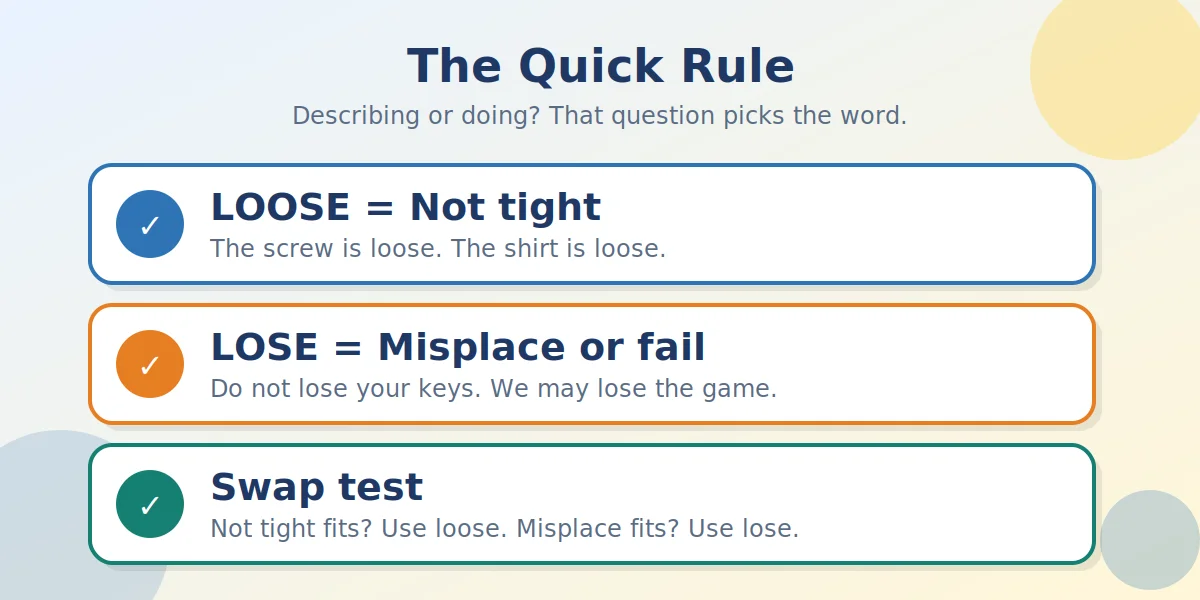
Use loose when something is not tight, not firmly fixed, or free to move. Use lose when you misplace something, fail, or no longer have it.
Loose means not tight. Example: My shoes are loose.
Lose means to misplace or fail. Example: Do not lose your keys.
If you can replace the word with not tight, use loose. If you can replace it with misplace or fail, use lose.
Table of Contents
- Quick Answer at a Glance
- What Does Lose Mean?
- What Does Loose Mean?
- Loose vs Lose: Comparison Table
- Pronunciation: Loose vs Lose
- How to Choose in 3 Steps
- Loose as a Verb
- Word Family: Loss, Lost, Loosen, Losing
- Examples in Sentences
- Common Mistakes: Loose vs Lose Correction Table
- Idioms and Phrases
- Memory Trick
- Practice Questions with Answer Key
- Frequently Asked Questions
- Final Takeaway
Loose and lose look similar, but they have different meanings, spellings, and pronunciations. Many learners mix them up in writing and tests. This guide explains the difference in simple words. You will learn clear definitions, examples, and a memory trick. You will also get practice questions to test your skills.
What Does Lose Mean?
Lose is a verb only. It means to misplace something, to fail, or to no longer have something.
Lose Definition
To lose means to stop having something. It can mean to misplace an object, to fail in a game, or to be defeated. It can also mean to waste time or an opportunity.
Common Uses of Lose
To misplace: I lose my phone often.
To fail: Our team may lose the match.
To be defeated: She did not want to lose the debate.
To stop having: He lost his job last year.
To waste: Do not lose time on this task.
Lose in Everyday Sentences
I always lose my glasses.
We could lose the game if we play badly.
She lost her wallet on the bus.
Do not lose hope. Keep trying.
What Does Loose Mean?
Loose is mainly an adjective. It means not tight, not firmly fixed, or free to move. It can also be a verb in some cases.
Loose Definition
Loose describes something that is not tight. It can describe clothes, a knot, a tooth, or a screw. It can also describe something that is free or not held in place.
Loose as an Adjective
The shirt is loose on me.
The dog is loose in the yard.
A loose screw needs fixing.
Her hair hung loose over her shoulders.
Loose as a Verb
As a verb, loose means to release or untie something. This use is less common in everyday speech.
He loosed the rope from the post.
She loosed the dog from its chain.
Loose in Everyday Sentences
My belt is too loose.
The button on my coat is loose.
The pages of the old book are loose.
The horse broke loose from the fence.
Loose vs Lose: Comparison Table
| Feature | Loose | Lose |
|---|---|---|
| Part of speech | Adjective, rarely a verb | Verb only |
| Pronunciation | /lu:s/ with an s sound | /lu:z/ with a z sound |
| Meaning | Not tight, free, or not firmly fixed | To misplace, fail, or no longer have |
| Rhymes with | Goose | Choose |
| Example | The knot is loose. | Do not lose the ticket. |
| Common error | Writing loose for lose | Writing lose for loose |
Pronunciation: Loose vs Lose
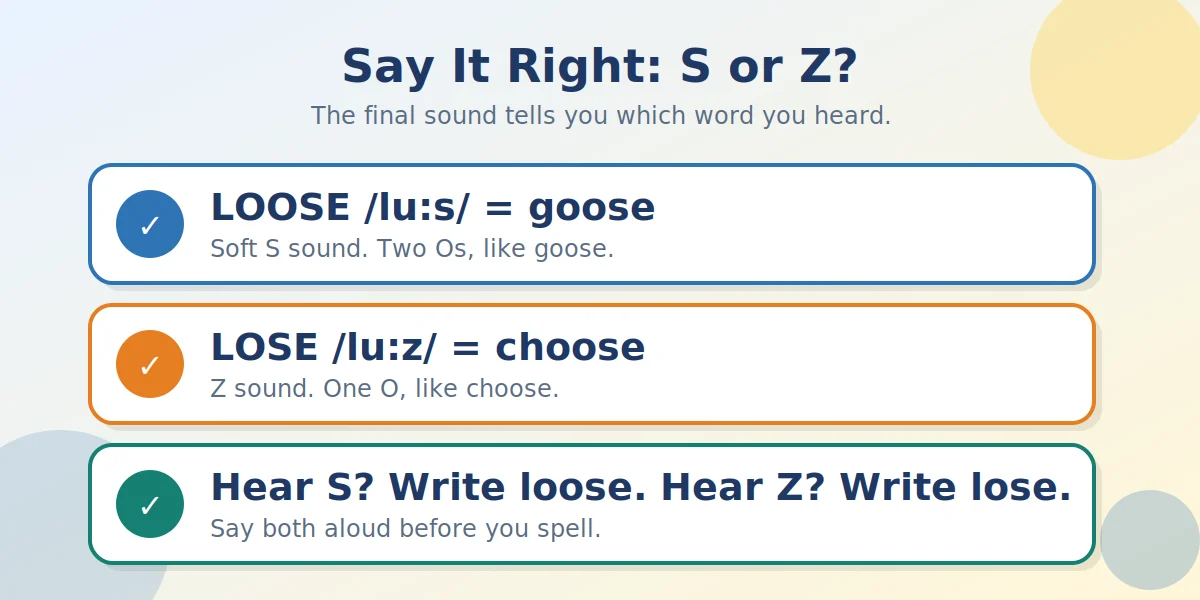
Pronunciation is a key difference in loose vs lose. The spelling changes the final sound.
How to Say Loose
Say loose as /lu:s/. It ends with a clear s sound. It rhymes with goose.
How to Say Lose
Say lose as /lu:z/. It ends with a z sound. It rhymes with choose.
Pronunciation Rule
If you hear an s sound, the word is loose. If you hear a z sound, the word is lose. This rule helps in listening and speaking tests.
How to Choose in 3 Steps
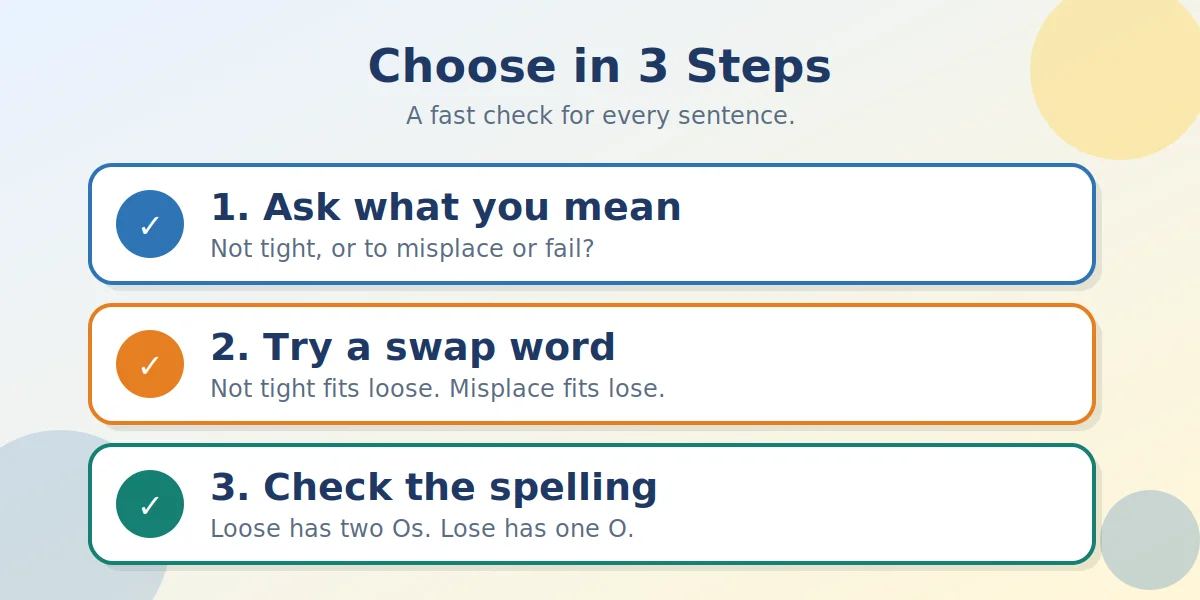
Use these three steps to pick the right word every time.
Step 1: Ask What You Mean
Ask yourself: Do I mean not tight or to misplace or fail? If you mean not tight, use loose. If you mean to misplace or fail, use lose.
Step 2: Test with a Replacement Word
Replace the word with not tight. If the sentence still makes sense, use loose. Replace the word with misplace or fail. If the sentence still makes sense, use lose.
Example: The screw is loose. Test: The screw is not tight. This works. So, loose is correct.
Example: I might lose my keys. Test: I might misplace my keys. This works. So, lose is correct.
Step 3: Check the Sentence
Read the full sentence again. Check the spelling. Loose has two Os. Lose has one O. This final check can catch a simple spelling error.
Loose as a Verb
Loose as a verb means to release, untie, or set free. It is less common than loose as an adjective. It is still correct in formal and literary English.
Loose vs Loosen
Loose means to release something fully. Loosen means to make something less tight. They are related but not the same.
Loose: He loosed the knot.
Loosen: She loosened the knot.
Use loosen when you make something less tight but not fully free. Use loose when you set something completely free.
Examples of Loose as a Verb
The farmer loosed the cows into the field.
He loosed the arrow from the bow.
She loosed her hair from the braid.
Word Family: Loss, Lost, Loosen, Losing
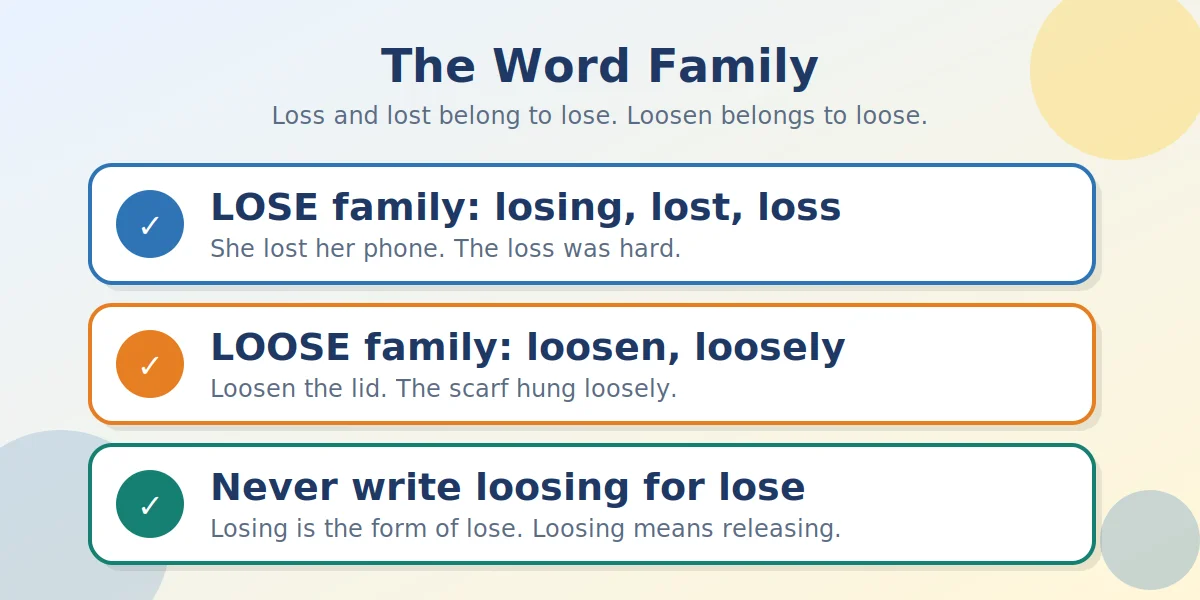
Word families help you avoid mistakes. Loss and lost belong to lose, not loose. Loosen belongs to loose.
Lose Word Family
| Word | Part of Speech | Meaning | Example |
|---|---|---|---|
| Lose | Verb | To misplace or fail | I do not want to lose this game. |
| Losing | Verb form | In the process of losing | We are losing the match. |
| Lost | Past tense | No longer have | She lost her phone. |
| Loss | Noun | The act of losing | The loss was hard for the team. |
Loose Word Family
| Word | Part of Speech | Meaning | Example |
|---|---|---|---|
| Loose | Adjective, verb | Not tight, or to release | The rope is loose. |
| Loosen | Verb | To make less tight | Loosen the lid before you open it. |
| Loosely | Adverb | In a loose way | The scarf hung loosely around her neck. |
| Looseness | Noun | The state of being loose | The looseness of the shirt made it comfy. |
Examples in Sentences
Loose Examples
- The door handle is loose.
- His jeans are too loose.
- The dog got loose from the yard.
- She wore a loose dress in summer.
- A loose tooth needs care.
Lose Examples
- I do not want to lose my job.
- We might lose the bus if we are late.
- He lost his temper during the talk.
- She lost weight last year.
- Do not lose your focus in the exam.
Mixed Examples for Contrast
- If the knot is loose, you may lose the package.
- A loose lid can make you lose water from the bottle.
- Do not lose your keys because the keychain is loose.
- A loose shoe can make you lose balance.
- If you lose weight, your clothes may feel loose.
Common Mistakes: Loose vs Lose Correction Table
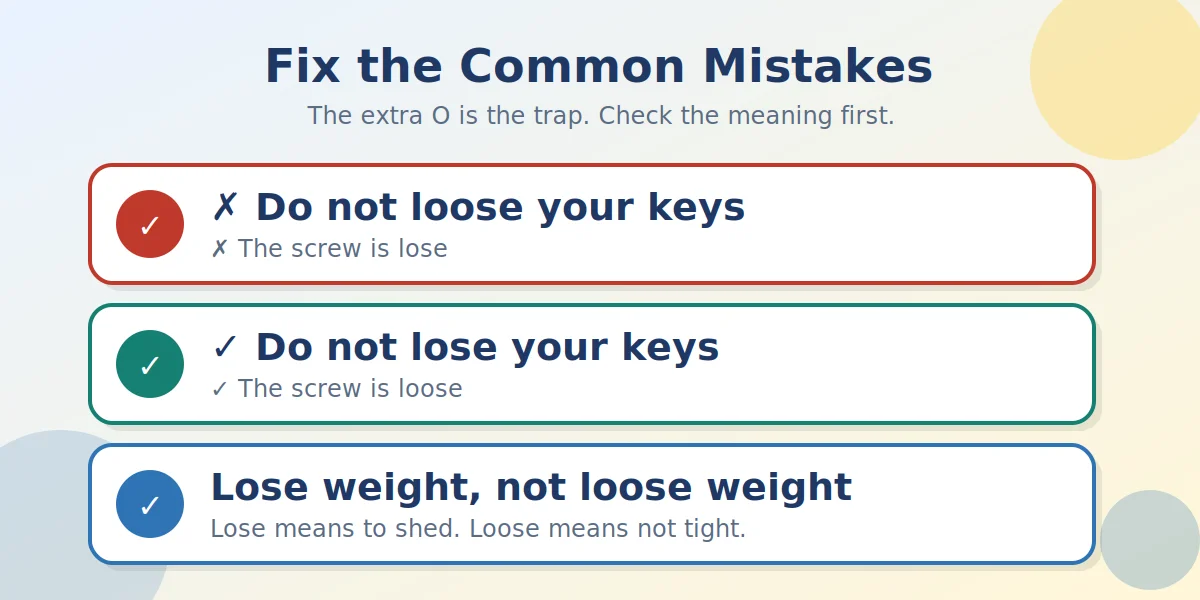
Many writers use loose when they mean lose. This is the most common error in loose vs lose grammar.
| Wrong Sentence | Correct Sentence | Reason |
|---|---|---|
| I hope I don’t loose my keys. | I hope I don’t lose my keys. | Lose means to misplace. |
| The team will loose the game. | The team will lose the game. | Lose means to fail. |
| My shoes are lose. | My shoes are loose. | Loose means not tight. |
| The screw is lose. | The screw is loose. | Loose means not firmly fixed. |
| Don’t loose your temper. | Don’t lose your temper. | Lose means to no longer control. |
| The dog is lose in the yard. | The dog is loose in the yard. | Loose means free to move. |
Why the Mistake Happens
The words look alike. They also sound alike to many learners. The extra O in loose causes confusion. Many people type fast and do not check the spelling.
How to Avoid It
Use the 3 step test in this guide. Check the meaning first. Then check the pronunciation. Then check the spelling. With practice, the choice becomes automatic.
Idioms and Phrases
Idioms with Loose
Cut loose: To break free or have fun without limits. Example: After exams, students cut loose and relaxed.
Let loose: To release or allow freedom. Example: The teacher let loose the balloons.
On the loose: Free and not caught. Example: The escaped dog is on the loose.
Loose ends: Small tasks left unfinished. Example: She tied up loose ends before the trip.
Idioms with Lose
Lose track: To forget where something is or how time passes. Example: I lost track of time.
Lose your temper: To become angry. Example: He lost his temper in the meeting.
Lose your cool: To lose calm control. Example: She did not lose her cool under pressure.
Lose sight of: To forget an important goal. Example: Do not lose sight of your dream.
Lose face: To lose respect or status. Example: He did not want to lose face in front of his team.
Memory Trick
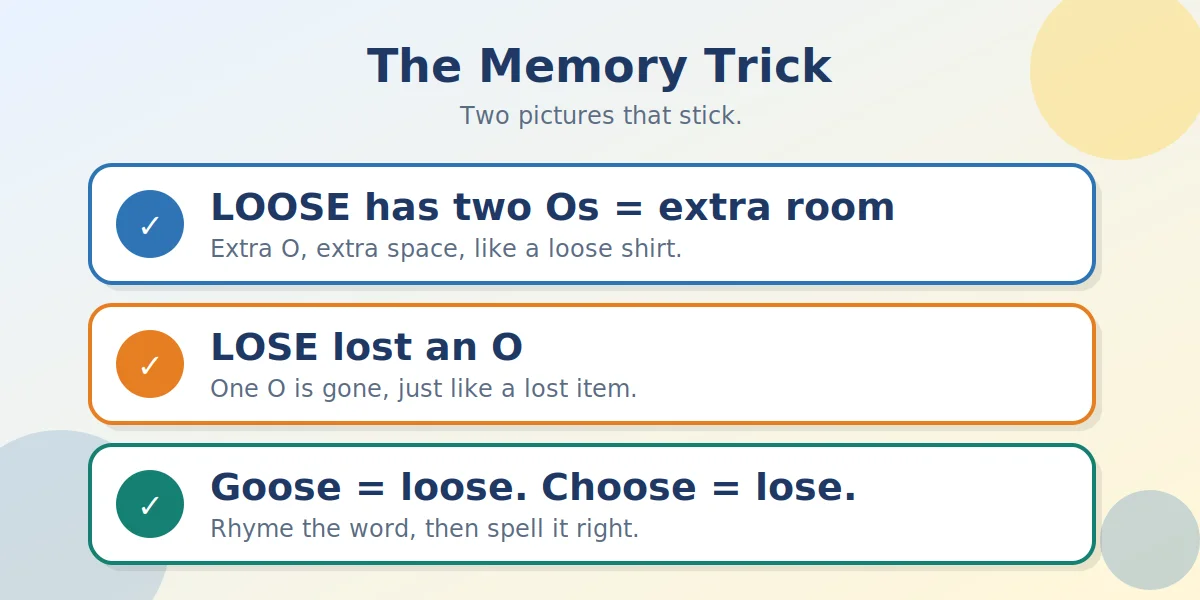
The Double O Trick
Loose has two Os. Think of the extra O as extra room. Something loose has room to move. Lose has one O. It lost the other O. This image makes the spelling easy to recall.
The Rhyme Trick
Loose rhymes with goose. Lose rhymes with choose. Say the rhymes aloud. The sound will guide your spelling.
Quick Visual Memory Aid
Picture a loose goose with room to move. Picture a person who must choose not to lose. These two images link sound, spelling, and meaning in one step.
Practice Questions with Answer Key
Choose loose or lose for each sentence.
- My jacket is too ______.
- I do not want to ______ my wallet.
- The knot on the rope is ______.
- Our team might ______ the final.
- The dog broke ______ from the chain.
- She did not want to ______ her job.
- A ______ screw can cause noise.
- Do not ______ hope.
- His pants feel ______ after weight loss.
- If you ______ your ticket, you cannot enter.
Answer Key
- Loose: The jacket is not tight.
- Lose: To misplace the wallet.
- Loose: The knot is not tight.
- Lose: To fail in the final.
- Loose: Free from the chain.
- Lose: To no longer have the job.
- Loose: Not firmly fixed.
- Lose: To no longer have hope.
- Loose: Not tight after weight loss.
- Lose: To misplace the ticket.
Frequently Asked Questions
Is loose a verb or an adjective?
Loose is mainly an adjective that means not tight, free, or not firmly fixed. It can also be a verb that means to release or untie something. That verb use is less common in everyday speech.
Is lose a noun?
No, lose is a verb only, so it cannot name a thing on its own. The noun form is loss, and it names the act of losing something. For example, the loss of the keys caused stress for the family.
What is the past tense of lose?
The past tense of lose is lost, and the past participle is also lost. For example, she lost her phone yesterday on the bus. She has lost it twice this month, so she now uses a zipped pocket.
What is the difference between loose and lose in pronunciation?
Loose is said with a clear s sound, and it rhymes with goose. Lose is said with a clear z sound, and it rhymes with choose. That final sound tells them apart.
How do you use loose and lose in a sentence?
Use loose to describe something that is not tight, such as a shirt that fits with room. Use lose when you mean to misplace, fail, or no longer have something, such as keys. Meaning should guide the word you choose.
What is the trick to remember them?
Loose has two Os, and that extra O gives a picture of extra room, just like something loose. Lose has only one O because it lost the other O. Loose rhymes with goose, while lose rhymes with choose.
Final Takeaway
Remember this one rule: Loose means not tight. Lose means to misplace or fail. Check the meaning first. Then check the sound. Then check the spelling. With this rule, you will avoid the most common mistake with these words.
Related ClarifyWords Guides
Explore more commonly confused words in the ClarifyWords Confused Words category.