

Principal vs Principle: Meaning, Rules, and Easy Examples
Principal and principle sound the same, but they do not mean the same thing. If you are searching for principal vs principle, this guide explains each word in plain language, with clear examples you can use at school, at work, and in everyday writing.
Quick Answer: Principal vs Principle
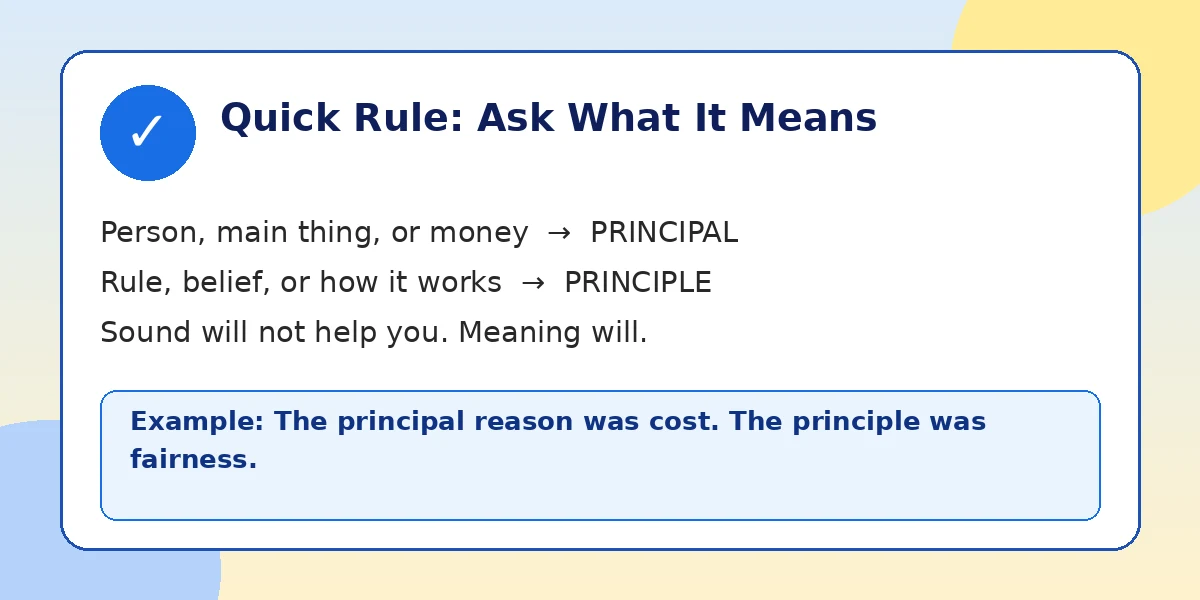
Principal means the main or most important person or thing. It can also mean a school leader or the original amount of a loan.
Principle means a rule, belief, basic truth, or law that guides how something works or how someone behaves.
Use principal for a person, a main thing, or money. Use principle for a rule, belief, or fundamental idea.
Examples:
- The principal welcomed the students on their first day.
- Honesty is an important principle in our family.
- She paid $2,000 toward the loan principal.
- Safety is our principal concern.
- The machine works on a simple scientific principle.
Both words sound the same, so pronunciation cannot help you choose. Their meanings and grammatical roles are different.
Table of Contents
- Principal vs Principle at a Glance
- What Does Principal Mean?
- What Does Principle Mean?
- Principal vs Principle: Key Differences
- How to Choose Between Principal and Principle
- Common Phrases That Use Principle
- Common Mistakes to Avoid
- Principals vs Principles: The Plural Forms
- Easy Ways to Remember the Difference
- Practice Questions: Principal or Principle?
- Frequently Asked Questions
- Conclusion
- Related Guides
Principal vs Principle at a Glance
The easiest way to remember the difference in principal vs principle is to connect principal with a person or something important. Connect principle with a rule or belief.
| Feature | Principal | Principle |
|---|---|---|
| Part of speech | Noun and adjective | Noun only |
| Main meaning | Main, leading, or most important | Rule, belief, or basic truth |
| Person | A school leader or leading individual | Not used to mean a person |
| Money | Original amount borrowed or invested | Not used for a loan amount |
| Common example | The school principal spoke. | Fairness is a guiding principle. |
| Related form | Principally, principalship | Principled, unprincipled |
Both words are homophones. This means they have the same pronunciation but different spellings and meanings.
What Does Principal Mean?
Principal can be a noun or an adjective. As an adjective, it describes something important or primary. As a noun, it can identify a person, a leading thing, or an amount of money. In principal vs principle, this is the person, main thing, or money side.
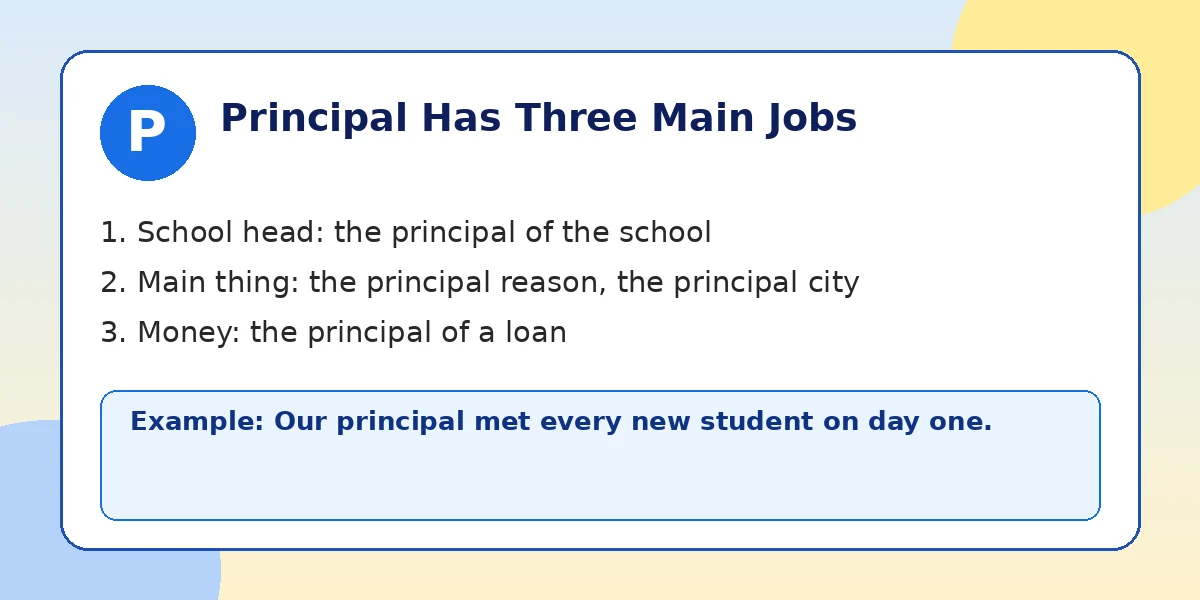
1. Principal as an Adjective: Main or Most Important
The adjective principal means main, chief, primary, or most important. It identifies the leading reason, concern, aim, or thing in a group.
It does not always mean the only one. It means the most important among several things.
Examples:
- Cost was the principal reason for choosing the smaller house.
- Our principal objective is to improve student safety.
- The principal concern is the lack of clean water.
- Her principal argument focused on fairness.
- The principal ingredient in this recipe is rice.
In each sentence, principal describes a noun. It tells readers which reason, objective, concern, argument, or ingredient is most important.
2. Principal as a Noun: A School Leader
In the United States, a principal is the person who leads a school. This person oversees staff, students, school policies, and daily operations.
A school principal may also handle discipline, communicate with parents, and support teachers.
Examples:
- The principal announced the new school rules.
- I scheduled a meeting with the principal.
- The vice principal helped resolve the problem.
- The students waited outside the principal’s office.
In American English, principal is the usual word for a school leader. In the United Kingdom, headteacher or head is more common.
Capitalize the word when it forms part of a formal title or begins a sentence. For example, write Principal Smith when using it as a formal title.
3. Principal as a Noun: A Leading Person
A principal can also be a person with a leading role, major responsibility, or important position. This use appears in business, performance, and research.
Examples:
- The company’s principals approved the new plan.
- She became the principal dancer in the production.
- The principal investigator presented the research findings.
- The firm invited its principals to the annual meeting.
A principal investigator is the researcher with primary responsibility for a study or research project.
In business, a principal may be an owner, partner, or person with authority. In a performance, a principal dancer or actor has a leading role.
4. Principal in Law
In legal contexts, principal refers to a person who has a primary role or responsibility. Its exact meaning depends on the legal context.
For example, in a principal agent relationship, the principal authorizes an agent to act on their behalf. The agent performs tasks for the principal.
The word can also describe a person primarily responsible for an obligation. In criminal law, it may refer to the main participant in an offense.
Examples:
- The principal authorized the agent to sign the agreement.
- The contract explained the duties of the principal and agent.
- Investigators identified the principal participant in the offense.
These are specialized uses. In everyday writing, the main distinction remains the same: principal refers to a person with a leading role, not a rule.
5. Principal in Finance: The Original Loan or Investment Amount
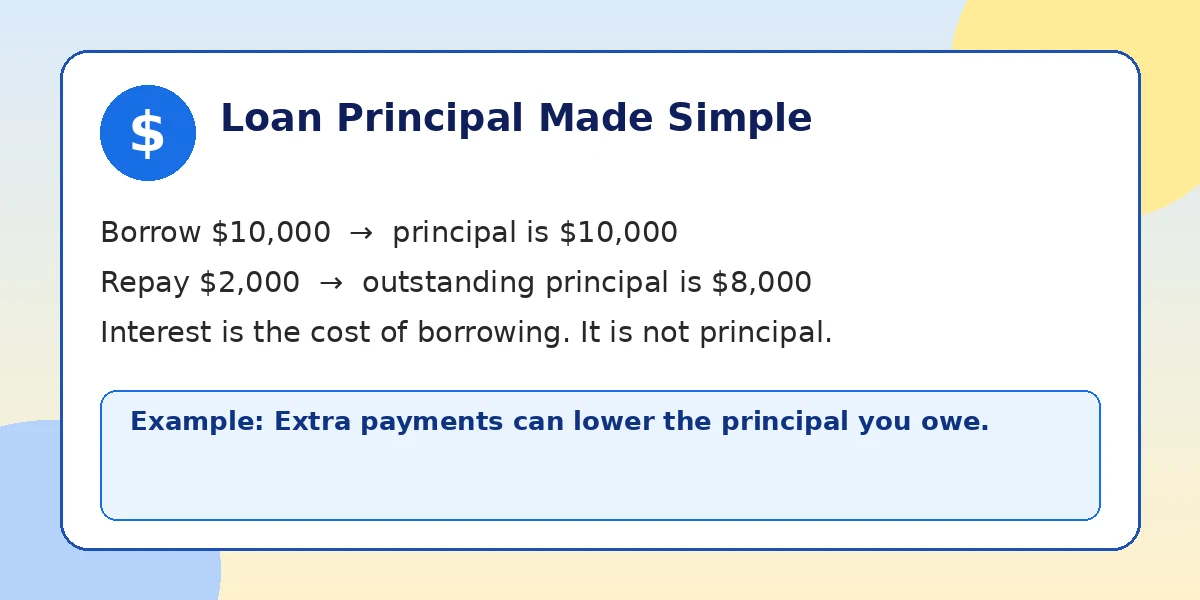
In finance, principal means the original amount of money borrowed or invested. It does not include interest.
For a loan, the borrower generally pays interest on the outstanding principal. As the principal decreases, the amount of interest may also change.
Example:
Suppose you borrow $10,000 from a bank.
- Original loan principal: $10,000
- Amount repaid toward principal: $2,000
- Remaining principal: $8,000
This is a simple example. It assumes the full $2,000 payment reduces the principal. Actual loan payments may also cover interest and fees.
Principal vs interest:
| Term | Meaning | Example |
|---|---|---|
| Principal | The original amount borrowed or invested | $10,000 loan |
| Interest | The cost of borrowing money or the return earned on an investment | Interest charged by the lender |
Example sentences:
- I made an extra payment toward the loan principal.
- The outstanding principal is now $8,000.
- The lender calculates interest using the remaining principal.
- The investment earned interest on its original principal.
Remember this distinction when writing about a principal amount, loan principal, or outstanding principal. The correct word for the amount itself is principal.
What Does Principle Mean?
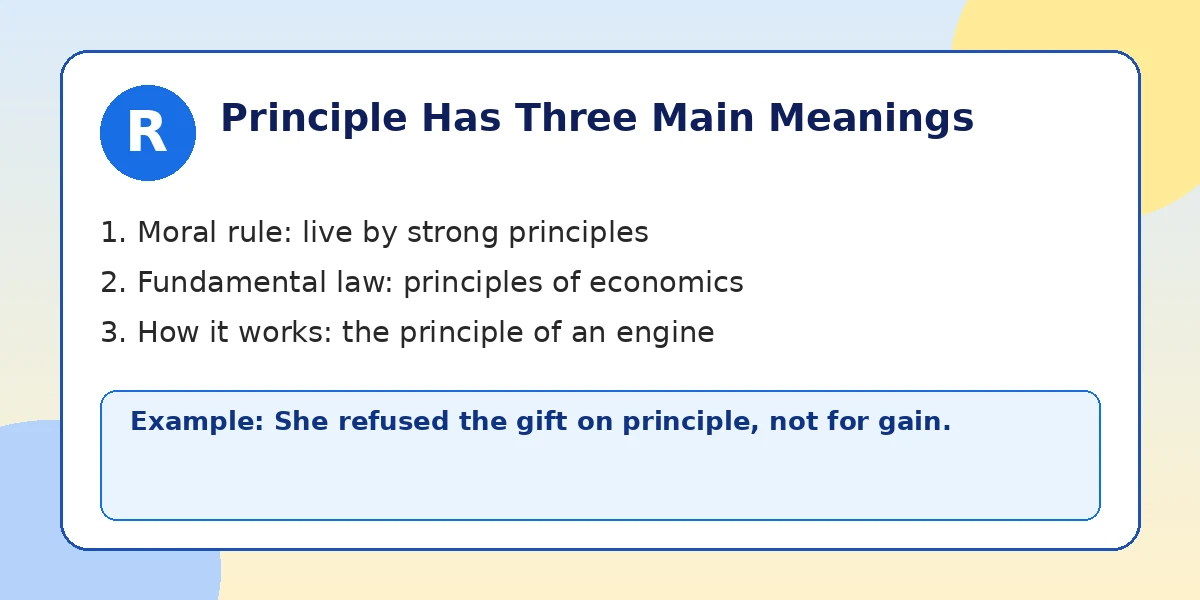
Principle is a noun. It means a basic rule, belief, truth, or idea that guides behavior or explains how something works. In principal vs principle, this is the rule, belief, or truth side.
Unlike principal, it is not used as an adjective. It has several related meanings.
1. Principle as a Moral or Ethical Rule
A principle can be a personal belief or moral standard. It guides how someone behaves and makes decisions.
Common examples include honesty, fairness, respect, and responsibility.
Examples:
- Honesty is a core principle of good leadership.
- She refused to lie because it went against her principles.
- Fairness is an important principle in our workplace.
- He took a principled stand against discrimination.
- My parents taught me to live by strong principles.
A person who follows strong moral standards may be called a person of principle or a principled person.
The adjective is principled, not principle.
2. Principle as a Fundamental Truth or Rule
A principle can also be a basic truth, general rule, or central idea. It may guide a subject, system, or way of thinking.
You will often see this meaning in education, business, mathematics, economics, and philosophy.
Examples:
- The principle of supply and demand affects market prices.
- Students learned the basic principles of mathematics.
- The principle of equality supports the argument.
- The book explains several principles of human behavior.
- The design follows a simple principle of balance.
In these examples, the word describes an idea or rule. It does not identify a person or something that ranks first.
3. Principle in Science and Technology
In science and technology, a principle is a basic law, idea, or rule that explains how something works.
It may describe a natural process or the operation of a device.
Examples:
- The principle of conservation of energy states that energy cannot be created or destroyed in an isolated system.
- The lesson explains the basic principles of fluid mechanics.
- The engine works on a simple mechanical principle.
- The experiment demonstrates a key principle of physics.
You may also encounter phrases such as scientific principles, design principles, and operating principles.
The spelling remains principle because each phrase refers to a rule, idea, or explanation.
Principal vs Principle: Key Differences
The main difference is grammatical as well as semantic. Principal can describe something important or name a leading person. Principle names a rule, belief, or fundamental truth.
| Question | Use principal | Use principle |
|---|---|---|
| Are you referring to a school leader? | Yes | No |
| Do you mean the main or most important thing? | Yes | No |
| Are you discussing a loan’s original amount? | Yes | No |
| Do you mean a moral belief or rule? | No | Yes |
| Are you explaining how something works? | No | Yes |
| Are you describing someone’s ethical standards? | No | Yes |
Compare these sentence pairs:
| Principal | Principle |
|---|---|
| The principal spoke to the parents. | Honesty is a key principle. |
| Safety is our principal concern. | Safety is a guiding principle. |
| She is the principal investigator. | Informed consent is an ethical principle. |
| He paid down the loan principal. | The device works on a basic principle. |
The words may sound identical, but you cannot use them interchangeably. Choose the spelling that matches the meaning.
How to Choose Between Principal and Principle
Use these simple checks for principal vs principle whenever you are unsure which spelling fits.
1. Ask What You Mean
First, identify the meaning of the word.
- A person in charge? Use principal.
- A leading person or performer? Use principal.
- The main or most important thing? Use principal.
- An original loan or investment amount? Use principal.
- A moral rule or belief? Use principle.
- A basic truth or scientific rule? Use principle.
This meaning test works in school, business, finance, science, and everyday writing.
2. Try the Swap Test
Replace the word with a simpler word that has the same meaning.
If main, chief, or leader fits, choose principal.
If rule, belief, or basic truth fits, choose principle.
Examples:
- The principal reason was cost. The main reason was cost. Therefore, principal is correct.
- Honesty is an important principle. Honesty is an important rule. Therefore, principle is correct.
- The loan principal is $10,000. The main amount is $10,000. Therefore, principal is correct.
3. Check Whether It Describes Another Noun
When the word describes a noun, principal is often the correct choice. It means main or most important.
Examples: principal reason, principal objective, principal concern, principal ingredient, principal argument.
Principle is a noun. It names the rule or idea itself.
Examples: guiding principle, moral principle, scientific principle, basic principle, principle of fairness.
Do not use principle as an adjective. Use principal for main or chief, and principled for someone who follows moral standards.
4. Remember That Both Words Sound the Same
Principal and principle are homophones. They share the same pronunciation but have different meanings.
In US English, both are pronounced approximately /ˈprɪnsəpəl/. You cannot identify the correct spelling by listening alone.
You must use the sentence’s meaning and grammar. A spell-checker may also miss the error because both words are correctly spelled.
Common Phrases That Use Principle
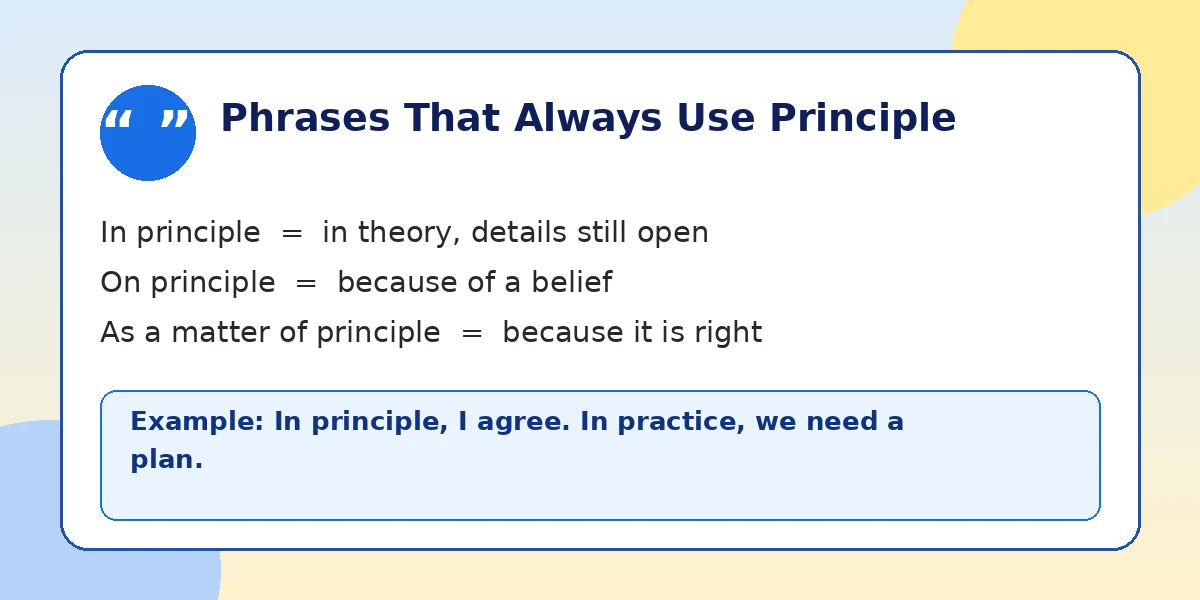
Several common expressions always use principle. These phrases refer to rules, beliefs, or general ideas.
| Phrase | Meaning | Example |
|---|---|---|
| In principle | In theory or as a general idea | I agree with the plan in principle. |
| On principle | Because of a personal belief or moral rule | She refused the offer on principle. |
| As a matter of principle | Because of a strong belief | He returned the money as a matter of principle. |
| Matter of principle | An issue involving a belief or standard | For her, honesty is a matter of principle. |
| Guiding principle | A rule that directs decisions or actions | Respect is our guiding principle. |
| First principles | Basic ideas used to understand or solve something | Start with the first principles of physics. |
| Principle behind something | The basic rule that explains it | We studied the principle behind the machine. |
| Man or woman of principle | A person with strong moral standards | She is a woman of principle. |
In Principle vs On Principle
These expressions look similar, but they have different meanings.
In principle means in theory or in general. It often shows agreement with an idea, even when practical details remain unresolved.
- I support the proposal in principle, but we need a budget.
- The board agreed in principle to the changes.
On principle means because of a personal belief or moral standard.
- He does not accept gifts on principle.
- She refused to lie on principle.
Use in principle for general or theoretical agreement. Use on principle for an action based on a belief.
Common Mistakes to Avoid
Because the words sound alike, writers often choose the wrong spelling in principal vs principle. The following examples show common errors and their corrections.
| Incorrect | Correct | Why |
|---|---|---|
| The school’s principle spoke to us. | The school’s principal spoke to us. | A principal leads a school. |
| Honesty is an important principal. | Honesty is an important principle. | Honesty is a moral rule. |
| I agree in principal. | I agree in principle. | The fixed phrase uses principle. |
| She paid the loan principle. | She paid the loan principal. | Principal means the amount borrowed. |
| He violated his principals. | He violated his principles. | Principles are beliefs or rules. |
| The principle investigator led the study. | The principal investigator led the study. | Principal means the lead researcher. |
| Our principle concern is safety. | Our principal concern is safety. | Principal means main or chief. |
| The principal behind the device is simple. | The principle behind the device is simple. | Principle means the rule explaining how it works. |
| The company opened a new principle office. | The company opened a new principal office. | Principal means main or chief. |
Why Spell-Check May Not Catch These Errors
A spell-checker checks whether a word is spelled correctly. It may not recognize whether that word fits the sentence.
Both principal and principle are valid English words. A sentence can contain a correctly spelled word that has the wrong meaning.
For example, a spell-checker may accept this sentence:
The school principle welcomed the students.
But the correct sentence is:
The school principal welcomed the students.
Always check the meaning, especially in formal emails, school assignments, business documents, and financial writing.
Principals vs Principles: The Plural Forms
The plural forms are principals and principles. They follow the same distinction as the singular words.
- Principals means multiple school leaders or leading individuals.
- Principles means multiple rules, beliefs, or basic truths.
Examples with principals:
- The school principals attended the district meeting.
- The company’s principals approved the agreement.
- Three principals signed the business documents.
Examples with principles:
- The students learned five basic principles of science.
- Her principles guide her decisions.
- The organization follows strong ethical principles.
Remember the difference when writing about several people or several beliefs. The letter sequence matters, even though the words sound the same.
Easy Ways to Remember the Difference
A few memory tricks can help you choose the correct spelling in principal vs principle. Use them as reminders, then check the sentence’s meaning.
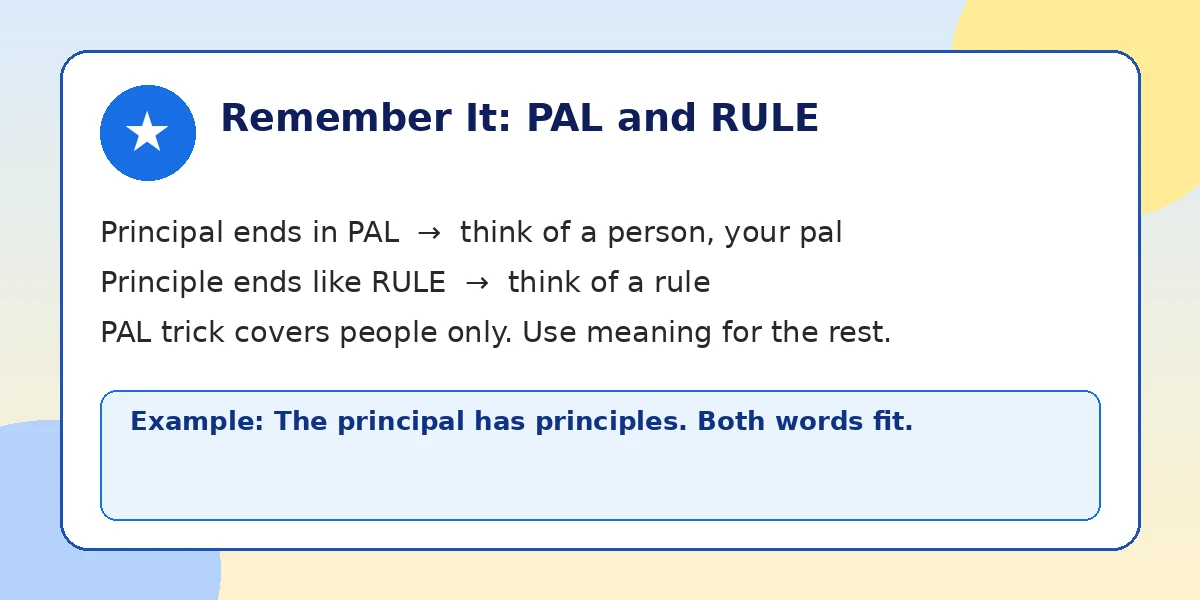
1. Principal Has Pal
The word principal contains pal.
Think of a school principal as your pal. This trick helps you remember the spelling for a school leader.
However, it does not cover every meaning of principal. The word also refers to a main concern or an amount of money.
2. Principle Means a Rule
Think of principle as a rule or belief.
A moral principle guides behavior. A scientific principle explains how something works.
This is a useful reminder for the noun’s main meanings.
3. Principal Has an A
The word principal contains the letter A near its end.
Think of A as a reminder of adjective. Principal can be an adjective meaning main or most important.
For example: principal reason, principal goal, principal concern.
This trick helps distinguish the adjective from principle, which is a noun.
4. Check the Word’s Meaning First
No memory trick covers every situation. The most reliable method is to identify what the sentence means.
Use principal for a leader, leading person, main thing, or financial amount. Use principle for a rule, belief, or basic truth.
5. Remember Their Related Forms
The words also have different related forms:
| Word | Related form | Meaning |
|---|---|---|
| Principal | Principally | Mainly or for the most part |
| Principal | Principalship | The position or office of a school principal |
| Principle | Principled | Guided by strong moral beliefs |
| Principle | Unprincipled | Not guided by moral standards |
Examples:
- The project is principally funded by private donations.
- She accepted the principalship at a local school.
- He made a principled decision.
- The dishonest company acted in an unprincipled way.
Do not write principle reason when you mean the main reason. Also, do not use principle as an adjective.
Practice Questions: Principal or Principle?
Choose principal or principle to complete each sentence in this principal vs principle practice set. Use the context to decide which spelling fits.
- The school ______ welcomed the new students.
- Honesty is an important ______ in our family.
- I made an extra payment toward my loan ______.
- Safety is our ______ concern.
- The ______ investigator explained the research.
- She refused to compromise her ______.
- The experiment demonstrates a scientific ______.
- I agree with the proposal ______, but the details need work.
- Their ______ objective is to reduce costs.
- Students studied the basic ______ of physics.
Answer Key and Explanations
- Principal: A principal is the person in charge of a school.
- Principle: Honesty is a moral rule or belief.
- Principal: In finance, principal means the original amount borrowed.
- Principal: Here, principal means the main or most important concern.
- Principal: A principal investigator leads or takes primary responsibility for research.
- Principles: Principles are personal beliefs or moral standards.
- Principle: A scientific principle explains a basic rule or truth.
- In principle: This fixed phrase means in theory or in general.
- Principal: The adjective principal means main or most important.
- Principles: Scientific principles are basic rules or truths.
Frequently Asked Questions
1. Is it in principle or in principal?
The correct expression is in principle. It means in theory or in general, even when practical details remain unsettled. For example, you may agree in principle but still need to confirm the final details.
2. Is it principal investigator or principle investigator?
The correct term is principal investigator. It refers to the researcher with primary responsibility for a study or project. Use principal because the role is a leading position, not a rule.
3. Can principle be used as an adjective?
No. Principle is a noun that means a rule, belief, or basic truth. Use principal as an adjective when you mean main or most important. Use principled to describe someone guided by moral standards.
4. Is the head of a school a principal or a principle?
The head of a school is a principal. In the United States, this is the standard term for the person who leads a school. A principle is a rule or belief, not a person.
5. Is “He violated his principals” correct?
Usually, no. If you mean that someone broke their moral rules or beliefs, write “He violated his principles.” The word principals refers to school leaders or other people with leading roles.
6. What does principal amount mean?
The principal amount is the original sum borrowed or invested, separate from interest. For a loan, the outstanding principal is the amount still owed. Payments may cover interest and fees as well as principal.
7. What is the difference between in principle and on principle?
In principle means in theory or general agreement. On principle means because of a personal belief or moral standard. For example, you might agree in principle but refuse on principle because of your values.
Conclusion
The difference between principal vs principle comes down to meaning and grammar.
Use principal for a school leader, leading person, main concern, or original loan amount. Use principle for a moral rule, belief, or fundamental truth.
When unsure, try the swap test. If main or leader fits, choose principal. If rule or belief fits, choose principle.
Related Guides
Explore more commonly confused words:
You can also explore the Confused Words category on ClarifyWords for more help with spelling, grammar, and commonly mixed up words.