Black or White: Meaning, Differences, Examples, and Usage
Have you ever been asked to pick between two colours? You may wonder if the phrase means more than a colour choice. It can. This guide explains black or white in plain English. You will learn its three main senses. You will also learn how it differs from two similar phrases. You will learn how to avoid common mistakes.
Quick Answer
The phrase means a choice between two colours or two opposing options. It can also suggest a situation with only two clear possibilities. Note the difference from a similar phrase. The form with and can describe two colours together or a situation that seems clearly right or wrong. The form with in can mean something is written or printed.
Example: “Would you like the black jacket or the white one?” This question asks you to choose a colour. In short, black or white asks for a pick between two options.
Table of Contents
- Quick Answer
- The Three Main Senses
- Comparison Table
- What Black Means in Everyday Choices
- What White Means in Everyday Choices
- Everyday Examples
- Black and White Thinking
- The False Dilemma Fallacy
- When a Choice Really Has Only Two Options
- Shades of Gray
- Common Mistakes
- Memory Trick
- Practice Questions
- FAQs
- Final Takeaway
The Three Main Senses
The words black and white have literal and figurative meanings. Their meaning depends on how someone uses them in a sentence. This section covers the three senses you will meet most often.
1. A Literal Choice Between Two Colours
The simplest sense describes choosing between the colours black and white. Black is a dark colour that absorbs light. White is a light colour that reflects most visible light. When someone uses or, they present two alternatives. The listener can choose either option.
Examples:
- “Do you want a black phone or a white one?”
- “Should we paint the bedroom black or white?”
- “I cannot decide between the black shoes and the white pair.”
- “Would you prefer a black coffee mug or a white one?”
In each example, the speaker asks someone to choose between two colours. The choice is direct. It does not imply a deeper judgement.
2. A Clear Cut Distinction Between Two Sides
The form with and can describe a situation that seems simple and clear. It often suggests a situation with two opposing sides. For example, “Following the safety rules is not a clear cut issue.” This sentence suggests different circumstances may apply. The correct decision may depend on the details.
Another example: “She sees every disagreement as a clear cut issue.” This means she may see only two sides instead of considering other viewpoints. However, not every situation has a clear answer. Some decisions involve different opinions, facts, and contexts. When you hear this form, ask whether the issue is truly simple. Often it is not.
3. Something Written or Printed
The form with in is an established English idiom. It means something is written, printed, or recorded rather than simply spoken. People often use this form when discussing agreements, instructions, promises, and official documents.
Examples:
- “The company policy is in written form.”
- “Please put the agreement in writing.”
- “I want the final decision in writing.”
- “The instructions are written on the first page.”
The written form suggests that information provides something people can read and check. A spoken promise can be forgotten or disputed. A written record is harder to deny. That is why contracts, rules, and offers are often put in writing before anyone acts on them.
Cambridge Dictionary defines this idiom as meaning in writing. Dictionary.com gives the same sense, and adds that the written form can feel official. Merriam Webster also lists being in writing or print as a sense of the phrase with and.
Comparison Table
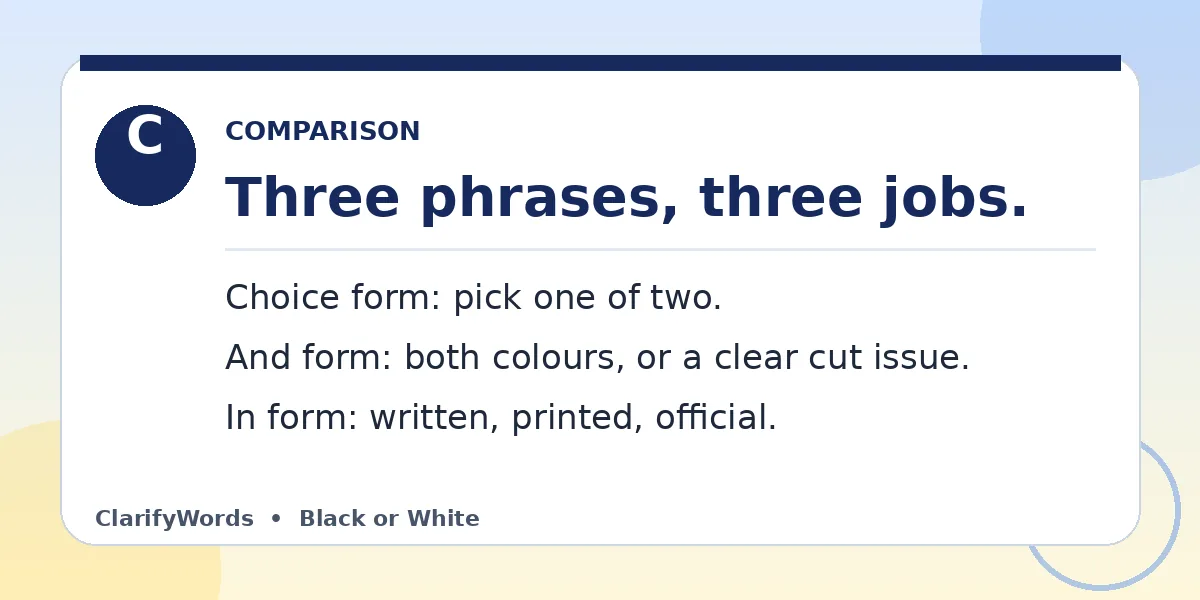
These phrases look similar, but they serve different purposes. The table below compares black or white with its two close relatives. Understanding their grammar makes them easier to use.
| Phrase | Meaning | Example |
|---|---|---|
| Choice form | A choice between two alternatives | “Choose the black dress or the white one.” |
| And form | Two colours together, or a clear distinction | “The photograph is in black and white tones.” |
| In form | Something written or printed | “The rules are in writing.” |
When should you use each form? Use or for a choice. When someone asks you to choose between two alternatives, use or. Use and for two things together. Use and when describing both colours or a situation with opposing sides. Use in for written information. Use this form when something appears in writing or print. Remember that or and and are not interchangeable in these phrases. Each one communicates a different meaning.
What Black Means in Everyday Choices
In everyday language, black often suggests formality, elegance, and power. A black suit looks formal. A black car often looks sleek. A black dress is a classic choice for an evening event. Black can also suggest seriousness. A black cover on a notebook looks neat and plain.
Black has practical downsides too. Black clothes show lint and light dust. A black car shows dirt and scratches more easily. A black room can feel dark if it gets little light. These points matter when you choose a colour for daily use, not just for looks.
What White Means in Everyday Choices
White often suggests freshness, simplicity, and a clean look. A white shirt looks crisp. A white room feels bright and open. White paint can make a small room feel larger. White is also linked with new beginnings in many everyday expressions.
White has practical downsides too. White clothes stain easily. A white sofa needs more care than a dark one. White shoes show mud after rain. When you pick white, you trade a fresh look for more cleaning. That trade off is part of many real colour decisions.
Everyday Examples
Colour choices are common in everyday conversations. The questions below show black or white in real talk. People use these words when shopping, decorating, and making simple decisions.
Choosing between clothing colours:
- “Should I buy the black sneakers or the white pair?”
- “She wants a black jacket or a white one for winter.”
- “Do you prefer the black T shirt or the white one?”
Choosing colours for cars and homes:
- “Would you choose a black car or a white one?”
- “Should we paint the kitchen walls black or white?”
- “The customer asked for a black sofa or a white one.”
Choosing between two everyday options:
The word or can also connect choices beyond colours.
- “Should we watch a comedy or a drama?”
- “Would you prefer tea or coffee?”
- “Should I take the bus or walk?”
These examples show how or connects two possible choices. The speaker does not always expect the options to be colours. The same pattern works for food, travel, and plans.
Short conversations show natural usage.
Conversation 1, shopping. Alex: “Which shoes should I buy?” Sam: “Do you prefer the black pair or the white pair?”
Conversation 2, home decoration. Mia: “What colour should we choose for the curtains?” Leo: “Let us compare the dark and light options first.”
Conversation 3, personal preference. Emma: “Would you rather have a black phone or a white one?” Noah: “I would choose the black one.”
A popular cultural reference is Michael Jackson’s song with this title, released in November 1991. The song is about racial harmony. It is a useful cultural note, but it is not the main meaning of the phrase in this guide.
Black and White Thinking
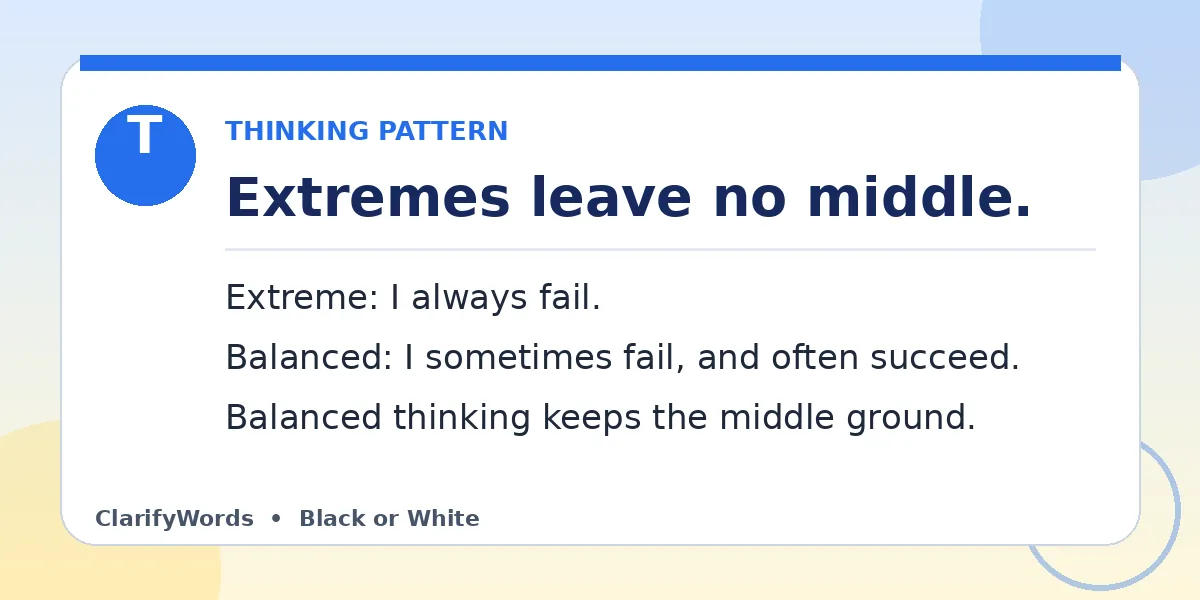
Black and white thinking means viewing situations through two extreme categories. A person may see something as completely good or completely bad. This way of thinking leaves little room for middle possibilities. The American Psychological Association uses the term dichotomous thinking for this pattern. It also calls it polarized thinking.
This is a language and thinking pattern, not a diagnosis. Many people think in extremes at times, especially when they feel stressed or tired. A pattern becomes a problem only when it often harms work, health, or relationships. If that happens, a professional can help. This guide does not diagnose anyone.
Everyday examples:
Example 1, schoolwork. “I made one mistake, so my entire assignment is terrible.” This statement ignores the parts that may be correct.
Example 2, friendship. “If my friend disagrees with me, they are not a real friend.” This ignores the possibility of having different opinions while keeping a friendship.
Example 3, personal goals. “If I cannot do something perfectly, there is no point trying.” This overlooks progress and the value of learning.
Example 4, work. “My presentation was not perfect, so I am completely unsuccessful.” A single presentation does not define someone’s entire work performance.
Example 5, diet. “I ate one snack, so my whole diet is ruined.” One snack does not erase all earlier effort. A balanced view looks at the week, not one moment.
Example 6, study. “I am bad at maths.” One hard topic does not mean a person cannot learn maths. It may mean they need more practice on that topic.
Balanced Thinking
Balanced thinking considers more details and possible outcomes.
| Extreme thought | Balanced thought |
|---|---|
| I always make mistakes. | I sometimes make mistakes, but I also do many things well. |
| Everyone dislikes me. | Some people may disagree with me, while others support me. |
| Everything must be perfect. | Doing good work matters more than being perfect. |
| This plan is completely useless. | Some parts of this plan may still be helpful. |
Balanced thinking does not mean avoiding decisions. It means considering the available information before deciding. It also means leaving room for mixed results.
The False Dilemma Fallacy
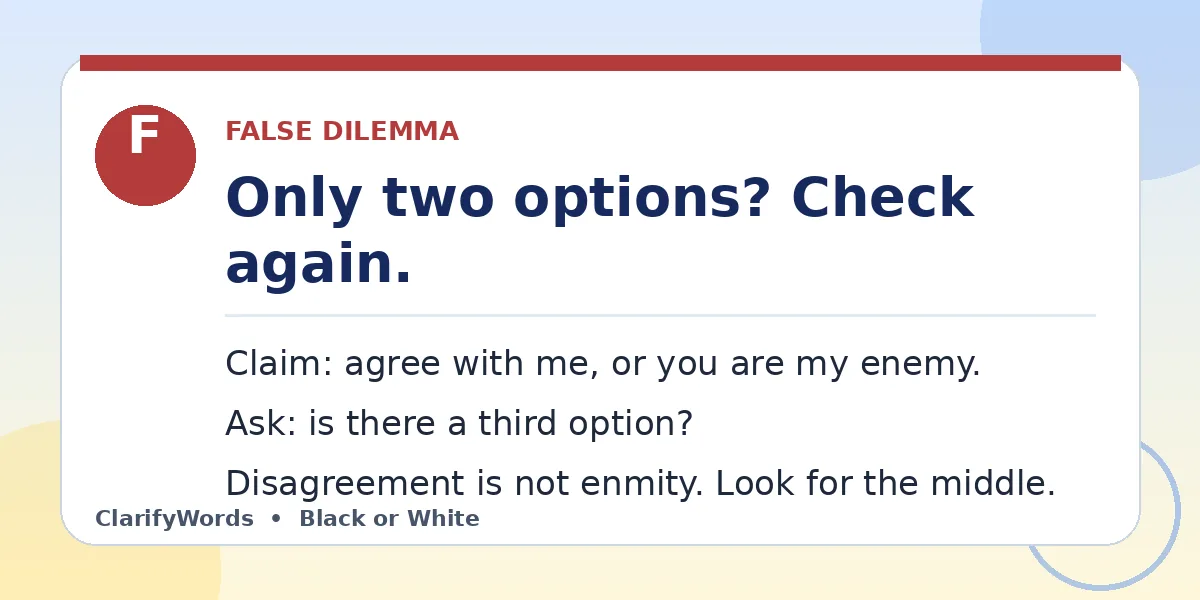
The fallacy with this name is a logical error. It happens when someone presents only two choices even when other reasonable options exist. It is also called a false dilemma, false dichotomy, false binary, or either or fallacy. Purdue University’s Online Writing Lab explains that an either or argument oversimplifies an issue by reducing it to two sides.
Everyday examples:
Example 1, friendship. “Either you agree with me, or you are my enemy.” Why is this a fallacy? People can disagree without becoming enemies. The statement ignores other possibilities.
Example 2, education. “Either you get the highest grade, or you are a failure.” Why is this a fallacy? Students can earn different grades and still learn valuable skills.
Example 3, work. “Either you accept this job, or you will never find another one.” Why is this a fallacy? Someone may have other job opportunities, career choices, or plans.
Example 4, personal decisions. “Either you follow my advice, or you do not care about your future.” Why is this a fallacy? A person can care about their future while choosing a different path.
Example 5, debate. “Either you support this plan, or you oppose progress.” Why is this a fallacy? A person can support progress and still want a better plan. Partial support and a revised plan are both real options.
To spot this fallacy, ask one question. Are there other reasonable options? If yes, the two options are not the whole story. Look for a third option, a partial option, or a mix of both sides.
When a Choice Really Has Only Two Options
Not every two option choice is a false dilemma. Sometimes only two possible states exist.
For example:
- A shop is either open or closed at a particular time.
- A basic switch is either on or off.
- A door is either locked or unlocked.
These are genuine binary choices in their stated context. A false dilemma occurs when someone ignores other reasonable possibilities. It does not apply simply because only two options are mentioned. The test is simple. Is there a middle, a mix, or a third option? If no, a yes or no choice is fine. If yes, forcing two extremes is the error.
Choosing between two available train tickets is also a genuine decision. You can pick one ticket or the other. That does not make the choice a fallacy. The problem starts only when someone claims those are the only possible outcomes in a wider situation.
Shades of Gray
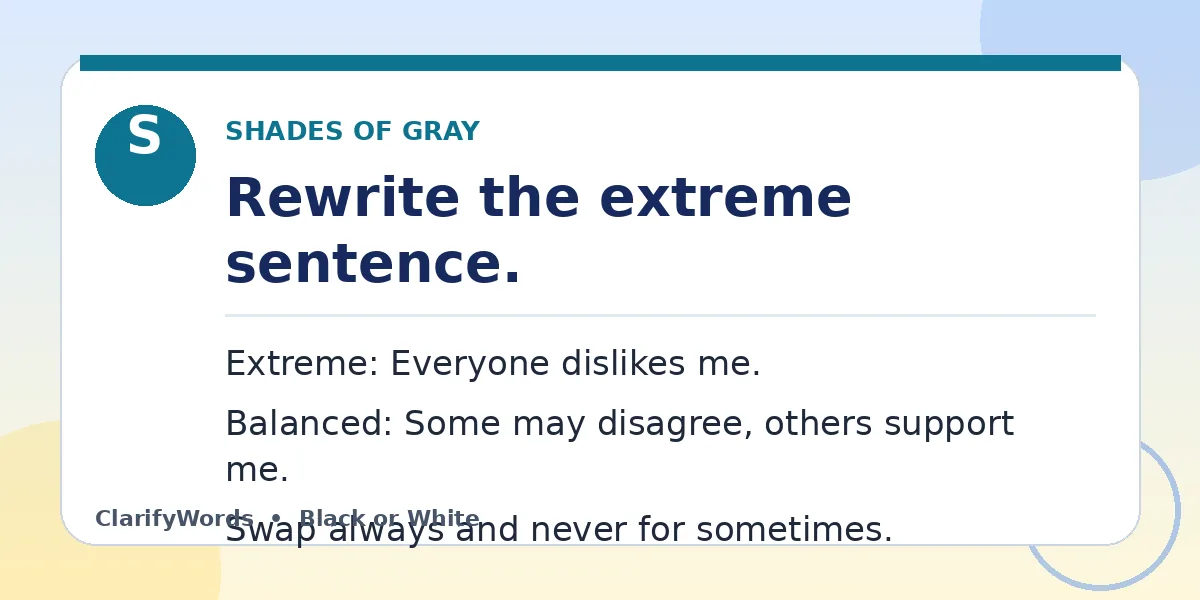
Shades of gray means the different possibilities between two opposing extremes. The expression reminds us that not every situation has only two answers. Sometimes a decision involves several factors and viewpoints. In American English, gray is the usual spelling. In British English, grey is the usual spelling. The meaning is the same.
How to Rewrite Extreme Statements
You can make extreme statements more balanced by adding details and considering other possibilities.
| Extreme statement | More balanced rewrite |
|---|---|
| I always fail. | I have failed at some tasks, but I have succeeded at others. |
| Everyone dislikes me. | Some people may not like me, but others may enjoy my company. |
| This idea is completely useless. | This idea may not work in every situation, but it could still help. |
| You are either right or wrong. | Both viewpoints may have some valid points. |
| I must get everything perfect. | I can do my best without getting every detail right. |
| There are only two ways to solve this. | There may be other solutions worth considering. |
| This was the worst day ever. | Today was difficult, but some parts may have gone well. |
Try this practice exercise. Take an extreme sentence from your own day. Replace always or never with sometimes. Replace completely with partly. Then add one fact that softens the claim. The new sentence will sound more accurate and less harsh.
Why does this matter? Considering different possibilities can help people make better decisions. It can also improve communication and reduce misunderstandings. For example, two friends may disagree about a movie. One likes the story, while the other dislikes the ending. Neither person needs to be completely right or wrong. Both can have valid opinions. Balanced thinking helps people understand these differences without treating every disagreement as a conflict.
Common Mistakes
English learners sometimes confuse these phrases because they contain the same colour words. Here are the mistakes to avoid.
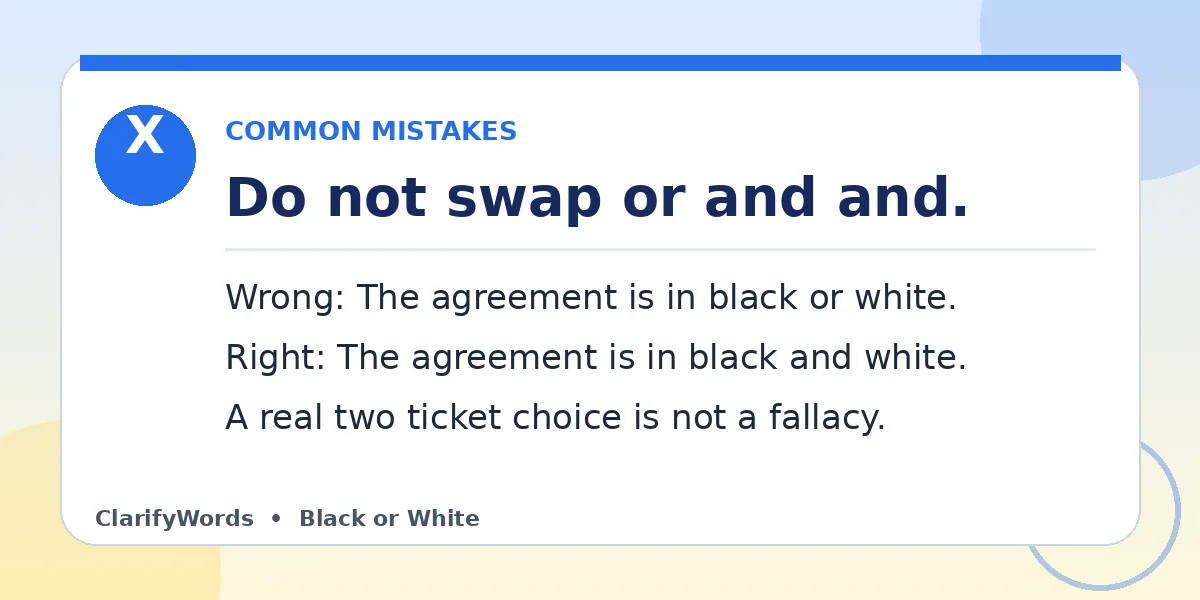
- Using or instead of and in the established idiom. Incorrect: “The agreement is in black or white form.” Correct: “The agreement is in black and white form.” The established idiom uses and when referring to written information.
- Confusing a literal choice with a thinking pattern. Choosing a black shirt or a white one is a simple colour decision. The thinking pattern is different. It describes viewing situations through two extreme categories.
- Confusing thinking patterns with logical fallacies. These concepts are related, but they are not identical. Dichotomous thinking describes a way of viewing situations. A false dilemma describes an argument that presents only two options while ignoring others.
- Assuming every two option choice is a fallacy. A real choice between two available options is not automatically faulty reasoning. For example, choosing between two available train tickets is a genuine decision.
- Ignoring middle possibilities. Some situations involve more than two reasonable answers. Before deciding that something is completely right or wrong, consider its context and supporting details.
- Using extreme language in formal writing. Words like always, never, completely, and totally can weaken a formal argument. In formal writing, prefer precise words such as often, partly, or in most cases. In a contract or a report, prefer unambiguous wording and explicit documentation over a catchy idiom.
Usage note: This article uses black and white as colour words and descriptions of choices. These meanings are separate from racial labels. When you write about people, follow the style guide for your publication. Capitalisation rules for racial terms are a separate topic and are not covered here.
Memory Trick
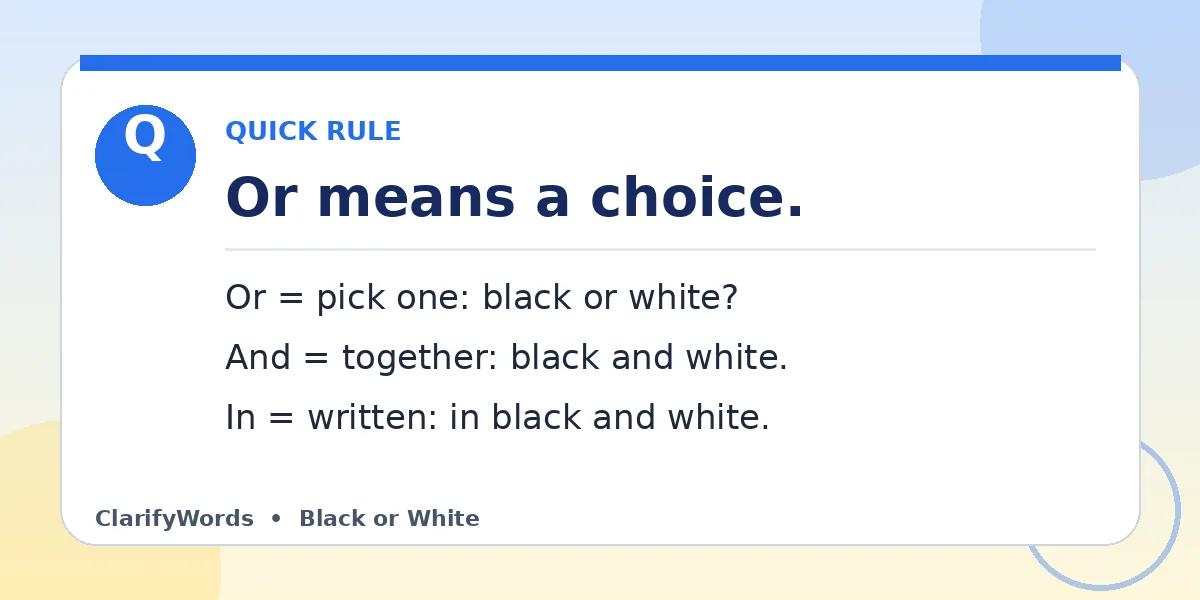
Remember three simple words: or, and, and in.
Or means a choice. Or connects two alternatives. Example: “Would you like the black shirt or the white one?” Think of or as choosing one option.
And means together. And connects two things. Example: “The picture is in black and white tones.” Think of and as including both colours.
In means written information. In appears in the established phrase for something recorded in writing. Example: “The agreement is in black and white form.” Think of in as something you can read on paper.
Gray means the middle ground. Gray represents possibilities between two extremes. When a situation is complicated, remember that more than two answers may exist.
Quick test: Fill the gap. “Would you like the black ___ white jacket?” The answer is or, because the sentence asks you to choose. Test yourself with black or white in a sentence of your own.
Practice Questions
Try these ten questions to check what you have learned. These questions test black or white and its close relatives.
Part 1: Multiple Choice Questions
- What does or usually express in a colour choice?
A. Two things together
B. A choice between alternatives
C. Something written down
D. A clear legal agreement - What does the idiom with in mean?
A. In different colours
B. Completely confusing
C. Written or printed
D. A personal opinion - What is dichotomous thinking?
A. Considering several possibilities
B. Thinking through two extreme categories
C. Making a shopping list
D. Learning new colours - Which term is another name for the fallacy with this name?
A. False dilemma
B. White lie
C. Clear distinction
D. Balanced thinking - What does shades of gray suggest?
A. Only two possible choices
B. A printed document
C. Middle possibilities between extremes
D. A black and white photograph
Part 2: Fill in the Blanks
Complete each sentence with or, and, or in.
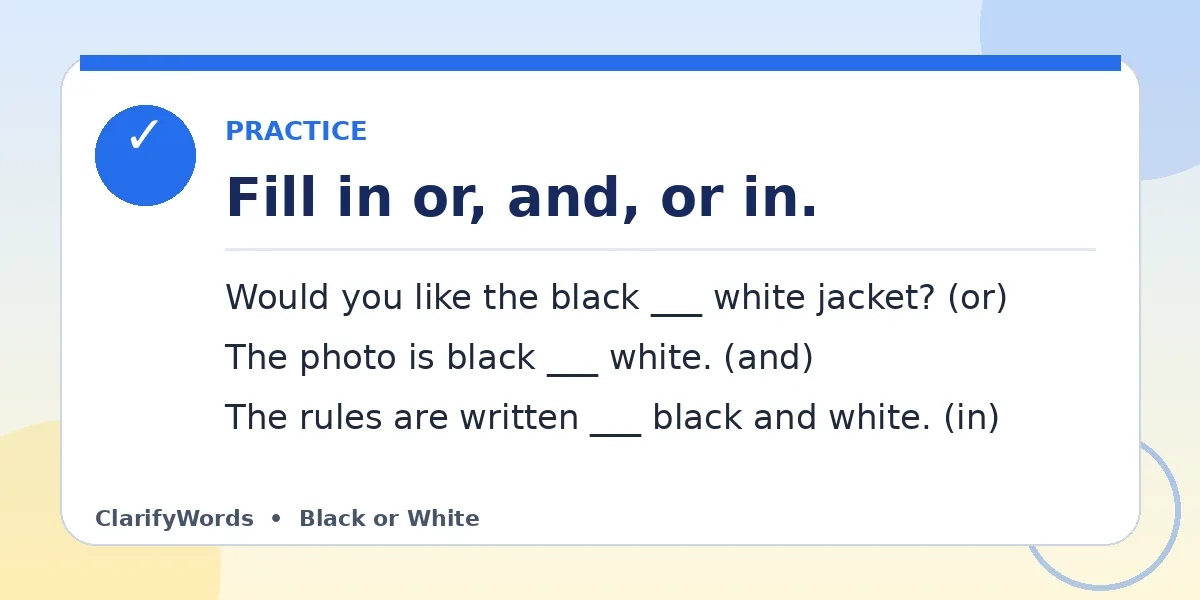
- Would you like the black ___ white jacket?
- The old photograph is black ___ white.
- The rules are written ___ black and white.
Part 3: Correct the Mistakes
Rewrite each sentence using the correct phrase.
- The company agreement is in black or white.
- Either you agree with every decision I make, or you are against me.
Answer Key
| Question | Correct answer | Explanation |
|---|---|---|
| 1 | B | Or presents alternatives. |
| 2 | C | The idiom refers to written or printed information. |
| 3 | B | Dichotomous thinking focuses on two extremes. |
| 4 | A | False dilemma is another name for this fallacy. |
| 5 | C | Shades of gray represent middle possibilities. |
| 6 | Or | The sentence asks someone to choose. |
| 7 | And | Both colours describe the photograph. |
| 8 | In | The established phrase refers to written information. |
| 9 | The company agreement is in black and white. | Use and in the established idiom. |
| 10 | You can disagree with my decisions without being against me. | The original statement ignores other possibilities. |
FAQs
1. What does black or white mean?
It can describe choosing between two colours or two alternatives. In figurative language, it can suggest two opposing possibilities with no middle option. The exact meaning always depends on the full sentence and its context.
2. What is the difference between black or white and black and white?
The first form usually presents two alternatives for a choice. The second form connects two colours or describes opposing sides. The meaning also changes in set phrases, such as the thinking pattern that uses the form with and.
3. What does in black and white mean?
It means something is written, printed, or officially recorded. For example, a written agreement provides clear information that both parties can read and check later. This sense is common in contracts, rules, and formal offers.
4. What is black and white thinking?
It means viewing situations through two extreme categories, such as completely right or completely wrong. It is also called dichotomous or polarized thinking, because it leaves little room for middle possibilities or mixed results.
5. What is the black or white fallacy?
It is a reasoning error that presents only two choices when other reasonable options exist. It is also called a false dilemma, false dichotomy, or either or fallacy. The claim that no others exist is the error.
6. Is black and white thinking the same as the false dilemma fallacy?
No, they are related but different ideas. The thinking pattern describes how a person views a situation through two extremes. The fallacy is a logical error in an argument that presents two choices while ignoring other reasonable possibilities.
7. What does shades of gray mean?
It refers to the possibilities between two opposing extremes. It describes situations with different viewpoints, mixed results, or several reasonable answers, rather than only two choices. Gray is the American spelling, while grey is the British spelling.
Related Guides
Improve your understanding of common English phrases with these related guides:
Explore more word meanings and everyday English lessons in the Vocabulary category.
Final Takeaway
Use or when you offer a choice. Use and when you describe two colours together or a clear cut contrast. Use in when you mean something is written down. When someone asks black or white, answer the choice first, then add nuance if needed. When a situation looks simple, check for shades of gray before you decide. Most real decisions have more than two sides.