

Win or Lose: Meaning, Examples, and Easy Grammar Guide
Have you ever wondered whether to use win and lose when talking about a game or a contest? Many learners mix up these two words. This guide explains both words in simple English. You will learn their meanings, verb forms, and common mistakes. You will also see clear examples from sports, work, and daily life.
Quick Answer
“Win or lose” means “whether you succeed or fail.” People use it before a game or contest. The result is not yet known. It shows support and a positive attitude.
Example: “Win or lose, I will enjoy the game.”
Table of Contents
- Quick Answer
- What Does This Phrase Mean?
- What Does “Win” Mean?
- What Does “Lose” Mean?
- Win vs Lose: Comparison Table
- Verb Forms of Win and Lose
- Where to Place the Phrase in a Sentence
- This Phrase vs Won or Lost
- This Phrase in Sports and Games
- This Phrase at Work and in Daily Life
- Related Phrases You Should Know
- Common Mistakes Learners Make
- Easy Memory Trick
- Practice Questions
- FAQs
- Final Takeaway
What Does This Phrase Mean?
Simple Definition
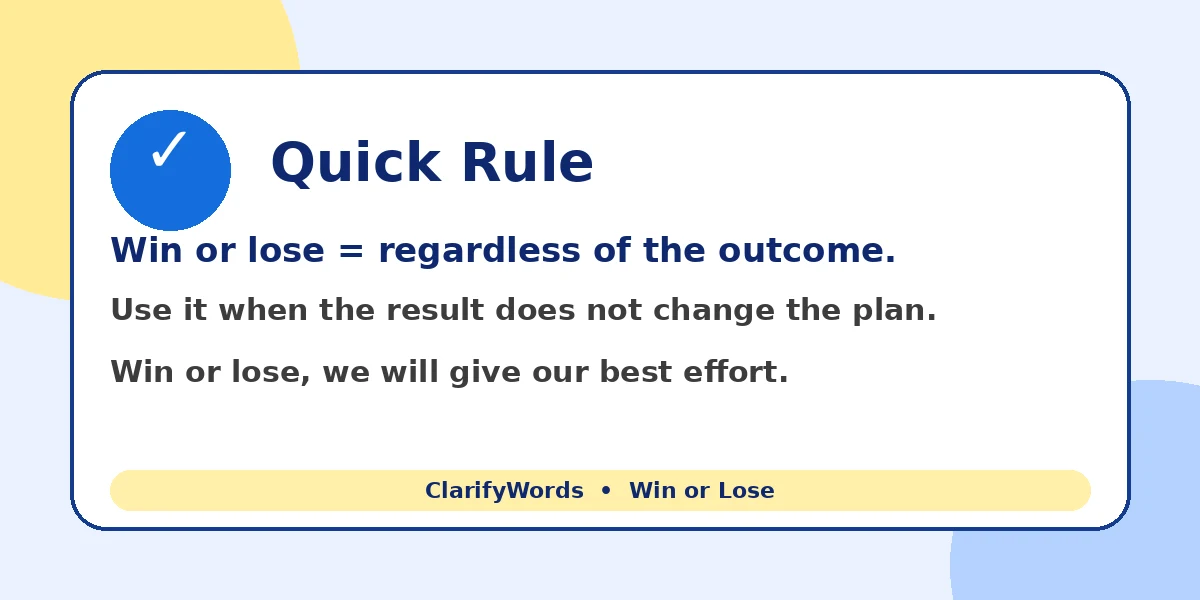
This phrase covers both possible results of a contest or effort. It means the result does not change your support or effort.
How It Is Used in a Sentence
- “Win or lose, we are proud of you.”
- “The team played well, whatever the result.”
- “I will support you, whatever the result.”
Tone and Feeling
The phrase sounds supportive and calm. It reduces pressure. It focuses on effort, teamwork, and learning.
What Does “Win” Mean?
Win as a Verb
Win means to succeed in a game, contest, race, or election. It can also mean to get a prize or reward.
Examples:
- “She won the spelling contest.”
- “Our team wants to win the match.”
Win in Everyday Life
You can win a match, a prize, a job, a scholarship, or respect.
Win as a Noun
Win can also mean a victory. Example: “That was a big win for the team.” This use is less common than the verb use.
What Does “Lose” Mean?
Lose as a Verb
Lose means to fail to win a game or contest. It also means to no longer have something, or to be unable to find it.
Examples:
- “They lost the final by one point.”
- “He lost his keys.”
Lose in Everyday Life
You can lose a game, a key, a job, time, or confidence. Lose is broader than win. It covers loss of things, chances, and feelings, not only defeat.
Lose as a Noun?
Lose is usually a verb. The noun form is “loss.” Example: “It was a sad loss for the team.”
Win vs Lose: Comparison Table
| Feature | Win | Lose |
|---|---|---|
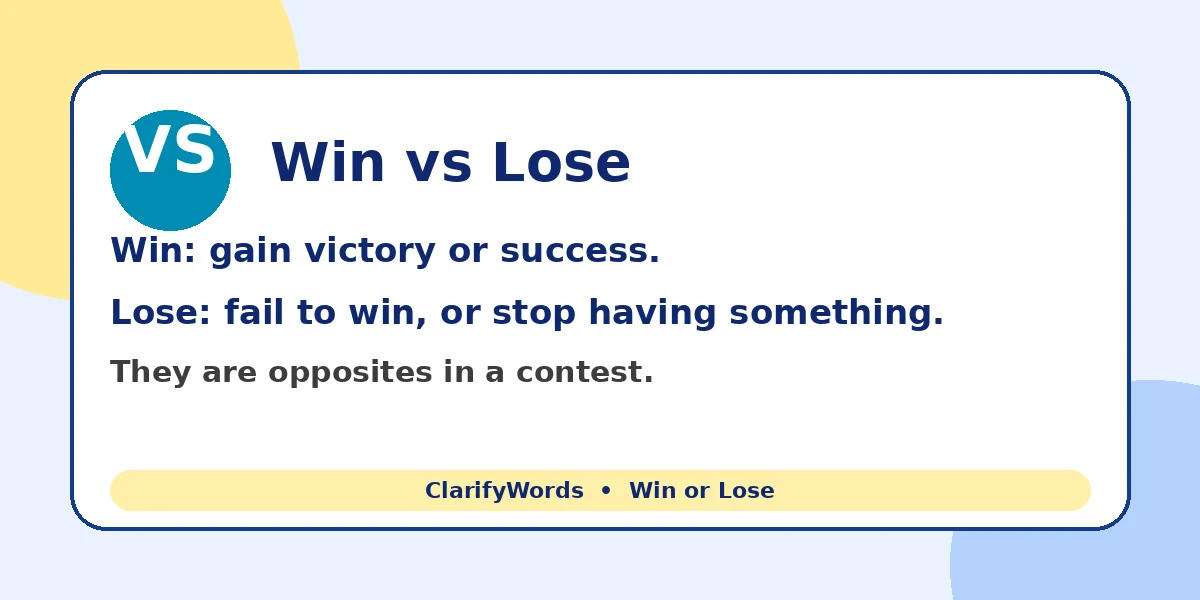
| Meaning | Succeed in a contest | Fail to win, or no longer have something |
| Outcome | Victory or success | Defeat or loss |
| Feeling | Happy, proud | Sad, disappointed |
| Example | “We won the game.” | “We lost the game.” |
| Opposite | Lose | Win |
| Part of speech | Verb (also noun) | Verb |
| Past form | Won | Lost |
Verb Forms of Win and Lose
Win Verb Forms
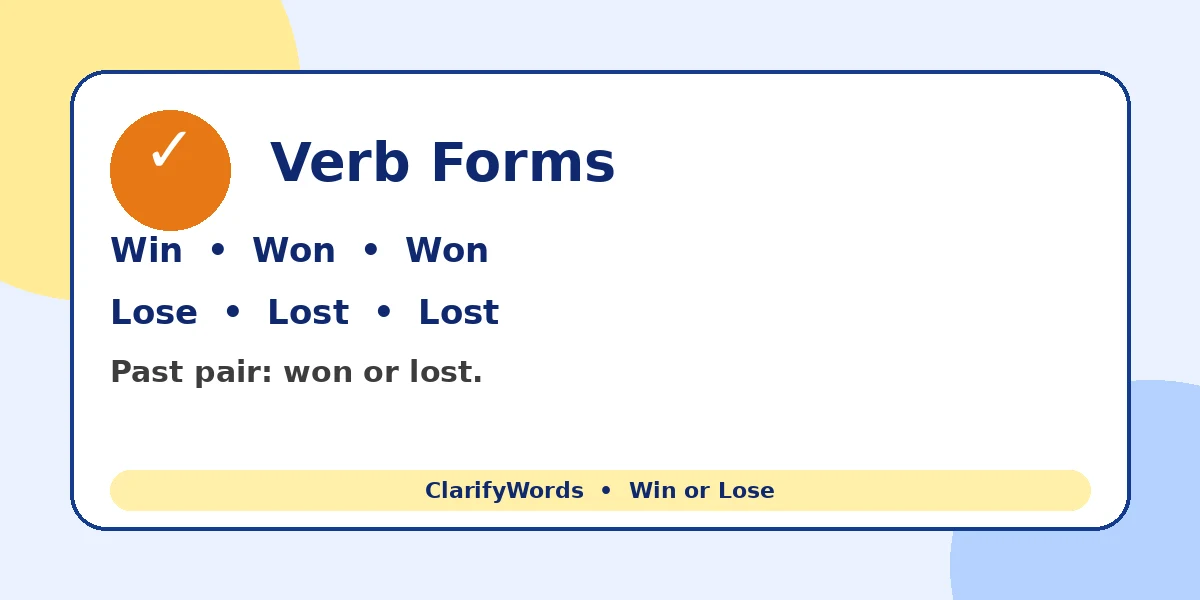
- Base form: win
- Past simple: won
- Past participle: won
- Present participle: winning
- Third person singular: wins
Example: “They win today. They won yesterday. They have won before.”
Lose Verb Forms
- Base form: lose
- Past simple: lost
- Past participle: lost
- Present participle: losing
- Third person singular: loses
Example: “They lose today. They lost yesterday. They have lost before.”
Common Grammar Mistakes in Verb Forms
Do not say “winned” or “losed.” Those forms are wrong. Do not confuse “won” with “one,” or “lost” with “loss.”
Where to Place the Phrase in a Sentence
You can put this phrase at the start or at the end of a sentence. At the start, use a comma after it. At the end, use a comma before it.
- Start: “Win or lose, we will support you.”
- End: “We will support you, win or lose.”
- Middle use is less common. Keep the phrase short and clear.
This Phrase vs Won or Lost
Use this phrase for a result that is still unknown. Use “won or lost” after the result is known. The past pair talks about a finished contest.
- Before: “Win or lose, I will try my best.”
- After: “We do not know yet if they won or lost.”
- Present truth: “You win some, you lose some.”
This Phrase in Sports and Games
Sports give the clearest examples of this phrase.
- Football: “Win or lose, the match was exciting.”
- Cricket: “Our team played with heart, whatever the result.”
- Chess: “I learn from every game, whatever the result.”
- Video games: “Let us play one more round, whatever the result.”
- Board games: “Family game night is fun, whatever the result.”
This Phrase at Work and in Daily Life
The phrase also works outside sports.
- Job interview: “I learned a lot from the interview, whatever the result.”
- Exam: “I tried my best, whatever the result.”
- Business: “The deal taught us a lesson, whatever the result.”
- Audition: “I am proud I tried, whatever the result.”
Related Phrases You Should Know
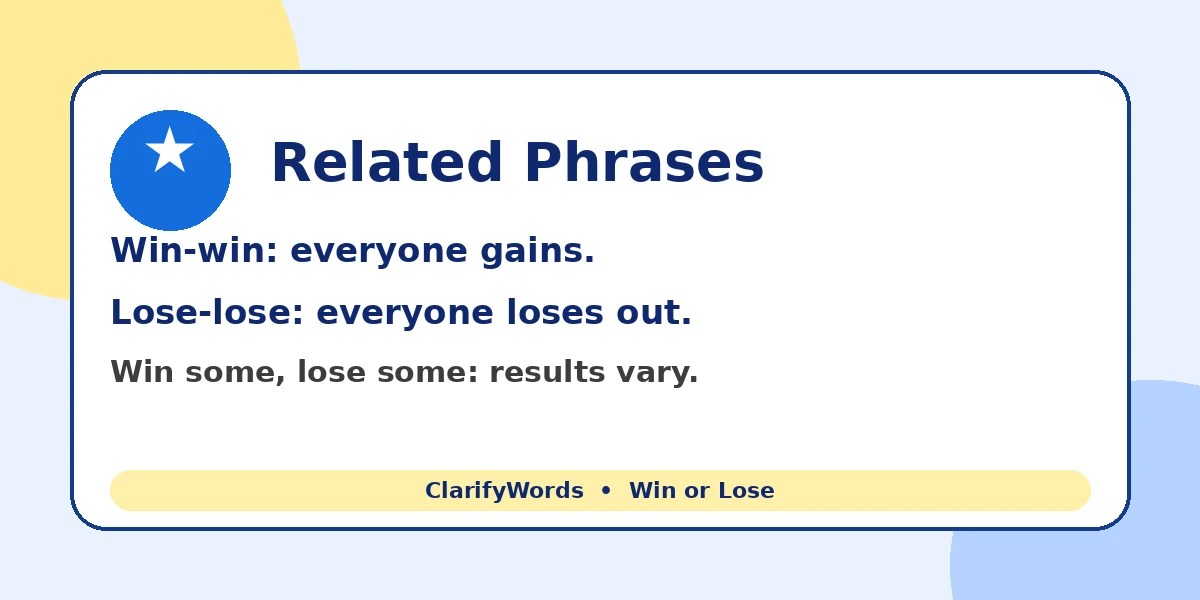
Win-Win
A win-win situation helps everyone. Example: “It was a win-win deal for both teams.”
Lose-Lose
A lose-lose situation helps no one. Example: “That argument was lose-lose for everyone.”
Win Some, Lose Some
This phrase means you cannot win every time. Sometimes you win. Sometimes you lose. Example: “Win some, lose some. That is life.”
Win the Battle, but Lose the War
This phrase means a small short term win with a larger long term loss. Example: “They won the debate but lost the trust of the team.”
Other Related Words
Victory, defeat, success, failure, champion, draw, tie, compete, competition, score, and result.
Note: Pixar also has a series with this title about a school softball team. That title is not the vocabulary phrase. This guide covers the English phrase only.
Common Mistakes Learners Make
Lose vs Loose (Most Common Mistake)
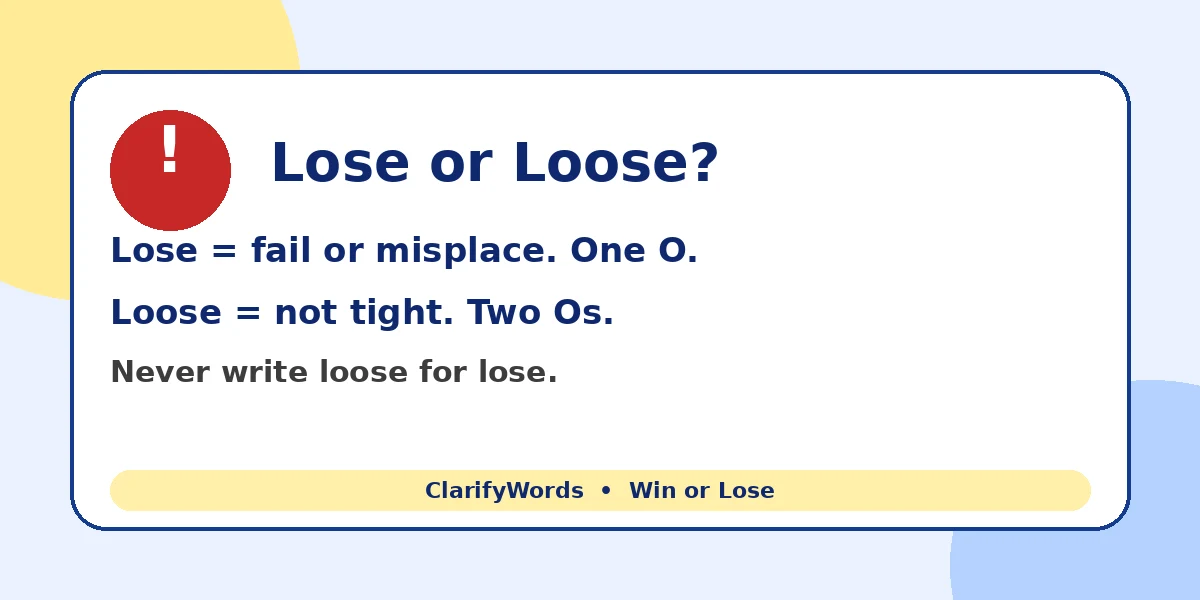
Lose means to fail to win, or to no longer have something. Loose means not tight, or free.
- Correct: “Do not lose your ticket.”
- Correct: “My shoe is loose.”
- Wrong: “Do not loose your ticket.”
Win vs Won
Win is present. Won is past. Do not mix them. Say “I win today” and “I won yesterday.”
Lose vs Loss
Lose is a verb. Loss is a noun. Say “They lost the game” and “It was a big loss.”
Using This Phrase in the Wrong Place
Do not use this phrase for a sure result. Use it only when both outcomes are possible, or the result is still unknown.
Easy Memory Trick
Think of win with W for “winner.” Think of lose with one o. Loose has two o’s, like two loose loops. If you mean “fail to win,” use lose. If you mean “not tight,” use loose.
Trick sentence to remember: “Keep your cool, and do not lose your focus, whatever the result.”
Practice Questions: Test Yourself
- What does this phrase mean?
- Fill in the blank: “Win or ____, I will support you.”
- What is the past tense of win?
- What is the past tense of lose?
- Choose the correct word: “Do not ____ your keys.” (lose / loose)
- Choose the correct word: “My belt is ____.” (lose / loose)
- Is “winned” correct? Why or why not?
- Write a sentence with this phrase about a football match.
- What does “win-win” mean?
- What does “win some, lose some” mean?
Answer Key
- Whether you succeed or fail; whatever the result.
- Lose.
- Won.
- Lost.
- Lose.
- Loose.
- No. The past tense of win is won.
- Example answer: “Our football team played well, whatever the result.”
- A situation where everyone benefits.
- You cannot win every time; sometimes you win and sometimes you lose.
More Ways to Use Win and Lose
Win Plus a Noun
Win often takes a noun after it. The noun names the prize or contest. Common patterns are win a game, win a match, win a race, and win a prize. You can also win a scholarship, win an award, and win a contract. In each case, win means gain by effort or success.
Examples:
- “She won a gold medal.”
- “He won the school election.”
- “They won a new contract.”
Lose Plus a Noun
Lose also takes a noun after it. The noun names what is gone or missed. Common patterns are lose a game, lose a key, lose a job, and lose a chance. You can also lose time, lose patience, and lose confidence. In each case, lose means no longer have it or fail to keep it.
Examples:
- “She lost her phone.”
- “He lost his temper in the meeting.”
- “They lost a good chance to save money.”
Synonyms and Near Synonyms
Win has near synonyms such as triumph, prevail, succeed, and conquer. Lose has near synonyms such as fail, forfeit, miss, and drop. Synonyms are not always exact. Triumph sounds stronger than win. Miss sounds softer than lose. Choose the word that fits the situation.
Win and Lose in Everyday Speech
People use win and lose in casual talk as well as in formal writing. A friend may say, “You win this time.” A coach may say, “We lost, but we played well.” A teacher may say, “Do not lose hope.” These uses show that win and lose are basic English verbs. Learners meet them early and use them often.
A Note on Tone
Win sounds positive in most cases. Lose sounds negative in most cases. But lose is not always bad. Losing a bad habit is good. Losing fear can help you grow. Losing weight may be a health goal. Context decides the feeling, not the word alone. Read the full sentence before you judge the tone.
Win and Lose in Questions
Questions with win and lose are common in tests and games. A teacher may ask, “Who won the quiz?” A friend may ask, “Did you lose your ticket?” Answer with the correct past form. Use won for win and lost for lose. Do not add ed to either verb.
FAQs
What does this phrase mean?
It means whether you succeed or fail in a contest or effort. People use it before a result is known. It shows support that does not depend on the final score or outcome.
Is this phrase correct grammar?
Yes, it is correct and common in English. It joins two opposite outcomes into one short phrase. It means whatever happens in a contest, game, exam, or other effort you try.
What is the difference between win and lose?
Win means to succeed in a contest or effort. Lose means to fail to win, or to no longer have something. In games they are direct opposites, but lose has wider everyday uses.
What is the past tense of win and lose?
The past tense of win is won, and the past tense of lose is lost. Both verbs are irregular, so do not add ed to them. Their past participles are also won and lost.
Is this phrase an idiom?
It works like a set phrase or idiom in everyday English. Its meaning is clear from win and lose, but it is mainly used to show support. Use it whatever the result turns out to be.
What is the difference between lose and loose?
Lose is a verb that means to fail to win or to misplace something. Loose is mainly an adjective that means not tight or free. They sound similar, but their spellings and meanings are different.
Can I say “win or loose”?
No, use lose in this phrase. Loose is wrong here because it means not tight or free. It does not mean to fail to win a game, match, or contest.
Final Takeaway
Win means succeed. Lose means fail to win or no longer have something. “Win or lose” means “whatever the result.” Use it to show support, effort, and a positive attitude.