

All or Nothing: Meaning, Examples, and How to Use It Correctly
Have you ever heard someone say, “It is all or nothing”? The phrase sounds bold. It also sounds simple. Yet many learners are unsure what it really means. This guide explains it in plain English. You will learn its meaning, its grammar, and its uses in daily life. You will also learn about all-or-nothing thinking and how to avoid that trap.
Quick Answer
All or nothing means doing something completely or not at all. It leaves no room for a middle option. A person may accept everything or walk away with nothing.
Example: “The deal was take it all or leave it all. We took the full offer or we left with nothing.”
Table of Contents
- Quick Answer
- What Does This Phrase Mean?
- Examples of This Phrase in Sentences
- All-or-Nothing Thinking
- Synonyms for This Phrase
- Opposites of This Phrase
- This Phrase vs Similar Phrases
- When All-or-Nothing Is Actually Reasonable
- Common Mistakes Learners Make
- Easy Memory Trick
- Practice Questions
- FAQs
- Final Takeaway
What Does This Phrase Mean?
Simple Definition
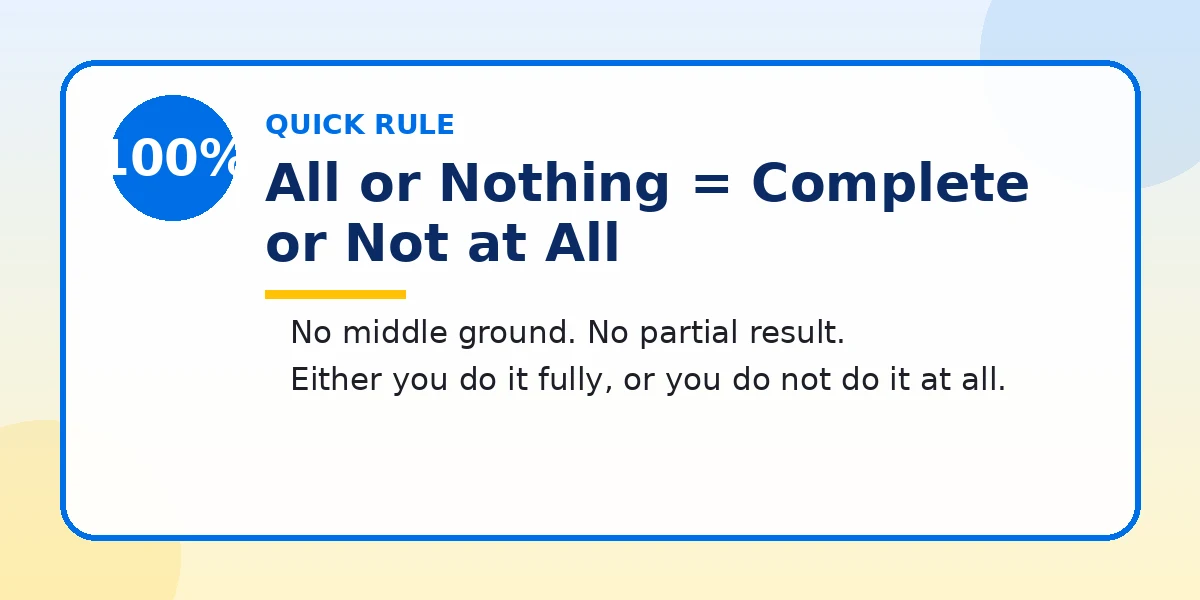
The phrase describes a situation with only two outcomes. You get everything, or you get nothing. There is no partial result. Use it for a choice, a deal, or an attitude.
This phrase can describe a plan. It can describe a person. It can describe a rule. In each case, the idea is the same. Compromise is off the table.
Dictionary Meanings
| Dictionary | Meaning |
|---|---|
| Cambridge | Relates to doing something either completely or not at all. |
| Merriam-Webster | Accepting no less than everything; also, risking everything. |
| American Heritage | Involving either complete success or failure, with no intermediate result; also, refusing to accept less than all demands. |
Merriam-Webster records 1764 as the first known use of the term in its first sense. That date comes from that dictionary alone. It is not a full origin story for the phrase.
Grammar: Phrase or Adjective?
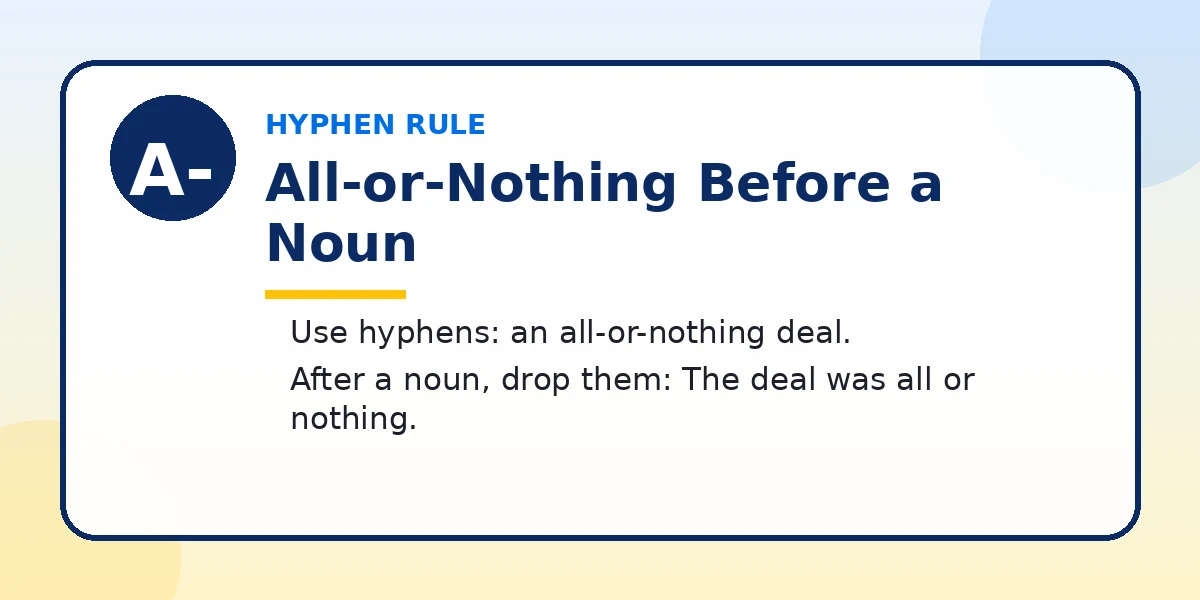
This phrase works as a set phrase. It also works as an adjective when it comes before a noun. In that position, use hyphens: all-or-nothing.
- Before a noun: “She made an all-or-nothing decision.”
- After a noun: “The decision was complete or nothing at all.”
- As a phrase: “It is this way with her.”
This hyphen rule follows standard compound modifier rules. A phrase that modifies a noun gets hyphens. The same phrase after the noun does not.
Two Main Senses
The phrase has two main senses. First, it can mean accepting no less than everything. A person wants the full deal or no deal. Second, it can mean risking everything. A team bets all its effort on one final play.
Both senses share one core idea. There is no middle ground. Keep that idea in mind as you read the examples below.
Examples in Sentences
Quick Examples
- “The team played for everything in the final match.”
- “She gave the project her full effort or nothing at all.”
- “The offer left no middle ground.”
- “The choice left no middle ground.”
- “It is this way with him. He loves a plan fully or drops it at once.”
Sports
Sports give the clearest examples of this phrase. A downhill race is decided on one run. One mistake can end the whole race. A final match can also work this way. A team goes for everything in the last minute. The coach risks a full attack. A loss ends the season.
Example: “The final was winner takes all. One goal decided the trophy.”
Business and Deals
Deals often use this phrase. A seller may offer a package deal. The buyer takes all items or none. The deal avoids partial sales. A contract may work the same way. Both sides agree to every term or there is no deal.
Example: “The seller made an all-or-nothing offer. We accepted every term or walked away.”
Diet and Fitness
Diet and fitness show the risky side of this phrase. A person follows a strict diet. One slip feels like failure. The plan then stops. The same pattern shows up in exercise. A person misses one workout. They feel the whole routine is ruined. They quit the plan.
Example: “Her diet was strict and unforgiving. One cookie felt like a total failure.”
Work and Study
Work and study also show this pattern. A student studies all night or not at all. The result is stress and low focus. A steady plan works better. At work, one mistake can feel like total failure. A worker may think, “I am terrible at my job.” That thought ignores all the good work they did.
Example: “His study plan left no room for error. He crammed for one night, then gave up for a week.”
Relationships
In relationships, this phrase can sound harsh. A partner may demand full loyalty or end the bond. The rule leaves no space for growth. A friend may also think this way. One missed call feels like proof of no care. That view ignores a long history of care.
Example: “She either loves you or hates you. It is this way with her.”
Everyday Habits
Everyday habits show the same idea in small ways. A person cleans the whole house or skips it. Small steps feel useless. The task then grows. A reader may binge-watch a whole season instead of one episode. The habit is extreme, not balanced.
Example: “I cannot watch just one episode. It is this way for me.”
All-or-Nothing Thinking
What Is All-or-Nothing Thinking?
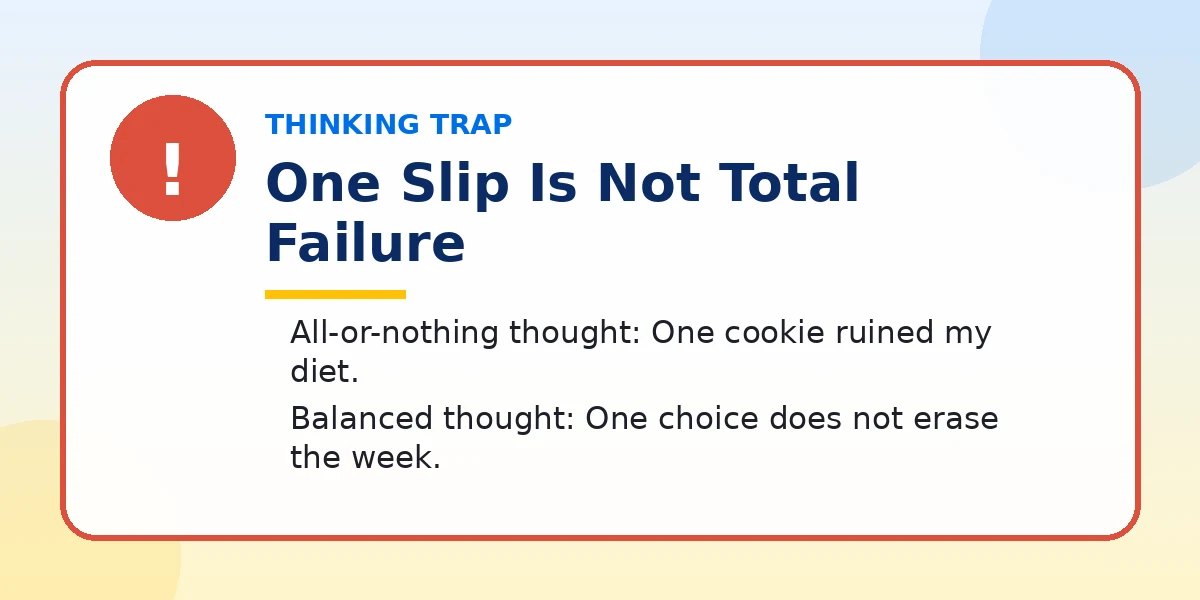
All-or-nothing thinking sees events in extremes. A result is either perfect or a failure. There is no middle ground. In cognitive behavioral therapy (CBT), this pattern is called a cognitive distortion. It is also called black-and-white thinking or dichotomous thinking.
This pattern is a thinking style, not a diagnosis by itself. Many people slip into it at times. It becomes a problem when it shapes most decisions. It can then lead to stress, guilt, and giving up.
Examples by Life Area
| Life Area | All-or-Nothing Thought | Balanced Alternative |
|---|---|---|
| Work | “I made one mistake, so I am terrible at my job.” | “I got most of it right and I know what to fix.” |
| Diet | “I ate one cookie, so my diet is ruined.” | “One choice does not erase the whole week.” |
| Exercise | “I missed the gym twice, so I failed my goal.” | “Two missed sessions are a small break, not a failure.” |
| Relationships | “They let me down once, so I cannot trust them.” | “One lapse does not define the whole relationship.” |
| Study | “I did not get top marks, so I am a failure.” | “I learned a lot, even if one grade was low.” |
| Mood | “I had a bad morning, so the whole day is ruined.” | “Part of the day went badly. The rest can still go well.” |
Signal Words
Watch for absolute words. They often signal this pattern. Common signal words are always, never, completely, totally, ruined, perfect, pointless, every, and none. When you hear those words in your own thoughts, pause. Ask if the claim is really absolute.
Causes
Perfectionism is a common cause. It sets standards that allow no error. Fear of failure is another cause. It links self-worth to results. Rigid rules also play a role. Rules like “never miss a day” cannot survive real life. Stress can raise extreme thinking. Low self-esteem can turn a setback into proof of failure. Upbringing can also shape this pattern. A child who hears that only perfect work counts may carry that rule into adult life.
Effects
This pattern has real costs. It can cause procrastination. A person delays a task because they cannot do it perfectly. It can cause burnout. A person works at full speed, then crashes and does nothing. It can cause guilt after a small slip. It can cause a person to quit a good plan too soon. In relationships, it can make forgiveness harder. A small flaw feels like total betrayal.
8 Practical Fixes
- Notice absolute words like always, never, and ruined. Name the thought for what it is.
- Reframe a setback as a small step back, not a total failure.
- Set smaller, clear goals that you can meet on a normal day.
- Allow a middle ground. Look for a third option between two extremes.
- Rate progress on a scale of 1 to 10. A week at 8 out of 10 is still strong.
- Focus on effort, not only results. Effort is under your control.
- Track partial progress. Write down what went well, not only what went wrong.
- Plan a full, good, and minimum version of a goal. A 20 minute walk beats no walk at all.
A useful replacement phrase is “all or something.” It means some effort still counts. Another is “progress over perfection.” Both phrases keep you moving after a slip.
If this pattern is constant, if it links to low mood or worry on most days, or if it harms your work or relationships, consider talking to a professional. CBT is a common approach for this pattern. This guide does not diagnose anyone. It only explains the pattern in plain terms.
Synonyms for This Phrase
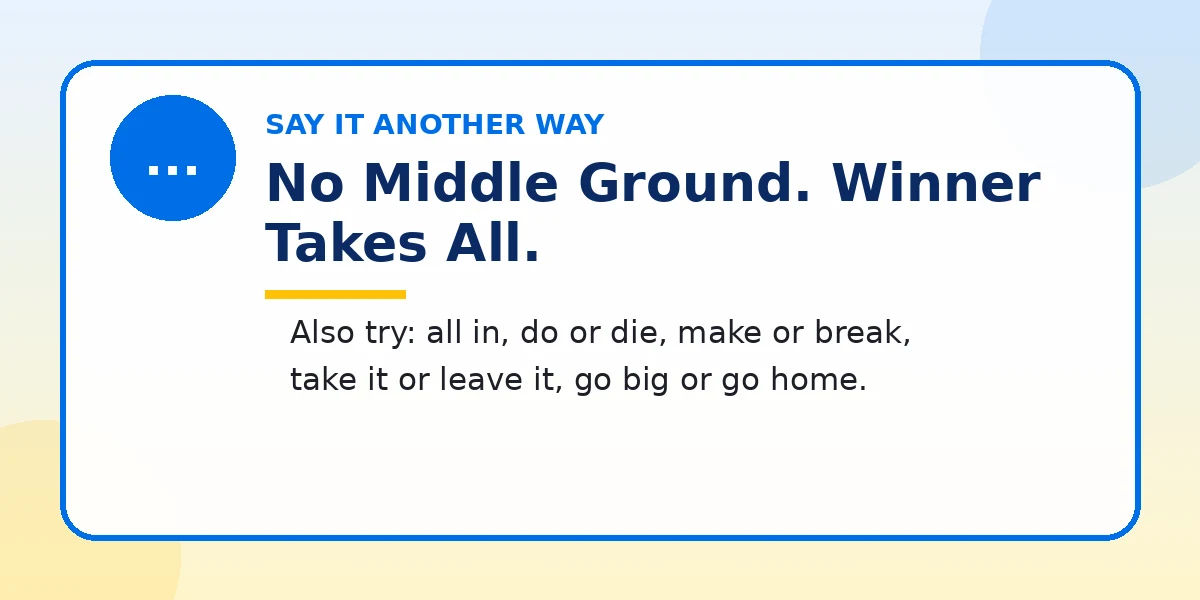
Synonyms are not all exact. Each one fits a different context. Use the table below to pick the right word.
| Synonym | Nuance | Example |
|---|---|---|
| All in | Full commitment to one plan | “We are all in on this launch.” |
| Do or die | A high-risk choice with no safe exit | “It is do or die for the team this week.” |
| Make or break | A moment that decides success or failure | “This deal is make or break for the startup.” |
| Absolute | Complete and total, with no limits | “She demanded absolute focus from the team.” |
| Total commitment | Full effort with no partial plan | “The project needs total commitment.” |
| No holds barred | No rules or limits in a contest | “The debate was no holds barred.” |
| Winner takes all | One side gains the full prize | “The final round is winner takes all.” |
| Uncompromising | Refusal to accept a middle ground | “He took an uncompromising stand in talks.” |
| No middle ground | Only two outcomes, no compromise | “There is no middle ground in this deal.” |
Note the differences. “All in” stresses commitment. “Winner takes all” stresses a contest prize. “Do or die” stresses risk. “No middle ground” stresses the lack of compromise. Pick the phrase that matches your meaning.
Opposites of This Phrase
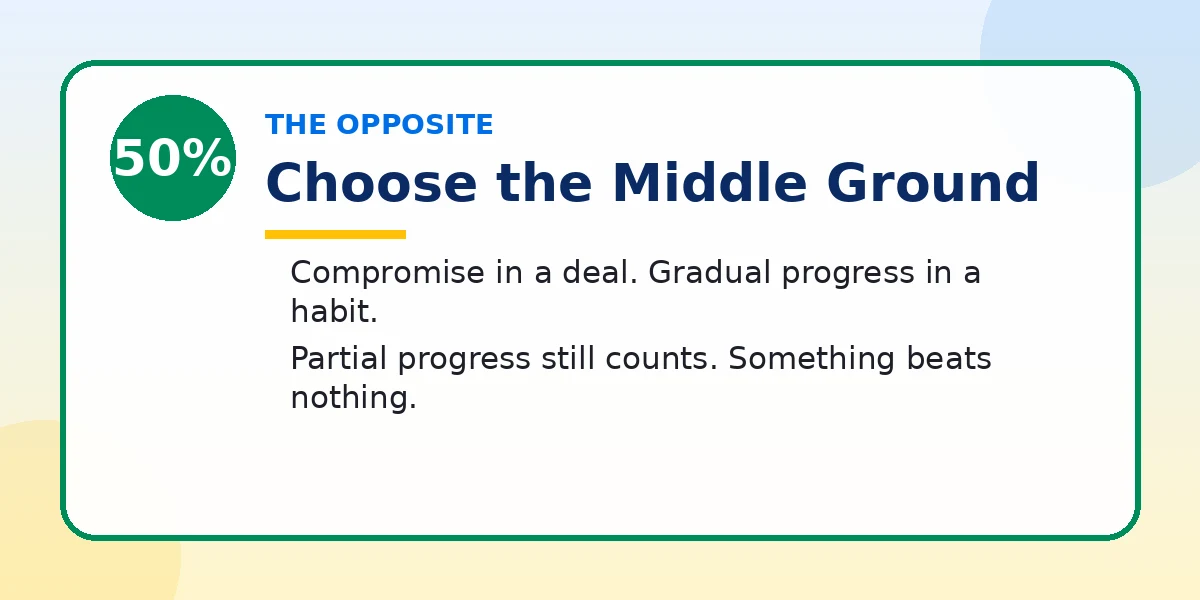
There is no single perfect opposite. The best opposite depends on the sense you mean.
| Sense | Opposites | Example |
|---|---|---|
| A strict choice | Compromise, middle ground, meet in the middle | “They reached a compromise instead of an all-or-nothing deal.” |
| Effort and habits | Gradual, partial, incremental, something is better than nothing | “A short walk is partial progress, and it still counts.” |
| Thinking | Flexible, balanced, thinking in grays | “Flexible thinking leaves room for partial success.” |
| Risk | Play it safe, hedge your bets, cautious | “She hedged her bets instead of risking everything.” |
For a deal, compromise is the natural opposite. For a habit, gradual progress is the natural opposite. For a thought pattern, flexible thinking is the natural opposite. Match the opposite to the sense.
This Phrase vs Similar Phrases
| Phrase Pair | Difference | When to Use Each |
|---|---|---|
| This phrase vs all in | All in means full commitment to one plan. This phrase means a full result or no result. | Use all in for effort. Use this phrase for outcomes. |
| This phrase vs compromise | Compromise seeks a middle ground. This phrase rejects it. | Use compromise for shared deals. Use this phrase for strict terms. |
| This phrase vs go big or go home | Go big or go home is slang for bold action. This phrase is a strict choice. | Use go big or go home in casual talk. Use this phrase in clear, plain writing. |
| This phrase vs winner takes all | Winner takes all means one winner gains all. This phrase can apply to any choice, not only contests. | Use winner takes all for contests. Use this phrase for deals, plans, and attitudes. |
| This phrase vs take it or leave it | Take it or leave it is a final offer with no talks. This phrase is the wider idea behind such an offer. | Use take it or leave it for an offer. Use this phrase for the general pattern. |
A common confusion is this phrase vs win or lose. Win or lose allows a loser and a winner. It shows support whatever the result is. This phrase allows no partial result at all. The two phrases are close, but they are not the same.
When All-or-Nothing Is Actually Reasonable
Not every all-or-nothing choice is a trap. Some outcomes are truly binary. A single-run race is decided on one run. A pass or fail test has no partial pass. A safety rule may need full compliance. Partial compliance may have no value.
Legal agreements can also need clear terms. A contract may need a full deal or no deal. Quitting a harmful habit may need a clear break. A commitment may need a clear yes or no. In these cases, a partial result does not help.
Use this test before you choose. Ask: does a partial result have any real value? If yes, choose a middle path. If no, an all-or-nothing choice may be fair. The trap is not the phrase itself. The trap is using it where partial progress would still count.
Common Mistakes Learners Make
Using All-or-Nothing as a Verb
Do not use the phrase as a verb. Say “He made an all-or-nothing decision.” Do not say “He all-or-nothing the plan.” The phrase describes a choice. It does not act as an action word.
Hyphen Errors
Use hyphens before a noun. Drop them after a noun. “An all-or-nothing deal” is correct. “The deal was all-or-nothing” is not the standard form. After a noun, write “The deal was complete or nothing at all.”
Confusing This Phrase with All In
All in means you commit fully. This phrase means the result is full or zero. A person can be all in on a plan and still accept partial progress. Do not swap the two phrases without checking the meaning.
Using It for Gradual Goals
Do not use this phrase for goals that grow step by step. Learning a language, saving money, and building fitness are gradual goals. Partial progress counts in all three. Use words like gradual or steady for those goals.
Overusing It in Formal Writing
This phrase is common in speech and casual writing. In formal writing, use it sparingly. Words like uncompromising, absolute, or complete may fit better. In a formal report, “an uncompromising stance” may read more clearly than “an all-or-nothing stance.”
Easy Memory Trick
Picture a light switch with no dimmer. The light is either on or off. There is no soft glow. That image shows this idea.
Trick sentence to remember: “All or nothing is a light switch, not a dimmer. It is on, or it is off, with nothing in between.”
Use that image when you check your own thoughts too. If a thought sounds like a switch with no dimmer, it may be all-or-nothing thinking. Look for the dimmer. Find a middle setting that still counts.
Practice Questions: Test Yourself
- What does all or nothing mean?
- Fill in the blank: “The deal was ___ or nothing.”
- Which sentence uses all-or-nothing correctly? A) He made an all-or-nothing decision. B) He all-or-nothing the plan.
- What is a synonym for this phrase in a contest? A) Compromise B) Winner takes all C) Partial D) Flexible
- What is the opposite of this phrase for a strict deal? A) Absolute B) Compromise C) Total D) Do or die
- Is “The deal was all-or-nothing” correct after a noun? Why or why not?
- Give an example of all-or-nothing thinking about exercise.
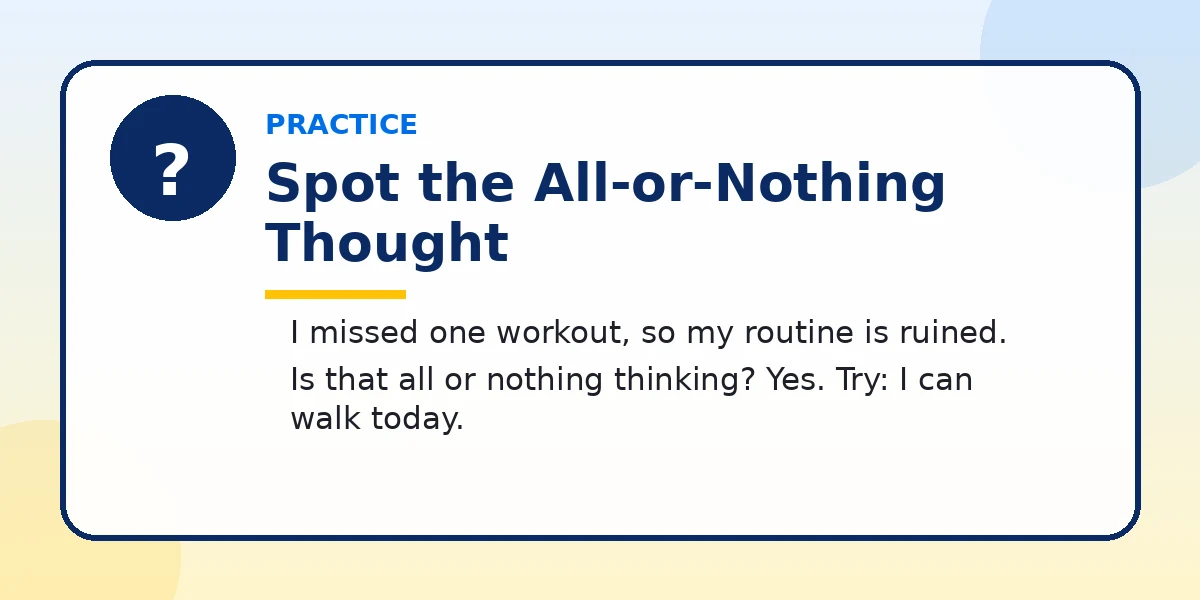
- Rewrite this thought in a balanced way: “I missed one workout, so my routine is ruined.”
- What is the difference between this phrase and all in?
- Write a sentence with this phrase about a sports final.
Answer Key
- Doing something completely or not at all, with no middle ground or partial result.
- All.
- A. All-or-nothing is an adjective before the noun decision. It is not a verb.
- B. Winner takes all.
- B. Compromise.
- No. After a noun, drop the hyphens: “The deal was complete or nothing at all.”
- Example answer: “I missed one gym day, so my whole fitness plan has failed.”
- Example answer: “I missed one workout. I can walk today and return to my plan tomorrow.”
- All in means full commitment to a plan. This phrase means a full result or no result.
- Example answer: “The final was all or nothing. One goal decided the trophy.”
FAQs
What does all or nothing mean?
All or nothing means accepting only a complete result or risking everything for one outcome. It can describe a decision, a deal, or an attitude with no middle ground at all.
What is another word for all or nothing?
An all-or-nothing situation can be described as absolute, total, or complete. If it involves a risky choice, all in or do or die may fit. The best word depends on context.
What is the opposite of all or nothing?
The opposite depends on context. For a strict choice, it may be compromise or a middle ground. For a goal, gradual progress or partial success fits better. Flexible thinking offers another clear alternative.
Is it all or nothing or all-or-nothing?
Use all-or-nothing before a noun, as in “an all-or-nothing decision.” Use all or nothing after a noun or as a standalone phrase, as in “The choice is all or nothing.” This follows standard compound modifier rules.
What is an example of all-or-nothing thinking?
Someone who misses one workout and decides their entire fitness plan has failed is using all-or-nothing thinking. Instead of seeing one missed day as a temporary setback, they view it as complete failure.
How do you stop all-or-nothing thinking?
Start by noticing extreme words such as always, never, and ruined. Look for evidence, consider a middle ground, and replace absolute judgments with balanced thoughts. A therapist can also help you change this pattern.
Final Takeaway
All or nothing means complete or not at all, with no middle ground. Use hyphens before a noun and no hyphens after it. Use the phrase for truly binary choices. For habits, goals, and thoughts, look for the middle ground. Partial progress still counts.