
May vs Might: What’s the Difference? Rules and Examples

May vs might can confuse even good writers. Both words express possibility. They often appear in similar sentences. Their meanings are not always the same.
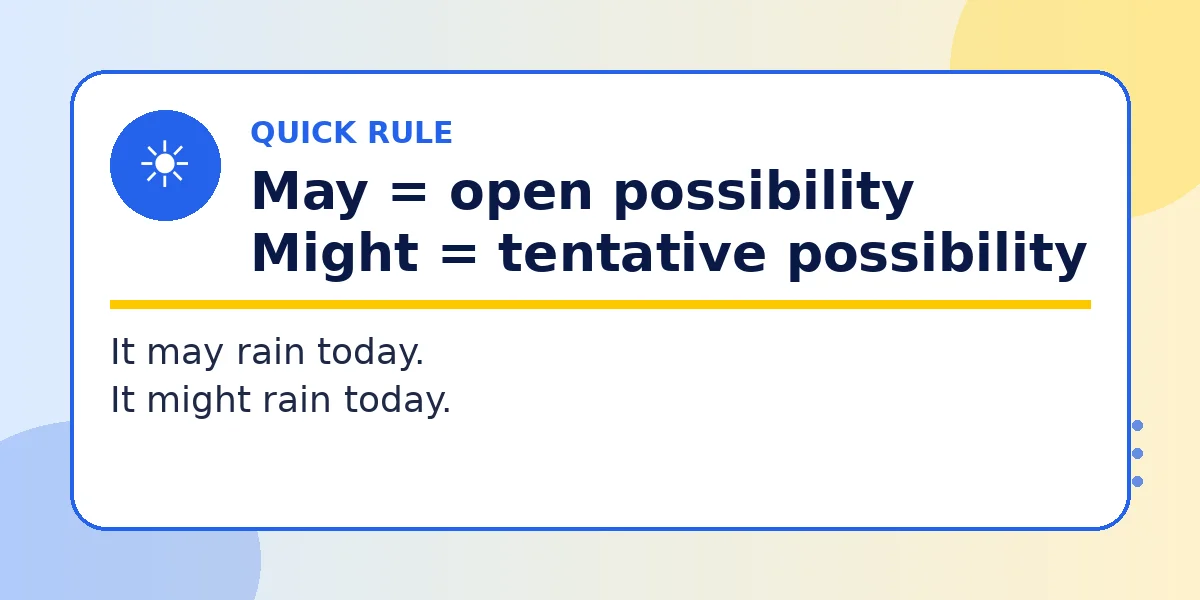
May usually expresses a more open possibility. It also expresses formal permission, wishes, and concession. Might usually expresses a more tentative possibility. It also expresses hypothetical situations, tentative suggestions, and unrealized past possibilities. The difference is not based on fixed probability percentages. Context and speaker intent matter most.
Quick Answer
Use may when you express an open possibility, ask for formal permission, grant permission, or express a wish or concession. Use might when you express a more tentative possibility, make a gentle suggestion, or describe a hypothetical or unrealized situation.
Examples:
It may rain this afternoon. Rain is a real possibility.
It might rain this afternoon. Rain is also possible, but the speaker sounds more tentative.
May I use your phone? This is a formal permission request.
You might want to check your email. This is a gentle suggestion.
Both words can describe present and future possibilities. Their meanings often overlap. That short test covers most uses of may vs might in everyday writing. The sections below show when the choice changes meaning and when it does not.
Table of Contents
- May vs Might at a Glance
- When to Use May
- When to Use Might
- Permission and Formality in American and British English
- May Not vs Might Not
- May vs Might in Reported Speech
- May vs Might in Conditional Sentences
- May Have vs Might Have
- May Be vs Maybe
- Grammar Rules for May and Might
- Common Mistakes
- Quick Decision Rule
- Memory Trick
- Practice Questions
- Frequently Asked Questions
- Related Guides
May vs Might at a Glance
May and might are modal auxiliary verbs. This table sums up may vs might at a glance. They change the meaning of the main verb. They express possibility, permission, and related meanings. The main difference is the speaker’s intent. May often sounds more open or confident. Might often sounds more tentative.
| Use | May | Might |
|---|---|---|
| Main job | Possibility and permission | Tentative possibility |
| Possibility | Often sounds more open | Often sounds more uncertain |
| Present possibility | Yes | Yes |
| Future possibility | Yes | Yes |
| Past possibility | May have plus past participle | Might have plus past participle |
| Formal permission | Common | Very formal and less common |
| Wishes | Common | Uncommon |
| Suggestions | Possible | Often sounds more tentative |
| Concession | Common | Less typical |
| Reported speech | Original form may remain | Common backshifted form |
| Unreal conditionals | Less common | Normally preferred |
Are May and Might Interchangeable?
Yes, often for possibility. Consider these sentences.
She may visit us tomorrow.
She might visit us tomorrow.
Both sentences mean a visit is possible. The second sentence may sound more tentative. The choice does not always change the basic meaning.
The choice matters in other cases. Consider these sentences.
May I leave early? This asks permission.
I might leave early. This expresses a possibility.
One sentence asks for permission. The other sentence only predicts an action. Intent decides the best word.
When to Use May
May to Express Possibility
Use may for a present or future possibility that is open and real.
The package may arrive today.
She may need extra time.
We may visit our grandparents this weekend.
This information may help you understand the problem.
May also appears in formal writing for general possibilities.
Regular exercise may improve overall health.
May to Ask for and Give Permission
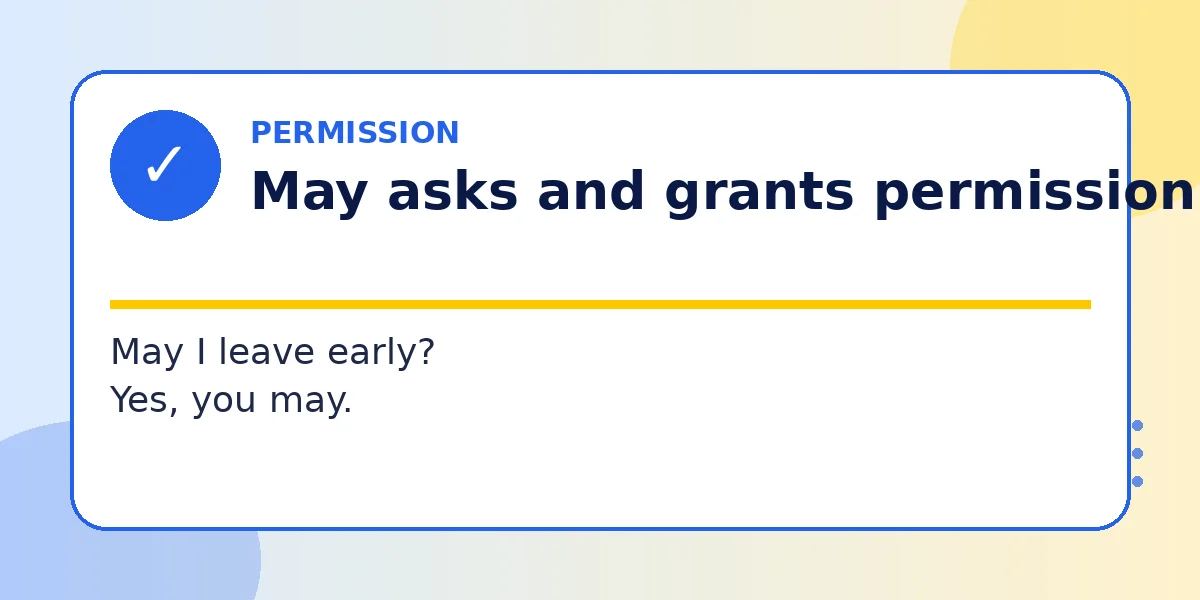
May is the standard word for formal permission. Use it to ask permission.
May I come in?
May we use this room?
May I ask you a question?
Use it to grant permission.
You may leave after the meeting.
Students may use calculators during the test.
Employees may work remotely on Fridays.
Use may not to deny permission.
Visitors may not enter the restricted area.
In this sentence, may not means not allowed. Context tells you the meaning, as the next sections show.
May to Express Wishes and Hopes
May expresses formal wishes and blessings.
May you have a wonderful birthday!
May your dreams come true.
May you find happiness and success.
May peace be with you.
These uses are formal and traditional. Might does not normally replace may in a wish.
May to Express Concession
May can acknowledge a point and then contrast it. The pattern is may plus a statement, then but plus a contrasting statement.
It may be expensive, but it is worth the price.
She may be young, but she is very experienced.
The task may seem difficult, but you can complete it.
When to Use Might
Might to Express a Less Certain Possibility
Use might for a present or future possibility that feels tentative or remote.
I might go shopping later.
They might arrive after dinner.
We might need another meeting.
He might know the answer.
Might does not always mean less likely than may. Context matters. Cambridge Grammar notes that native speakers can disagree about relative certainty. Treat the probability difference as a tendency, not a fixed rule.
Might to Make Tentative Suggestions
Might softens advice and recommendations. This pattern is common in conversation and at work.
You might want to rest for a while.
You might try a different approach.
We might consider another option.
You might like to read this book.
Compare a direct instruction with a soft suggestion.
Try another approach. This is a direct instruction.
You might try another approach. This is softer advice.
Might in Hypothetical and Unreal Situations
Might is the normal choice for imagined or unreal situations.
If I had more time, I might learn another language.
She might accept the offer if the salary improved.
We might travel more if flights were cheaper.
Might is especially common in second and third conditionals. Those patterns are covered in detail below.
Might as the Past or Backshifted Form of May
Might is traditionally the past form of may. This link shows up in reported speech.
Direct speech: I may attend the event.
Reported speech: She said she might attend the event.
But might is not limited to the past. It also describes present and future possibilities.
I might call you tonight. This sentence refers to a possible future action, not a past action.
Permission and Formality in American and British English
Both words can appear in permission requests. Permission is where may vs might differ most sharply. They are not equally natural in every context.
Is May More Formal Than Might?
May is the conventional choice for formal permission. Might is also polite, but it sounds especially formal in a request.
May I speak with the manager?
Might I ask you a question?
You may leave the room now.
Might is not usually natural for granting permission. The normal grant is “Yes, you may.” A reply of “Yes, you might” sounds conditional or sarcastic unless a condition is meant.
May vs Can for Permission in American English
In American English, may, can, and could all ask permission, but they differ in tone.
May I borrow your pen? This is formal and polite.
Can I borrow your pen? This is natural and conversational.
Could I borrow your pen? This is polite and considerate.
May is common in formal settings such as schools, workplaces, and official instructions. Can is widely accepted in everyday American conversation. The grammar rule stays the same. Only the tone changes.
Formal: May I leave early today?
Casual: Can I leave early today?
Polite: Could I leave early today?
May vs Might for Permission in British English
British English follows the same grammar rules. The main difference is formality and everyday use.
May I use your computer?
Might I make a suggestion?
You may enter the building.
In British English, “Might I” is more likely in formal or carefully polite situations than in casual conversation. In American English, it can sound old fashioned. In both varieties, may remains the standard word for granting permission.
May Not vs Might Not
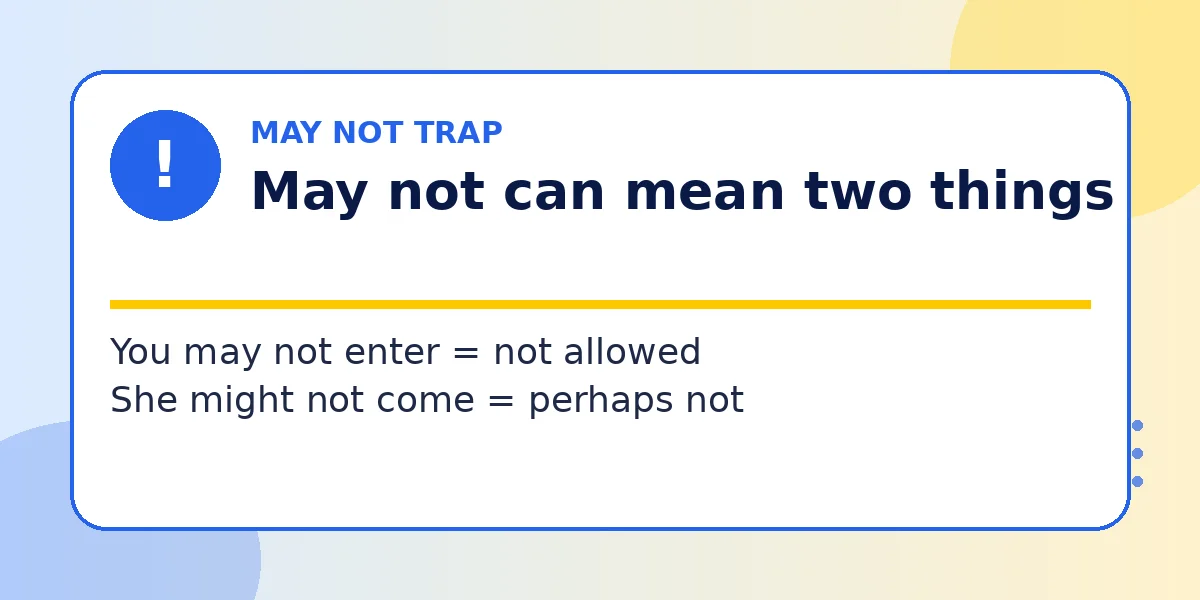
This is one of the most useful distinctions in this guide. May not can express either prohibition or negative possibility. Might not normally expresses only negative possibility.
When May Not Means Prohibition
In rules, instructions, and restrictions, may not means not allowed.
Students may not use phones during the exam.
Visitors may not enter this room.
Employees may not share confidential information.
When May Not Means Possibility
In a prediction, may not means perhaps not.
She may not attend the party.
The store may not open tomorrow.
He may not know the answer.
Here, may not expresses uncertainty. It does not state a rule.
Why Might Not Usually Means Perhaps Not
Might not normally means only perhaps not. It does not normally prohibit.
She might not come to dinner.
They might not finish the project today.
It might not rain tomorrow.
Each sentence suggests something may fail to happen. None of them states a ban.
May Not vs Might Not Comparison Table
| Sentence | Meaning |
|---|---|
| You may not enter. | You are not allowed to enter. |
| You may not agree with me. | Perhaps you do not agree with me. |
| You might not agree with me. | Perhaps you do not agree with me. |
| We may not finish today. | Perhaps we will not finish today. |
| We might not finish today. | Perhaps we will not finish today. |
Quick tip: when may not appears in a rule or instruction, check whether it means not permitted. When it appears in a prediction, it usually means perhaps not. If you mean perhaps not, use might not to avoid confusion.
May vs Might in Reported Speech
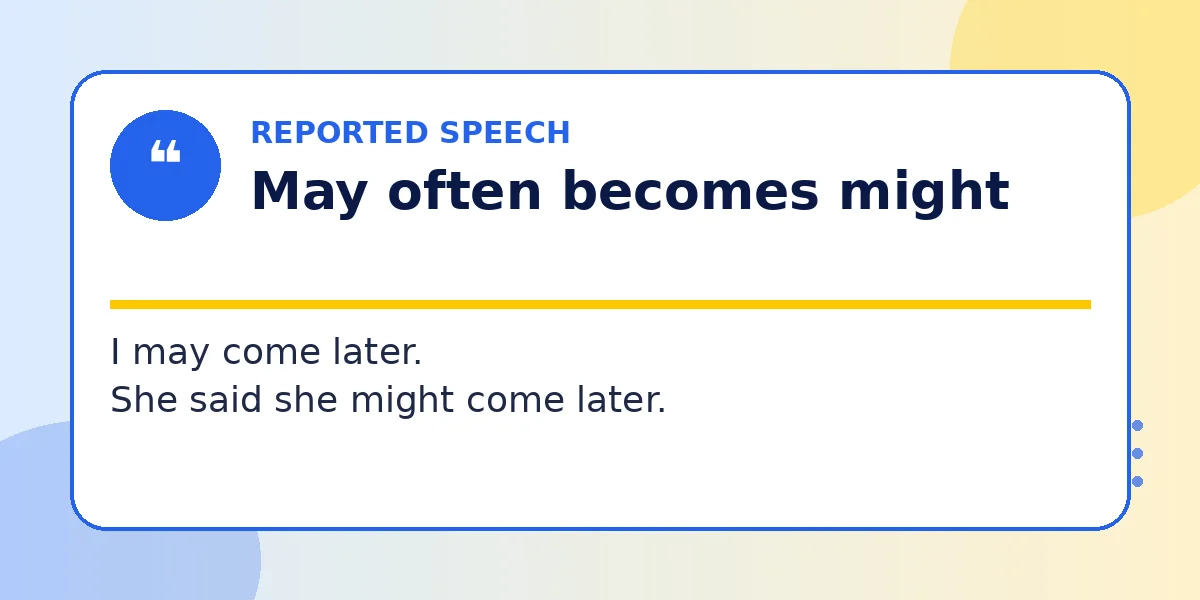
When the reporting verb is in the past, may expressing possibility often changes to might. Reported speech is another area where may vs might behave differently. This shift is called backshift. Backshift is not automatic.
When May Changes to Might
Direct speech: Sarah said, “I may visit tomorrow.”
Reported speech: Sarah said that she might visit the next day.
Direct speech: “It may rain tonight,” John said.
Reported speech: John said it might rain that night.
When May Does Not Need to Change to Might
Use a present reporting verb, and may can stay.
Direct speech: “I may need help.”
Reported speech: She says she may need help.
Keep may when the possibility is still current at the time of reporting.
Direct speech: “The package may arrive tomorrow.”
Reported speech: He said the package may arrive tomorrow.
Permission follows a different pattern. Do not report a permission grant with might.
Direct speech: “You may leave now.”
Reported speech: The teacher said we could leave.
Common Reported Speech Examples
I may come later. Reported: She said she might come later.
It may snow tonight. Reported: He said it might snow that night.
I may need help. Reported: She says she may need help.
You may leave now. Reported: The teacher said we could leave.
It might rain tomorrow. Reported: He said it might rain the next day.
Note that might does not normally change in reported speech.
May vs Might in Conditional Sentences
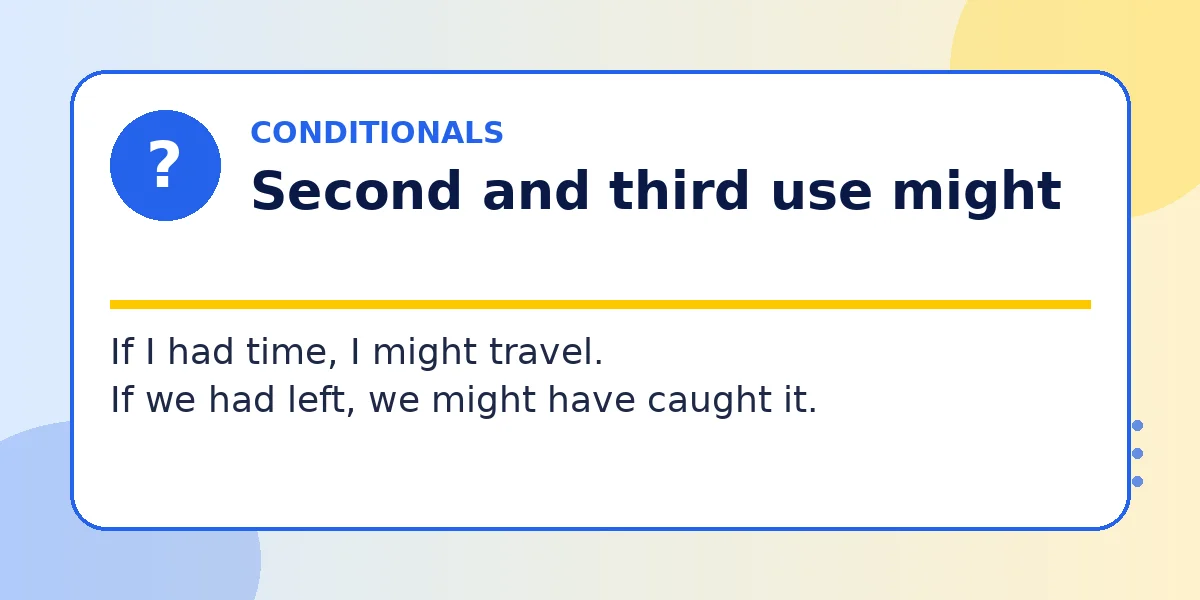
Both words can appear in first conditionals. Conditionals show another split in may vs might. Might is normally preferred in second and third conditionals.
First Conditional Sentences
Structure: If plus present simple, then may or might plus base verb.
If it rains, we may stay home.
If she finishes early, she might join us.
If you study tonight, you may pass the test.
May often sounds more open or confident here. Might sounds more tentative.
Second Conditional Sentences
Structure: If plus past simple, then might plus base verb.
If I had more money, I might buy a new car.
If she lived nearby, she might visit us.
If we had more time, we might travel abroad.
The past form in the if clause expresses distance from reality, not past time. These are hypothetical situations.
Third Conditional Sentences
Structure: If plus past perfect, then might have plus past participle.
If I had left earlier, I might have caught the train.
If she had studied harder, she might have passed.
If they had called us, we might have helped them.
Third conditionals describe possibilities that did not become reality.
Conditional Comparison Table
| Conditional | Usual choice | Example |
|---|---|---|
| First conditional | May or might | If we hurry, we may arrive on time. |
| Second conditional | Might | If I had a car, I might drive there. |
| Third conditional | Might have | If we had left early, we might have arrived on time. |
May is possible in some less typical conditional contexts. Might remains the usual choice for remote or unreal situations.
May Have vs Might Have
Both forms describe uncertain past events. The past forms add one more layer to may vs might. They differ for unrealized past possibilities. Structure: may or might plus have plus past participle.
May Have for Past Possibility
Use may have to guess that something happened. The speaker does not know if it happened.
She may have forgotten her keys.
He may have missed the bus.
They may have left early.
The package may have arrived yesterday.
Might Have for Past Possibility
Might have works the same way for an uncertain past event.
She might have forgotten her keys.
He might have missed the bus.
They might have left early.
The package might have arrived yesterday.
Might have often sounds more tentative here, but not absolutely. Both forms are correct for an unknown past event.
Might Have for Unrealized Past Possibilities
Use might have for an action that was possible but did not happen.
I might have called, but I decided to wait.
She might have won, but she made a mistake.
We might have visited them, but we ran out of time.
Might have can also express criticism about a past action.
You might have told me about the change. This suggests the person did not provide the information.
May Have vs Might Have Comparison Table
| Meaning | May have | Might have |
|---|---|---|
| Uncertain past event | Yes | Yes |
| Past speculation | Yes | Yes |
| Alternative past possibility | Less typical | Common |
| Unrealized past action | Not normally | Yes |
| Expressing criticism | Less typical | Common |
Remember the test. If the outcome is still unknown, either form works. If the action is known not to have happened, use might have.
May Be vs Maybe
May be and maybe are frequently confused. A spelling trap sits beside may vs might in this pair. They have different grammatical functions.
May Be as a Verb Phrase
May be is a two word verb phrase. May is a modal auxiliary verb. Be is the base form of the verb to be.
She may be tired.
He may be the right person for the job.
The answer may be incorrect.
They may be at home.
Maybe as a One Word Adverb
Maybe is a one word adverb. It means perhaps or possibly.
Maybe she is tired.
Maybe we should leave early.
He will maybe call tomorrow.
Unlike may be, maybe does not form a modal verb phrase.
May Be vs Maybe Comparison Table
| Feature | May be | Maybe |
|---|---|---|
| Spelling | Two words | One word |
| Part of speech | Modal verb plus base verb | Adverb |
| Meaning | Possibly is or exists | Perhaps |
| Example | She may be busy. | Maybe she is busy. |
Both forms can communicate possibility.
She may be at work.
Maybe she is at work.
Easy Ways to Remember May Be vs Maybe
Replace the word with perhaps. If the sentence still works, maybe is likely correct.
Maybe he is sleeping.
Perhaps he is sleeping.
For may be, look for subject plus modal plus be.
She may be sleeping.
You cannot combine those words into “She maybe sleeping” in standard English.
Grammar Rules for May and Might
May and might follow the same basic modal rules. Most errors with may vs might come from treating the two words as identical in every context.
Use the Base Form of the Verb
Structure: subject plus may or might plus base verb.
Correct: She may leave early.
Correct: He might call tomorrow.
Correct: They may visit next week.
Correct: We might need more time.
Incorrect: She may leaves early.
Incorrect: He might called tomorrow.
Incorrect: They may visiting next week.
Do not change the main verb to match the subject.
Never Add To After May or Might
Correct: I may go tomorrow.
Correct: She might join us.
Correct: They may need help.
Incorrect: I may to go tomorrow.
Incorrect: She might to join us.
Incorrect: They may to need help.
Never Add an S Ending
May and might keep the same form for every subject.
Correct: I may visit.
Correct: She may visit.
Correct: He might agree.
Correct: They might agree.
Incorrect: She mays visit.
Incorrect: He mights agree.
Use Have Plus Past Participle for the Past
Structure: may or might plus have plus past participle.
Correct: She may have forgotten.
Correct: He might have left.
Correct: They may have arrived.
Correct: We might have missed the train.
Do not use a simple past form after have.
Incorrect: She might have went home.
Correct: She might have gone home.
Forming Questions and Negative Sentences
Place may or might before the subject to form a question.
May I come in?
May we start now?
Might I ask a question?
Form negatives by adding not directly after the modal.
She may not attend.
He might not agree.
We may not finish today.
They might not arrive on time.
Do not use do or does with a modal.
Incorrect: Do you may leave?
Common Mistakes
Assuming May Always Means More Likely Than Might
May often sounds more confident, but this is not a strict rule. Both words express possibility. Speakers can interpret relative certainty differently.
The company may hire more employees.
The company might hire more employees.
Both sentences are correct. Neither sentence gives a measured probability.
Thinking Might Is Only the Past Tense of May
Might is traditionally the past form of may. It also describes present and future possibilities.
I might visit my parents tomorrow.
This sentence describes a possible future visit, not a past action.
Confusing May Not With Might Not
Context decides the meaning of may not.
You may not park here. This is a prohibition.
You might not find a parking space. This is uncertainty.
Use might not when you mean perhaps not.
Using May Have for an Unrealized Past Possibility
For a past guess with an unknown outcome, either form works.
She may have missed the bus.
For an action known not to have happened, use might have.
I might have called, but I forgot.
Forgetting the Base Verb After May and Might
Incorrect: He might goes home.
Correct: He might go home.
Incorrect: She may left early.
Correct for a past guess: She may have left early.
Correct for a future action: She may leave early.
Confusing May Be With Maybe
Incorrect: She maybe at school.
Correct: She may be at school.
Also correct: Maybe she is at school.
Treating Reported Speech Backshift as Mandatory
Backshift depends on the reporting verb and on whether the possibility is still current.
She says she may come later. Present reporting verb, so may stays.
She said she might come later. Past reporting verb, so might is the usual form.
Both sentences are correct in their own contexts.
Quick Decision Rule
Ask three questions in order. Use this test whenever you hesitate over may vs might.
First, is it permission? If yes, use may. May is the standard word for asking, granting, and refusing permission.
Second, is it reported from a past viewpoint? If yes, use might. Might is the usual backshifted form of may.
Third, is it only possibility? If yes, either word works. Might sounds more tentative. May sounds more open.
Use may when you express an open possibility, formal permission, a wish, or a concession.
It may snow tonight.
May I borrow your book?
You may leave now.
May you have a wonderful day.
It may be difficult, but we can try.
Use might when you express a tentative possibility, a gentle suggestion, a hypothetical situation, a reported may from a past viewpoint, or an unrealized past possibility.
I might visit tomorrow.
You might want to rest.
If I had more money, I might travel.
She said she might arrive late.
I might have helped, but nobody asked me.
When either word works, choose based on tone and intent.
We may need more time.
We might need more time.
Memory Trick
Think of MAY as More open, Ask permission, Yes to wishes.
May happen. This is an open possibility.
May I? This asks permission.
May you succeed. This is a wish.
It may be true, but. This is a concession.
Think of MIGHT as More tentative, In hypotheticals, Gone past possibilities, Helpful suggestions, Tentative tone.
Might happen. This is tentative.
You might try. This is a soft suggestion.
If I had time, I might go. This is hypothetical.
I might have called, but I did not. This is an unrealized past action.
May sounds more open. Might sounds more tentative. This is a memory aid, not an absolute probability rule.
Practice Questions
Fill in the Blank
- It ______ rain later, so take an umbrella.
- ______ I use your bathroom, please?
- If I had more free time, I ______ learn Spanish.
- She ______ not attend the meeting tomorrow.
- He ______ have forgotten his wallet at home.
- You ______ want to check your answers again.
- If we had left earlier, we ______ have caught the train.
- ______ you always find happiness and peace.
Choose the Correct Sentence
9. Which sentence asks formal permission correctly?
A. May I leave early?
B. Might I leaves early?
C. I may to leave early?
10. Which sentence uses maybe correctly?
A. She maybe tired.
B. Maybe she is tired.
C. She may tired.
11. Which sentence describes an unrealized past action correctly?
A. I may have called, but I forgot.
B. I might have called, but I forgot.
C. I might called, but I forgot.
12. Which sentence reports speech correctly?
A. She said she may arrive late.
B. She said she might arrive late.
C. She said she might arrives late.
Practice Answer Key
- May or might. Both words express a possible future event.
- May. May is the conventional formal permission request.
- Might. Might is the normal choice for a hypothetical result.
- May or might. Both words can express negative possibility here. Use might not if you want to avoid any permission reading.
- May or might. Both words express past speculation with an unknown outcome.
- Might. Might softens the suggestion.
- Might. Might have expresses an unrealized past possibility.
- May. May is the normal word for a formal wish.
- A. May I leave early? is correct formal permission.
- B. Maybe she is tired. is correct. Maybe is a one word adverb.
- B. I might have called, but I forgot. is correct. Might have marks an action that did not happen.
- B. She said she might arrive late. is correct. Might is the usual backshifted form of may for possibility.
Some questions allow more than one correct answer. Intended meaning decides the best choice.
Frequently Asked Questions
What is the main difference between may and might?
May usually expresses a more open possibility, while might often sounds more tentative. May also covers formal permission, wishes, and concession. Might also covers tentative suggestions, hypothetical situations, and unrealized past possibilities.
Is might the past tense of may?
Yes, traditionally might is the past form of may, and it often replaces may in reported speech. However, might also describes present and future possibilities, so it is not limited to past meaning alone.
Does may mean more likely than might?
May often sounds more confident, but this is only a general tendency. Neither word represents a fixed probability percentage. Native speakers can disagree about relative certainty, so context matters more than any number.
Can may and might be used interchangeably?
Yes, in many possibility sentences the two words can swap without changing the basic meaning. However, they are not interchangeable for permission, wishes, or unrealized past actions, where the choice changes the meaning.
Is may more formal than might in American English?
May is a common formal choice for asking and granting permission in American English. Might is also polite, but it sounds especially formal in a request and is less common for granting permission.
What is the difference between may have and might have?
Both forms can express guesses about past events with unknown outcomes. However, might have can also describe an unrealized past possibility, which is an action that could have happened but did not.
What is the difference between may be and maybe?
May be is a two word verb phrase that combines a modal verb with the base verb be. Maybe is a one word adverb that means perhaps, so the two forms serve different grammatical roles.
Related Guides
Explore more grammar guides on ClarifyWords:
Which vs That: Simple Rules and Examples
Fewer vs Less: What’s the Difference? Explained
Learn or Learned: Which One Should You Use?
Choose or Chose: Learn the Difference Easily
Analysis vs Analyses: Meaning and Examples
Its vs It’s: Meaning, Rules, and Examples
Affect vs Effect: Meaning and Examples
Who vs Whom: Meaning and Examples
Final Takeaway
May and might overlap for possibility, but they are not identical. That is the full picture of may vs might. Use may for open possibilities, formal permission, wishes, and concession. Use might for tentative possibilities, soft suggestions, hypothetical situations, and unrealized past actions. When in doubt, ask whether the sentence is about permission, a past report, or only possibility. That test gives you the right word in most cases.