

Learned or Learnt: Which Is Correct?

Quick Answer: Learned or Learnt?
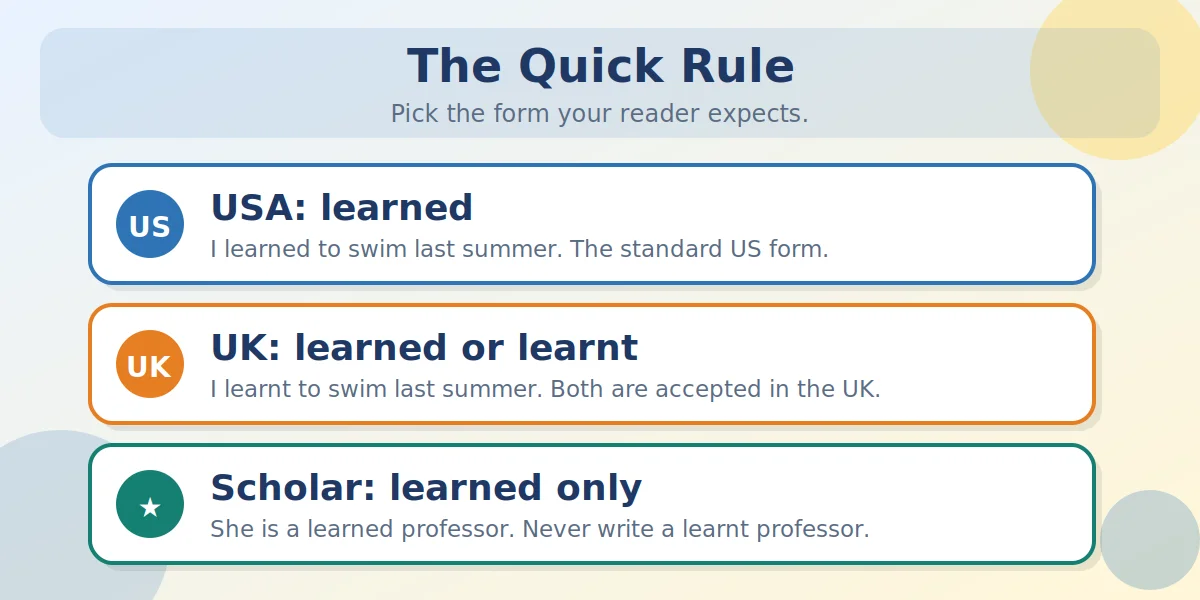
Is it learned or learnt? Both spellings are correct, but they are used differently across English varieties. Learned is the standard spelling in American English. In British English, both learned and learnt are accepted.
Both words are past-tense and past-participle forms of the verb learn. They have the same meaning when used as verbs. However, learned has an additional use as an adjective meaning educated or scholarly. In that context, learnt is never correct.
If you’re writing for an American audience, choose learned. It is the standard choice for school assignments, professional documents, emails, and everyday writing.
Table of Contents
- Quick Answer
- At a Glance
- What Does Learn Mean?
- What Does Learned Mean?
- What Does Learnt Mean?
- What Is the Difference?
- American vs. British English
- Formal or Informal?
- Past Tense and Past Participle
- Learned as an Adjective and Pronunciation
- How to Choose
- Other -ed and -t Verbs
- Common Mistakes to Avoid
- Easy Memory Trick
- Practice Questions
- Frequently Asked Questions
- Conclusion
- Related Guides
Learned vs. Learnt at a Glance
The main difference between learned and learnt is regional spelling preference. Both forms work as verbs, but American English strongly favors learned.
| Feature | Learned | Learnt |
|---|---|---|
| Part of speech | Verb and adjective | Verb |
| Simple past | Yes | Yes |
| Past participle | Yes | Yes |
| American English | Standard | Uncommon |
| British English | Accepted | Accepted |
| Meaning as a verb | To gain knowledge or skill | To gain knowledge or skill |
| Scholarly adjective | Correct | Incorrect |
| Verb pronunciation | One syllable | One syllable |
Examples:
- American English: I learned how to drive last year.
- British English: I learnt how to drive last year.
- Scholarly adjective: She is a learned professor.
Both verb forms describe the same action. Your intended audience determines which spelling you should choose.
What Does Learn Mean?
Learn is a verb that means gaining knowledge, information, or a skill. You can learn through studying, practicing, experiencing something, or receiving instruction.
For example, children learn new subjects at school. Adults learn skills through work and everyday experiences. Someone can also learn from mistakes or advice.
The word learn is the base form of both learned and learnt.
Present-Tense Examples of Learn
- I learn something new every day.
- She learns quickly when someone explains a concept.
- They learn English at school.
- We learn from our mistakes.
- He wants to learn how to cook.
Notice that learn changes to learns with he, she, and it. Its present participle is learning. The past forms are different. American English generally uses learned, while British English accepts learned and learnt.
What Does Learned Mean?
Learned is the standard American past-tense and past-participle form of learn. It describes gaining knowledge or developing a skill. Use it when talking about something you understood, discovered, or practiced in the past.
Learned as the Simple Past Tense
The simple past describes an action that happened and finished in the past.
- I learned how to swim when I was six.
- She learned an important lesson yesterday.
- We learned about American history in school.
- He learned to play the guitar last summer.
- They learned the truth after the meeting.
In each sentence, learned describes a completed action.
Learned as the Past Participle
Learned also works as a past participle. It appears with helping verbs such as has, have, and had.
- I have learned several useful skills.
- She has learned how to manage her time.
- They had learned the rules before the game.
- We have learned a lot from this experience.
It also appears in passive constructions:
- The lesson was learned through experience.
- The new method was learned during training.
These uses follow standard English grammar. The spelling remains learned in American English.
More Examples of Learned in Sentences
- My brother learned three languages in college.
- The students learned a new formula today.
- I learned that patience takes practice.
- She has learned to manage her finances.
- We learned valuable lessons from our mistakes.
What Does Learnt Mean?
Learnt is an accepted alternative past-tense and past-participle form of learn. It is especially associated with British English. It has the same meaning as learned when used as a verb. The difference is spelling, not meaning.
Learnt as the Simple Past Tense
Use learnt to describe a completed action, particularly when following British English conventions.
- I learnt to swim when I was young.
- She learnt a new language at university.
- We learnt about the local history.
- He learnt an important lesson from his mistake.
These sentences are grammatically acceptable in British English.
Learnt as the Past Participle
Learnt can also follow helping verbs such as has, have, and had.
- I have learnt a lot from my teachers.
- She has learnt to play the piano.
- They had learnt the rules before the match.
- We have learnt several useful techniques.
It also works in passive sentences:
- The skill was learnt through practice.
- The lesson had been learnt before the next meeting.
For American readers, learned is the more familiar and appropriate choice.
Examples of Learnt in Sentences
- He learnt how to repair bicycles.
- I learnt something interesting during the course.
- They learnt the importance of teamwork.
- She has learnt to speak confidently.
- We learnt from our previous mistakes.
Remember that learnt does not have a different grammatical meaning. It is simply an alternative spelling of learned.
Learned vs. Learnt: What’s the Difference?
The difference between learned and learnt mainly concerns regional spelling preferences. Both forms describe the same action when they function as verbs.
Meaning and Grammatical Function
Both words mean to gain knowledge, information, or a skill. They can serve two grammatical functions:
- Simple past: I learned the answer yesterday.
- Past participle: I have learned the answer.
The same sentences can use learnt in British English. Neither spelling suggests that someone learned more or less. They also do not describe different types of learning.
Spelling and Regional Preferences
Learned follows the regular spelling pattern of adding -ed to a verb. Learnt uses an alternative -t ending. American English generally prefers regular -ed forms. British English accepts both patterns for this verb. The distinction is similar to other spelling pairs, including dreamed/dreamt and burned/burnt.
Detailed Learned vs. Learnt Comparison
| Point | Learned | Learnt |
|---|---|---|
| Base verb | Learn | Learn |
| Ending | -ed | -t |
| Past-tense meaning | Gained knowledge | Gained knowledge |
| Past-participle meaning | Previously gained knowledge | Previously gained knowledge |
| US preference | Strong preference | Rare |
| UK acceptance | Yes | Yes |
| Scholarly adjective | Yes | No |
The simplest rule is to use learned for American English. British writers can choose either form and maintain consistency.
Learned or Learnt in American vs. British English
Regional usage is the most important factor when choosing between these spellings.
Learned in American English
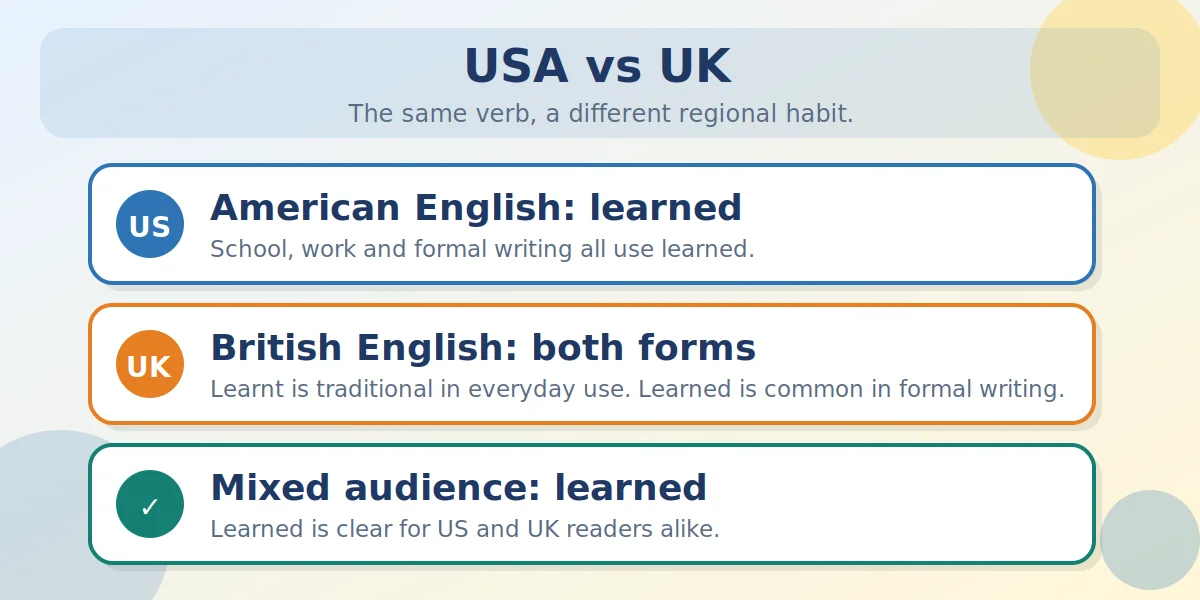
American English uses learned as the standard past-tense and past-participle form. It is the preferred spelling in school assignments and examinations, college essays and research papers, professional emails, business reports, books and articles written for US readers, and everyday conversations and written communication.
- I learned something useful in class.
- She has learned how to manage the project.
- We learned about the new policy yesterday.
Learnt is not the usual American choice. Some readers may interpret it as a British spelling or an error. However, it is not universally incorrect English. It is an accepted form in other English varieties.
Learned and Learnt in British English
British English accepts both learned and learnt as past-tense and past-participle forms. Learnt has a traditional association with British English. Learned is also widely used in modern British writing.
- I learnt a valuable lesson.
- I learned a valuable lesson.
- She has learnt to drive.
- She has learned to drive.
All four sentences are acceptable in British English. The choice often depends on personal preference, publication standards, and regional writing conventions.
Why American and British English Use Different Spellings
English has developed different spelling conventions across regions. Some words have more than one accepted past form. American English generally favors the -ed form of learn. British English preserves both the -ed and -t alternatives. This difference appears in several other verbs, including dreamed and dreamt, burned and burnt, and spelled and spelt. Neither regional preference changes the basic meaning of the verb.
Is Learned or Learnt More Formal?
Neither spelling is automatically more formal in every English variety. Regional conventions and the intended audience matter more.
Learned in Formal Writing
For American academic and professional writing, learned is the safest choice. Use it in university assignments, research papers, business proposals, professional reports, formal letters, and educational materials.
For example: “Our team learned several important lessons during the project.” This spelling follows standard American English conventions.
Learnt in Informal and Everyday Writing
Learnt is acceptable in British English, including formal and informal contexts. It is not inherently slang or an incorrect form. However, American readers are less accustomed to seeing it. If your readers are mainly in the United States, learned is the better option.
Should You Keep One Spelling Consistent?
Yes. Choose one spelling according to your audience and use it throughout your document.
Avoid writing: “I learned the rules yesterday. Later, I learnt another useful lesson.”
Instead, maintain one spelling: “I learned the rules yesterday. Later, I learned another useful lesson.”
A publication’s style guide may determine which form you should use. When no specific guide applies, follow the conventions of your target audience.
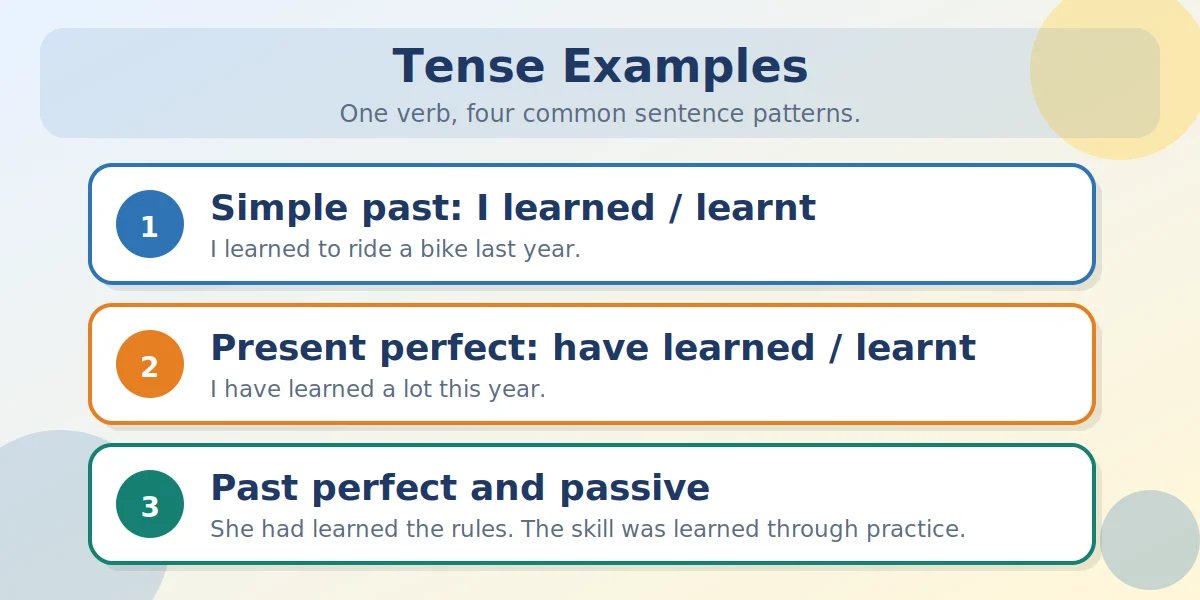
Learned or Learnt as the Past Tense and Past Participle
Both forms can function as the simple past and past participle of learn. Understanding these grammatical roles makes the choice easier.
Simple Past Tense: Learned vs. Learnt
The simple past describes an action completed at an earlier time. Structure: Subject + learned/learnt + object.
- I learned a new skill yesterday.
- She learned French in high school.
- He learnt the answer during class.
- They learnt an important lesson last week.
Use learned for American English. Both forms are acceptable in British English.
Present Perfect Tense: Have Learned or Have Learnt
The present perfect connects a past action to the present. Structure: Subject + has/have + past participle.
- I have learned many useful things.
- She has learned how to drive.
- They have learnt a new technique.
- We have learnt from our previous mistakes.
The helping verb changes according to the subject. The past participle follows it.
Past Perfect Tense: Had Learned or Had Learnt
The past perfect describes an action completed before another past event. Structure: Subject + had + past participle.
- I had learned the material before the examination.
- She had learned the rules before joining the team.
- They had learnt the procedure before the inspection.
- We had learnt our lesson by that point.
Both spellings work in this construction.
Passive Voice: Was Learned or Was Learnt
A passive construction focuses on the action or result rather than the person performing it. Structure: Subject + was/were + past participle.
- The lesson was learned through experience.
- The technique was learned during training.
- The skill was learnt through regular practice.
- Several important lessons were learned that day.
American writing generally uses learned in these sentences.
Is Learn a Regular or Irregular Verb?
Learn can follow two different past-form patterns. Learned follows the regular -ed pattern. Learnt represents the alternative -t form.
| Verb form | Learned pattern | Learnt pattern |
|---|---|---|
| Base form | Learn | Learn |
| Third-person singular | Learns | Learns |
| Simple past | Learned | Learnt |
| Past participle | Learned | Learnt |
| Present participle | Learning | Learning |
For American English, learned is the standard regular form. British English accepts both past forms.
Learned as an Adjective: Meaning and Pronunciation
Learned can also function as an adjective. Its meaning and pronunciation depend on how you use it. This distinction matters because the scholarly adjective always requires the -ed spelling.
Learned Meaning Educated or Scholarly
Learned describes someone who has gained extensive knowledge through education and study. It can also describe work that shows deep knowledge or scholarship.
- The learned professor answered every question.
- She is a learned historian.
- The article appeared in a learned journal.
- He consulted several learned scholars.
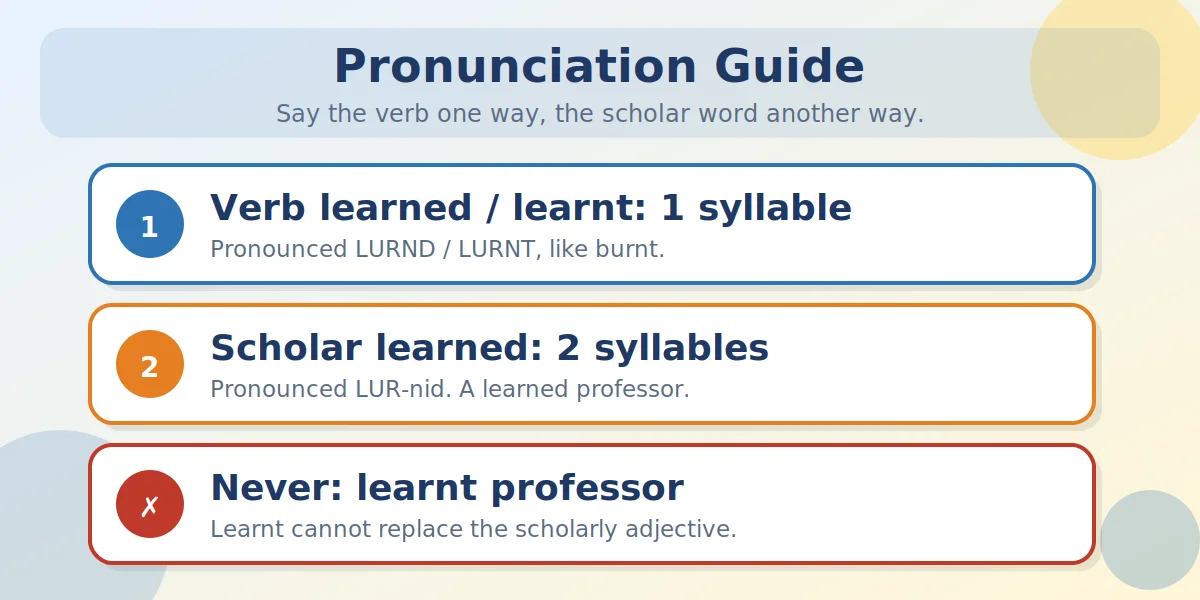
In these examples, learned has two syllables. It sounds like “LUR-nid.” Important: Never write learnt when you mean educated, knowledgeable, or scholarly. Learned is the correct adjective in both American and British English.
Learned Meaning Acquired Through Experience
Learned can also describe something developed through teaching, training, or experience.
- Learned behavior can develop through observation.
- The child displayed a learned response.
- Learned skills often improve with practice.
- The study examined learned helplessness.
In this meaning, learned has one syllable, like the verb. Learnt is also occasionally used for this acquired-by-learning meaning. However, learned is the clearer choice for American readers.
How to Pronounce Learned as a Verb
When learned functions as a verb, pronounce it with one syllable. Its pronunciation is similar to “LURND.” Learnt also has one syllable. It sounds similar to “LURNT.”
- I learned to cook.
- She learnt to drive.
Neither verb form has an extra syllable.
How to Pronounce Learned as an Adjective
When learned means educated or scholarly, it has two syllables. The pronunciation is “LUR-nid.” Compare the two meanings:
| Word use | Meaning | Syllables | Pronunciation |
|---|---|---|---|
| Learned (verb) | Gained knowledge | 1 | LURND |
| Learnt (verb) | Gained knowledge | 1 | LURNT |
| Learned (adjective) | Educated or scholarly | 2 | LUR-nid |
| Learned (adjective) | Developed through experience | 1 | LURND |
The Cambridge Dictionary’s pronunciation guide confirms the two pronunciations. Its learned entry also distinguishes the scholarly and acquired-behavior meanings. Links: https://dictionary.cambridge.org/us/pronunciation/english/learned and https://dictionary.cambridge.org/us/dictionary/english/learned
How to Choose Between Learned and Learnt
Use your audience, writing purpose, and intended meaning to make the right choice.
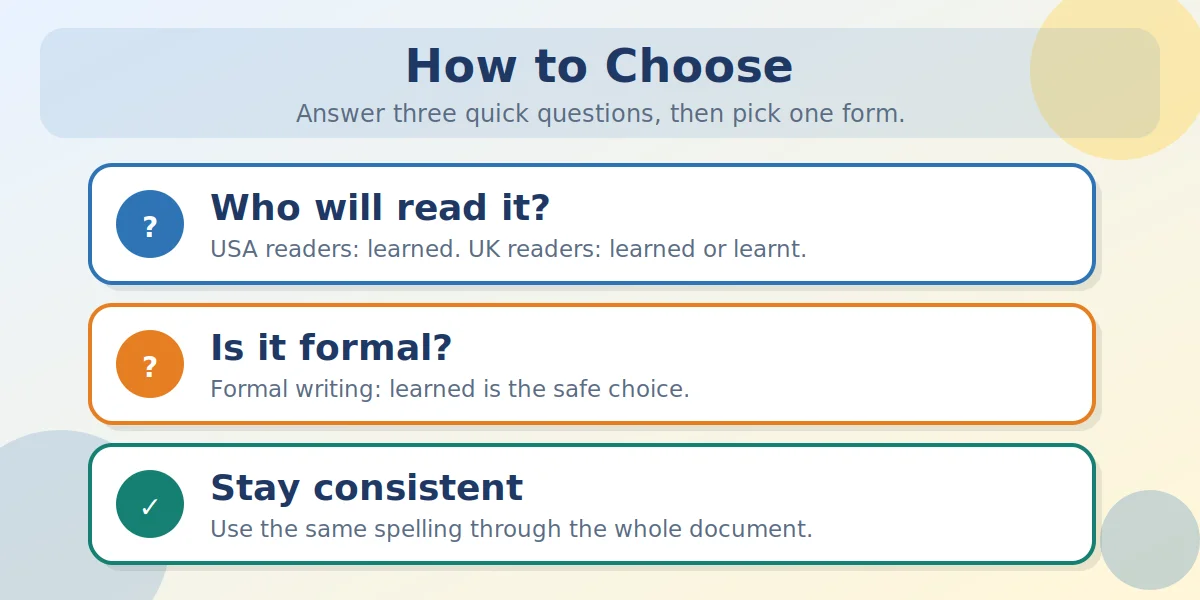
If You Are Writing for an American Audience
Choose learned. It is the standard spelling in US English. Use it in essays, emails, articles, reports, and other documents.
If You Are Writing for a British Audience
Both learned and learnt are acceptable. Choose the form that fits your preferred British English convention. Keep it consistent throughout the text.
If You Are Writing an Academic Paper or School Assignment
For American schools and colleges, use learned. Always check your teacher’s instructions or the required style guide. Some institutions specify particular spelling conventions.
If You Are Writing for an International Audience
Learned is a practical choice for a broad international audience. It is standard in American English and accepted in British English. This makes it a familiar option for many readers.
If You Mean Educated or Scholarly
Always write learned. For example: Correct: The learned author discussed the subject. Incorrect: The learnt author discussed the subject. This adjective rule applies in both English varieties.
Other Verbs With -ed and -t Spelling Variations
Learned and learnt are not the only forms with alternative -ed and -t endings. Several other English verbs have similar variations. Their regional preferences and acceptance can differ.
Common -ed and -t Verb Pairs
| -ed form | -t form |
|---|---|
| Learned | Learnt |
| Dreamed | Dreamt |
| Burned | Burnt |
| Spelled | Spelt |
| Smelled | Smelt |
| Kneeled | Knelt |
| Spilled | Spilt |
Examples:
- I dreamed about my vacation.
- She burnt the toast.
- He spelled the word correctly.
- They knelt beside the garden.
- We spilled some water.
Some pairs have stronger regional preferences than others. Do not assume every -ed and -t form follows exactly the same rule.
Are Both Forms Always Correct?
Not necessarily. Acceptance depends on the individual verb and the English variety. Some alternatives are widely accepted in both regions. Others are more strongly associated with British or American English. Check a reliable dictionary when you are unsure. You can also explore our guide to spelt or spelled at https://clarifywords.com/spelt-or-spelled/ for another common example.
Common Mistakes to Avoid
A few mistakes appear repeatedly when writers compare these spellings.
Using Learnt in American Formal Writing
Learnt is accepted English, but it is uncommon in American writing. Incorrect choice for standard US usage: “I learnt the answer yesterday.” Preferred American form: “I learned the answer yesterday.”
Using Learnt as an Adjective Meaning Educated
The scholarly adjective always uses learned. Incorrect: She is a learnt professor. Correct: She is a learned professor.
Switching Between Learned and Learnt in One Document
Changing spellings without a reason can make a document look inconsistent. Choose one form that matches your audience. Maintain it from the introduction to the conclusion.
Confusing Learned and Learnt With Learn
Learn is the present or base form. Learned and learnt are past forms. Compare: Present: I learn quickly. Past: I learned quickly. Present perfect: I have learned quickly. Using the wrong form can change the tense of your sentence.
Writing Lernt Instead of Learnt
Lernt is not a correct spelling. The accepted alternative form is learnt, with an additional vowel after the l.
Assuming Learnt Is Wrong Everywhere
Learnt is not a universal spelling mistake. It is accepted in British English as a past-tense and past-participle form. The important distinction is regional preference.
Easy Memory Trick: How to Remember Learned or Learnt
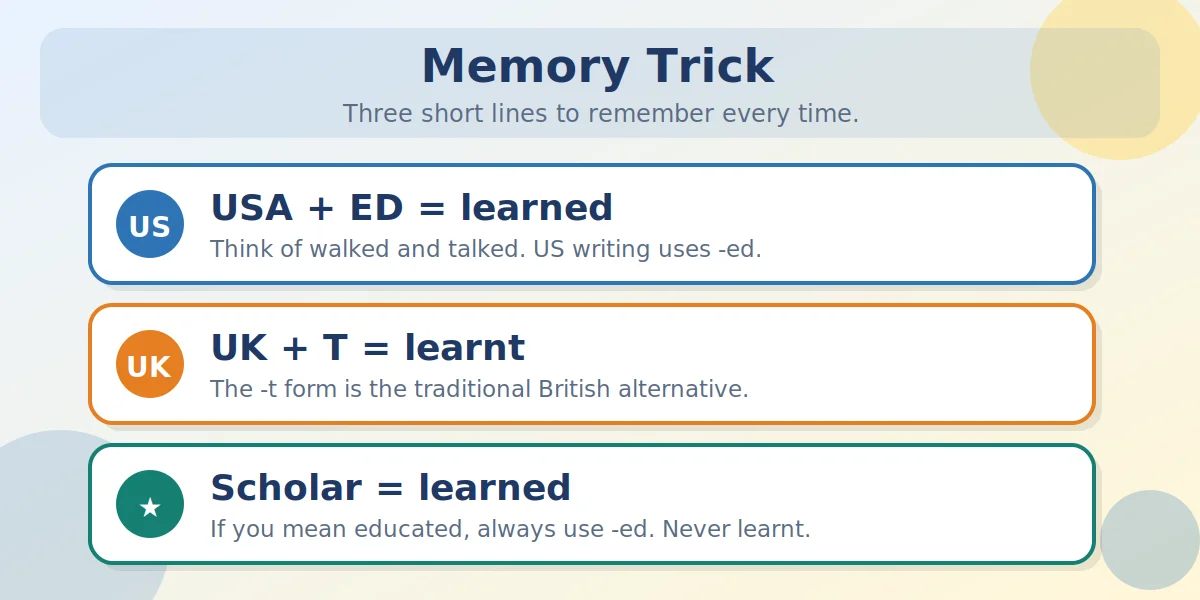
You do not need to memorize complicated grammar rules. Remember three simple points.
Remember the American -ED Rule
American English generally uses learned. Think of the familiar -ed ending in words such as walked, talked, and played. When writing for US readers, choose learned.
Remember the British Alternative
British English accepts both learned and learnt. The -t form is a traditional alternative. It does not change the meaning of the verb.
Remember the Scholarly Adjective
If learned means educated or knowledgeable, always use -ed. Think of a learned professor. A scholarly person is always learned, never learnt.
Quick memory trick:
- American writing: Learned.
- British writing: Learned or learnt.
- Scholarly adjective: Learned.
Practice Questions: Learned or Learnt?
Test your understanding with these questions. Choose the spelling that best fits each sentence.
Fill-in-the-Blank Questions
- I ______ how to swim when I was seven. (American English)
- She has ______ several useful skills. (American English)
- They ______ the lesson during their training. (British English)
- He had ______ the rules before the match. (British English)
- The ______ professor delivered an interesting lecture.
- We ______ about the subject in school. (American English)
- The skill was ______ through regular practice. (American English)
- She has ______ to play the piano. (British English)
- The students ______ a valuable lesson yesterday. (American English)
- He is a highly ______ scholar.
Choose the Correct Spelling
- Which is standard in American English? A. Learnt B. Learned
- Which adjective describes an educated person? A. Learnt B. Learned
- Which statement about British English is correct? A. Only learned is accepted. B. Both learned and learnt are accepted.
- Which is the correct spelling? A. Lernt B. Learnt
Practice Answer Key With Explanations
- Learned: American English uses learned as the standard simple past form.
- Learned: The present perfect uses have + past participle.
- Learnt: This is an accepted British English form.
- Learnt: British English accepts learnt after had.
- Learned: The scholarly adjective always uses learned.
- Learned: This is the standard American spelling.
- Learned: American English uses learned in passive constructions.
- Learnt: Both past participle forms are accepted in British English.
- Learned: Learned is the standard American past-tense form.
- Learned: Use learned when describing someone with extensive knowledge.
- B. Learned: This is the standard American spelling.
- B. Learned: Learnt cannot replace the scholarly adjective.
- B. Both learned and learnt are accepted: British English recognizes both forms.
- B. Learnt: Lernt is a misspelling.
Frequently Asked Questions About Learned or Learnt
Is Learnt Correct in American English?
Learnt is a legitimate English spelling, but Americans rarely use it. Learned is the standard American form for the past tense and past participle. Choose learned for US schoolwork, professional writing, and publications.
Is Learned or Learnt Correct in British English?
Both learned and learnt are correct in British English. Learnt has a traditional British association, while learned is also widely used. Either spelling works as the verb’s past tense and past participle.
What Is the Past Tense of Learn?
The past tense of learn is learned or learnt. American English normally uses learned, while British English accepts both forms. For example, “I learned something yesterday” and “I learnt something yesterday” are grammatically correct.
Is It Lesson Learned or Lesson Learnt?
Both expressions are correct, depending on the English variety. Lesson learned is standard in American English, while lesson learnt is accepted in British English. Both describe knowledge gained through an experience or mistake.
Can Learnt Be Used as an Adjective?
Learnt can occasionally describe something acquired through experience or training. However, learned is required when describing an educated or scholarly person. For example, write “a learned professor,” never “a learnt professor.”
Should I Use Learned or Learnt in Formal Writing?
Use learned in American formal writing, including essays, reports, and professional documents. British writers can use either spelling. Always follow your institution’s or publisher’s style guide when it specifies a preferred form.
Conclusion: Should You Use Learned or Learnt?
Both learned and learnt are correct past-tense and past-participle forms of learn. They have the same meaning as verbs, but their regional preferences differ.
American English uses learned as the standard spelling. British English accepts both learned and learnt.
Remember the adjective exception. When learned means educated or scholarly, it always takes the -ed ending.
If you’re writing for an American audience, choose learned. It is the clearest and most familiar option.
Related Guides
For more word guides, explore our Grammar category. See also our Learn or Learned guide, our Spelt or Spelled guide, our Loose vs Lose guide, and our Fewer vs Less guide.