Farther vs Further: Meaning, Difference, and Examples
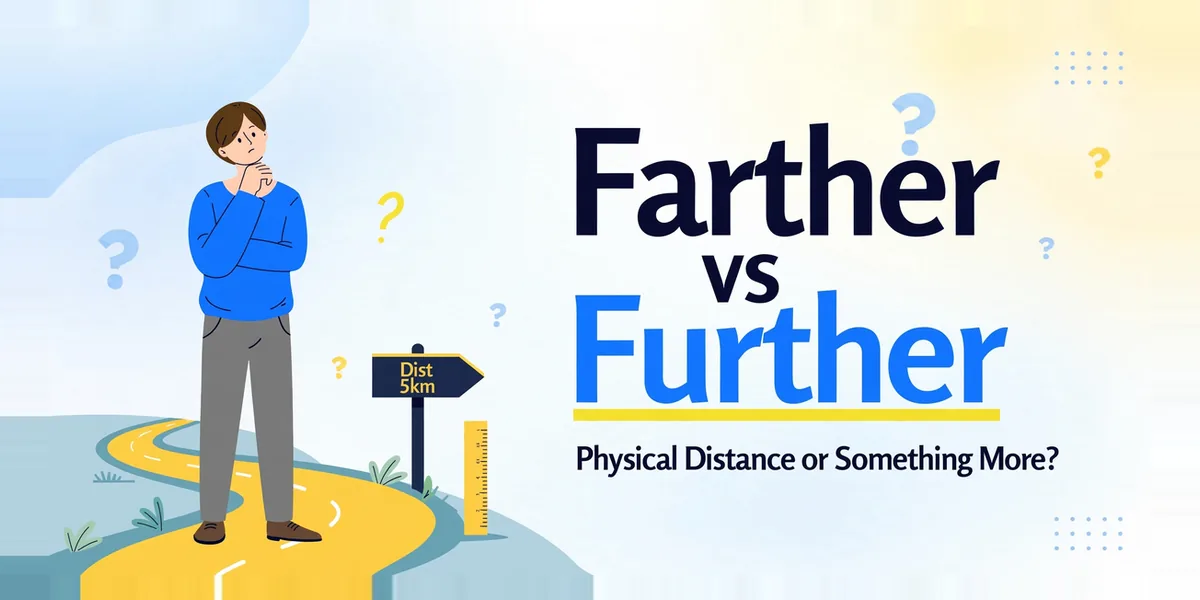
Choosing between farther and further can be confusing because both words compare distance. However, they do not always mean the same thing.
The traditional American English rule is simple: use farther for physical distance and further for figurative distance or something additional. However, this rule has some flexibility.
Both words can describe physical distance. The best choice often depends on the meaning and context.
This guide explains farther vs further in plain English, with clear rules, examples, and a simple memory trick.
Farther vs Further: Quick Answer
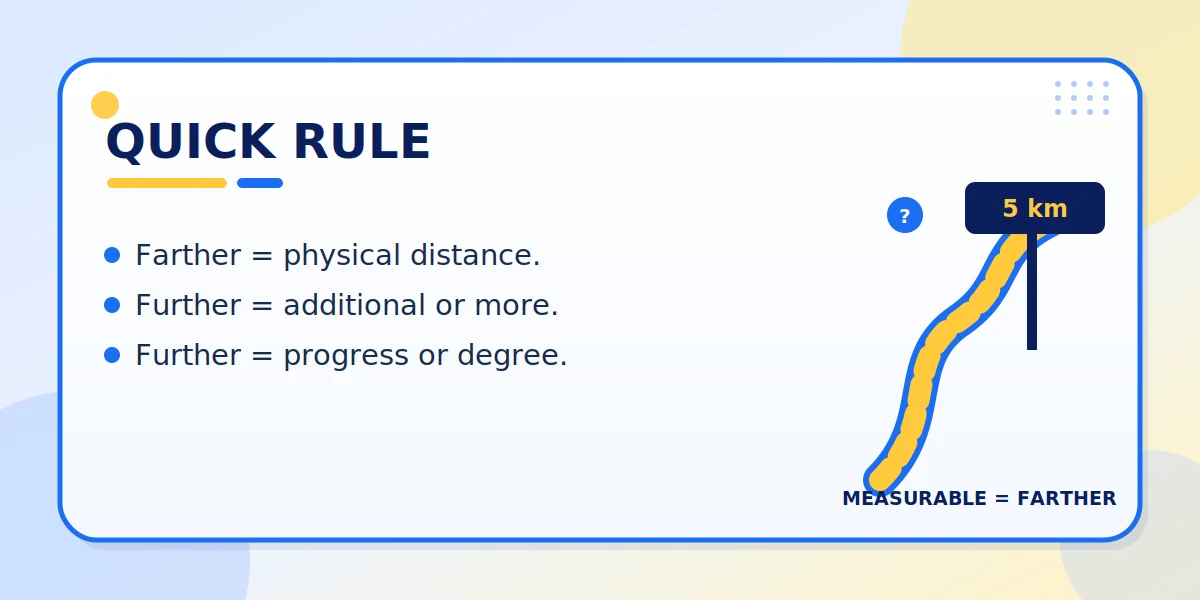
Use farther when comparing measurable physical distances. Use further when you mean additional, more advanced, or greater in degree or extent.
| Word | Main use | Example |
|---|---|---|
| Farther | Physical distance | We walked farther than expected. |
| Further | Additional information | I need further details. |
| Further | Progress or advancement | This course will further your career. |
| Further | Figurative distance | Nothing could be further from the truth. |
In American English, farther is the usual choice for physical distance. However, further can also describe actual distance.
The distinction is a helpful writing guideline, not an absolute grammar rule.
Table of Contents
- Quick Answer
- What Does Farther Mean?
- What Does Further Mean?
- Key Differences
- When to Use Farther vs Further
- Farthest vs Furthest
- American and British English
- Common Expressions with Further
- Common Mistakes
- A Brief History of Farther and Further
- How to Remember
- Practice Questions
- Frequently Asked Questions
What Does Farther Mean?
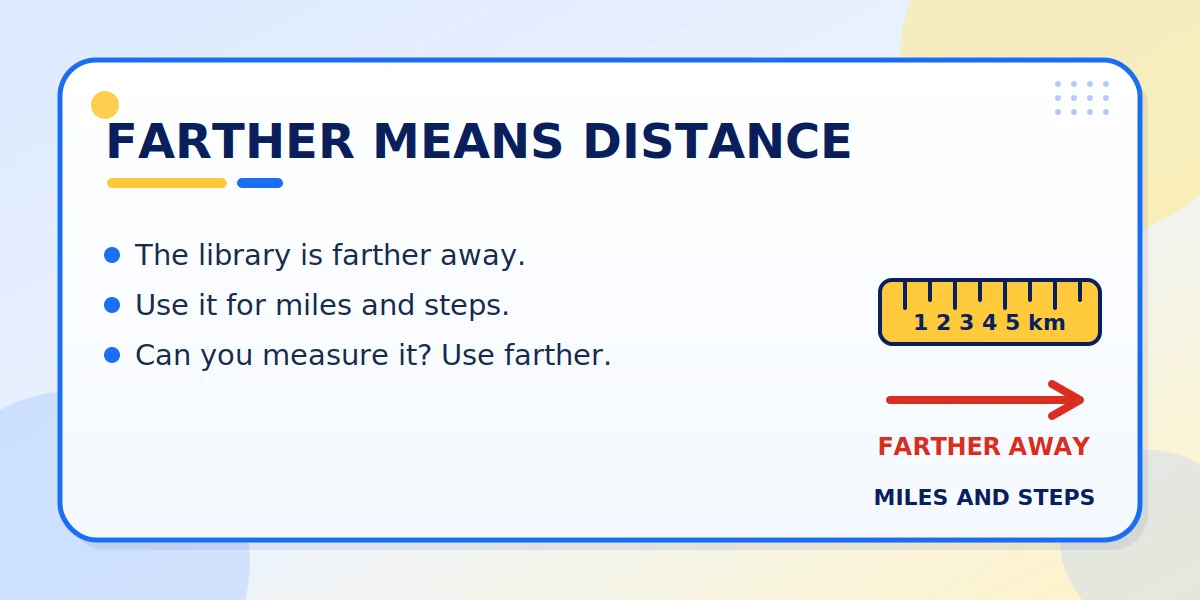
Farther is the comparative form of far. It usually means at or to a greater physical distance.
Use it when comparing how far apart two places or objects are. It is especially useful for distances you can measure.
Farther as an Adverb
As an adverb, farther describes how much distance someone or something covers.
Examples:
- We walked farther than the other group.
- My office is farther from home than yours.
- How much farther is the nearest gas station?
- The runner traveled farther than she expected.
In each example, farther refers to physical distance.
Farther as an Adjective
Farther can also describe a person, place, or thing located at a greater distance.
Examples:
- The farther building belongs to the university.
- We chose the farther parking lot because it was cheaper.
- The farther side of the field was covered with trees.
- Keep driving until you reach the farther entrance.
Here, farther describes a noun rather than an action.
When Should You Use Farther?
Choose farther when you compare measurable physical distances.
For example:
- The airport is farther away than the train station.
- We need to walk farther to reach the beach.
- Their house is farther down the street.
This is the clearest choice for American English writers discussing actual distance.
However, you may also see further in these contexts. Many dictionaries accept both words for physical distance.
What Does Further Mean?
Further has several meanings. It can describe physical distance, figurative distance, progress, degree, or something additional.
It is also an adjective and a verb. These uses make it more flexible than farther.
Further as an Adverb
As an adverb, further can mean to a greater degree, extent, or distance.
Examples:
- We need to investigate the problem further.
- She wants to develop her writing skills further.
- The discussion went further than expected.
- The road continues further beyond the village.
- Let’s examine this question further before deciding.
The word can describe both literal and figurative distance. The meaning depends on the sentence.
Further as an Adjective
As an adjective, further usually means additional, extra, or more.
Examples:
- Please provide further information.
- We need further evidence before reaching a conclusion.
- No further action is necessary.
- The company will announce further changes next month.
- Contact the office for further details.
In these examples, further means additional. You cannot replace it with farther without changing the meaning or making the sentence incorrect.
Further as a Verb
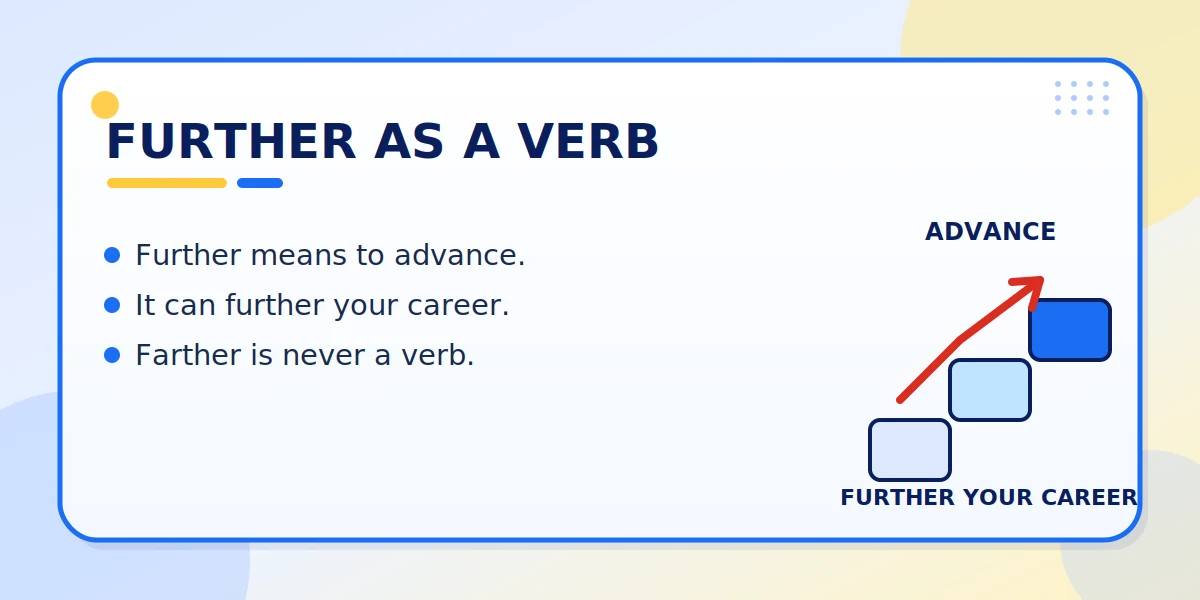
Further is also a verb. It means to advance, promote, or help something develop.
Examples:
- She took additional classes to further her education.
- The new policy could further economic growth.
- He joined the organization to further his career.
- The grant will further medical research.
Notice that further describes an action in these sentences.
Farther is not the standard modern verb for this meaning. Therefore, write further your career, not farther your career.
Other Uses of Further
Further can also introduce another point in a discussion or piece of writing.
For example:
- Further, the report identifies several financial risks.
- We should consider the cost. Further, we need to examine the timeline.
In this use, further means something like additionally or moreover.
Farther vs Further: Key Differences
The difference comes down to meaning, not spelling. The main difference involves physical distance versus additional meaning, degree, or progress. However, the two words overlap when describing distance.
Farther vs Further Comparison Table
| Feature | Farther | Further |
|---|---|---|
| Physical distance | Commonly preferred in American English | Also accepted |
| Figurative distance | Less common as the traditional choice | Commonly preferred |
| Additional or extra | Not used with this meaning | Yes |
| Progress or advancement | Not standard as a verb | Yes, as a verb |
| Degree or extent | Sometimes used | Commonly used |
| Parts of speech | Adverb and adjective | Adverb, adjective, and verb |
Examples That Show the Difference
Consider these sentences:
Physical distance:
- We drove farther than we planned.
- The next town is farther away.
Additional information:
- Please send further instructions.
- We need further details about the project.
Progress or advancement:
- The training will further your professional development.
- The new program aims to further scientific research.
Figurative distance:
- Nothing could be further from the truth.
- Her explanation took the discussion further.
The context tells you which word fits.
Can Farther and Further Be Used Interchangeably?
Sometimes, yes. Both words can describe physical distance.
For example:
- We walked farther than expected.
- We walked further than expected.
Both sentences are acceptable. American English traditionally favors farther for this meaning.
However, the words are not interchangeable in every situation. Further can mean additional or function as a verb. Farther cannot replace it in those uses.
When to Use Farther vs Further
The easiest way to choose is to identify what you want to express.
Use Farther for Physical Distance
Choose farther when comparing actual distances between people, places, or objects.
Examples:
- The grocery store is farther from my house.
- We traveled farther than the tour guide recommended.
- The farther exit leads to the highway.
- How much farther do we need to drive?
This is the traditional American English preference.
Use Further for Figurative Distance or Degree
Choose further when discussing progress, development, discussion, or an abstract idea.
Examples:
- We need to look further into the problem.
- The team wants to take the project further.
- Her argument goes further than the original proposal.
- The investigation revealed further complications.
These examples do not describe a simple physical measurement.
Use Further When You Mean Additional or More
When further means additional, farther is not a suitable replacement.
Examples:
- Please provide further information.
- We have no further questions.
- The manager requested further changes.
- The school will publish further instructions.
You can often replace further with additional in these sentences.
Use Further as a Verb
Use further when something advances or promotes a goal.
Examples:
- The internship could further your career.
- The research may further our understanding of climate change.
- The organization works to further educational opportunities.
Do not use farther as a verb in these sentences.
Is It Farther Along or Further Along?
Both expressions are used, including in American English.
Use farther along when you want to emphasize physical distance or a location along a route.
Example: The next gas station is farther along the highway.
Use further along when discussing progress, development, or a stage in a process.
Example: We are further along in the project than we were last month.
However, further along can also describe physical distance. The choice is not always strict. If you want to emphasize measurable distance, farther along is a clear American English choice.
Farthest vs Furthest: What Is the Difference?
Farthest and furthest are the superlative forms associated with farther and further. Both can describe the greatest distance, but their usual preferences differ.
What Does Farthest Mean?
Farthest usually means at the greatest physical distance from a starting point or reference location.
Examples:
- That is the farthest town from our home.
- Which runner reached the farthest point?
- The farthest parking space is still available.
- This is the farthest we have traveled by car.
American English commonly favors farthest for measurable distance.
What Does Furthest Mean?
Furthest can describe the greatest distance, degree, or extent. It often appears in figurative contexts.
Examples:
- This is the furthest we can go with the current budget.
- Her research takes the subject furthest.
- Which proposal goes furthest toward solving the problem?
- We walked to the furthest point on the trail.
The word can also describe physical distance. It is not limited to figurative meanings.
Farthest vs Furthest Comparison Table
| Word | Common use | Example |
|---|---|---|
| Farthest | Physical distance | That is the farthest point on the map. |
| Furthest | Figurative degree or extent | This is the furthest I can take the discussion. |
| Farthest or furthest | Physical distance | Which town is farthest or furthest away? |
For clear American English writing, choose farthest for measurable distance and furthest for figurative extent. Remember that both forms can describe physical distance.
Farther vs Further in American and British English
The choice between these words can vary by region. American and British English follow similar meanings, but their preferences differ.
American English Usage
American English commonly favors farther for physical distance.
Writers usually choose further for additional information, progress, degree, and figurative distance.
Examples:
- The next exit is farther away.
- We need further research.
- The new course will further her education.
- Nothing could be further from the truth.
This distinction is a practical choice for American writers. It helps readers understand the intended meaning.
British English Usage
British English uses further more often for physical distance than American English does.
For example, a British writer might say:
- We walked further than we planned.
- The station is further down the road.
Farther is also understood and used in British English. The distinction is not a strict division between the two varieties.
Which Rule Should American Writers Follow?
For clear American English, follow this simple guideline:
- Use farther for measurable physical distance.
- Use further for additional information.
- Use further for progress, degree, and figurative distance.
- Use further as a verb meaning advance or promote.
If further sounds natural in a sentence about physical distance, it is not automatically wrong.
Common Expressions with Further
Some expressions use further in established ways. Learning these phrases makes the distinction easier to remember.
Further from the Truth
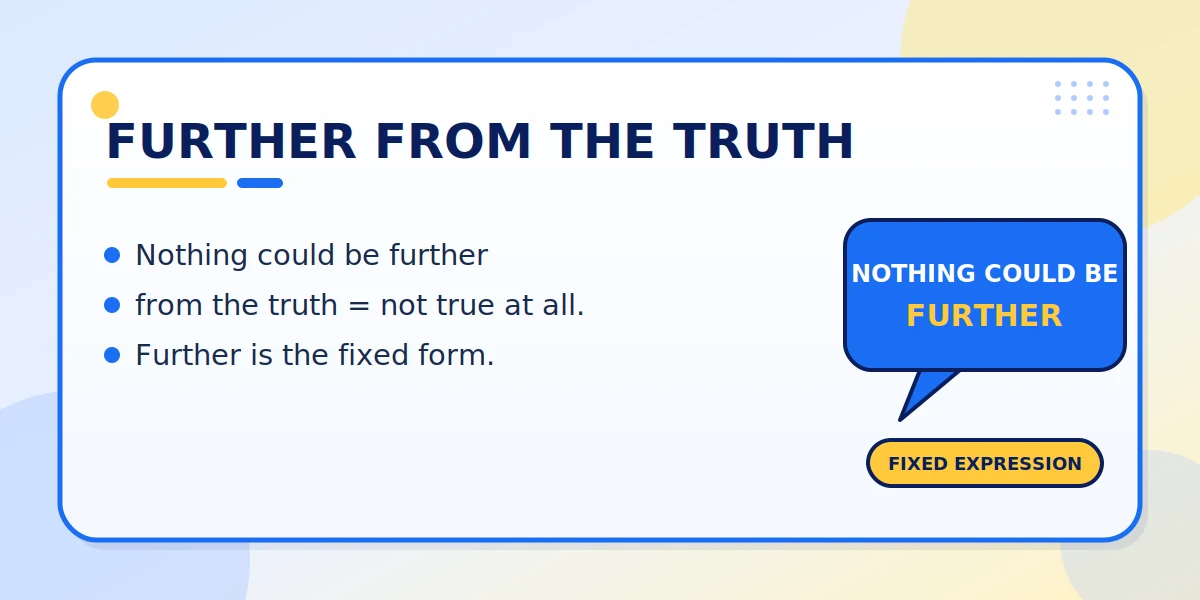
The established expression is “nothing could be further from the truth.”
It means that a statement or belief is completely false or inaccurate.
Examples:
- The idea that he dislikes his job could not be further from the truth.
- Nothing could be further from the truth than that accusation.
Major dictionaries recognize this expression with further. It is the conventional form to use in careful writing.
Without Further Ado
Without further ado means without more delay, discussion, or unnecessary introduction.
Examples:
- Without further ado, let’s begin the meeting.
- Without further ado, I would like to introduce our speaker.
This expression often appears in speeches, presentations, and introductions.
Furthermore
Furthermore means in addition or moreover. Writers use it to introduce another supporting point.
Examples:
- The proposal is affordable. Furthermore, it is easy to implement.
- The course improves writing skills. Furthermore, it builds confidence.
Use it when you want to connect related ideas. Avoid using it repeatedly in every paragraph.
Further To
Further to is a formal expression used in business correspondence. It refers to an earlier message, discussion, or matter.
Example: Further to our conversation yesterday, I have attached the revised proposal.
In everyday writing, you might use following up on instead.
Other Common Expressions
You will also see further in these phrases:
- Further information: Additional information.
- Further research: More research.
- Further discussion: More discussion.
- Further action: Additional action.
- Further notice: Another announcement or update.
- Go further: Make more progress or cover more distance.
- Further afield: At a greater distance from a particular place.
These expressions show how further works in everyday and formal English.
Common Mistakes with Farther and Further
Even experienced writers sometimes mix up these two words. Watch for these common errors.
1. Using Farther When You Mean Additional
Incorrect: Please send me farther details.
Correct: Please send me further details.
Further means additional here. Farther does not have that meaning.
2. Assuming Further Cannot Describe Physical Distance
Incorrect rule: Further only describes figurative distance.
Better rule: Further can describe physical distance, too. American English simply tends to prefer farther for measurable distances.
For example, both sentences work:
- We walked farther than expected.
- We walked further than expected.
3. Using Farther as a Verb
Incorrect: The program will farther your education.
Correct: The program will further your education.
Further means advance or promote in this sentence. It is the standard verb form.
4. Treating the Traditional Rule as Absolute
Some writers believe farther must always describe physical distance. Others believe further can never describe actual distance.
Neither belief reflects all modern usage.
The traditional distinction remains useful, especially in American English. However, dictionaries recognize overlap between the words.
5. Confusing Farthest and Furthest
Incorrect rule: Farthest always describes distance, while furthest never does.
Better rule: Farthest is commonly preferred for physical distance in American English. Furthest often describes figurative extent, but both can refer to physical distance.
A Brief History of Farther and Further
The histories of farther and further help explain why their meanings overlap.
The word further comes from Old English forms related to forth. These forms carried meanings such as forward, onward, beyond, and more distant.
Farther developed later as a Middle English variant of further. Its spelling was influenced by far. The two words therefore share a history rather than having completely separate origins.
According to Merriam-Webster’s Dictionary of English Usage, the modern distinction has a relatively recent history. It identifies Vizetelly’s 1906 recommendation as an early usage rule. He advised using farther for physical distance and further for quantity or degree.
Henry Fowler discussed the distinction in his 1926 usage guide. He observed that many people preferred one word for most purposes rather than consistently separating the two meanings. He predicted that further might eventually replace farther.
That prediction has not come true. Both words remain in modern English, although their preferred uses have become more distinct in some contexts.
How to Remember Farther vs Further
A simple memory trick can help you choose the right word in the farther vs further pair.
A Simple Memory Trick
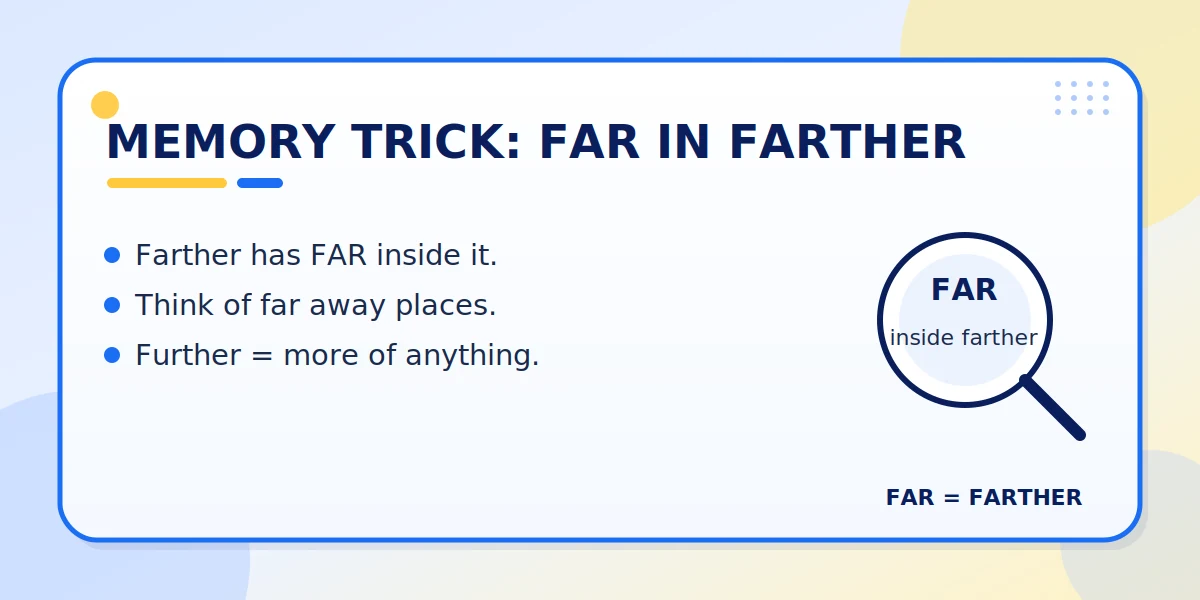
Remember:
- Farther = physical distance.
- Further = additional, figurative, or progress.
The word farther contains far. Think of something being far away.
For further, think of doing more, learning more, or moving a process forward.
This trick gives you a useful starting point. It does not mean further is always wrong for physical distance.
Quick Decision Test
Ask yourself these questions before choosing:
- Am I comparing measurable physical distances? Choose farther as the usual American English preference.
- Do I mean additional or extra? Choose further.
- Am I talking about progress or advancement? Choose further.
- Am I describing a figurative degree or extent? Choose further.
- Am I describing physical distance where further sounds natural? It can also be correct.
Farther vs Further Practice Questions
Test your understanding with these 10 questions. Choose the word that best completes each sentence.
- We walked _____ than we planned to reach the campsite.
- Please send me _____ information about the application.
- The new program will _____ scientific research.
- Nothing could be _____ from the truth.
- The library is _____ from my house than the grocery store.
- Without _____ ado, let’s welcome our guest.
- We need to investigate the issue _____ before deciding.
- Which is the _____ point on this hiking trail?
- _____ to our earlier discussion, I have attached the report.
- The two towns are much _____ apart than they appear on the map.
Answer Key with Explanations
- Farther. The sentence compares the physical distance covered while walking. Further is also possible, but farther is the usual American English choice.
- Further. The word means additional information. Farther cannot replace it with this meaning.
- Further. Here, further is a verb meaning to advance or promote scientific research.
- Further. “Nothing could be further from the truth” is the established expression for something completely false.
- Farther. The sentence compares the physical distance between two places. Farther is the traditional American English choice.
- Further. “Without further ado” is a fixed expression meaning without more delay or unnecessary introduction.
- Further. The sentence refers to examining an issue more thoroughly. It describes additional investigation, not physical distance.
- Farthest. The sentence asks about the greatest physical distance along a hiking trail. Furthest is also possible in some usage.
- Further. “Further to” is a formal expression that refers to an earlier conversation or message.
- Farther. The sentence compares the physical distance between two towns. Further can also describe distance, but farther is the usual American English preference.
Frequently Asked Questions About Farther vs Further
Is farther or further correct?
Both words are correct, but their uses often differ. American English usually favors farther for physical distance and further for additional information, progress, or figurative distance. Context decides which word fits best in each sentence.
Is farther only used for physical distance?
No. Farther traditionally refers to physical distance, but writers have also used it for broader meanings over time. In careful American English, however, farther remains the clearer choice for a measurable distance.
Can further be used for physical distance?
Yes. Further can describe actual distance, and British English often uses it this way in everyday writing. American English generally prefers farther for measurable distances, but further is not automatically incorrect.
Is it farther down the road or further down the road?
Both expressions are used. American writers often choose farther down the road when discussing physical distance. Further down the road is also common and can refer to distance or future progress.
Is it farther from the truth or further from the truth?
Use further from the truth. The established expression is “nothing could be further from the truth.” It means a statement is completely false or far from reality, and careful writers use this fixed form.
Is it farthest or furthest?
Both are superlative forms of far. American English commonly uses farthest for physical distance and furthest for figurative extent or degree. However, furthest can also describe actual distance in many everyday sentences.
Is further a verb?
Yes. Further can mean to advance, promote, or help something develop. For example, a course can further your education. Farther is not the standard verb with this meaning, so use further here.
Final Takeaway: Farther vs Further
The simplest rule for farther vs further is to use farther for measurable physical distance and further for additional information, progress, and figurative meaning.
Remember that this is a traditional American English preference, not an absolute rule. Both words can describe physical distance.
When you mean extra information or advancement, choose further. When you compare actual distances, farther is usually the clearest choice.
Related Guides
For more help with commonly confused words, explore these ClarifyWords guides: