Right or Wrong: Meaning, Difference, and Examples
Quick Answer
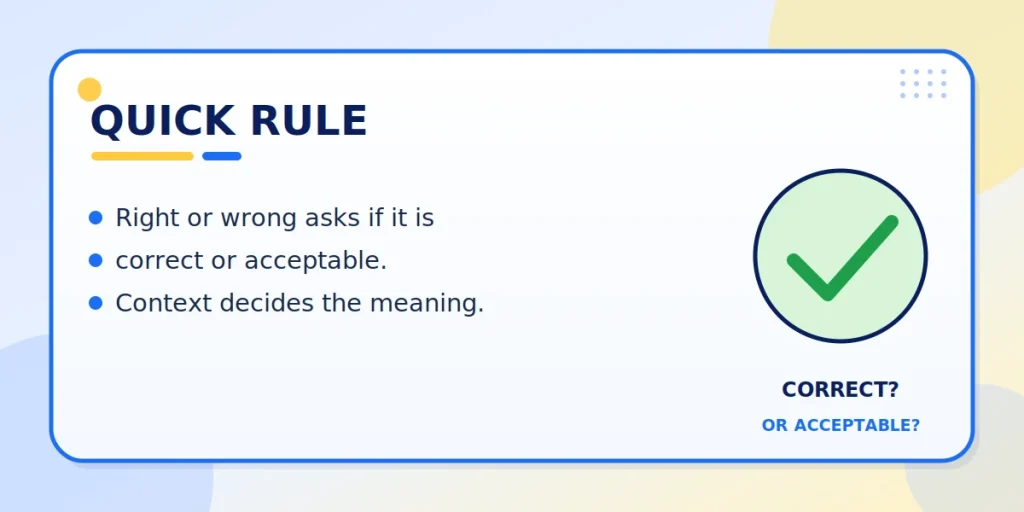
Right or wrong means correct or incorrect, acceptable or unacceptable, or morally good or bad. Its meaning depends on the situation and the standard being used.
A factual judgment asks whether something agrees with the truth. A moral judgment asks whether an action is morally acceptable. A subjective judgment depends on personal taste. A legal judgment depends on the law.
For example:
- Factual: Your answer is correct or incorrect based on the facts.
- Moral: Helping someone in need is generally considered right.
- Subjective: Choosing vanilla over chocolate is a matter of personal preference.
- Legal: Driving through a red light is generally against the law.
The phrase also appears in expressions such as “Right or wrong, I will support you.” Here, it means regardless of whether the person is correct.
Table of Contents
- What Does the Phrase Mean?
- Four Ways to Understand Right and Wrong
- Dictionary Meanings of Right and Wrong
- Right vs Wrong: Key Differences
- How to Use the Phrase in a Sentence
- Right vs Correct
- Wrong vs Incorrect vs Mistaken
- Common Idioms With Right and Wrong
- The Phrase in Everyday Situations
- Seven Common Mistakes to Avoid
- A Simple Memory Trick
- Practice Questions
- Frequently Asked Questions
- Final Takeaway
What Does Right or Wrong Mean?
This phrase presents two possible judgments about something. It asks whether an idea, an action, or a decision is correct, acceptable, or morally good.
However, the phrase does not always have one fixed meaning. Context determines the kind of judgment being made.
Consider these examples:
- Was my answer correct? This asks whether the answer is factually correct.
- Was telling the secret the moral choice? This asks whether the action was morally acceptable.
- Is this the best choice for me? This asks whether the choice suits someone’s needs.
- Was the driver’s action legal? This asks about legality.
The words also have meanings beyond this common phrase. Right can describe something correct, suitable, or morally good. Wrong can describe something incorrect, unsuitable, or morally bad.
The phrase can also express commitment. A speaker may promise support that continues regardless of the judgment.
Four Ways to Understand Right and Wrong
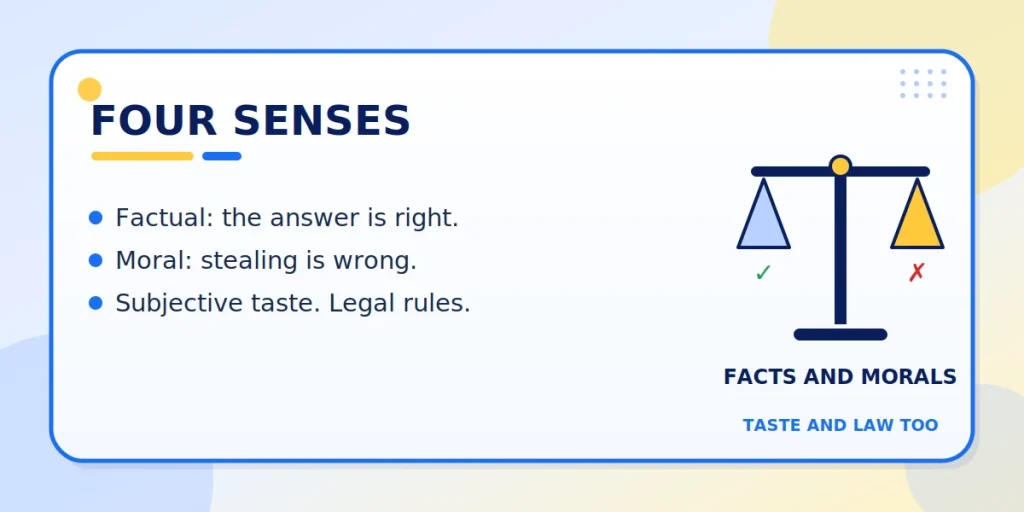
People use these words in several different contexts. Four useful categories are factual, moral, subjective, and legal.
These categories help explain the phrase. They are not a formal dictionary classification.
1. Factual Right and Wrong
A factual judgment concerns information that can be checked against evidence, reliable records, or expert knowledge.
An answer is right when it agrees with the available facts. It is wrong when it contradicts them.
Examples:
- The Earth orbits the Sun. That statement is right.
- The Earth is flat. That statement is wrong.
- At standard atmospheric pressure, water boils at 100°C. That statement is right.
- Saying that seven times eight equals 54 is wrong.
Factual judgments do not depend mainly on personal feelings. Evidence helps determine whether a claim is correct.
2. Moral Right and Wrong
A moral judgment concerns whether an action is good, fair, harmful, or ethical.
People often consider honesty, kindness, fairness, responsibility, and respect when making moral decisions.
Examples:
- Returning a lost wallet is generally considered morally right.
- Cheating someone to gain money is generally considered wrong.
- Helping a person who needs assistance is usually seen as a good action.
- Taking credit for another person’s work is generally unfair.
Moral questions can become complicated. People may disagree about the best action, especially when values conflict.
For example, someone might lie to protect another person from immediate harm. One person may consider the lie wrong, while another may consider it understandable.
3. Subjective Right and Wrong
A subjective judgment depends on personal taste, beliefs, experiences, or preferences.
It does not always have one universally correct answer.
Examples:
- One person prefers vanilla ice cream, while another prefers chocolate.
- Someone may think a blue shirt looks better than a red one.
- One reader may enjoy a novel that another reader dislikes.
- A person may prefer studying in the morning rather than at night.
These preferences are not necessarily factual or moral judgments. They reflect individual opinions.
However, subjective beliefs can influence moral judgments. Different people may have different ideas about what is acceptable.
4. Legal Right and Wrong
A legal judgment concerns whether an action follows the laws that apply in a particular place.
An action may be lawful or unlawful under specific legal rules. The answer can depend on the jurisdiction.
Examples:
- Following a valid traffic signal is generally legally required.
- Driving through a red light without a legal exception is generally unlawful.
- Stealing someone’s property can violate the law.
- Paying required taxes follows a legal obligation.
Legal and moral judgments are not always identical. Something may be legal but still seem unfair to some people.
Legal questions require attention to the relevant laws. These examples explain general language usage only.
Comparison of the Four Senses
| Type | Main question | What determines the judgment? | Example |
|---|---|---|---|
| Factual | Is it true? | Evidence and facts | The Earth orbits the Sun. |
| Moral | Is it ethical? | Values and moral principles | Returning a lost wallet. |
| Subjective | Does it suit someone’s taste? | Personal preference | Choosing vanilla ice cream. |
| Legal | Is it lawful? | Applicable laws | Following traffic rules. |
Can Something Be Right in One Sense but Wrong in Another?
Yes. A decision can receive different judgments depending on the standard being used.
For example, a person might tell the truth in a cruel way. The statement may be factually right but morally questionable.
Similarly, an action might follow the law but still seem unfair. A person’s opinion might feel right to them but seem wrong to others.
Always identify the standard before judging an action or statement.
Dictionary Meanings of Right and Wrong
Merriam-Webster, Oxford Learner’s Dictionaries, Cambridge, and Britannica describe several meanings for both words.
Both can function as different parts of speech. Their meanings change with their grammatical roles.
What Does Right Mean?
The word right can be an adjective, noun, adverb, or verb.
| Part of speech | Meaning | Example |
|---|---|---|
| Adjective | Correct or true | Your answer is right. |
| Adjective | Morally good or acceptable | It is right to treat people fairly. |
| Adjective | Suitable or appropriate | She is the right person for the job. |
| Noun | Something morally good or proper | We should try to do what is right. |
| Noun | A legal or moral entitlement | Everyone has the right to speak. |
| Adverb | Correctly or accurately | You guessed right. |
| Verb | To correct or repair an injustice | The company tried to right its mistake. |
More examples:
- Right answer: The answer agrees with the facts.
- Right decision: The decision is suitable or reasonable.
- Human rights: Basic entitlements people have.
- Right a wrong: Correct an injustice or unfair situation.
Merriam-Webster also explains that right can emphasize conformity to truth or fact. It can carry a stronger positive meaning than correct in some contexts.
What Does Wrong Mean?
The word wrong can function as an adjective, noun, adverb, or verb.
| Part of speech | Meaning | Example |
|---|---|---|
| Adjective | Incorrect or untrue | That answer is wrong. |
| Adjective | Morally unacceptable | It is wrong to cheat. |
| Adjective | Unsuitable or inappropriate | This is the wrong tool for the job. |
| Noun | An unfair or harmful act | The victim wanted justice for the wrong. |
| Noun | Something morally or legally unacceptable | We should speak out against a wrong. |
| Adverb | Incorrectly or in an unsuitable way | You spelled the name wrong. |
| Verb | To treat someone unfairly | He believed his employer had wronged him. |
More examples:
- Wrong answer: The answer does not match the facts.
- Wrong choice: The choice does not suit the situation.
- In the wrong: Responsible for a mistake or disagreement.
- Do someone wrong: Treat someone unfairly or badly.
The word wrong comes from Old English wrang, with Scandinavian and Old Norse connections. Its history helps explain the idea of something being twisted or not straight.
Right vs Wrong: Key Differences
The words right and wrong express opposite judgments in many situations. Their exact meanings depend on context and the standard being used.
| Feature | Right | Wrong |
|---|---|---|
| Basic meaning | Correct, proper, or acceptable | Incorrect, improper, or unacceptable |
| Facts | Agrees with the evidence | Contradicts the evidence |
| Morality | Considered ethical or fair | Considered unethical or unfair |
| Suitability | Fits the situation or purpose | Does not fit the situation or purpose |
| Law | Follows applicable legal rules | Breaks applicable legal rules |
| Example | Your calculation is right. | Your calculation is wrong. |
Are Right and Wrong Always Opposites?
They often express opposing judgments, but real situations can be more complex.
For example, a person may make a decision with good intentions but cause harm. Their intentions may seem right, but the result may seem wrong.
A statement can also be factually correct but incomplete. A decision can suit one person but create problems for another.
The important question is not simply which word to choose. It is which standard applies.
For another simple comparison of opposite choices, see true or false (https://clarifywords.com/true-or-false/).
How to Use Right or Wrong in a Sentence
You can use the phrase in questions, statements, and introductory expressions. Its grammar depends on the sentence structure.
1. Question Form
Use the phrase when asking whether something is correct, acceptable, or justified.
Examples:
- Was my answer correct?
- Is ignoring the warning a good idea?
- Do you think her decision was wise?
- Can you tell me whether this calculation is correct?
These questions invite someone to judge a statement, action, or decision.
2. Predicate Form
A predicate tells the reader something about the subject. You can place right or wrong after a linking verb such as is, was, seems, or feels.
Examples:
- I do not know whether the answer is right or wrong.
- We still do not know if his decision was correct.
- We need to decide if the information is correct.
- The teacher explained why the statement was wrong.
In these examples, linking verbs connect the subject to a description or judgment.
3. Sentence Opener: Use a Comma
You can begin a sentence with this phrase when it means regardless of whether something is correct or acceptable.
Examples:
- Right or wrong, I will support my friend.
Other openers work the same way, for example with a decision, a team, or a belief.
The opening phrase creates a pause before the main statement.
Comma rule: Place a comma after an introductory phrase when it sets up the main clause. A comma is appropriate here because the phrase comes before the main statement.
The comma helps readers understand that the speaker will continue regardless of the judgment.
4. Using Whether Right or Wrong
This expression means regardless of which judgment applies. It can also introduce a question or a qualifying clause.
Examples:
- She deserves a fair hearing, whatever the judgment.
- We should examine the decision, whatever the judgment.
- He accepted the result, whether his answer was right or wrong.
- The manager wanted to understand the choice, whatever it was.
Use a comma when the expression introduces a sentence or adds a separate qualifying phrase.
Do not add a comma automatically when the words form part of the main sentence. Follow the sentence structure instead.
Right vs Correct
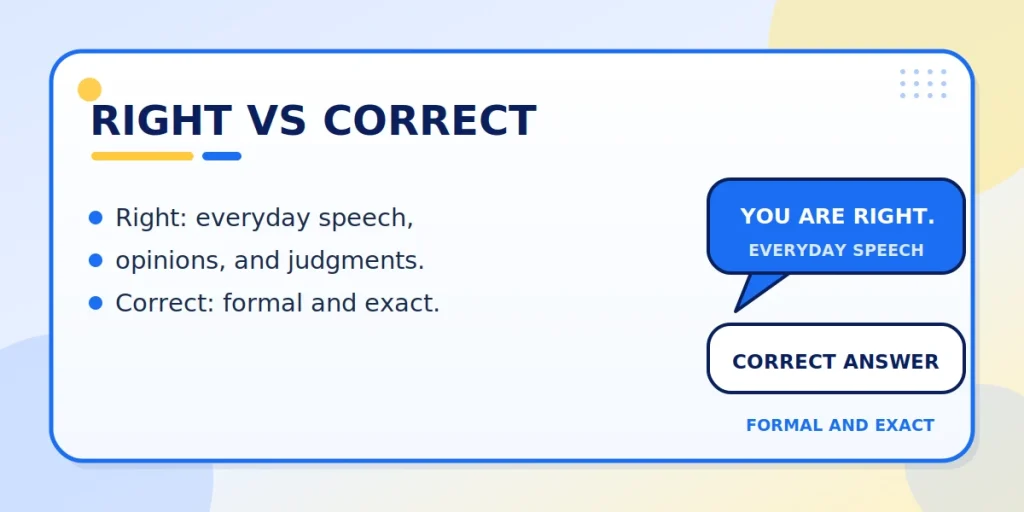
Right and correct often have similar meanings. Both can describe something that agrees with facts or meets a standard.
However, they do not always sound the same in context.
| Right | Correct |
|---|---|
| Common in everyday conversation | Often sounds more formal |
| Frequently used for opinions and decisions | Frequently used for methods and instructions |
| Can suggest moral approval | Usually focuses on accuracy or conformity |
| Can describe something suitable | Can describe something accurate or properly done |
Examples:
- Your answer is right.
- Your answer is correct.
- I think she made the right decision.
- Follow the correct procedure.
Oxford Learner’s Dictionaries notes a general tendency toward correct in formal instructions and documents. Right appears more often in everyday judgments and opinions.
This is a tendency, not a strict rule. Both words can work in many of the same sentences.
Wrong vs Incorrect vs Mistaken
These three words describe errors, but they emphasize different things.
| Word | Main meaning | Common use | Example |
|---|---|---|---|
| Wrong | Not correct, suitable, or morally acceptable | Facts, behavior, choices, and situations | Your answer is wrong. |
| Incorrect | Not accurate or not in agreement with a standard | Facts, details, and information | The address is incorrect. |
| Mistaken | Having an incorrect belief or understanding | A person, opinion, or judgment | I was mistaken about the time. |
When Should You Use Wrong?
Use wrong when something is incorrect, unsuitable, or morally unacceptable.
- That is the wrong answer.
- It was wrong to blame her.
- We took the wrong road.
When Should You Use Incorrect?
Use incorrect when you want to focus on accuracy or a failure to meet a standard.
- The form contains incorrect information.
- Your calculation is incorrect.
- The report includes an incorrect date.
When Should You Use Mistaken?
Use mistaken when someone has an incorrect belief, impression, or understanding.
- I was mistaken about the meeting time.
- She was mistaken in her judgment.
- You are mistaken if you think the task is finished.
A useful distinction is that wrong can describe a person, action, answer, or situation. Incorrect focuses on accuracy, while mistaken focuses on a person’s belief.
Common Idioms With Right and Wrong
Several English expressions use these words in ways that go beyond their basic definitions.
1. Know Right From Wrong
Meaning: Understand the difference between acceptable and unacceptable behavior.
Example: Children gradually learn to know right from wrong.
This expression usually refers to moral understanding. It does not simply mean knowing whether an answer is correct.
2. Two Wrongs Don’t Make a Right
Meaning: Responding to a bad action with another bad action does not make the second action acceptable.
Example: He spread a rumor because someone had insulted him. Two wrongs don’t make a right.
The proverb warns against revenge and retaliation.
Benjamin Rush wrote the related wording “three wrongs will not make one right” in 1783. That wording is not the modern proverb, and the modern proverb should not be credited to Benjamin Franklin.
3. Right a Wrong
Meaning: Correct an injustice or make up for something unfair.
Example: The organization worked to right a wrong done to the family.
Here, right functions as a verb. It means to correct or repair an injustice.
4. In the Wrong
Meaning: Responsible for a mistake, disagreement, or unfair action.
Example: After reviewing the evidence, he admitted he was in the wrong.
The expression often appears when people discuss blame or responsibility.
5. Do the Right Thing
Meaning: Choose an action that is morally good, fair, or responsible.
Example: She returned the extra money because she wanted to do the right thing.
The expression often refers to a choice that requires honesty or courage.
6. My Country, Right or Wrong
Meaning: A statement of loyalty to one’s country, even when it makes mistakes.
The phrase is associated with an 1816 toast by American naval officer Stephen Decatur. It is often quoted as “Our country, right or wrong!”
Carl Schurz later challenged the idea that loyalty requires supporting a country when it acts wrongly. On February 29, 1872, he said a country should be kept right if right and set right if wrong.
The discussion highlights a difference between loyalty and unquestioning approval.
7. Get It Wrong
Meaning: Make a mistake or understand something incorrectly.
Examples:
- I got the answer wrong.
- Do not get the directions wrong.
- The reporter got the name wrong.
This is a common expression in everyday English.
8. Don’t Get Me Wrong
Meaning: Do not misunderstand what I am saying.
Examples:
- Don’t get me wrong, I like the idea.
- Don’t get me wrong, I respect her decision.
- I enjoy the job, but don’t get me wrong. It can be stressful.
Speakers often use this phrase before explaining a different opinion or adding a qualification.
Right or Wrong in Everyday Situations
People make judgments about facts, behavior, and personal choices every day. The context helps determine the meaning.
At School
Students use these words when checking answers, following rules, or evaluating behavior.
- Your answer is right because it matches the evidence.
- Copying another student’s work is generally wrong.
- Asking for help when confused is a reasonable choice.
At Work
Workplace decisions may involve accuracy, fairness, responsibility, and company rules.
- The report contains the right figures.
- Sharing confidential information without permission may be wrong.
- Following the correct safety procedure helps prevent mistakes.
In Relationships
People may disagree about honesty, loyalty, respect, and responsibility.
- Apologizing after hurting someone is often the right thing to do.
- Ignoring someone’s feelings can be hurtful.
- Supporting a friend does not always mean agreeing with every decision.
In Personal Decisions
Some choices depend on individual needs and preferences.
- Choosing a morning workout may be right for one person.
- Working at night may suit someone else.
- Preferring one color over another is not usually a moral issue.
For related examples of choices that can seem like opposites, explore black or white (https://clarifywords.com/black-or-white/) and all or nothing (https://clarifywords.com/all-or-nothing/).
In Moral Dilemmas
A moral dilemma happens when a person must choose between competing values or responsibilities.
For example, imagine a friend asks you to hide the truth. You may want to protect the friendship, but you also value honesty.
There may be no easy answer. Consider the possible harm, the people affected, and the values involved before deciding.
Seven Common Mistakes to Avoid
Understanding the phrase becomes easier when you recognize common errors.
1. Treating Every Judgment as Factual
Not every question has an answer that evidence can settle.
A favorite color is a preference. It is not a factual question with one correct answer.
2. Assuming Right Always Means Morally Good
The word right can mean factually correct, suitable, or morally acceptable.
A person can give the right answer in an unkind way. The answer may be accurate even when the behavior is not kind.
3. Assuming Wrong Only Means Incorrect
Wrong has several meanings. It can describe an inaccurate answer, an unsuitable choice, or an unfair action.
Consider the context before deciding what the word means.
4. Confusing Legal and Moral Judgments
Legal rules and personal moral beliefs do not always agree.
An action can be legal but still seem unfair. Do not assume that every legal action is automatically morally right.
5. Using Correct and Right as Perfect Substitutes
The words often overlap, but they can have different tones.
Correct often emphasizes accuracy. Right can also suggest suitability or moral approval.
6. Forgetting the Comma After an Introductory Phrase
When the phrase opens a sentence with a concessive meaning, use a comma.
Correct: “Right or wrong, I will support her.”
The comma separates the introductory expression from the main clause.
7. Attributing Idioms to the Wrong Historical Source
Popular expressions sometimes have complicated histories.
Do not assume Benjamin Franklin created “two wrongs don’t make a right.” The related wording recorded by Benjamin Rush in 1783 used three wrongs, not two.
A Simple Memory Trick
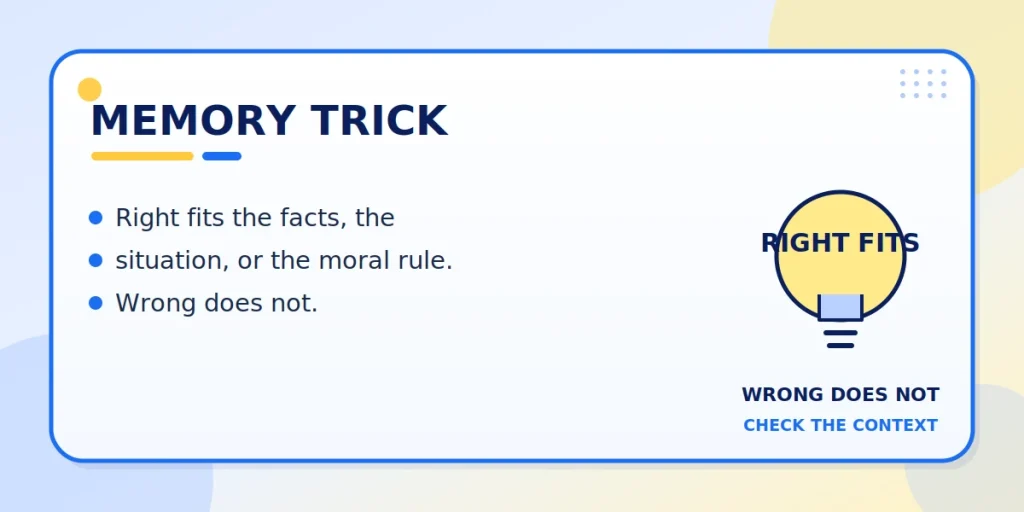
Use this sentence to remember the main distinction:
Right fits the facts, the situation, or the moral standard. Wrong does not.
Think about the kind of judgment you are making:
- Facts: Does the statement match the evidence?
- Situation: Does the choice suit the purpose?
- Morality: Is the action fair or ethical?
- Law: Does the action follow the applicable rules?
- Preference: Does the choice reflect someone’s personal taste?
This quick check helps you understand the meaning before choosing a word.
Practice Questions
Test your understanding with these ten questions. Choose the best answer for each one.
Questions
- What does this phrase usually ask someone to judge?
A. Whether something is expensive or cheap
B. Whether something is correct or incorrect
C. Whether something is old or new
D. Whether something is easy or difficult - Which example shows a factual judgment?
A. Vanilla tastes better than chocolate.
B. The Earth orbits the Sun.
C. Blue is the prettiest color.
D. Morning is the best time to exercise. - Which sentence shows a moral judgment?
A. The answer is 24.
B. The address is incorrect.
C. Stealing from someone is wrong.
D. The shirt is too large. - Which example is mainly subjective?
A. Seven times eight equals 56.
B. A person prefers red over blue.
C. A traffic signal is red.
D. The report contains an error. - Which part of speech is right in “You guessed right”?
A. Noun
B. Adjective
C. Adverb
D. Verb - What does “right a wrong” mean?
A. Make an incorrect guess
B. Correct an injustice
C. Choose the right direction
D. Admit a factual mistake - What punctuation follows an introductory concessive phrase?
A. A comma
B. A period
C. A semicolon
D. No punctuation - Which word best completes this sentence? “The form contains ______ information.”
A. mistaken
B. incorrect
C. morally
D. rightfully - What does “don’t get me wrong” mean?
A. Do not make a mistake.
B. Do not misunderstand what I mean.
C. Do not choose the wrong answer.
D. Do not change your opinion. - What does “two wrongs don’t make a right” teach?
A. Every mistake deserves punishment.
B. A bad response does not justify another bad action.
C. People should never disagree.
D. Every decision has one correct answer.
Answer Key
| Question | Correct answer | Explanation |
|---|---|---|
| 1 | B | The phrase often asks whether something is correct or incorrect. |
| 2 | B | This statement can be checked against scientific evidence. |
| 3 | C | This sentence expresses a moral judgment about an action. |
| 4 | B | Taste and color preferences depend on personal opinion. |
| 5 | C | Right modifies the verb guessed, so it functions as an adverb. |
| 6 | B | The expression means correcting an unfair or harmful situation. |
| 7 | A | A comma follows an introductory concessive phrase. |
| 8 | B | Incorrect describes information that is not accurate. |
| 9 | B | The expression asks someone not to misunderstand the speaker. |
| 10 | B | One harmful action does not justify another harmful action. |
Frequently Asked Questions
1. What is a simple sentence with this phrase?
“Was your answer right or wrong?” is a simple example. It asks whether an answer is correct. The phrase also works in questions about actions, decisions, and judgments. It also works for choices and everyday actions.
2. Do I need a comma after this phrase?
Yes, use a comma when the phrase begins a sentence and means regardless of whether something is correct. The comma separates the opening phrase from the main clause that follows it.
3. Does this phrase refer to facts or morality?
It can refer to both. In a factual question, it concerns accuracy and evidence. In a moral question, it concerns whether an action is ethical, fair, or acceptable. Look at the context first, then decide which standard applies.
4. Can I use “whether” with this phrase in a sentence?
Yes. The expression is grammatically acceptable when the context is clear. For example, “She defended her decision, whatever the judgment.” It means she defended it regardless of whether it was correct.
5. Can this phrase begin a sentence?
Yes. You can begin a sentence with the phrase when it introduces a concessive idea. For example, “Right or wrong, he accepted responsibility.” A comma normally follows the introductory phrase.
6. How do you use the phrase in a question?
Use it to ask whether an answer, belief, action, or decision is correct or acceptable. For example, “Do you think my decision was right or wrong?” The surrounding context explains the intended judgment.
7. What is the difference between right and wrong?
Right describes something correct, suitable, fair, or acceptable. Wrong describes something incorrect, unsuitable, unfair, or unacceptable. Their meanings depend on whether the discussion concerns facts, morality, personal judgment, or law.
Final Takeaway
The words right and wrong describe opposite judgments, but their meanings depend on context. They can concern facts, morality, personal preferences, or legal rules.
Use right for something correct, suitable, or acceptable. Use wrong for something incorrect, unsuitable, or unacceptable. When you see the phrase in a sentence, identify the standard behind the judgment.
For more word comparisons and everyday vocabulary guidance, visit the ClarifyWords Vocabulary category (https://clarifywords.com/category/vocabulary/).