Passed vs Past: Meaning, Differences, and Examples
Quick answer: Use passed as the past tense or past participle of the verb pass. Use past for an earlier time, movement beyond a point, or something that has already happened. For example, you passed the store, but you walked past the store.
The words sound the same, but they do different jobs in a sentence. Once you understand what each word does, choosing the correct spelling becomes much easier. This guide explains passed vs past with clear rules, examples, and memory tricks.
Table of Contents
Passed vs Past: The Quick Answer
Passed vs Past: Comparison Table
What Does Passed Mean?
What Does Past Mean?
Passed vs Past in Common Phrases
Phrasal Verbs and Expressions with Passed
How to Use Past When Telling Time
Is “Passed Tense” Correct?
Common Passed vs Past Mistakes
Easy Ways to Remember Passed vs Past
Passed vs Past: Pronunciation
Where Do Passed and Past Come From?
Practice Questions: Passed or Past
Frequently Asked Questions
Passed vs Past: The Quick Answer
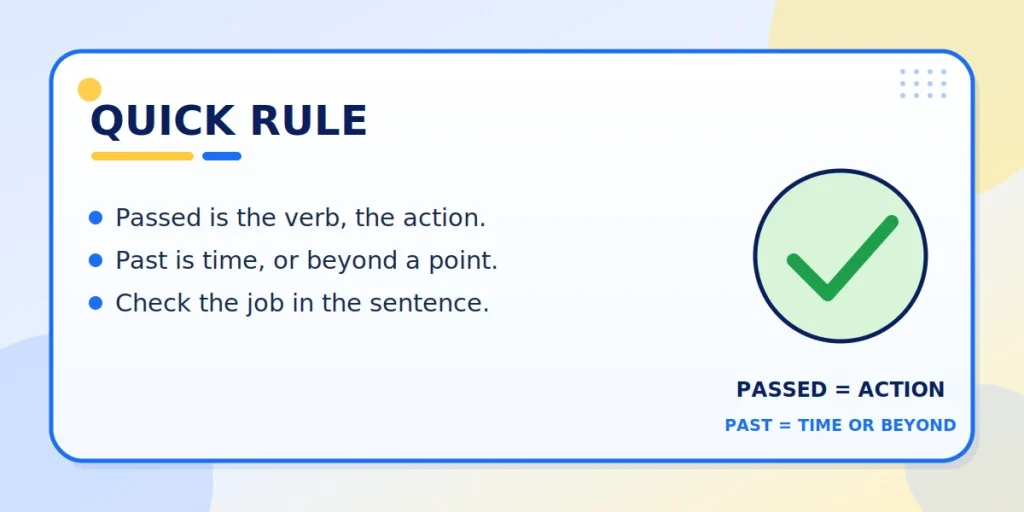
The easiest way to choose between these words is to check what the sentence needs.
Use passed when:
- Someone or something completed an action.
- A person succeeded in a test or exam.
- Something moved, changed, transferred, or went by.
- Time moved forward.
Use past when:
- You mean an earlier time or period.
- Something moves beyond a place or point.
- You describe a time on the clock.
- You refer to someone’s previous experiences.
Consider these examples:
Passed: Jordan passed his driving test.
Past: Jordan walked past the driving school.
Passed: Several hours passed before we received an answer.
Past: We talked about our past experiences.
You can also use both words in one sentence:
The bus passed our street and continued past the shopping center.
The first word describes an action. The second shows where the bus continued.
Passed vs Past: Comparison Table
This table summarizes the difference between the two words.
| Feature | Passed | Past |
|---|---|---|
| Main grammatical role | Verb form | Adjective, adverb, preposition, or noun |
| Base word | Pass | Past |
| Main meaning | Completed an action of passing | Earlier time or beyond a point |
| Describes an action | Yes | No |
| Refers to time | Yes, as in time passed | Yes, as in past midnight |
| Example | She passed the exam. | The exam is in the past. |
Remember: Passed is primarily a verb form in everyday writing. It can also function as an adjective in certain established or specialized expressions. Past has four main grammatical roles.
What Does Passed Mean?
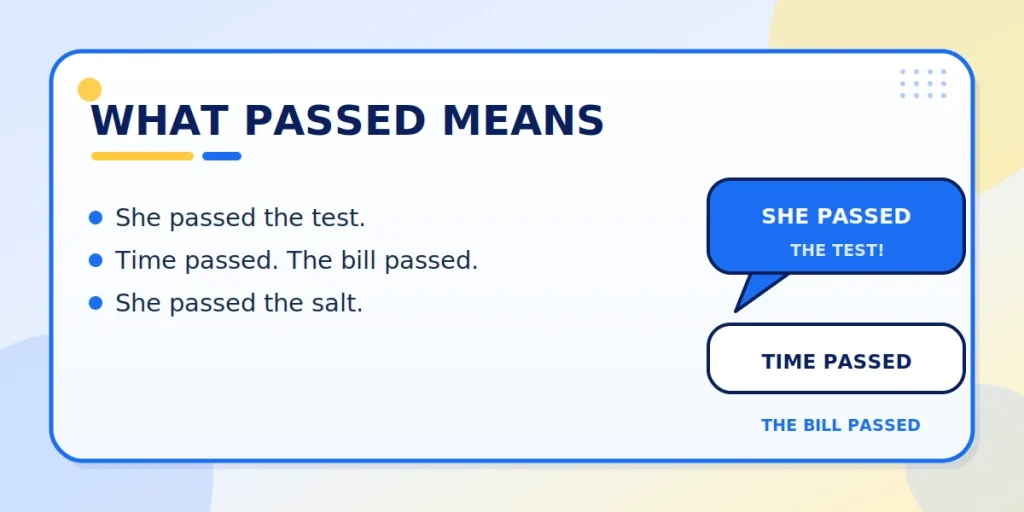
Passed is the simple past tense and past participle of the verb pass. It describes an action that happened or was completed.
The verb pass has several meanings. Its meaning depends on the sentence.
Passed Means Went By or Moved Beyond
Use passed when someone or something moves by a person, place, or object.
Examples:
- A delivery truck passed our house this morning.
- The runner passed two competitors near the finish line.
- We passed the old school on our way downtown.
- Several cars passed us on the highway.
In each sentence, passed describes the action of moving by something.
Compare these sentences:
We passed the library.
We walked past the library.
Both sentences are correct. In the first, passed is the main verb. In the second, walked is the verb, and past describes the direction.
Passed Means Succeeded in a Test or Exam
Use passed when someone meets the required standard in a test, examination, or course.
Examples:
- Mia passed her driving test.
- I passed the final exam.
- He passed all his science classes.
- The student passed the course with a good grade.
The opposite is failed. For example, someone who did not meet the required standard failed the test.
Passed Means Gave or Transferred Something
Passed can describe giving something to another person or transferring information and responsibility.
Examples:
- She passed me the documents.
- He passed the salt to his sister at dinner.
- The teacher passed the message to the principal.
- The manager passed the request to another department.
The action may involve a physical object, a message, or responsibility.
Passed Means Time Went By
Use passed when describing time moving forward.
Examples:
- Two hours passed before the doctor arrived.
- Several days passed without an update.
- A year has passed since we moved.
- Time passed quickly during the vacation.
Here, passed is the verb. It tells readers that a period of time went by.
Passed Means Approved Something
Use passed when a group or authority formally approves a proposal, bill, motion, or law.
Examples:
- Congress passed the bill.
- The committee passed the proposal.
- The board passed a new resolution.
- The council passed the measure after a long discussion.
In these examples, passed means approved or accepted.
Passed Away Means Died
Passed away is a polite expression meaning died. People often use it when discussing someone’s death with care and respect.
Examples:
- Her grandfather passed away last year.
- My neighbor’s dog passed away peacefully.
- His aunt passed away after a long illness.
The expression is passed away, not past away. The word passed is the verb in this phrase.
Can Passed Be an Adjective?
Yes. Although passed is mainly a verb form, dictionaries also record adjective uses.
For example, passed ball is an established baseball term. The word can also describe someone who has successfully completed an examination or course.
These uses do not change the basic rule. In ordinary sentences, passed most often functions as the past tense or past participle of pass.
What Does Past Mean?
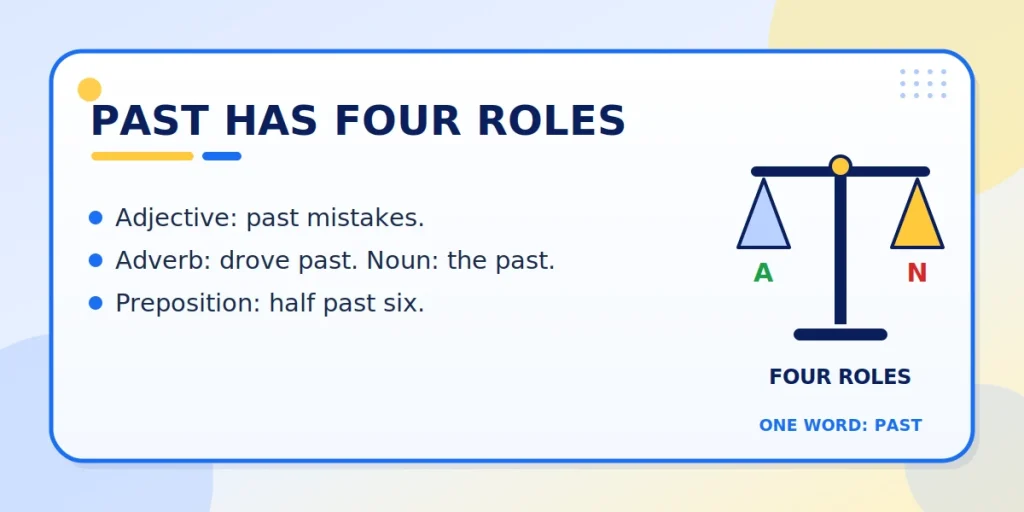
Past can function as an adjective, adverb, preposition, or noun. It often refers to an earlier time or something beyond a particular point.
Understanding these four roles helps you recognize when past belongs in a sentence.
Past as an Adjective
An adjective describes a noun. Use past as an adjective when referring to something from an earlier time.
Examples:
- We discussed our past experiences.
- The past president attended the ceremony.
- She learned from her past mistakes.
- He wants to leave his past behind.
In these sentences, past describes experiences, a president, mistakes, and a period of someone’s life.
It can also describe something that has ended or is no longer current.
Past as an Adverb
An adverb can describe how or where an action happens. Past works as an adverb when something moves beyond a point or place.
Examples:
- The car drove past.
- I watched the train go past.
- She hurried past without speaking.
- The dog ran past while we were talking.
Notice that past does not describe the action itself. It tells readers where the movement continued.
Past as a Preposition
A preposition connects a noun or pronoun to another part of a sentence. Past can show movement beyond a place, a time later than a stated hour, or movement beyond a limit.
Examples:
- We walked past the school.
- The store is just past the bridge.
- It is ten minutes past noon.
- The temperature rose past 100 degrees.
In each sentence, past connects the surrounding words and shows a position, time, or limit.
Past as a Noun
A noun names a person, place, thing, or idea. The past refers to an earlier period or the events of someone’s previous life.
Examples:
- We cannot change the past.
- She prefers not to discuss her past.
- The past taught him valuable lessons.
- They looked back on the past with gratitude.
The word often appears with the, as in the past. It can refer to personal history or an earlier period in general.
Passed vs Past in Common Phrases
Some expressions cause more confusion than others. The best approach is to look at the meaning and grammatical structure of each phrase.
Walked Past vs Walked Passed
The correct phrase is usually walked past when you mean that someone moved beyond a place.
Correct: We walked past the bank.
Incorrect for this meaning: We walked passed the bank.
Why? Walked is already the verb. You need past to show where the walking happened.
However, passed works when it is the main verb:
We passed the bank on our way home.
Both sentences describe movement. Their sentence structures are different.
Past Due vs Passed Due
The correct expression is past due. It means that something should already have been paid, completed, or submitted.
Examples:
- Your electricity bill is past due.
- The assignment is three days past due.
- The payment became past due last week.
Do not write passed due when you mean overdue. The expression uses past to show that the deadline has gone by.
Get Past vs Get Passed
Both expressions can be correct, but they have different meanings.
Get past means to move beyond something, overcome a difficulty, or stop being affected by an issue.
Examples:
- We need to get past this disagreement.
- The hikers could not get past the fallen tree.
- She worked hard to get past her fear.
Get passed can mean that someone or something receives a pass or is approved in a particular context.
For example:
The bill still needs to get passed by the Senate.
Here, passed refers to approval. The Senate must approve the bill.
Passed Away vs Past Away
Passed away is the correct expression when you mean that someone died.
Example: Her grandmother passed away peacefully.
Past away is incorrect for this meaning. Use passed because it is the verb form in the expression.
Time Passed vs Past Time
These phrases have different grammatical structures.
Time passed means that time went by.
Examples:
- Time passed while we waited.
- A few weeks passed before she called.
Past time refers to an earlier period or can appear in expressions about something being overdue.
Examples:
- We often talk about the past time we spent together.
- It is past time to make a decision.
Choose passed when you need the verb describing time going by. Choose past when you refer to an earlier period or use it to show that a point has been exceeded.
Half Past vs Half Passed
The correct expression for telling time is half past.
Example: The appointment is at half past two.
That means the appointment is at 2:30. The word past shows that 30 minutes have gone beyond the hour.
Half passed two is not the standard expression for this time.
Phrasal Verbs and Expressions with Passed
A phrasal verb combines a verb with a word such as on, out, or down. These combinations can create meanings that differ from the base verb.
The examples below use passed, the past-tense form of pass.
Passed On
Passed on has several meanings. It can describe transferring something, declining an opportunity, or dying.
Examples:
- She passed on the information to her team.
- He passed on the invitation.
- The family said their beloved dog had passed on.
The intended meaning depends on the context.
Passed Out
Passed out can mean became unconscious or distributed something to a group.
Examples:
- He passed out after standing in the heat.
- The teacher passed out the worksheets.
- Volunteers passed out water bottles.
Passed Down
Passed down means transferred something from an older person or generation to a younger one.
Examples:
- The necklace was passed down through the family.
- She passed down her favorite recipes.
- The tradition was passed down for generations.
Passed Over
Passed over means overlooked or not selected, often when another person receives an opportunity.
Examples:
- She was passed over for the promotion.
- The committee passed over his application.
- He felt disappointed after being passed over.
Passed Up
Passed up means chose not to take an opportunity or accept an offer.
Examples:
- He passed up the chance to study abroad.
- She passed up a job offer.
- I would not pass up an opportunity like that.
Passed Around
Passed around means circulated or shared something among several people.
Examples:
- They passed around the photographs.
- The students passed around a notebook.
- Someone passed around a box of snacks.
Passed Through
Passed through can mean traveled through a place or experienced a process.
Examples:
- We passed through three towns before reaching the coast.
- The package passed through several processing centers.
- The region passed through a difficult period.
For more on passed away, see the section above. It is one of the established expressions formed with passed.
How to Use Past When Telling Time
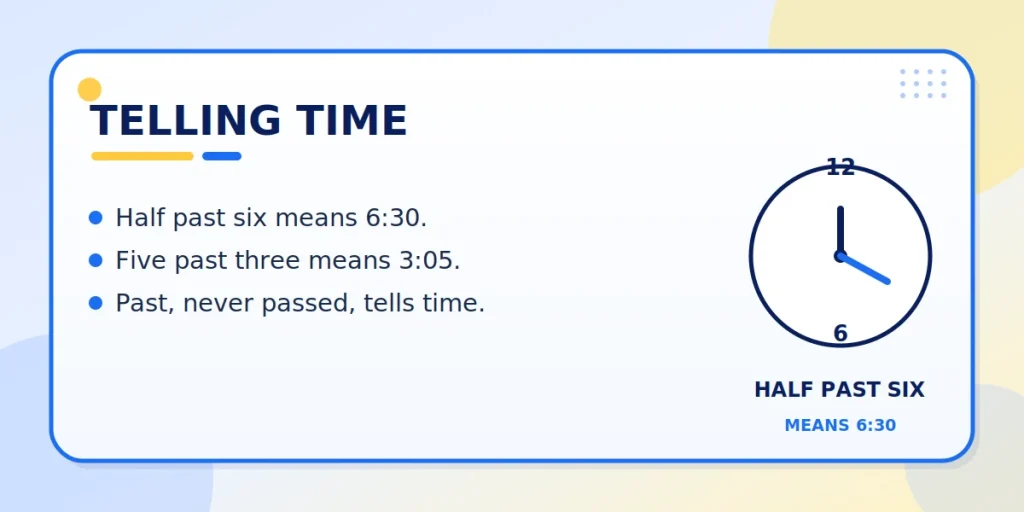
The word past appears often when people say or write the time. It tells you how many minutes have gone beyond the hour.
What Does Half Past Mean?
Half past means 30 minutes after the hour.
For example:
- Half past one means 1:30.
- Half past five means 5:30.
- Half past eleven means 11:30.
The expression uses past, not passed. Here, past is a preposition that relates the minutes to the hour.
Examples of Past in Clock Times
You can use past with several common time expressions.
| Expression | Meaning |
|---|---|
| Five past two | 2:05 |
| Ten past three | 3:10 |
| Quarter past four | 4:15 |
| Twenty past five | 5:20 |
| Half past six | 6:30 |
These expressions are common ways to say the time. You can also use the numbers directly, such as six thirty.
Why Is It Past and Not Passed?
In a clock expression, past shows how far the minutes have moved beyond the hour.
For example, twenty past seven means 20 minutes after seven. The word does not describe an action performed by someone.
Passed is a verb form. It belongs in a sentence such as:
Twenty minutes passed before the meeting began.
Compare the structures:
Twenty past seven: a time expression.
Twenty minutes passed: a complete clause with a verb.
Is “Passed Tense” Correct?
No. The correct grammatical term is past tense, not passed tense.
The past tense describes a verb form used for an action or state in an earlier time.
The confusion happens because passed is itself a past-tense verb form. However, it is not the name of a tense.
Compare these examples:
Correct: The past tense of pass is passed.
Incorrect: The passed tense of pass is passed.
What Is the Past Tense of Pass?
The verb pass has several forms. The past tense and past participle are both passed.
| Verb form | Word | Example |
|---|---|---|
| Base form | Pass | I pass the library daily. |
| Third-person singular | Passes | She passes the library daily. |
| Present participle | Passing | He is passing the library. |
| Past tense | Passed | She passed the library yesterday. |
| Past participle | Passed | He has passed the library. |
The past participle usually appears with a helping verb, such as has, have, or had.
Examples:
- She has passed the exam.
- They had passed the store before they noticed it.
- We have passed that point already.
Remember the distinction: past tense names a grammatical form. Passed is one example of that form.
Common Passed vs Past Mistakes
Because the words sound alike, writers sometimes choose the wrong spelling. These examples show the correct forms and explain why they work.
| Incorrect | Correct | Reason |
|---|---|---|
| We walked passed the bank. | We walked past the bank. | Past shows movement beyond a place. |
| The bill is passed due. | The bill is past due. | Past due means overdue. |
| It is half passed eight. | It is half past eight. | Past appears in clock expressions. |
| She past the exam. | She passed the exam. | Passed is the verb. |
| He past away last year. | He passed away last year. | Passed away is the correct expression. |
| The passed tense is simple. | The past tense is simple. | Past tense is the grammatical term. |
| Several days past. | Several days passed. | Passed describes time going by. |
How to Check Whether You Need Passed or Past
Use these checks when you are unsure:
- Look for the action. If the word describes an action, you may need passed.
- Check the sentence structure. If another verb already describes the action, past may show direction or position.
- Look for a time expression. Phrases such as past midnight and half past six use past.
- Check the meaning. If you mean an earlier period or something beyond a point, use past.
- Try the base verb. If pass fits as the main verb, passed may be its past form.
Do not choose based only on pronunciation. Both words sound alike, so the sentence’s meaning must guide your spelling.
Easy Ways to Remember Passed vs Past
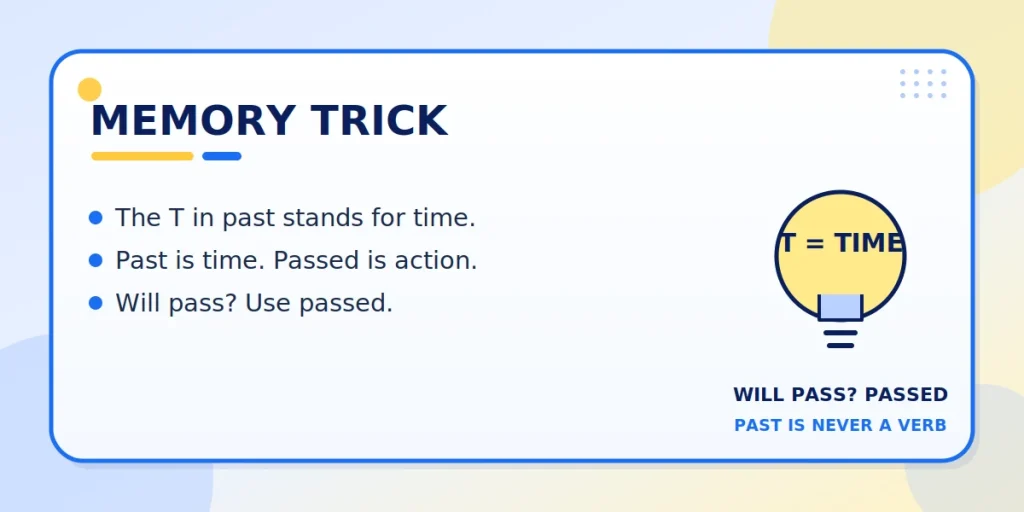
A few simple checks can help you choose the right word quickly.
The Verb Test
Use passed when the sentence needs the past form of the verb pass.
Examples:
- She passed the ball.
- He passed the exam.
- The afternoon passed quickly.
If the word describes an action, passed is likely the correct choice.
The Future Tense Test
Try changing the sentence to the future tense.
She passed the store yesterday.
She will pass the store tomorrow.
The change from passed to will pass shows that the original word is a verb.
This test is a useful clue, but always check the sentence’s meaning.
The Time Test
Remember the T in past for time.
Examples:
- past midnight
- half past four
- the past year
- past experiences
This trick helps with many common time expressions.
The Beyond Test
Use past when something moves beyond a place, person, or limit.
Examples:
- The car drove past the house.
- We walked past the entrance.
- The temperature went past 90 degrees.
Think of past as showing that something has gone beyond a point.
Passed vs Past: Pronunciation
In standard US English, passed and past are homophones. This means they have the same pronunciation but different meanings and spellings.
Both are pronounced /pæst/.
The shared sound explains why people confuse these words in writing. However, pronunciation cannot tell you which spelling belongs in a sentence.
Check the grammatical role instead. Use passed for the verb form of pass. Use past for an earlier time, a previous period, or movement beyond a point.
Where Do Passed and Past Come From?
The words have a shared historical connection, but their modern uses are different.
Origin of Passed
Passed is the past tense and past participle of pass. The verb developed through Middle English and French forms connected to the Latin word passus, meaning a step or pace.
Its modern meanings include moving by something, succeeding in an examination, transferring something, and allowing time to go by.
Origin of Past
Past developed from a Middle English form associated with the past participle of pass. Over time, it became established as a word with several grammatical roles.
Today, it can function as an adjective, adverb, preposition, or noun.
Although the words share a historical connection, that does not make them interchangeable. Their modern grammatical roles determine which spelling you need.
Practice Questions: Passed or Past
Choose passed or past to complete each sentence. Read the whole sentence before selecting your answer.
Choose Passed or Past
- We drove ___ the old library on our way home.
- Nina ___ her driving test last Friday.
- The electricity bill is two weeks ___ due.
- My uncle ___ away several years ago.
- The train leaves at half ___ six.
- Three hours ___ before the doctor called.
- The necklace was ___ down through generations.
- We cannot change the ___.
- The ___ tense of pass is passed.
- He ___ the school and continued walking ___ the park.
Answer Key with Explanations
- Past. Past shows that the car moved beyond the library.
- Passed. Passed is the past-tense form of pass and means she succeeded.
- Past. Past due means the bill should already have been paid.
- Passed. Passed away is the established expression meaning died.
- Past. Half past six means 6:30.
- Passed. Passed is the verb describing time going by.
- Passed. Passed down means transferred from one generation to another.
- Past. The past is a noun referring to an earlier period.
- Past. Past tense is the correct grammatical term.
- Passed, past. Passed describes the action, while past shows the direction.
Frequently Asked Questions About Passed vs Past
Is It Passed or Past the Store?
Use past the store when describing movement beyond it. For example, “We walked past the store.” Use passed the store when passed is the main verb, as in “We passed the store.”
Is It Passed Due or Past Due?
The standard expression is past due. It means a payment, assignment, or other obligation is overdue. For example, “My electricity bill is past due.” Do not use passed due with this meaning.
Is Passed the Past Tense of Pass?
Yes. Passed is both the simple past tense and the past participle of pass. For example, “She passed the exam” uses the simple past, while “She has passed” uses the past participle.
Is “Passed Tense” Grammatically Correct?
No. The correct grammatical term is past tense. Passed is only a form of the verb pass. For example, the past tense of pass is passed. The phrase passed tense is never the name of the tense.
Is It Half Past or Half Passed?
Use half past when telling time. It means 30 minutes after the hour. For example, “The class starts at half past nine” means the class starts at 9:30. Half passed is not correct here.
Are Passed and Past Pronounced the Same?
Yes. In standard US English, passed and past are homophones. Both have the same pronunciation. Their meanings and grammatical roles differ, so you must use the sentence’s context to choose the spelling.
Can Passed Ever Be an Adjective?
Yes. Dictionaries recognize adjective uses of passed in certain established or specialized contexts, such as a passed ball in baseball. However, passed mainly functions as the past tense or past participle of pass in everyday writing.
Keep Learning: More Commonly Confused Words
Choosing the correct word often depends on understanding its meaning and grammatical role. Explore these related ClarifyWords guides for more clear explanations and examples.
- Then vs. Than
- Loose vs. Lose
- Lead or Led
- Choose or Chose
- Lay or Laid
- Lie vs. Lay
- Affect vs. Effect
- Whose vs. Who’s
- Its vs. It’s
Browse more guides in the Confused Words category.
Final reminder: Use passed when you need the past form of pass. Use past for an earlier time, a previous period, or movement beyond a point. Once you identify the word’s job, the correct spelling becomes clear.