

Judgment vs Judgement: What’s the Difference?
Judgment is the correct standard spelling in American English. Judgement is the usual spelling in British English for general writing. Judgment is also the standard spelling for court decisions in British and Australian legal writing.
The difference is regional spelling, not meaning. Both forms describe an opinion, a decision, or the ability to make sensible choices.
For American readers, the choice is simple. Write judgment in everyday, academic, professional, and legal contexts.
Quick Answer: Judgment vs Judgement at a Glance
The judgment vs judgement question has one short answer for US readers and a longer answer for UK readers.
| Feature | Judgment | Judgement |
|---|---|---|
| American English | Standard spelling | Recognized variant, not preferred |
| British English | Accepted spelling | Usual general spelling |
| Australian English | Legal contexts | General contexts |
| Meaning | Opinion or decision | Same meaning |
| Pronunciation | Same | Same |
| Legal writing | Standard | Less common |
| Example | Trust your judgment. | Trust your judgement. |
Both spellings are valid English. Your audience determines which one you should choose.
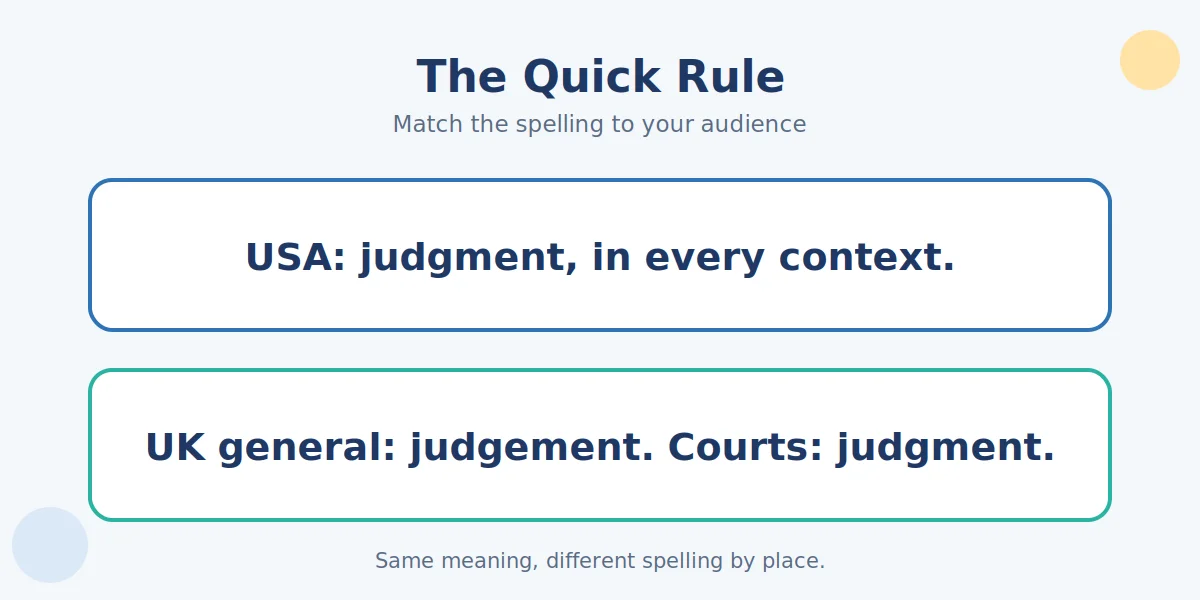
Table of Contents
- What Do Judgment and Judgement Mean?
- Judgment vs Judgement: Comparison Table
- Which Spelling Is Correct in American English?
- Which Spelling Is Correct in British English?
- Why Do Courts Use Judgment?
- Against My Better Judgment or Judgement
- Related Words and Expressions
- The Dropped E Spelling Pattern
- Common Spelling Mistakes
- How to Remember the Difference
- Practice Questions
- Frequently Asked Questions
- Final Takeaway
What Do Judgment and Judgement Mean?
The judgment vs judgement question starts with meaning. Judgment and judgement are two spellings of the same English noun. They have identical meanings and pronunciation.
The word has several related meanings. It can describe someone’s ability to make sensible decisions. It can also mean an opinion formed after careful thought. In legal writing, it means a formal court decision.
What Does Judgment Mean?
Judgment refers to the ability to consider information and make sensible decisions. It can also describe a conclusion formed after considering the facts.
The word has three common meanings:
- Good decision making: the ability to make sensible choices.
- An opinion or conclusion: a decision formed after considering available information.
- A legal decision: a formal ruling made by a court.
Here are some examples:
- Her good judgment helped the company avoid a major loss.
- You should use your own judgment before accepting the offer.
- The judge issued a written judgment after reviewing the case.
- His judgment of the situation was accurate.
In American English, judgment is the standard spelling for all these meanings.
What Does Judgement Mean?
Judgement has exactly the same meanings as judgment. British and Australian writers commonly use this spelling in general writing.
Consider these examples:
- She showed excellent judgement during the interview.
- His judgement of the situation was correct.
- It was an error of judgement.
- The committee questioned her professional judgement.
These sentences use judgement in the same way Americans use judgment.
Neither spelling changes the word’s meaning or grammatical role. The difference comes from regional spelling preferences.
Are Judgment and Judgement Pronounced Differently?
No. Both spellings have the same pronunciation. They sound identical when spoken. The extra letter E in judgement does not change the pronunciation.
This is strictly a written spelling difference.
Judgment vs Judgement: Comparison Table
In the judgment vs judgement comparison, the main difference is the regional spelling preference. American English uses judgment, while British English generally uses judgement in general writing.
| Feature | Judgment | Judgement |
|---|---|---|
| American English | Standard spelling | Recognized variant, not preferred |
| British English | Accepted spelling | Usual general spelling |
| Australian English | Legal contexts | General contexts |
| Meaning | Opinion or decision | Same meaning |
| Pronunciation | Same | Same |
| Legal writing | Standard | Less common |
| Example | Trust your judgment. | Trust your judgement. |
Remember: both spellings are valid English. Your audience determines which one you should choose.
Which Spelling Is Correct in American English?
For the judgment vs judgement question in the US, judgment is the standard American spelling. Americans use it in everyday writing, school assignments, business writing, and legal documents.
The spelling follows established American English conventions. It also appears consistently in major American dictionaries and style guides.
Why Americans Write Judgment Without the E
American English favors judgment over judgement. This shorter form has a long history in English. It was already in use before Noah Webster’s dictionaries.
Noah Webster helped popularize and establish shorter American spellings. However, he did not invent judgment.
Is Judgement Ever Acceptable in American English?
Some American dictionaries recognize judgement as an alternative spelling. However, judgment remains the conventional and preferred choice.
Use judgment when writing for American readers. This applies to formal and informal writing.
For example:
- Standard US: She showed excellent judgment.
- Standard US: I trust your judgment.
- Standard US: The judge issued a judgment.
- Standard US: It was a difficult judgment call.
Using judgement in an American document may distract readers. It can also make the document look inconsistent with American style.
American English Examples of Judgment
Here are five examples showing the correct American spelling:
- Her judgment helped the team make the right decision.
- Use your best judgment when handling difficult situations.
- The manager questioned his judgment during the meeting.
- The court delivered its judgment after reviewing the evidence.
- Buying that expensive car was a poor judgment call.
In each sentence, judgment refers to a decision, opinion, or legal ruling.
Which Spelling Is Correct in British English?
For the judgment vs judgement question in the UK, British English generally uses judgement in everyday writing. However, judgment remains an accepted spelling and is standard in legal contexts.
This distinction explains why British publications may use both forms.
Why British English Usually Uses Judgement
British English commonly retains the extra E in words such as judgement, acknowledgement, and ageing.
The spelling appears in expressions about personal decisions and opinions.
Examples include:
- She showed excellent judgement during the interview.
- It was a poor judgement call.
- His judgement of character was impressive.
- The decision reflected her professional judgement.
These examples use the usual British general spelling.
When British English Uses Judgment
British legal writing commonly uses judgment when referring to a court decision.
For example:
- The court delivered its judgment on Friday.
- The judge reserved judgment until the following week.
- The legal team reviewed the written judgment.
This convention also appears in British legal publishing guidance. Individual publishers may have additional house styles.
British English Examples
| General British writing | British legal writing |
|---|---|
| She showed good judgement. | The court issued its judgment. |
| It was an error of judgement. | The judge delivered the judgment. |
| Trust your own judgement. | The written judgment explained the ruling. |
The spelling depends on the context. Both forms belong to British English.
What About Australian English?
Australian English follows a similar distinction between general and legal writing.
The Australian Government Style Manual gives clear guidance:
- Use judgement in general writing.
- Use judgment when referring to a court decision.
For example:
- You can speak without fear of judgement.
- Please cite the High Court’s latest judgment.
This is another reason judgment works well as an international spelling choice.
Why Do Courts Use Judgment?
The judgment vs judgement rule changes in court. Judgment has a specific meaning in legal writing. It refers to an official decision made by a court.
The spelling is standard in American legal documents. British and Australian legal writing also commonly uses it.
What Does Judgment Mean in Legal Writing?
A legal judgment is a court’s formal decision. It resolves a dispute or determines the rights of the parties.
For example:
- The court issued a judgment in favor of the plaintiff.
- The judge explained the judgment in a written opinion.
- The defendant challenged the court’s judgment.
Why Legal Writing Uses Judgment Without the E
Legal writing traditionally favors judgment in several English speaking countries.
This convention applies even when general British or Australian writing uses judgement.
For example, the Australian Government Style Manual specifically preserves judgment for court decisions.
Therefore, legal documents provide an important exception to the general British and Australian spelling preference.
Common Legal Expressions That Use Judgment
| Legal term | Meaning |
|---|---|
| Court judgment | An official decision issued by a court |
| Summary judgment | A court decision without a full trial when the legal requirements are met |
| Final judgment | A decision that finally resolves the relevant legal dispute |
| Judgment debt | A debt established by a court judgment |
| Judgment creditor | A person or organization entitled to enforce a judgment debt |
Summary judgment is especially common in American legal writing. It allows a court to decide a matter without a trial when there is no genuine dispute over material facts.
Judgment vs Verdict: Are They the Same?
No. A judgment and a verdict are related, but they are not identical.
A judgment is the court’s formal decision. A verdict is a finding made by a jury or, in some cases, a judge.
Consider these examples:
- The jury returned a guilty verdict.
- The court entered its judgment after the verdict.
A verdict determines the outcome of a trial, while a judgment is the court’s formal decision.
Against My Better Judgment or Judgement
The judgment vs judgement choice also affects this phrase. The expression against my better judgment means doing something despite believing it may be unwise.
It describes a decision that goes against your own good sense.
What Does Against My Better Judgment Mean?
People use this expression when they knowingly make a questionable decision.
For example:
- I bought the expensive shoes against my better judgment.
- She accepted the offer against her better judgment.
- He agreed to help, against his better judgment.
In each example, the person believes the decision may be wrong.
Is It Against My Better Judgment or Against My Better Judgement?
Both spellings are used, depending on the English variety.
- American English: against my better judgment.
- British English: against my better judgement is the usual general form.
For American writing, always choose judgment.
More Examples in Everyday Sentences
Here are three additional examples:
- I stayed up late against my better judgment.
- She trusted the stranger against her better judgment.
- They invested in the project against their better judgment.
These examples show how the expression works in everyday situations.
Related Words and Expressions
Several words and phrases contain judgment. Understanding their spelling helps you avoid common mistakes.
Judgmental or Judgemental?
Judgmental is the standard recommended adjective spelling. It describes someone who judges others too quickly or harshly.
Examples:
- She sounded judgmental during the discussion.
- Try not to be judgmental about other people’s choices.
- His judgmental comments upset the entire team.
Judgmental is the standard adjective in both American and British English. Judgemental is not the standard form.
| Word or phrase | American English | British English |
|---|---|---|
| Noun | judgment | judgement |
| Adjective | judgmental | judgmental |
| Plural noun | judgments | judgements |
| Common phrase | judgment call | judgement call |
| Legal phrase | summary judgment | summary judgment |
What Does Judgment Call Mean?
A judgment call is a decision based on personal assessment. It often involves uncertainty or incomplete information.
For example:
- Choosing the right candidate was a judgment call.
- The manager made a judgment call during the emergency.
- Whether to cancel the event is a judgment call.
The phrase is common in American business and everyday writing.
What Does Summary Judgment Mean?
Summary judgment is a legal decision made without a full trial.
A court may grant it when the evidence shows no genuine dispute over material facts. The law must also support a decision without a trial.
For example:
- The defendant requested summary judgment.
- The judge granted summary judgment after reviewing the evidence.
This legal expression always uses judgment in standard American writing.
Judgment vs Judgements: What Is the Correct Plural?
The plural depends on the spelling convention you follow.
| Singular | Plural | English variety |
|---|---|---|
| Judgment | Judgments | American English |
| Judgement | Judgements | General British English |
Examples:
- The judge issued several judgments in related cases.
- Her professional judgements impressed the committee.
For American writing, use judgments.
Other Common Expressions With Judgment
| Expression | Meaning |
|---|---|
| Good judgment | The ability to make sensible decisions |
| Sound judgment | A reasonable and reliable decision |
| Poor judgment | An unwise decision |
| Error of judgment | A mistake in decision making |
| Judgment debt | A debt established by a court |
| Value judgment | An opinion based on personal beliefs or values |
Use judgment in these expressions when following American English.
The Dropped E Spelling Pattern
Judgment is not the only word with different American and British spellings.
Several English words follow a similar pattern. American English often drops a final silent E before adding certain endings.
Judgment vs Judgement
American English uses judgment. British English usually uses judgement in general writing.
The difference involves the additional E before the ending.
However, this pattern does not apply to every word. Always check the accepted spelling for each word.
Acknowledgment vs Acknowledgement
Both spellings refer to recognizing or confirming something.
- American English: acknowledgment.
- British English: acknowledgement.
Examples:
- She sent an acknowledgment of the payment.
- He received an acknowledgement from the office.
Aging vs Ageing
Both spellings refer to the process of getting older.
- American English: aging.
- British English: ageing.
Examples:
- Aging is a natural process.
- The report discusses ageing populations.
Does This Pattern Apply to Every Word?
No. English spelling has many exceptions.
You should not automatically remove an E whenever you add an ending. Some words follow different spelling rules.
When uncertain, consult a reliable dictionary. Also, follow one spelling convention throughout your document.
For more examples, read our guides to canceled vs cancelled and gray vs grey.
Common Spelling Mistakes
Writers sometimes confuse regional preferences with incorrect spelling. Understanding the rules helps prevent these errors.
Using Judgement in American Writing
American English prefers judgment.
Less suitable for standard US writing: She showed excellent judgement.
Recommended: She showed excellent judgment.
Assuming Judgment Is Wrong in British English
This is another common mistake.
British English accepts judgment. It is also the usual spelling for court decisions.
Correct: The judge delivered the judgment.
Assuming the Two Spellings Have Different Meanings
Judgment and judgement have the same meaning.
The extra E does not change the word’s definition or pronunciation.
Both forms can refer to good decision making, personal opinions, and court decisions.
Mixing Both Spellings in One Document
Using both forms randomly can make writing look inconsistent.
Choose the spelling that matches your audience.
For example, American documents should consistently use judgment. British documents generally use judgement in ordinary writing.
Follow the relevant legal convention when discussing court decisions.
Writing Judgemental Instead of Judgmental
The recommended standard adjective is judgmental.
Incorrect for standard American writing: Her judgemental comments were unnecessary.
Correct: Her judgmental comments were unnecessary.
Quick Mistakes and Corrections Table
| Less suitable or incorrect | Recommended spelling |
|---|---|
| Judgement in standard US prose | Judgment |
| Judgemental | Judgmental |
| Judgements in US writing | Judgments |
| Judgment used as if it had a separate meaning | Same meaning as judgement |
| Randomly mixing both forms | Follow one spelling style |
For more spelling comparisons, visit our Spelling Differences category.
How to Remember the Difference
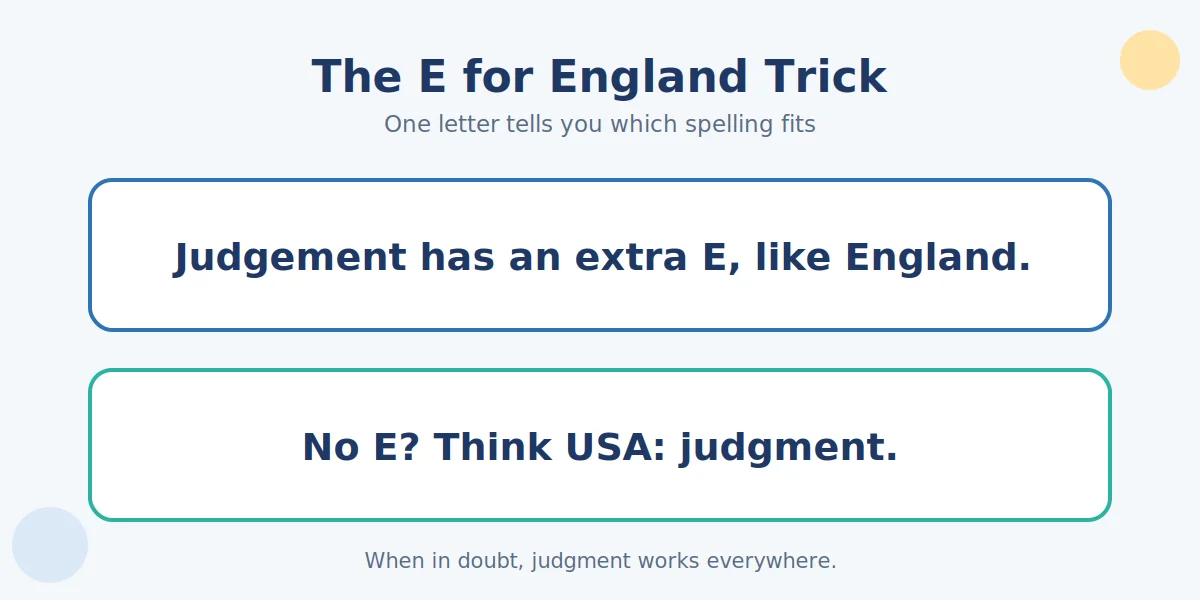
The judgment vs judgement memory trick is simple. A simple memory trick can help you remember which spelling to use.
Remember the E in England
Think of the letter E in England.
The usual British spelling, judgement, contains an extra E. The American spelling, judgment, leaves it out.
Remember:
- England: judgement.
- America: judgment.
This mnemonic helps you remember the general regional difference.
When in Doubt, Choose Judgment
If you are unsure which spelling to use, choose judgment.
It is the standard American spelling. It is also accepted in British English and used in legal writing across the varieties discussed.
Here is the easiest way to remember:
| Writing context | Recommended spelling |
|---|---|
| American English | Judgment |
| British general writing | Judgement |
| British legal writing | Judgment |
| Australian general writing | Judgement |
| Australian legal writing | Judgment |
| International writing | Judgment |
For ClarifyWords readers, the safest everyday choice is judgment.
Practice Questions: Judgment or Judgement?
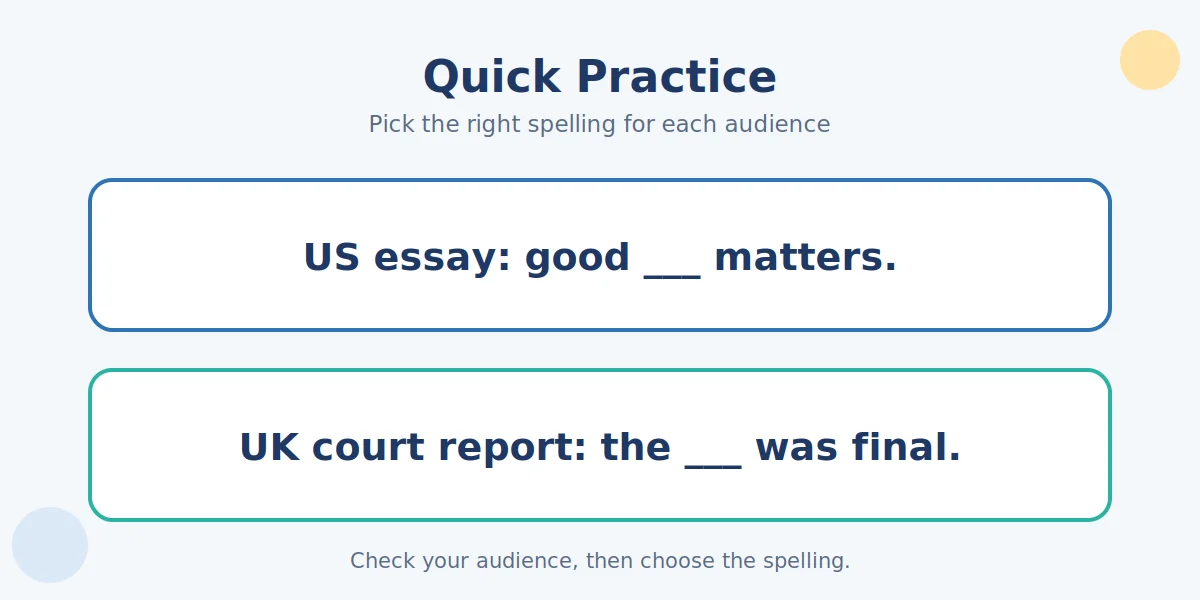
Test your understanding with these 10 questions. Choose the spelling that best fits each sentence.
Choose the Correct Spelling
- She showed excellent _____ when handling the difficult situation.
a) Judgement
b) Judgment - British writers commonly use _____ in everyday writing.
a) Judgment
b) Judgement - The judge delivered the final _____ yesterday.
a) Judgement
b) Judgment - You should trust your own _____ when making important decisions.
a) Judgment
b) Judgement - Her _____ helped the company avoid a major mistake.
a) Judgement
b) Judgment - It was an error of _____ to accept the offer without reading it.
a) Judgement
b) Judgment - His _____ comments made everyone uncomfortable.
a) Judgemental
b) Judgmental - The lawyer requested _____ before the trial began.
a) Summary judgement
b) Summary judgment - The court issued several written _____ during the year.
a) Judgements
b) Judgments - Australian general writing commonly uses which spelling?
a) Judgment
b) Judgement
Answer Key With Explanations
| Question | Correct answer | Explanation |
|---|---|---|
| 1 | b) Judgment | American English uses judgment. |
| 2 | b) Judgement | Judgement is the usual British general spelling. |
| 3 | b) Judgment | Legal writing uses judgment. |
| 4 | a) Judgment | Judgment is standard American spelling. |
| 5 | b) Judgment | American English drops the extra E. |
| 6 | b) Judgment | This is the standard US expression. |
| 7 | b) Judgmental | Judgmental is the recommended adjective spelling. |
| 8 | b) Summary judgment | This is the standard American legal spelling. |
| 9 | b) Judgments | Judgments is the American plural. |
| 10 | b) Judgement | This is the usual Australian general spelling. |
How did you do? If you answered all 10 correctly, you understand the main spelling differences.
Frequently Asked Questions
Is judgment or judgement correct in American English?
Judgment is the standard American spelling. Americans use it in everyday, academic, professional, and legal writing. Some dictionaries list judgement as a variant, but it is not the preferred form in the United States.
Is judgement incorrect in British English?
No. Judgement is the usual British spelling in general writing, while judgment is also accepted, particularly in legal contexts. The right choice depends on the type of writing and the audience you are writing for.
Why do lawyers spell it judgment?
Judgment is the established spelling for formal court decisions in American legal writing. British and Australian legal writing also commonly use it. This convention applies even when general writing uses judgement instead.
Is judgmental or judgemental correct?
Judgmental is the standard recommended spelling. It describes someone who judges others too quickly or harshly. Use judgmental in both American and British English for standard writing, not judgemental every time.
Is it against my better judgment or judgement?
Against my better judgment is the standard American expression. British writers commonly use against my better judgement in general writing. Both phrases mean exactly the same thing, so choose by audience.
What is the plural of judgment?
The American plural is judgments. British writers generally use judgements in ordinary writing. Both forms follow the same regional spelling pattern as the singular form they come from in each variety.
Final Takeaway: Use Judgment for American English
The judgment vs judgement difference is regional spelling. Both words have the same meaning and pronunciation.
Here is what to remember:
- American English: judgment.
- British English: judgement in general writing.
- British legal writing: judgment.
- Australian English: judgement in general writing.
- Australian legal writing: judgment.
- Standard adjective: judgmental.
Noah Webster helped popularize the shorter spelling in America, but he did not invent it. Both forms have a much longer history.
If you are writing for an American audience, choose judgment every time. It is the standard spelling for ClarifyWords readers.
For more explanations of spelling differences, explore our Spelling Differences guides. You can also read our guides to canceled vs cancelled, gray vs grey, and whose vs who’s.
References: Oxford Advanced Learner’s Dictionary: Judgement; Oxford Advanced American Dictionary: Judgment; Cambridge Dictionary: Judgment; Australian Government Style Manual: Common Misspellings and Word Confusion; Australian Government Style Manual: Spelling; United States Courts: Glossary of Legal Terms; Ninth Circuit Court: Glossary; Grammarphobia: Judgment or Judgement.