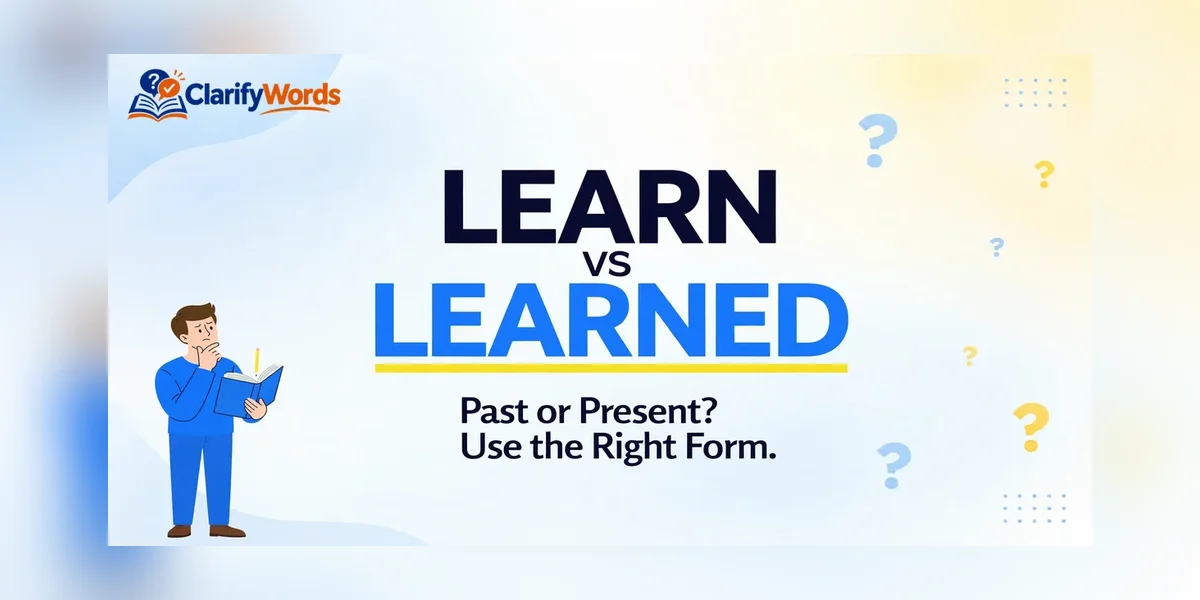
Learn or Learned: What’s the Difference?
Quick Answer
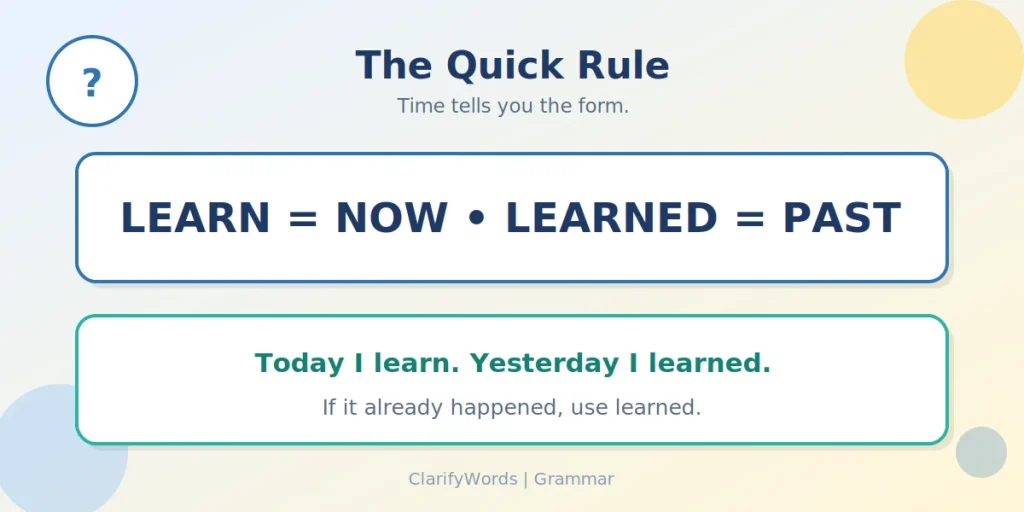
Should you write learn or learned? The correct choice depends on the tense of your sentence. Learn is the base form of the verb, while learned is its simple past tense and past participle. Use learn for present actions, habits, and future situations. Use learned for completed past actions and with helping verbs such as have, has, and had. In American English, learned is the standard past form. Learnt is also correct, but it is more common in British English.
For example:
- I want to learn Spanish.
- I learned Spanish in college.
Let’s look at the rules, examples, and common mistakes to help you choose the correct word. This guide covers learn or learned in full, with rules, examples, and practice.
Table of Contents
- Learn vs. Learned at a Glance
- What Does Learn Mean?
- What Does Learned Mean?
- Learn Verb Forms
- When to Use Learn
- When to Use Learned
- Learned vs. Learnt
- Learned as an Adjective
- Common Mistakes
- Examples in Real Sentences
- Memory Trick
- Practice Questions
- Frequently Asked Questions
Learn vs. Learned at a Glance
The main difference between learn and learned is their grammatical form. Learn is the base verb, while learned describes a completed action or forms part of a perfect tense.
| Word | Grammatical form | When to use it | Example |
|---|---|---|---|
| Learn | Base form | Present, future, and after modal verbs | I learn quickly. |
| Learned | Simple past | Completed past actions | I learned yesterday. |
| Learned | Past participle | Perfect tenses and passive voice | I have learned a lot. |
| Learnt | Alternative past form | Mainly British English | I learnt something new. |
For American English, choose learned when describing past actions. Use learn when the sentence requires the base form. If you still hesitate over learn or learned, check the time clue in the sentence.
What Does Learn Mean?
Learn is a verb that means to gain knowledge, information, or a skill through study, experience, or instruction. It can also mean discovering a fact or becoming aware of something.
For example:
- I want to learn another language.
- Children learn new things every day.
- We learn from our mistakes.
- She wants to learn how to play the piano.
You can use learn when discussing education, personal experiences, professional skills, or new information. The word also appears in common expressions:
- Learn by heart: Memorize something.
- Learn the hard way: Understand something through an unpleasant experience.
- Learn from experience: Gain knowledge through things that happen to you.
What Does Learned Mean?
Learned is the simple past tense and past participle of learn in American English. Use it when someone gained knowledge or developed a skill in the past. It also appears with helping verbs.
Learned as the Simple Past Tense
Use learned for an action that happened and finished in the past. Examples:
- I learned French last year.
- She learned how to drive at 18.
- We learned an important lesson yesterday.
- They learned about American history in school.
Learned as a Past Participle
A past participle is a verb form used with helping verbs to create certain tenses. Use learned after have, has, or had. Examples:
- I have learned a lot from my teachers.
- She has learned several new skills.
- They had learned the rules before the competition.
The simple past and past participle look the same, but their grammatical functions differ.
Learn Verb Forms
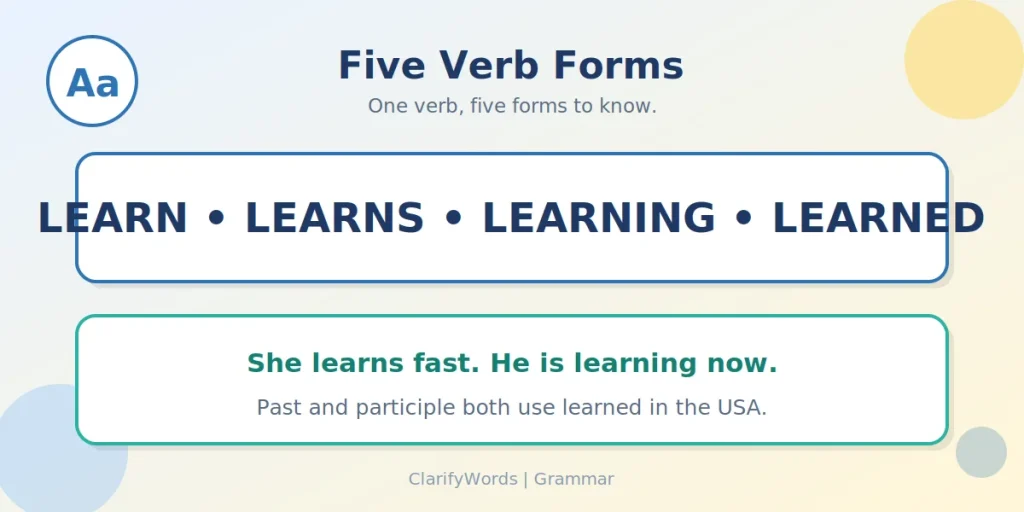
Here are the five principal forms of the verb learn.
| Verb form | Correct form | Example |
|---|---|---|
| Base form | Learn | I learn quickly. |
| Third person singular | Learns | She learns quickly. |
| Present participle | Learning | He is learning English. |
| Simple past | Learned | I learned English. |
| Past participle | Learned | I have learned English. |
Learnt is an alternative simple past and past participle form, mainly used in British English.
The present tense form also changes depending on the subject:
- I learn.
- You learn.
- He learns.
- She learns.
- We learn.
- They learn.
Remember to add s when using learn with a third person singular subject, such as he, she, or it.
When to Use Learn
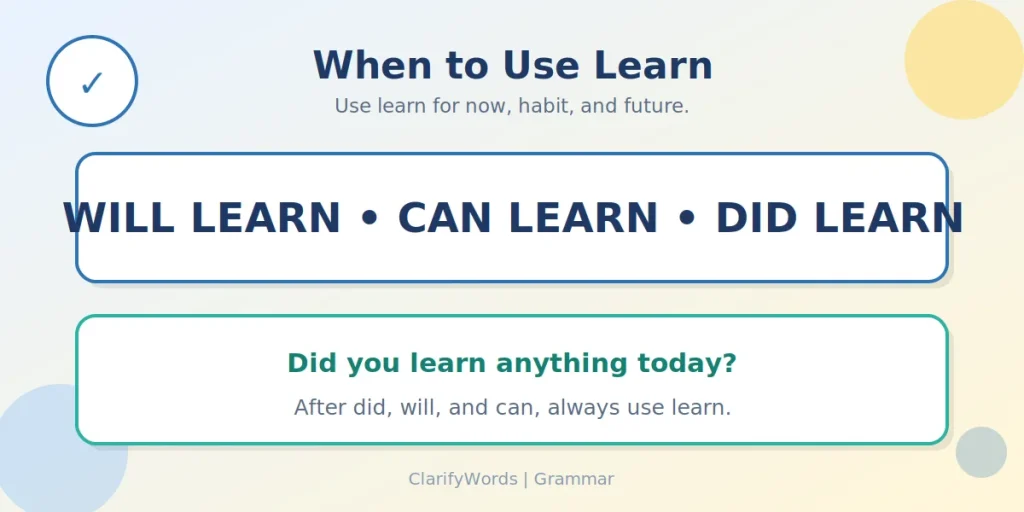
Use learn when the sentence requires the base form of the verb. This includes present actions, repeated habits, future actions, and constructions involving modal verbs or did. The learn or learned choice is simple once you spot the helper verb.
1. For Present Actions and Habits
Use learn to describe something that happens regularly or is generally true. Examples:
- I learn something new every day.
- Children learn quickly through practice.
- We learn English at school.
For third person singular subjects, use learns instead.
2. For General Truths
Use learn when discussing facts or general experiences. Examples:
- People learn throughout their lives.
- Children learn through observation.
- We learn from our mistakes.
3. For Future Actions
Use learn after will when describing something that will happen. Examples:
- I will learn Spanish next year.
- She will learn the new software.
- They will learn the results tomorrow.
Do not write will learned. The verb after will must remain in its base form.
4. After Modal Verbs
Use learn after modal verbs such as can, could, should, and must. Examples:
- You can learn a new skill.
- Everyone should learn from experience.
- Students must learn the basic rules.
5. After Did and Did Not
This is one of the most important rules to remember. Use learn, not learned, after did or didn’t. Examples:
- Did you learn anything?
- I did not learn French.
- She didn’t learn the answer.
- He did learn an important lesson.
Why? The helping verb did already shows that the action happened in the past. Therefore, the main verb stays in its base form.
When to Use Learned
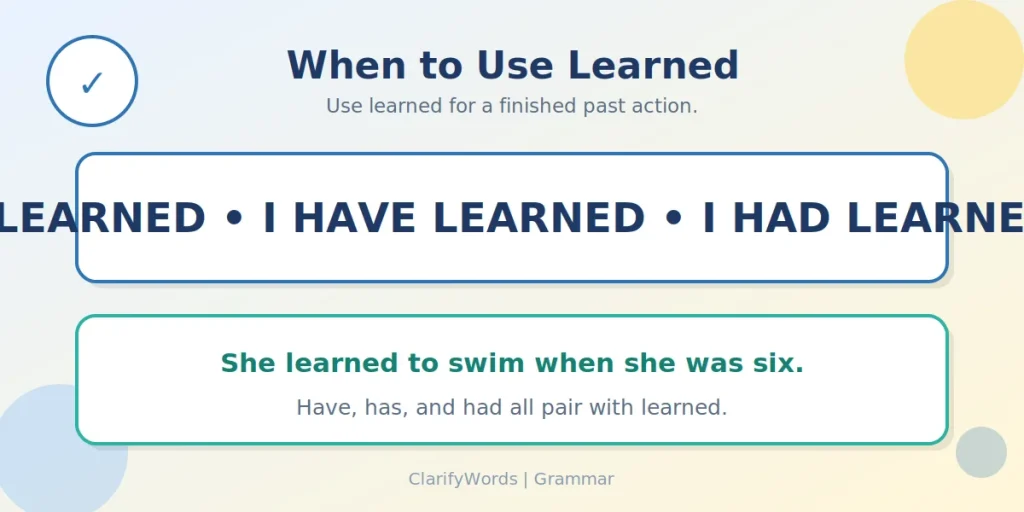
Use learned when describing a completed past action or forming a perfect tense. It also appears in passive constructions.
1. For Completed Actions in the Past
Use learned when an action happened and finished before now. Examples:
- I learned to swim when I was six.
- She learned English in college.
- We learned about the project yesterday.
Words such as yesterday, last year, and last summer often indicate a finished past action.
2. With Have and Has
Use learned with have or has to form the present perfect tense. Structure: Have/Has + learned. Examples:
- I have learned a lot this year.
- She has learned several new skills.
- They have learned from their mistakes.
The present perfect connects a past experience with the present.
3. With Had
Use learned with had to form the past perfect tense. Structure: Had + learned. Examples:
- I had learned the basics before starting the course.
- She had learned to drive before moving abroad.
The past perfect shows that one action happened before another past event.
4. With Will Have
Use learned with will have to form the future perfect tense. Structure: Will Have + learned. Examples:
- I will have learned enough Spanish by next year.
- She will have learned the new system by Monday.
5. In Passive Voice
Use learned in passive constructions to show that someone acquired a skill or knowledge. Examples:
- The lesson was learned the hard way.
- The skill was learned through practice.
- These habits were learned during childhood.
Here is a quick summary:
| Construction | Example |
|---|---|
| Simple past | I learned yesterday. |
| Present perfect | I have learned. |
| Past perfect | I had learned. |
| Future perfect | I will have learned. |
| Passive voice | The skill was learned. |
Learned vs. Learnt: What’s the Difference?
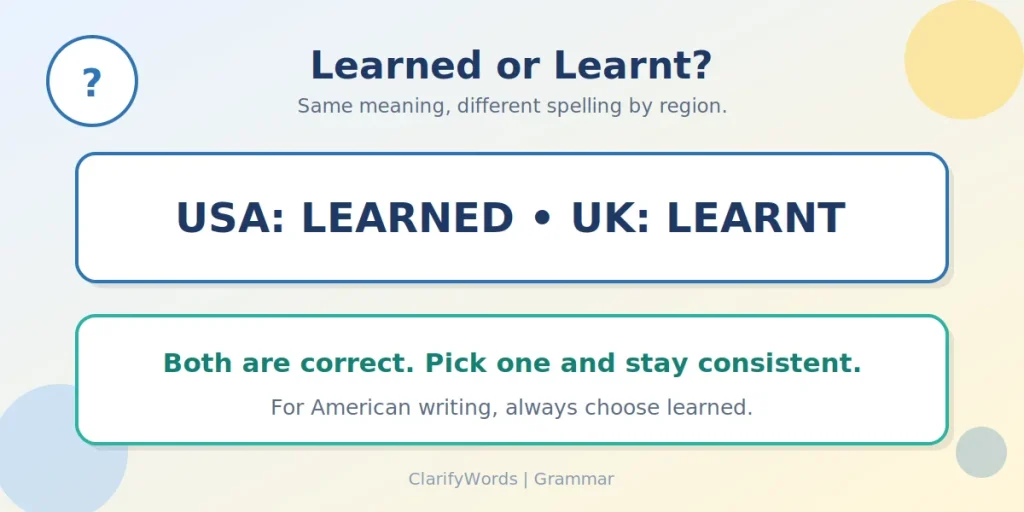
Learned and learnt are both correct past tense and past participle forms of learn. They have the same meaning, but their usage differs by region.
Learned in American English
In American English, learned is the standard spelling. Examples:
- I learned something important today.
- She learned English at school.
- We have learned many useful skills.
If you’re writing for an American audience, choose learned.
Learnt in British English
In British English, learnt is traditionally more common. However, learned is also accepted. Examples:
- I learnt something important today.
- She learnt English at school.
- We have learnt many useful skills.
Are Learned and Learnt Both Correct?
Yes. Both are established English verb forms. The difference is regional, not grammatical.
Here is a simple comparison:
| American English | British English |
|---|---|
| Learned | Learnt or learned |
| I learned the lesson. | I learnt the lesson. |
| She has learned French. | She has learnt French. |
For American writing, use learned consistently. Avoid switching between learned and learnt without a reason.
Other verbs have similar spelling variations:
| -ed form | -t form |
|---|---|
| Learned | Learnt |
| Burned | Burnt |
| Dreamed | Dreamt |
| Spelled | Spelt |
| Leaped | Leapt |
These are individual spelling variations. You cannot automatically change every verb ending in ed to a t form.
For more American and British spelling differences, see our guide to judgment vs. judgement (https://clarifywords.com/judgment-vs-judgement/).
Learned as an Adjective
Learned can also function as an adjective. It describes someone who has extensive knowledge or education. This meaning is different from the past tense verb. Examples:
- She is a learned professor.
- He is a learned scholar.
- The conference included several learned experts.
How to Pronounce Learned as an Adjective
The scholarly adjective learned has two syllables. It is pronounced differently from the past tense verb.
| Usage | Syllables | Pronunciation |
|---|---|---|
| Learned as a verb | One | Rhymes with earned |
| Learned as a scholarly adjective | Two | LEARN-ed |
The scholarly adjective is always spelled learned, even in British English. Do not write a learnt scholar.
There is another adjective use in expressions such as learned behavior. Here, it means behavior acquired through experience or observation. In this meaning, learned has one syllable. The British spelling learnt behavior is also possible.
Common Mistakes with Learn and Learned
Writers often confuse these forms when using helping verbs or describing past actions. Here are common mistakes and their corrections:
| Incorrect | Correct | Reason |
|---|---|---|
| Did you learned anything? | Did you learn anything? | Use the base form after did. |
| I didn’t learned French. | I didn’t learn French. | Use learn after didn’t. |
| I have learn a lot. | I have learned a lot. | Use the past participle after have. |
| She had learn English. | She had learned English. | Use learned after had. |
| He learnt me to swim. | He taught me to swim. | Use teach when giving instruction. |
| A learnt scholar | A learned scholar | Use learned for the scholarly adjective. |
| I learnted the lesson. | I learned the lesson. | Learnted is not a correct verb form. |
| I learnied English. | I learned English. | Learnied is not a correct verb form. |
Learn vs. Teach: Don’t Confuse These Verbs
Learn and teach are related, but they describe different actions.
- Learn: To gain knowledge or a skill.
- Teach: To give someone knowledge or instruction.
For example:
Incorrect: He learned me how to swim.
Correct: He taught me how to swim.
Also correct: I learned how to swim from him.
Remember that you learn something yourself, while someone teaches it to you.
Learn or Learned: Examples in Real Sentences
These examples show the learn or learned choice in everyday situations.
School and Education
- I learn something new in class every day.
- I learned about American history last semester.
- She has learned how to write essays.
Languages and Skills
- I want to learn Spanish.
- He learned to play the guitar last year.
- They have learned several new languages.
Work and Professional Development
- Employees learn new skills during training.
- She learned how to use the software.
- We have learned valuable lessons from this project.
Life Lessons and Personal Experiences
- We learn from our mistakes.
- I learned an important lesson from that experience.
- She has learned to be more patient.
Notice that the correct form depends on the sentence’s tense and structure, not simply on the subject.
How to Remember the Difference Between Learn and Learned
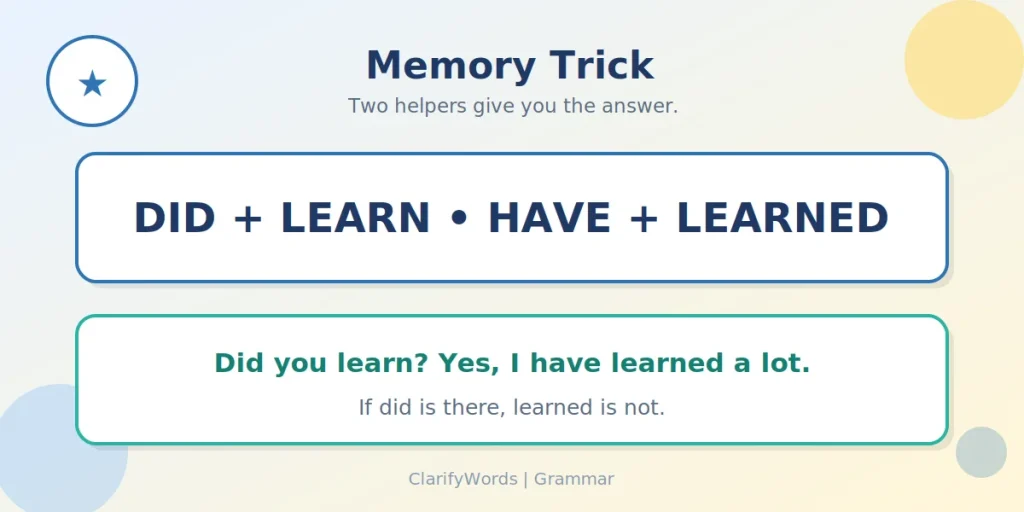
When you are unsure about learn or learned, use this simple memory trick:
Learn = Now, regularly, or later.
Learned = Already happened.
Compare these sentences:
- Today, I learn something new.
- Yesterday, I learned something new.
Also remember these three useful rules:
- Did + learn.
- Have/has/had + learned.
- Will + learn.
These patterns will help you choose the correct form in most everyday sentences.
Practice Questions: Learn or Learned?
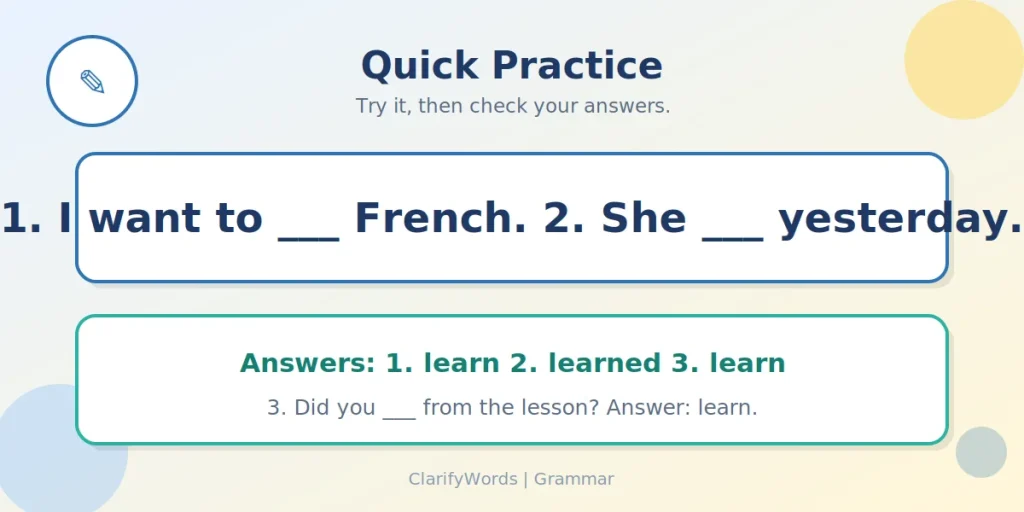
Test your understanding with these five questions. Fill in each blank with the correct form.
- I want to _____ how to speak French.
- She _____ a new skill yesterday.
- Did you _____ anything from the lesson?
- We have _____ a lot this year.
- He will _____ how to drive next summer.
Answer Key
- Learn: Use the base form after want to.
- Learned: Use the simple past for a completed action.
- Learn: Use the base form after did.
- Learned: Use the past participle after have.
- Learn: Use the base form after will.
If you answered all five correctly, you understand learn or learned and its main rules.
Frequently Asked Questions
These answers settle the most common learn or learned questions.
1. What Is the Past Tense of Learn?
The past tense of learn is learned in American English. Learnt is also correct, especially in British English. Both forms describe knowledge or a skill gained in the past, so either spelling can be right in the right place.
2. Is Learnt Correct in American English?
Yes, learnt is a valid English word, but it is uncommon in American English. American writers generally use learned as the standard past tense and past participle form, so learned is the safer choice for readers in the United States.
3. Should I Use Learned or Learnt?
Use learned when you write in American English. Learnt is traditionally more common in British English, although learned is also accepted there. Both forms carry the same meaning, so the choice is about audience and consistency, not correctness.
4. Do You Say Did Learn or Did Learned?
Say did learn, not did learned. The helping verb did already expresses the past tense, so the main verb must stay in its base form. This rule also applies to questions and negatives.
5. Can Learned Be Used as an Adjective?
Yes. Learned can describe someone who is highly educated or knowledgeable, as in a learned professor. This adjective has two syllables and is pronounced LEARN-ed, unlike the one syllable verb form, which rhymes with earned.
6. What Is the Difference Between Learn and Teach?
Learn means to gain knowledge or develop a skill, while teach means to give someone knowledge or instruction. Students learn from teachers, and teachers teach students, so the two verbs describe opposite sides of the same lesson.
If you want to improve your grammar further, explore these related ClarifyWords guides: fewer vs. less (https://clarifywords.com/fewer-vs-less/), who vs. whom (https://clarifywords.com/who-vs-whom/), judgment vs. judgement (https://clarifywords.com/judgment-vs-judgement/), its vs. it’s (https://clarifywords.com/its-vs-its/), and whose vs. who’s
(https://clarifywords.com/whose-vs-whos/). You can also browse all our Grammar guides (https://clarifywords.com/category/grammar/).