Learning Spanish: A Complete Beginner’s Guide to Getting Started
Learning Spanish starts with a few useful words, simple sentences, and regular practice. You do not need perfect grammar or expensive courses to begin.
The best approach combines vocabulary, pronunciation, listening, speaking, and basic grammar. Small daily sessions can help you build skills without feeling overwhelmed.
This guide shows you exactly how to start. You will learn what to study first, how long progress takes, and which resources can help. It also includes a 30-day plan, daily routines, beginner exercises, and practical memory tricks.
Whether you want to travel, connect with family, improve your career, or learn for fun, you can start today.
Learning Spanish works best when you practise a little every day.
Quick Answer: What’s the Best Way to Start Learning Spanish?
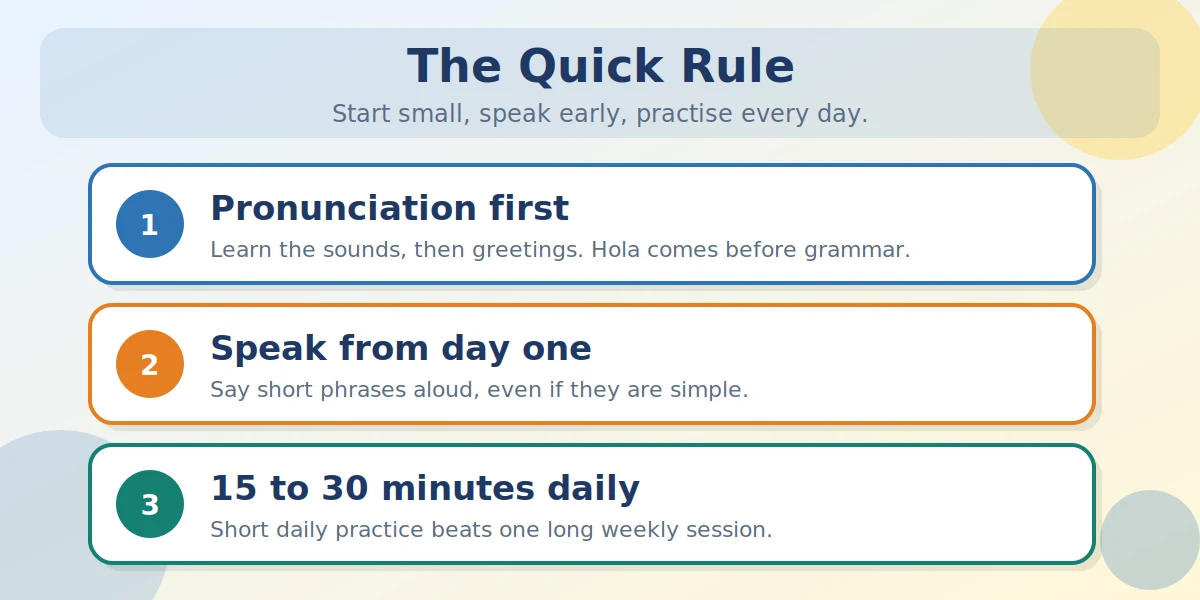
The best way to start learning Spanish is to study common words, practice basic grammar, and listen to simple conversations. Speak aloud from the beginning, even if you know only a few phrases.
Follow these steps: learn Spanish pronunciation and the alphabet. Memorize common greetings and everyday expressions. Build a vocabulary of useful words and phrases. Study basic grammar, including articles and present-tense verbs. Listen to beginner Spanish audio every day. Practice speaking with short sentences and simple questions. Review what you learn using flashcards and spaced repetition.
Start with 15 to 30 minutes each day. Focus on understanding and using Spanish rather than memorizing long word lists.
Learning Spanish from day one means using phrases, not only reading rules.
Learning Spanish at a Glance
| Question | Short answer |
|---|---|
| Is Spanish easy for English speakers? | It has familiar vocabulary, but grammar and listening take practice. |
| What should I learn first? | Pronunciation, greetings, basic vocabulary, and simple sentences. |
| How much should I study daily? | Start with 15 to 30 minutes. |
| Can I learn Spanish for free? | Yes. Free lessons, podcasts, videos, and flashcards can help. |
| Should I speak from day one? | Yes. Begin with short phrases and simple introductions. |
| Do I need grammar first? | Learn basic grammar alongside speaking and listening. |
| How long does it take? | It depends on your goals, study time, and practice. |
| Which Spanish should I learn? | Choose the variety that matches your communication needs. |
A practical learning sequence looks like this: pronunciation, then basic phrases, then vocabulary, then grammar, then listening, then speaking, then reading and writing. You do not need to master one stage before starting another. Combine these skills as you progress.
Table of Contents
- Why Learn Spanish?
- Is Spanish Easy to Learn for English Speakers?
- Your First Week of Learning Spanish
- Spanish Grammar for Beginners
- How Long Does It Take to Learn Spanish?
- Your 30-Day Spanish Learning Plan
- Your Month-by-Month Learning Roadmap
- How Much Spanish Should You Study Each Day?
- The Best Ways to Learn Spanish
- Free vs Paid Spanish Learning Resources
- Spanish From Spain vs Latin America
- Spanish Cognates and False Friends
- Common Mistakes to Avoid
- Practice Spanish With Dialogues and Exercises
- A Simple Memory Trick for Spanish Vocabulary
- How to Track Your Spanish Learning Progress
- Frequently Asked Questions
- Start Learning Spanish Today
- Related Guides
Why Learn Spanish?
Spanish is useful for travel, work, education, and personal relationships. It also connects you with a wide range of cultures and communities. Learning Spanish can open doors at home, at work, and while travelling. Here are seven reasons to consider learning it.
Spanish Is Spoken Around the World
Spanish is one of the world’s most widely spoken languages. According to Instituto Cervantes’ 2024 report, Spanish has more than 600 million potential speakers worldwide. Almost 500 million are native speakers. More than 24 million people are also learning Spanish worldwide. These figures show the language’s international reach. Spanish is spoken across Europe, North America, Central America, South America, and parts of Africa.
Spanish Is Useful in the United States
Spanish has an important place in American communities. Many people use it at home, at work, and in everyday conversations. Learning Spanish can help you communicate with neighbors, customers, colleagues, and friends. It can also help you connect with Spanish-speaking relatives. This is especially useful for heritage learners who understand some Spanish but struggle to speak it.
Spanish Makes Travel Easier
Knowing Spanish can make trips more comfortable. You can order food, ask for directions, book accommodation, and handle everyday situations. You can also speak with local people beyond common tourist interactions. Spanish is particularly useful when visiting Spain, Mexico, Colombia, Argentina, Peru, Chile, Costa Rica, and Guatemala. Even basic expressions can make travel more enjoyable.
Spanish Can Support Your Career
Spanish can be valuable in jobs involving regular communication. It may help in customer service, healthcare, education, hospitality, tourism, international business, and community services. For example, a Spanish-speaking employee may communicate more easily with Spanish-speaking customers. However, basic conversational Spanish is not the same as professional language proficiency. Some jobs require advanced communication skills.
Spanish Helps You Connect With Family
Some people learn Spanish to communicate with parents, grandparents, partners, or relatives. You may understand Spanish conversations but struggle to respond. Regular speaking practice can help close that gap. Learning family expressions also helps you understand cultural traditions and personal stories.
Spanish Opens Access to More Culture
Spanish gives you direct access to books, films, music, television, and local traditions. You can explore Spanish-language literature and understand songs without depending entirely on translations. It also helps you notice regional expressions and cultural differences.
Learning Spanish Builds a Useful Skill
Learning a language gives you a practical goal to work toward. You can measure progress through simple achievements: introducing yourself, ordering food, understanding a short conversation, describing your daily routine, reading a beginner story, and speaking with another person. Each milestone gives you a clear reason to keep practicing.
Is Spanish Easy to Learn for English Speakers?
Spanish is generally approachable for English speakers. Many Spanish words look familiar, and pronunciation follows recognizable patterns. Learning Spanish feels easier when you start with words you already recognise. However, some parts require more attention. Verb endings, grammatical gender, and listening comprehension can challenge beginners.
Why Spanish Can Feel Easier
- Familiar vocabulary: words such as animal, hospital, and natural resemble English.
- Consistent vowels: Spanish vowels usually have more predictable sounds than English vowels.
- Recognizable sentence patterns: many basic sentences follow a subject, verb, and object structure.
- Accessible learning materials: beginners can find lessons, podcasts, books, and conversation partners.
What Makes Spanish Challenging?
- Grammatical gender: nouns have masculine or feminine forms.
- Verb conjugation: verb endings change with the subject and tense.
- Ser vs estar: both mean “to be,” but their uses differ.
- Listening: native speakers often connect words in natural speech.
- Regional accents: pronunciation and vocabulary vary between countries.
- Past tenses: Spanish uses different past forms for different meanings.
These challenges become easier when you study them in context.
Is Learning Spanish as an Adult More Difficult?
Adults can learn Spanish successfully at any age. You can use your existing knowledge to understand grammar and recognize familiar words. Your main challenge may be finding enough practice time. A short daily routine can help you build a consistent habit. You do not need to sound like a native speaker. Focus first on understanding people and expressing your ideas clearly.
Your First Week of Learning Spanish: A Starter Kit
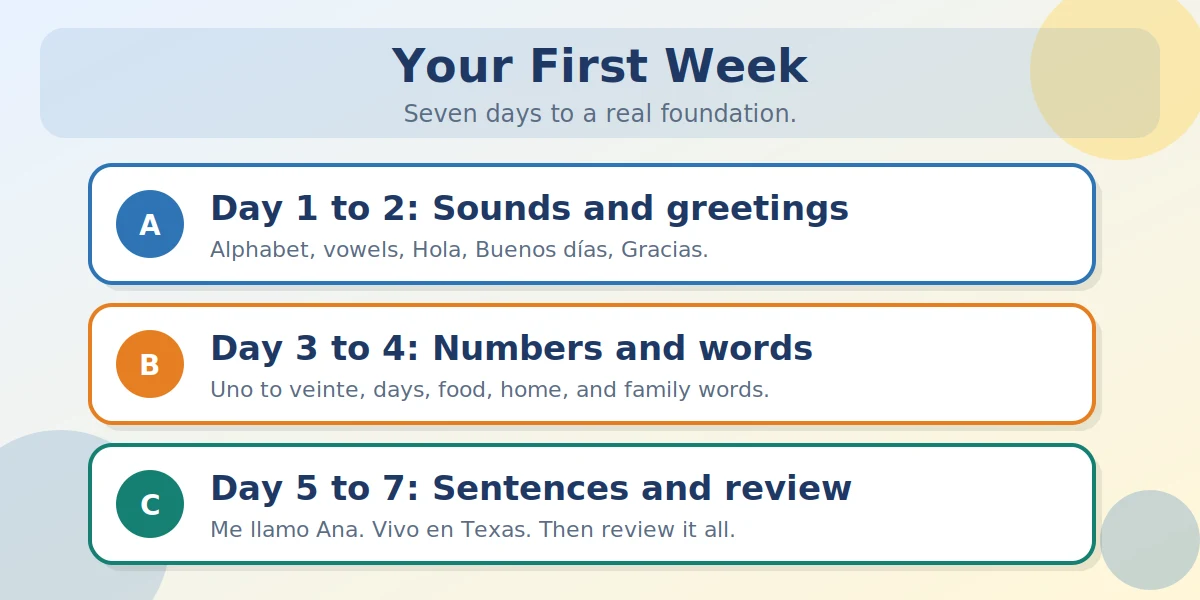
The first week should focus on practical Spanish. Learn words and sentences that you can use immediately. Learning Spanish in week one is about use, not perfection. You do not need to study every grammar rule. Build a small foundation and practice using it.
Day 1: Learn the Spanish Alphabet and Pronunciation
The modern Spanish alphabet contains 27 letters, including ñ. The combinations ch and ll are digraphs, not separate alphabet letters. Start with the five Spanish vowels:
| Vowel | Sound | Example |
|---|---|---|
| A | ah | agua |
| E | eh | elefante |
| I | ee | iglesia |
| O | oh | ojo |
| U | oo | uno |
| Ñ | ny | niño |
Pay attention to these pronunciation rules: H is usually silent, as in hola. J is similar to a strong English H, as in jardín. Ñ sounds similar to “ny” in canyon. R has a single tap in many positions. RR uses a stronger rolled sound. LL often sounds like Y, depending on the region. C and Z sounds vary between Spain and Latin America. Practice reading simple words aloud. Listen to a native speaker and repeat each word.
Day 2: Master Essential Spanish Greetings
| Spanish | English |
|---|---|
| Hola | Hello |
| Buenos días | Good morning |
| Buenas tardes | Good afternoon |
| Buenas noches | Good evening or good night |
| ¿Cómo estás? | How are you? |
| Estoy bien | I am fine |
| Muy bien | Very well |
| Mucho gusto | Nice to meet you |
| Gracias | Thank you |
| De nada | You’re welcome |
| Por favor | Please |
| Hasta luego | See you later |
| Adiós | Goodbye |
Practice: say five greetings aloud without looking at the English translations. Then create a short conversation using them.
Day 3: Learn Numbers, Days, and Time Expressions
Numbers: 1 uno, 2 dos, 3 tres, 4 cuatro, 5 cinco, 6 seis, 7 siete, 8 ocho, 9 nueve, 10 diez, 11 once, 12 doce, 13 trece, 14 catorce, 15 quince, 16 dieciséis, 17 diecisiete, 18 dieciocho, 19 diecinueve, 20 veinte.
Days: lunes Monday, martes Tuesday, miércoles Wednesday, jueves Thursday, viernes Friday, sábado Saturday, domingo Sunday.
Time: hoy today, ayer yesterday, mañana tomorrow, ahora now, después later, siempre always, nunca never.
Day 4: Build Your First Essential Vocabulary List
- People: hombre, mujer, niño, amigo, familia
- Home: casa, puerta, mesa, silla, habitación
- Food: agua, pan, leche, arroz, comida
- Verbs: ser, estar, tener, ir, hacer
- Places: escuela, trabajo, tienda, ciudad, hospital
- Descriptions: bueno, malo, grande, pequeño, bonito
- Questions: qué, quién, dónde, cuándo, por qué
- Connectors: y, pero, porque, también, aunque
Learn the English meaning of each word. Then use it in a simple sentence. For example: casa means house. Mi casa es grande means my house is big. Agua means water. Quiero agua means I want water.
Day 5: Learn Your First Useful Spanish Sentences
- Me llamo Ana. My name is Ana.
- Soy de Estados Unidos. I am from the United States.
- Vivo en Nueva York. I live in New York.
- Tengo hambre. I am hungry.
- Tengo sed. I am thirsty.
- No entiendo. I don’t understand.
- ¿Puedes ayudarme? Can you help me?
- ¿Cuánto cuesta? How much does it cost?
- Quiero aprender español. I want to learn Spanish.
- ¿Dónde está el baño? Where is the bathroom?
Notice how you can change a few words to create new sentences. For example: Vivo en México. Vivo en California. Vivo en una ciudad pequeña. The basic structure stays similar.
Day 6: Practice Listening and Speaking
Spend time hearing Spanish spoken naturally. Choose a short beginner audio lesson or video. Listen once without reading the transcript. Then listen again while following the words. Try these exercises: repeat each sentence aloud, copy the speaker’s pronunciation, record your own voice, compare your recording with the original, and repeat difficult sentences until they feel comfortable. This technique is called shadowing. It helps you practice pronunciation, rhythm, and speaking confidence.
Day 7: Review Everything You Learned
Try these activities: say your name and where you live, count from one to twenty, name the days of the week, recall 20 vocabulary words, ask five simple questions, answer five questions in Spanish, and listen to a short beginner conversation. Your first-week milestone: you should be able to introduce yourself, recognize common expressions, and form a few simple sentences. Do not worry if you forget some words. Review them and continue.
Spanish Grammar for Beginners: The Essentials You Need
You do not need advanced grammar to start communicating. Focus on the basic rules that help you build sentences. Learning Spanish grammar is easier when each rule comes with a sentence you can say.
Understand Basic Spanish Sentence Structure
Spanish often follows a subject, verb, and object pattern. For example: Yo como una manzana. Translation: I eat an apple. Yo is the subject. Como is the verb. Una manzana is the object. However, Spanish often leaves out subject pronouns. The verb ending can show who performs the action. For example: Hablo español. Translation: I speak Spanish. You do not always need to say yo before hablo.
Learn Masculine and Feminine Nouns
Spanish nouns have grammatical gender. They are generally masculine or feminine. Common masculine nouns often end in -o. Common feminine nouns often end in -a. Examples: el libro and la mesa, el niño and la niña, el gato and la gata, el amigo and la amiga. Articles must agree:
| Article | Use |
|---|---|
| El | Masculine singular |
| La | Feminine singular |
| Los | Masculine plural |
| Las | Feminine plural |
| Un | Masculine singular, indefinite |
| Una | Feminine singular, indefinite |
There are exceptions: el problema is masculine, while la mano is feminine. Adjectives also change: el libro rojo means the red book. La casa roja means the red house.
Learn the Three Main Spanish Verb Groups
Spanish infinitive verbs usually end in -ar, -er, or -ir. Examples: hablar means to speak, comer means to eat, vivir means to live.
| Subject | Hablar | Comer | Vivir |
|---|---|---|---|
| Yo | hablo | como | vivo |
| Tú | hablas | comes | vives |
| Él or ella | habla | come | vive |
| Nosotros | hablamos | comemos | vivimos |
| Vosotros | habláis | coméis | vivís |
| Ellos or ellas | hablan | comen | viven |
In much of Latin America, people use ustedes instead of vosotros for the plural you. Some verbs are irregular. Ser, estar, ir, and tener are important examples.
Understand Ser vs Estar
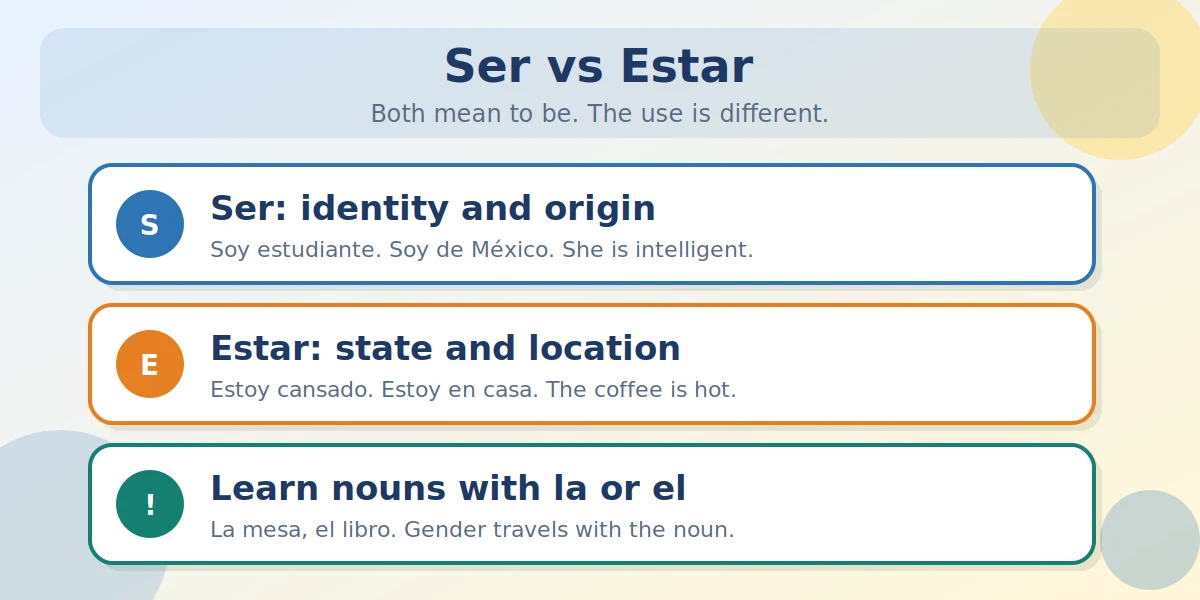
Both ser and estar mean “to be.” However, they serve different purposes. A useful beginner guide is to associate ser with identity and characteristics. Associate estar with location and states.
| Use ser | Example |
|---|---|
| Identity and profession | Soy estudiante. I am a student. |
| Origin | Soy de México. I am from Mexico. |
| Characteristics | Ella es inteligente. She is intelligent. |
| Use estar | Example |
|---|---|
| Temporary states | Estoy cansado. I am tired. |
| Location | Estoy en casa. I am at home. |
| Conditions | Él está enfermo. He is sick. |
| State of food or drink | El café está caliente. The coffee is hot. |
The permanent versus temporary rule is only a starting point. Spanish has many exceptions and special uses.
Learn Common Spanish Question Words
- Qué: what. ¿Qué quieres?
- Quién: who. ¿Quién eres?
- Dónde: where. ¿Dónde vives?
- Cuándo: when. ¿Cuándo llegas?
- Por qué: why. ¿Por qué estudias?
- Cómo: how. ¿Cómo estás?
- Cuánto: how much or how many. ¿Cuánto cuesta?
Practice asking and answering one question each day.
Understand Which Grammar to Learn Next
A useful order is: present tense, common irregular verbs, preterite past tense, imperfect past tense, future expressions, por versus para, saber versus conocer, and subjunctive mood. Do not rush through every tense. Learn each one through examples and everyday conversations.
How Long Does It Take to Learn Spanish?
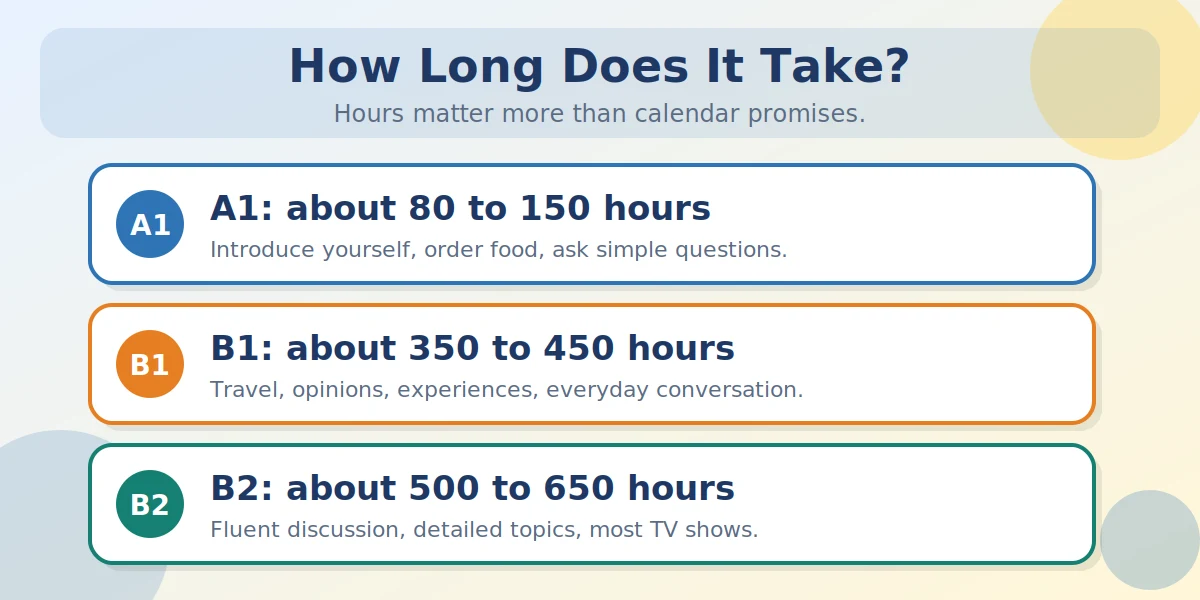
The time needed to learn Spanish depends on your goal. Learning Spanish takes different amounts of time for different goals. Learning enough for a vacation takes less time than developing professional communication skills. Your starting level, study schedule, practice quality, and exposure also matter.
Understand the Different Spanish Learning Goals
- Travel survival: order food, ask directions, and use basic expressions.
- Basic communication: discuss familiar subjects and handle routine interactions.
- Independent conversation: describe experiences, express opinions, and discuss everyday topics.
- Confident communication: understand more complex discussions and communicate spontaneously.
- Professional proficiency: handle demanding workplace conversations and understand complex information.
These goals require different levels of knowledge. Memorizing travel phrases does not mean you can hold a long conversation.
Understand the CEFR Spanish Levels
| Level | What you can do |
|---|---|
| A1 Beginner | Introduce yourself and understand familiar expressions. |
| A2 Elementary | Handle simple everyday conversations. |
| B1 Intermediate | Discuss familiar topics and manage many travel situations. |
| B2 Upper intermediate | Communicate with greater fluency and understand detailed discussions. |
| C1 Advanced | Use Spanish effectively in complex situations. |
| C2 Proficient | Understand and express highly nuanced ideas. |
The Council of Europe’s CEFR framework describes these abilities through practical communication tasks. These levels are more useful than simply calling yourself fluent or intermediate.
How Long Does It Take at Different Study Speeds?
| Daily study time | Approximate hours per year |
|---|---|
| 15 minutes | 91 hours |
| 30 minutes | 183 hours |
| 60 minutes | 365 hours |
These figures assume consistent study every day. They do not predict a specific proficiency level. Listening, speaking, feedback, and the quality of your lessons also affect progress.
How Long Does It Take to Learn Spanish for Different Goals?
| Goal | Level | What it covers |
|---|---|---|
| Travel basics | Selected A1 skills | Greetings, food, directions, and essential questions. |
| Routine communication | A2 | Everyday expressions and familiar conversations. |
| Independent conversation | B1 | Opinions, experiences, and connected speech. |
| Confident communication | B2 | Detailed discussions and spontaneous interaction. |
| Advanced communication | C1 or higher | Complex academic and professional language. |
You can learn useful travel phrases well before reaching A1. A complete CEFR level requires broader skills across different situations.
What Does the Foreign Service Institute Say?
The US Foreign Service Institute (FSI) provides a useful professional training benchmark. It places Spanish among its Category I languages for English speakers. Its published estimate is 24 to 30 weeks, or approximately 600 to 750 classroom hours. This estimate comes from intensive training for US diplomats. The stated endpoint is General Professional Proficiency, measured at Speaking-3 and Reading-3 on the Interagency Language Roundtable (ILR) scale. It is not a beginner conversation target or a promise of fluency after 600 hours. For independent learners, the timeline may be much longer. Your schedule and practice conditions will differ from intensive diplomatic training.
Your 30-Day Spanish Learning Plan
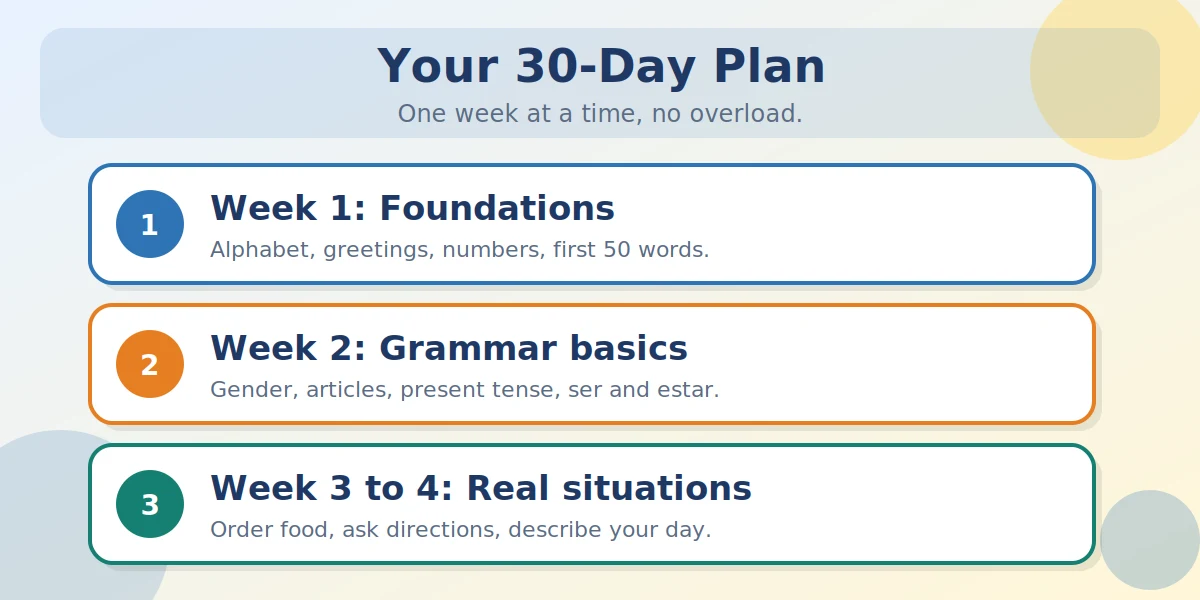
A 30-day plan gives you a clear place to start. It helps you build a routine without studying too many things at once. Learning Spanish in 30 days is about building a habit you can keep.
Week 1: Build Your Foundations
Spanish alphabet and vowel sounds, common greetings and introductions, numbers from one to twenty, days of the week, essential everyday words, and simple self-introduction sentences. Weekly milestone: introduce yourself and recognize common Spanish expressions.
Week 2: Build Vocabulary and Learn Basic Grammar
Masculine and feminine nouns, definite and indefinite articles, subject pronouns, present-tense -ar, -er, and -ir verbs, ser and estar, and vocabulary about food, family, home, and work. Weekly milestone: write simple sentences about yourself and familiar subjects.
Week 3: Improve Listening and Speaking
Beginner audio conversations, common questions and answers, high-frequency verbs, everyday expressions, short spoken introductions, and listening and pronunciation exercises. Try recording yourself speaking for one minute. Listen again and identify words that need more practice. Weekly milestone: participate in short, prepared conversations.
Week 4: Practice Real-Life Situations
Ordering food and drinks, asking for directions, describing your daily routine, talking about family and interests, understanding simple questions, and reviewing vocabulary and grammar. Weekly milestone: handle familiar situations using simple Spanish.
What Should You Achieve After 30 Days?
After a month of consistent practice, you may be able to introduce yourself, recognize common words and phrases, ask basic questions, form simple present-tense sentences, understand slow, beginner-level conversations, and read short and simple Spanish passages. Your actual progress depends on your starting point and study routine. Thirty days is a foundation, not a fluency deadline.
Your Month-by-Month Spanish Learning Roadmap
- Month 1, foundations: pronunciation, greetings, vocabulary, and basic grammar.
- Month 2, sentence building: present tense, common expressions, and short conversations.
- Month 3, communication: listening, speaking, past-tense basics, and wider vocabulary.
- Months 4 to 6, skill development: longer conversations, reading, writing, and stronger comprehension.
- Months 7 to 12, intermediate development: more complex discussions and independent communication.
- Beyond 12 months, advanced development: greater accuracy, fluency, and professional or academic skills.
This is a flexible study roadmap, not a guaranteed CEFR progression. Some learners move faster because they study intensively or use Spanish daily. Others need more time because they have fewer opportunities to practice. Your goal should be steady improvement across all four skills.
How Much Spanish Should You Study Each Day?
You do not need hours of free time to start. Choose a schedule that fits your daily routine. Learning Spanish every day beats long sessions you skip.
The 15-Minute Daily Spanish Routine
| Activity | Minutes |
|---|---|
| Review vocabulary | 4 |
| Learn new words or grammar | 4 |
| Listen and repeat | 4 |
| Recall what you learned | 3 |
Use this schedule to maintain a daily learning habit.
The 30-Minute Daily Spanish Routine
| Activity | Minutes |
|---|---|
| Vocabulary review | 5 |
| Grammar and sentence building | 7 |
| Listening practice | 8 |
| Speaking practice | 7 |
| Quick review | 3 |
Try to speak aloud during every session. Even simple sentences count as useful practice.
The 60-Minute Daily Spanish Routine
| Activity | Minutes |
|---|---|
| Vocabulary and flashcards | 10 |
| Grammar | 10 |
| Listening | 15 |
| Speaking | 15 |
| Reading and writing | 10 |
Use different activities to avoid spending the entire hour on grammar or vocabulary.
Is Daily Practice Better Than Studying Once a Week?
Regular practice makes it easier to maintain a learning habit. Short sessions give you repeated opportunities to recall words and use grammar. They also make it easier to notice mistakes. For example, studying for 20 minutes daily gives you 140 minutes each week. One long weekly session may be harder to fit into your schedule. Choose consistency over occasional marathon sessions.
The Best Ways to Learn Spanish
Different learning methods develop different skills. A balanced approach gives you more complete language practice. Learning Spanish well means mixing speaking, listening, reading, and writing. Here are eight useful methods, ranked by their practical contribution to communication.
1. Speak With Real People Regularly
Speaking helps you turn passive knowledge into active communication. You learn to form sentences, respond to questions, and express ideas. You also receive feedback on pronunciation and grammar. Try language exchange partners, private Spanish tutors, conversation groups, online speaking sessions, and role-playing everyday situations. Platforms such as Tandem, HelloTalk, italki, and Preply can help you find conversation partners or tutors. Best for: speaking confidence, pronunciation, and conversational ability.
2. Listen to Understandable Spanish Every Day
Listening helps you recognize words when people speak naturally. Start with slow, beginner-friendly audio. Choose material that contains familiar vocabulary and clear speech. Useful resources include Coffee Break Spanish, Dreaming Spanish, Notes in Spanish, SpanishPod101, and Language Transfer. Listen to short sections more than once. Follow transcripts when necessary. Best for: listening comprehension, pronunciation, and natural expressions.
3. Learn Vocabulary in Context
Learning words inside sentences helps you understand how people use them. Instead of memorizing only comer (to eat), learn: Quiero comer means I want to eat. Me gusta comer means I like eating. Vamos a comer means we are going to eat. Use topic-based vocabulary lists. Review useful words with flashcards and spaced repetition. Best for: vocabulary development and sentence building.
4. Read Spanish at Your Current Level
Reading helps you recognize sentence patterns and understand vocabulary. Start with short and simple material. Good options include beginner dialogues, graded readers, short stories, bilingual books, and simple Spanish articles. Do not choose material that requires looking up every second word. You should understand enough to follow the general meaning. Best for: vocabulary, grammar recognition, and reading comprehension.
5. Practice Writing and Self-Correction
Writing helps you organize your thoughts in Spanish. Start with short sentences about familiar topics. For example: Me llamo Laura. Vivo en Texas. Trabajo en una escuela. Me gusta leer. Translation: My name is Laura. I live in Texas. I work at a school. I like reading. Try writing a short daily journal. Correct repeated mistakes and rewrite difficult sentences. Best for: grammar, vocabulary, and sentence structure.
6. Use Grammar Resources Strategically
Grammar helps you understand how Spanish sentences work. However, avoid studying too many rules at once. Focus on one concept, then use it in real sentences. For example, study present-tense -ar verbs. Then write sentences using hablar, trabajar, and estudiar. Best for: sentence accuracy and understanding language patterns.
7. Use Spanish in Everyday Life
You can practice without opening a textbook. Try labelling objects around your home, describing what you are doing, counting objects in Spanish, reading food labels, writing a shopping list in Spanish, changing selected device settings to Spanish, and thinking of short Spanish sentences during daily tasks. Best for: vocabulary recall and regular exposure.
8. Consider Classes, Tutors, and Immersion
Structured lessons can provide guidance and feedback. A teacher can explain difficult grammar and identify repeated mistakes. A tutor can also create conversations around your goals. Immersion provides more opportunities to use Spanish throughout the day. However, traveling to a Spanish-speaking country is not essential. You can create a useful learning environment at home. Best for: structured progress, feedback, and intensive practice.
Free vs Paid Spanish Learning Resources
You can start learning Spanish without paying for a course. Many free resources provide lessons, listening practice, vocabulary tools, and grammar explanations. Paid resources may offer additional structure or personal feedback.
Best Free Resources
| Resource | Best for |
|---|---|
| Language Transfer | Guided audio lessons |
| Dreaming Spanish | Comprehensible listening practice |
| Anki | Spaced-repetition flashcards |
| Quizlet | Vocabulary review |
| SpanishDict | Dictionary, translations, and grammar |
| Coffee Break Spanish | Beginner audio lessons |
| YouTube | Pronunciation and Spanish lessons |
| Library graded readers | Reading practice |
Check each resource’s current free access and account requirements.
Best Paid Spanish Learning Resources
| Resource | What it offers |
|---|---|
| Duolingo paid plans | Additional app learning features |
| Babbel | Structured language lessons |
| Rosetta Stone | Immersive learning activities |
| Memrise paid plans | Vocabulary and listening features |
| italki | Individual language tutors |
| Preply | Personalized online lessons |
| Wyzant | Private tutoring options |
Features and prices can change. Check official websites before choosing a subscription.
Free vs Paid: Which Should You Choose?
- You are a complete beginner: start with free beginner lessons.
- You need more structure: consider a guided paid course.
- You struggle with speaking: invest in conversation practice.
- You need grammar explanations: use a course or reliable grammar reference.
- You want flexible self-study: combine free apps, audio, and reading.
- You need personal feedback: consider a qualified tutor.
Paid resources are not automatically better. Choose tools that help you practice your weakest skills.
The Best Free Starter Stack
You do not need ten different apps. Start with five useful resources: one structured course to learn basic grammar and sentence patterns, one listening resource to practice understanding spoken Spanish, one flashcard tool to review new vocabulary, one dictionary to check meanings and example sentences, and one conversation platform to practice speaking with another person. Use each tool for a specific purpose. This keeps your routine simple.
Spanish From Spain vs Latin America: Which Should You Learn?
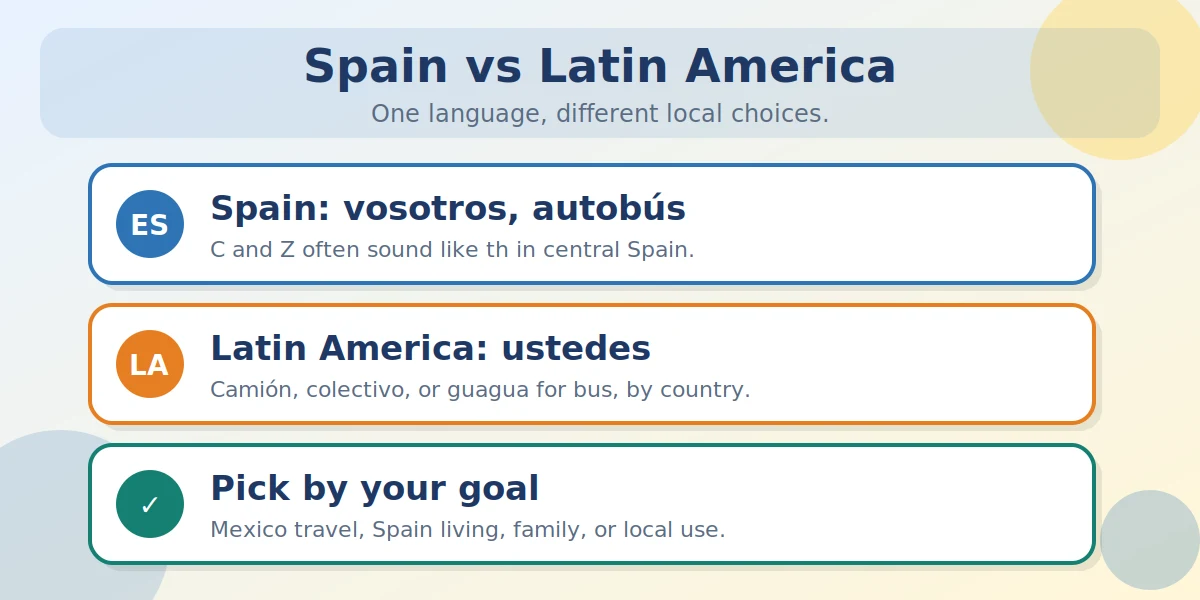
Spanish is spoken across many countries. However, pronunciation, vocabulary, and some grammar forms vary by region. You do not need to learn every variety. Start with the Spanish most relevant to your goals.
Understanding the Main Spanish Varieties
- Castilian Spanish: spoken in Spain, with regional differences.
- Mexican Spanish: used throughout Mexico, with regional vocabulary and accents.
- Rioplatense Spanish: associated with Argentina and Uruguay.
- Colombian Spanish: includes several regional varieties across Colombia.
- Caribbean Spanish: spoken in countries and regions such as Cuba, Puerto Rico, and the Dominican Republic.
These are not completely separate languages. Speakers can generally communicate across varieties.
Key Differences Between Spain and Latin American Spanish
| Feature | Spain | Latin America |
|---|---|---|
| Informal plural you | Vosotros in much of Spain | Ustedes |
| C and Z pronunciation | Often a th sound in central and northern Spain | Generally an s sound |
| Bus vocabulary | Autobús | Camión, colectivo, guagua, or autobús, depending on the country |
| Pronunciation | Varies by region | Varies by country and region |
| Voseo | Limited regional use | Common in some countries |
For example, the word cena means dinner. In much of central Spain, its C has a sound similar to the English TH in “think.” In most of Latin America, it sounds like S.
What Is Voseo?
Voseo means using vos instead of tú for informal singular “you.” It is common in Argentina and Uruguay, as well as parts of other Latin American countries. Compare: tú tienes and vos tenés, tú eres and vos sos, tú hablas and vos hablás. You may hear these forms in conversations, films, music, and regional learning materials.
Which Spanish Should You Learn?
- Traveling to Mexico: Mexican Spanish.
- Living in Spain: Spanish from Spain.
- Communicating with Argentine relatives: Rioplatense Spanish.
- Working with Colombian communities: Colombian Spanish.
- General communication in the US: the variety used by your local community.
If you have no specific preference, choose one consistent beginner course. You can explore other accents later. The most important thing is understanding and communicating clearly.
Spanish Cognates and False Friends Every Beginner Should Know
English and Spanish share many words with similar forms. These words can make vocabulary learning easier. However, some similar-looking words have different meanings. Learning the difference can prevent confusion.
What Are Spanish Cognates?
Cognates are words in different languages with shared historical origins and similar forms. Examples: animal, hospital, importante (important), natural, familia (family), restaurante (restaurant), automático (automatic), tropical, música (music), diferente (different). Many cognates are easy to recognize. However, their pronunciation may differ. You should also check their meaning in context.
What Are False Friends?
False friends are words that look or sound similar in two languages. Their meanings are different.
| Spanish word | Real meaning | Common confusion |
|---|---|---|
| Embarazada | Pregnant | Embarrassed |
| Éxito | Success | Exit |
| Actualmente | Currently | Actually |
| Asistir | To attend | To assist |
| Carpeta | Folder | Carpet |
| Sensible | Sensitive | Sensible |
For example: Estoy embarazada means “I am pregnant.” It does not mean “I am embarrassed.” Learning these differences helps you avoid common translation mistakes.
Avoid Translating English Expressions Word for Word
Some English expressions do not translate naturally into Spanish. For example, English speakers sometimes say “make sense.” A direct translation is hacer sentido. However, tener sentido is the standard expression in many contexts. Example: Eso tiene sentido. Translation: That makes sense. Learn complete expressions instead of translating every word separately.
Common Mistakes to Avoid When Learning Spanish
- Memorizing too many words at once: long vocabulary lists can become overwhelming. Learn a smaller number of useful words. Review them regularly and use them in sentences. For example, learn five food-related words. Then create sentences using each one.
- Confusing ser and estar: both verbs mean “to be,” but they serve different purposes. Incorrectly choosing one can change the meaning of your sentence. Practice with contrasting examples: Soy profesor means I am a teacher. Estoy ocupado means I am busy.
- Ignoring grammatical gender: remember that Spanish nouns have grammatical gender. Do not memorize mesa alone. Learn la mesa. Likewise, learn el libro rather than only libro. This helps you use articles and adjectives correctly.
- Translating every sentence directly from English: English and Spanish do not always follow identical patterns. A literal translation may sound unnatural. Learn common expressions as complete phrases. Notice how native speakers use them.
- Avoiding speaking until you feel ready: you do not need perfect grammar to start speaking. Begin with short introductions and familiar expressions. Gradually move toward longer conversations. Mistakes are part of learning. Use feedback to improve.
- Depending entirely on one app: apps can help with vocabulary and basic grammar. However, they cannot replace every form of language practice. Combine app lessons with listening, reading, writing, and real conversations.
- Studying too much grammar too early: trying to understand every verb tense can slow your progress. Learn the present tense first. Add more grammar when you need it. Focus on using each rule rather than memorizing explanations.
- Neglecting listening practice: knowing written words does not mean you will recognize them in conversation. Listen to Spanish every day. Start with slow audio and gradually move toward natural speech.
- Changing learning methods too often: trying a new app or course every few days can interrupt your progress. Choose a manageable learning system. Follow it long enough to evaluate what works. Change your approach when you identify a clear weakness.
Practice Spanish With Dialogues and Exercises
Practice helps you remember vocabulary and use grammar. Start with simple conversations before attempting longer discussions.
Dialogue 1: Introducing Yourself
- Carlos: Hola, ¿cómo te llamas?
- Ana: Me llamo Ana. ¿Y tú?
- Carlos: Me llamo Carlos. Mucho gusto.
- Ana: Mucho gusto.
- Carlos: ¿De dónde eres?
- Ana: Soy de México. ¿Y tú?
- Carlos: Soy de Estados Unidos.
Translation: Carlos asks Ana her name. Ana says her name is Ana and asks Carlos. Carlos says his name is Carlos and that it is nice to meet her. Ana replies the same. Carlos asks where she is from. Ana says she is from Mexico and asks Carlos. Carlos says he is from the United States.
Dialogue 2: Ordering Food
- Cliente: Hola. ¿Me trae el menú, por favor?
- Camarero: Claro. Aquí tiene.
- Cliente: Quiero una ensalada y agua, por favor.
- Camarero: ¿Algo más?
- Cliente: No, gracias.
- Camarero: Muy bien.
Translation: the customer asks for the menu, the waiter brings it, the customer orders a salad and water, the waiter asks if anything else is needed, the customer says no, thank you, and the waiter replies very well.
Dialogue 3: Asking for Directions
- Persona A: Disculpe, ¿dónde está la estación?
- Persona B: Está cerca del banco.
- Persona A: ¿Está lejos de aquí?
- Persona B: No, está a cinco minutos caminando.
- Persona A: Muchas gracias.
- Persona B: De nada.
Translation: Person A asks where the station is. Person B says it is near the bank. Person A asks if it is far. Person B says no, it is five minutes away on foot. Person A says thank you very much. Person B says you’re welcome.
Spanish Vocabulary Quiz
- What does “gracias” mean? A. Please B. Thank you C. Goodbye.
- What does “la casa” mean? A. House B. School C. Table.
- What does “mañana” mean? A. Yesterday B. Today C. Tomorrow.
- What does “¿Dónde?” mean? A. When? B. Where? C. Why?
- What does “comer” mean? A. To eat B. To speak C. To live.
Spanish Grammar Quiz
- Choose the correct article: ___ libro. A. La B. El C. Las.
- Complete: Yo ___ español. A. hablo B. hablas C. hablan.
- Complete: Ella ___ estudiante. A. está B. eres C. es.
- Complete: Nosotros ___ en casa. A. estoy B. estamos C. está.
- Translate “I am hungry.” A. Estoy hambre. B. Tengo hambre. C. Soy hambre.
Practice Quiz Answer Key
- B. Thank you. Gracias expresses gratitude.
- A. House. Casa means house or home.
- C. Tomorrow. Mañana can also mean morning in context.
- B. Where? Dónde asks about location.
- A. To eat. Comer is an -er verb.
- B. El. Libro is masculine.
- A. Hablo. Hablo is the yo form of hablar.
- C. Es. Ser describes identity here.
- B. Estamos. Estamos is the nosotros form of estar.
- B. Tengo hambre. Spanish uses tener for this expression.
If you missed several questions, revisit the relevant vocabulary or grammar section. Try the quiz again after reviewing.
A Simple Memory Trick to Remember Spanish Vocabulary
Remembering new words can be difficult, especially when you study several words together. A simple technique is the Look, Link, Say, Recall method. It connects vocabulary with meaning, pronunciation, and active memory.
Use the Look, Link, Say, Recall Method
- Look: read the Spanish word and its English meaning. Example: la mesa means “the table.”
- Link: connect the word with something familiar. Picture the table where you eat breakfast or work.
- Say: pronounce the word aloud. Then use it in a sentence. La mesa es grande. Translation: The table is big.
- Recall: cover the English translation. Look at the Spanish word and remember its meaning. Try recalling it again later without checking your notes.
Use Spaced Repetition
Spaced repetition means reviewing information at increasing intervals. Instead of reviewing every word repeatedly in one session, revisit difficult words over time. For example: first review immediately after learning, second review later that day, third review the next day, fourth review several days later, and fifth review the following week. You can use Anki, Quizlet, or physical flashcards.
Learn Words in Context
Avoid memorizing disconnected vocabulary whenever possible. Learn words through useful sentences. For example: agua means water, Quiero agua means I want water. Casa means house, Mi casa es pequeña means my house is small. Comer means to eat, Me gusta comer means I like eating. Libro means book, Leo un libro means I read a book. Amigo means friend, Mi amigo es amable means my friend is kind. This approach helps you remember vocabulary and understand how to use it.
How to Track Your Spanish Learning Progress
Tracking your progress helps you understand what is improving and what needs more attention. Do not measure your ability only through app streaks or the number of words memorized. Measure what you can actually understand, say, read, and write.
Create a Weekly Spanish Progress Tracker
| Area | Weekly target |
|---|---|
| Vocabulary | Learn and review 30 to 50 words |
| Listening | Complete five beginner sessions |
| Speaking | Practice three times |
| Reading | Read two short passages |
| Writing | Complete five short entries |
| Grammar | Review one or two concepts |
Adjust these targets according to your schedule. Consistent progress matters more than completing every task.
Measure Your Real Communication Skills
Ask yourself these questions at the end of each month: Can I introduce myself without reading? Can I understand a beginner conversation? Can I ask and answer simple questions? Can I describe my daily routine? Can I read a short Spanish passage? Can I explain a basic need in Spanish? If you can do more each month, your skills are developing.
Use CEFR Levels to Evaluate Your Progress
The CEFR provides a useful framework for measuring language ability. You can use its A1, A2, B1, B2, C1, and C2 descriptions to understand your progress. For example, A1 focuses on familiar expressions and simple communication. B1 involves more independent communication about familiar topics. Use these descriptions as learning goals. Formal examinations can provide a more structured assessment when needed.
Frequently Asked Questions About Learning Spanish
How long does it take to learn Spanish?
It depends on your goals and study routine. You may learn useful travel phrases within weeks. Developing independent conversational ability takes longer. Regular listening, speaking, and vocabulary practice all contribute to progress.
Can I learn Spanish in 30 days?
Yes, you can build a useful foundation in 30 days. You can learn greetings, essential vocabulary, basic grammar, and simple sentences. However, becoming fluent requires much more practice and sustained exposure.
Can I learn Spanish for free?
Yes. Free courses, podcasts, videos, dictionaries, and flashcard tools provide useful learning opportunities. Combine these resources with regular speaking practice. You can make meaningful progress without purchasing an expensive course.
Is Spanish difficult for English speakers?
Spanish is generally approachable for English speakers because many words look familiar. However, grammatical gender, verb conjugations, and listening comprehension require practice. A structured routine makes these challenges easier to manage.
Can I teach myself Spanish without taking classes?
Yes. You can learn independently using online lessons, podcasts, books, flashcards, and videos. However, conversation partners or tutors can provide valuable feedback. Try speaking regularly instead of relying entirely on self-study materials.
Which Spanish should I learn: Spain or Latin America?
Choose according to your goals. Learn Mexican Spanish if you plan to communicate in Mexico. Choose Spanish from Spain if you plan to live there. You can understand other regional varieties as your listening skills improve.
Can I become fluent using only a language app?
An app can help you build vocabulary and understand basic grammar. However, complete language ability also requires listening, reading, writing, and real conversations. Combine app lessons with practical communication for more balanced progress.
Start Learning Spanish Today
Learning Spanish becomes easier to manage when you follow a clear routine. Start with pronunciation, greetings, and useful vocabulary. Then add grammar, listening, reading, and speaking practice. You do not need to study for hours every day. Begin with 15 to 30 minutes and increase your practice when possible. Use the first-week starter kit to build your foundation. Follow the 30-day plan to develop your skills. Then continue with the month-by-month roadmap. Choose learning resources that match your goals. Practice speaking even when you make mistakes. Review vocabulary regularly and measure your progress through real communication. Most importantly, use Spanish whenever you get the chance. A few useful sentences today can become longer conversations with consistent practice. Start with one lesson, learn a few useful phrases, and make Spanish part of your daily routine.
Related Guides
For more word guides, explore our Vocabulary category. See also our Yes or No guide, our True or False guide, and our Less Than and Greater Than guide.