

Defense vs Defence: Which Spelling Is Correct?

Quick Answer: Defense vs Defence
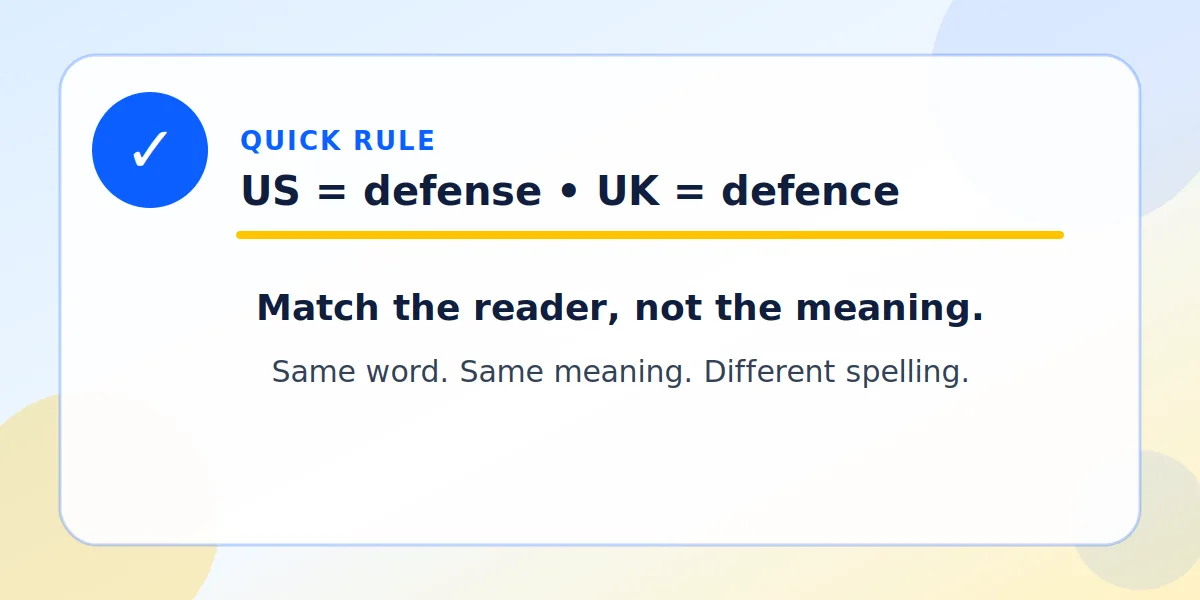
Defense is the standard spelling in American English. Defence is the standard spelling in British English. The words have the same meaning. They name protection, a means of protection, a legal case, or a sports unit. Use defense for a United States audience. Use defence for a United Kingdom or Commonwealth audience. The choice in defense vs defence depends on the reader, not on the meaning. Never mix the two spellings in one document, except in proper names that keep their own spelling. This guide covers defense vs defence in full, from related forms to proper names.
Table of Contents
- Defense vs Defence at a Glance
- What Does Defense Mean?
- What Does Defence Mean?
- US vs UK vs Australia/Canada Usage
- Related Forms and the i-Suffix Rule
- Meanings by Context
- Proper Nouns Never Change
- Pronunciation: Defense vs Defence
- How to Choose the Right Spelling
- Common Mistakes to Avoid
- Canada Note: Why You Will See Both Spellings
- Memory Trick: S for States, C for Commonwealth
- Practice Questions: Defense or Defence?
- Frequently Asked Questions
- Conclusion
- Related Guides
Defense vs Defence at a Glance
Defense vs defence is a spelling question, not a meaning question. The table below gives the quick rule for the base word and its common related forms.
| Term | US Spelling | UK Spelling | Notes |
|---|---|---|---|
| Noun | defense | defence | Same meaning in both varieties |
| Plural noun | defenses | defences | Add s to the base form |
| Adjective | defensive | defensive | Always with s in both varieties |
| Adverb | defensively | defensively | Always with s in both varieties |
| Adjective | defensible | defensible | Always with s in both varieties |
| Adjective | indefensible | indefensible | Always with s in both varieties |
| Without protection | defenseless | defenceless | Regional spelling carries over |
| Without protection, adverb | defenselessly | defencelessly | Regional spelling carries over |
| Player | defenseman | defenceman | Sports agent noun |
| Compound | self-defense | self-defence | Hyphenated compound follows the regional rule |
| Verb | defend | defend | Same in both varieties |
Defense and defence are the same word. The spelling is the only difference. The choice depends on your audience. It does not depend on the meaning. That simple point answers most questions about defense vs defence, but the related forms and proper names need care.
What Does Defense Mean?
Defense is a noun in American English. It names protection or a means of protection. It can also name a side in a legal case. It can name a team or unit in sport. It can name armed forces and military spending. In each use, the core idea stays the same. Something or someone is protected, defended, or argued for.
Meanings of defense:
- Protection against attack, harm, criticism, or illness.
- A means of protection, such as a wall, a shield, or a vaccine.
- The case, side, or lawyers for the defendant in a trial.
- The players or unit that stops opponents from scoring.
- Armed forces, spending, or a military budget.
- An argument in support of a person or idea.
Examples in American English:
- The city built a strong defense against flooding.
- Her defense of the plan was clear and calm.
- The team played good defense in the second half.
- The lawyer prepared a strong defense for her client.
- National defense spending was a major topic in the debate.
In American writing, defense is the expected form in every one of these sentences. A United States reader will see defence as a British spelling, not as a mistake in a British text, but as the wrong choice for an American text. That distinction matters for school work, business writing, news writing, and website content aimed at United States readers.
What Does Defence Mean?
Defence is the British spelling of the same noun. The meaning does not change. The grammar does not change. Only the final letter changes, from s to c. A British reader uses defence in the same sentences where an American reader uses defense. The word still names protection, a legal case, a sports unit, or armed forces.
Meanings of defence:
- Protection against attack, harm, criticism, or illness.
- A means of protection, such as a wall, a shield, or a vaccine.
- The case, side, or lawyers for the defendant in a trial.
- The players or unit that stops opponents from scoring.
- Armed forces, spending, or a military budget.
- An argument in support of a person or idea.
Examples in British English:
- The city built a strong defence against flooding.
- She spoke in my defence when I was criticised.
- The team played a strong defence in the second half.
- The lawyer prepared a strong defence for her client.
- Defence spending was a major topic in the debate.
A reader in London expects defence. A reader in New York expects defense. Both readers understand both forms. The task for a writer is to match the form to the reader. That is the whole difference in defense vs defence at the level of the base word.
US vs UK vs Australia/Canada Usage
United States: Defense Is Standard
Defense is the standard form in the United States. Use it in school writing. Use it in business writing. Use it in news writing. Use it on a United States website. Use it in legal writing in the United States, where the defense is the side for the accused. United States style guides, dictionaries, and spellcheckers default to defense. For a United States audience, defence will look like a British import, even when the writer knows it is correct elsewhere.
United Kingdom: Defence Is Standard
Defence is the standard form in the United Kingdom. Use it in school writing. Use it in business writing. Use it in news writing. Use it on a United Kingdom website. British dictionaries list defence as the headword and defense as the American form. A British reader expects defence in a story about a football team, a court case, or government spending. Defense in that context will look American, not wrong in an absolute sense, but wrong for that audience.
Australia and New Zealand: Defence Is Standard
Australia uses defence. New Zealand uses defence. Both follow British spelling for this word. Australian examples include a strong defence in sport and defence policy in government writing. New Zealand writing follows the same pattern. For readers in these countries, defence is the normal, expected form, just as it is in the United Kingdom.
Canada: Defence Is Standard, but US Spelling Is Frequently Seen
Canada uses defence as the formal standard. American spelling still appears often. This point is covered in more detail in the Canada Note below. For now, the short rule is this. In formal Canadian writing, use defence. In casual Canadian writing, you may still see defense, because United States media and trade have a strong influence. Do not treat either sighting as proof that the other form is wrong everywhere.
Ireland and Commonwealth English: Defence Is Standard
Ireland uses defence. Most Commonwealth countries use defence. The rule is simple. Match the spelling to the country of the reader. If the reader is in a country that follows British spelling, use defence. If the reader is in the United States, use defense. That audience rule is the safest guide for defense vs defence in international writing.
Related Forms and the i-Suffix Rule
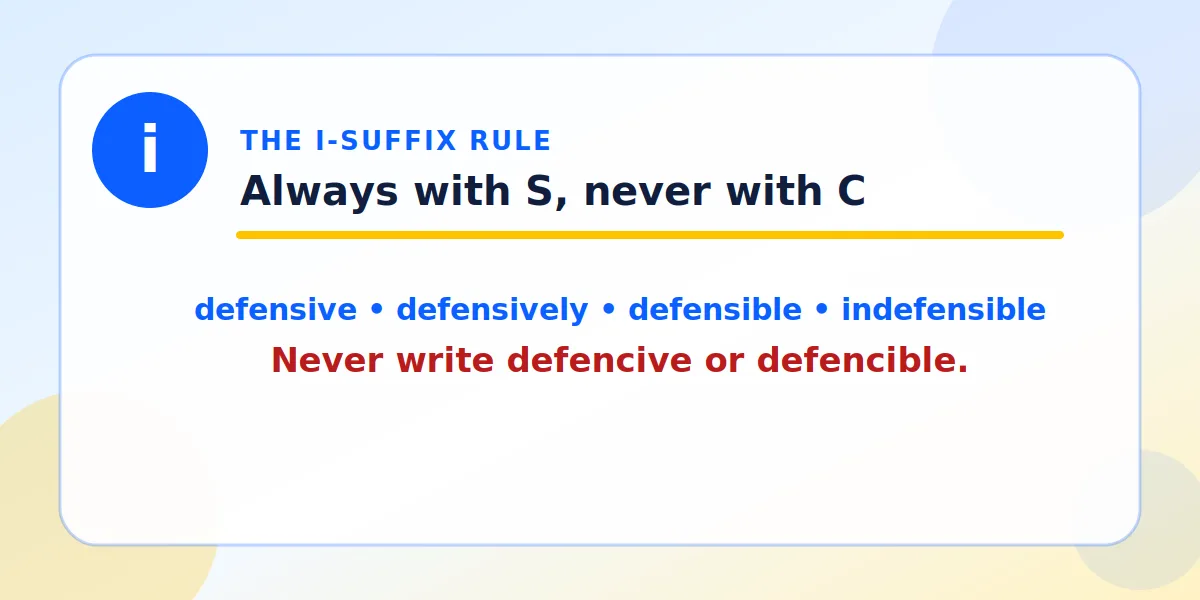
The i-suffix rule is the key rule for related words, and it is the point where most writers slip. When a suffix begins with i, use s in both varieties. This rule applies in American English. It applies in British English too. It does not matter that the British base word ends in c. The i suffix forces an s.
Words that keep s in both varieties:
| Word | Meaning |
|---|---|
| defensive | Ready to protect or defend, or quick to take criticism personally |
| defensively | In a defensive way |
| defensible | Able to be defended or justified |
| indefensible | Not able to be defended or justified |
Words such as defensive, defensively, defensible, and indefensible keep the s in both varieties. Never write defencive. Never write defencible. Both forms are wrong in American English. Both forms are wrong in British English. A spellchecker may not always catch defencive, because it may read it as a rare word, so check this rule by eye.
Words that change with region follow a different pattern. For these words, the s or c carries over from the base noun:
| US Form | UK Form |
|---|---|
| defenseless | defenceless |
| defenselessly | defencelessly |
| defenses | defences |
| defenseman | defenceman |
| self-defense | self-defence |
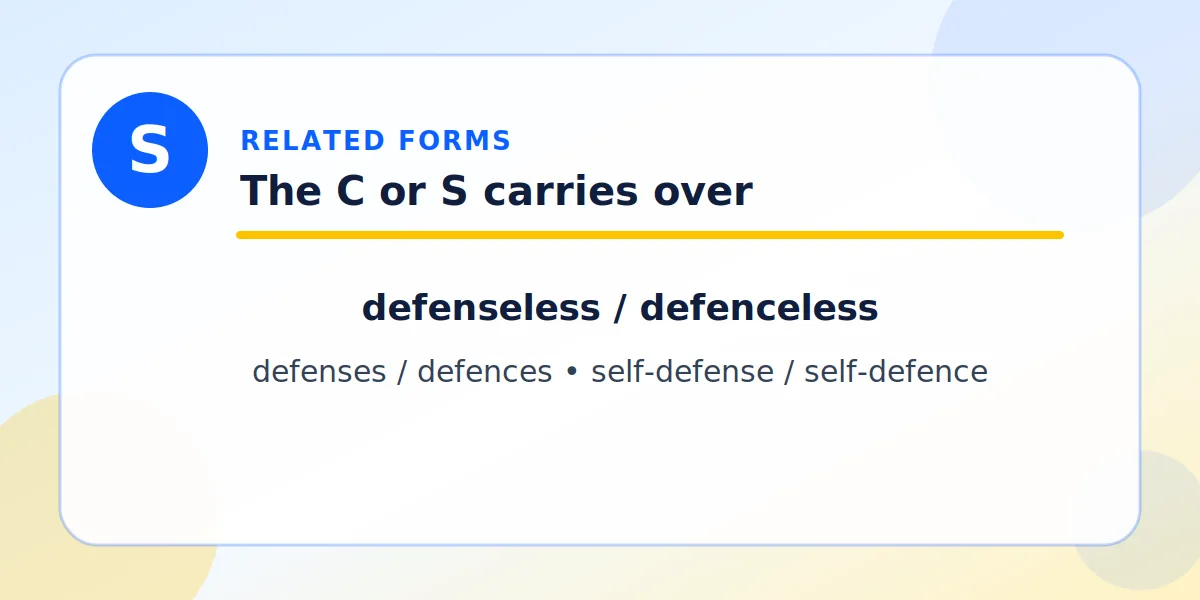
These words follow the regional rule. The base spelling decides the derived spelling. Defense gives defenseless. Defence gives defenceless. The same logic gives defenses and defences, and self-defense and self-defence. Only the i suffix breaks that pattern, and it breaks it in the same way in both varieties.
The Verb Is Defend, Not Defense or Defence
The verb is defend in both varieties. Use defends, defended, and defending. Do not use defense as a verb in formal writing. Do not use defence as a verb in modern writing. The verb form is the same for American and British readers, which makes it a useful check. If you can replace the word with defend in the sentence, then defend is the word you need, not defense or defence.
Examples:
- She defended her friend when others criticised him.
- The team defends well in the second half.
- He defended his research in the thesis exam.
- They will defend the title next season.
US Sports Exception: Defense as a Verb
In American sports writing, defense sometimes appears as a verb. Writers may say a player will defense an opponent. This use is jargon. Style guides call it incorrect outside sport. Merriam-Webster lists a sports verb sense, but that listing does not make it good formal style. Use defends against in formal writing. Use defends against in school work, business writing, and news writing. Keep the sports verb, if you use it at all, for casual sports talk where the audience expects jargon.
Meanings by Context
Defense vs defence keeps the same meaning across contexts, but the examples change. Each context below shows defense vs defence in real sentences, in the places readers meet it most.
Military and Government
In military and government use, defense means armed forces and protection for a country. It also means spending on those forces. Examples include national defense and defense spending. The United States Department of Defense uses the American spelling. The United Kingdom Ministry of Defence uses the British spelling. In British writing, you will see defence spending, defence policy, and defence forces. In American writing, you will see defense spending, defense policy, and defense forces. The topic is the same. Only the spelling follows the country.
Examples:
- The government increased defense spending this year. (US)
- The government increased defence spending this year. (UK)
- National defense was a major election topic. (US)
- National defence was a major election topic. (UK)
Law
In law, the defense or defence is the case for the defendant. It can also mean the lawyers for the defendant. The defense attorney presents the case. The defense argues that the evidence is weak. The prosecution presents its case first in a criminal trial, and the defense then presents its own case and evidence. A defense lawyer, defence lawyer, or counsel for the defence all name the same role, with spelling set by the country.
Examples:
- The defense called three witnesses. (US)
- The defence asked for more time to prepare. (UK)
- She conducted her own defense in court. (US)
- He was cross examined by the defence. (UK)
- Ignorance was not a valid defense in that case. (US)
Phrases to know in law include in defense of an action, a defense of the accused, and the defense rests. In British writing, each phrase uses defence. The legal meaning does not change with the spelling.
Sport
In sport, defense and defence name the players or unit that stops opponents from scoring. The defense stopped the attack. The defense held its line. The team played strong defense. In British English, writers often say a player plays in defence. In North American English, writers often say a player plays on defense. The preposition changes with the variety, and the spelling changes with it, but the role on the field stays the same.
Examples:
- The team’s defense forced two turnovers. (US)
- The club’s defence looked stronger this season. (UK)
- She plays on defense for her school team. (US)
- He plays in defence for his club team. (UK)
- A title defence means the champion competes again to keep the title. (UK)
- A title defense means the champion competes again to keep the title. (US)
Argument and Support
Defense and defence can name an argument in support of a person or idea. She gave a strong defense of her plan. Her defense was clear and calm. In British English, the same sentence uses defence. The meaning stays the same. This use appears in essays, reviews, and everyday speech. Common phrases include in defense of someone, in defence of an idea, and a defense of a book or theory.
Examples:
- He published an essay in defense of free speech. (US)
- He published an essay in defence of free speech. (UK)
- She leapt to her friend’s defense. (US)
- She leapt to her friend’s defence. (UK)
- What points can be raised in defence of this argument? (UK)
Science
In science, a defense mechanism protects the mind from stress. The immune defense fights illness. The body uses many defenses. Each defense has a clear job. In British writing, the same sentences use defence, defences, and defence mechanism. The science does not change. Only the spelling follows the audience.
Examples:
- A good diet helps build the body’s natural defenses. (US)
- A good diet helps build the body’s natural defences. (UK)
- The vaccine strengthens the body’s defenses against infection. (US)
- The immune system is our main defense against disease. (US)
Education
A thesis defense is an oral exam. The student defends the research in front of examiners. In the United States, the spelling is thesis defense. In the United Kingdom, the spelling is thesis defence. The same rule covers a PhD defense or PhD defence and a dissertation defense or dissertation defence. Students should use the spelling of their university and country, and they should keep it consistent in the whole thesis.
Chess and Titles
In chess, defense means a set of moves used by the player with the black pieces. Cambridge lists this as a games sense of the word. In sport, a title defence means the previous winner competes again to keep the title. Oxford lists this title sense for defence. Both senses are less common than the protection sense, but they show the same rule. The spelling follows the variety, and the meaning follows the context.
Proper Nouns Never Change
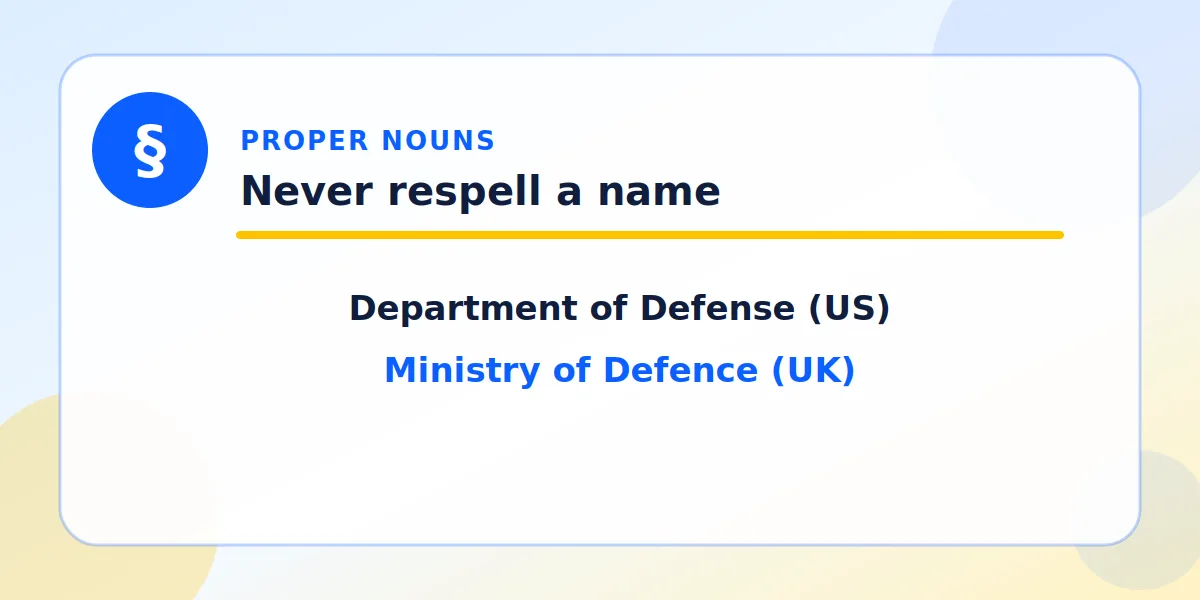
Proper nouns keep their official spelling. Do not change them to match your audience. Do not change them to match your style guide. This rule overrides the audience rule, and it is the rule most competitors cover only in passing.
US proper nouns:
- United States Department of Defense
- Secretary of Defense
- DoD
- Defense Department
UK proper nouns:
- Ministry of Defence
- Secretary of State for Defence
- MOD
Canada proper noun:
- Minister of National Defence
Mixed example:
A joint statement can name the United States Department of Defense, the Ministry of Defence of Germany, and the Ministry of Defence of the UK in one title. Each name keeps its own spelling. That is correct, even in one sentence. A writer who “fixes” Ministry of Defence to Ministry of Defense in that title has introduced an error, not corrected one. The same applies in reverse. Never respell Department of Defense as Department of Defence to suit a British audience.
The rule also covers team names, book titles, law titles, and quoted text. Keep the original spelling in a quote, even when it differs from your own style. A quote with a changed spelling is no longer an exact quote.
Pronunciation: Defense vs Defence
General Pronunciation
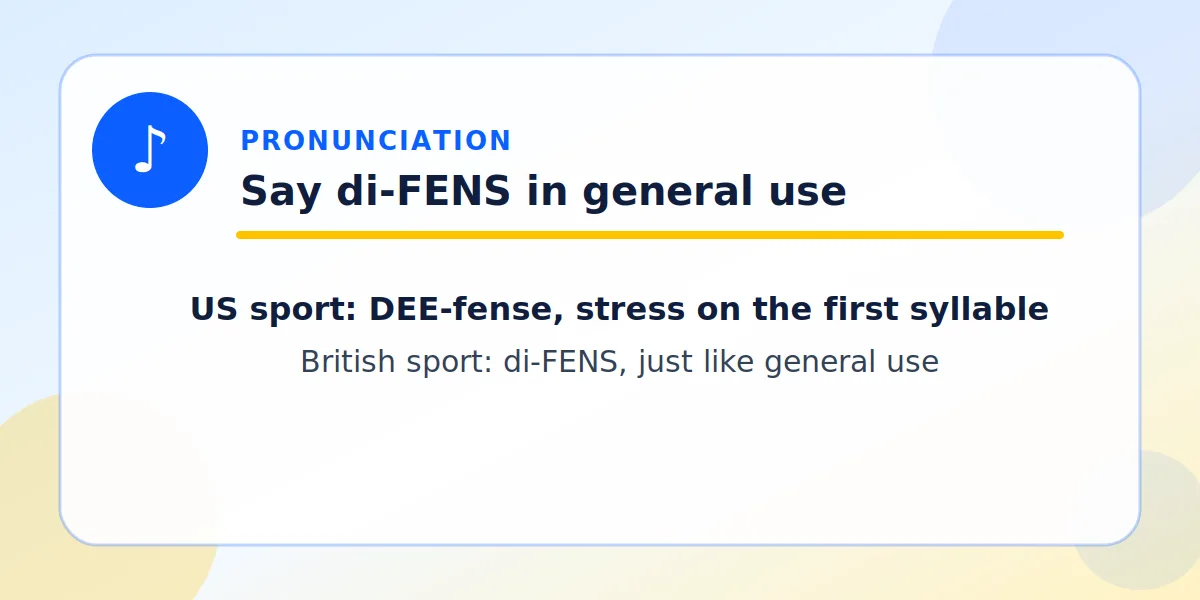
Say di-FENS in general use. Put stress on the second syllable. The spelling does not change the sound. Defense and defence sound the same in general use. Dictionaries give /di-FENS/ for both forms. A listener cannot tell from sound alone which spelling a writer used. Only the written text shows the choice.
US Sports Pronunciation
In American sport, some speakers say DEE-fense. They stress the first syllable. They use it as the opposite of offense. This pronunciation is common in broadcasts and in crowd chants. It is not the general pronunciation. A boxer defending a title still uses di-FENS in general speech, while a football broadcast may use DEE-fense for the on field unit. The difference is a sports habit, not a second word.
British Sport Pronunciation
British speakers keep the general sound in sport too. They say di-FENS. They do not switch to DEE-fense. A British football report will talk about a team’s defence with the general pronunciation. That contrast is a useful detail for readers who hear both forms in international broadcasts and wonder if they are hearing two words. They are hearing one word, with a sports variant in American use.
How to Choose the Right Spelling
Use these steps in order when you face defense vs defence in your own writing.
1. Name Your Audience
First, name your audience. Are your readers in the United States? Use defense. Are they in the United Kingdom, Australia, Canada, or New Zealand? Use defence. Are they in Ireland or another Commonwealth country? Use defence. This single choice settles most cases.
2. Check Your Style Guide
Then check your style guide. A school, publisher, or employer may set a rule. Follow that rule, even when it differs from your personal habit. A United States publisher will expect defense. A United Kingdom publisher will expect defence. A style guide removes guesswork, so check it before you start.
3. Check Your Spellchecker Setting
Next, check your spellchecker. Many tools use American English by default. A British writer may see defence marked wrong, even when it is correct for the audience. That is a settings problem, not a spelling error. Change the language setting first, to British English or to the variety you need, before you accept a correction. Do not let a default setting rewrite a correct British text into American spelling, or the reverse.
4. Stay Consistent
Then use one spelling in the whole text. Do not switch between defense and defence. Do not mix defence with defenseless in one document, or defense with defenceless. Proper nouns are the only exception, and they keep their own spelling by rule. Consistency is what makes a text look edited, even when a reader does not know the rule.
5. Choose for a Global Audience
For a global audience, choose your main market. State the choice in your style notes. That keeps the text clear for editors and for future writers on the same project. If most readers are in the United States, use defense and note that choice. If most readers are in the United Kingdom or the Commonwealth, use defence and note that choice. A clear note prevents mixed spelling across pages.
Common Mistakes to Avoid
Because defense vs defence looks simple, writers often stop at the base rule and miss the traps. The table below lists the common errors and the correct forms.
| Incorrect | Correct | Why |
|---|---|---|
| The team played strong defencive football. | The team played strong defensive football. | Defensive always uses s, in both varieties. |
| That excuse is indefencible. | That excuse is indefensible. | Words with an i suffix always use s. |
| She spoke in defence of the plan in a US report. | She spoke in defense of the plan in a US report. | A US audience expects defense. |
| The company discussed defence policy in a US report. | The company discussed defense policy in a US report. | Match the spelling to the audience, except in proper names. |
| The Ministry of Defense announced new spending in a UK report. | The Ministry of Defence announced new spending in a UK report. | Proper names keep their own spelling. |
| The Department of Defence issued a statement. | The Department of Defense issued a statement. | The US body uses Defense, even in a UK text. |
| She wrote to my defense of the plan. | She wrote in my defense of the plan. | The fixed phrase uses in, not to. |
| The team defenses the opponent in formal writing. | The team defends against the opponent in formal writing. | The verb is defend, except in casual US sports jargon. |
| Canada always uses defence, so defense is a typo there. | Canada uses defence formally, but defense appears often. | Canada is mixed, not absolute. See the Canada Note. |
| Defense and defence in the same article, with no reason. | One spelling through the whole article, except proper names. | Mixed spelling looks unedited. |
Why Spellcheck May Not Catch These Errors
A spellchecker checks whether a word is spelled correctly in its set dictionary. It may not check whether that word fits the audience. Both defense and defence are valid English words. A sentence can contain a correctly spelled word that has the wrong form for the audience. A spellchecker set to American English will flag defence, even in a correct British text. A spellchecker set to British English will flag defense, even in a correct American text. Always check the audience and the language setting, not only the red underline.
Canada Note: Why You Will See Both Spellings
Canada uses defence as the formal standard. Yet American spelling appears often. You may see defense in business writing. You may see it in media and advertising. The influence comes from trade and media. It also comes from the shared border with the United States. Canadian government titles use defence, as in Minister of National Defence, and formal Canadian documents follow that standard.
Do not call Canada a purely American spelling country. Do not call it a purely British spelling country either. Pick one form for a document. Stay with it. That mixed picture is why defense vs defence needs a Canada note of its own. If you write for a Canadian government audience, use defence. If you write for a Canadian business audience that uses American spelling in its own house style, follow that house style and stay consistent. The Canada point in defense vs defence is a reminder that real usage is sometimes mixed, even when the formal rule is clear.
Memory Trick: S for States, C for Commonwealth
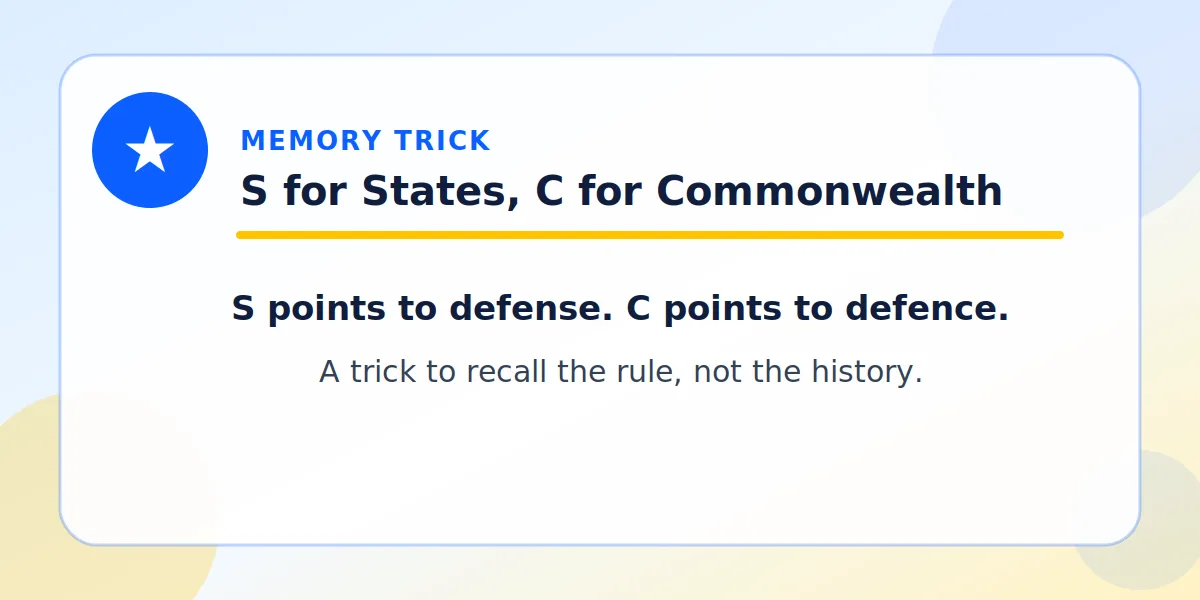
Use this memory trick only. It is a recall aid, not a history lesson.
S is for States. Think of the United States. That points to defense, with s. C is for Commonwealth. Think of the Commonwealth. That points to defence, with c.
This trick helps you recall the rule fast. It does not explain the origin of the words. The origin lies in Old French and Latin forms, and in later spelling habits in each country. Use the trick to choose, and use the audience rule to check. A second trick helps with the related forms. If the suffix starts with i, the letter is always s. Defensive, defensively, defensible, and indefensible all follow that rule, in both varieties.
Practice Questions: Defense or Defence?
Choose defense or defence, or the correct related form, to complete each sentence. Use the audience and the context to decide.
- Which spelling is correct for a US website: defense or defence?
- Is defensive spelled with c or s in British English?
- What is the plural of defense in the United States, and of defence in the United Kingdom?
- Is defense a verb in formal writing?
- Is it self-defense or self-defence in the United Kingdom?
- Which phrase is correct in British English: in my defence or to my defence?
- Which spelling is correct in the name Department of Defense?
- Which spelling is standard in formal Canadian writing?
- Is defencive correct in British English?
- Can you use defense and defence in the same document, with no proper names involved?
Answer Key and Explanations
- Defense. The reader is in the United States, so the American form fits the audience.
- Defensive, with s. Words with an i suffix keep s in both varieties, so defensive never becomes defencive.
- Defenses in the United States, and defences in the United Kingdom. The plural follows the regional base spelling.
- No. Use defend as the verb in formal writing. Defense as a verb is casual US sports jargon only.
- Self-defence. The UK form uses c, and the hyphenated compound follows the regional rule.
- In my defence. The UK form uses c, and the fixed phrase uses in, not to.
- Defense. The name is a proper noun, so it keeps its official American spelling.
- Defence. Canada uses defence as the formal standard, even though defense appears often in casual use.
- No. Defencive is wrong in both varieties. Use defensive in American and British English.
- No. Stay with one spelling in a document, except for proper names that keep their own spelling.
Frequently Asked Questions
1. Is it spelled defense or defence?
Both spellings are correct, but they belong to different varieties of English. Defense is the American form, and defence is the British form. Choose the form that matches your audience, and use that form consistently through the whole document.
2. Is defence grammatically correct?
Yes, defence is grammatically correct in British English, and it is standard there. It is the normal spelling in the United Kingdom, Australia, Canada, and New Zealand. It is not a mistake.
3. How do you spell defence in the US?
In the United States, spell the word defense, with s and not c. The US form is standard in American schools, news, and business writing. A United States reader, teacher, or editor will expect defense in an American text.
4. Is it in my defence or in my defense?
Use in my defense in American English, and use in my defence in British English. Do not use to my defense or to my defence. The fixed phrase uses in, and only the final letter changes with the variety.
5. How do you pronounce defense?
Say di-FENS in general use, with stress on the second syllable, for both spellings. In American sport, some speakers say DEE-fense, with stress on the first syllable, as the opposite of offense. British speakers keep the pronunciation in sport too.
6. Is it defense or defence in Canada?
Formal Canadian writing uses defence. American spelling still appears often in Canadian business and media, so you will see both forms. Pick one form for a document, and stay consistent through the whole text.
7. Is it self-defense or self-defence?
Use self-defense in American English, and use self-defence in British English. The hyphenated compound follows the same regional rule as the base noun. The meaning, protection of yourself, stays the same in both forms.
Conclusion
Defense vs defence comes down to audience, consistency, and proper names. If you remember only one test for defense vs defence, match the reader. Use defense for American readers. Use defence for British and Commonwealth readers. Keep related forms in mind, especially the i suffix rule that keeps defensive, defensively, defensible, and indefensible with s in both varieties. Keep proper nouns unchanged, so Department of Defense stays with s and Ministry of Defence stays with c. Stay consistent in each document. That is the whole rule, and it covers every case in this guide.
Related Guides
Explore more spelling guides on ClarifyWords:
You can also explore the Spelling Differences category on ClarifyWords for more help with American and British spelling.