Which vs That: What Is the Difference?
Choosing between which and that confuses many writers. The choice depends on one question. Is the clause essential, or is it extra detail? This guide gives you a simple rule, clear examples, and a fast test you can use every time. Use this which vs that guide whenever you are unsure about a clause.
Quick Answer
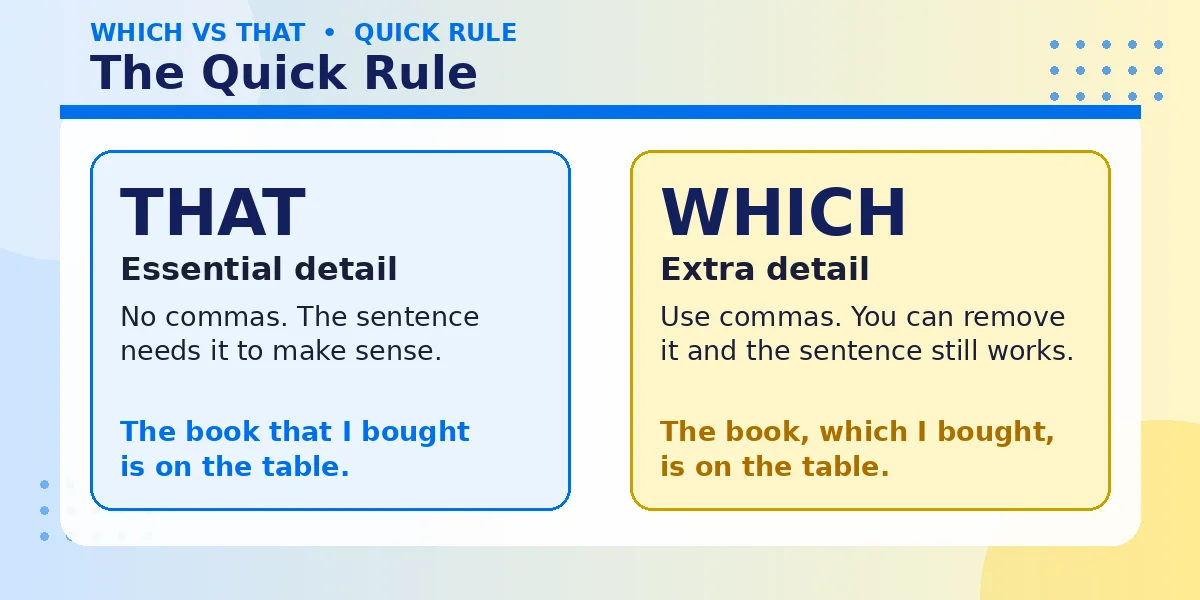
Use that for essential information. Use which for extra information. The books that are on the desk belong to me. My laptop, which I bought last year, still works well. That introduces a restrictive clause. Which introduces a nonrestrictive clause. Commas matter. That usually takes no commas. Which takes commas when it adds extra information.
Table of Contents: Quick Answer; Which vs That Comparison Table; When to Use That; When to Use Which; The Delete Test; How Commas Change Meaning; Special Cases; American English vs British English; Common Mistakes; Memory Trick; Practice Questions; Frequently Asked Questions; Related Guides.
Which vs That: Comparison Table
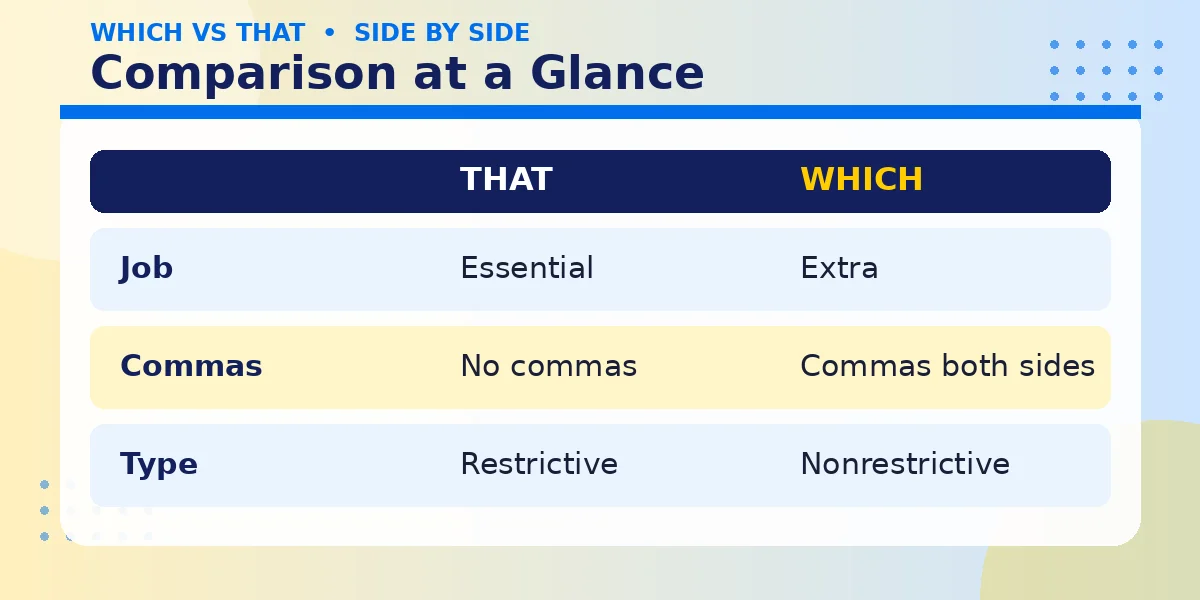
| Feature | That | Which |
|---|---|---|
| Clause type | Restrictive | Nonrestrictive |
| Information | Essential | Extra |
| Role | Identifies the noun | Adds detail about the noun |
| Commas | No commas | Commas required |
| Effect if removed | Meaning may change | Main meaning stays clear |
| Example | The car that has a flat tire is mine. | My car, which has a flat tire, is outside. |
Keep this which vs that comparison in mind when you edit your own sentences.
When to Use That
Use that for essential information. The clause tells the reader which person or thing you mean. Without the clause, the sentence loses a key detail.
That for Essential Information
The student that won the competition received a medal. The phone that has a cracked screen belongs to me. The employees that arrived early received breakfast. Each clause limits the noun. It does not just add a fact. It points to a specific student, phone, or group of employees.
That Usually Takes No Comma
Incorrect: The shoes, that are near the door, are mine. Correct: The shoes that are near the door are mine. That cannot introduce a nonrestrictive clause in standard use. Do not set it off with commas.
Can You Use That for People?
Yes, that can refer to people in a restrictive clause. The woman that called me is my teacher. The woman who called me is my teacher. Who is preferred for people in formal writing. That is possible, but who sounds more formal and more precise.
When to Use Which
Use which for extra information. The clause adds detail, but the reader already knows which noun you mean. The main point stays clear if you remove the clause.
Which for Extra Information
My house, which has a blue door, is near the park. Sarah’s laptop, which she bought last month, is already broken. The meeting, which lasted two hours, ended at noon. Each clause gives background. It does not identify the noun. The reader already knows the house, laptop, or meeting.
Commas Around Nonrestrictive Which Clauses
Place a comma before which and after the clause in the middle of a sentence. My bicycle, which is red, needs repairs. Place a comma before which at the end of a sentence. I visited the museum, which was recently renovated. The commas show the clause is extra. They help the reader pause and read the detail as an aside.
Why Which Cannot Replace That in Every Sentence
The cookies that contain nuts are for the adults. The cookies, which contain nuts, are for the adults. The first sentence points to one group of cookies. The second sentence talks about all the cookies and adds a detail about them. The choice changes the meaning.
The Delete Test
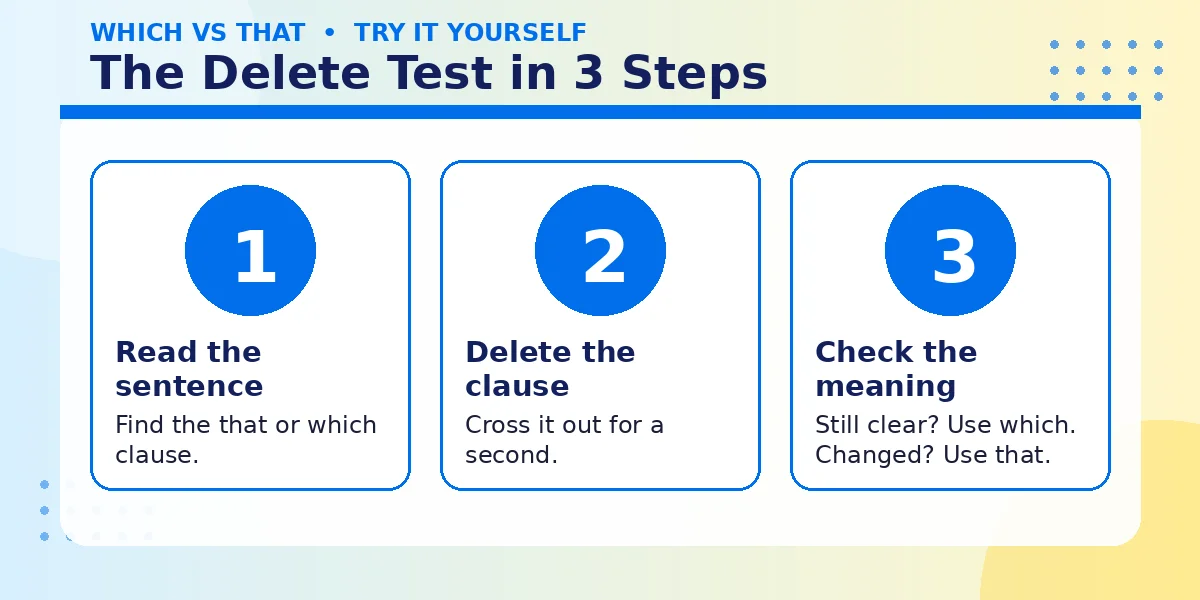
The delete test gives you a fast way to choose. Remove the clause. Then check the main sentence. The which vs that decision becomes easy with this three step test.
- Step 1: Find the Relative Clause. Look for the clause that starts with that or which. It describes the noun before it.
- Step 2: Remove the Clause. Delete the whole clause, including commas if present.
- Step 3: Check the Main Meaning. Ask one question. Does the sentence still point to the same person or thing? If the meaning changes, use that with no commas. If the noun stays clear, use which with commas.
Worked Examples
Essential: The house that has a red roof belongs to my uncle. Without the clause: The house belongs to my uncle. The reader no longer knows which house you mean. Use that. Extra: My house, which has a red roof, belongs to my uncle. Without the clause: My house belongs to my uncle. The reader still knows the house. Use which with commas. The delete test is a practical guide. Context can affect whether a clause feels essential. Use your judgment when a sentence is unclear.
How Commas Change Meaning
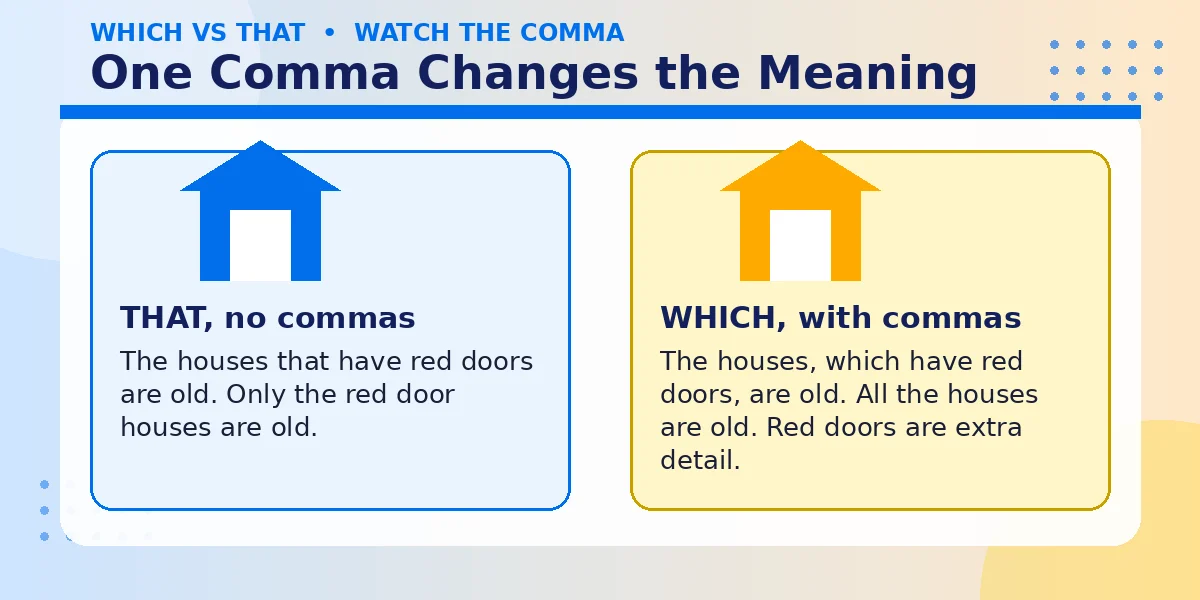
A comma can change the scope of a sentence. The same words can point to a small group or a whole group. Read each pair with care.
Houses
The houses that have gardens are expensive. The houses, which have gardens, are expensive. The first sentence talks about houses with gardens. The second sentence talks about all the houses. It adds that they have gardens.
Classrooms
The classrooms that have computers are open. The classrooms, which have computers, are open. The first sentence limits the open rooms to rooms with computers. The second sentence says all the rooms are open and adds that they have computers.
Offices
The offices that have windows are being renovated. The offices, which have windows, are being renovated. The first sentence limits the work to offices with windows. The second sentence says all the offices are being renovated.
Refunds
We refund orders that ship late. We refund orders, which ship late. The first sentence limits refunds to late orders. The second sentence presents late shipping as extra information about orders in general. Context matters. The number of items and shared knowledge can change how a reader reads a clause. Purdue OWL uses this point to show why punctuation needs care.
Special Cases
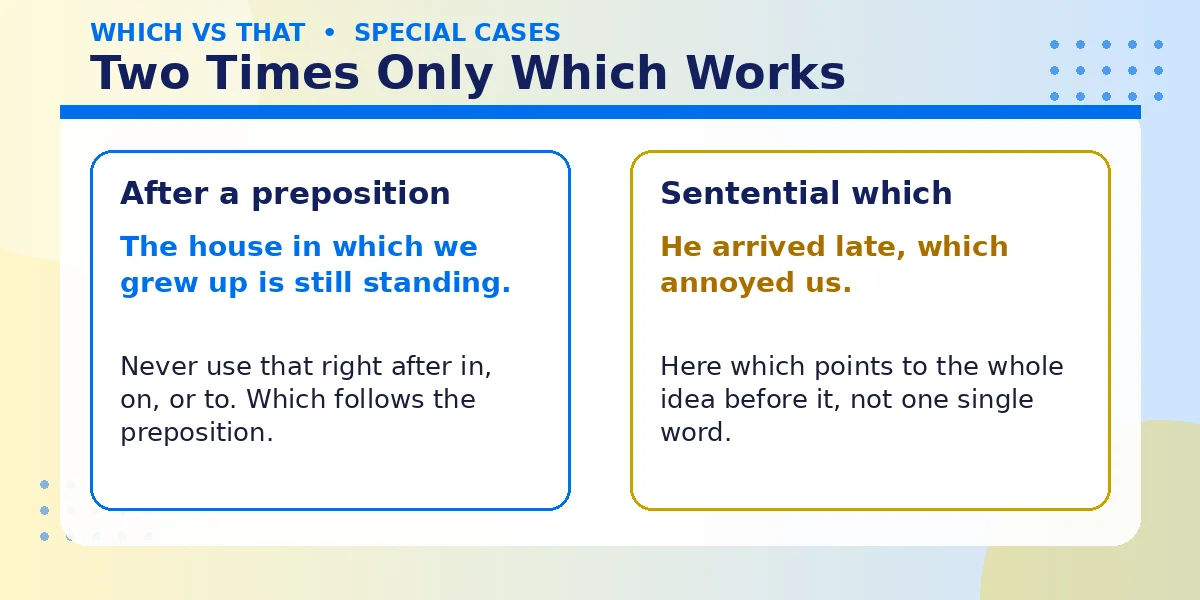
Not every use of which follows the main comma rule. Some uses have a different job in the sentence. These which vs that exceptions do not change the main rule.
Which After a Preposition
The subject about which we spoke was interesting. The room in which I work is small. The reason for which she left remains unknown. These clauses do not always need commas. The preposition comes before which. This form sounds formal. Everyday alternative: the subject that we spoke about. That form moves the preposition to the end. It sounds more natural in speech.
Sentential Which
Which can refer to a whole clause, not just a noun. He missed the train, which made him late. She forgot her passport, which caused a problem. Use a comma before which in this use. The clause comments on the whole event.
Interrogative Which
Which can start a direct or indirect question. Which dress do you prefer? I asked her which dress she preferred. The relative clause comma rule does not apply here. Which asks a question or reports one.
When That Can Be Omitted
You can omit that when it is the object in a defining clause. The book that I borrowed was interesting. The book I borrowed was interesting. You cannot omit that in the same way when it is the subject. The dog that chased the cat was fast. The dog chased the cat was fast. The second sentence does not work as intended. Keep that when it is the subject.
That Which
That which is a formal phrase. It means the thing that or what. That which matters most is honesty. This is a separate construction. It is not a simple choice between which and that.
American English vs British English
The main rule comes from formal American English. British English allows more variety.
The Standard American English Rule
Use that for restrictive clauses. Use which for nonrestrictive clauses. Do not use commas around restrictive clauses. Use commas around nonrestrictive clauses. Purdue OWL and the Microsoft Writing Style Guide support this pattern.
How British English Uses Which and That
British English often accepts which in restrictive clauses without commas. The book which I borrowed was excellent. American editors often prefer that in this case. British readers may accept which without a problem.
What Dictionaries and Style Guides Say
Merriam-Webster describes actual use. It recognizes restrictive which. Cambridge Dictionary explains defining and non-defining relative clauses. It uses those terms for restrictive and nonrestrictive clauses. Formal American writing still prefers the that and which distinction. The distinction helps readers see whether information is essential or extra.
Common Mistakes
Watch for these errors in your own writing. Most which vs that errors come from commas, not from the words themselves.
Using Which Without a Comma in a Formal American Restrictive Clause
This breaks the standard American pattern. Use that for essential information.
Putting a Comma Before That
That does not take a comma in a restrictive clause. Remove the comma or change the word.
Adding Commas Around Essential Information
Commas signal extra information. They weaken a clause that identifies the noun.
Using Which to Refer to People
Use who for people in formal writing. Which refers to things, animals, and groups in most cases.
Applying the Main Rule to Every Use of Which
Interrogative which and prepositional which follow different patterns. Do not force the comma rule onto them.
Removing That When It Is the Subject
Check the role of that first. If that is the subject, keep it. If that is the object, you may omit it.
Memory Trick
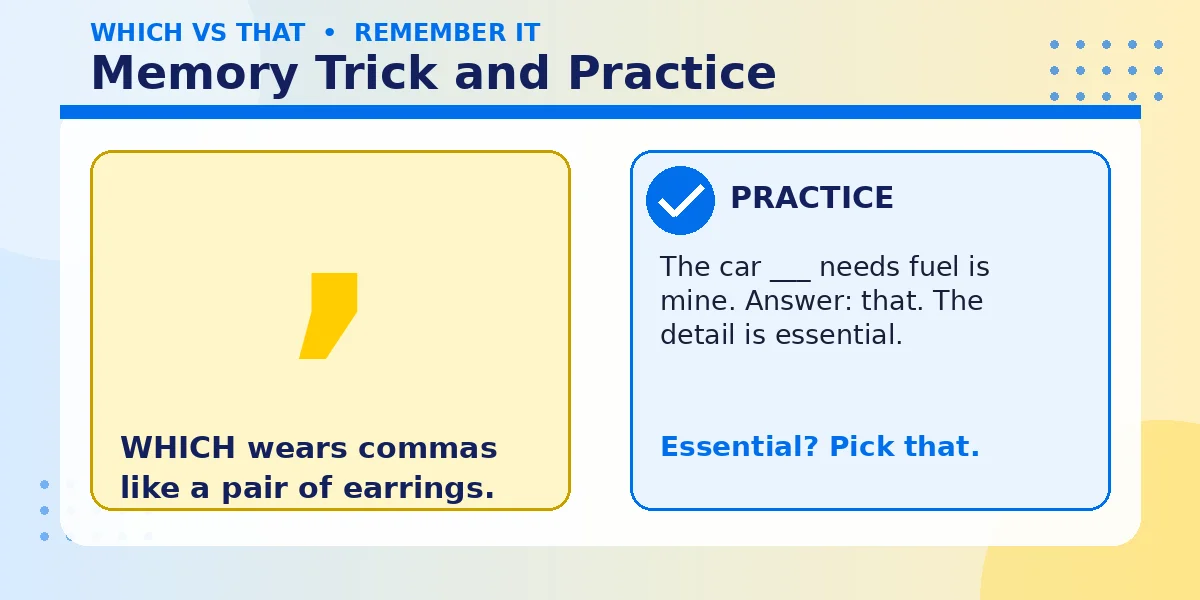
Use a simple pair of cues. That means the detail that identifies it. Which means extra information, enclosed in commas. Try the delete test. Remove the clause. Ask if the main meaning stays clear. Essential? Use that. Extra? Use which. Extra information? Add commas.
Practice Questions
Choose Which or That
- The jacket ___ I bought yesterday is too small.
- My car, ___ is parked outside, needs washing.
- The restaurant ___ serves Italian food is always busy.
- Her new phone, ___ she received last week, is already damaged.
- The students ___ completed the assignment can leave early.
Correct the Punctuation
- My laptop which I bought last year still works well.
- The books, that are on the table, belong to Sarah.
- The house that has a white fence, is mine.
Identify the Special Construction
- She asked me which route was faster.
- The team missed the deadline, which disappointed the manager.
Answer Key
- that. The clause identifies which jacket. It is essential.
- which. The clause adds extra detail about a known car. It needs commas.
- that. The clause identifies which restaurant. It is essential.
- which. The clause adds extra detail about a known phone. It needs commas.
- that. The clause identifies which students. It is essential. Who is also fine for people.
- My laptop, which I bought last year, still works well. The clause is extra, so it needs commas and which.
- The books that are on the table belong to Sarah. The clause is essential, so it needs that and no commas.
- The house that has a white fence is mine. The clause is essential, so it needs that and no comma after the clause.
- Interrogative which. Which introduces an indirect question.
- Sentential which. Which refers to the whole event of missing the deadline.
Frequently Asked Questions About Which vs That
Can that introduce a nonrestrictive clause?
No. In standard English, that introduces restrictive clauses only. Use which for nonrestrictive clauses about things. Set the clause off with commas on both sides, or with one comma at the end of a sentence.
Is that a relative pronoun?
Yes. That can act as a relative pronoun in restrictive clauses. It also works as a demonstrative pronoun, determiner, adverb, and conjunction in other sentences. Its role depends on the sentence, so check how it is used.
Do you always need a comma before which?
No. You need a comma when which starts a nonrestrictive relative clause. You do not always need one after a preposition, as in the room in which I work. You also do not need one in an indirect question.
Can which be used in a restrictive clause?
Yes, mainly in British English and some informal American use. Formal American writing usually prefers that for restrictive clauses and reserves which for nonrestrictive clauses. Follow the formal rule for school, work, and published writing.
Can that be omitted from a sentence?
Yes, when that is the object of a verb in a defining clause, as in the book I borrowed. You cannot omit that when it is the subject of the clause. Keeping subject that avoids a broken sentence.
Can you use that for people?
Yes, that can introduce a restrictive clause about people. Who is usually preferred for specific people in formal writing, but that remains possible. Choose who when you want a formal tone and a clear reference to a person.
What does that which mean?
That which is a formal phrase that means the thing that or what. It is a separate construction, not a normal choice between the two relative pronouns. You will meet it in formal writing more than in speech.