A vs An: What is the Difference? Rules, Examples, and Exceptions
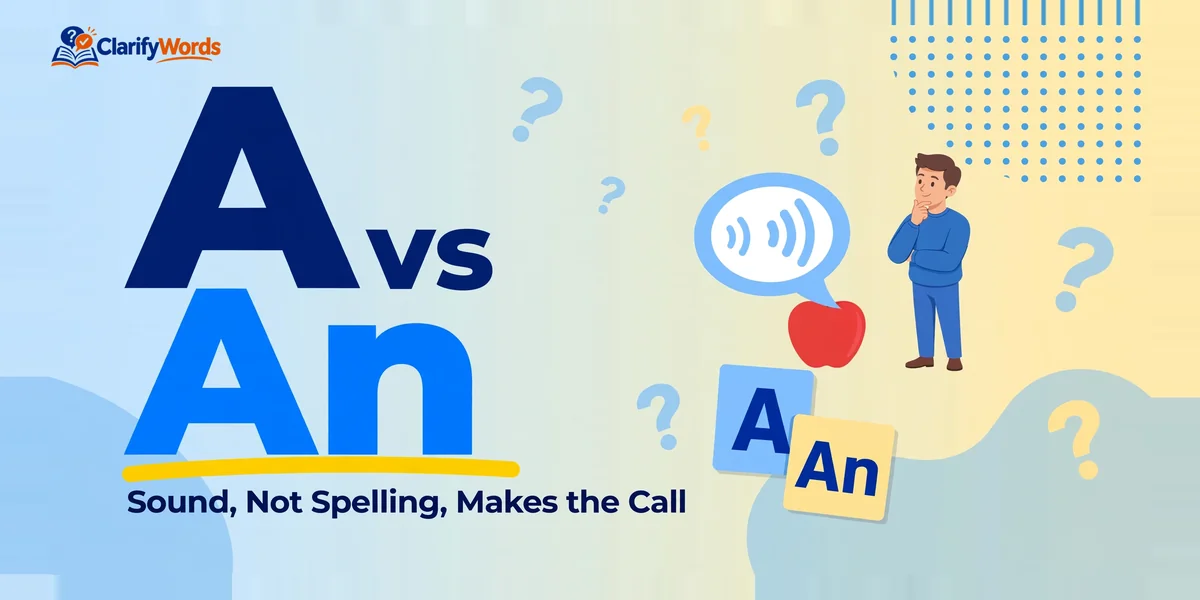
The difference is simple: use a before a consonant sound and an before a vowel sound. The first letter does not decide the answer. The sound you hear does.
For example, write a university because university begins with a “yoo” sound. Write an umbrella because umbrella begins with a vowel sound.
This a vs an rule is easy to apply once you focus on pronunciation. Both words are indefinite articles. They introduce one nonspecific person, place, thing, or idea. Use them only with singular countable nouns.
A vs An: Quick Answer
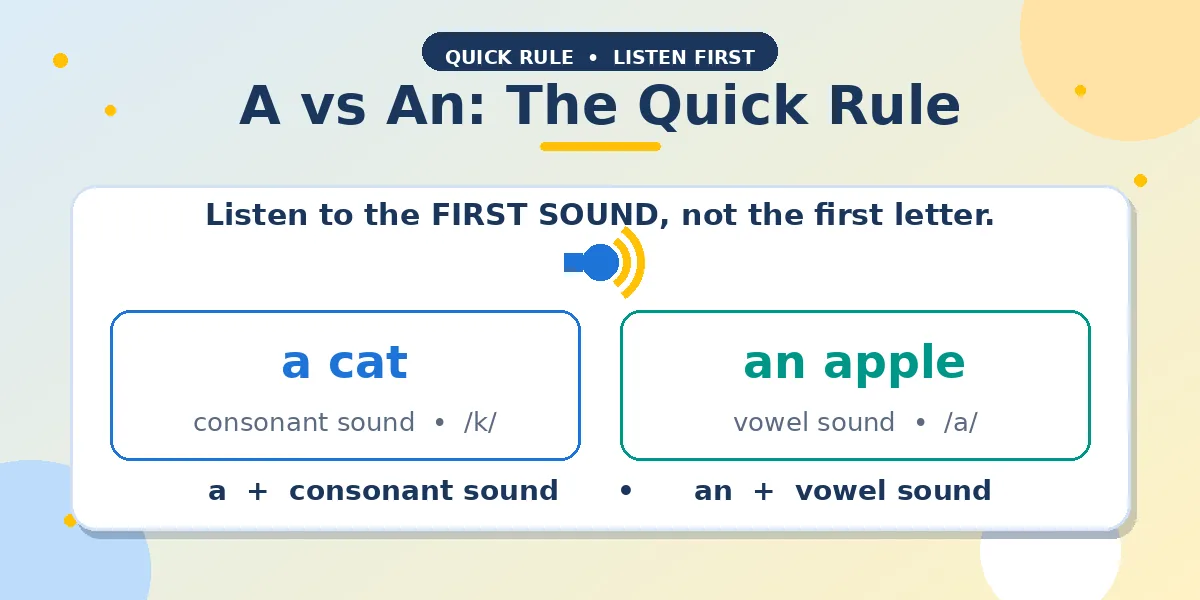
Use a before a word that starts with a consonant sound. Use an before a word that starts with a vowel sound.
| Use A | Use An |
|---|---|
| a dog | an apple |
| a book | an egg |
| a university | an umbrella |
| a European country | an hour |
| a one-time offer | an honest answer |
| a NATO summit | an FBI agent |
The rule applies to the first spoken sound of the next word. It does not depend on whether that word begins with a vowel or consonant letter. Purdue OWL explains the same sound based rule and gives examples such as a union and an honest error in its article usage guide.
Table of Contents
- A vs An: Quick Answer
- When to Use A in A vs An
- When to Use An in A vs An
- A vs An Before Adjectives and Other Modifiers
- A vs An: Tricky Words and Common Exceptions
- A vs An Before Acronyms and Initialisms
- A vs An, The, and No Article
- American and British English Differences
- Common A vs An Mistakes
- A vs An: An Easy Memory Trick
- A vs An Practice Questions and Answers
- Frequently Asked Questions
When to Use A in A vs An
Use a before a singular countable noun when the next word begins with a consonant sound. The noun does not need to start with a consonant letter.
Use A Before Consonant Sounds
These words begin with clear consonant sounds:
- a cat
- a house
- a teacher
- a book
- a car
- a purple shirt
- a helpful neighbor
Use a when the next word starts with a spoken sound like B, C, D, F, H, or T. The spelling may vary, but the sound guides your choice.
Use A Before Words With a Y Sound
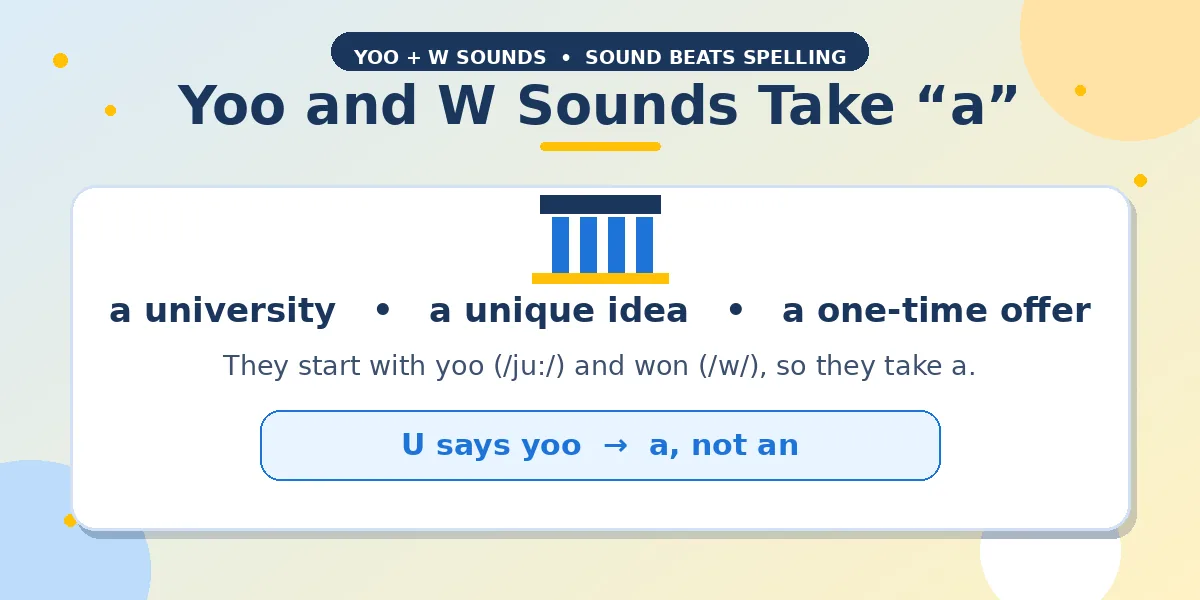
Some words begin with the letter U or the letters EU. Their first sound is like the Y in yes or you. That is a consonant sound, so use a.
Examples include:
- a university
- a unique idea
- a uniform
- a union
- a European country
- a eucalyptus tree
- a eulogy
Do not write an university or an unique idea. The opening sound is not a vowel sound.
Use A Before Words With a W Sound
The words one and once begin with a W sound. Use a before them.
- a one-time offer
- a one-dollar bill
- a one-way street
- a once-in-a-lifetime chance
- a pirate with one eye
The same rule applies to numbers. Say the number aloud before choosing the article. For example, write a 1 when you read the number as “one.”
When to Use An in A vs An
Use an before a singular countable noun when the next word begins with a vowel sound. The word may start with A, E, I, O, or U, but the sound matters more than the letter.
Use An Before Vowel Sounds
Examples include:
- an apple
- an egg
- an idea
- an orange
- an umbrella
- an invitation
- an unusual experience
The first sound flows directly into the article. That is why an orange sounds natural, while a orange does not.
Use An Before Words With a Silent H
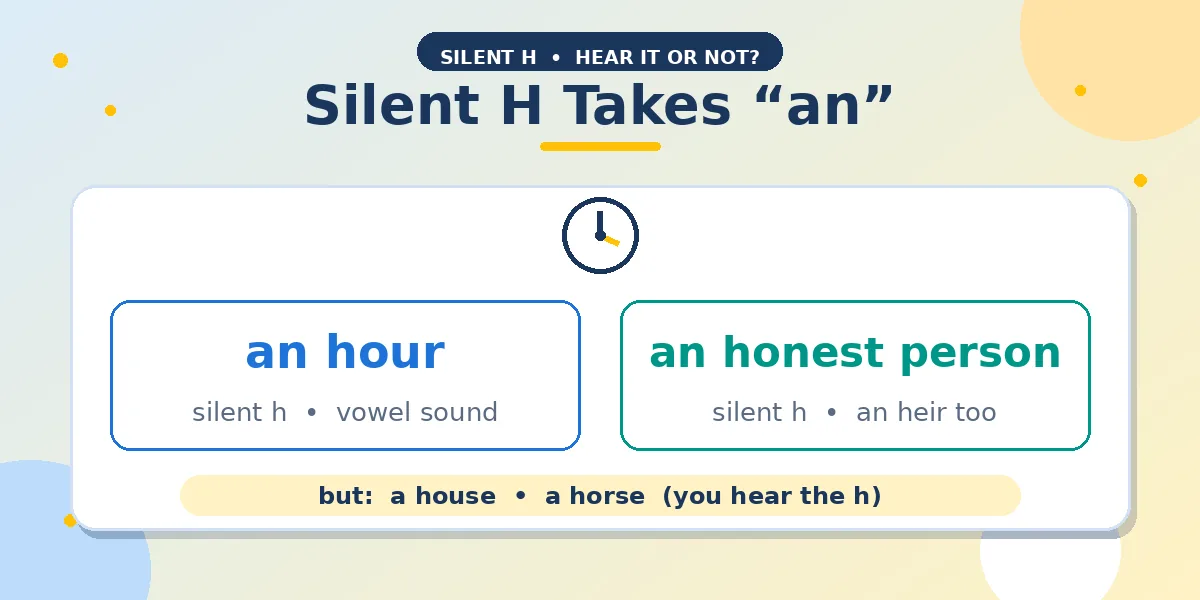
Some words begin with H in writing but do not pronounce that letter. The next sound is a vowel, so use an.
- an hour
- an honest person
- an honor
- an heir
- an heirloom
- an honorable decision
Compare those examples with a house, a horse, and a helpful person. Their H sounds are pronounced, so they take a.
Use An Before Certain Letters and Numbers
The spoken name of a letter can begin with a vowel sound, even when the letter itself is a consonant.
- an F
- an M
- an N
- an S
- an X
- an 8
- an 11
For contrast, use a B, a T, and a 10. Their spoken names begin with consonant sounds.
A vs An Before Adjectives and Other Modifiers
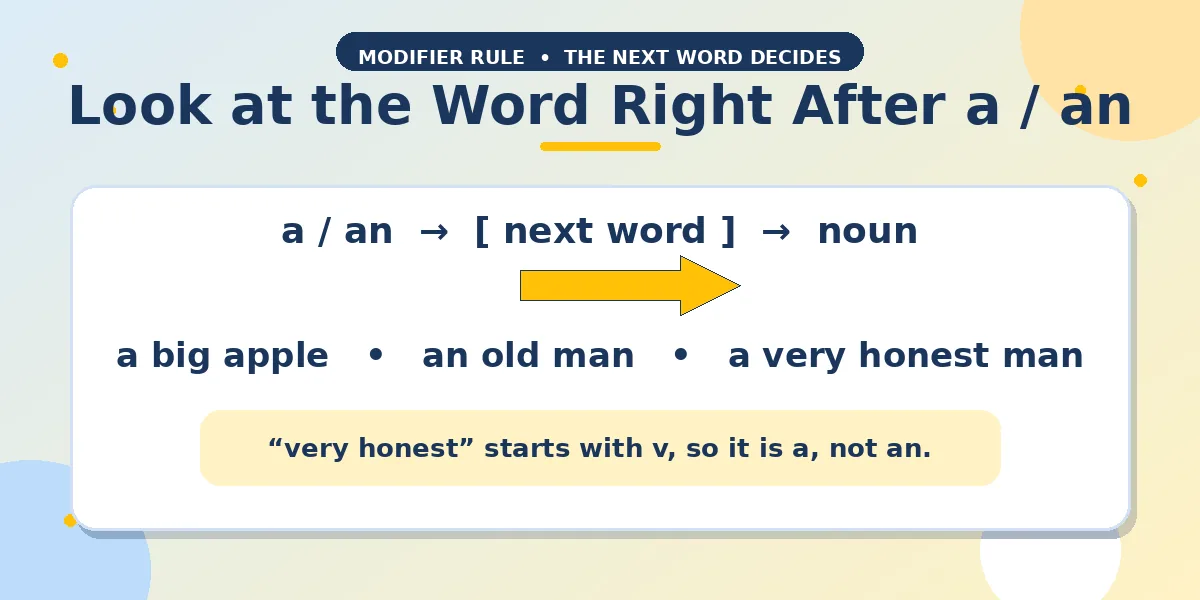
The article agrees with the first word immediately after it. It does not wait for the main noun.
For example, apple takes an by itself. But big comes first in a big apple, so the phrase takes a.
Use A When the Modifier Starts With a Consonant Sound
- a big apple
- a beautiful house
- a useful tool
- a brilliant idea
- a purple Audi
- a really honest person
Use An When the Modifier Starts With a Vowel Sound
- an old man
- an expensive car
- an excellent teacher
- an interesting book
- an orange dress
- an extremely useful guide
What If an Adverb Comes First?
Check the first word after the article, even when it is an adverb.
Write a very honest man, not an very honest man. The word very starts with a V sound.
Also write a really useful guide and an unusually helpful person. The words really and unusually determine the article.
A vs An: Tricky Words and Common Exceptions
A few familiar words confuse writers because their spelling does not reveal their opening sound. Use this reference table when you need a quick check.
| Word or phrase | Correct form in American English | Why |
|---|---|---|
| hour | an hour | The H is silent |
| honest | an honest answer | The H is silent |
| heir | an heir | The H is silent |
| university | a university | Starts with a Y sound |
| unique | a unique choice | Starts with a Y sound |
| European | a European city | Starts with a Y sound |
| one-time | a one-time offer | Starts with a W sound |
| umbrella | an umbrella | Starts with a vowel sound |
| herb | an herb | The H is usually silent |
| herbal tea | an herbal tea | The H is usually silent |
| herbicide | a herbicide | The H is pronounced |
| herbivore | a herbivore | The H is pronounced |
| historic | a historic event | The H is pronounced |
| hotel | a hotel | The H is pronounced |
| hospital | a hospital | The H is pronounced |
Historic or Historical?
In standard modern American usage, write a historic event and a historical document. The H is pronounced in both words.
Historic means important or influential in history. Historical means connected to the past or the study of history.
You may still see an historic in older writing or in speech that drops or weakens the H. However, major American style guidance favors a historic. The Chicago Manual of Style also bases the choice on sound and gives a historic occasion as its example. The AP Stylebook gives the same advice for a historic event.
Herb or Herbal?
American speakers usually pronounce herb without its H. Therefore, use an herb and an herbal tea in American English.
The H is pronounced in herbicide and herbivore. Use a herbicide and a herbivore. In much British English, speakers pronounce the H in herb, so a herb is common.
A vs An Before Acronyms and Initialisms
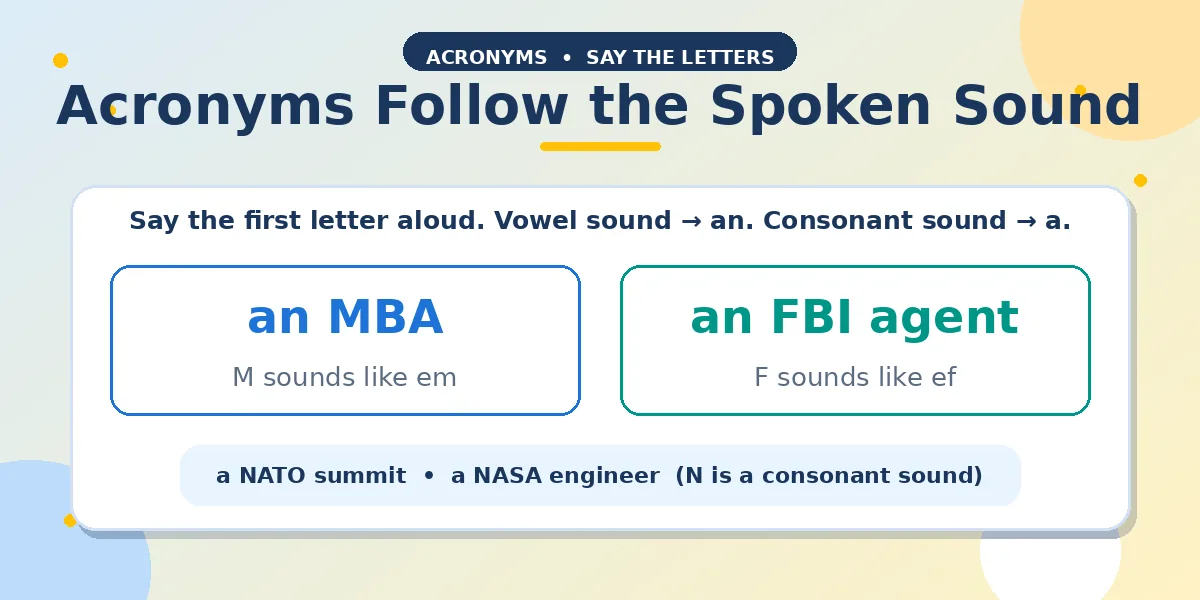
Abbreviations follow the same sound rule as ordinary words. The article depends on how you say the abbreviation, not how you write it.
An acronym is usually spoken as a word, such as NASA or NATO. An initialism is spoken one letter at a time, such as FBI or MBA.
Use A When the Spoken Name Starts With a Consonant Sound
- a NATO summit
- a NASA engineer
- a PDF file
- a CEO
- a URL
- a FIFA tournament
For example, NATO begins with an N sound when spoken as a word. PDF begins with the P sound when you say its letters.
Use An When the Spoken Name Starts With a Vowel Sound
- an MBA graduate
- an FBI agent
- an NFL player
- an NBA game
- an MRI scan
- an HIV diagnosis
- an HTML document
- an EU official
The letter names M, F, N, and others begin with vowel sounds. That explains an MBA and an FBI agent.
Some abbreviations can be pronounced in more than one way. For example, a speaker who says FAQ as a word may use a FAQ. A speaker who says each letter may use an FAQ. Choose the article that matches your pronunciation.
A vs An, The, and No Article
Choosing an article involves more than listening for a vowel or consonant sound. First, check whether the noun is countable and whether it is specific.
When to Use A or An
Use a or an with one nonspecific, singular countable noun.
- I saw a bird in the yard.
- She bought an umbrella.
- He needs a new laptop.
These examples introduce something that is not yet identified.
When to Use The
Use the when you mean a particular person or thing. The reader or listener can identify which one you mean.
- I saw a bird. The bird was blue.
- She bought an umbrella. The umbrella was expensive.
- He needs the laptop on my desk.
The often appears when a noun has already been mentioned. It can also identify something through context.
When to Use No Article
Do not use a or an with ordinary plural nouns or uncountable nouns.
- Dogs need exercise.
- Books can teach us new skills.
- Water is important.
- She gave me useful advice.
- We need more information.
Use a quantity phrase when you need to count an uncountable noun. For example, write a piece of information, a glass of water, or a bit of advice.
Purdue OWL explains that a and an are used with count nouns, while plural and noncount nouns follow different article patterns in its guide to using articles.
American and British English Differences
Pronunciation can vary by region. That can change which article sounds right. For an American audience, use standard American pronunciation as your guide.
Herb
American English: an herb and an herbal tea.
British English: a herb is common because the H is pronounced.
Hotel and Hospital
Use a hotel and a hospital in standard American English. The H is pronounced in both words.
Some speakers in Britain may drop the H in certain words. Their article choice may reflect that pronunciation. Do not assume every British speaker uses an hotel or an hospital.
Historic
Use a historic event in standard American writing. This also matches the pronunciation with a clear H sound.
You may encounter an historic in older sources or in speech with a weak H. For clear modern American writing, choose a historic.
Common A vs An Mistakes
Avoid these frequent errors when writing or editing.
Choosing by the First Letter
Incorrect: An university student.
Correct: A university student.
The word begins with a Y sound, not a vowel sound.
Forgetting the Silent H
Incorrect: A hour passed.
Correct: An hour passed.
The H in hour is silent.
Ignoring the First Modifier
Incorrect: An very honest man.
Correct: A very honest man.
The word immediately after the article is very.
Using A or An With a Plural Noun
Incorrect: A books are on the table.
Correct: Books are on the table.
Use a book for one book, or books for more than one.
Using A or An With an Uncountable Noun
Incorrect: She gave me an advice.
Correct: She gave me some advice.
You can also say a piece of advice. The quantity phrase makes the amount countable.
Choosing an Article by an Abbreviation’s First Written Letter
Incorrect: A FBI agent arrived.
Correct: An FBI agent arrived.
The letter F is spoken as a name that starts with a vowel sound.
A vs An: An Easy Memory Trick
Remember this short rule:
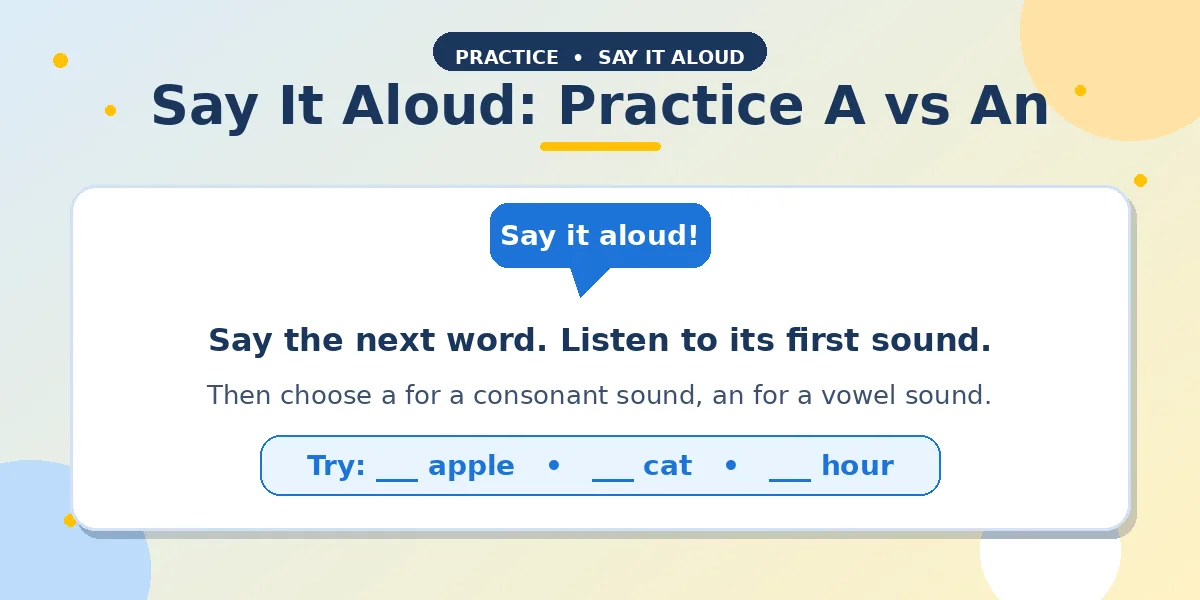
A goes before a consonant sound. An goes before a vowel sound.
Do not focus on the first written letter. Listen to the first sound instead.
Use the Say It Aloud Test
- Find the word immediately after the article.
- Say that word aloud.
- Listen to its first sound.
- Choose a for a consonant sound.
- Choose an for a vowel sound.
- Check that the noun is singular and countable.
For example, university starts with a Y sound, so write a university. Hour starts with a vowel sound because its H is silent, so write an hour.
This quick test works for adjectives, abbreviations, letters, and numbers too.
A vs An Practice Questions: Choose A or An
Test the rule with these ten sentences. Fill each blank with a or an.
- She waited for ___ hour.
- He studies at ___ university.
- I bought ___ orange.
- They adopted ___ European dog.
- She is ___ honest person.
- He wants to become ___ FBI agent.
- We saw ___ one-eyed pirate.
- It was ___ unusual experience.
- She made ___ very useful suggestion.
- He ordered ___ herbal tea.
Answer Key With Explanations
| No. | Answer | Explanation |
|---|---|---|
| 1 | an hour | The H is silent, so the word starts with a vowel sound. |
| 2 | a university | The first sound is the consonant Y sound. |
| 3 | an orange | The word begins with a vowel sound. |
| 4 | a European dog | European begins with a Y sound. |
| 5 | an honest person | The H is silent. |
| 6 | an FBI agent | F is pronounced with a vowel sound at the start. |
| 7 | a one-eyed pirate | One begins with a W sound. |
| 8 | an unusual experience | Unusual begins with a vowel sound. |
| 9 | a very useful suggestion | Very is the first word after the article. |
| 10 | an herbal tea | American English usually drops the H in herb. |
Frequently Asked Questions
Is it a hour or an hour?
The correct phrase is an hour. The H in hour is silent, so the word begins with a vowel sound. Use an before it, as in “I will call you in an hour.”
Is it a university or an university?
The correct phrase is a university. Although university starts with the vowel letter U, its first sound is like the Y in you. That consonant sound requires a, not an.
Is it a MBA or an MBA?
Use an MBA because the letter M is pronounced “em.” Its name begins with a vowel sound. The same rule explains phrases such as an MRI scan and an FBI agent.
Is it a historic or an historic?
In standard modern American English, a historic is preferred because speakers pronounce the H. You may still see an historic in older writing or in speech with a weakened H sound.
Is it a herb or an herb?
In American English today, use an herb because the H is usually silent. British speakers commonly pronounce the H and use a herb. Choose the article that matches your pronunciation.
Does a/an follow the adjective or the noun?
The article follows the first word immediately after it, which may be an adjective or adverb. Write a big apple, an old house, and a very honest person. The noun does not control the choice.
Can a/an be used with plurals or uncountable nouns?
No. Use a and an only with singular countable nouns. Say books or some water, not a books or an water. For uncountable nouns, use phrases such as a glass of water.
Final Takeaway
The choice between a and an depends on sound, not spelling. Use a before consonant sounds and an before vowel sounds.
Check the word immediately after the article, even when a modifier comes first. Remember that these articles work with singular countable nouns, not ordinary plurals or uncountable nouns.
With this a vs an rule in mind, when in doubt, say the phrase aloud. Your pronunciation will usually make the right choice clear.
Related Guides
For more help with common grammar questions, explore who vs whom, which vs that, fewer vs less, and learn or learned. You can also browse the ClarifyWords Grammar category for more practical writing advice.