

Lead or Led: What’s the Difference and Which Is Correct?

Many writers confuse lead and led because they look similar. They sound different in some uses. They also follow different grammar rules.
This lead or led guide explains the difference in plain language. You will learn when to use each word. You will also learn how to avoid the most common mistake. By the end of this lead or led guide, the choice will feel simple.
Quick Answer: Lead or Led?
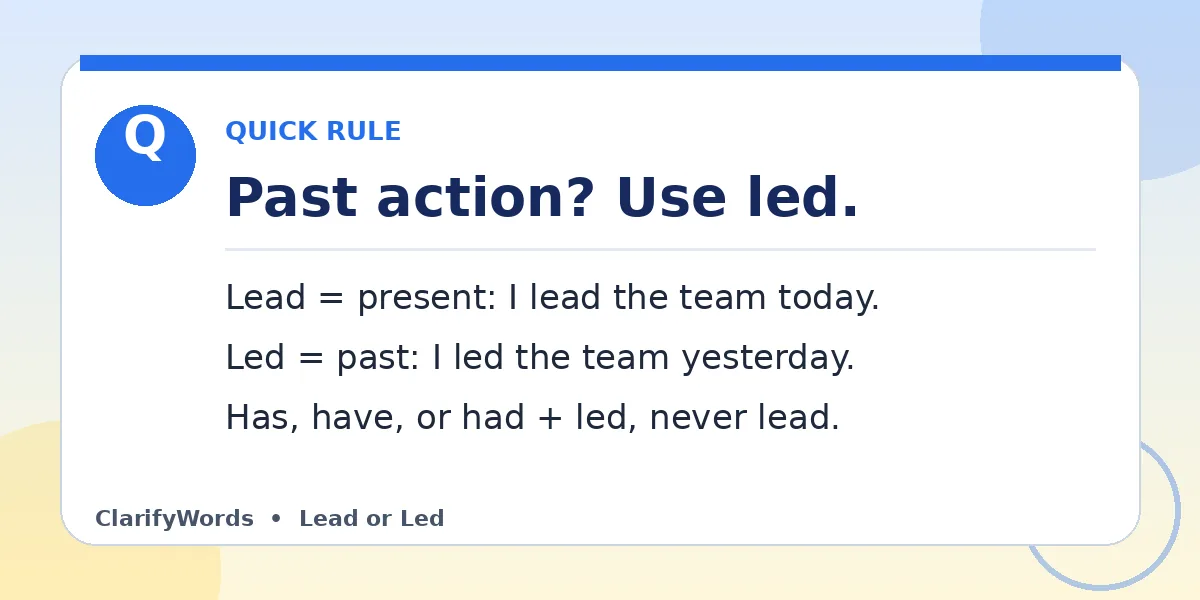
Use lead for present tense and infinitive forms. Use led for past tense and past participle forms.
Lead is pronounced LEED when it is a verb. Led is pronounced LED. The spelling changes when the time changes.
Examples: She leads the team today. / She led the team yesterday.
If the action already happened, use led. If the action happens now or in the future, use lead. Keep this lead or led pair in mind while you write.
Table of Contents
- Quick Answer
- What Does Lead Mean?
- What Does Led Mean?
- Lead vs Led Comparison Table
- The Pronunciation Trap
- Lead Verb Forms Table
- When to Use Lead
- When to Use Led
- Lead as a Metal and Other Noun Uses
- Common Mistakes Table
- Three Question Decision Test
- Memory Tricks
- Common Expressions
- Practice Questions
- FAQs
- Conclusion
What Does Lead Mean?
Lead is a verb that means to guide, direct, or be in charge. It can describe a person, a group, or a process.
Merriam-Webster lists several verb senses for lead. These include guiding someone on a way, directing someone on a course, and directing the operations of a team. Lead can also mean leading a parade, being first, having a margin over others, or bringing an action to a conclusion.
Examples: I lead a small team. / Please lead us to the exit. / She leads the workshop every week.
Lead also appears in common phrases. Lead the way means to go first and show others the path.
What Does Led Mean?
Led is the past tense and past participle of lead. It is the only standard form for past time.
Led is pronounced LED. It does not follow the regular pattern of adding ed to a verb.
Examples: She led the meeting yesterday. / She has led the team for two years. / She had led the project before the company expanded. / The tour was led by a local guide.
Grammarphobia confirms that led is the only standard past tense and past participle. All ten standard dictionaries in its review agree on this point. That single rule answers most lead or led questions.
Lead vs Led: Comparison Table
| Word | Part of Speech | Form / Meaning | Pronunciation | Example |
|---|---|---|---|---|
| Lead | Verb | Present tense / infinitive | LEED | They lead the discussion every Monday. |
| Led | Verb | Past tense / past participle | LED | They led the discussion yesterday. |
| Lead | Noun | Position / advantage / clue | LEED | Our team has the lead. |
| Lead | Noun | Heavy metal | LED | The pipes were made of lead. |
The Pronunciation Trap: Three Ways to Say Lead and Led
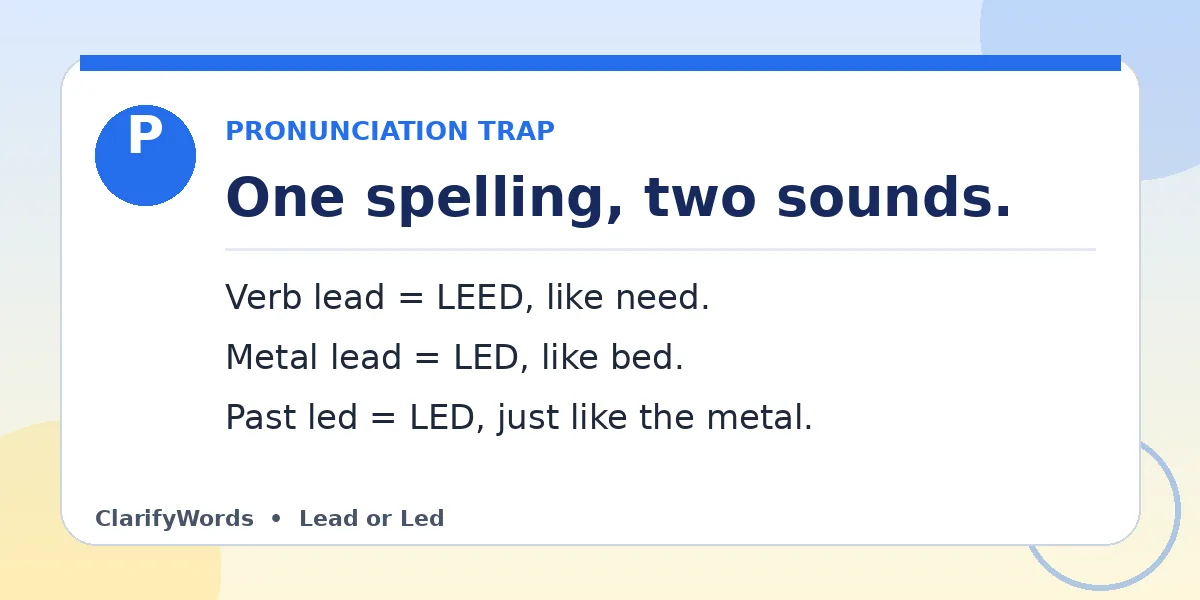
Lead as a verb is pronounced LEED. Lead as a noun for a position, advantage, clue, or example is also pronounced LEED. Lead as a noun for the heavy metal is pronounced LED.
Led is always pronounced LED. This creates confusion because the metal lead and the past tense led sound the same.
Merriam-Webster offers a simple test. If the verb sounds like LED, write led. That test helps in past tense sentences.
LED in capital letters is a different word. It stands for light emitting diode. It names a type of light.
Lead Verb Forms Table
| Form | Word | Pronunciation | Example |
|---|---|---|---|
| Base form / infinitive | lead | LEED | They want to lead the project. |
| Third person singular | leads | LEED | She leads the workshop. |
| Present participle / gerund | leading | LEED-ing | He is leading the discussion. |
| Simple past | led | LED | He led the discussion yesterday. |
| Past participle | led | LED | They have led the project before. |
There is no regular ed form. Led is the only standard past and past participle form.
When to Use Lead
Use Lead in Present Tense
I lead the meeting on Fridays. / They lead the discussion every week.
Use Lead for Future Time
She will lead the team next year. / He will lead the workshop tomorrow.
Use Lead After Modal Verbs and in Infinitives
She can lead the discussion. / They plan to lead the campaign.
Use Lead in Instructions and General Truths
A good manager leads by example. / A clear leader leads with honesty.
Use Lead in Present Continuous
He is leading the group today. / She is leading the class this week.
When to Use Led
Use Led in Simple Past
She led the class last week. / They led the parade yesterday. Time markers such as yesterday, last week, last month, and ago signal simple past.
Use Led in Present Perfect
She has led three workshops. / They have led the team since January.
Use Led in Past Perfect
She had led the department before she moved to London.
Use Led in Passive Voice
The class was led by an experienced teacher. / The project had been led by two managers.
Use Led as a Past Participle in Other Constructions
It was a self-led study group.
Lead as a Metal and Other Noun Uses
Lead the Metal
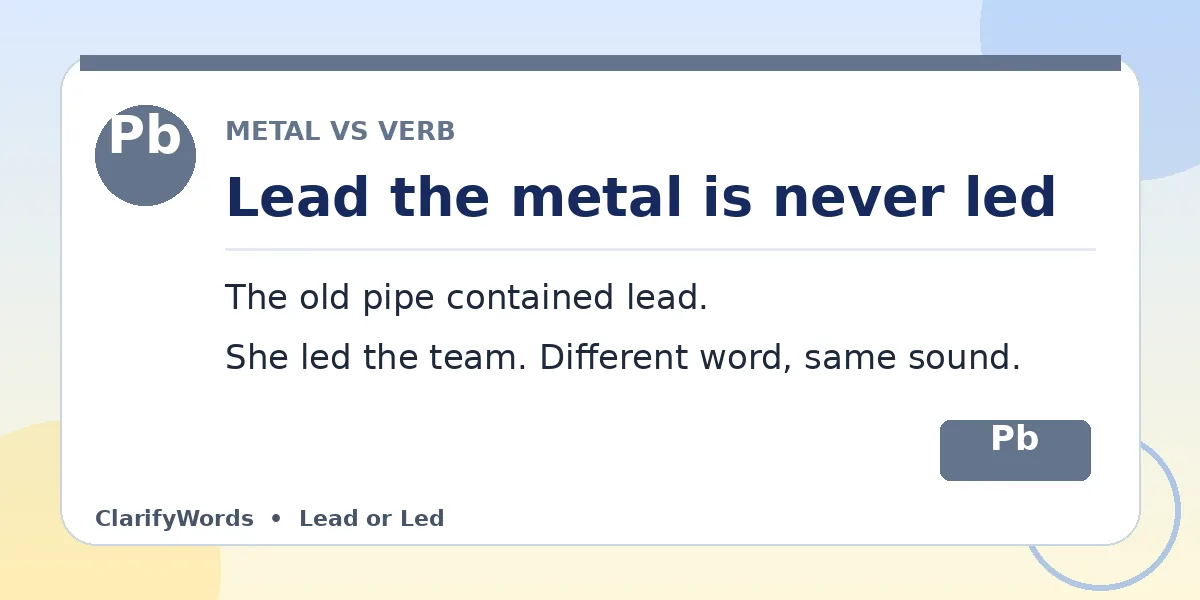
Lead is a heavy, soft, gray metal. Its chemical symbol is Pb. Its atomic number is 82. Related terms include lead paint, lead pipes, and unleaded. Old houses may contain lead paint. The metal form is pronounced like LED.
Lead as a Position or Advantage
Take the lead. / In the lead. / Have a lead over someone. / Our team took the lead in the second half.
Lead as a Clue or Example
The police followed a new lead. / A reporter follows a lead in a story. / Lead by example means to show others through action.
Lead as a Role, Performer, or Adjective
Lead role. / Lead singer. / Lead actor. / She played the lead role in the school play. / He is the lead singer of the band. In these uses, lead is pronounced LEED.
Common Mistakes Table
| Mistake | Correction | Note |
|---|---|---|
| She lead the meeting yesterday. | She led the meeting yesterday. | Lead is present tense, not past tense. |
| They have lead the project. | They have led the project. | The past participle after have must be led. |
| The tour was lead by a guide. | The tour was led by a guide. | Passive voice requires the past participle led. |
| Leaded as the past tense | Use led. | Leaded is a separate adjective in leaded petrol and leaded glass. |
| Led for the metal | Use lead (pronounced LED) for the metal. | |
| Lead for LED light | Use LED for light emitting diode. |
Is Leaded Ever Correct?
Leaded is not correct as the past tense of lead. The correct past form is led. Leaded is a separate adjective. It appears in terms such as leaded petrol and leaded glass.
Why the Read Analogy Fails
Read keeps the same spelling in present and past forms. Lead changes spelling in the past form. The verb follows the pattern of feed and fed, and bleed and bled.
Self-Led and Similar Forms
A self-led course lets learners set their own pace.
Three Question Decision Test: Lead or Led?
- Is the action happening now or in the future? If yes, use lead. Example: She leads the team today.
- Is the action already finished, or does the sentence use has, have, or had? If yes, use led. Example: She has led the team for two years.
- Is the word the metal or a noun meaning position, clue, or role? If yes, use lead, but check the pronunciation. Example: The pipes were made of lead.
Memory Tricks That Actually Work
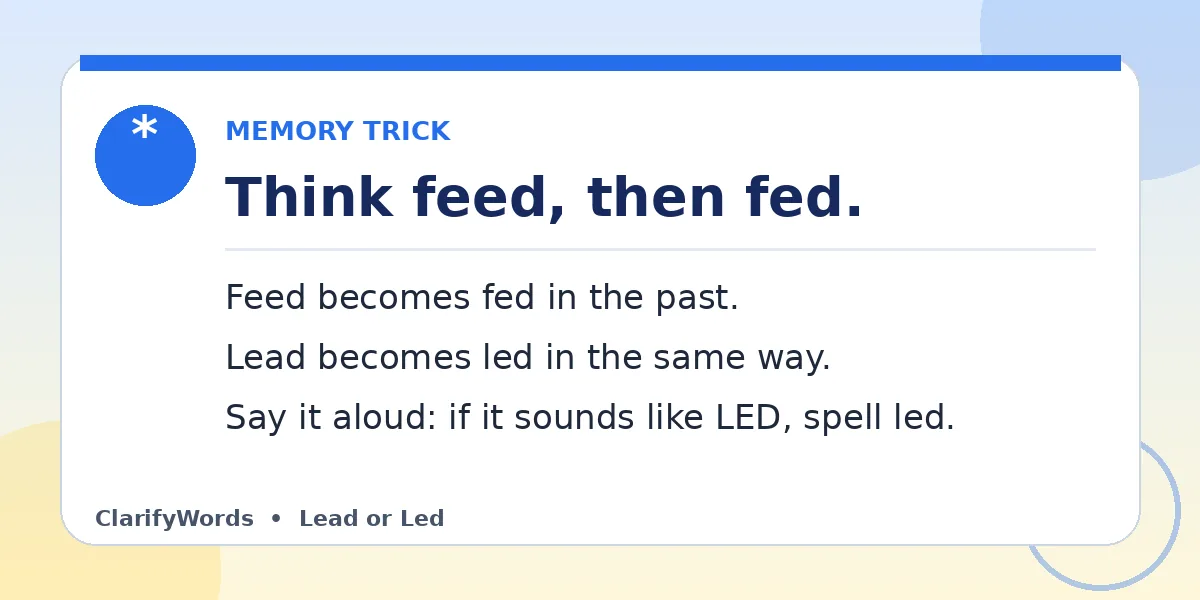
These lead or led tricks work in real writing.
- Present has ee, past has e. Lead has two e letters. Led has one e letter.
- Feed becomes fed. Bleed becomes bled. Lead becomes led.
- Guided or directed substitution test: If guided or directed fits, and the time is past, use led.
- Yesterday test: If yesterday fits the sentence, use led.
- Has, have, or had test: If one of these words appears before the verb, use led.
- Sound test: If the verb sounds like LED, write led.
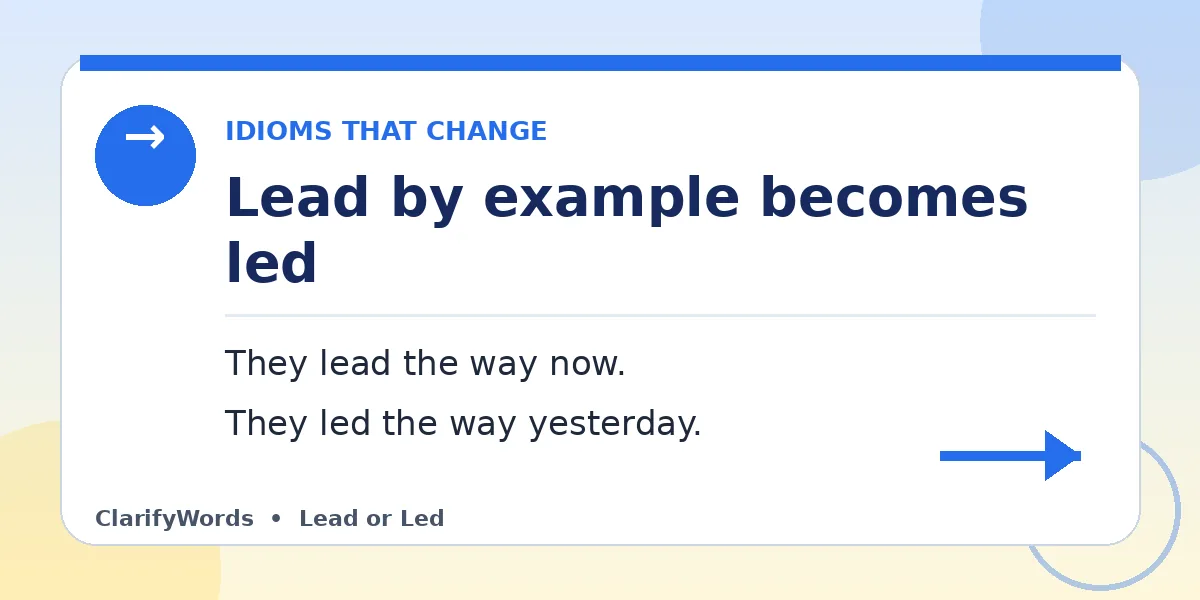
Common Expressions That Change From Lead to Led
| Present Form | Past Form | Example |
|---|---|---|
| Lead the way | Led the way | She led the way through the forest. |
| Lead to | Led to | The decision led to a major change. |
| Lead by example | Led by example | He led by example during the crisis. |
| Lead astray | Led astray | False information led them astray. |
| Lead someone on | Led someone on | He led her on for months. |
| Lead to believe | Led to believe | The report led us to believe the plan would work. |
| Lead a team | Led a team | She led a team of five people. |
| Self-led | Self-led (unchanged adjective) | The course is self-led. |
Practice Questions With Answer Key
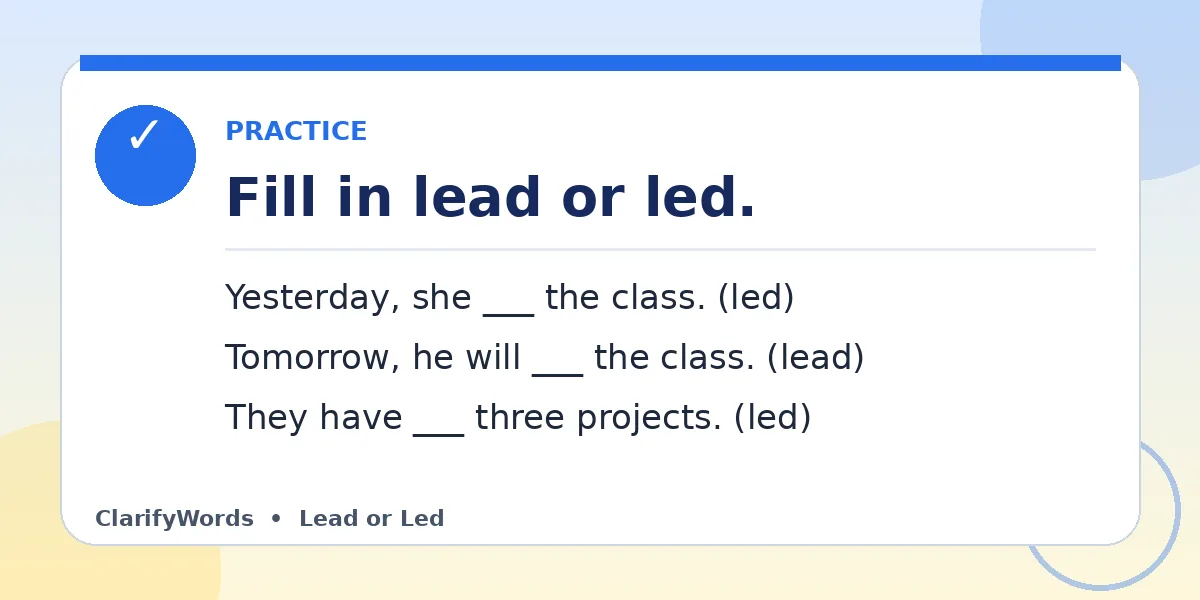
- She ___ the team yesterday. (lead / led)
- They have ___ the project since March. (lead / led)
- The class was ___ by a new teacher. (lead / led)
- He will ___ the workshop tomorrow. (lead / led)
- The pipes were made of ___. (lead / led)
- Our team took the ___ in the final round. (lead / led)
- She ___ the meeting every Monday. (leads / led)
- They had ___ the project before the merger. (lead / led)
- The lead singer ___ the band last night. (lead / led)
- She felt ___ to apply for the role. (lead / led)
Answer Key: 1. Led. Yesterday signals simple past. 2. Led. Have requires the past participle. 3. Led. Was requires the past participle in passive voice. 4. Lead. Will requires the base form. 5. Lead. The sentence names the metal noun. 6. Lead. The sentence names a position noun. 7. Leads. Every Monday signals present tense, and the subject is third person singular. 8. Led. Had requires the past participle in past perfect. 9. Led. Last night signals simple past. 10. Led. Felt signals past time.
FAQs
Is it lead or led for yesterday?
Use led for yesterday. Yesterday signals a completed past action. The verb lead cannot show past time. Write: “She led the meeting yesterday.” The past form led keeps the sentence clear and correct.
Is it has lead or has led?
Use has led, not has lead. Has requires the past participle form. Led is the past participle of lead. Write: “She has led the team for two years.” This form is correct in present perfect sentences.
Is led the past tense of lead?
Yes, led is the past tense of lead. It is also the past participle. The verb does not add ed to form the past tense. Use led for simple past, perfect tenses, and passive voice.
Can lead be a noun?
Yes, lead can be a noun. It can mean a leading position, an advantage, a clue, or a role. It can also mean the heavy metal. Pronunciation depends on the meaning.
Is lead pronounced LEED or LED?
Lead is pronounced LEED as a verb. It is also pronounced LEED for a position or role. It is pronounced LED only for the heavy metal. Led is always pronounced LED.
What is the difference between led and LED?
Led is the past tense of lead. LED is a different word. LED stands for light emitting diode. It names a type of light. Use capital letters for the device.
Is leaded ever correct?
Leaded is not the past tense of lead. The correct past tense is led. Leaded is a separate adjective. It appears in terms like leaded petrol and leaded glass. Use led for every past action.
Conclusion
Lead and led follow one clear rule. That is the whole lead or led rule in one line. Use lead for present tense and infinitive forms. Use led for past tense and past participle forms.
Check the time of the action before you write. Check for has, have, had, was, or were. Those words often signal led.
Remember the metal meaning too. Lead names a heavy metal when pronounced LED. The rest of the time, pronunciation and tense guide the choice.
When in doubt, replace the verb with guided or directed. If the sentence still makes sense in the past, use led. That test prevents the most common error. It also builds confidence with every sentence you write.